That’s “International” because it features national teams rather than clubs, as depicted by the mighty footballing nations of Brazil and Italy tussling it out on the title screen. Brazil were world champions at the time, having beaten Italy on penalties in the 1994 World Cup final, so it makes sense that they’d be the first two teams you see.
ISS Pro is part of the long and somewhat confusing legacy of Konami’s many, many football titles, so here’s a quick attempt at a history lesson. Konami had made football games before, notably Konami Hyper Soccer on the NES, but they really got going in 1994 when they released Jikkyou World Soccer: Perfect Eleven for the SNES, better known overseas as the original International Superstar Soccer. ISS, and especially it’s 1995 update ISS Deluxe, were the best the SNES had to offer in terms of football, with a perfect balance of fast-paced, arcade-y action and more realistic touches. The ISS series continued on the next generation of consoles with games like ISS 64, all the way up to ISS 3 on the PS2. However, in 1996 the series spun off into Goal Storm for the PS1, the first to feature fully 3D polygonal models. This side-series continued with today’s game ISS Pro, before ending on the PS1 in 2001 with ISS Pro Evolution 2. Still with me? Okay. From here, Konami embarked on one of their most successful franchises – and the only “real” videogames Konami still makes – in the Pro Evolution Soccer series, which is still going to this day. I was going to stay still going strong today, but that’s not really true, and Konami’s football games have now been thoroughly eclipsed by the glitz and glamour of EA’s FIFA series. For a long time the two franchises were neck-and-neck in the race to win the hearts of digital football fans, with FIFA having the appeal of being fully licensed and accurate and Pro Evo generally offering slightly more fun gameplay and, most importantly, the ability to create players with giant pumpkins for heads. Even I have jumped ship to FIFA these days, but for many years I was a big cheerleader for the Pro Evo series, and I have spent a lot of time playing them.

That brings me back around to International Superstar Soccer Pro, and the reason I decided to write about it: the chance to wallow in a pit of unadulterated nostalgia like a self-indulgent hippo. ISS Pro was the football game when I was a kid. I have played thousands of matches in this game. In 1997 I probably spent more time with its polygonal superstars than I did with my own family, and I can’t wait to get back into it.
When compared to modern football sims, ISS Pro’s menu reveals that it’s rather lacking in options. You can play a one-off “friendly” match – quotes included because I played against my brother a lot and those friendly matches were anything but – or a penalty shootout, but no management options, no player editing and not even ISS’s trademark Scenario mode, where you’re given tasks such as “it’s the last ten seconds of the match, score from this corner” and challenged to clear them all. The two main game modes are the International Cup, which is a bootleg World Cup because you have to pay to use the World Cup name, and the International League. For this article, I’ll be running through a cup on the “normal” difficulty setting, because getting through a whole league would take a week or so. I wouldn’t be surprised if I ended up doing a league next time I’ve got a spare week. Maybe I’ll update this article if I do.

Now it’s time to choose which team I’ll be playing as from the 32 countries on offer, from titans of the international game such as Germany and Argentina to relative minnows like Morocco and Scotland. Normally I’d play as England in an attempt to burn off any unwanted feelings of patriotic pride that have built up in my psyche, but after the embarrassment that was England at Euro 2016 I don’t think that’ll be necessary. Instead, I’ll be playing as Denmark. Once again nostalgia comes into play, because I often played as Denmark when I was a kid. Not for any great love of the Danes or admiration for their bacon, but because their kit – red shirts with white sleeves and white shorts – is the closest in appearance to that of my beloved Rotherham United. In later games I’d change the player names to match up with the then-current Rotherham squad. That’s sadly not an option here, but it was always nice to see players of the calibre of Trevor Berry and Leo Fortune-West banging goals in against the likes of Germany. So, the Danish, then. A middling team with no real superstars to call on. Let’s hope for an easy draw in the cup.

Hey, that’s not so bad! France could prove to be a real test, but 1997 was long before Belgium had emerged as a football power and Wales, well, Wales were abysmal. In real life both Belgium and Wales failed to qualify for Euro ‘96, the then-most recent major tournament. In fact, Wales finished rock-bottom of their qualifying group, a group that included such indomitable opponents as Albania and Moldova. I’m not particularly worried about the Wales match, is what I’m saying.

Oh good, my first match is against Wales. That should give me a chance to get back into the swing of things. A nice, easy three points to start the group stage should calm the Danish nerves.

Here are the teams, and there are a few things to discuss. The first is that these are not real players. The ISS and Pro Evo games are often lacking official licenses for things like player names and competitions, so you’re provided with sixteen completely-made up players with names that are roughly appropriate for their country of origin. This is different to some of the later ISS games, where they used players that were clearly meant to be existing footballers but attempted to obfuscate their origins via the often hilarious means of giving them slightly altered names. Thus, Ronaldo became Ronarid and Zinedine Zidane was rechristened Ziderm, which was apparently enough to keep the lawyers at bay.
The other things is the parade of emoticons in various states of excitement. It might give the team sheet the appearance of an overexcited Tweet, but these faces represent each player’s condition, and the better their condition the better they’ll play. For example, most of my team has the yellow face that comes with a middling emotional state, but the striker Laudrup looks like his wife’s just run away with another man and they ran over a puppy on their way out. Normally this means I’d replace him, but all my back-up strikers were miserable too, so Laudrup will just have to fight through his grief. On the other hand, I found a young lad called Pingel on the bench and he’s definitely up for it, so into the first team he goes. Don’t make me regret giving you a chance, Pingel.

Here we go, then, two teams ready to give their all. Wales will be playing in their “it looks like a dinosaur tried to claw through your chest” away kit to avoid a clash. I should point out that the graphical errors, especially the black dots, are an emulation issue. They mostly appear on red-coloured objects, so it’s a good job I chose Denmark.

The game is underway, and the two teams of blocky, polygonal men try to do the same thing they always do: score more goals than the opposition. For once it’s nice to play a game for VGJunk where I already know all the controls, because they’re the same as they always are in the Pro Evo series (and he first thing I do in any FIFA game is change the controls to match the Pro Evo system.) The most important are X for passing to the nearest team-mate you’re facing, square to shoot – the longer you hold the button, the more powerful your shot – and R1 for sprinting. Defending is a matter of getting in the way, and when you’re close you can press X for a standing tackle or circle for a sliding tackle. I like to think of circle as The Foul Button, and it’s very easy to trip a player so that they go rolling away in a comically exaggerated manner. I’m not saying that’s a particularly good strategy, but seeing your opponent hurtling across the ground like a nitrous-injected armadillo does soften the blow of any incoming yellow cards.

The action is smooth, and unlike many football games of the preceding era flowing, passing football is not only possible but highly recommended. It’s not the fastest game of soccer out there, mind you: the most notable factor that slows things down, and is probably the core gameplay’s biggest flaw, is that players can’t perform one-touch passes. You can shoot first time, but players have to take at least one touch before they can pass the ball on and that does make build-up play and counter-attacks noticeably more restrained.
Still, things are going well. Denmark are enjoying much of the possession, and I’m passing the ball around well in a congested midfield.

Bugger. That wasn’t in the script. Wales have dug deep and somehow come up with a goal, a goal that definitely didn’t come about because I was messing around and tried a back-heel pass on the edge of my own area, allowing Wales’ lurking striker Jenkins to steal the ball and slot it home.

Not to worry, I went straight up the other end and scored when a player broke free and unleashed a drive that the keeper could only parry into his own goal, as you can see in this replay. ISS Pro might not let you view a replay whenever you like, but you get one after each goal and the 3D graphics mean you can rotate and manipulate the camera to see the goal from whatever angle you like. It’s a nice touch, and when you concede it allows you to identify which of your defenders were slacking off. Not that I’ve got anyone to replace them with, my subs are all so miserable that you’d think our manager made then watch The Road instead of giving them a team talk.

The goals are flowing now, and Denmark take the lead. A high ball into the box, a mighty leap from the untested youngster Pingel and a header so ferocious it caused the commentator to shout “that boy must have a steel skull!” Straight into the old onion bag, and it’s two-one to Denmark.
ISS Pro is definitely a goal-heavy game, as you will see over the course of this article. The main reason for this is the relatively small size of the pitch, which means it never takes long to get to the opponent’s goal once you’ve gained possession. Strikers are all fairly good at their jobs, at least from close range, and while the AI of the goalkeepers certainly isn’t terrible they do struggle in one-on-one situations.

The match continued to be a real ding-dong affair, with Wales retaking the lead before another equaliser from Denmark and then, right at the death, a scrappy, toe-poked goal that just about gave me a 4-3 win. A real match for the neutral, then, and after only one game I’m remembering why I loved ISS Pro so much: accurate controls, over-the-top animations, an even closer resemblance to real football than in any of its forebears and goals galore.

Pingel has replayed my faith in him in spades. Spades of goals. Great honking shovelfuls of them. Now I’ve just got to hope he stays happy all tournament, because the players’ mood changes between each match.

France are up next, and this shot of Petersen and his luxurious, cubic mane of hair give me a chance to talk about one really good thing and one bad thing about ISS Pro. The good thing is the inclusion of a dedicated through-ball button – that is, a pass that goes into space for a team-mate to run on to rather than a pass that goes directly to feet. An integral part of real football, the through ball was never really captured adequately until this generation of football games, and ISS Pro was one of the first – if not the first – to map the through ball onto a single button and have it work fairly well. It’s a delicate balancing act, because it’d be easy to make the through ball far too powerful a tool by having the player you’re passing too always know exactly where the ball’s going. ISS Pro reigns this in by making defenders good at cutting out wayward through balls, but it’s still an extremely useful tool when the situation is right for it.
On to the bad, and you see how Pingel is standing next to Petersen, staring at his team mate with ill-concealed lust? Yeah, that’s all he’ll do, despite there being space ahead of him. ISS Pro’s player positioning is very rigid, and your CPU-controlled team-mates will often simple refuse to make any kind of move. If you’re the forward and you’ve got the ball, midfielders won’t make runs ahead of you to provide you with a passing option, forcing you to play it backwards and hope they move into a better position. It’s not a game-breaking problem but it can be frustrating, especially when you can see a great opportunity if only someone would make the effort to shift themselves.

After struggling against Wales, France proved to be much more amenable to letting me tackle them, and in the end I ran out a four-nil winner. I think what’s happening is that all that time spent playing ISS Pro is coming back to me, because France surely can’t be worse than Wales. It didn’t help the French cause that their centre-back scythed Pingel down in the area. Pingel got up and put the resulting penalty away. The kid’s got ice in his veins.

My final group stage game was against Belgium, and a scrappy first half meant I went in at the break with a slender one-goal lead. Then I started the second half by lumping the ball into the Belgian area using R2, a button marked as “centering” which you can use to cross balls into the box or, when you’re elsewhere on the pitch, to smash it up field in the preferred manner of League Two defenders up and down the country. The result of this aerial bombardment was that eventually one of the Belgian players was so overcome with ennui that he turned the ball into his own goal in an attempt to feel something. It didn’t make him any happier. I didn't do much for his identical twin brother’s mood, either.

Having topped their group with three wins out of three – Pingel scoring more goals than England managed in the whole of Euro 2016 along the way – Denmark are into the knockout stages of the tournament and a round-of-16 clash against near neighbours Sweden in a battle for Scandinavian bragging rights.

Another disappointing thing about ISS Pro, albeit a very minor one, is that the “away” team always plays in their change kit even if there’s no clash. It just doesn’t seem right to be playing Sweden and Brazil (spoilers: I beat Sweden and then play Brazil) when they’re wearing blue and not their trademark yellow.

I made the mistake of underestimating Sweden and overestimating how good my players were at slide tackles, and while the referee seemed to have forgotten to bring his cards and was too embarrassed to admit it – although frankly some of the tackles were so heinous they should have the police looking at them rather than a match official – I was punished when Sweden banged in this free kick. I blame the goalkeeper. What kind of positioning is that?! You’re never going to save anything if you’re in a different bloody postcode. It also didn’t help that only 33% of the wall bothered to jump.

I pulled it around in the end, of course, and a ten-goal thriller ended six-four to the Danes. Pingel wrapped things up with another penalty. Kick it low into the bottom-right corner, that’s how I take all my penalties in football games. It always works, except on FIFA when my tendency to play as shit teams means my penalty takers are usually players with the grace and composure of a nervous chihuahua at a fireworks display. If only I could sign Pingel for my current FIFA efforts to get AFC Wimbledon into the Champions League.

My quarter-final opponents were Brazil: then World Champions, home of some of the greatest talents ever to play the game, the most successful team in World Cup history. This could be a real test for the plucky young Danes.

Never mind, they can’t stand up to Denmark’s bruising, physical style of play. Literally can’t stand up, in this poor sod’s case. He appears to be paralysed from the hair down. The referee has yet to issue Denmark with a single yellow card. Ugly rumours of pay-offs and match fixing begin to circulate and the referee’s parentage is called into question by the fans. The match ends 5-1 and Brazil head home, disappointed but relieved that at least they weren’t beaten 7-1 this time. That’s progress, that is.

Notice that the Brazilians have two people marking Pingel so closely that they could read the label on his underpants if they wanted to. Not that it did them any good, mind you.

His name is Pingel, and he’ll make you tingle. A new icon of world football is born. Going by his current international goalscoring rate, Pingel would be worth about £700 million on today’s transfer market.

It’s Denmark versus Italy for a place in the final. Pingel has a sad condition face. Not the “trapped alone in a black void of nothingness” grey face but the slightly more cheery “oh, I dunno, just a case of the Mondays I guess” blue face. Not that it matters: he could have replaced each of his limbs with a single strand of cooked spaghetti and he’d still be the first name on the team sheet.

I finally managed to receive a booking. I’m glad, I was beginning to suspect either the game was broken or it takes place in a lawless post-apocalyptic future where the only rule is to survive. Given the amount of cynical, hacking challenges that were going unpunished, I began to agree with the commentator every time he said “what a prime example of poor officials.”
Ah yes, ISS Pro has a commentator. While this is a very good game for its time and one that I’m tremendously fond of and am still having fun playing now, I’m only half-joking when I say the commentator is my favourite thing about the game. He is ridiculously over the top, his mood takes huge swings from second to second and occasionally he lapses into complete nonsense. Here, I put together a little video of some of his highlight.
I can’t adequately express just how much I love this commentary. It’s so incredibly dumb, yet utterly unforgettable, the football equivalent of NBA Jam’s famous announcer. Between me and my friend / football game co-op partner, some of his lines have entered that in-jokey lexicon that friends have, particularly his cries of “keeper fumbles” and “goal, goal, SUPER GOAL!” but I think my favourite will always be “SCORCHIO!” Presumably that’s a reference to this sketch from The Fast Show, of all things. Then there’s his varied reading of each country’s name, each one dripping with a different emotion but all of them completely detached from the surrounding sentence. He says “France” like a man struggling to stay awake but his pronunciation of “Mexico” is dense with condescension and “Uruguay” fills him with a sort of rueful amusement. Best of all, as mentioned here, “Nigeria” is said by a completely different person. Incredible.

As the scoreline reaches seven-nil, I’m beginning to regret not playing ISS Pro on the higher difficulty setting. I’m making it look easier than it really is, thanks to squandering several years of my childhood mastering its intricacies, but it’s still not a very difficult game. One thing I’ve noticed is that it’s very easy to waste time, so if you get the lead and decide to simply keep possession and knock it around amongst your defenders there’s very little the CPU team can do about it.

With Italy brushed aside as easily as one might sweep the laundry from the exercise bike you swore you were going to use every day, Denmark have reached the final. Their opponents: Germany. Of course it’s Germany. I’m going to make damn sure this one doesn’t go to penalties, I’ll tell you that much. Fortunately, the Danish team are all in good spirits, so I’ll be playing an attacking 3-4-3 formation with Pingel at the point of the attack. He’s a goal machine, nothing can stop him, although if I’m going to be completely honest whichever player I’d played as the main striker would have ended up scoring all the goals.

An early goal from the oft-overlooked Rasmusse settles the nerves, sending a delightful chipped shot over the German keeper and into the far side of the net. I say Rasmusse is overlooked because he can’t compete with Pingel, but I’m also biased against him because his name reminds me of this song, which was completely inescapable for a while and in turn reminds me of drinking dangerously cheap vodka.

As they always do, the Germans put up some staunch resistance… for a while, at least, but it was all clicking for me and I was having a lot of fun. It’s fair to say that ISS Pro is a very transitional game, a mid-way point between the less involved, sprite-based games of the 8 and 16-bit generations and today’s accurate-as-you-like soccer sims, and it has its flaws, but those flaws do not stop it being very good fun. Once you’re locked into the game's mindset, and you’ve learned what you can and can’t do within the confines of the game engine, it becomes a fast-past, high-action football game that was a step ahead of anything else at the time and… well, I keep just wanting to use the word “fun,” but that’s what it is. A ray of sports sunshine, narrated by a madman.

At the final whistle, Denmark had racked up a score of eight goals to three. The performance was wrapped up, appropriately enough, by Pingel smashing one into the top corner from outside the area. That puts him on about thirty goals for the tournament. If there isn’t a small army of drug testers waiting for him in the locker room, then the anti-doping bodies are not doing their jobs.

That’s it, the tournament is over and Denmark are crowned champions before their adoring fans. Only the first eleven players step up to claim the trophy. That means Pingel, who is still technically a substitute, is not involved in the trophy-lifting ceremony. Never have I seen anything so shockingly unfair in a videogame.
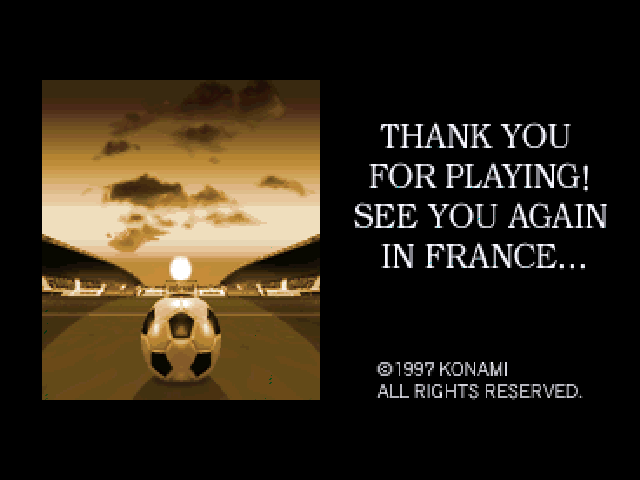
The credits roll, and ISS Pro draws to a close with the promise that they’ll see us again in France. This refers to the 1998 World Cup, which was held in France. Denmark made it to the quarter-finals of that tournament, where they were defeated by Brazil. I think we all know why they didn’t go any further. Starts with P, ends with "ingel."

Its flaws range from big ones, like players being unwilling to move when you’re on the attack and most teams being very similar in terms of ability, to smaller things like not being able to change the length of matches outside the friendly mode, but International Superstar Soccer Pro was a great game in 1997 and is still an enjoyable kickabout even today. FIFA may have grown ever more realistic and all-encompassing, but sometimes it’s nice to take a break from that relentless need to be perfect, to escape from FIFA’s utterly po-faced seriousness, and enjoy some (relatively) simple footballing action. That’s something ISS Pro delivers by the bucket-load, and while it’s not something that I’d recommend to a total non-football fan (and if that’s you, then thanks for making your way through this article) but for quick, no-fuss action, especially against or even in cooperation with a friend, it’s difficult to think of a retro football game I’d rather play. ISS 64, maybe. Oh, or the GameCube version of ISS 2. It’s a good series, that’s what I’m getting at here. Now I’ve just got to get the commentator shouting “Scorchio!” set as my phone’s ringtone.