It’s been a while since I covered a really terrible game, and my extremely low self-esteem will not allow me to go a moment longer without subjecting myself to some bloody ‘orrible home computer game from the eighties. Where else could I turn, then, but to the ZX Spectrum? That’s a library full of games that’ll make you wish you lost your hands in a terrible combine harvester accident, and here’s one of them – it’s Ocean Software’s 1986 I-blame-Charles-de-Gaulle-em-up It’s A Knockout!
What do we have here, then? A logo, and some playing cards with pictures on them. The pictures are of something you might mistake for a camel if you’ve never seen a camel, a ship, the pyramids being menaced by a boss from Xevious and the world’s crappiest lightbulb. That doesn’t tell us much about what gameplay we’re going to get, does it? Well, it might help to know that It’s A Knockout is based on the gameshow of the same name that was broadcast on the BBC from the sixties through the eighties. Teams competed in “wacky” games while wearing oversized costumes and falling over a lot thanks to spinning floors and large amounts of water. Imagine if the mascots from a Disney park got hammered and gatecrashed a school sports day and you’ve got a good idea of how It’s A Knockout worked.
The British version of It’s a Knockout involved towns and villages competing against each other, but before that there was Jeux Sans Frontieres – basically the same thing, but with representatives from different European countries battling it out. That seems to be what this version of It’s A Knockout is based on, given that you have to choose a country to play as. I have trouble believing this, but I’ve seen it cited in several different places so get this – supposedly the idea of Jeux Sans Frontieres was the brainchild of French Resistance leader and later President of France Charles de Gaulle. You know, one of the most important figures in the history of 20th-century Europe. Apparently it was intended to promote friendly relations between French and Germany after the war. Makes sense to me, it’s difficult to engage in a land war when you’re all dressed in novelty penguin costumes.
With my country selected, I suppose I’d better get to the first event, because of course this is a collection of minigames.
Here we go with Flying Flans, the pasty-based aerial bombardment game beloved by kids of all ages. One large man places a flan on the end of the see-saw. The other large man then hits the see-saw with a hammer, sending the pie arcing over the dividing wall towards you, the hapless butler. The goal is to position yourself so that the flan lands on your tray, and then you can deposit the flan at the right-hand side of the screen to score a point. That’s about it, really. You can only move left or right, the flans are flung along a variety of different angles and the controls are so loose that the only way to score any points is scuttle over to the flans’ vague landing area and hope they drop onto your tray. You can at least turn quickly on the spot, which doubles the potential area for a safe flan landing, but it’s still a struggle to get your waiter in place.
The only other thing of note is that any missed pies land on the floor and leave a slippery mess behind, making it even more difficult to position yourself correctly as you slide across the cream-drenched floor. Mental note, never use the phrase “cream-drenched” ever again. So, as the minigame goes on you’ve got less and less control over your character and by the end it feels like you have no control at all. This all goes on for roughly four thousand hours, until the timer eventually runs down and you’re thrust into the next circle of hell.
Next up is the Bronte Bash. You can imagine how my heart broke to realise that the Bronte Bash isn’t a triple-tag-team bout against Anne, Charlotte and Emily. I had visions of being defeated by Charlotte’s signature move, an excruciating leg-lock she calls Pain Eyre, but such wonders were not meant to be and instead we’re left with… this. The “bronte” on the title presumably refers to the brontosaurus – although why it isn’t called “Bronto Bash” I’ll never know – and it’s whack-a-mole. A dinosaur pops out of one of the six hole, and you use the joystick to position the one-ton weight over its head. Press fire, drop the weight, bash the bronto, score a point. This is probably the best of It’s A Knockout’s games purely because the controls seem to work correctly and you can actually tell what you’re supposed to be doing, but it still isn’t any fun. The fact that all the sprites in this game have the all-black look of an LCD handheld feels very appropriate, because that’s the closest kid of gameplay I can think of to It’s A Knockout.
Game number three is Harlem Hoppers, which is of course a reference to the famous Harlem district of Cairo. Not really, I imagine it’s supposed to invoke the Harlem Globetrotters because this is tangentially basketball-related. The vaguely pharaoh-like person on the right rolls a ball down the camel’s back. I say camel, that’s definitely not the face of a camel. It looks more like Goofy wearing a Rick James wig. None of this looks anything like what it’s supposed to look like, with the exception of the pyramids.
Anyway, the ball rolls down the camel’s back, flicks into the air at a random angle and you have to move left or right to catch it. Yep, it’s the same as Flying Flans, with one difference: your character is attached to a bungee cord so you’re constantly being dragged back towards the left of the screen. I can scarcely believe it, but the developers must be recognised for achieving the impossible and making the flan game less fun to play.
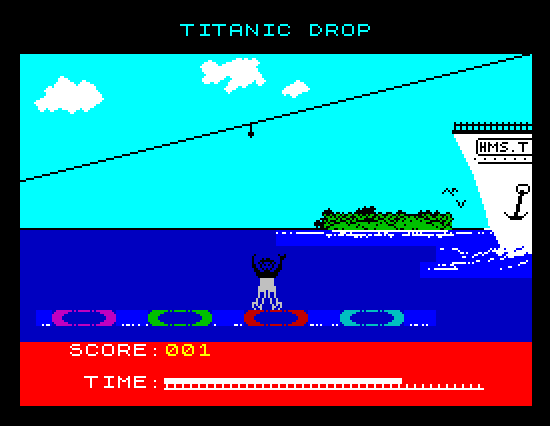
Onwards to Titanic Drop, a tasteless recreation of one of history’s worst maritime disasters / another rubbish minigame. People slide along the zipwire, and you press the fire button to have them let go and hopefully land in the life rings bobbing about on the water’s surface.
This game’s only saving grace is that you have to take the peoples’ momentum into account when you drop them, which at least gives you something to think about. Plus you get a little sprite of them looking absolutely horrified, which provides a nice bit of camaraderie with the player. Other than that, this game is ruined by the awful hit detection that often sees you scoring nul points even when you drop someone right through the ring. The rings are constantly changing colour, so perhaps that’s got something to do with it – maybe you’re supposed to be dropping them into a certain colour of ring, but I played this game multiple times and I sure as hell couldn’t figure it out.
Here we see that absolute high point of It’s A Knockout. Not the minigame itself, which is shit, but that fact that it’s called Diet of Worms. This is a truly fantastic pun that marries the fact that you’re playing as a bird eating worms and also the other Diet of Worms: the imperial diet of the Holy Roman Empire held in 1521 that was called in part to denounce the protestant reformation of Martin Luther. That is the kind of next-level punning that I can only aspire to.
Sadly the minigame has nothing to do with papal responses to threats to the church’s power. Instead you control an emu that has to pick up worms and drop them in the tray at the bottom of the screen. Sounds simple enough, but unlike the other minigames where the controls were merely bad – too sticky, too floaty, too fussy – in Diet of Worms I had no idea what I was doing to make the emu move. You’d think it’d be as simple as up, down, left and right with fire to peck at the worms, but half the time the bird was wandering around aimlessly no matter how I tried to wrangle it into position. I think there might be a specific button on the keyboard that makes the emu head towards the tray, but I couldn’t tell you what that button is. As a result, I never managed to pick up more than two or three worms and my emu staggered across the field with the rubbery gait of a drunken farmer, making me the emu-based embarrassment of Europe.
Finally, there’s an obstacle race. The obstacles in question are walls, water-filled ditches and what look in the screenshots like holes in the floor. They’re not, they’re bouncing balls. The obstacle race seemingly exists solely to fulfil the mandatory joystick-waggling quota that all home computer multi-event games were beholden to. Waggle left and right to get your character moving, press fire to have them jump over obstacles. Except the balls, which you can’t jump over. Or avoid at all, as far as I could see. If they’re at just the right position when you reach them, sometimes you’ll run straight through them – but nine times out of ten they’re impossible to dodge. At first I thought this was just me being crap at the game, but the bottom half of the screen shows your computer-controlled opponent and they also couldn’t avoid the balls.
All the events are complete, and I have come rock-bottom of the scoreboard. I know it looks like I’m at the top, but you can see I scored the lowest total points. The fact that the creators of this game didn’t or couldn’t program in a way of displaying the countries in order of their scores seems like a perfect encapsulation of It’s A Knockout’s level of ambition – a low level it doesn’t even manage to reach. Perhaps the Commodore 64 or Amstrad versions are more palatable; they certainly look a lot better, and I can’t imagine they play any worse. This is just a terrible product from top to bottom. You’re constantly fighting against the controls, (if you can even figure them out,) the games themselves have all the depth of a gnat’s thimble and the graphics are somehow outperformed by a Game & Watch. At least the title’s accurate: playing It’s A Knockout has roughly the same effect as huffing a chloroform-soaked rag.
Showing posts with label ocean. Show all posts
17/08/2018
04/01/2017
HIGHLANDER (COMMODORE 64)
Oh hey, it’s 2017. For the first article of the year, I’m going for a real “start as you mean to go on” vibe with a game that’s not only a British home computer game, but also a licensed game so terrible you won’t believe that the developers had the cheek to charge money for it instead of doing the decent thing and personally smashing every copy with a lump hammer. Yes, barely a week since I proclaimed Rugrats: Totally Angelica to be the worst game I’ve ever played, here comes something that’s more than worthy of challenging for that particular title. It’s the Commodore 64 version of Ocean Software’s 1986 princes-of-the-universe-em-up Highlander!
That’s right, it’s a game based on the classic? Cult classic? Let’s go with cult classic action-fantasy film from the same year. Highlander seems to have maintained a fairly prominent place in the pop-cultural memory, anyway, and I’m sure most people know it’s about Connor MacLeod, a member of a group of immortal people who can only be killed by decapitation. The immortals fight each other in order to a) not get decapitated and b) claim a vague and mysterious prize called, imaginatively, The Prize. If nothing else, Highlander is famous for its tagline of “there can be only one,” meaning that the last immortal left with their head attached gets the prize. Despite what this title screen may suggest, claiming The Prize does not turn the recipient into a stone statue with the expression of someone who’s just reached the bathroom after a very long car ride.
There aren’t many options offered to you when you start a game of Highlander. You can play a two-player game against a friend, but friendship is a precious gift and you shouldn’t put it at risk by subjecting another human to this. What else have we got? Well, a few fairly well-rendered pictures of swords. That’s always nice. Everyone loves a good pixel sword. Where would videogames be without swords, eh? Yes, you’re right, I absolutely am stalling. Okay, fine, here’s Highlander.
Yes, it is a one-on-one swordfighting game, because there are few other directions a Highlander game could take. Maybe a business management game where you try to create as many bizarre and forgettable sequels, animated spin-offs and reboots as possible from a series that was wrapped up quite neatly at the end of the first movie. That could be interesting.
You play as Connor MacLeod, naturally. That’s him on the left, with the flowing locks and large brown socks. Your opponent is none other than Juan Sanchez Villa-Lobos Ramirez, the ancient Egyptian / latterly Spanish swordsman famously played by the resolutely Scottish Sean Connery. If you’re ever in need of a quick mood-lifter, try saying “My name’sh Ramiresh” to yourself in the most over-the-top Connery impersonation you can. It always cheers me up.
Ramirez wastes no time trying to give MacLeod the ultimate haircut, which is weird because he’s MacLeod’s friend and mentor. You could argue that this is all supposed to be training, but that doesn’t explain why Ramirez is happy to attack relentlessly and then lop your head off. The only real explanation is that no-one at Ocean gave a shit about what they were doing when making Highlander, an explanation amply supported by almost every other facet of the game.
In an effort to defend myself, I checked out the controls and they’re laid out exactly as I expected them to be – that is, they’re supposedly the same as every other one-on-one fighting game for the C64. Moving the joystick moves your character, while moving the stick while holding the fire button produces a variety of attacks at different heights or puts you in a blocking position. So, you can swing your sword that the opponents head, body or most importantly neck, and you can block at various different heights. You can even kneel down. In a game about avoiding decapitation, this seems like the second dumbest move you can make after drawing a dotted line around your neck, but there you go.
However, there’s a problem. Quite a major problem, in fact. None of this works. Oh, sure, your character moves around the screen and sometimes swings their sword, but it has nothing to do with your input. Getting the same move to come out twice in a row when you want it to is about as likely as finding Elvis’ ghost clogging up your downstairs toilet. MacLeod frequently moves according to his own whims, which especially noticeable when he keeps walking backwards without any prompting.
On top of that, the player receives almost no feedback about what’s going on. A constant “ting, ting, ting” sound effect plays that I presume is meant to represent the mighty blows of these swordsmen clashing together but sounds more like a woodpecker trapped inside a paint can, and it has nothing to do with when the swords actually clash. They don’t clash, really. They just pass through everything, air, sword, and body part alike, without any kind of visual feedback, resulting in the juddering, amorphous mess you can see in the GIF above. You do have a health bar, of sorts: it’s the pixel-thick line at the bottom. Sometimes it goes down when a sword comes near you. Mind you, sometimes it goes down when a sword doesn’t come near you, so it’s hardly a reliable indicator of impending decapitation. Your health, or power, or whatever it’s supposed to represent, will regenerate if you stand still for a while, but this is nigh-impossible to see in action because the CPU characters attack with such relentless aggression that you’d think Connor MacLeod had been round their house, defacated in a pot-plant and wiped his arse with their dog.
I was completely unable to defeat Ramirez, but that doesn’t matter because you can load any of Highlander’s battles and there’s no reward for victory anyway. There’s no attempt at a storyline or anything in this one, you simply load up the character you want to fight and then keep fighting them. Even if you do manage to win a fight, all that happens is that you win counter moves up by one and you get to do it again.
This second bout is against Fasil, a low-tier immortal in a business suit and shades. You’d be forgiven for assuming Ocean forgot to draw eyes on his sprite but no, he’s supposed to be wearing sunglasses. They got that detail right, but then managed to misspell Fasil’s name as “Fazir,” because of course they did.
Fasil and MacLeod fight right at the beginning of the movie, in order to introduce the audience to the concept of blokes swordfighting in dingy locations. With that in mind, you’d think Fasil would be the first opponent in the game, a notion only strengthened by Fasil being easier to defeat than Ramirez. I still didn’t have any idea what was going to happen when I moved the joystick, but as long as I was moving the joystick MacLeod managed to jerk across the screen and wave his arms around often enough for Fasil to suffer a spontaneous decapitation in roughly fifty percent of our battles. You can see Fasil’s mistake in the screenshot above: rather than going for the killing blow, he’s resorted to stabbing MacLeod right in the balls, adding further evidence to my theory than all these fights have nothing to do with claiming the Prize and are rooted in everyone having a deep-seated loathing of Connor.
Finally, you can do battle against the Kurgan himself. Did Ocean misspell Kurgan’s name, too? You bet your ass they did. It’s disappointing but completely expected that no effort was made to recreate Clancy Brown’s, erm, unique face for this game, and he’s been drawn with the suggestion of a beard, which makes him look more like a middle-aged dad than a feared killer. A middle-aged dad with ridiculously large feet, at that.
You may also notice that Connor’s head has fallen off. Get used to seeing that if you’re dumb enough try fighting against Kurgan, because he’s ridiculously overpowered in comparison to the other two fighters. I don’t think I ever landed a hit on him. The game wouldn’t tell me even if I did, but I never saw his health bar move, either. Kurgan wins simply by walking forwards and bashing you a couple of times, because his attacks do way more damage than anyone else’s. It’d be nice if you could defend yourself, but as I’ve mentioned the combat in this game simply does not work. Sure, there are blocking moves in the game, but they could be replaced with animations of Connor singing “Touch My Bum” for all the use they are. Let’s say Kurgan’s about to swing his sword, so you think “I know, I’ll block his attack.” The first problem is that you’ve got no way of knowing whether your joystick input is going to correspond to the move you want. Even if by some miracle it does, Connor moves so slowly that you have no chance of reacting in time anyway. Kurgan swings, Connor does something, maybe, and then Connor’s head falls off.
I honestly cannot overstate how utterly devoid of fun Highlander is. Purely in terms of gameplay, this probably is the worst game I’ve ever played. Other games have hideous aesthetics or offensive content or an even thicker coating of money-grubbing cynicism, but when it comes to the basic act of playing the game Highlander is pure, concentrated misery. You’re barely even playing it at all, and that’s what makes it so awful: the whole point of computer and videogames is that the player is in control. That’s what separates them from other media. When that’s taken away, what do you have left? Absolutely bugger all, that’s what.
With all that said, there is one solitary reason to load up Highlander, and that’s the music. There’s only one track, but that track is Martin Galway’s SID interpretation of Queen’s “A Kind of Magic” and it’s definitely worth a listen.
It’s one moment of quality in what is otherwise an abject disaster, and best of all it’s the title theme, so you don’t even have to play the game to hear it. In this way, even Highlander for the Commodore 64 can be enjoyed. And here I always thought I was a pessimist, but that’s one hell of a “glass half-full” statement.
That’s right, it’s a game based on the classic? Cult classic? Let’s go with cult classic action-fantasy film from the same year. Highlander seems to have maintained a fairly prominent place in the pop-cultural memory, anyway, and I’m sure most people know it’s about Connor MacLeod, a member of a group of immortal people who can only be killed by decapitation. The immortals fight each other in order to a) not get decapitated and b) claim a vague and mysterious prize called, imaginatively, The Prize. If nothing else, Highlander is famous for its tagline of “there can be only one,” meaning that the last immortal left with their head attached gets the prize. Despite what this title screen may suggest, claiming The Prize does not turn the recipient into a stone statue with the expression of someone who’s just reached the bathroom after a very long car ride.
There aren’t many options offered to you when you start a game of Highlander. You can play a two-player game against a friend, but friendship is a precious gift and you shouldn’t put it at risk by subjecting another human to this. What else have we got? Well, a few fairly well-rendered pictures of swords. That’s always nice. Everyone loves a good pixel sword. Where would videogames be without swords, eh? Yes, you’re right, I absolutely am stalling. Okay, fine, here’s Highlander.
Yes, it is a one-on-one swordfighting game, because there are few other directions a Highlander game could take. Maybe a business management game where you try to create as many bizarre and forgettable sequels, animated spin-offs and reboots as possible from a series that was wrapped up quite neatly at the end of the first movie. That could be interesting.
You play as Connor MacLeod, naturally. That’s him on the left, with the flowing locks and large brown socks. Your opponent is none other than Juan Sanchez Villa-Lobos Ramirez, the ancient Egyptian / latterly Spanish swordsman famously played by the resolutely Scottish Sean Connery. If you’re ever in need of a quick mood-lifter, try saying “My name’sh Ramiresh” to yourself in the most over-the-top Connery impersonation you can. It always cheers me up.
Ramirez wastes no time trying to give MacLeod the ultimate haircut, which is weird because he’s MacLeod’s friend and mentor. You could argue that this is all supposed to be training, but that doesn’t explain why Ramirez is happy to attack relentlessly and then lop your head off. The only real explanation is that no-one at Ocean gave a shit about what they were doing when making Highlander, an explanation amply supported by almost every other facet of the game.
In an effort to defend myself, I checked out the controls and they’re laid out exactly as I expected them to be – that is, they’re supposedly the same as every other one-on-one fighting game for the C64. Moving the joystick moves your character, while moving the stick while holding the fire button produces a variety of attacks at different heights or puts you in a blocking position. So, you can swing your sword that the opponents head, body or most importantly neck, and you can block at various different heights. You can even kneel down. In a game about avoiding decapitation, this seems like the second dumbest move you can make after drawing a dotted line around your neck, but there you go.
However, there’s a problem. Quite a major problem, in fact. None of this works. Oh, sure, your character moves around the screen and sometimes swings their sword, but it has nothing to do with your input. Getting the same move to come out twice in a row when you want it to is about as likely as finding Elvis’ ghost clogging up your downstairs toilet. MacLeod frequently moves according to his own whims, which especially noticeable when he keeps walking backwards without any prompting.
On top of that, the player receives almost no feedback about what’s going on. A constant “ting, ting, ting” sound effect plays that I presume is meant to represent the mighty blows of these swordsmen clashing together but sounds more like a woodpecker trapped inside a paint can, and it has nothing to do with when the swords actually clash. They don’t clash, really. They just pass through everything, air, sword, and body part alike, without any kind of visual feedback, resulting in the juddering, amorphous mess you can see in the GIF above. You do have a health bar, of sorts: it’s the pixel-thick line at the bottom. Sometimes it goes down when a sword comes near you. Mind you, sometimes it goes down when a sword doesn’t come near you, so it’s hardly a reliable indicator of impending decapitation. Your health, or power, or whatever it’s supposed to represent, will regenerate if you stand still for a while, but this is nigh-impossible to see in action because the CPU characters attack with such relentless aggression that you’d think Connor MacLeod had been round their house, defacated in a pot-plant and wiped his arse with their dog.
I was completely unable to defeat Ramirez, but that doesn’t matter because you can load any of Highlander’s battles and there’s no reward for victory anyway. There’s no attempt at a storyline or anything in this one, you simply load up the character you want to fight and then keep fighting them. Even if you do manage to win a fight, all that happens is that you win counter moves up by one and you get to do it again.
This second bout is against Fasil, a low-tier immortal in a business suit and shades. You’d be forgiven for assuming Ocean forgot to draw eyes on his sprite but no, he’s supposed to be wearing sunglasses. They got that detail right, but then managed to misspell Fasil’s name as “Fazir,” because of course they did.
Fasil and MacLeod fight right at the beginning of the movie, in order to introduce the audience to the concept of blokes swordfighting in dingy locations. With that in mind, you’d think Fasil would be the first opponent in the game, a notion only strengthened by Fasil being easier to defeat than Ramirez. I still didn’t have any idea what was going to happen when I moved the joystick, but as long as I was moving the joystick MacLeod managed to jerk across the screen and wave his arms around often enough for Fasil to suffer a spontaneous decapitation in roughly fifty percent of our battles. You can see Fasil’s mistake in the screenshot above: rather than going for the killing blow, he’s resorted to stabbing MacLeod right in the balls, adding further evidence to my theory than all these fights have nothing to do with claiming the Prize and are rooted in everyone having a deep-seated loathing of Connor.
Finally, you can do battle against the Kurgan himself. Did Ocean misspell Kurgan’s name, too? You bet your ass they did. It’s disappointing but completely expected that no effort was made to recreate Clancy Brown’s, erm, unique face for this game, and he’s been drawn with the suggestion of a beard, which makes him look more like a middle-aged dad than a feared killer. A middle-aged dad with ridiculously large feet, at that.
You may also notice that Connor’s head has fallen off. Get used to seeing that if you’re dumb enough try fighting against Kurgan, because he’s ridiculously overpowered in comparison to the other two fighters. I don’t think I ever landed a hit on him. The game wouldn’t tell me even if I did, but I never saw his health bar move, either. Kurgan wins simply by walking forwards and bashing you a couple of times, because his attacks do way more damage than anyone else’s. It’d be nice if you could defend yourself, but as I’ve mentioned the combat in this game simply does not work. Sure, there are blocking moves in the game, but they could be replaced with animations of Connor singing “Touch My Bum” for all the use they are. Let’s say Kurgan’s about to swing his sword, so you think “I know, I’ll block his attack.” The first problem is that you’ve got no way of knowing whether your joystick input is going to correspond to the move you want. Even if by some miracle it does, Connor moves so slowly that you have no chance of reacting in time anyway. Kurgan swings, Connor does something, maybe, and then Connor’s head falls off.
I honestly cannot overstate how utterly devoid of fun Highlander is. Purely in terms of gameplay, this probably is the worst game I’ve ever played. Other games have hideous aesthetics or offensive content or an even thicker coating of money-grubbing cynicism, but when it comes to the basic act of playing the game Highlander is pure, concentrated misery. You’re barely even playing it at all, and that’s what makes it so awful: the whole point of computer and videogames is that the player is in control. That’s what separates them from other media. When that’s taken away, what do you have left? Absolutely bugger all, that’s what.
With all that said, there is one solitary reason to load up Highlander, and that’s the music. There’s only one track, but that track is Martin Galway’s SID interpretation of Queen’s “A Kind of Magic” and it’s definitely worth a listen.
It’s one moment of quality in what is otherwise an abject disaster, and best of all it’s the title theme, so you don’t even have to play the game to hear it. In this way, even Highlander for the Commodore 64 can be enjoyed. And here I always thought I was a pessimist, but that’s one hell of a “glass half-full” statement.
Labels:
awful,
c64,
commodore 64,
fighting,
highlander,
licensed,
ocean
28/09/2016
ROBOCOP 3 (NES)
Today, a game about robots, cops and meddling studio executives with Probe and Ocean’s 1992 NES your-move-creep-em-up RoboCop 3. You know, a game based on the movie where RoboCop can fly and hangs around with children.
Children like this weird-faced, uzi-toting little munchkin. Doesn’t a six-year-old having access to a submachine gun break some kind of law, RoboCop? Do your goddamn job! It’s going to be difficult serving the public trust when you’re using a schoolkid as a shoulder-mounted gun emplacement.
Okay, a confession: I’ve never actually seen RoboCop 3. I’ve heard about it, and somehow the morbid curiosity that made me watch Hellraisers four through eight (nine is apparently where I draw the line) was not strong enough to get me to sit through the family-friendly adventures of the incredible flying robot-cop. From what I’ve read, though, Robocop 3 the game follows the plot of the movie fairly accurately. I’m sure that if anyone can spin gold from RoboCop 3, it’ll be the titans of game development that are Probe and Ocean. I’m sure Ocean were hoping that this would be as big a hit as their home computer ports of RoboCop, but I’m going to guess that it really wasn’t.
The game begin with a call from Anne Lewis, RoboCop’s partner, and she’s in trouble. Not to worry, dealing with trouble is what RoboCop does best and he’s quickly off to to save her. In a car, he’s not flying yet.
I have to say, that’s some nice artwork on Officer Lewis. Well drawn in a very small number of colours, I’m very impressed with it. It’s a look that really shows Probe’s history as a home computer developer, too.
Not so impressive is RoboCop himself, who looks like he’s having real trouble driving his car. I’m having problems parsing which way around the hand that’s holding the steering wheel is supposed to be facing. It’s not terrible-looking, just kind of awkward.
That, erm, that is true, I guess? Things may well go on behind closed doors, although I don’t see what that’s got to do with RoboCop, who spends most of his time on the streets or inside large industrial facilities. I thought it might have been a hint about a secret in the first stage or something, but having investigated thoroughly I think it’s just weird. Also weird is the description of the criminals you’ll be facing as “splatterpunks,” but that’s the kind of weird I can appreciate. Whatever else RoboCop 3’s failings may be, at least it’ll always have the cachet of having used the word “splatterpunk.”
It will come as absolutely no surprise to anybody that RoboCop 3 is a side-scrolling action platformer where RoboCop travels through the city while shooting criminals (sorry, splatterpunks) and jumping over things. That’s what I always think of when I remember RoboCop: the vast amount of jumping he does. In Probe’s defence, they have at least made RoboCop feel very heavy when he jumps, with every landing producing a satisfying thump as he hits the floor.
What else can RoboCop do, besides jumping? Well, he can aim his gun diagonally upwards, which is handy because a lot of enemies pop out of windows to take pot-shots at our hero. You can also switch between two different weapons: a handgun and a missile launcher. You might think that given a choice between a pistol and a rocket launcher your pistol would get less use than Bruce Willis’ hairbrush, but in practice they’re both about as useful as each other – the missiles are more powerful but slower than the pistol’s shots, so they end up killing things at about the same rate. On the plus side, killing a bad guy with the missiles causes them to fly away off the top of the screen rather than exploding in a bloody mess.
One problem with RoboCop 3’s combat is that it can be quite difficult to defeat criminals when they’re right next to you, thanks to their tendency to stand “inside” RoboCop, where his guns cannot reach. This instance was particularly infuriating, because this bad guy ran up behind RoboCop and kicked him right in his big metal arse. This somehow caused RoboCop damage. That does not seem right at all. What’s the point of the hugely expensive and complicated robotification process if you can still feel pain when someone kicks your backside? Did OCP cheap out and use spray-painted plastic instead of titanium alloy when crafting RoboCop’s buttocks? Actually, that sounds like something OCP might do.
The stage ends in extremely anticlimactic fashion as RoboCop reaches a dead end and has to stand around and shoot a certain amount of criminals before the level abruptly ends. Thanks to the combination of RoboCop’s crouching ability and the enemies’ tendency to fire at head height, most of the combat revolves around shoot people in the groin. Is this inspired by the scene in the original movie where RoboCop shoots that guy’s balls off? Honestly, shoot one person in the genitals and you'll never live it down.
Between stages, you’re given the chance to repair RoboCop by using the maintenance tokens you’ve collected. Simply select which part of RoboCop’s body you want fixed and spend your tokens accordingly. Supposedly, having high damage on a body part will cause that part to malfunction. It always seemed to be the legs, in my case, and every now and then RoboCop will be unable to move for a moment or two if his legs aren’t repaired. I’m not sure whether I noticed this more because the way I played the game (badly) meant RoboCop’s legs took all the damage, or if RoboCop’s so stiff and awkward to control even when he’s fully repaired that it’s hard to tell when he’s on the blink. I figured I’d better explain this system to you, because I wouldn’t want you to think that RoboCop spends his between-mission breathers sitting atop the Throne of Justice, presiding over his court as a jester makes jokes that are really going to struggle to get a laugh.
Stage two sees RoboCop fighting his way through a car factory. Why? I don’t know, the game didn’t bother to explain. All it said was that RoboCop’s making his way to the “ultimate conflict,” and as he’s a Jesus Christ analogue I assume that means he’ll be fighting the antichrist at some point. The thing is, according to what I’ve read of RoboCop 3 The Movie’s plot, Anne Lewis is killed at around this point in the movie. The game makes absolutely no mention of this shocking development, presumably convinced that the player’s desire to eliminate crime will be sufficient impetus for them to continue without the waters needing to be muddied with something so trite as vengeance.
This stage adds a lot more platforming into the mix – fussy, miserable platforming that requires a lot of very accurate leaping from a character who’s made of a ton of solid metal and bloody controls like it, too. Fortunately, missing a jump here isn’t instantly fatal. You just loose health while you’re in the goop. No, the insta-death pits come later in the game, so that’s something to look forward to. Amongst its other quirks, RoboCop 3 also has a strange lives / continues system: you have one life, and when RoboCop explodes the “Game Over” screen appears and you go back to the title screen… where you can continue from the start of stage you died on. So, not Game Over, then? Okay, cool.
Suddenly, a ninja appears. That’s generally how ninjas work, I suppose. So, it’s the agile, speedy ninja versus RoboCop, who may be a hero but who is as lithe and nimble as a bin-bag full of microwave ovens. This seems like it would pose a problem for RoboCop, but the ninja seems less interested in stopping our hero and more excited to show off his totally sick flip jumps. It’s understandable that you’d want to showcase your ninja training, even if it does give the this fight the air of a junior school gymnastics performance with RoboCop in the role of the bored father. The ninja somersaults around the place, RoboCop shoots the ninja when the opportunity presents itself and the pair of them chase each other around the arena in this manner until one of them emerges the victor. On to stage three, then.
What? There’s another half of the stage to go, with another ninja fight at the end? I suppose I’d better get on with it, then, starting with shooting this criminal hiding in a pile of tires. Hang on, that exact scenario also happened in Rolling Thunder! Man, I wish I was playing Rolling Thunder, it’s a much better game than RoboCop 3: where Rolling Thunder has precise controls and easily-identifiable enemies with distinct attack patterns and threat levels, RoboCop 3 is a fussy game with enemies that puddle into a generic soup of felonious activity. There’s simply nothing interesting about them. Even the ninjas are boring.
When stage three does finally begin, a few things are different. For one, RoboCop is walking towards a tank. This fact is highlighted by the artillery shells that occasionally come flying across the screen. You can see one at the bottom left of the screen, where I managed to avoid it thanks to the other change: RoboCop can fly now, because he has a jetpack. It might seem like a very un-RoboCop thing to happen, this sudden change from the future of law enforcement to the Rocketeer, but it’s probably the nearest this game gets to being fun. You boost upwards by holding the jump button, RoboCop moves fairly smoothly and it’s a nice change from his usual leaden-footed stomping. It doesn’t alter the gameplay too much, because you still need solid footing to effectively deal with the enemies, but even if it’s little more than being able to do a big jump it’s a welcome addition.
I do like that graffiti down there, because it appears to say “diet.” Like, as a command, perhaps in response to the hefty thud RoboCop makes when he lands from a jump.
Oh, yeah, I should probably mention that RoboCop can upgrade his weapons during each stage by collecting the appropriate items. His pistol starts off firing single shots but can be powered up to three-round bursts – you know, like how RoboCop’s gun works in the movie – and onwards to a three-way spread shot. I think the spread shot is actually less useful than the rapid fire, because it doesn’t put as many bullets out as the rapid fire and the ability to aim diagonally makes part of the spread redundant. As for the missiles, they can be upgraded to homing missiles. “Homing missiles? That sounds great!” I hear you say, but they’re hardly flawless. For starters, they don’t work on some enemies, most notably the ninjas, who emit some kind of jamming field according to the on-screen text. The homing missiles also aren’t that good at homing, and will often fly around in circles a few times before lethargically wandering towards a splatterpunk. Supposedly there are also explosive rockets, but I don’t think I ever managed to upgrade the missiles that far so I’ll have to take the manual’s word for it.
Here’s the tank, well-camouflaged for the urban hellscape of downtown Detroit. Getting close to it is the hard part, because the grenade launcher on the side emits a constant stream of damaging ping-pong balls. Once you get right up to the tank, however, it’s a matter of dealing with all the criminals that pop out of it, as well as their accomplices who run in from the edges of the screen. A simple enough prospect, but there’s one problem: the splatterpunks have learned how to crouch. This makes it almost impossible to avoid their attacks when you’re fighting them on a flat plane (and makes it that much more difficult to snipe their gonads off), so the only real strategy is to kill them all before your health runs out.
Once the tank is dealt with, the stage is over and RoboCop’s jetpack is drained of fuel, regardless of whether you actually used it or not. This causes the game to order RoboCop to “walk back to the OCP tower.” What happened to that car he was driving earlier, huh? Walk back to the tower, I ask you. Is this any way to treat a RoboCop? He’s certainly not likely to win any speed-walking competitions, so the villains’ sinister schemes – whatever the bloody hell they may be – have plenty of time to come to fruition as RoboCop plods his way back to headquarters like a pensioner on his way home from the pub.
It wasn’t kidding, you really do have to walk back through the stage you just completed. As far as I can tell, it’s exactly the same lay-out as last time. Well, that’s one way to avoid having to design new levels, I guess. Most games make you complete the whole thing before you unlock Mirror Mode, but RoboCop 3 is generous enough to give you an early taste.
The only new things to worry about in this stage are these small, unassuming orbs that are scattered around the place like your nan’s throw cushions. They’re actually land mines that will blow up if you touch them. Exploding throw cushions, then. They’re also prone to some completely baffling collision detection, where sometime you can detonate them with your gun but at other times you bullets will pass right through them. It’s especially strange because the hit detection is pretty much okay in the rest of the game, it’s just these bombs that do their own weird thing.
Waiting at the end of the stage (and pacing back and forth) is ED-209, everyone’s favourite badly-programmed murder droid. It’s still his job to defeat RoboCop, despite being terrible at it. Makes sense to me, would you want to be the one to tell ED-209 he’s been made redundant? I thought not. Anyway, ED-209 hangs around the left hand side of the screen and launches many, many projectiles at RoboCop’s general position. This makes it difficult to get a clean shot at ED-209, especially because you have to shoot him in the head, but I managed to find a sweet spot near his feet where I took as little damage as possible while attacking his weak spot. It’s not quite as efficient as luring ED-209 onto some stairs, but it’ll do.
The final stage is about to get underway, but not before RoboCop 3 offers up a lesson in road safety.
You’re in the upper offices of OCP headquarters. There are multiple ninjas. Ignore the ninjas. Not only do ninjas hate not being the centre of attention, but you can’t hurt them anyway. Instead, the entire final stage consists of walking up to this computer terminal and holding up on the d-pad.
If you do that, RoboCop begins decrypting whatever this computer system is supposed to be. Don’t worry about the ninjas, they’ll spend 90 percent of the fight somersaulting around the screen while RoboCop gets to work. That’s right, the climactic encounter of RoboCop 3 involves the player holding a button on the controller and gazing at RoboCop’s arse. I’ve faced off against some truly awful final bosses in my time writing VGJunk, but I think “fiddling with a computer” might be the very worst of them.
With the computer thoroughly hacked, RoboCop flies away with two children. They’re acting as ballast, I think, lest RoboCop accidentally has an Icarus moment. That means RoboCop 3 is over, which is sort of a relief because even though it’s a very short game it still feels like a bit of a slog. Part of that is down to RoboCop himself, because he’s slow and lumpen. On paper, RoboCop feels like he should make a good videogame hero, but he’s not really a good fit for most action games. There must be some way to make playing as RoboCop fun while still feeling like RoboCop – a lightgun game, maybe – but side-scrolling platformers with lots of jumping are not it. On top of that, the swarms of boring enemies that pop up seemingly at random don’t make the gameplay any more engaging, and there’s a lot of annoyance in constantly taking little bits of damage. On the plus side, it doesn’t look bad and the soundtrack is above average, composed as it is by Commodore 64 music legend Jeroen Tel. Plus, you’re playing as RoboCop. There’s still a ten-year-old inside me that will always be excited by that prospect, even if he is flying around and rescuing kids rather than blowing away perps in an extremely gory manner. So, on the whole RoboCop 3 isn’t quite as terrible as I expected, but I would still highly recommend you watch RoboCop instead of playing it. Hell, I think I’d recommend you watch RoboCop 2 over this. At least it has that scene where the failed RoboCop experiment rips its own head off.
Children like this weird-faced, uzi-toting little munchkin. Doesn’t a six-year-old having access to a submachine gun break some kind of law, RoboCop? Do your goddamn job! It’s going to be difficult serving the public trust when you’re using a schoolkid as a shoulder-mounted gun emplacement.
Okay, a confession: I’ve never actually seen RoboCop 3. I’ve heard about it, and somehow the morbid curiosity that made me watch Hellraisers four through eight (nine is apparently where I draw the line) was not strong enough to get me to sit through the family-friendly adventures of the incredible flying robot-cop. From what I’ve read, though, Robocop 3 the game follows the plot of the movie fairly accurately. I’m sure that if anyone can spin gold from RoboCop 3, it’ll be the titans of game development that are Probe and Ocean. I’m sure Ocean were hoping that this would be as big a hit as their home computer ports of RoboCop, but I’m going to guess that it really wasn’t.
The game begin with a call from Anne Lewis, RoboCop’s partner, and she’s in trouble. Not to worry, dealing with trouble is what RoboCop does best and he’s quickly off to to save her. In a car, he’s not flying yet.
I have to say, that’s some nice artwork on Officer Lewis. Well drawn in a very small number of colours, I’m very impressed with it. It’s a look that really shows Probe’s history as a home computer developer, too.
Not so impressive is RoboCop himself, who looks like he’s having real trouble driving his car. I’m having problems parsing which way around the hand that’s holding the steering wheel is supposed to be facing. It’s not terrible-looking, just kind of awkward.
That, erm, that is true, I guess? Things may well go on behind closed doors, although I don’t see what that’s got to do with RoboCop, who spends most of his time on the streets or inside large industrial facilities. I thought it might have been a hint about a secret in the first stage or something, but having investigated thoroughly I think it’s just weird. Also weird is the description of the criminals you’ll be facing as “splatterpunks,” but that’s the kind of weird I can appreciate. Whatever else RoboCop 3’s failings may be, at least it’ll always have the cachet of having used the word “splatterpunk.”
It will come as absolutely no surprise to anybody that RoboCop 3 is a side-scrolling action platformer where RoboCop travels through the city while shooting criminals (sorry, splatterpunks) and jumping over things. That’s what I always think of when I remember RoboCop: the vast amount of jumping he does. In Probe’s defence, they have at least made RoboCop feel very heavy when he jumps, with every landing producing a satisfying thump as he hits the floor.
What else can RoboCop do, besides jumping? Well, he can aim his gun diagonally upwards, which is handy because a lot of enemies pop out of windows to take pot-shots at our hero. You can also switch between two different weapons: a handgun and a missile launcher. You might think that given a choice between a pistol and a rocket launcher your pistol would get less use than Bruce Willis’ hairbrush, but in practice they’re both about as useful as each other – the missiles are more powerful but slower than the pistol’s shots, so they end up killing things at about the same rate. On the plus side, killing a bad guy with the missiles causes them to fly away off the top of the screen rather than exploding in a bloody mess.
One problem with RoboCop 3’s combat is that it can be quite difficult to defeat criminals when they’re right next to you, thanks to their tendency to stand “inside” RoboCop, where his guns cannot reach. This instance was particularly infuriating, because this bad guy ran up behind RoboCop and kicked him right in his big metal arse. This somehow caused RoboCop damage. That does not seem right at all. What’s the point of the hugely expensive and complicated robotification process if you can still feel pain when someone kicks your backside? Did OCP cheap out and use spray-painted plastic instead of titanium alloy when crafting RoboCop’s buttocks? Actually, that sounds like something OCP might do.
The stage ends in extremely anticlimactic fashion as RoboCop reaches a dead end and has to stand around and shoot a certain amount of criminals before the level abruptly ends. Thanks to the combination of RoboCop’s crouching ability and the enemies’ tendency to fire at head height, most of the combat revolves around shoot people in the groin. Is this inspired by the scene in the original movie where RoboCop shoots that guy’s balls off? Honestly, shoot one person in the genitals and you'll never live it down.
Between stages, you’re given the chance to repair RoboCop by using the maintenance tokens you’ve collected. Simply select which part of RoboCop’s body you want fixed and spend your tokens accordingly. Supposedly, having high damage on a body part will cause that part to malfunction. It always seemed to be the legs, in my case, and every now and then RoboCop will be unable to move for a moment or two if his legs aren’t repaired. I’m not sure whether I noticed this more because the way I played the game (badly) meant RoboCop’s legs took all the damage, or if RoboCop’s so stiff and awkward to control even when he’s fully repaired that it’s hard to tell when he’s on the blink. I figured I’d better explain this system to you, because I wouldn’t want you to think that RoboCop spends his between-mission breathers sitting atop the Throne of Justice, presiding over his court as a jester makes jokes that are really going to struggle to get a laugh.
Stage two sees RoboCop fighting his way through a car factory. Why? I don’t know, the game didn’t bother to explain. All it said was that RoboCop’s making his way to the “ultimate conflict,” and as he’s a Jesus Christ analogue I assume that means he’ll be fighting the antichrist at some point. The thing is, according to what I’ve read of RoboCop 3 The Movie’s plot, Anne Lewis is killed at around this point in the movie. The game makes absolutely no mention of this shocking development, presumably convinced that the player’s desire to eliminate crime will be sufficient impetus for them to continue without the waters needing to be muddied with something so trite as vengeance.
This stage adds a lot more platforming into the mix – fussy, miserable platforming that requires a lot of very accurate leaping from a character who’s made of a ton of solid metal and bloody controls like it, too. Fortunately, missing a jump here isn’t instantly fatal. You just loose health while you’re in the goop. No, the insta-death pits come later in the game, so that’s something to look forward to. Amongst its other quirks, RoboCop 3 also has a strange lives / continues system: you have one life, and when RoboCop explodes the “Game Over” screen appears and you go back to the title screen… where you can continue from the start of stage you died on. So, not Game Over, then? Okay, cool.
Suddenly, a ninja appears. That’s generally how ninjas work, I suppose. So, it’s the agile, speedy ninja versus RoboCop, who may be a hero but who is as lithe and nimble as a bin-bag full of microwave ovens. This seems like it would pose a problem for RoboCop, but the ninja seems less interested in stopping our hero and more excited to show off his totally sick flip jumps. It’s understandable that you’d want to showcase your ninja training, even if it does give the this fight the air of a junior school gymnastics performance with RoboCop in the role of the bored father. The ninja somersaults around the place, RoboCop shoots the ninja when the opportunity presents itself and the pair of them chase each other around the arena in this manner until one of them emerges the victor. On to stage three, then.
What? There’s another half of the stage to go, with another ninja fight at the end? I suppose I’d better get on with it, then, starting with shooting this criminal hiding in a pile of tires. Hang on, that exact scenario also happened in Rolling Thunder! Man, I wish I was playing Rolling Thunder, it’s a much better game than RoboCop 3: where Rolling Thunder has precise controls and easily-identifiable enemies with distinct attack patterns and threat levels, RoboCop 3 is a fussy game with enemies that puddle into a generic soup of felonious activity. There’s simply nothing interesting about them. Even the ninjas are boring.
When stage three does finally begin, a few things are different. For one, RoboCop is walking towards a tank. This fact is highlighted by the artillery shells that occasionally come flying across the screen. You can see one at the bottom left of the screen, where I managed to avoid it thanks to the other change: RoboCop can fly now, because he has a jetpack. It might seem like a very un-RoboCop thing to happen, this sudden change from the future of law enforcement to the Rocketeer, but it’s probably the nearest this game gets to being fun. You boost upwards by holding the jump button, RoboCop moves fairly smoothly and it’s a nice change from his usual leaden-footed stomping. It doesn’t alter the gameplay too much, because you still need solid footing to effectively deal with the enemies, but even if it’s little more than being able to do a big jump it’s a welcome addition.
I do like that graffiti down there, because it appears to say “diet.” Like, as a command, perhaps in response to the hefty thud RoboCop makes when he lands from a jump.
Oh, yeah, I should probably mention that RoboCop can upgrade his weapons during each stage by collecting the appropriate items. His pistol starts off firing single shots but can be powered up to three-round bursts – you know, like how RoboCop’s gun works in the movie – and onwards to a three-way spread shot. I think the spread shot is actually less useful than the rapid fire, because it doesn’t put as many bullets out as the rapid fire and the ability to aim diagonally makes part of the spread redundant. As for the missiles, they can be upgraded to homing missiles. “Homing missiles? That sounds great!” I hear you say, but they’re hardly flawless. For starters, they don’t work on some enemies, most notably the ninjas, who emit some kind of jamming field according to the on-screen text. The homing missiles also aren’t that good at homing, and will often fly around in circles a few times before lethargically wandering towards a splatterpunk. Supposedly there are also explosive rockets, but I don’t think I ever managed to upgrade the missiles that far so I’ll have to take the manual’s word for it.
Here’s the tank, well-camouflaged for the urban hellscape of downtown Detroit. Getting close to it is the hard part, because the grenade launcher on the side emits a constant stream of damaging ping-pong balls. Once you get right up to the tank, however, it’s a matter of dealing with all the criminals that pop out of it, as well as their accomplices who run in from the edges of the screen. A simple enough prospect, but there’s one problem: the splatterpunks have learned how to crouch. This makes it almost impossible to avoid their attacks when you’re fighting them on a flat plane (and makes it that much more difficult to snipe their gonads off), so the only real strategy is to kill them all before your health runs out.
Once the tank is dealt with, the stage is over and RoboCop’s jetpack is drained of fuel, regardless of whether you actually used it or not. This causes the game to order RoboCop to “walk back to the OCP tower.” What happened to that car he was driving earlier, huh? Walk back to the tower, I ask you. Is this any way to treat a RoboCop? He’s certainly not likely to win any speed-walking competitions, so the villains’ sinister schemes – whatever the bloody hell they may be – have plenty of time to come to fruition as RoboCop plods his way back to headquarters like a pensioner on his way home from the pub.
It wasn’t kidding, you really do have to walk back through the stage you just completed. As far as I can tell, it’s exactly the same lay-out as last time. Well, that’s one way to avoid having to design new levels, I guess. Most games make you complete the whole thing before you unlock Mirror Mode, but RoboCop 3 is generous enough to give you an early taste.
The only new things to worry about in this stage are these small, unassuming orbs that are scattered around the place like your nan’s throw cushions. They’re actually land mines that will blow up if you touch them. Exploding throw cushions, then. They’re also prone to some completely baffling collision detection, where sometime you can detonate them with your gun but at other times you bullets will pass right through them. It’s especially strange because the hit detection is pretty much okay in the rest of the game, it’s just these bombs that do their own weird thing.
Waiting at the end of the stage (and pacing back and forth) is ED-209, everyone’s favourite badly-programmed murder droid. It’s still his job to defeat RoboCop, despite being terrible at it. Makes sense to me, would you want to be the one to tell ED-209 he’s been made redundant? I thought not. Anyway, ED-209 hangs around the left hand side of the screen and launches many, many projectiles at RoboCop’s general position. This makes it difficult to get a clean shot at ED-209, especially because you have to shoot him in the head, but I managed to find a sweet spot near his feet where I took as little damage as possible while attacking his weak spot. It’s not quite as efficient as luring ED-209 onto some stairs, but it’ll do.
The final stage is about to get underway, but not before RoboCop 3 offers up a lesson in road safety.
You’re in the upper offices of OCP headquarters. There are multiple ninjas. Ignore the ninjas. Not only do ninjas hate not being the centre of attention, but you can’t hurt them anyway. Instead, the entire final stage consists of walking up to this computer terminal and holding up on the d-pad.
If you do that, RoboCop begins decrypting whatever this computer system is supposed to be. Don’t worry about the ninjas, they’ll spend 90 percent of the fight somersaulting around the screen while RoboCop gets to work. That’s right, the climactic encounter of RoboCop 3 involves the player holding a button on the controller and gazing at RoboCop’s arse. I’ve faced off against some truly awful final bosses in my time writing VGJunk, but I think “fiddling with a computer” might be the very worst of them.
With the computer thoroughly hacked, RoboCop flies away with two children. They’re acting as ballast, I think, lest RoboCop accidentally has an Icarus moment. That means RoboCop 3 is over, which is sort of a relief because even though it’s a very short game it still feels like a bit of a slog. Part of that is down to RoboCop himself, because he’s slow and lumpen. On paper, RoboCop feels like he should make a good videogame hero, but he’s not really a good fit for most action games. There must be some way to make playing as RoboCop fun while still feeling like RoboCop – a lightgun game, maybe – but side-scrolling platformers with lots of jumping are not it. On top of that, the swarms of boring enemies that pop up seemingly at random don’t make the gameplay any more engaging, and there’s a lot of annoyance in constantly taking little bits of damage. On the plus side, it doesn’t look bad and the soundtrack is above average, composed as it is by Commodore 64 music legend Jeroen Tel. Plus, you’re playing as RoboCop. There’s still a ten-year-old inside me that will always be excited by that prospect, even if he is flying around and rescuing kids rather than blowing away perps in an extremely gory manner. So, on the whole RoboCop 3 isn’t quite as terrible as I expected, but I would still highly recommend you watch RoboCop instead of playing it. Hell, I think I’d recommend you watch RoboCop 2 over this. At least it has that scene where the failed RoboCop experiment rips its own head off.
20/03/2013
JURASSIC PARK (SNES)
It's not just me that sings "I like dinosaurs, I like dinosaurs" whenever they hear the theme music, right? Good, just checking. It's Jurassic Park!
Ocean Software's 1993 SNES version of Jurassic Park, to be precise. Nothing as popular as Jurassic Park, and especially something so popular with "the youth," was ever going to escape being turned into videogames and it wasn't long after the film was released that seemingly every console of the time had a Jurassic Park to call its own. There was even one for the 3DO, which feels appropriate given the franchise's focus on lumbering beasts who should never have been introduced into the modern world.
Given just how incredibly successful Jurassic Park was - it was the highest-grossing movie of all time until some soppy love story about two dorks on a boat claimed top spot - it's unlikely that you haven't heard about it. Still, here's a short recap: old man attempts to build his own Disneyland, but with cloned dinosaurs in place of the enchanted princesses. The ancient gods of Hubris and Comeuppance don't miss a chance like that, so the dinosaurs escape and eat some people and a generation of children decide to become paleontologists despite having been given a lifelong fear that velociraptors are hiding in their kitchens. There's a bit with a T. Rex and a cup of water that you'll recognise even if you've never seen the film because it's been parodied a million times. It's essentially Special Effects: The Movie.
Ocean were given the task of converting the movie into games for Nintendo's consoles, and I'm sure those of you familiar with Ocean's tie-in videogames will be groaning already, but hey - Ocean surely must have one decent game somewhere in their catalogue and maybe it's this one, so join me as we head into Jurassic Park.
You play as Dr. Alan Grant, a dinosaur expert with a big hat and (judging by his personality in the movie, at least) a hatred of children. Ocean decided that this wasn't enough for the hero of a videogame, so now Grant is also fully trained in the use of firearms, a master of jungle warfare and a computer expert. It's a good job too, because every other character from the movie has buggered off. They're alive, somewhere - they sometimes send you messages - but they're not on the island and they're definitely not going to help you on your quest beyond offering vague hints about where to go next.
Oh yeah, your quest. Your overall aim is to get off the island, but there are several hoops to jump through before you can leave. First things first - turn the power back on and reboot the park's computer system.
Actually, first things first - walk right a bit and meet your first dinosaurs! They're Procompsognathus, and they're guarding a giant shotgun shell. I want that ammunition.
Fortunately, you start with what is supposed to be a stun-gun but appears to actually be a highly advanced weapon that can fire superheated plasma. It vaporises the little dinosaurs instantly, which I suppose would stun you, but only mentally and for an extremely short time before your corporeal form boiled away into the atmosphere.
Jurassic Park is a top-down shooter, then, similar to something like The Chaos Engine or even, in a teeny-tiny way, to Zelda: A Link to the Past. No, scratch that last one. Jurassic Park can't stand up to being compared to a Zelda game. It's got an large-ish overworld map for you to explore but that's where the similarities end.
It's clear from early on that a large part of your gameplay experience is going to be based on wandering around. The game will give you a vague objective if you touch the special lampposts/spawn points dotted around the place, but it's frustratingly coquettish about how to accomplish these goals. Turn the power on, it says, but there's no hint as to where the generator might be so you'll be spending a good while trudging around the parts of the island you can reach, being trampled to death by triceratops.
Get run over by a triceratops and it's instant death, and the triceratops is invulnerable despite Grant having picked up a rocket launcher somewhere along the way. That's what the icons that looks like bumblebees at the bottom-right of the screen are, and while I've directed your attention to the HUD, take a good long look at the entire thing. Hideous, isn't it? Okay, Ocean, I know you wanted the player to be able to keep track of their score but was it necessary for said score to be displayed in huge yellow numbers at all times? Also, the ammo counter might seem to suggest that you have four rockets and twelve ball-bearings (they're actually bola snares) but you don't. There isn't a 1:1 correlation between the amount of ammo you can fire and how much is shown. It might have been helpful for your ammunition to be displayed as, I dunno, a number or something, but I guess Ocean had already shot their numerical wad with the enormous banana-y score counter.
Bitching about the HUD aside, the rest of the graphics are actually kinda nice, in a bulky and very "western" sort of way. All the dinosaurs are easily recognisable, Grant stomps around with a pleasing chunkiness and the backgrounds are detailed without being overly fussy.
Just beyond the triceratops, I wandered into a herd of dinosaurs that looked peaceful enough. Ocean seem to have gotten the wrong end of the stick when these dinosaurs were described to them as "duck-billed," because they've just given them straight-up duck heads.
Then the duckosaurs stampeded and trampled me into the ground. There has been rather a lot of death by trampling already in this game.
It's a bit bloody late for that, Timmy. Also, I'm a world-renowned dinosaur expert and you're just some kid whose grandfather got me into this mess, so suggest you keep your mouth shut.
So yeah, sometimes characters from the movie send you short messages, like this no-pressure reminder from John Hammond.
"Do what you can" of course means "deal with them all or you can't complete the game." You might also notice that these messages cover the whole playing area when they appear, which can be jolly helpful if you're in combat when they pop up. Here's a free hint - pressing L or R gets rid of them. If you decide to play this game, you'll thank me for pointing that out.
Eventually you'll stumble across a building. The buildings are where the bulk of your tasks are performed, like accessing computers and collecting ID cards. If you've never played this particular Jurassic Park game before, entering a building might take you by surprise...
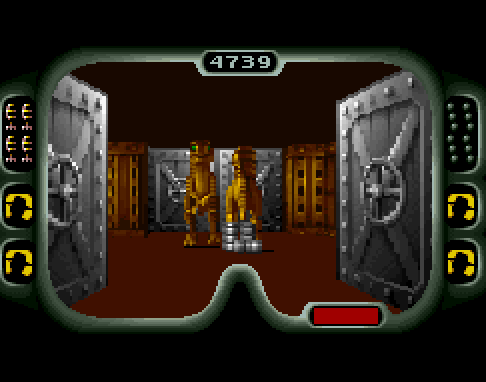
...because suddenly you're playing a Doom-style first person shooter. Okay, maybe not quite like Doom because it's not advanced enough to have things like different heights and walls that aren't at ninety-degree angles to each other. It's Wolfenstein 3D with dinosaurs, then.
There's a dinosaur now! You should probably shoot it. There's a range of different weapons available: you start with the stun gun, but you can pick up rocket launchers, shotguns, tranquillizer darts and bola snares. They all work the same way, though - fire them at the dinosaur and it'll fall over. Well, maybe not fall over. The rocket launcher makes them explode, as do the bolas for some reason. Bolas, in case you didn't know, are metal balls tied together with ropes that are supposed to entangle your prey. Not so in Jurassic Park, where the bolas cause any dino they hit to blow up. Why? I have no idea. Maybe they filled in the gaps in the dinosaurs' DNA sequences with semtex.
Enemies are also noticeably less perceptive indoors.
That green thing in the background is a computer, and once you've turned the power on by bumping your face into the generator, you can use the computers by bumping your face into them.
Oh joy. This kind of situation makes up the core of the Jurassic Park gameplay experience: you make your way between buildings via the overworld, then plod through the buildings to accomplish a minor goal only to be told that to progress you have to travel to another building to perform another minor task, often being sent straight back to the building you just came from because you turned on a specific computer or, more likely, found an ID card.
This game absolutely loves ID cards. It worships them, and expects you to do the same. I think there might actually be more ID cards than dinosaurs. Apart from the children, every character from the movie has one, all of them required to progress (apart, I believe, from Ellie Sattler. She does have an ID card, but as far as I can see it doesn't actually do anything) and all of them are scattered around the various buildings of the island. I do mean every character, too, right down to Donald Gennaro, the lawyer who gets eaten by the T. Rex, and Dr. Wu. Dr. Who? Dr. Wu, the park's chief geneticist. Yeah, I had no bloody clue who he was either, but as an InGen employee it at least makes sense he would have an ID card. Why the hell was Gennaro even issued with an ID card, and more importantly why is it lying on the floor of a utility shed? I know the alternative would be digging my way through a mountain of tyrannosaurus shit to find it, but you know what? I would have preferred that.
Once you've got the power back on, you can head to the Visitor Center to reboot the computer system. At least this makes a modicum of sense - the generator's in a utility shed and the computer system is housed in the main building - but that all goes out the window with your next task.
Stop the raptors getting into the Visitor Center, commands Ian Malcolm from whatever distant otherrealm he now inhabits. Actually, since he was played by Jeff Goldblum it was probably more along the lines of "Aah, Grant, stop the umm, raptors, umm, from getting into the ahh, hmm, Visitor Center." Thank you, Ocean Software, for sparing us from that.
The Raptor Pen seems like a good place to investigate if you're having raptor-related troubles, and indeed that is where you need to head if you want to keep the Visitor Center safe.
The interior areas are all bland, repetitive environments that use a very small set of wall textures and contain almost no landmarks, making navigation a real pain in the backside, but the Raptor Pen does have one of the few nice touches I remember from the indoor bits: you can see the jungle environment in the center of the building. It's just a flat image, it's not animated or anything, but given that every other square inch of the building is made of the same drab, grey walls that'd make a veteran submarine crew feel cold and claustrophobic it's a welcome touch.
Anyway, the problem is that the raptors are getting into the Visitor Center via a tunnel that leads from the Raptor Pen to the Visitor Center's basement. This tunnel needs to be blocked up. If only there was a flimsy wooden crate nearby...
Thank the heavens! This will do the job nicely - as a dinosaurologist, Dr. Grant knows only too well that the greatest weakness of any carnivorous therapod is the humble packing container. You wanna just push that crate in front of the tunnel there, champ?
Done and done. This wooden crate will surely resist all efforts by the highly intelligent and powerfully muscled velociraptors to gain entrance to the Visitor Center. Dr. Grant, you're a genius!
Is sarcasm poisoning something that can happen? Because I'm feeling a bit light-headed. Maybe it's just the my brain trying to make sense of the wooden crate stopping the dinosaurs.
I feel a bit better now that I'm outside, negotiating the mountains and collecting dinosaur eggs. There are eighteen eggs scattered around the map, and you have to collect them all before you can complete the game. I think. I'm not sure what happens if you reach the end of the game without picking up all the eggs, and while I'm sorry for not giving you the full rundown on the egg situation there was no way in hell I was getting to the end without having all the eggs in my possession. I'm only halfway through the game and it already feels like I've been here far too long, a feeling that reaches a peak in the next section - the ship.
The ship can fuck right off, frankly. It's big, it's decorated entirely in one shade of brown I like to call "Satan's Diarrhoea" and it's so jam-packed with dinosaurs you'll think P&O are running a buy-one-get-one-free offer on all tickets for extinct reptiles. Your mission is to destroy all the dinosaurs on board. Yup, just kill 'em all. There's even a counter that tells you how many you have left to slaughter. Just take a second to consider what this must feel like for Dr. Grant. Here is a man who has dedicated his life to the study of dinosaurs, spending years rubbing fossils with a shaving brush in the remotest, most god-forsaken corners of the planet, until one day he comes face-to-face with the creatures he has built his life around. Then someone nudges him in the direction of a shotgun and says "there better not be any of these left alive when I get back." I know Grant is pragmatic enough to realise that the dinosaurs can't be allowed to reach the mainland, but that's still got to hurt.
Hunting down the dinosaurs isn't the problem. The problem is that you can't just go about it in a straightforward fashion, because Ocean have decided that this game was a good chance to release Backtracking: The Video Game under the cover of it being a Jurassic Park title. You walk over to the ship from the Visitor Center. You proceed through the first level of the ship, terminating any dinosaurs you see with extreme prejudice. Along the way you'll find a locked door and Dr. Wu's ID card. Dr. Wu's card does not open that door. It opens a door in the Visitor Center, so off you pop, all the way back through the dino-infested mountains to the Center where you can use Wu's card to open a door and increase your security clearance level.
Once you've done that, traipse all the way back to the SS Dickabout and proceed down to level 2 and through the doors unlocked by your higher security clearance. Then you have to find a separate elevator to the one you just used in order to reach the lower decks and murder all the dinosaurs down there. Don't worry, you'll be in the mood to murder something by the time you reach this point. Eventually you'll clear out all the dinosaurs and have to walk back through the empty, confusingly laid-out ship to return to the world map. Oh, and you have to come back to the third level of the ship later. To call this whole rigmarole brain-meltingly, soul-sappingly tedious would be to greatly underestimate what an absolute ball-ache this section is. If there was an option to make Grant turn his shotgun on himself, I would have taken it.
It wouldn't be so bad it the gameplay was any fun, but I'm sure those of you who grew up playing Ocean games won't be surprised to find out that the gameplay is, in fact, not fun.
Firstly, the indoor sections. It's undoubtedly an impressive technical feat to cram a 3D shooter into a SNES cart. I'm not arguing against that as an accomplishment - but then again, it would be technically impressive if you used a laser to etch the entirety of Stephen King's latest bestseller onto a single grain of rice, but that doesn't mean it'd be the preferred method of experiencing the text. In short, the SNES can handle the FPS areas, but it'd can't handle them well.
The buildings are samey and uninteresting, which would be bad enough even if they weren't a chore to navigate. You can't strafe, turning around on the spot takes an age and to get through a doorway you have to line yourself up with it pretty much perfectly or you'll slide around on the doorframe like a pisshead trying to get into his house after a particular heavy session down the Nag's Head. Your woeful movement options aren't perhaps the handicap they could have been, however, because the dinosaurs aren't all that interested in coming to get you. You only ever fight two kinds of dinosaurs indoors - raptors and the spitting Dilophosaurus - and to be brutally honest they are so monumentally thick that the next time you hear someone pose the question "what killed the dinosaurs?" you'll want to reply "an inability to detect threats unless said threats are rubbing up against them and waving a gun."
Look at them, just standing there. Your bullets / rockets / exploding bola snares have unlimited range, so most of the 3D combat involves picking off the dinosaurs from a safe distance. Sometimes dinosaurs will be placed next to doors or around blind corners to catch you off guard, but on the whole they are almost entirely non-threatening.
Things get flipped when you're wandering around outside - now the dinosaurs are much more of a threat, constantly chipping away at your health and proving oddly difficult to hit. On the whole I'd have to say that the top-down gameplay is preferable to the 3D stuff, but it's still not great. For example, Grant can jump. This is useful for hopping over the occasional canal or thorny vine.
There's a thorny vine now. They're dotted around the overworld, and they're utterly pointless. Grant's jumping abilities are developed enough to clear them with ease and they're never bunched together to form a maze, or a jumping puzzle, or anything remotely interesting. They're just... there, every now and then, requiring so little effort to bypass that you'll wonder why the developers even included them in the game at all. My current theory is that they're there to force you to pay attention while you aimlessly wander the park, looking for the next ill-defined objective, to punish you if you lose concentration and walk into a briar patch.
Oh yeah, my objectives. I'm getting towards the end now, and your final major task is to enter the raptor nest, find the egg chamber and drop a canister of nerve gas. That seems awfully dangerous, can't I just push some crates in front of the exits?
I entered the raptor next through a forest clearing, but for some reason the interior is a giant stone maze adorned with Jurassic Park logos, so fair play to the raptors from sprucing the place up a little.
And now they're all going to die. I wonder if there are any other theme parks that have a supply of nerve gas on hand? The Wizarding World of Harry Potter, maybe. Those kids can get unruly if they're sorted into a house they don't like.
With the raptors re-extinctioned, Jurassic Park is almost over. All that's left to do is plod through the ship again and use the computer there to call for a helicopter off the island, but before I do that there are a few more things about the game I'd like to mention. While I've complained a lot, there are a few things that I genuinely enjoyed about the game. For one thing, incompetent embryo thief and park computer expert Dennis Nedry likes to send you messages.
Messages designed to get you killed. Nedry has changed from a greedy traitor to flat-out psychopath, trying to have Grant die a horrible death by feeding him inaccurate information like "raptors won't attack unless you shoot them" and "go on, touch the electric fence, it'll be fun."
Immature, yes, but these messages make me laugh whenever they pop up, probably because I imagine that there were kids out there who read these messages and believed that touching the electric fence really would give you a free life; and so off they went, face-first, into the nearest charged-up barrier. That's a thought to warm the cockles of my cold, dark heart.
I've already mentioned that I like the graphics, but even better is the game's soundtrack. I particularly like the "Ocean" theme that plays when you get near the ship.
Soothing and sinister all at once, this is probably the best piece in a soundtrack of surprising quality. Even as I say that, however, there are problems with the music. Each area has it's own accompanying theme, which is all well and good until you notice that a lot of the areas are very close to each other and you'll be moving through many different zones at a fair old pace... and each time you change zones, the new music takes a while to start up, so you end up only ever hearing brief snatches of each tune as you move from the jungle to the mountains to the sea. A minor flaw, really, but it's a shame when the music is probably the best thing about the game.
Oh, and there's a Tyrannosaurus Rex.
Of course there's a T. Rex. The velociraptors may have been the break-out stars of Jurassic Park, but it was the T. Rex that everyone came to see in the first place, and here he is on your Super Nintendo. There are two of them, (I think,) each patrolling a certain part of the map, and if you get too close they'll run out of the jungle and eat you.
Like so. They're completely invulnerable, except to tranquillizer darts which slow them down a little, but really you should just avoid the Rex altogether and it's possible to complete the game without ever seeing one. Imagine that, if you'd played all the way through a Jurassic Park game and not seen a single T. Rex. Well you've seen it now, and it's little more than an easily-avoidable environmental hazard. I'm... not sure that's better.
Okay, I've had enough of this. Time to end the game, which is now just a simple matter of getting to the helipad and enjoying the dramatic and fulfilling ending.
That's the ending, huh? Yup, I definitely feel fulfilled. Ful-filled with hate. Aside from this one screen, the ending consists of the Mode 7 shot of the island that you're shown in the intro and the credits, which you can also see in the intro. Ninety percent of Jurassic Park's ending sequence is taken directly from screens shown to you before you've even started the game. I should have left Grant in the raptor nest with the nerve gas.
Maybe I have been a little harsh on Jurassic Park. I know there are people out there who think it's a good game, and while I certainly wouldn't go that far I will concede that it is at least a relatively competent game. One of its biggest failings is a lack of focus - neither of the two gameplay styles are much cop, but there's a foundation there that could have been built into something much more enjoyable had Ocean decided to focus on one style or the other. This feels especially true of the outdoor sections: a good game could have been borne from those areas with a little more variety, particularly if it had ditched the overworld concept and had discrete stages.
I'm not saying that overworlds are a bad thing in general, but the specific one in Jurassic Park is, like the buildings, awkwardly laid-out and confusing. Any amateur cartographers out there should definitely give this game a swing, because to get anywhere you'll need to make more maps than Magellan. Once you do know what you're doing, and in what order, and where all the ID cards and eggs are located, then the game should only take a couple of hours to beat. It's a good job too, because - and this is the final blow to any chances of me enjoying Jurassic Park - you can't save your game. No passwords, no battery back-up, no nothing. Do it all in one go, or don't do it at all. You have infinite continues, so if you're willing to leave your SNES on until you get it done then I suppose you have a chance to witness the extravagant ending sequence for yourself, but I would strongly advise against it.
So maybe I'm being unfairly critical, but I can't bloody stand this game. Hey, no-one ever said you were going to get balanced, unbiased reportage here at VGJunk. Sure, it's got dinosaurs, decent graphics, a good soundtrack and some fairly impressive 3D gameplay but all of that is buried beneath the unremitting tide of pointless and frustrating design decisions. Suddenly that 3DO version of Jurassic Park is sounding like a much more tempting prospect.
Labels:
jurassic park,
ocean,
SNES
Subscribe to:
Posts (Atom)