Showing posts with label fighting. Show all posts

27/11/2018

KNUCKLE HEADS (ARCADE)

As we all know, when Street Fighter II landed in arcades and revolutionised the fighting game genre, every developer under the sun rushed to put out their own take on the one-on-one brawler. What’s less clear is why Namco decided to name their effort after a Three Stooges insult. It’s the 1992 global-weirdo-convention-em-up Knuckle Heads!

That’s a surprisingly severe logo for a game that, as mentioned, is all about a bunch of weirdos getting together for a punch-up. Tekken this ain’t, folks - but it is a fighting game, so despite the quirks and foibles of the gameplay which we’ll get to in due time, at its core Knuckle Heads is all about hitting the other person until they stop moving. But why are they fighting?


The bright lights and the sharp-suited host reveal that Knuckle Heads is framed as a televised fighting tournament, with the combatants battling it out for a ten billion dollar prize. Given that the prize is ten billion dollars, it’s a real surprise that only six people entered the tournament. For that amount of cash I’d enter the goddamn tournament even after seeing the kind of violent lunatics I’d be up against. There’s always the tiniest chance I might win the tournament and claim enough cash to solve all my problems, or I’d be bludgeoned to death by a viking and in a way that’d also solve all my problems. It’s a win-win situation.
Yes, I did say that one of the characters is a viking. Let’s meet him, and all the other characters, right now!


First up is Rob Vincent, an American fighter with two tonfas, a supremely smug expression and a chin that Bruce Campbell is probably going to want back at some point. Rob’s the most generic character in the game, but even so he’s still fairly interesting. You certainly don’t see many ginger, tonfa-wielding America fighters in videogames, do you? He’s also dressed kinda like M. Bison. He is certainly not as cool as M. Bison, though.


The obligatory Japanese representative is Fujioka. He is, of course, a ninja. He attacks with a sickle and chain, also known as a kusarigama. I remember that from playing Nioh. See, videogames are educational, presuming you want to learn all the many ways humans have tried to murder each other over the centuries. A less common part of the ninja get-up is Fujioka’s headgurad, which makes him look like a contestant on the Japanese version of Gladiators. Ninjas, you will go on my first whistle! I should go and pre-emptively apologise to my neighbours, because now I’m going be blasting the Gladiators theme while I write this article. Oh, and on the subject of ninjas, this image made me finally get around to looking up why ninjas are so often depicted as wearing fishnets, as you can see on Fujioka’s arms. Disappointingly it’s not because ninjas make their uniforms out of discarded Babybel packaging. It’s supposed to be a stylised representation of chainmail, apparently.


Hailing from China is Christine, the staff-swinging acrobatic fighter who presumably chose this outfit so she could enjoy her hobby of hiding in grape vats. She’s ninety percent of the way to wearing California Raisin cosplay. Yeah, there’s not much to say about Christine. She’s a good character for a beginner to pick. Oh, and her voice lines were provided by Megumi Hayashibara, who’s probably best known as the voice of Rei in Neon Genesis Evangelion. Or Ranma in Ranma ½. Or Jessie (well, Musashi) in the Pokemon anime. She’s voice acting royalty, is what I’m getting at, and Namco spared no expense in getting big-name anime voice actors in for Knuckle Heads.


The characters get a bit more unusual from here, starting with the aforementioned viking Gregory. He’s not a real viking, of course. He’s only thirty-nine years old. A historical re-enactor who has taken things way too far, one assumes. Gregory is the powerhouse character of the roster, ready to cause carnage with his twin axes but always with a smile on his face. Of course he’s smiling, this is one of the rare occasions where owning two massive axes is going to pay off for him. And hey, it’s nice to see a character from Norway rather than the usual fighting game locales.


The Brazilian representative is Claudia, who combines the usual Brazilian fighting game clichés into a scantily-clad, jungle-dwelling, carnival-themed character. She’s also a lot like Street Fighter’s Vega, what with the claws and all. She likes to jump around a lot, so you’ve got to give her bikini top a lot of credit. That thing is solid. She’s also got a big-name voice actor, with her lines being provided by Sailor Moon herself, Kotono Mitsuishi.


The weirdness reaches its apex with the final character: it’s Blat, the tiny Greek man who fights with an enormous hammer. Of course, there are very few Greek fighting game characters to crib from and little in the way of non-historical Greek stereotypes that’d work as the basis for a videogame fighting style unless Blat threw bottles of ouzo at people or something, so Namco had free reign to create their own take on a “Greek” fighter. They went with “peculiar gremlin man who stole the weapon and armour of a fantasy barbarian who was three times their size.” It’s a bold look, but I’m not complaining.


Okay, so the time has come to actually pick a character and play the game. As is traditional by this point, I’ll be playing as Rob Vincent, because he was the first character highlighted on the select screen and he’s also the least interesting, which means he’s the closest Knuckle Heads has to a main character. Having seen the attract mode I already know that Rob has his own versions of the fireball and the dragon punch, so he’s basically American Ryu. No, hang on, that’d be Ken. Oh, you know what I mean, let’s get on with the fighting.


The first bout takes place on the bustling streets of Hong Kong, where the locals have come out in numbers to see Christine crack Rob’s head open with her stick. A bit rude, considering I hadn’t had a chance to figure out what the buttons are yet, but that shouldn’t take long because there are only three of them. You’ve got high attack, low attack and… jump? Well look at that, you have to press a button to jump in this game. That’s a significant difference from Street Fighter et al, and I’ll tell you what – it was a nightmare trying to get used to pressing a button to jump. Decades of fighting game experience have conditioned me to press up to jump, so that’s what I kept doing the whole time I was playing Knuckle Heads. I tried to mentally condition myself to accept this control quirk by murmuring “just like Smash Bros., just like Smash Bros.,” over and over again, but that did not work. It just made me think about the weird “Gaaanondooorf” chant from the Smash Bros. games.


Another interesting feature of Knuckle Heads’ gameplay is that only having two attack buttons means that you have to charge up to perform stronger blows. Keeping the button pressed for a second or so gives your character a coloured aura – it’s up to you whether you belt out a Dragonball Z-style scream as you do so, but it certainly adds to the ambience – and then letting go of the button makes your character perform a different attack. In Rob’s case, he hops forwards and attacks twice with his tonfas. I don’t think I ever landed this attack on a CPU character, possibly because a glowing red aura is a bit of a giveaway re: what attack’s coming next.


Knuckle Heads is still a 2D fighter at heart, though, so much of what you know about other examples of the genre will serve you well here. Special moves are executed using the usual joystick-and-button combos, (like Rob’s dragon punch here,) although fireballs seem to be more away-toward-attack than traditional fireball motions, and I’m very happy to report that Knuckle Heads has smooth, responsive special move inputs. I’ve played many a fighting game where trying to perform a task as basic as launching concentrated spiritual energy from your hands was a real struggle, but for the most part Knuckle Heads let me use my special moves when I wanted to, not at some point thirty seconds and multiple attempts down the line. It’s a good job, too, because the dragon punch quickly became a crutch that I relied on to defeat Christine. The only time she wasn’t blocking was when she was using her jumping attacks, you see.


Next into the fray is Fujioka, and he’s just as much of a videogame ninja as you’d expect. Lots of fast attacks and agile movements, plus a costume that would in no way help him to be stealthy unless he was trying to sneak in as an extra in a He-Man cartoon. Nice y-fronts, dork. Fujioka is also very fond of fireballs. Normally this would be a good thing because I could jump over his projectiles and kick him in the face, but of course I kept forgetting that I had to press a button to jump.
It was also at this point that I realised I’d made a grave mistake in choosing to play as Rob. The issue is that Rob uses a very short-range weapon in a tournament where his opponents are wielding long sticks and extending chains, and a lot of the time range is king in Knuckle Heads. It’s not an insurmountable problem, although it might feel like it when Fujioka chooses to fight from a different postcode and keeps whipping you in the face. If you are going to play as Rob, my advice is to practise using his fireballs.


I must admit, it feels a bit strange to be fighting beneath the (presumably) disappointed gaze of Jesus Christ. Maybe I can convince him that Claudia is a moneylender or something. Namco really went all out to make sure you knew this stage was set in Brazil, huh? The statue of Christ the Redeemer, the carnival dancers, the big neon sign that says “Brasil.” Then there’s Claudia herself who, as previously mentioned, combines most of the usual tropes of videogame Brazilians into a character who ends up fighting mostly like a cat. Lots of leaping and clawing attacks from Claudia. She’s especially fond of the one where she jumps off the top of the screen and then tries to land on your head – unfortunately for her, it’s very obvious when she’s doing this, so you can be ready with a block or a dragon punch.


Other than that, the most notable thing about Claudia is that she stands like a T. Rex in her neutral stance. Or maybe it’s more like a praying mantis. A praying mantis wearing a gold bikini and shoulderpads.


Now we’re off to the land of the ice and snow, from the midnight sun where the fact that Rob’s attacks have no range really does blow. It’s viking impersonator Gregory! You know, Greg the viking? Yeah, that guy. His fellow historical re-enactors have all piled into the longboat to watch their friend fight beneath the northern lights. The Norse aesthetic is somewhat undermined by Gregory’s musical theme, which is not the kind of rousing Scandinavian drinking song you might expect – instead it’s a strange techno / rave tune. It’s certainly a, erm, unique combination.


Being Knuckle Head’s biggest, strongest character, you won’t be surprised to lean that Gregory likes to get in close, using his charging headbutt to close the distance so he can get you with his backbreaker or his “Tidal Wave” axe attack. In a way this does play to Rob’s strengths, because it mitigates the differences in range. I found that the dragon punch has enough invincibility frames that you can often sneak one through before Gregory’s attacks land, but one very useful tactic that applies to all battles in Knuckle Heads is to simply block whatever’s coming your way and then go for a throw once the enemy’s attack is over. This is an especially effective tactic because you can block everything (except throws) simply by holding back on the joystick because – get this – there is no crouching in this game. That’s right, no ducking, no crouching attacks and no need to block low. Even more that jump being on a button, the complete lack of crouching took a lot of getting used to because it’s such a fundamental part of most fighting games. I was still trying to land low attacks by the time I reached the fifth fight…


...which is against over-armoured, hammer-swinging Greek diddyman Blat. I feel like that hammer is too much. Like, I understand that this is a weapon-based fighting tournament, but that thing’s just taking the piss. I’m surprised Blat didn’t turn up with a gun. But a hammer he has, and he likes to spin around a lot and clip you with its massive hitbox when you’re convinced you should have avoided the attack. Knuckle Heads is mostly a solidly put-together game, but it definitely lacks the precision of Street Fighter II or SNK’s fighting games, with sometimes fuzzy hit detection that’s not bad enough to ruin the game but will make you utter a slightly annoyed “hmm” every now and then.


Perhaps it’s unfair to keep comparing Knuckle Heads to Street Fighter II, because Namco were clearly trying to do something a bit different, especially when compared to more formulaic clones like Fighter’s History or World Heroes. The lack of low attacks gives the fights a very different feel to most fighting games – I’m so used to high-low mixups being a fundamental aspect of fighting game strategy, and the lack of that option means it can be difficult to break through your opponent’s defence. This means Knuckle Heads becomes much more of a test of patience and timing rather than finding openings through aggressive play, and the best strategy almost always seem to be to wait for your opponent to make a mistake and then punish it because you simply don’t have the offensive tools to pressurise effectively.
Anyway, I managed to beat Blat by repeatedly chucking him across the screen, and with all the other playable character defeated it’s time to move on to the final boss, right? Well, you’d think so, but Knuckle Heads has yet another twist up its sleeve.


It’s a two-on-one fight now! I’m the one, naturally. Blat and Gregory have teamed up to take Rob down, and I’ve made the terrible mistake of getting caught between them, where their long-reaching attacks can keep me trapped. This explains why you can’t crouch and why jump is on a button – it’s because in the two-on-one fights you need up and down on the joystick to walk up and down between background planes, like you would in a side-scrolling beat-em-up. Not only are there two-on-one fights, you can have up to four fighters on screen at once in versus mode.


The multi-man melees had the potential to be a frustrating, overwhelming mess, but fortunately Namco managed to keep them just on the right side of chaotic. Your opponents can hit each other, for starters, and you can throw them into each other, too. Your special moves come to the fore here, because they’re more likely to hit both opponents at once, and if you’re playing as a character who had the foresight to bring a weapon that doesn’t boil down to “punching, but with a stick strapped to your arm” then keeping your enemies as far away as possible is a good strategy, too.
On the whole the tag battles work much better than I expected them to. They’re quite difficult, of course, but it’s easy to get your character facing the right way and blocking being so effective prevents one enemy hitting you high while the other hits you low, for example. My biggest gripe is that each of these battles is still a two-round fight, which is downright rude. I just beat two fighters at once, I shouldn’t have to beat them again.


After three tag battles, you do have to face Knuckle Heads’ equivalent of a final boss – but disappointingly it’s just a golden doppelganger of whatever character you’re playing as. That said, I’ve played a lot of arcade fighting games where you struggle to the end only to be presented with a final boss who is, to use the technical term, absolute bullshit – I’m looking at you, every SNK fighting game ever. Still, it’s hard to drum up much enthusiasm for Rob Redux, even if it does give you a taste of what’d happen if the Oscars statuette came to life and got rowdy. The same tactics apply here, especially the block-throw-repeat loop, and soon the ten billion dollar prize will be in your hands.


Rob’s ending was not what I was expecting. I though he was going to live the life of a playboy millionaire, or maybe eschew the money to devote his life to martial arts training, but no – instead he used the money to bail out his father’s failing business. Then he asks for a job. Rob, you have ten billion dollars, the only job you need is building your own Scrooge McDuck-style money vault.


I like that Rob literally hangs up his tonfas, that’s a nice touch.
Each character has their own ending, and unsurprisingly Rob’s is the least interesting of the bunch. Christine uses the money to fund her own kung-fu action movie. Fujioka turns out to be an undercover cop who’s investigating the show’s host for drug smuggling, and it must have been a fun day down at the precinct when he was picking ninja gear as his undercover outfit. Claudia uses her billions to buy the Amazon rainforest in order to protect it, sorely underestimating the cash value of the Amazon rainforest. Gregory gives the money to his estranged wife and kids – the wedge between them no doubt being Greg’s insistence that he’s a viking – and his generosity helps them reconcile. My favourite ending is Blat’s, because he manages to spend ten billion dollars on women and booze in just three years. Eat your heart out, George Best.


And that’s Knuckle Heads, Namco's bold and sometimes experimental take on the fighting game formula. Whether this was the inspiration for the weapon-based combat of Soul Edge, who can say?  I definitely had a fun time playing it, though. Not as polished as the cream of the fighting game crop, a little more one-note in its gameplay and the small roster of characters is a drawback, granted, but Knuckle Heads' gameplay is smooth, intense and colourful enough to be ideal for a bit of pick-up-and-play action. The characters are mostly interesting, (not you, Rob,) the graphics are bright and cheery and the soundtrack has some excellent tunes, especially Christine’s theme. I believe it’s what the kids refer to as a “banger.”


If you listen to it long enough, it starts to sound like it’s being sung by meowing cats. Actually, the first time I heard this I thought “this really reminds me of “Iron Eyes” from Street Fighter EX3, a track I bloody love.” I looked up Knuckle Heads’ soundtrack after I finished the game to see it was composed by Takayuki Aihara… who also composed “Iron Eyes.” Good ear, me.


Anyway, give Knuckle Heads a try. If you manage to get three other friends together to try the four-player mode, let me know what it’s like. The four-player battle, I mean, not having three friends. Obviously I’m not not interested in that.

28/08/2018

TUFF E NUFF (SNES)

Has it really been almost two years since I covered a game with Jaleco’s name on it? It’s definitely time to remedy that - I have missed diving into the library of the Masters of Mediocrity, a videogame developer more middle-of-the-road than a zebra crossing. Today’s offering is the 1993 SNES game Tuff E Nuff, and it’s a fairly decent Street Fighter II clone. I haven’t actually played it yet, but I saw some screenshots and it was developed by Jaleco so if Tuff E Nuff isn’t a fairly decent Street Fighter II clone I’ll eat my hat, your hat, an Abraham Lincoln stovepipe stuffed full of baseball caps, whatever hats you like.


Tuff E Nuff is a hell of title, huh? It’s edgy, it’s hip, it’s street, or at least that’s what I assume the people in charge of localising the game thought. It’s a title that reminds me of 90’s glam metal band Enuff Z’Nuff, and I suppose it’s possible that the name crept into the localiser’s mind while listening to “Fly High Michelle.” Enuff Z’Nuff have their own genuine videogame connection, of course:  Guilty Gear character Chip Zanuff is named after the band’s bassist.
In Japan, Tuff E Nuff is known by the grammatically wonky but far more poetic title of Dead Dance, and I’m as surprised as you are that Dead Dance isn’t the name of a nineties glam metal band.


Jaleco have slapped the standard Mad Max / Fist of the North Star story onto Tuff E Nuff: World War Three, only the strong survive, shoulderpads come back in a big way, roving gangs of psychopaths, the usual. They’re described as “crazy times,” which I’m convinced is a reference to "Tough Boy", the opening theme for the second series of Fist of the North Star. Out of this chaos emerges some kind of punch king, who conquers the world – and then for some reason holds a fighting tournament.


The “remaining four great states” send their champions to the tournament in the hopes of defeating “JADE” the fighting king and restoring peace to the land. Given how hard Tuff E Nuff is leaning on Fist of the North Star for inspiration my guess is that Jade will be a very large man with short blonde hair like Fist of the North Star villain Raoh. If he isn’t, you can add another eatin’ hat to my plate.


The three gameplay modes are story, two-player and basic versus CPU battles, and I’ll be playing through story mode. I think it’s supposed to be an ironic name, because if you’ve watched the game’s intro that’s all the story you’re getting. Arcade mode might be a better name, but even arcade modes in fighting games usually have some kind of ending.
Right from the off you can spot a flaw with Tuff E Nuff – there are only four playable characters. You’ve got generic post-apocalyptic punchman Syoh, the equally generic Zazi, Kotono the lady ninja and hulking wrestler Vortz. We’ll meet them all in time, but I’ll be playing through the game as Syoh so let’s get to it.


First up is a battle against Zazi, which is being held in a sports arena that just about survived the apocalypse. Zazi’s weapons are his bare fists, and so are Syoh’s so this should be an evenly-matched fight.


Extremely evenly matched, because Syoh and Zazi are the exact same bloody character with slightly different sprites. Tuff E Nuff’s cast of characters just shrank from four to three, and the tiny character roster is a real mark against the game. Imagine if the SNES version of Street Fighter II was released and the only playable characters were Ryu, Ken, Chun Li and Zangief.


Gameplay-wise, TEN is very much what you’d expect. You’ve got four attack buttons for light and heavy punches and kicks, you hold back to block, special moves are executed with d-pad manoeuvres plus a button, so if you’ve ever played a fighting game of the era you’ll have no trouble getting a handle on TEN’s gameplay.
As for those special moves, would you be shocked to learn that Syoh and Zazi fight a lot like Ryu and Ken? They’ve both got the traditional fireball and a rising punch that calls to mind the towering form of a dragon. The fireball is executed in the usual way, while the dragon punch is away, down forward and punch – I had trouble getting the dragon punch to come out a few times, but that might be because I’m so used to doing dragon punches the Street Fighter way. On the whole, though, the controls feel more than adequate for the job at hand. They’re fairly crisp, characters move as you’d expect and I could launch a fireball about nine out of ten times I tried. This is very important, because I’d guess that about eighty percent of the damage I inflicted while playing TEN was chip damage from blocked fireballs.


Syoh and Zazi have one other special move and it’s their most interesting by far. It’s a defensive upwards swipe that protects from frontal attacks and is performed by holding the d-pad towards your opponent for a moment and then pressing back and punch. This feels like a very usual command for a fighting game move to me, but its addition gives Syoh’s fighting style that extra tool it sorely needed to avoid becoming extremely simplistic. It’s great for turning attack into defensive attack in an instant and catching your opponent off-guard when they try to jump up and plant their foot in your nasal cavity.
Above you can see I used this move to land the final blow on Zazi, and you can also see that TEN offers players an instant replay of the fight’s last few moments, which is a nice touch in a game that otherwise feels a bit bare-bones.


Kotono is your next opponent, and she’s got all the graceful ninjas skills you’d expect, like speedy dashing attacks and the power to throw sharp bits of metal at your face. Definitely very ninja-ish, even if she does appear to be wearing hiking socks and lederhosen shorts, as though she’s going to throw down her kunai at the end of the fight and start up the oompah music.


The end of the fight came a lot quicker than I would have liked, because Kotono kept kicking my ass. Considering she’s the second opponent you face you’d think you’d get something of an easier ride but no, she careens around the screen like a squirrel with amphetamines stuffed in its cheeks and even Syoh’s defensive special move was having trouble stopping Kotono in her tracks.


Once I eventually managed to scrape a win against Kotono it was onwards to a bout against Vortz, the massive wrestler. Like most fighting game wrestlers, Vortz is all about getting up close and putting his techniques of bone origami into practise, so it’s a bloody good job the command for Syoh’s fireball is fairly responsive.
The most interesting thing about Vortz is that he’s from The Netherlands. You don’t get many Dutch fighting game characters, do you? Or Dutch videogame characters in general, I suppose. The intro said that the fighters were from the four remaining great states, so The Netherlands' international cachet must have really spiked after the bombs fell. Perhaps the atomic war boiled away the oceans – traditionally The Netherlands' bitterest foe – and they expanded from there.
After the repeated application of off-brand hadokens, Vortz was felled and Syoh emerged victorious. So we’re off to battle the fighting king now, right? Wrong! There are a bunch more CPU-only characters to fight before we get to the final boss, starting with a man called Beans.


Beans’ weapons is “American sack.” I have no idea what that entails. I’m just praying that he doesn’t have elephantiasis of the testicles and he’s making the most of it by painting the star-spangled banner across his ballbag.


Oh thank god. Beans is just your typical post-apocalyptic shoulderpads-n-mohawk thug, although he’s definitely on the more flamboyant end of that particular spectrum. Most wasteland warriors go for studs or spikes on their shoulderpads, but not Beans; he seems to have a curled-up sheepdog puppy on each arm.
With a fighting style you could confidently describe as “crap,” Beans only has two special moves. There’s a strange flying kick that’s easily countered by using Syoh’s special defensive punch, and a flurry of very short-range punches. This makes that fight against Beans far easier than the last three battles, and it really does feel like Beans should have been your very first opponent, a useless fighter for you to practise on before moving on to opponents who don’t look like they stopped off for a game of American Football on their way to the disco. Oh, wait, is that what “American sack” is supposed to mean? Sack is a thing in American football, right?


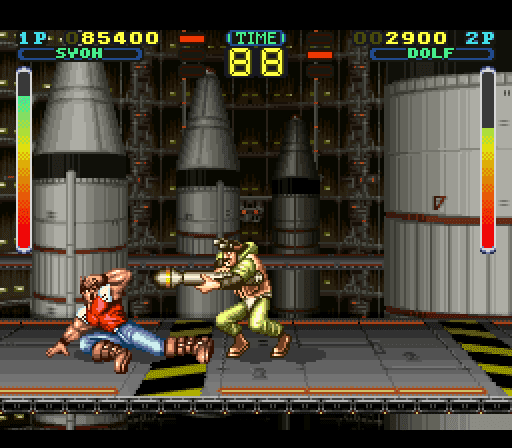
Next up is Libyan soldier Dolf. His weapons are listed as rocket launcher and bowie knife. Nice and fair, then. In his defence, Dolf mostly uses the rocket launcher to clonk you over the head and when he does fire it the rocket travels so slowly that it’s easy to avoid, undercutting the very concept of rockets. It’s another simple fight, because the range of Dolf’s attacks are far shorter than you’d think they’d be and I often snuck in the odd hit by virtue of Syoh’s legs being that little bit longer. Dolf also like to jump a lot, and here’s my number one top tip for playing Tuff E Nuff: learn what your best anti-air move is, because the enemies love jumping towards you. In Syoh’s case it’s either his defensive special or his standing hard kick. To reiterate, find your best anti-air and learn it, embrace it, treat it like a lover.


Speaking of Syoh’s special moves, you can see above that they’re better than they were before. His defensive special now covers Syoh in a sparkling curtain of what my top scientists have dubbed “murder energy,” and as a result it does seem to offer more protective coverage. What happens is that ever time you win a fight, one of you special moves gets a bit better and a lot flashier, with dragon-headed fireballs and pillars of energy making an appearance as you pummel your way through the story mode. I’m not sure whether they improved attacks do more damage – if they do it’s not by much, I don’t think – but they’ve got bigger hitboxes and they look a lot cooler, which is far more important.


Here’s Rei, a shrine maiden type who rather undersells her fighting prowess by listing her weapon as “iron shoes.” This is technically correct. Rei is indeed wearing iron shoes, much to the irritation of whoever lives below her in the battle tower. However, Rei can also create small black holes and shoot fire along the floor. I probably would have lead with that on my personal profile, Rei. Maybe the box on the form was too small to fit “wizard with the power to control space and time who wears iron shoes.”


Again, this is another relatively easy fight, thanks to Rei’s reliance on predictable and easy-to-block projectiles. My theory is that the developers spent a lot more time working on the playable characters, giving them more balanced special moves and such, which is why they’re harder to beat than the middle section of the fighting tournament.
At least Rei’s stage looks nice, what with the rolling mist and the candlelight. TEN looks rather nice overall, in my opinion. Nothing that’s likely to blow you away and a few of the animations look a bit stiff, but it’s certainly not ugly and there are a few especially nice touches, like Dolf riding into battle by clinging onto one of the missiles in the background of his stage.


After Rei is the masked wrestler Gajet. Gajet is Vortz, except a different colour and with a Phanto from Super Mario Bros. 2 stuck to his face. His weapon is “great strength,” which is all well and good but my weapon is, as previously established, murder energy. Bye, Gajet. At least you made me hum the Inspector Gadget theme while we were fighting.


Then everything fell apart when I had to fight Sirou the slicin’ samurai. The difficulty level swings up wildly here, most thanks to Sirou’s big sword and his even bigger hitboxes: one swipe from his mighty blade covers half the bloody screen. Sirou’s fast, he’s ruthless and you know what? He’s quite good fun to fight against. I wouldn’t go so far as to say it was the intention all along, but all the previous fights and the upgrading of Syoh’s special moves seem to have built to a fight where I felt quite evenly matched, a fight where the outcome was dependant on my skill and reflexes. The resulting battle was an exciting slugfest of clashing blows and fireballs that look like dragons carved from marshmallow, topped off with the realisation that there are still two fights to go and I’m probably going to get my arse handed to me. Okay then, who’s next?


It’s K’s, and he’s got weapon arm. Aren’t all weapons “arms”? I guess he’s probably got a robot hand or something.


Oh yeah, those are definitely weapon arms. A whole lot of weapon arm. Enough weapon arm that you’d think K’s would have trouble maintaining his balance, although on the flip side he’s never going to have trouble getting the Christmas decorations out of the loft, is he? Another day, another German fighting game character with cyborg arms.
As you might expect, much of K’s’s (good lord) fighting style involves poking at you with his robotic orang-utan arms or using the rocket boosters concealed within to get close enough for yet more poking, but he’s also got a projectile move that launches electricity which covers the screen from top to bottom so you can’t jump over it and frankly that is the height of rudeness.


At last, it’s the final battle against Jade. Turns out he’s a big guy in armour with spiky blonde hair and a “fighting aura,” so yeah, he’s Raoh. That’s one less hat for me to eat, I suppose.


Then I got into the fight, and Jade proceeded to use his fighting aura to carve me a wide variety of interesting new orifices. I could not get near him, although of course a good part of that is down to me being bad at videogames. Jade doesn’t feel like he’s quite in “SNK Boss” territory, but he’s still a right pain in the arse to fight.


Jade does look cool, though. Many of his attacks represent his fighting aura with this red flash effect that illuminates his sprite as he fights, and it does make him seem very powerful. Powerful enough for me to have to turn to the Game Genie for an infinite health code if I wanted to beat him in a reasonable amount of time, although I reckon I would have gotten there in the end if I’d put in a bunch more practise. TEN does generously offer you passwords if you lose a fight, so you can come back and practise to your heart’s content – it’s just that my heart was more than content with getting battered by Jade ten or fifteen times rather than the fifty it would have probably taken me to beat him fair and square.
With the fighting king disposed of, it’s time to see how Syoh will celebrate his victory. Will be become corrupted by the power of marshmallow dragon fists and embark upon a tyrannical rule? Will he become an inspiration to the downtrodden and hopeless? Will he open a chip shop in a Middlesbrough suburb?  Only the game’s ending can provide us with those answers.


Or, you know, no fucking answers at all. This is all you get if you complete the game on normal, and even beating the hard difficulty just shows some developer credits and a few screenshots. Great, you’re tuff e nuff, now piss off. Thanks for that, Jaleco.


The problem is that I’m playing the US / EU version of the game. The original Japanese version actually does have a story mode that doesn’t makes a mockery of the word “story.” The Japanese version has proper endings for each of the playable characters and the fighters even talk to each other between fights, but all of that was excised for the overseas releases for reasons I can’t ascertain. I hate to put these things down to laziness on the developer’s part but come on, pretty much anything would have been better that the shallow excuse for an ending you get in this version of the game.
Another feature present in the Japanese game was that the fighter’s faces become progressively more bloodied as they take damage, although the exclusion of that gimmick is more easily explained with Western developers being squeamish about a game where women can have their faces graphically rearranged.


There’s one saving grace for Tuff E Nuff that I should share with you all: via the magic of cheat codes, you can play as the boss characters in two-player and versus CPU modes! That’s right, if you wanted to take Beans out for a spin in the hope of unravelling the mysteries of his American sack, that option is available to you. The boss characters have all their special moves intact and thus they’re completely unbalanced, but they’re all there and that makes it even more baffling that they’re not available in the versus modes without using a cheat code.


Let’s go back to the very beginning of this article and oh hey, look, your hats shall remain unconsumed. Tuff E Nuff is, in fact, a fairly decent Street Fighter II clone. Maybe even a little bit more than fairly decent. It’s got plenty of fighting action, it mostly controls well, the graphics are nice and the characters are a pretty engaging bunch of pugilistic weirdos. However, it’s held back from greatness in part by being too beholden to the fighting games that came before it, but also because of things like the tiny roster of playable characters, the weird difficulty curve and the poor localisation. There is a translation of the Japanese version out there, though, so if you do want to play Tuff E Nuff / Dead Dance, that’s probably the version to seek out, and it’s proof that when Jaleco really pushed themselves they could reach the heady heights of, ooh, a seven out of ten.


Oh, and I can’t leave without mentioning Tuff E Nuff’s famously terrible US cover art. The story goes that when UK games magazine CVG were covering the game, they didn’t have any official art to use so they drew their own – and Jaleco liked it so much they asked if they could use it for the game’s actual cover, despite the Japanese version already having a perfectly good cover illustration. Absolutely baffling, I’m sure you’ll agree, and the screaming face of this Liefeldian monstrosity probably traumatised hundreds of kids across the Western hemisphere. Is it supposed to be Jade? It must be, right? It’s just that I don’t remember Jade having one gigantic tooth in his upper jaw, like a triceratops’ beak. Then there’s the tagline “master the moves to master me,” and hey, buddy, I don’t want to master you. No judgement, I’m just not into that kind of relationship. Now please close your mouth.

VGJUNK Archive

Search This Blog

Followers