Today’s game is a cutesy Famicom romp through a series of colourful worlds, where a young girl, erm, does things? I can’t really be more specific than that. It’s a confusing game. Welcome to Lost Word of Jenny, developed by Takara and released in 1987. Before we get started, take a close look at the title. Yes, it’s “Lost Word” and not “Lost World.” I hope you don’t have as much difficulty as I – and several others, if a quick internet search is anything to go by – did making the distinction. “Lost World” just feels more correct, somehow, probably because “lost world” is a phrase sometimes used in English whereas “Lost Word” sounds like an indecipherable error message from an ancient computer.
Here’s Jenny now. Jenny has a lot of hair. Perhaps too much hair for such a small head, and it threatens to engulf her diminutive features. If Jenny looks a bit doll-like, that’s because she’s a doll. Specifically, she’s based on the real Japanese “Jenny” doll, which was originally known as “Takara Barbie.” This gave me cause for concern, because playing a videogame based on Barbie is not something I need in my life right now. Things are stressful enough without adding another god-awful minigame collection based around fashion, but thankfully Lost Word of Jenny is actually a platformer.
Jenny is also Cinderella, it seems. Cinderella in space, maybe, what with the featureless black void and the horse kicking up a trail of stardust.
Here’s Jenny now, at the bottom of the screen, long of limb and full of youthful energy. The game begins with Jenny leaving her house and traversing this map screen, trying to reach the entrance to each stage while avoiding the many hazards that block her path. These hazards include cars, which move as though they’re being driven by a chimp fed a steady diet of amphetamines. I can see how that would be a hazard. On the other hand, puppies. Deadly, enraged puppies. Yes, the puppies hurt you if you touch them. No, I have no idea why. I’ve complained before about how many videogame heroes can take damage from bubbles, but this is a step beyond that. At least a bubble could conceivably contain poison gas. A puppy is a puppy. If you asked people to compile a list of the least threatening things in the world, puppies would be number one with a bullet. There are therapies out there that give people puppies to make them feel better. I just can’t get over it. My only explanation is that Jenny reeks of Pedigree Chum.
Also, there’s a building over there marked “NASA.” Obviously, this was my first port of call, but it wouldn’t let me in. Instead, I wandered around for thirty seconds or so until I found a stage that would admit Jenny.
It’s a pirate ship. “Gabacho the Ship,” according to the title that appeared when I walked in. Here’s where I hope that Lost Word of Jenny came with a detailed instruction manual, because at first I had no idea what I was supposed to be doing. Stages in this game aren’t the usual “get from the left to the right” affairs, instead comprising a few screens, usually with a second set of screens below that you can reach by travelling down a ladder or staircase. Some time spent jumping around and trying out Jenny’s combat skills – she can perform a high kick or a crouching punch – eventually led me to one of the barrels you can see above. They’re the key to completing the stage: find all the barrels and open them (or open them and defeat the creatures inside) to collect the important items they contain. Most important of all are the keys. Keys let you exit the stage, and six are needed to finish the game. Every stage has their own variation on the special containers you need to find, be it barrels, gravestones or gift-wrapped presents, but finding and opening them all is the main thrust of the game.
Already Jenny has proven herself to be better than Barbie. I can’t imagine Barbie kicking a crocodile in the face. Jenny’s got something of Wonder Momo about her, especially those high kicks, but both games were released within months of each other so I don’t think it’s anything other than coincidence. Then there’s this adorable crocodile, a chubby, big-eyed reptile friend. I’d almost feel bad about beating it to death with Jenny’s bare hands if it wasn’t trying to kill me. On the plus side, being a fashion doll means that Jenny can probably put the crocodile’s skin to good use.
I’ll say right now that the enemy design is my favourite thing about Lost Word of Jenny, with some of the most precious little weirdoes I’ve seen in an 8-bit game for a long while. Jenny herself doesn’t have much personality, which is a shame, but the monsters more than make up for it.
For example, check out that mouse. It’s nothing more than a simple cartoon rodent but it’s expertly drawn, extremely basic but packed with character, and it’s a great example of the amount of charm that can be packed into a tiny amount of pixels.
Eventually I made it down below deck, and checking every single barrel finally revealed a pirate. Sadly he did not pop out of the barrel when I inserted a sword. Even more sadly, he decided to sit on top of Jenny and chip away at her health while I struggled to get her into a position to kick him. The crocodile looks on, his glee at his vicarious revenge evident in his expression.
Once the pirate was beaten – I managed to get into a spot where I could crouch down and repeatedly punch him in the Jolly Roger – he dropped a key.
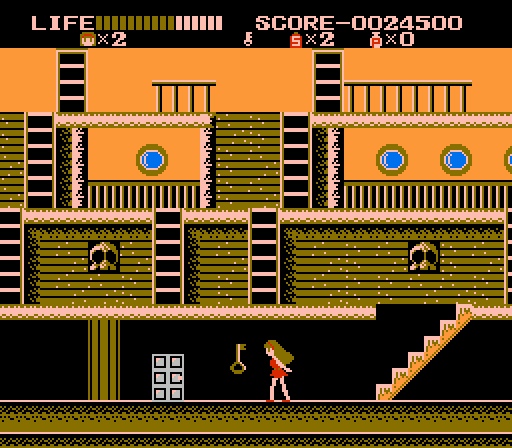
The key opens the grey exit door. Does it open that exit door right next to where it spawned? Does it bollocks. Instead, there are multiple doors scattered throughout the stage, and only one will let Jenny leave, where she will presumably head back to the “overworld” section and pick another stage.
Wait, what? Did you just call me a cow head, Lost Word of Jenny? You cheeky bastard. That sounds like an isult screamed by a five-year-old so angry they can't get their words out.
Never mind, I’m guessing this guy is Cow Head. This stage is a long corridor with little to stand in Jenny’s way – a couple of fiery cauldrons and some moving spikes – until you get to a certain point and Cow Head rises from the ground, intent on putting a stop to Jenny’s vague quest. You have to beat him to progress, which I found out after saying “yeah, see ya” and running for the exit, but the exit won’t open until Cow Head is Cow Dead. Fortunately, I discovered a decent strategy. You can’t see her thanks to some sprite flicker, but I managed to get Jenny to stand just to the left of that cauldron. From there, you can use your high kick to bash Cow Head and he can’t retaliate, trapped as he is on his higher perch. Strong and cunning, that’s Jenny.
I’m glad I figured this out early, because you have to fight Cow Head after every stage. It’s the same level layout and pattern, but it becomes more difficult each time – the spikes move faster and multiple Cow Heads appear at once, some of them on the bottom half of the screen where I couldn’t trap them with my mighty kicks. During those fights, I simply died a lot.
Okay, now it must be time to get on to the next stage proper, right?
Or not, whatever. This stage is announced as “Whomanchun,” and it gives us a chance to play a little game of “Ghost or KKK?” I’m going with ghost, because I really don’t want to imagine there’s a violent racist in this otherwise saccharine Famicom platformer. At most, you could say he’s the ghost of a Klan member, condemned to an eternity of purgatorial wandering for his crimes. Whatever it is, I’d like the name of his detergent because those sheets are immaculate.
During Whomanchun, you play some kind of slot machine game. Numbers spin around in the reels at the bottom. Presumably, something happens. I have no idea what, and I couldn’t detect any influence on later gameplay. How very mysterious.
Now we’re back to the regular stages, with a world made of cake. Now I want cake. I don’t have any cake, so I had to settle for a cigarette and my sixth cup of coffee. I think the cake would have been healthier, so I’ll blame Lost Word of Jenny the next time I see my doctor.
The enemies here are the kinds of things you might expect to see on a giant cake, like giant ants and hunched-over over men with pumpkins for heads. Hang on, that doesn’t seem right. There are two other spookily-themed stages, and the pumpkin man wasn’t deemed appropriate for either of them? He looks like an elderly farmer who was tending his pumpkin patch on Halloween night when he was struck by lightning and fused with his crops, but here he is, trudging his way through the icing.
There are also witches. Someone didn’t think the cake world through at the planning stage and panicked when it came to designing enemies.
Those monsters should have been in this stage. It’s even called Monster’s House! The monster in question must be Dracula, because I’m getting a real Castlevania vibe from this. Diagonal staircases, bats, knights in armour and a hero who struggled to interact with the aforementioned stairs, all the signs are here. That’s definitely one of Lost Word of Jenny’s more irritating flaws: she struggles with moving up and down levels. Staircases have to be approached at just the right angle – and if they’re at the bottom of the screen you risk falling to your death – and ladders are fickle creatures that might let you climb them, or not, depending on whether you’ve got Jenny’s pixels lined up just right.
I headed into the basement. It’s certainly colourful down here, isn’t it? I’d worry about a house with Duplo foundations, but the monsters don’t seem to mind. Speaking of monsters, it’s the definitely-not-a-shitbag-racist ghost from the Whomanchun stages, wandering around with a flaming torch that is not helping in my attempts to paint him as nothing more than a simple spectre. Naturally, Jenny ran straight over there to exorcise him with her blessed fists.
The ghost dropped a number 6. Well, I’m sure it’s not important.
Now I can get into the space stage, which is the closest I’ll ever come to my childhood dream of joining NASA until they loosen their acceptance requirements and start hiring tubby asthmatics who are bad at maths. This stage deviates from the rest by not being a standard platformer. Instead, Jenny can fly as long as you’re holding the jump button, so you can drift through the level and have even more trouble than usual defeating the monsters because trying to kick them in mid-air (mid-vaccuum?) is a real pain in the arse.
As ever, the monster designs paper over the cracks somewhat. This stage has these boggle-eyed little aliens, and it’s a shame I had to kick them to find the keys I needed. I would have much preferred to have made friends with them. It does seem odd that a game based on a fashion doll revolves around her battering her way through the inventory of Fluffy Smilekins’ Plush Toy Emporium, and normally I’d be very glad that they took such an unexpected route – but I like all the enemies so much that this approach has backfired.
Never mind. I retract my previous statement. I reached the graveyard stage and immediately had to fist-fight the Grim Reaper. That’s not just my bag, that’s overhead storage locker in which I store the holdall that contains all my other, smaller bags.
As fun as giving Death a taste of his own medicine sounds, it isn’t that great in practise, and I should probably discuss Lost Word of Jenny’s gameplay. The platforming aspect is fine, staircase issues aside. Jenny handles well, and jumping is reliable and precise. It’s the combat where things suffer. This is a surprisingly difficult game, given the source material and overall pastel-daydream tone, thanks in large part to the very short range of Jenny’s attacks. The saving grace is that she can attack very rapidly, but still enemies have a habit of getting stuck “inside” Jenny as she struggles to hit them. A projectile weapon, even a short-range one, would have gone a long way towards making the combat more pleasant, and Jenny does have one. If you’ve collected enough power-ups, you can use a spray-can weapon – but it’s limited-use, and annoyingly enemies seem to have a roughly twenty-five percent chance of ignoring it completely. Plus, by the time you reach the last couple of Cow Head stages the spray is almost mandatory, so you have to save all your sprays for that which doesn’t help you when the bats in the Monster’s House stage have decided that Jenny’s sinuses would make a perfect new nesting site.
The level design is okay, with nothing to get hugely exited about. In several stage, some of the special containers you need to open are blocked off in such a way that you have to approach the bottom level via a specific staircase from the top level for a soupçon of maze navigation, but that’s about it. It does feel very much like an early arcade game, which is hardly surprising.
The final main stage is Flower Land. Really put a lot of thought into that name, huh, guys? I would have called it Hayfever Nightmare Zone, myself. There’s land, and there are flowers, with leaves for climbing on and praying mantises seeking refuge from a Disney movie about loveable insects. There’s no refuge here, my friends, only brutal hand-to-hand combat. And flowers.
I defeated another Whomanchun, and received the number one. I hope this doesn’t represent a countdown as I gradually exterminate the last surviving members of their species. I also picked up the sixth and final key, which leaves me with only one last Cow Head encounter before I can wrap this up.
Multiple Cow Heads are no joke, unless your idea of a joke is “what would be a terrible thing to put in your kid’s lunchbox.” Still, I’d saved up all my sprays, so I managed to send them all back to the great ranch in the sky. Okay, time to roll the credits!
Oh ho, not so fast. You know those numbers you’ve seen Jenny find throughout the game? I hope you wrote those down. You see, each stage contains one number and one letter, and before you can complete Lost Word of Jenny you have to enter those numbers and letters into this combination lock. The first time through, I did not write those letters and numbers down. I barely even remembered seeing them, so intent was I on trying not to die. Thus, I was literally locked out of the ending, and had to complete the whole game again. Ghosts ‘n Goblins has a surprise competitor for “most dickish end-of-game move,” and as I said at the start I really hope this was explained in the original manual. Even if it was, you just know there’s some poor Japanese kid out there who struggled through the game only to be denied by a tiny frog-faced wizard right at the last. The sheer cruelty of it is astonishing.
So, I played through the whole game again, pen and notepad by my side and a litany of curses seeping through my clenched teeth, until I managed to open the lock. I’m fairly certain it’s random every time, too, so I can’t even tell you the code.
At least the ending is nice, with a roll-call of all the enemies in the game. I think you even get a bit of information about each character: I would take this with a pinch of salt because my Japanese knowledge is on roughly the same level of my knowledge on cardiac microsurgery, but I think it says that the ghost thing is called Biibii and he’s gathered together the world’s most evil creatures. It might be a touch harsh to say I’d have rather just watched this ending than actually playing through the game, but then I do love those monster designs.
Lost Word of Jenny is a flawed game, especially in the monster-punching stakes, and it has a soundtrack so repetitive and wheedling I’d strongly urge you pack your eardrums with old rags and candle wax before attempting to play it. However, I ended up enjoying it far more than I expected to. It’s crisp, it looks nice for its time and there’s plenty to do without it being overlong, and while I’m not saying it’s an undiscovered masterpiece I suspect there are quite a lot of people out there who’d really enjoy sinking their teeth into it. Maybe those people can figure out some of the game’s more confusing moments, like what the small red bird I occasionally found actually does, or why Jenny is relentlessly pursued by a cow skeleton. As for me, I shall end this article proud in the knowledge that I might have helped a couple of people avoid getting stuck on that lock.
08/07/2016
06/07/2016
MARIO'S EARLY YEARS: FUN WITH LETTERS (SNES)
Blow the dust off your SNES mouse and strap on your thinking caps, because it’s time to learn. Specifically, it’s time for some preschool-level English. What, you’re not excited by that prospect? What if I told you the lessons were brought to you by everyone’s favourite turtle-crushing jack-of-all-trades, Super Mario himself? Oh, you’re still not interested. That’s probably fair enough. I’m going to write about Software Toolworks’ 1994 SNES edutainment title Mario’s Early Years: Fun With Letters anyway, though. I mean, I’ve played it now. It’d be a waste to not write about it.
All your favourite Super Mario friends are here: Mario, of course, and Luigi, as well as Yoshi (who has orange arms for some reason) and Princess Peach. Princess Peach does not look very well. In fact, she looks like she fell forty feet and landed directly on her head, completely obliterating her neck.
Theses familiar faces will be helping us learn all about letters. There were also Mario’s Early Years games released that dealt with numbers and “preschool fun,” but I’ll be sticking with the letters variant because my intense personal hatred of maths even extends to cheap educational games.
Seven minigames await those brave enough to attempt mastery of the English language, each more fiendish than the last! Okay, so they’re not fiendish at all, which is a good thing for a game aimed at four-year-olds. You can play as either Mario, Princess Peach or Yoshi, although there’s no difference between the characters aside from their sprites. Luigi is nowhere to be seen. Perhaps he thinks all this is beneath him.
The first stop is Last Letter World. Drink it in, folks – this is probably as close to a Lego Super Mario game as you’re ever likely to see. The goal is simple: click on the blocks showing words that end with the specified letter. Get all three and you’ll be given a new set of words, and might even move on to the next screen.
The next screen is more of the same thing, only with a slightly different layout. I did find Luigi, though. He’s always having a nap at the bottom of the screen, grabbing what precious little rest he can during one of the rare moments when Princess Peach isn't being kidnapped. You can click on Luigi to wake him up, but that doesn’t do much. He just wakes up and stares out of the screen at you, silently judging you when you make a mistake in this preschool educational game. Not that I ever made a mistake, of course.
As a game, it works. I don’t know what else to tell you about it, really. I played it for long enough that eventually the game decided “okay, buddy, you’ve had enough” and kicked me back to the selection screen. I suppose I’ll play another game, then?
The next one I picked was First Letter World. Having just come from Last Letter World, I think both you and I will have a pretty good handle on how this works. Princess Peach still doesn’t look quite right, mind you. She’s giving the back of Mario’s head the crazy eyes. The whole game’s got that slight bootleg-y feel to it – you can see where the original Mario sprites were used, and you can definitely see where they weren’t and the art styles don’t match up quite correctly. Things like the Princess’ coked-out expressions and Luigi’s stubby-legged sitting pose grate on the eye because they don’t look Nintendo enough, if you get my meaning. That said, it’s probably only because I’ve wasted my life jumping on Koopa Troopas that it bothered me.
For instance, look at this Goomba. He’s almost identical to a regular Super Mario Goomba, but not quite. He’s very slightly the wrong shade of brown, leaning towards “unfortunate trouser stain” rather than “rich chestnut” on the spectrum of browns. His teeth don’t look quite right. But he’s definitely a Goomba, very much appropriate for a Super Mario-related game, and as a kid who loved all things Super Mario I probably would have eaten this game up if I’d had it is a kid. Okay, maybe not – I was already well past this stage of language development when my Mario obsession was in full swing – but a Super Mario themed educational game would have held my interest much longer than a similar game starring, I dunno, Mickey Mouse or the members of Ocean Colour Scene.
What… what are you digging that hole for, Peach? Don’t you have mushroom slaves to do that kind of thing for you? Unless it’s a secret and you didn’t want anyone to see you digging. You know what, never mind. I didn’t see anything, your highness.
Also of note is the appearance of one of the Koopa Kids. They aren’t all in the game – I think Ludwig is the only other one to be featured – but Iggy is quite prominent throughout the game. His name has been extended to “Icky Iggy.” The reasons for this sobriquet are not explained, but dark and disturbing possibilities were suggest by my mind every time I saw the rainbow-haired freak.
And now, Vowel World. That’s Vowel World, for all your vowel needs. Huge bargains on vowels. This week only, Us are half-price!
Okay, so vowel world is exactly the same as First Letter World, except the first letter is always a vowel. I think you could have gotten away with combining the two, chaps. In lieu of there being anything more insightful for me to say, I’ll direct your attention to that incredibly shifty elephant. It’s up to something, that elephant, and the secret knowledge that only it possess gives it an illicit thrill. My theory is that the elephant is secretly delighted to have replaced its elephant ears with huge, grey human ears without anyone noticing.
I mentioned the not-quite-right look of Mario’s Early Years, and here’s a good example. When you get an answer correct, sometimes a character will pop up and offer some words of encouragement. Mario might stick his head up and say “Super!” for instance. Because he’s Super Mario, you see. Actually, now I think about it, I think these little phrases only appear once you’ve woken Luigi up, so now we know what he’s there for besides making the place look untidy. Anyway, some other characters also appear. Non-Mario characters, like the strange brown thing emerging from that blue pipe. What the hell is that thing? I feel like I’m rather well-versed in the fauna of the Mushroom Kingdom, but that creature is something different. It possesses a certain monkey-like quality, but without the usual cartoon signifiers of monkeyhood. No prehensile tail, no prominent ears, no bananas. It’s also got a harrowed look on its face, as though it should be screaming rather than congratulating me for knowing that Egg starts with E. It’s those dark circles under its eyes that do it. If it is a monkey, it’s one that was forced to smoke five packs of cigarettes a day while scientists clipped electrodes to its brain. Wait, never mind, I’ve figured it out. This is a monkey. It has no ears because the elephant used it's powerful trunk to tear them off and attach them to its own head. This theory explain everything.
Next up is Sound World, which you’ll be shocked to learn is a lot like all the preceding worlds. This time you’ve got to click the right picture based on the sound it starts with. I know it sounds like I’m giving it short shrift, but it’s not a bad set-up for teaching very young kids about phonics. To this end, Mario’s Early Years is absolutely packed with voice clips. The most digitised speech I’ve ever heard in a SNES game, possibly, although International Superstar Soccer Deluxe had quite a lot. The entire game is narrated by a child who repeats whatever you do out loud, such as saying “you picked dinosaur, that starts with D.” I think you can guess what action makes the kid say that. There are also, as mentioned, the encouraging voice clips from the likes of Mario. After so many years of Mario having the same voice, I was taken aback when he started talking and it wasn’t Charles Martinet doing his usual cheerful yelping. Instead, it’s the same Brooklyn accent that Mario had in the Super Mario cartoons, the voice that made him sound like he was going to have the boys over to play poker and complain about his wife’s cooking once he’d dealt with Bowser. It makes sense, in a way. This game is supposed to be teaching children about English and I don’t think that modern Mario would be the best person to learn from. The most complex sentence he ever utters is the grammatically incorrect “It’s-a me, Mario!” and mostly he just whoops and hollers. His vocabulary is ninety percent overexcited trapeze artist on his first day at work and ten percent Italian stereotype. As I say, probably not the best English teacher.
Next comes Sentence World, where you must find the correct word to complete the sentence. Here, Luigi is sitting in the mud like the slovenly beast he is. No self-respect, that’s Luigi’s problem.
Like all the other games, this is a perfectly acceptable learning tool for the young ‘uns, but it suffers from the same problem that hampers the rest of Mario’s Early Years: there’s just not enough of it. There’s only a very limited selection of different word combinations, so few that you’ll see them all in a single play session, and as a result the game's ability to keep kids engaged is hampered. Maybe the developers could have included a wider range of possibilities if they hadn’t crammed the cartridge full of speech samples, but they did and so I’m stuck repeatedly confirming that yes, Luigi is in the mud.
At least this mode offers some nicer (and more on-model) artwork, even if I did struggle to realise that Mario is carrying a frying pan and not a magnifying glass. He could be a detective, all right? He’s been every other bloody thing.
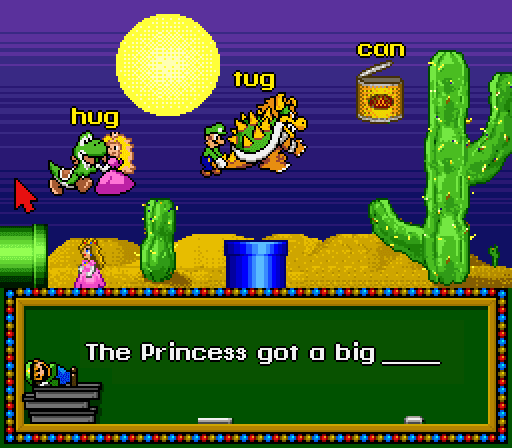
On the subject of this screenshot, check out Princess Peach. She has a box over her crotch. I’m ninety-nine percent certain that is is a simple coincidence and not a crude joke on the part of the developers, but having read a lot of TCRF and seen some of the secret developer messages hidden in games I still have that one percent of doubt.
However, this is clearly the best of the games because I got the narrating kid to say “The Princess got a big can” and I’m definitely immature enough to get a laugh out of that. You might also enjoy the idea of Luigi giving Bowser a tug. Hey, whatever, man. If that’s your bag, I’m not here to judge.
This is Building World. Your goal: to find the missing part of the displayed word. This is easily the most tedious of all the minigames, because there are only three words to complete. There’s “red”, there’s “mop” and there’s “bus.” That’s it. I played this game for longer than anyone has in the past twenty years, I changed characters, I even reset the game, but those were the only three words that would appear. If you want prepare your child for a future career of mopping red buses, this is the game to give them. Otherwise, read them a goddamn book or something, you lazy get.
It goes on and on and on, too. I managed to get the first stage, Last Letter World, to end after a while by answering correctly enough times, but in every other game this refused. I’m sure I played each game for as long as Last Letter World, but I was trapped in a loop of endlessly repeating the same questions until I gave up and quit back to the main menu. There’s no sense of reward to Mario’s Early Years, unless you count that weird monkey-creature popping up and saying “I like your choice!” every now and then, which seems like a mis-step. Give the player a little cutscene of Mario and friends running around, or maybe even a short Super Mario level to play through, or something to keep them engaged. The gameplay isn’t enough of a draw on its own, that’s for sure.
The final stop on our whirlwind tour of the alphabet is, appropriately enough, Alphabet World. Alphabet World isn’t a game, it’s simply a slideshow with a different picture illustrating each letter. It didn’t get off to a great start. A is for apple, huh? Wow, how original. I wasn’t expecting anything excitingly avant-garde or anything, but c’mon.
Thankfully, things improved when I reached B and saw Bowser with a top hat, dancing down a staircase like Fred Astaire. My only complaint is that it’s not animated. Maybe that’s why Bowser keeps abducting Peach, he’s just after a dance partner.
Don’t worry, I’m not going to go through every letter of the alphabet, but there are a few I wanted to pick out. For instance, this cat. This seemingly normal, everyday cat that’s probably shedding hair all over the raspberry ripple. For some reason, the narrator describes it as “crazy cat.” What do you know about this cat that we don’t, Mr. Narrator? What shocking madness swirls within its feline brain? I’m disappointed that I’ll never know the answer to that question, just as I’m disappointed that the picture for “crazy cat” wasn’t a beatnik hammering away at some bongos.
M is for Mario, naturally, and we’re treated to the rare sight of Mario actually doing some plumbing. Some half-hearted wrench-twiddling, by the looks of it, for which he will no doubt charge an exorbitant fee.
I’m beginning to suspect that the developers had something against Princess Peach. Against her face, specifically. They’ve tried to capture her charming, regal nature but ended up with something that looks like a bowling ball wrapped in ham.
Finally there’s Yoshi. Not finally in the alphabet, obviously – I didn’t play through this game without learning something – but I don’t think the last picture is interesting enough to show you. It’s a zipper. If you really want to see a zipper, look at your trousers or something. No, Yoshi is where I’ll draw this article to a close. Yoshi, staring at himself with a judgemental look on his face. Recursive Yoshis. He’s probably thinking about eating himself.
With no ending to aim for and all the minigames played for longer than was safe for my boredom levels, Mario’s Early Years: Fun With Letters is over. The final verdict? It’s okay. The Super Mario license is one that seems a damn good choice for getting the kids of 1994 to play an educational game. It doesn’t have that unpleasant feeling of cynical exploitation that so many licensed kid’s games do, and the minigames are (for a kid) diverting and colourful enough that I could see it having some actual value as a teaching aid. The big problem is longevity: even the most studious of children are going to get bored after they’ve seen every single combination of answers multiple times after just a few hours play, and if this was a full-price release (which I assume it was) then it doesn’t represent good value for money. Then there’s the not-quite-right look of the graphics, which kids will certainly pick up on, because they’re not idiots when it comes to their beloved media characters. On the whole, then, it’s decent effort but there are far better ways to help your kid learn. Methods that don’t feature Princess Peach looking like she headbutted a meat grinder, for starters.
Labels:
educational,
mario's early years,
SNES,
software toolworks,
super mario
01/07/2016
SUPER FAMICOM MAHJONG COVERS
Writing VGJunk for all this time has revealed certain truths about videogames to me. Jaleco games are almost always slightly disappointing, licensed Game Boy Color tie-ins are a plot by the devil to darken the collective soul of humanity, and Japan loves mahjong games. Really loves them, judging by the sheer volume of titles based on the ancient tile game. On every format since the dawn of gaming, mahjong games were there and in great numbers, so today’s article won’t be an exhaustive look at the history and evolution of the mahjong game. For starters, I’ve never been able to get my head around mahjong’s betting system, despite knowing the basic rules of the game, and my usual poker tactic of going all-in on every hand will probably not suffice. Instead, here’s a bunch of cover art from Super Famicom mahjong games. I had to narrow it down to one console, but don’t worry, that still gives me more than enough to look at.
You’re going to get some anime in your Japanese mahjong games, naturally. That’s one way to sell the product – by giving you a crazy cast of characters to play against, a bunch of wild-haired, big-eyed challengers of the sort you’re unlikely to meet at your local real-life mahjong parlour. Okay, so I could see the old bloke with the moustache being there in real life, but not so much the rest of them. Do they even let school kids into mahjong parlours? Maybe if their parents are hardcore gamblers and they bring their kids along, making them sit and wait in the corner with a bottle of cheap fizzy pop and a bag of crisps until dad has blown that week’s wage packet.
I’m guessing the generic looking brown-haired guy on the left is the main character, a personality-free cipher who allows the player to project their own dreams of becoming the world’s best mahjong player onto him. I say this because everyone else looks far too interesting to be the main character. Like, check out the slick-looking guy at the bottom right. What’s his deal? Aside from his crippling gambling addiction, obviously.
This poor woman has been in the mahjong parlour so long she’s resorted to eating the scoring sticks. She also appears to be some kind of futuristic cyborg. Sitting around playing mahjong seems like a criminal waste of cyborg powers, but who am I to judge? Even robots need down-time. Except they don’t. Because they’re robots.
The “bishoujo” in the title means “pretty girl,” and that’s another fairly standard type of mahjong game – the kind with cute girls that encourage you to play further because if you do well enough they might take their top off. This is especially prevalent in arcade mahjong games, and if this was an article about arcade mahjong games you’d be seeing a lot more pixellated boobs. Okay, maybe not boobs, I’m not good enough at mahjong to get that kind of pay-off. Pixellated lingerie, at least. You can recreate the experience at home by playing mahjong and looking at a page from the Ann Summers catalogue every time you win a point.
I’ll be honest, this doesn’t look super real. For starters, these young ladies appear to be playing as a three-person team, and I don’t think that’s part of the standard mahjong rule set. The one at the back has the facial expression of someone who’s just about to sneeze. Also, you know, they’re cartoons. If I bought a game called “Super Real Mahjong” I’d be expecting to play against haggard middle-aged salary men and little old women who will absolutely crush you, not rejected cast members from a harem anime.
Ah, this is more like it! A bunch of people who look as though they’re having an absolutely miserable time playing mahjong. So many stern expressions! I guess that’s what you get in the world of pro mahjong. The lady at the middle-left has something of a wry smile, but other than that everyone’s got their game face on.
If this image I found on the official website of the Japan Professional Mahjong League is anything to go by, the game has not become any more cheerful during the intervening years. Given the famously small size of Japanese living spaces, the winner is probably upset because he’s going to have to give up either his bed or his toilet to make room for his giant trophy.
“You’ve stepped into the wrong mahjong parlour, my friend. We’re your worst goddamn nightmare.”
That’ll be ancient literary figure Son Goku the Monkey King, not Goku from Dragonball Z, then? Disappointing. Yes, I know Goku is based on the Monkey King – they both have a nature that is irrepressible, for one thing – but the Money King was never forced into taking driving lessons by his wife so they’re clearly very different characters. This is quite a sinister-looking Son Goku, too, his eyes burning red with ape rage, one of the most dangerous kinds of rage there is. Perhaps he just lost a game of mahjong? Or maybe he did something wrong and the secret phrase was used to punish him, causing the circlet that keeps him under control to contract and crush his skull. It’s most likely a combination of the two: he saw he was about to lose at mahjong so he started urinating on the board, causing his headgear to be activated.
This one’s a Shanghai game – the game where you eliminate matching mahjong tiles from a pile rather than the actual game of mahjong – but I’m willing to loosen the entry requirements for this article for a big blue dragon. I’m actually having trouble telling whether the dragon is a CG render or a traditional picture. Something about his whiskers screams “nineties CG” to me. However it was created, it’s an arresting visual. Exploding blue dragons do tend to catch the eye, especially when they’re balancing mahjong tiles on their nose.
Garfield has tried to sneak onto the cover of this game. He’s even wearing sunglasses to disguise his identity, but he’s not fooling anyone. Get back to your dull comic strip, Garfield, this game is for mahjong fans and lovers of cartoon men whose heads have been deformed into the shape of an eggplant wrapped in human skin. I’m sure those are supposed to be his lips at the bottom of his chin, where all sensible people keep their lips, but I can’t help seeing them as a pair of vestigial testicles. Going back to Garfield, given Jim Davis’ stated goal of creating the slobbish cat solely to make money I’m amazed that a cursory internet search didn’t bring up an official Garfield mahjong game. Garfield probably has tons of fans in Asia, so this seems like a misstep. There you go, Jim – you can have that idea for free.
Forget the bunny girl, check out that weird creature running across the mahjong tiles. It looks like a penguin and a pineapple had one-night stand and dressed the resulting child as Batman.
“What shall I draw for the cover art for this new mahjong game?”
“How about a women tying her shoelace while a weird owl-gremlin looks up her skirt?”
“Yeah, I can do that. Do you want me to give her a really messed-up spine?
“If you wouldn’t mind, that’d be great.”
This is a game where various historical figures gather to do battle in the arena of mahjong, including Napoleon, George Washington and Sherlock Holmes, who isn’t real but is out of copyright and therefore free to use. I’d be surprised if that wasn’t the reason for his inclusion. Some of the other characters are eluding me, though. I have no idea who the warrior on the right of the table is, but something tells me he’s probably a playable character in a Dynasty Warriors game. The third man at the table appears to be a caricature of Steve Buscemi, and behind him is what I took to be Abraham Lincoln until I realised he’s wearing a toga. Caesar? Let’s go with Caesar. Which Caesar? Look, I’m not going to narrow down my options by picking one specific Caesar. My history teacher would be appalled with me.
See, the problem here is that you’ve tried to make playing mahjong look cool. I think that was the intention, at least. Is he supposed to be throwing those tiles? If this was an anime I’d swear his arm was in that position so the animators didn’t have to bother moving his mouth when he talked, but as it’s a still picture I’ll assume he’s posing like a big overdramatic dork.
Oh look, he’s back, with a side parting in his hair so deep and precise it must have been carved there by a bloody laser beam, his shirt unbuttoned halfway down to send his mahjong groupies into a sexual frenzy. I half expect that if he moved his hand, the disappearing shadow would reveal he’s got a Phantom of the Opera-style deformed half to his face. Women want him, men want to be him, but all he cares about is the thrill of mahjong and no-one, no matter how big their eyes or how colourful their hair, can tame him.
Now this guy seems like a more believable face of mahjong – a slightly unnerving face, one that you could easily see haunting the gloomy corner of a gambling hall. When your girlfriend takes you home for dinner with her parents for the first time, this is exactly the kind of face you don’t want to see glowering at you over the spaghetti bolognese. Of course, it’s terrible of me to judge a man on his appearance. Whoever he is, he’s probably a perfectly nice chap in real life and mahjong is a fun, friendly game played by families and not just in dingy, smoke-filled rooms. It is possible that playing the Yakuza games has coloured my opinions of mahjong. After all, the main character of the Yakuza games plays mahjong, and he’s also a yakuza member who smashes his enemies’ faces into the nearest, hardest object he can find.
This one’s mostly bog-standard super-deformed anime faces… apart from the one at the bottom, which is genuinely unnerving me a little. It’s that mouth, it’s like a hellish portal to a dimension of sheer pain. Hang on, this is another cover featuring someone who’s about to eat a scoring stick. Is that something that actually happens in mahjong? Are they like breadsticks? Do they come with a dipping sauce?
I don’t want to denigrate the ancient and noble Chinese dragon, but when your mythological creature is a dragon but also has deer antlers, bat wings and the full Santa Claus hair and beard combo, it might be getting a bit busy, design-wise. You don’t need to try so hard, pal. You’re already a dragon, and that’s pretty cool. There’s no need to dress like you crashed face-first through a fancy dress shop’s unsold stock.
Here’s a look I like to call “Wolverine’s Japanese Grandad.” The hair and the sideburns clearly run in the family.
Finally for today, here’s a cover that’s just nice, cute and simple (kinda like me). Hello Kitty’s dominance over all forms of media extends to SNES mahjong games, of course, but it’s that confused fish-man who really steals the show. He’s giving a two-fingered peace sign, but one look at his eyes is enough to tell you that he has no idea what’s going on. What are these tiles for? How does this game work? Why is that cat wearing dungarees? It’s all a mystery to him, but he wants to fit in so he’s going along with it. I think we can all empathise with that desire to be part of the group. I feel you, fish-man.
Haisei Mahjong Ryouga
You’re going to get some anime in your Japanese mahjong games, naturally. That’s one way to sell the product – by giving you a crazy cast of characters to play against, a bunch of wild-haired, big-eyed challengers of the sort you’re unlikely to meet at your local real-life mahjong parlour. Okay, so I could see the old bloke with the moustache being there in real life, but not so much the rest of them. Do they even let school kids into mahjong parlours? Maybe if their parents are hardcore gamblers and they bring their kids along, making them sit and wait in the corner with a bottle of cheap fizzy pop and a bag of crisps until dad has blown that week’s wage packet.
I’m guessing the generic looking brown-haired guy on the left is the main character, a personality-free cipher who allows the player to project their own dreams of becoming the world’s best mahjong player onto him. I say this because everyone else looks far too interesting to be the main character. Like, check out the slick-looking guy at the bottom right. What’s his deal? Aside from his crippling gambling addiction, obviously.
Bishoujo Janshi Suchie-Pai
This poor woman has been in the mahjong parlour so long she’s resorted to eating the scoring sticks. She also appears to be some kind of futuristic cyborg. Sitting around playing mahjong seems like a criminal waste of cyborg powers, but who am I to judge? Even robots need down-time. Except they don’t. Because they’re robots.
The “bishoujo” in the title means “pretty girl,” and that’s another fairly standard type of mahjong game – the kind with cute girls that encourage you to play further because if you do well enough they might take their top off. This is especially prevalent in arcade mahjong games, and if this was an article about arcade mahjong games you’d be seeing a lot more pixellated boobs. Okay, maybe not boobs, I’m not good enough at mahjong to get that kind of pay-off. Pixellated lingerie, at least. You can recreate the experience at home by playing mahjong and looking at a page from the Ann Summers catalogue every time you win a point.
Super Real Mahjong PIV
I’ll be honest, this doesn’t look super real. For starters, these young ladies appear to be playing as a three-person team, and I don’t think that’s part of the standard mahjong rule set. The one at the back has the facial expression of someone who’s just about to sneeze. Also, you know, they’re cartoons. If I bought a game called “Super Real Mahjong” I’d be expecting to play against haggard middle-aged salary men and little old women who will absolutely crush you, not rejected cast members from a harem anime.
Pro Mahjong Tsuwamono
Ah, this is more like it! A bunch of people who look as though they’re having an absolutely miserable time playing mahjong. So many stern expressions! I guess that’s what you get in the world of pro mahjong. The lady at the middle-left has something of a wry smile, but other than that everyone’s got their game face on.
If this image I found on the official website of the Japan Professional Mahjong League is anything to go by, the game has not become any more cheerful during the intervening years. Given the famously small size of Japanese living spaces, the winner is probably upset because he’s going to have to give up either his bed or his toilet to make room for his giant trophy.
Pro Mahjong Kiwame 2
“You’ve stepped into the wrong mahjong parlour, my friend. We’re your worst goddamn nightmare.”
Mahjong Goku Tenjiku
That’ll be ancient literary figure Son Goku the Monkey King, not Goku from Dragonball Z, then? Disappointing. Yes, I know Goku is based on the Monkey King – they both have a nature that is irrepressible, for one thing – but the Money King was never forced into taking driving lessons by his wife so they’re clearly very different characters. This is quite a sinister-looking Son Goku, too, his eyes burning red with ape rage, one of the most dangerous kinds of rage there is. Perhaps he just lost a game of mahjong? Or maybe he did something wrong and the secret phrase was used to punish him, causing the circlet that keeps him under control to contract and crush his skull. It’s most likely a combination of the two: he saw he was about to lose at mahjong so he started urinating on the board, causing his headgear to be activated.
Game no Tetsujin: The Shanghai
This one’s a Shanghai game – the game where you eliminate matching mahjong tiles from a pile rather than the actual game of mahjong – but I’m willing to loosen the entry requirements for this article for a big blue dragon. I’m actually having trouble telling whether the dragon is a CG render or a traditional picture. Something about his whiskers screams “nineties CG” to me. However it was created, it’s an arresting visual. Exploding blue dragons do tend to catch the eye, especially when they’re balancing mahjong tiles on their nose.
Tokoro’s Mahjong
Garfield has tried to sneak onto the cover of this game. He’s even wearing sunglasses to disguise his identity, but he’s not fooling anyone. Get back to your dull comic strip, Garfield, this game is for mahjong fans and lovers of cartoon men whose heads have been deformed into the shape of an eggplant wrapped in human skin. I’m sure those are supposed to be his lips at the bottom of his chin, where all sensible people keep their lips, but I can’t help seeing them as a pair of vestigial testicles. Going back to Garfield, given Jim Davis’ stated goal of creating the slobbish cat solely to make money I’m amazed that a cursory internet search didn’t bring up an official Garfield mahjong game. Garfield probably has tons of fans in Asia, so this seems like a misstep. There you go, Jim – you can have that idea for free.
Super Nichibutsu Mahjong 2: Zenkoku Seiha Hen
Forget the bunny girl, check out that weird creature running across the mahjong tiles. It looks like a penguin and a pineapple had one-night stand and dressed the resulting child as Batman.
Super Nichibutsu Mahjong
“What shall I draw for the cover art for this new mahjong game?”
“How about a women tying her shoelace while a weird owl-gremlin looks up her skirt?”
“Yeah, I can do that. Do you want me to give her a really messed-up spine?
“If you wouldn’t mind, that’d be great.”
Mahjong Taikai II
This is a game where various historical figures gather to do battle in the arena of mahjong, including Napoleon, George Washington and Sherlock Holmes, who isn’t real but is out of copyright and therefore free to use. I’d be surprised if that wasn’t the reason for his inclusion. Some of the other characters are eluding me, though. I have no idea who the warrior on the right of the table is, but something tells me he’s probably a playable character in a Dynasty Warriors game. The third man at the table appears to be a caricature of Steve Buscemi, and behind him is what I took to be Abraham Lincoln until I realised he’s wearing a toga. Caesar? Let’s go with Caesar. Which Caesar? Look, I’m not going to narrow down my options by picking one specific Caesar. My history teacher would be appalled with me.
Naki no Ryuu: Mahjong Hishouden
See, the problem here is that you’ve tried to make playing mahjong look cool. I think that was the intention, at least. Is he supposed to be throwing those tiles? If this was an anime I’d swear his arm was in that position so the animators didn’t have to bother moving his mouth when he talked, but as it’s a still picture I’ll assume he’s posing like a big overdramatic dork.
Mahjong Hishouden: Shin Naki no Ryuu
Oh look, he’s back, with a side parting in his hair so deep and precise it must have been carved there by a bloody laser beam, his shirt unbuttoned halfway down to send his mahjong groupies into a sexual frenzy. I half expect that if he moved his hand, the disappearing shadow would reveal he’s got a Phantom of the Opera-style deformed half to his face. Women want him, men want to be him, but all he cares about is the thrill of mahjong and no-one, no matter how big their eyes or how colourful their hair, can tame him.
Sakurai Shouichi no Jankiryuu Mahjong Hisshouhou
Now this guy seems like a more believable face of mahjong – a slightly unnerving face, one that you could easily see haunting the gloomy corner of a gambling hall. When your girlfriend takes you home for dinner with her parents for the first time, this is exactly the kind of face you don’t want to see glowering at you over the spaghetti bolognese. Of course, it’s terrible of me to judge a man on his appearance. Whoever he is, he’s probably a perfectly nice chap in real life and mahjong is a fun, friendly game played by families and not just in dingy, smoke-filled rooms. It is possible that playing the Yakuza games has coloured my opinions of mahjong. After all, the main character of the Yakuza games plays mahjong, and he’s also a yakuza member who smashes his enemies’ faces into the nearest, hardest object he can find.
Saibara Rieko no Mahjong Hourouki
This one’s mostly bog-standard super-deformed anime faces… apart from the one at the bottom, which is genuinely unnerving me a little. It’s that mouth, it’s like a hellish portal to a dimension of sheer pain. Hang on, this is another cover featuring someone who’s about to eat a scoring stick. Is that something that actually happens in mahjong? Are they like breadsticks? Do they come with a dipping sauce?
Joushou Mahjong Tenpai
I don’t want to denigrate the ancient and noble Chinese dragon, but when your mythological creature is a dragon but also has deer antlers, bat wings and the full Santa Claus hair and beard combo, it might be getting a bit busy, design-wise. You don’t need to try so hard, pal. You’re already a dragon, and that’s pretty cool. There’s no need to dress like you crashed face-first through a fancy dress shop’s unsold stock.
Jissen! Mahjong Shinan
Here’s a look I like to call “Wolverine’s Japanese Grandad.” The hair and the sideburns clearly run in the family.
Sanrio Shanghai
Finally for today, here’s a cover that’s just nice, cute and simple (kinda like me). Hello Kitty’s dominance over all forms of media extends to SNES mahjong games, of course, but it’s that confused fish-man who really steals the show. He’s giving a two-fingered peace sign, but one look at his eyes is enough to tell you that he has no idea what’s going on. What are these tiles for? How does this game work? Why is that cat wearing dungarees? It’s all a mystery to him, but he wants to fit in so he’s going along with it. I think we can all empathise with that desire to be part of the group. I feel you, fish-man.
Labels:
cover art,
mahjong,
super famicom
Subscribe to:
Posts (Atom)