Showing posts with label cute. Show all posts

08/07/2016

LOST WORD OF JENNY (FAMICOM)

Today’s game is a cutesy Famicom romp through a series of colourful worlds, where a young girl, erm, does things? I can’t really be more specific than that. It’s a confusing game. Welcome to Lost Word of Jenny, developed by Takara and released in 1987. Before we get started, take a close look at the title. Yes, it’s “Lost Word” and not “Lost World.” I hope you don’t have as much difficulty as I – and several others, if a quick internet search is anything to go by – did making the distinction. “Lost World” just feels more correct, somehow, probably because “lost world” is a phrase sometimes used in English whereas “Lost Word” sounds like an indecipherable error message from an ancient computer.


Here’s Jenny now. Jenny has a lot of hair. Perhaps too much hair for such a small head, and it threatens to engulf her diminutive features. If Jenny looks a bit doll-like, that’s because she’s a doll. Specifically, she’s based on the real Japanese “Jenny” doll, which was originally known as “Takara Barbie.” This gave me cause for concern, because playing a videogame based on Barbie is not something I need in my life right now. Things are stressful enough without adding another god-awful minigame collection based around fashion, but thankfully Lost Word of Jenny is actually a platformer.


Jenny is also Cinderella, it seems. Cinderella in space, maybe, what with the featureless black void and the horse kicking up a trail of stardust.


Here’s Jenny now, at the bottom of the screen, long of limb and full of youthful energy. The game begins with Jenny leaving her house and traversing this map screen, trying to reach the entrance to each stage while avoiding the many hazards that block her path. These hazards include cars, which move as though they’re being driven by a chimp fed a steady diet of amphetamines. I can see how that would be a hazard. On the other hand, puppies. Deadly, enraged puppies. Yes, the puppies hurt you if you touch them. No, I have no idea why. I’ve complained before about how many videogame heroes can take damage from bubbles, but this is a step beyond that. At least a bubble could conceivably contain poison gas. A puppy is a puppy. If you asked people to compile a list of the least threatening things in the world, puppies would be number one with a bullet. There are therapies out there that give people puppies to make them feel better. I just can’t get over it. My only explanation is that Jenny reeks of Pedigree Chum.
Also, there’s a building over there marked “NASA.” Obviously, this was my first port of call, but it wouldn’t let me in. Instead, I wandered around for thirty seconds or so until I found a stage that would admit Jenny.


It’s a pirate ship. “Gabacho the Ship,” according to the title that appeared when I walked in. Here’s where I hope that Lost Word of Jenny came with a detailed instruction manual, because at first I had no idea what I was supposed to be doing. Stages in this game aren’t the usual “get from the left to the right” affairs, instead comprising a few screens, usually with a second set of screens below that you can reach by travelling down a ladder or staircase. Some time spent jumping around and trying out Jenny’s combat skills – she can perform a high kick or a crouching punch – eventually led me to one of the barrels you can see above. They’re the key to completing the stage: find all the barrels and open them (or open them and defeat the creatures inside) to collect the important items they contain. Most important of all are the keys. Keys let you exit the stage, and six are needed to finish the game. Every stage has their own variation on the special containers you need to find, be it barrels, gravestones or gift-wrapped presents, but finding and opening them all is the main thrust of the game.


Already Jenny has proven herself to be better than Barbie. I can’t imagine Barbie kicking a crocodile in the face. Jenny’s got something of Wonder Momo about her, especially those high kicks, but both games were released within months of each other so I don’t think it’s anything other than coincidence. Then there’s this adorable crocodile, a chubby, big-eyed reptile friend. I’d almost feel bad about beating it to death with Jenny’s bare hands if it wasn’t trying to kill me. On the plus side, being a fashion doll means that Jenny can probably put the crocodile’s skin to good use.
I’ll say right now that the enemy design is my favourite thing about Lost Word of Jenny, with some of the most precious little weirdoes I’ve seen in an 8-bit game for a long while. Jenny herself doesn’t have much personality, which is a shame, but the monsters more than make up for it.


For example, check out that mouse. It’s nothing more than a simple cartoon rodent but it’s expertly drawn, extremely basic but packed with character, and it’s a great example of the amount of charm that can be packed into a tiny amount of pixels.


Eventually I made it down below deck, and checking every single barrel finally revealed a pirate. Sadly he did not pop out of the barrel when I inserted a sword. Even more sadly, he decided to sit on top of Jenny and chip away at her health while I struggled to get her into a position to kick him. The crocodile looks on, his glee at his vicarious revenge evident in his expression.
Once the pirate was beaten – I managed to get into a spot where I could crouch down and repeatedly punch him in the Jolly Roger – he dropped a key.
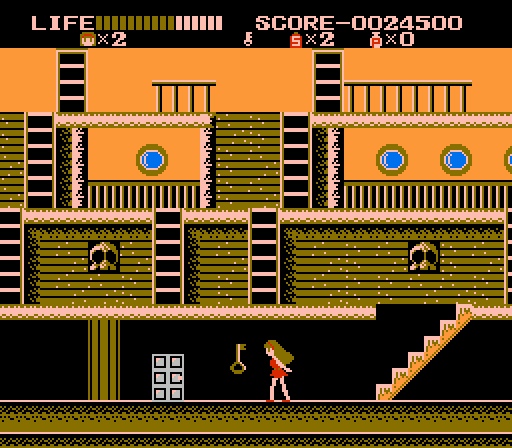

The key opens the grey exit door. Does it open that exit door right next to where it spawned? Does it bollocks. Instead, there are multiple doors scattered throughout the stage, and only one will let Jenny leave, where she will presumably head back to the “overworld” section and pick another stage.


Wait, what? Did you just call me a cow head, Lost Word of Jenny? You cheeky bastard. That sounds like an isult screamed by a five-year-old so angry they can't get their words out.


Never mind, I’m guessing this guy is Cow Head. This stage is a long corridor with little to stand in Jenny’s way – a couple of fiery cauldrons and some moving spikes – until you get to a certain point and Cow Head rises from the ground, intent on putting a stop to Jenny’s vague quest. You have to beat him to progress, which I found out after saying “yeah, see ya” and running for the exit, but the exit won’t open until Cow Head is Cow Dead. Fortunately, I discovered a decent strategy. You can’t see her thanks to some sprite flicker, but I managed to get Jenny to stand just to the left of that cauldron. From there, you can use your high kick to bash Cow Head and he can’t retaliate, trapped as he is on his higher perch. Strong and cunning, that’s Jenny.
I’m glad I figured this out early, because you have to fight Cow Head after every stage. It’s the same level layout and pattern, but it becomes more difficult each time – the spikes move faster and multiple Cow Heads appear at once, some of them on the bottom half of the screen where I couldn’t trap them with my mighty kicks. During those fights, I simply died a lot.
Okay, now it must be time to get on to the next stage proper, right?


Or not, whatever. This stage is announced as “Whomanchun,” and it gives us a chance to play a little game of “Ghost or KKK?” I’m going with ghost, because I really don’t want to imagine there’s a violent racist in this otherwise saccharine Famicom platformer. At most, you could say he’s the ghost of a Klan member, condemned to an eternity of purgatorial wandering for his crimes. Whatever it is, I’d like the name of his detergent because those sheets are immaculate.
During Whomanchun, you play some kind of slot machine game. Numbers spin around in the reels at the bottom. Presumably, something happens. I have no idea what, and I couldn’t detect any influence on later gameplay. How very mysterious.


Now we’re back to the regular stages, with a world made of cake. Now I want cake. I don’t have any cake, so I had to settle for a cigarette and my sixth cup of coffee. I think the cake would have been healthier, so I’ll blame Lost Word of Jenny the next time I see my doctor.
The enemies here are the kinds of things you might expect to see on a giant cake, like giant ants and hunched-over over men with pumpkins for heads. Hang on, that doesn’t seem right. There are two other spookily-themed stages, and the pumpkin man wasn’t deemed appropriate for either of them? He looks like an elderly farmer who was tending his pumpkin patch on Halloween night when he was struck by lightning and fused with his crops, but here he is, trudging his way through the icing.


There are also witches. Someone didn’t think the cake world through at the planning stage and panicked when it came to designing enemies.


Those monsters should have been in this stage. It’s even called Monster’s House! The monster in question must be Dracula, because I’m getting a real Castlevania vibe from this. Diagonal staircases, bats, knights in armour and a hero who struggled to interact with the aforementioned stairs, all the signs are here. That’s definitely one of Lost Word of Jenny’s more irritating flaws: she struggles with moving up and down levels. Staircases have to be approached at just the right angle – and if they’re at the bottom of the screen you risk falling to your death – and ladders are fickle creatures that might let you climb them, or not, depending on whether you’ve got Jenny’s pixels lined up just right.


I headed into the basement. It’s certainly colourful down here, isn’t it? I’d worry about a house with Duplo foundations, but the monsters don’t seem to mind. Speaking of monsters, it’s the definitely-not-a-shitbag-racist ghost from the Whomanchun stages, wandering around with a flaming torch that is not helping in my attempts to paint him as nothing more than a simple spectre. Naturally, Jenny ran straight over there to exorcise him with her blessed fists.


The ghost dropped a number 6. Well, I’m sure it’s not important.


Now I can get into the space stage, which is the closest I’ll ever come to my childhood dream of joining NASA until they loosen their acceptance requirements and start hiring tubby asthmatics who are bad at maths. This stage deviates from the rest by not being a standard platformer. Instead, Jenny can fly as long as you’re holding the jump button, so you can drift through the level and have even more trouble than usual defeating the monsters because trying to kick them in mid-air (mid-vaccuum?) is a real pain in the arse.


As ever, the monster designs paper over the cracks somewhat. This stage has these boggle-eyed little aliens, and it’s a shame I had to kick them to find the keys I needed. I would have much preferred to have made friends with them. It does seem odd that a game based on a fashion doll revolves around her battering her way through the inventory of Fluffy Smilekins’ Plush Toy Emporium, and normally I’d be very glad that they took such an unexpected route – but I like all the enemies so much that this approach has backfired.


Never mind. I retract my previous statement. I reached the graveyard stage and immediately had to fist-fight the Grim Reaper. That’s not just my bag, that’s overhead storage locker in which I store the holdall that contains all my other, smaller bags.
As fun as giving Death a taste of his own medicine sounds, it isn’t that great in practise, and I should probably discuss Lost Word of Jenny’s gameplay. The platforming aspect is fine, staircase issues aside. Jenny handles well, and jumping is reliable and precise. It’s the combat where things suffer. This is a surprisingly difficult game, given the source material and overall pastel-daydream tone, thanks in large part to the very short range of Jenny’s attacks. The saving grace is that she can attack very rapidly, but still enemies have a habit of getting stuck “inside” Jenny as she struggles to hit them. A projectile weapon, even a short-range one, would have gone a long way towards making the combat more pleasant, and Jenny does have one. If you’ve collected enough power-ups, you can use a spray-can weapon – but it’s limited-use, and annoyingly enemies seem to have a roughly twenty-five percent chance of ignoring it completely. Plus, by the time you reach the last couple of Cow Head stages the spray is almost mandatory, so you have to save all your sprays for that which doesn’t help you when the bats in the Monster’s House stage have decided that Jenny’s sinuses would make a perfect new nesting site.


The level design is okay, with nothing to get hugely exited about. In several stage, some of the special containers you need to open are blocked off in such a way that you have to approach the bottom level via a specific staircase from the top level for a soupçon of maze navigation, but that’s about it. It does feel very much like an early arcade game, which is hardly surprising.


The final main stage is Flower Land. Really put a lot of thought into that name, huh, guys? I would have called it Hayfever Nightmare Zone, myself. There’s land, and there are flowers, with leaves for climbing on and praying mantises seeking refuge from a Disney movie about loveable insects. There’s no refuge here, my friends, only brutal hand-to-hand combat. And flowers.


I defeated another Whomanchun, and received the number one. I hope this doesn’t represent a countdown as I gradually exterminate the last surviving members of their species. I also picked up the sixth and final key, which leaves me with only one last Cow Head encounter before I can wrap this up.


Multiple Cow Heads are no joke, unless your idea of a joke is “what would be a terrible thing to put in your kid’s lunchbox.” Still, I’d saved up all my sprays, so I managed to send them all back to the great ranch in the sky. Okay, time to roll the credits!


Oh ho, not so fast. You know those numbers you’ve seen Jenny find throughout the game? I hope you wrote those down. You see, each stage contains one number and one letter, and before you can complete Lost Word of Jenny you have to enter those numbers and letters into this combination lock. The first time through, I did not write those letters and numbers down. I barely even remembered seeing them, so intent was I on trying not to die. Thus, I was literally locked out of the ending, and had to complete the whole game again. Ghosts ‘n Goblins has a surprise competitor for “most dickish end-of-game move,” and as I said at the start I really hope this was explained in the original manual. Even if it was, you just know there’s some poor Japanese kid out there who struggled through the game only to be denied by a tiny frog-faced wizard right at the last. The sheer cruelty of it is astonishing.
So, I played through the whole game again, pen and notepad by my side and a litany of curses seeping through my clenched teeth, until I managed to open the lock. I’m fairly certain it’s random every time, too, so I can’t even tell you the code.


At least the ending is nice, with a roll-call of all the enemies in the game. I think you even get a bit of information about each character: I would take this with a pinch of salt because my Japanese knowledge is on roughly the same level of my knowledge on cardiac microsurgery, but I think it says that the ghost thing is called Biibii and he’s gathered together the world’s most evil creatures. It might be a touch harsh to say I’d have rather just watched this ending than actually playing through the game, but then I do love those monster designs.


Lost Word of Jenny is a flawed game, especially in the monster-punching stakes, and it has a soundtrack so repetitive and wheedling I’d strongly urge you pack your eardrums with old rags and candle wax before attempting to play it. However, I ended up enjoying it far more than I expected to. It’s crisp, it looks nice for its time and there’s plenty to do without it being overlong, and while I’m not saying it’s an undiscovered masterpiece I suspect there are quite a lot of people out there who’d really enjoy sinking their teeth into it. Maybe those people can figure out some of the game’s more confusing moments, like what the small red bird I occasionally found actually does, or why Jenny is relentlessly pursued by a cow skeleton. As for me, I shall end this article proud in the knowledge that I might have helped a couple of people avoid getting stuck on that lock.

13/09/2012

FUSHIGI NO YUME NO ALICE (PC ENGINE)

After that last soul-sapping article about dead baby extravaganza Mad Nurse, I need something cheerful and sunny to shine a ray of light into the gloom of VGJunk Towers, and what could be better for the job than FACE's 1990 PC Engine rainbow-and-gumdrops-em-up Fushigi no Yume no Alice?


It turns out that many things could have been better for the job. I should have stuck to playing OutRun and drinking enough Benylin to give me the visions with the dancing strawberries, but I started playing this PC Engine platformer and now I've got to see it through to the end. Right, so what's the deal here, then?


Starting by watching a young girl sleeping, are we? Nice. Not creepy at all. This is Alice, possibly the same Alice from the Wonderland books: Google Translate spits out "Wonderland" as a translation of "fushigi" and I know "yume" means "dream," so I guess the title could be something like "Alice's Wonderland Dream." Whatever the case, Alice is minding her own business and sleeping peacefully until the White Rabbit invades her vulnerable mind, because sentient rabbits can do that. From what I could decipher of the story, the White Rabbit tells Alice that whatever fantasy kingdom we're going with here is under attack by some standard-issue dark forces, and Alice is the only one who can save the Magical Land of Cutiepiania or whatever it's called.


Why is Alice chosen? I have no idea. Maybe she is the same Alice from Alice in Wonderland, so she's got experience. Maybe she was the first suitably pwecious little cherub that the White Rabbit stumbled upon. Maybe she's a one-woman dream-world version of The A-Team - if you have a problem, if no one else can help, and if you can force your way into her dreams then maybe you can hire... Alice.


Yep, it looks like the kingdom's gonna be juuust fine. That bloody rabbit couldn't have crept into Bruce Campbell's slumbering noggin, could he?
Just one look at the screenshot above will tell you most of what Fushigi no Yume no Alice is all about: it's a pastel-and-peaches hop-'n'-bop platforming adventure with a fairytale theme, and your mission is to move across the stage, jumping on enemies and squashing bosses until you reach the goal. Actually, in that shot you can see Alice's other power, and that's the power of shouting at things. That red Japanese word flying out of Alice's mouth is "Iya!" or "No!", and you can charge it up by holding down the button a la Mega Man's Buster Arm. Except, you know, with a pre-pubescent girl's high-pitched voice and not flares of boiling plasma. Oh, and if you hold down the button for too long Alice gets out of breath and becomes stunned for a moment.
Onward, then, to magical adventu- oh dear Jesus what is that?!


This is the first enemy you encounter, and I'll be honest - I wasn't expecting a waddling dodostrosity with disturbingly human-looking arms where its legs ought to be. It looks like a Silent Hill monster that got pushed through a Play-Doh Silly Shapes maker, and I hope there aren't any more of them.
Thankfully, it's easily defeated by either shouting at it or jumping on its abhorrent face. I'd recommend jumping. In fact, you might as well forget about the shouting entirely because once you get beyond the first few screens it becomes almost completely useless. Jumping on enemies does them much more damage, you don't run risk of being paralysed through holding your shouts in for too long and you can bounce on bad guys' heads Mario-style to travel around the place.


Oh good, a playing-card soldier. That's better, much more Alice in Wonderland and less a freakish reject from The Island of Dr. Moreau. These guys were obviously paying attention during whatever passes for military training in the Queen of Hearts' domain, because they can keep up a constant barrage of spears with seemingly no effort. They really, really want this little girl dead, or dream-dead, or whatever happens when you die on a dream-quest given to you by a rabbit with a watch fixation.


Hey look, a gingerbread house. They're famous for providing a safe haven to any young child lost in the woods! I'll just head inside, maybe turn the oven on to pre-heat while I wait for the owner to get here.


There's already someone inside, and it's not a cannibalistic witch but instead a super-awesome ghost. Really, just look at this party ghost and his / her... ghost babies? They look like they're drinking from bottles... oh god, I hope Mad Nurse's baby-killing ways haven't leaked into FYA I don't want to have to kill those babies twice.
So, between each round you fight a miniboss, and the first one is this ghost. This really familiar-looking ghost: I know I've seen him before somewhere, but it just won't come to me.... anyway, this ghost has learnt nothing useful for killing small girls from his time in the afterlife, and his only attack is to swoop down and fire the silhouette of a ghost at you. Just jump on the main ghost as he descends and bounce over his attack by using his head as an ectoplasmic springboard. Do that a couple of times and you've completed act one.


Hold on, so the ghost was the White Rabbit all along? No wonder he'd always late if he keeps dressing as a spectre and harassing little kids.
That's the first round of FYA done, and the stages mostly follow the same pattern: a few small acts with a miniboss at the end, followed by a tougher boss fight and then it's off to the next world.


The rest of the forest zone is much the same as the first act. Almost precisely the same, in fact, with each act following the exact same overground-underground-overground-gingerbread house pattern, just with the enemies and platforms moved around a little.
Speaking of enemies, that dandelion above attacks by firing dandelion seeds at you. Yes, dandelion seeds: tiny, harmless dandelion seeds, possibly the fluffiest substance found in all the plants in all the world. Alice can be hurt by dandelion seeds. I don't know why this bothers me so much... I mean, I do, it's because they're dandelion seeds, but it doesn't infuriate me when Mario takes damage because a mushroom slowly walked into his shin so why is the concept of dandelion death irking me so? I wish I had an answer for you, but I don't. I'm just going to tell myself that Alice suffers from terrible hayfever and move on.


The second mid-boss is a crocodile that blows bubbles at you. I was wondering what this crocodile's fairyland credentials were and the best I could come up with is that he's the croc from Peter Pan.


The big boss of the first world is much more recognisable, because he's Pinocchio. You can assume that this is Pinocchio before he becomes a real live boy because real live boys cannot launch their fists like Mazinger Z's rocket punch (and lord knows I spent enough time trying as a kid). It's also rare for a real boy to wear a hat so thoroughly, for want of a better word, pimpin'.
I struggled with the battle for a while until I realised I could bounce on Pinocchio’s rocket-fists in order to gain better access to his vulnerable head, and even after I'd figured that out I had trouble because when she's jumping Alice has all the precision and grace of a brick thrown against a trampoline, but with a little perseverance I managed to come out on top.
Pinocchio is consigned to that great woodchipper in the sky, Cinderella appears and gives Alice a book.


I'm sure that book will come in very handy once I figure out what it is and how it works.
So that's the first world of the five in the game completed, and you might have noticed that I haven't really talked about the gameplay. That's because the gameplay is, unfortunately, not good. Between the platform-hoppin', monster-stompin' core of the game and its chargeable projectiles, ladders and spike pits, FYA feels like a hybrid of Super Mario and Mega Man, and as you might except from the offspring of a robot boy and a fat Italian plumber it's a bit of a mess. Alice handles like a wet bar of soap on a linoleum floor, sliding around long after you've expected her to stop moving. The jumping seems especially flawed - the game is awfully fussy about the length of time you need to hold the button in order to get your jumps right, and you'll spend a lot of time just missing the platform you were aiming for. Combine that with some noticeably shonky collision detection and jumping onto enemies becomes a contest of luck rather than skill: I lost count of the amount of times I plummeted onto an enemy expecting to kill them, only for the game to register it as a hit against me while the enemy toddled off unscathed.
You know what else? That's just some of the problems with FYA. There'll be some more later, but for now let's look at stage two, The Falls.


That's falls as in waterfalls: sadly Alice hasn't come down with some Victorian fainting disease called "The Falls." I know, it's disappointing, but let's work with what we've got. Most of world two is made up of climbing up and down waterfalls, avoiding enemies like the standard snapping fish that leap out of the water as you jump over gaps and less common foes, like these raccoons that throw an endless supply of smiley-faced bombs around the screen. They don't seem to aim their bombs at Alice much, instead preferring the kind of carpet-bombing strategies usually reserved for large-scale wars. Still, judging by their happy faces the bombs are enjoying it.


World two also has midbosses, although FACE copped out a bit and just re-used the ghost and the crocodile from the first world. At least seeing the ghost again reminded me of where I've seen him before: he's Doopliss from Paper Mario: The Thousand-Year Door!


It's nice to see him getting out and about, although it's not much fun to be reminded of far superior games while I'm playing this frankly sub-par effort. While I'm talking about unpleasantness, let's talk about power-ups, or rather FYA's apparent lack of them. I'm nearly at the end of world two, and apart from the occasional one-heart health refill dropped by defeated enemies I haven't seen a single pick-up. Then, purely by accident, I discovered that Alice has a range of magic spells that are accessed by pressing jump while the game is paused. I've got two at the moment: the book that I got at the end of the first stage is actually a spell to temporarily increase Alice's jumping abilities, but the first one was a little more unusual; to demonstrate, here's Alice standing atop a pillar.


Nothing unusual here, unless you count flying walruses with neon-pink tusks as "unusual" (you probably should). However, when you activate Alice's first spell...


The screen goes dark, and a book has appeared! The book is a power-up that refills your magic gauge, and this magic power allows Alice to see and collect otherwise hidden power-ups. Now, this could be a neat idea - a spell that lets you investigate your surroundings and hopefully find some useful items - but it's ruined by two things. Firstly, there's never any indication that a particular location is somewhere that you should use the spell. No faint sparkles in the background or anything, but that might have made it too obvious, so I'll let that slide. However, there are never any other hints either, no subtle ones like an unusually-shaped platform or background elements that seem to be pointing to a certain spot. All you can do is randomly activate you power and hope you're near something worth spending a magic point to collect, because the spell doesn't last long.
The other problem is that this is the only way to get power-ups that aren't small health refills. Items never appear without the aid of magic, they're never a reward for completing a difficult section or exploring off the beaten track, it's all just blind luck or (if you've got the patience to play FYA more than once) memorisation. These are important power-ups, too, like items that increase your maximum health or fully restore your magic, and finding them is reduced to pain-in-the-arse magic radar bullshit. That's got to be another mark in the "Nope" column for FYA, but maybe the world's boss can cheer me up.


Hey look, it's a dog with a French horn. Of course it is. I've given up trying to figure out which children's stories the bosses are taken from - unless I missed a bit in Aladdin where his first wish was to join the Baghdad Dogharmonic Orchestra, I think this guy was made up for the game.
Did he cheer me up? Unusually for a dog playing a brass instrument, no, he did not. This is because this boss fight represents a sudden spike in the difficulty level so vertiginous that Edmund Hillary would have looked at it and said "that looks a bit steep, I think I'll just go around it". You see all those musical notes filling the screen? They can hurt you, they move around fairly fast and they have no real pattern. You can destroy them, either by jumping on them or shouting at them, but not nearly as fast as the dog can produce them. Everywhere you go, every move you make, a musical note is waiting there to fuck you up.
I still have no idea how I managed to beat this guy, other than sheer good fortune - without much planning on my behalf I somehow managed to bounce on top of the notes long enough to hit the dog until he was dead. Hey, I don't mind admitting that I fluked it. I'm just glad to see the back of world two.


"I hope changing Snow White's colour palette slightly will spare us the wrath of Disney's legal team," said the FACE employee.


World three - The Vegetables, and yes, those are definitely some big-ass vegetables. At least the backgrounds stick to the theme, because the enemies sure don't - just look at that Cool Pelican, (I'm using capitals because I assume that Cool Pelican is his actual given name,) he's got nothing to do with the wonderful world of botany aside from vomiting living bombs all over it. There's something of a "living bomb" theme in FYA, actually - half the enemies you encounter do nothing but deposit cutesy-wutesy little suicide bombers in your path.


There's not much else to say about The Vegetables. It's just like the first world but with a different background and some new enemies like these dwarves who are making up for their lack of height by forming a human (dwarven?) tower. Even the mid-bosses are the same, with Doopliss and Unrelated Crocodile reappearing to show off their new colour schemes and be quickly defeated.


The big boss is Red Riding Hood's wolf, still dressed as Granny but with the strange new power to launch deadly chocolate chips from his mouth. I'd have thought being a wolf would have been enough of an advantage in a fight against a seven-year-old, but what do I know? I attack neither grannies nor children, despite what my detractors would have you believe.
Happily, this fight is much easier than the horn-dog, especially once I figured out that there's a gap in the wolf's, um, chocolate rain that you can stand in to avoid being hit. It could have been even easier, too - from Snow White I received a magic spell that summons a small button, and when you stand on the button all on-screen enemies take damage. The only problem is you can't use your magic in the boss fights. Great. Thanks for that, FACE.
Once the wolf is dead you can move on to world four: the Palace.


Oh yes, dull grey walls with no furniture or ornamentation. Very palatial. Just like Buckingham Palace, this, what with all the lack of decor besides some odd goat-head masonry.
Okay, so I'm possibly being a bit too sarcastic there but I think the point still stands: Fushigi no Yume no Alice is supposed to be a wonderful fairytale adventure, so why could face have made it a little more, I don't know, adventurous? Aside from the enemies, who I will admit are an interesting, varied and well-animated bunch, the graphics are just a bit... bland. A bit obvious, with (ironically) no magic to them.
Oh look, this stage has clowns.


At least Alice is sensible enough to know she should run away from clowns when she sees them.
The Palace is a departure from the previous worlds in that it's all one long level with no mid-bosses - this is definitely a relief because as cool as that ghost's sprite is I was getting real tired of seeing him. It's also the point in the game that the difficulty level becomes a major problem. Despite the sickly-sweet theme and the rainbow colours on display, FYA is not a game likely to appeal to young children because it's hard as balls.


Look at all these enemies cluttering up the place, and that's not an uncommon amount of bad-guys to be surrounded by. Your shouting power is worthless so your only method of attack is to jump on them, and that's not easy when enemies like those witches are pressed right against the top of the screen. Even if you do manage to dispatch them, chances are you'll move too far back and just end up respawning them all again, or you'll try to move forward and take damage because the screen only scrolls when you get right up to the edge and enemies aren't afraid to throw projectiles at you from off-screen. If you take all those things and bundle them up with the ropey hit detection and Alice's reluctance to jump like she's bloody well told, you can see that Fushigi no Yume no Alice has, by this point, become a gruelling slog totally at odds with the storybook theme. It's all that White Rabbit's fault for enlisting a young girl instead of a crack mercenary unit or a bounty hunter or anyone who isn't a child.
The spell you got for beating the wolf makes you invincible for a few seconds. I suggest you use it when you can and try to run though the stage as quickly as possible.


It's a King with the power of Maltesers, and he'll be your opponent to finish the Palace. He's kinda like the dog, what with his screen-filling waves of projectile tomfoolery, and like the dog I had to ride a wave of good fortune to beat him. At least it's not that crocodile again.


The Nightmare is the name of the final stage and yes, they did just re-use the backgrounds from the last stage, well spotted. The Genie is the final spell you acquire, and when you summon him he's supposed to fly around the screen and kill any enemies he sees. You'll notice that Alice has a spear sticking out of her face. The Genie is not good at his job.
It's not just poorly-implemented gameplay mechanics and a needlessly high difficulty level that hold FYA back: there's also the matter of level design. Think about a good platform game - let's say Super Mario World. Any time you reach a new section of a level in Super Mario World, a quick glance at your surroundings will almost always tell you exactly what you need to do to progress, and only your skill with the controller stands between Mario and his goal. Each block and enemy is precisely placed to maximise the enjoyment of the game, the accurate controls allowing you to navigate these meticulously designed obstacle courses with skill and style. FYA, on the other hand, just whacks some narrow lines down and calls it a day.


Perhaps it's a little unfair to compare FYA to probably the greatest platform game ever made, but the fact remains that the level design in this game is generic, pointless and clumsy. Areas are repeated, platforms are located without rhyme or reason and the enemies seem to exist more to piss you off than to provide a legitimate challenge. I'll tell you something, I'm glad that this is a short game.


Still time for a clown in a graveyard, though. At least FACE recognises that the haunted graveyards of this world are a much more suitable home turf for clowns than the bright lights and popcorn of the circus.


Just beyond the graveyard clown lurks the final boss, a gorgon who can use her eye-beams to summon hordes of those freakish dodo-things. In fact, that's pretty much her only attack. She's got a lot of faith in those dodos, faith which is horribly misplaced as I grind them beneath Alice's bootheel and use their pulped remains to catapult myself onto the gorgon's head.


With a tedious inevitability that grates against my weary soul, the final boss has two forms. At least this one's more interesting than form one - I especially like the way it doesn't have legs but instead pulls itself along using a skeletal claw. Also I should point out that the eyeless, slit-mouthed snake-thing is extending from the creature's stomach and definitely not any other part of its anatomy from where you might image such a thing could extend.
The surprising thing about this guy is just how easy he is to defeat. No whirling tornadoes of unavoidable projectiles here: he just keeps jabbin' his snake at you, which is handy because you needed a platform to get to his head anyway. The skull-encrusted, devil-horned demonic emperor of storyland, easier to defeat than a clown standing on a beach-ball. I wonder how he managed to stave off a clown uprising while he was in charge? Well, he's not in charge now. Because he's dead.


Hey look, I rescued some kind of princess. Well, golly gee, there's a shocker. That's the end of the game, right? Right?


Oh good, we're done here and we can all move on with our lives. This is the entire ending, by the way: Alice talks to herself for a bit and then falls asleep, where no doubt the White Rabbit is waiting to sign her up for the fight against Robo-Hitler and his Traumen-Teufel-Truppe.
If you read this whole article you'll have figured out that Fushigi no Yume no Alice isn't worth bothering with, but if you skipped all those words and went straight for my final conclusion, here it is: this is a bad game. Not the worst I've ever played, but considering it's from an era packed with top-quality platformers with a cutesy flavour FYA is a big disappointment. There are a couple of nice touches - the enemies are pretty good, that ghost rules (at least the first time you fight him) and the music isn't terrible - but they're not nearly enough to save this one. At least you're treated to a nice picture of a bunny during the credits.


If I was that rabbit, I'd be on the phone to my agent, demanding to be removed from this game or at least to have my eyes blacked out.

VGJUNK Archive

Search This Blog

Followers