Showing posts with label punch out. Show all posts

03/12/2014

FIGHTERS OF THE WORLD: GERMANY

Oozing up from the depths of the VGJunk archives, it's the return of the Fighters of the World series, where I take a look at some of the fighting game characters that hail from a particular country to see what common threads and lazy ethnic stereotypes bind them together. Today it's the turn of Germany, so some of these themes may be a bit... delicate. Not all of them, though, so let's get into it wth the first contender.

Von Kaiser, Punch-Out!!


Punch-Out is always a good place to start these articles, because as I've mentioned many times before the game's characters are almost all solely defined by hyper-exaggerated national clichés. Also, because it came out before Street Fighter II - a game that surely helped crystallise the notions of what kind of fighters each country produces, from Brazilian beastmen to Indian mystics - you perhaps get a look at what kind of fighters could have been offered up if it wasn't for Capcom's arcade monolith. In Von Kaiser's case, however, we're immediately presented with the strongest running theme of all in the ranks of the German fighters, and that's militarism.


It's played up much more in the Wii reboot, but Von Kaiser's always been a military man. Unusually, he's aesthetically more akin to someone from the First rather than the Second World War, as denoted by his giant moustache. Most Nazis didn't have moustaches, except, you know, that one. His dialogue from the Wii game also mentions German precision, so that's another German stereotype right off the bat. The "German efficiency" thing is a factor in some of these characters, but not as many as you might expect given that it's a quality of "German-ness" that can be evoked in a character much less controversially than the whole "war" thing. I reckon that's probably because it was assumed that cold and calculating fighting game characters weren't going to sell games, especially during the fighting game boom of over-the-top, in-your-face and occasionally legally dubious SFII clones.
Did I mention that he's called Von Kaiser, by the way? Because as German-sounding names that a German person would never have go, it's a pretty good one. I don't have confirmation that "Von" isn't actually his first name, but in my heart I believe that his first name is actually Otto or Fritz or something, just to really hammer the point home.

Hugo Andore, Street Fighter


On to the Street Fighter series itself now, by way of Final Fight, with Hugo Andore. Moving from Germany to Metro City as a young man, Hugo's entire family joined the Mad Gear gang because the family that terrorises innocents and kidnaps women together stays together. Hugo is also a professional wrestler, which should come as no surprise when you realise he's based on Andre the Giant, although that does make it a bit odd that he's German as Andre the Giant was French. I think this is the power of the stereotypes coming through: French fighters are almost always lithe, graceful types, which Hugo most definitely is not.


Hugo went on to appear in Street Fighter III, where he continued to be extremely large but with a new face that resembles a half-melted Halloween mask of his old face. He also really likes potatoes, but I don't think that's a German thing. In fact, Hugo is one of the least typically "German" (in the videogame character sense) of all the fighters included here.

Rolento, Street Fighter


Another Street Fighter character who started out in Final Fight, Rolento takes us right back into the category of military Germans even if he does look like he's dressed for a commando raid on a banana farm. Rolento is apparently only of German heritage, having been born in the USA, but that's good enough for me. Like Hugo, old grenade-nipples here graduated from the Metro City school of being pummelled by vigilantes, and a few too many mayoral piledrivers gave him the bright idea of creating a utopian nation built around being in the army. Makes sense to me, if you ask any squaddie what being in the army is like they'll tell your it's a veritable Elysian garden of delights. Rolento really likes armies, always trying to drum up recruits for what will assuredly be a paradise on Earth so long as you like cold showers, five AM wake-up calls and long walks on the beach (in full combat gear). Alright, maybe I'm being a bit harsh on Rolento's plans: he does refuse to use M. Bison's brainwashing machine in Street Fighter Alpha 3, realising that no country can be a utopia if the citizens don't possess free will. When you stack him up against the villains of the Street Fighter series, that makes Rolento seem like a goddamn saint, although the next character might disagree with that appraisal.

Doctrine Dark, Street Fighter EX


Doctrine Dark: military code-name or astonishingly cruel parents? We may never know, because Doctrine's mind has completely snapped, just in case you thought the guy in the gas mask with the mad, staring eyes was a well-balanced individual. Doctrine's condition is down to Rolento, who once upon a time was leading a rival unit of troops to Doctrine's. The two groups go into a playful scuffle which soon descended into an all-out battle to the death. In perhaps the ultimate example of "it's all fun and games until someone gets hurt," Doctrine is left with terrible injuries that force him to dress like a scuba diver for the rest of his life. He doesn't blame these injuries on Rolento so much as he does on Guile, who he thinks should have trained him better. That's a bit of a let off for Rolento, frankly.
So, another soldier, but a much more modern one - in videogames, Germans are militaristic no matter the time period, it seems. Doctrine's definitely not one for efficiency, mind you. Engaging troops that are on your side in combat rates pretty low on the efficiency-o-meter.

Victor von Gerdenheim, Darkstalkers


One minor trend amongst German fighters (and for a horror fan such as myself, a much more welcome sight) is the Frankenstein's monster. I mean, it's possible that bits of him came from soldiers but that's not his main thing. German in the sense that it's his place of manufacture rather than the country of his birth, Victor was - like the monster in the original novel - put together by a mad scientist in Germany, the classic "reanimated corpse jigsaw" look given a fresh new twist via the creative excess of Japanese arcade character design. As such he's most like Hugo on the character front: strong, not too smart and not really evil, per se. It would be pure conjecture on my part to say that some Frankensteinian visual elements seeped into Hugo's SFIII redesign, intentionally or not, but his head does look like something you'd dig out of a gravesite.


Back to Victor, and as well as having the electrical powers that Frankensteins sometimes do in videogames, he can also stretch and expand his limbs when he attacks. Keep this in mind, because it's going to come up again.

Marco, Kaiser Knuckle


Marco is the star of Taito's arcade fighter Kaiser Knuckle, or he's the star to me, anyway. He's a strangely loveable off-brand Frankenstein with a head swathed in bandages, presumably for the well-being of anyone who might otherwise get a look at his face, and shoes that have burst open to reveal his toes as though he were a cartoon hobo. There are few surprises about his fighting style, with lots of powerful strikes and grapples that use his size to his advantage, but Marco can also do this:


As well as being utterly revolting and terribly unhygienic, this move shows that, like Victor, Marco can stretch his limbs to attack. At first I thought this might have been a case of Taito going a bit too hard on the homage after playing Darkstalkers, but apparently both Kaiser Knuckle and the first Darkstalkers were released in July of 1994. That doesn't leave any time for "inspiration" to pass between the games, so we must assume that two different companies coincidentally released fighting games featuring stretchy-armed German Frankensteins in the same month. I have a theory, however - elongating limbs are not a marks of a monster but are, in fact, a deeply German trait.

Helmut, Street Combat


I assume Helmut is supposed to be German, anyway. His name is Helmut and his head is shaped like German soldier's, erm, helmet, so I think it's a fair assumption to make. Helmut wasn't always a somewhat Nazi-looking cyborg, because Street Combat is actually the Super Famicom anime tie-in game Ranma 1/2: Chunai Gekitouhen only with all the sprites edited into completely different characters that don't require a licensing fee to use. Helmut was originally a skateboard-riding beach bum / high-school principal. Did whoever reworked the sprites have a special chart that showed what the exact opposite of each character was? I'm going to assume yes, they did, because otherwise how would you get from Hawaiian-shirt-wearing party dude to robotic death machine?


Helmut also has an extendable limb attack, if you're willing to accept the generous description of a medieval mace as a "limb."

Brocken, World Heroes


Brocken looks more like a Nazi than any character on this list so far, to the point that you might feel a bit uncomfortable choosing to play as him. Even if it's usually played down, it's understandable (if not particularly appropriate) that German characters sometimes had these Nazi overtones, particularly in Japanese-developed games. The Second War War was the most important period of the last century, after all, and through a combination of geographical distance and a lack of education on the horrors perpetrated by the Axis powers (both German and Japanese) Nazism is far less taboo in Japan than it is in the West.


Brocken himself is a cyber-soldier with, you guessed it, extendable limbs, like some kind of Nazi Inspector Gadget. That's at least four German fighters who can stretch their body parts, so I'm going to have to declare that a theme, and we're zeroing in on what would be the most German fighting game character of all time - a military Frankenstein with stretchy body parts. Honestly, that sounds pretty cool to me, sans the Nazi overtones.
One final note about Brocken: according to the SNK wiki, he was created for the Third Reich by time-travelling scientist Doctor Brown, a sentence that could also describe the most appalling Back to the Future sequel imaginable.

Hans, Human Killing Machine


All of these characters so far (with the possible exception of Helmut) have been of Japanese design, but Hans here is a British take on the German stereotype, courtesy of U.S. Gold's Street Fighter "sequel" Human Killing Machine. It's a sequel to the home computer port of the original Street Fighter in the sense that U.S. Gold promoted it that way despite it having nothing to do with Street Fighter, that is. Anyway, I'm amazed it's taken us this long to see a character in lederhosen, but it's no surprise that it comes from a British designer - I think even more so than war-related stuff the British mind turns to lederhosen, sausages and getting beaten at football when it thinks of the Germans, or at least my generation does. Bonus points for giving Hans the classic "German porn moustache," too.

Siegfried, Soul Calibur


Siegfried is big, blonde - I was expecting a higher percentage of blonde characters, you know - and, for a master knight who gets possessed by a demon sword on the regular, kind of boring. He's fun to play as, at least, and he still possesses the military theme of German fighters in a much less potentially offensive manner.

Z.W.E.I., Soul Calibur


Z.W.E.I... sorry, I had to stop for a moment because typing his name out like that is so aggravating. Z.W.E.I., on the other hand, does not look like he belongs to any particular theme, unless you count "potential Final Fantasy XVI lead character" as a theme. It's patently ridiculous to describe a game filled with sentient swords, undead pirates and kung-fu fighters with Elvis hairdos as having a "jump the shark" moment, but if Soul Calibur did possess such a thing then I think Z.W.E.I. would be it. He wears tight leather trousers and fights by summoning a werewolf ghost, so "Turbogoth" would have been a much better name for him, and far less annoying to type.

Wolfgang Krauser, Fatal Fury


At first glance, Wolfgang Krauser might appear to have none of the common German features - he's not a soldier, he can't elongate his limbs - but then you realise that he's got a nice bushy moustache and I think I'm going to accept that as part of the German "canon", if you will. It's not the unequivocal porn 'tashe that Hans is sporting, but give it time and I'm sure it could get there with some tender loving care. He'll be roaming Bavaria, offering to fix the plumbing of lonely hausfraus in no time.
Unfortunately, any fond feelings I may have towards Krauser are completely eradicated once I remember that he has a special move called "Blitz Ball" and I find myself unable to dissociate him from the bitter memories of Final Fantasy X's underwater minigame of the same name. I didn't even need Wakka's ultimate weapon, I was never going to use him as one of my main party members.

Wacker, Tough Guy
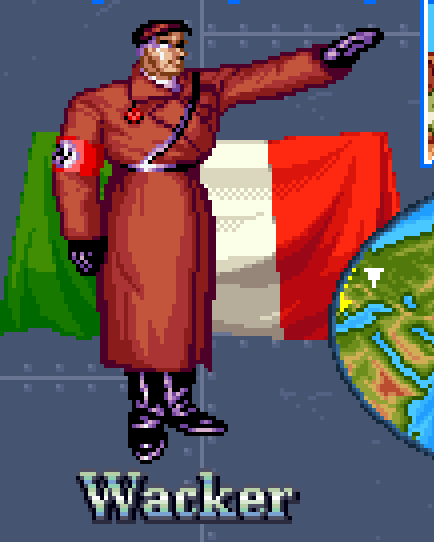

We've seen a few characters with a Nazi influence, but Taiwanese developer Panda Entertainment decided that they weren't going to pussyfoot around the issue in their DOS fighting game Tough Guy and so they included Wacker, a full-on, undeniable Nazi. For all the horrible things I've seen in videogames over the years, the overblown violence and cheap sexual titillation, a pixel sprite of a character giving a Nazi salute still has the power to shock. That's not even the half of it, either: check out Wacker's projectile attack.


Wow. I don't think I'm going too far out on a limb to say that being able to control a playable character who can throw giant energy swastikas around is somewhat beyond the pale. Wacker is an evil character and one of the game's bosses, but still, I'm definitely not comfortable with this and I think "playable Nazi" is a good place to draw this article to a close.
In summary, then: the Germans of the fighting game world are mostly soldiers and often very large. Sometimes their largeness is due to them being stitched together from the reanimated corpses of the dead. A higher percentage of them than you might think can extend their limbs, a trait which I can't think of a way to tie to their Germanness with the possible exception that some Japanese franchise, probably a manga, starred a German character with stretchy body parts who influenced videogame designers. Every German I've ever met has been a thoroughly pleasant and sensible individual, so hopefully they won't be offended by the stereotypes on display here - merely puzzled that, according to videogame designers, there are apparently no women in Germany.

27/08/2014

PUNCH-OUT!! (NES)

Today's game tells a real underdog story: a plucky young kid overcomes his diminutive stature and his relatively small arsenal of punches to rise through the ranks of the World Video Boxing Association, setting up a showdown with one of the most famous boxers of all time, or a dorky-looking head-swap, depending on which version you're playing. It's Nintendo's 1987 NES classic Punch-Out!!


I sometimes wonder if there's any point writing about games as well-remembered and universally beloved as Punch-Out, unsure whether I'll have anything new or interesting to say. Then I remember I never have anything new or interesting to say, and I've been playing Punch-Out a bit recently so here we go.


Here's Mike Tyson. Just in case you didn't recognise him, Nintendo were kind enough to repeat his name over and over again as the background to jog your memory. Now, before I get started, there's the issue of which version of Punch-Out I'll be playing - as I'm sure many of you know, there a few possibilities here. The game was originally released as Mike Tyson's Punch-Out!!, with the final opponent being Iron Mike himself. Later, the game was rebranded as Punch-Out!! Featuring Mr. Dream, with Tyson being replaced by the eponymous new champ. As kids, myself and everyone I knew assumed that this was because of Tyson's arrest and conviction for rape, but apparently the license had simply expired and Nintendo chose not to renew it, seemingly thanks to Tyson's shock defeat by Buster Douglas in 1990. If that's the case, the sighs of relief from Nintendo's marketing department probably caused a small hurricane.
There are no differences between the two other than the final opponent and the words "Mike Tyson's" on the title screen, but I'll be playing Mike Tyson's Punch-Out!! anyway because it makes the end of the game a bit more climactic than a bout against some bloke whose name sounds a bit like an insomnia medication.


You'll be playing as Little Mac, a young prospect from the Bronx, pictured above alongside his trainer Doc Louis. Doc Louis looks as though he's just remembered that he was supposed to pick his kid up from football practise six months ago, and Little Mac... well, he looks kinda dumb.


Cheerful, sure, but really, really stupid. Thicker than two short planks nailed onto a copy of War and Peace, denser than a loaf of bread baked using lead instead of flour. When you see the kind of freaks Mac is up against, his apparent stupidity will go a long way towards explaining why he's in the ring in the first place.
Also, I love that "playing the role of Mac, it's you!" line at the bottom. I hope no one was too disappointed that they wouldn't be playing the role of Doc Louis, shouting encouragement from ringside and catching Mac's spit in a bucket.


Doc Louis has just realised that his other kid has been waiting for him in the Tesco car park for nearly three years.
Little Mac's boxing career begins with a match against Glass Joe. He's a Frenchman who's not good at fighting, fancy that. I didn't think that stereotype was around in the '90s, but here we are, about to face a man from France who has has ninety-nine professional fights and has lost them all. I know promising young fighters generally start their careers by fighting untalented journeymen, but with his 99-and-0 record I think Mac would get better practise fighting a lamppost.


Our fighters step into the ring, the bell sounds and Punch-Out is underway, each fight promising up to three rounds of three minutes each as Mac climbs the rankings by pummelling a succession of cartoony and extremely large opponents. I said Mac was mentally dense, but his physical body must be made out of neutron star material because he only weighs three pounds less than Glass Joe despite Joe being eight feet tall with fists bigger than Mac's head.
So how does this work? Well, the goal is obviously to punch the other guy until they go down for a ten-count or, more likely, to knock them down three times in the same round for a TKO victory. To accomplish this, Mac has four main punches - left and right body shots and left and right straights to the head. Mac has two hands, and hey, the NES pad has two buttons, would you look at that, so there's one button for left and one button for right-handed punches, with head shots executed by holding up on the d-pad while you punch.


Yeah, like that. Punching alone isn't enough for victory, however, and the most vital skill to master for Punch-Out success is not getting hit. I mean, that's pretty true in regular boxing, but even more so in Punch-Out where everyone you fight is so tall you have to jump to hit them in the face and they generally weight hundreds of pounds more than you.
The most useful evasive manoeuvre is the dodge - pressing the joypad left or right will make Mac lean in that direction, (hopefully) avoiding any incoming punches. You can block, too, by pressing down on the pad, but dodging is just cooler, so do that.


That's all you need to know to beat Glass Joe - wait for one of his incredibly telegraphed punches, dodge to the side and then whack him in the face. Upon doing to he will be momentarily stunned - you can tell when this is because his expression changes to one of a fish that's licked an electrical socket - allowing you to follow up with more punches to the head. Keep that up and in no time at all Joe's record will be 100 losses, no wins.


Mario doesn't half get around. After this, he's going to go over some applications for planning permission before giving a lecture on the latest discoveries in the field of quantum electrodynamics.
As ever, Mac's face betrays not the merest hint of an intelligent thought.


All right, I'm already ranked number 2! Given how little a threat Glass Joe posed, I would say Mac is definitely ready for the next challenge. Unless the challenge is reading a book or doing simple addition rather than boxing. I think Mac might struggle in that case.


Oh good, it's more fighting, this time against a German fellow called Von Kaiser. I once described Punch-Out as "a pixellated catalogue of as many ethnic clichés as possible" and I think I'm happy to stick with that because this German is called Von Kaiser, and he's not even close to the worst of them. This NES version of Punch-Out is a sequel-slash-remake of the the arcade game of the same name, and it contains many of the same fighters, so whoever created the characters for the original game is to blame. One boxer who appeared in the arcade version but not the NES port was an Italian called Pizza Pasta, a name that's truly amazing for its sheer lack of effort more than anything else. Imagine if they'd set the whole game in Italy, it'd be packed with characters like Linguine Gondola and Vespa Massive Government Corruption. It's a shame they didn't stick with it, I could have been fighting a British contender called Steakn Chips.


Beating Von Kaiser isn't any more difficult than beating Glass Joe, and in a way I think it might even be easier - or at least faster - because Von Kaiser is slightly more aggressive and thus spends more of the fight throwing big, easily-dodged punches that you can punish him after.
What this fight does introduce is a gameplay element that's at the very core of the Punch-Out experience, and that's learning and reading your opponent's moves. Most boxers in the game have a "tell" that lets you know they're about to throw a punch. In Von Kaiser's case, he wobbles his head back and forth like a bobblehead in a tumble drier, giving you plenty of time to get out of the way. Naturally the later fighters aren't quite so obvious about it, but deciphering their movements and learning what comes next so you can accurately counter it is what Punch-Out is all about. I've seen it described as a puzzle game pretending to be a boxing game, and there's a lot of truth to that.


Blimey, that was fast. The Minor Circuit must be a pretty awful division if Glass Joe and Von Kaiser were the second and first ranked fighters, but getting a title shot after only two matches still seems a bit premature. Okay, which country gets a semi-offensive stereotype this time?


Why, it's Japan - nice to see that Nintendo didn't spare their own nation from the avalanche of cultural clichés that make up the game's cast.


Piston Honda is a serious man with serious eyebrows, eyebrows that he waggles to let you know when he's going to clobber you. He's also the first opponent with a real special move, a flurry of four quick jabs that can quickly drain your energy and, even worse, are hard to avoid by dodging. Instead, blocking is the better option here, but you can't just hold down block - Mac drops his guard after each punch, so you have to get into the rhythm of blocking again after each blow. One of Punch-Out's great strengths is that it's a game all about rhythm, of finding the right moments to dodge and feeling the rhythmic thud-thud-thud of a successful flurry of punches, all of it courtesy of a control system that's both simple and extremely precise.


Speaking of controls, there's one other punch I haven't mentioned yet: Mac's Super or Star Punch. Hitting your opponent just as they're about to throw certain punches can jar them out of the move, rewarding you with a star, the counter for which you can see in the top-left of the screen. Each star allows you to press the start button to unleash one giant leaping uppercut that will do a ton of damage if it connects. In the screenshot above, I did not connect, because I am still not very good at Punch-Out even after all these years. At least it gives you a good view of the effort Little Mac is putting into the punch, straining so hard that all his facial features have disappeared.


Once I did manage to hit Piston Honda with a few Star Punches - something that he seems particularly susceptible to - Mac's victory was assured and the WVBA Minor Circuit gained a new champion. Mac's reward? The adulation of the crowd, the chance to step up to the Major Circuit and a small trophy depicting an artist's mannequin standing atop a golden goblet.


Following your championship triumph, you're treated to the iconic scene of Little Mac doing his roadwork while Doc Louis rides a bicycle ahead of him. Little Mac and the Statue of Liberty have the exact same face. This is surely an omen that prove Mac is destined to become the true hero of all Americans.


Mac's first opponent on the Major Circuit is Don Flamenco, a Spaniard who's both a lover and a fighter. Don's bio says he's 23 years old. I know boxing can take a toll on a man, but there's no way he's only 23.


He looks like Prince Charles! Prince Charles after an unfortunate incident involving his head and a vice, but still, there's a definite resemblance to the heir to the British throne. There's the germ of a plot for a family friendly action-adventure movie in there somewhere - European royal is mistaken for a heavyweight boxer and finally learns the value of hard work after training for his upcoming title defence, while two-weight champion "Chopper" Gonzales launches a few ships and goes to a polo match. That's King of the Ring, coming to cinemas this holiday season.


Don seems like a challenge at first, and an aggravatingly cocky one at that: he taunts the player into trying to hit him, and when they do he counters with the Flamenco Uppercut. This could prove tricky if there wasn't a simple way to beat Don Flamenco: dodge his punch, hit him to stun him and then alternate between left and right punches to the face. As long as you keep up the left-right-left-right rhythm, Don will never become un-stunned and you can drain his entire energy bar. If it was any other boxing game I'd suspect this was a glitch, but because Punch-Out places such a strong emphasis on learning and exploiting your opponents' weaknesses I have to assume it was included purposely.


As I took a decent screenshot of it during the Don Flamenco fight, this seems like a good opportunity to talk about Mac's stamina. Measured in hearts, which are recorded in the bar at the top-left of the screen, Mac's stamina decreases when he blocks a punch or misses with a swing of his own, or when he gets punched. When your hearts reach zero, Mac turns pink and can't throw a punch, leaving you to dodge for a while until he gets a few hearts back and returns to his usual fist-throwing self.
I've always thought the stamina gauge was a touch redundant, but then again I think that might have been part of Nintendo's cunning plan - I tended to completely forget about it until my opponent blocked a few of my punches and bang, suddenly I can't fight back and I look like a wad of chewed bubblegum, panic stations are initiated and Mac gets a beating because I wasn't paying attention to how many hearts I had.


Next up: King Hippo. You can tell he's a king, because he's wearing a little crown that definitely didn't come with a Pretty Princess Dress-Up Kit with Real Crystal Accessories. I wonder if Hippo is his given name and he's a king, or if he's the king of the hippos. Either way, I feel confident I can beat him. He's got plenty of chin to aim for, for starters.


Okay, I think this represents at attempt by the fight promoters to surreptitiously slip some inter-species boxing onto the fight card, because I'm fairly sure King Hippo is actually a shaven gorilla wearing gloves and shorts.
Punch-Out's puzzle-like qualities come to the fore in this fight, as you dodge King Hippo's powerful punches whilst trying to figure out a way to actually hurt him - all of your shots are brushed aside until the fateful moment when the king raises his fist high in the air and, crucially, opens his massive gob. This is your chance, Mac - slug him in the mouth so hard that his shorts fall down!


This gives you a chance to clobber Hippo in the stomach while he struggles to hoist his trunks back up, leaving his vulnerable belly-button exposed. I wonder what horrors are lurking under those plasters. I can't imagine Hippo Island has the best medical facilities, I reckon "stick a plaster on it" is about the extent of their medical capabilities. I'm going to guess it's a hernia, which explains why King Hippo can never get up if you knock him down. Not to worry, his boxing career may be over but he's still going to make plenty of cash thanks to his appearances in the Captain N cartoon. Speaking of, I just looked up King Hippo's appearance in that show and I had (mercifully) forgotten that he was drawn with big, floppy man-breasts with extremely prominent nipples. Hopefully one day I'll manage to forget this fact again.


Great Tiger occupies the number one ranking, and as a videogame Indian you know he's got mystical powers, he will meditate then destroy you, something about curry, etcetera etcetera. At least most countries sometimes have slight variations on their traditional videogame stereotypes - the British are posh but also sometimes Cockney geezers - but Indians? Mystics and fakirs, every one.
I love the contrast between the images of Little Mac and Doc Louis on one corner and Great Tiger and the tiger skin in the other, especially because it seems to suggest that the tiger pelt is Great Tiger's trainer. I want it to pop up between rounds and say "don't worry, Tiger, you're doing grrrreat!"


A real test of reflexes, beating Great Tiger requires you to pay close attention to the gem in the centre of his turban. It flashes when he's about to strike, and hopefully you'll be quick enough to get out of the way. It's not hugely difficult, but it is fun, like every fight in Punch-Out - each bout is its own unique experience, and each must be approached with a winning mix of the cerebral (learning your opponent's moves) and the physical (getting out of the bloody way, punching back).


Great Tiger also has a special move where he spins around the ring at high speed, stopping only to throw punches at Mac. Easily blockable punches, it turns out, and you can deal with this move the same way you thwarted Piston Honda's jab combo. Great Tiger's wide open to counter-attack once he's finished, too, so you spend much of the fight hoping he'll do his special move so you can punish him for trying it. Punch-Out is incredibly satisfying in that respect, because once you've mastered your opponent's moves they go from being something to fear to a tool you can use to win, and that's a wonderful feeling.


And now, the main event, the Major Circuit Title Bout between Little "Tiny" Mac and Bald Bull, the champion and future exhibit in the Museum of Oddly-Shaped Human Skulls. Look at that thing, it's like an ostrich egg with a face painted on it.


He's a big lad, isn't he? The original arcade version of Punch-Out had the player's boxer displayed as a wireframe, so you would see the person you were fighting through their body, but obviously this approach wouldn't have worked on the less-powerful NES. Thus, Little Mac was made, well, little and his opponents huge, and as far as I'm concerned this worked out exceptionally well for the the game. It gives you a sense of overcoming the odds, of earning your victories, when you're beating down boxers the size of modest two-bedroom houses. It also allows the NES to impress graphically, with each boxer's massive sprite being packed with character and explaining why most of them are remembered to this day in gaming circles.


Bald Bull is definitely well remembered, and in my case that's because of his Bull Charge special move. Bald Bull hops towards Little Mac in a terrifying game of chicken with one of two outcomes: either Bull gets through and punches Mac hard enough to immediately knock him down, or Mac throws a body shot at just the right time, catching Bald Bull right in the gut and knocking him down. It was nice to discover that the correct timing for this punch, honed through hours of childhood battles against Bald Bull, was still floating around in my central nervous system, and I managed to catch him with the telling blow without even thinking about what I was doing. A pretty crappy superpower, yes, but a satisfying way for Mac to win his second belt.


The trophy's a bit bigger now, there's an egg cup between the mannequin and the goblet.


Little Mac's training at night now, so his bright pink tracksuit now seems less like a horrible fashion mistake and more a piece of hi-visibility safety gear. You should always be careful near roads, but after being punched by Bald Bull I don't think getting hit by a car would even register on Mac's pain sensors.


Now Mac's fighting in the World Circuit, and his first opponent is... Piston Honda again. You also have rematches against against Don Flamenco and Bald Bull, and while they do fight slightly differently - Don has a few new punches and Bald Bull can only be knocked down with Star Punches or by countering the Bull Charge - they're not different enough for me to go through them again. Don Flamenco is still an absolute chump, by the way.


While I'm fighting Piston Honda, I'd like to mention this bit of trash-talking that he sometimes spouts between rounds. Not up to the usual boxing standards, that one. "I'll win by technical knock-out" is hardly up there with "I want to eat your children" or even the usual threats of a comprehensive and extremely painful victory, but I can appreciate the almost poetic style.


A new fighter appears: Russian fizzy drink aficionado and yet another inductee into the Museum of Oddly-Shaped Human Skulls, it's Soda Popinski! Just in case you're having VGJunk beamed to your distant alien planet or something, the soda pop he drinks is actually booze. Popinski's original name was famously Vodka Drunkenski, so just remember that someone once sat down and thought "yes, this will be a good name for the Russian character in my videogame." That was a series of events that actually happened, for real.


There's nothing particularly special about Soda Popinski - it's just a good, solid fight against a tough opponent with no major gimmicks. I mean, the fact that he consumes ten times his body weight in fizzy pop a day is a gimmick, but it doesn't affect the gameplay any. Instead, it's a test of the reflexes and boxing skills you've honed over the previous fights, concentration etched on the player's face as they search for a way to land a Star Punch and desperately try to avoid looking to closely at Popinski's very tight briefs. I guess he misunderstood "trunks" to mean "swimming trunks".


He can't drive because he drank too much soda pop, you see. If you were really into over-analysing videogames, you could build a case for Soda's love of fizzy beverages mirroring Soviet desires to partake in the products of the Western world during the Cold War, with echoes of the production of Marshal Zhukov's "White Coke." I would never go that far, though. I'm too busy laughing at everyone's oddly-shaped skulls.


The number-one ranked Mr. Sandman has a relatively normally-shaped skull, although I'm sure Little Mac is hoping that won't be the case after the fight. It took me until I was approaching adulthood to realise that he's called Mr. Sandman because he's going to put you to sleep, because, like Mac,  I'm kind of dumb. I hope that's why he's called Mr. Sandman, anyway, and he doesn't creep into kids' bedrooms at night and knock them unconscious.


Ah, Mr. Sandman, the bout where so many of my youthful attempts to complete Punch-Out were unceremoniously crushed. It's Mr. Sandman's triple uppercut that's the problem, a flurry of three punches that will absolutely demolish Mac if any of them hit him and which are thrown without warning. Okay, so there's some warning, because Mr. Sandman stops moving for a moment before he throws them, but that just makes you tense up as you wait for the inevitable. My problem was that I always got too tense and then dodged too early, so that Mac was leaning back into position just as Sandman's uppercut came my way.


Of course, in this modern age of the internet and FAQs and embarrassingly accurate fan wikis, I had the key to Mr. Sandman's downfall revealed to me after about seven seconds on Google, and his weakness is his body: specifically, you have to stun him with a shot to the head and then you can get a few hits in on his body. I must have figured this out at some point in my youth, because I know I've fought the remaining boxers before, but I didn't remember this particular trick and I sure as hell wouldn't have figured it out on my own. I know it now, though, and with a bit of good fortune on the uppercut-dodging front I managed to get sweet revenge on Mr. Sandman for all the times he made me shout words at my NES that a nine-year-old shouldn't even know.


The champion of the World Circuit is a body-building fanatic called Super Macho Man. I think it's safe to assume he's worried about the size of his genitalia. Anyone who calls themselves "Super Macho Man" is overcompensating for something.


Yes, he certainly looks like someone who's secure in his masculinity. He found time to dye his hair from grey to black, so once again I'm left wondering whether his official age of 27 is entirely accurate.
After the bruising onslaught of Mr. Sandman, Super Macho Man is something of a relief to fight: he's not so fast, there's no special gimmick to hurting him and his punches seem easier to avoid. He does have one dangerous trick up his sleeve, or down his trunks, though, and that's his super spinning punch.


Sometimes he does it once and it's easy enough to avoid, but other times Super Macho Man spins and spins and spins with his fist extended. I'm not sure how this is hitting Little Mac, given that he barely reaches up to the waistband of Macho Man's budgie smugglers, but hit him it does and it results in a knockdown every time. It was at this point that I remembered that Little Mac can duck by double-tapping down on the d-pad, and I avoided Macho's whirling tornado of pain by repeatedly ducking as fast as I could and praying. Miraculously, this seemed to work, and with his most powerful move neutralized Little Mac could pick off the champion at his leisure.


"Last night, we found a small but great champ" cries the newspaper, although given the huge size difference between Little Mac and his opponents readers would be forgiven for assuming this was an April Fool's joke. Well, this is the April 1st edition of the paper. The newspaper also subtly gives you a password and tells you about the Dream Fight, but I'm more interested in that "Daddy, come back home!" message. Is it directed at Mario, whose picture accompanies the headline? Does Mario have children that Nintendo have kept secret for all these years, assuming that Baby Mario is actually Mario as a baby and not some secret love-child? Or is Mario desperately crying out for some parental affection? Everyone needs a family, and Luigi just isn't cutting it. It's a mystery that will never be solved, because it's time for the showdown we've all been waiting for: Little Mac versus Mike Tyson.


What an excellent pixel caricature of Iron Mike, depicted in happier times before he went to prison and started biting human ears. In fact, both Mac and Mike look genuinely happy to be there, with no greater desire in their hearts than to discover once and for all who is the best boxer in the world. I feel confident. I'm ready. I can do this.


Oh god no, I'm wrong, I can't do this. Please send help.


Tell my family I love them. I'm going into the light now. No more tears. No more pain. No more of Mike Tyson's fists trying to separate my head from my neck.


As you might have guessed, Tyson is a far, far tougher challenge than anything you've faced before. For the first half of round one he does nothing but throw gigantic uppercuts that knock you down should just one of them connect, adding different punches to the mix as the fight goes on. He doesn't have special moves, because he doesn't need them, but while his style may be impetuous his defence is not quite impregnable. The thing is, dodging alone isn't enough any more. It's something you'll probably notice as you progress through the game, but in this fight it's vital to realise that it's also important when you dodge. Move too soon and you'll avoid the punch but have no time to throw a counter of your own before Mike covers up, granting an extra layer of tension to the proceedings. You can get through, though, if your reflexes are sharp enough. There's a dollop of luck involved, too. If it all comes together for you, then maybe, just maybe, you can beat Mike Tyson.


Finger speed? Tyson's gone meta, he knows this is all a game. Anyway, I don't think it was down to finger speed as much as it was about headache-inducing levels of concentration. What happened was this: after a war of attrition, I eventually managed to beat Mike on a points decision. I was so overcome with excitement that, like the big clumsy dope I am, I accidentally hit the reset button on the emulator. Rather than put myself through the wringer again, I used a "one-punch-KO" Game Genie code to beat Mike for a second time, and you know what? It felt good. After all the sweat and toil I put into Punch-Out as a kid, I reckon I'd earned it.


And that's it, Punch-Out is over, Little Mac can retire with a perfect record and I can go through some deep breathing exercises in an attempt to relax my body, which has tensed up like a prison warden who's realised he's lost his keys. Before I finish up, though, there's the small matter of Tyson's replacement in the non-Mike Tyson's version of Punch-Out.


Look at this big palooka. From Dreamland, are you? That might explain why you look like a 'roided-out version Bert from Sesame Street. That's something that should only happen in a dream - a horrible, unsettling dream.


Mr. Dream is nothing but a re-coloured, head-swapped version of Tyson, which is fair enough. I can cut Nintendo some slack on this one, because with Punch-Out they created the best sports game - but not really a sports game - of the 8-bit era and one of the NES' very finest titles. As a workout for mind and fingers there's little to challenge it on the ol' grey box, and it's fondly remembered by everyone I've ever met who's played it, which is amazing when you consider it's a boxing game - a sport that's hardly one of the world's favourites. It's beautifully constructed, with massive sprites that ooze character (and aspartame, in Soda Popinski's case) and a soundtrack of tunes that are instantly memorable and yet never seem to get annoyingly repetitive despite there barely being a handful of them in the game.
It seems pointless to tell you to play Punch-Out, because more than likely you already have, but if this one somehow passed you by then give it a go. If you don't feel yourself getting into it, I'll eat my gem-studded magic turban.

VGJUNK Archive

Search This Blog

Followers