Showing posts with label masaya. Show all posts

08/03/2014

BS GOLF DAISUKI! O.B. CLUB (SUPER FAMICOM)

Golf: the sport of kings! Or is that horse racing? Or interbreeding, possibly? Never mind, what kings get up to in their spare time is their own business. Me? I spend my time writing about videogames, like this one: NCS / Masaya's 1995 Super Famicom a-good-walk-spoiled-em-up BS Golf Daisuki! O.B. Club!


That title comes out as something like Golf Lovers! Out of Bounds Club in English, so while they may love golf they're not especially good at it. It's like calling a football game Missed Penalty Soccer, or a dancing game Just Dance Like VGJunk. Those of you familiar with the Super Famicom's more obscure peripherals might have noticed the "BS" in the game's title, which doesn't stand for the thing BS usually stands for - instead it means "broadcast satellite" and denotes that Golf Daisuki was originally available as a downloadable title though the Japanese Satellaview service. I know, right? Downloadable videogames. Shame that concept never really took off.


Here are the controls, handily labelled for those of you who can read Japanese. I can't, but I figured them out anyway. It's golf: use a stick to knock a small ball into a hole. How complex can it be? Getting a decent screenshot of the woman on the menu screen proved a more difficult task, because in every shot I took she's got her eyes half-closed, captured in mid-blink to give a faint expression of smugness to her lecture.


Mission one: select your player character. The top two rows consist of a father, mother and their six children, which says something for the aphrodisiac qualities of golf. On the bottom row you've got a woman with the typical "kung-fu girl" haircut, a small child and, apropos of nothing, two cat people. Okay, sure, whatever. At least now I know that this isn't going to be serious and detailed golf simulation, because cats can't play golf. No, I'm not going to make a joke about Tiger Woods. I used up my terrible pun allowance in the last article.


So Golf Daisuki recreates crazy golf rather than the regular kind, although "crazy" golf implies a certain hecticness that this game doesn't possess and it's not "mini" golf either because there's a stage set in outer space, so I've settled on "whimsical golf" to describe it. Use your charming putter to smack your enchanting ball past the fantastical obstacles and into the surprisingly sober and uninteresting hole.


Here you can see me fucking that last part up, because I hadn't gotten to the game's power settings yet. Unlike almost every other golf game from this period, Golf Daisuki eschews the usual three-press controls system - press the button once to start the power meter moving, press it again to select your power and one more time to determine your accuracy - and simply allows you to choose how hard you hit the ball. Then you can aim using the dotted line, choose what type of spin to put on the ball and finally unleash your shot. The power bar always starts at eighty percent when starting at full power might have been more useful and your aim isn't automatically directed towards the hole like in most golf games, but once you get into the habit of remembering to change them for every shot then playing Golf Daisuki becomes a breeze, and you'll soon be pulling off shots with all manner of wild curves and carefully-calculated ricochets, like so:


Look at that; round the tower, past the fountain, over the bridge and straight into my opponent's heart like a dagger. That's if I was playing against an opponent in this match, I forget. There are three gameplay modes, although none of them change the essential experience of the game much. You can play alone to record your best score on a course, in a one-on-one match against either the computer or a fellow human, or in a four-player team battle.


The four-player mode is where Golf Daisuki shines brightest, especially if you're playing with friends. You get the usual fun of playing against someone who's sitting next to you and thus is immediately available for good-natured ribbing / a playful punch on the arm / a less playful punch in the mouth, but this game goes that step further than in ordinary golf games by having everyone's ball in play at the same time. You can see three of them in the screenshot above, and this means that Golf Daisuki's multiplayer mode has that added ingredient that improves any multiplayer mode - the ability to screw over your opponent for no purpose or gain. You can use your ball to knock the other players' balls out of the way, or behind an obstacle, or even out of bounds if you're feeling particularly vicious. Most of the time, doing so doesn't help you much and you'd be better served trying to play shots that lower your score, but I defy anyone not to send their competitors back to the tee or into a bunker when the opportunity arises.


Here, for example, it took all my mental fortitude to go for a complicated bank shot towards the pin instead of turning around and thwacking the red player's ball into the endless void of space. This is like crazy golf mixed with croquet, then. As such it makes me think of the movie Heathers, which is fine by me. I love that movie. You should watch it if you haven't. Take a drink every time Christian Slater reminds you of Jack Nicholson. Actually, don't do that, I don't want any liver failures on my conscience.


You can play any of the game modes on one of Golf Daisuki's six courses, each of which has eight holes. The first is the most "normal," a course of green grass and duck ponds, although it's hardly a regulation golf course. They don't tend to have pinball bumpers and friendly moles that will deposit your ball on the green if you knock it into their burrows, which is one of the reasons I don't watch regular golf.
You can see it's raining, too - weather effects blow in in real-time as you play, with the wet weather making your ball travel more slowly. There's also what seems to be a wind meter at the bottom of the screen, although because you play almost all your shots along the ground I never seemed to have to factor it in to my calculations.


The second course is a breakfast table, complete with huge slices of toast to negotiate and the coffee cups of an extremely messy giant to contend with. Knocking your ball into the spilled coffee causes it to melt away (and be called out of bounds) so the giant must take his coffee like me: enough granules for it to almost be chewy, enough sugar to dissolve golf balls and teeth alike. There are also musical notes scattered about the place that play the sound of dogs barking when you roll over them. I'll be honest, I'm at a loss to explain those.


Also on the table - unlicensed Donkey Kong breakfast cereals. DK's famous red tie has been replaced by a jaunty cravat in an attempt to throw off the lawyers. Nice work, Masaya.


Next up, some ancient ruins. Ancient ruins of various civilisations mixed together to form a golf course, with Moai statues sharing screen space with the Nazca hummingbird. Ramps become much more common in this course, as do conveyor belts made of quicksand and sections where the shading of the isometric viewpoint makes the scenery a little hard to parse.


That's what they call non-Euclidean geometry, right? It took me far longer than it should have to realise that the hole is actually sitting on a plateau and my golfer is at the bottom of a slope here. Lovecraft would be proud. There's a game idea for you hip young developers out there - a golf game set in the sinister void between dimensions where man's laws of physics and mathematics have no dominion.
My golfer is standing next to a present, and yes, they give you power-ups if you hit them. They're a mixed bag, with the only undeniably great one being the power to control your ball using the d-pad after you've taken a shot. There's also one involving a clown, and I shouldn't have to tell you that it rarely works in your favour - it swaps the positions of everyone's balls, but the problem is that if you managed to get the present that probably means you're further ahead than everyone else, so your ball is just going to be moved backwards. It's disappointing, and in general the presents are a missed opportunity because you have to go out of your way to collect them when a shot that puts you closer to the hole is generally a better use of your turn.


On an unrelated note, this girl has Sonic the Hedgehog's shoes.


Toytown is next, and the complexity of the courses is ramped up still further with teleporter panels, longer distances from tee to pin and a system of pipes that carry your ball from one place to the next, including this rather challenging shot where you have to jump your ball into the small box in front of said pipe. It's good fun, with most of the frustration it could cause being tempered by the fact your opposition aren't that great at golf either. It doesn't seem to matter which character you pick. Unless I'm missing something - a distinct possibility given that I'm about as observant as a cyclops with conjunctivitis - everyone plays the same.


Onward to the beach, which is hindering my attempts to say something interesting about it by being very similar to the first course. It's got more railings, I suppose? I know I did fairly well whenever I played it by throwing caution to the wind and just smacking the ball in the vague direction of the hole at 100% power, and that's a fairly reliably strategy for most of this game. It helps that there are a lot of arrow panels on most stages, panels on the ground that propel your ball in the direction shown if you hit them. They tend to keep you going in the right direction, but there are still plenty of chances to try something a bit different.


The last eight holes are floating in space, as you've seen already. They've got the artificial gravity working just right, so you don't need to worry about your balls floating away. Man, I have written the word "balls" a lot in this article. Balls. Balls. Yep, it doesn't looks like a real word any more. Thanks, Golf Daisuki.


A middle-aged man and a small child in Sonic the Hedgehog's shoes celebrate their golfing victory over a housewife and a humanoid cat amongst the eerie crystal pillars of a long-dead spacefaring civilization. You don't get that in EA's golf games.


Let's get the negative stuff out of the way, because BS Golf Daisuki! O.B. Club does have its flaws. The power-ups are an underdeveloped concept, there's not much in the way of options or difficulty levels or playable characters that aren't just interchangeable, mannequin-like placeholders. There are some issues with the game putting the camera in awkward positions when it's your shot, forcing you to manually drag the viewpoint into the right place and slowing the game down. The aiming line sometimes feels a touch inaccurate. Cat people creep me out, but that's a personal issue for which I am seeking professional help.


Those are minor things, though, and when it comes to the big question of whether or not I enjoyed playing Golf Daisuki I'd have to say "yes". It's just fun, simple fun that's good with friends. It's cheerful and chirpy, the graphics are nice, (as they ought to be, considering this game was made the year after the PS1 was released and wasn't broadcast until 1997,) and the gameplay is complex enough to be interesting while still having pick-up-and-play appeal.


As a final note, BS Golf Daisuki! O.B. Club reaffirms the simple truth behind all golf games: watching the actual sport of golf is a task of such brutal, soul-sapping dullness that enduring it for a mere moment can make me pray for the sweet release of death, but golf videogames? They can be a real pleasure to play. I'd test this theory with cricket, but cricket is somehow even worse than golf and I'm afraid of what I might do to myself and others if I sit down in front of a Test match.

19/07/2013

EPHEMERA, VOLUME 2

A couple of weeks ago, I wrote about five pieces of videogame ephemera - five little bits of dandruff from the shaggy head of the gaming giant, none worthy of a full article on their own but all too dear to me to be forgotten. Here are five more. It's a thing now!

A Bitchin' Pegasus

A simple one to start with - I really like the logo of Masaya, the videogames arm of Nippon Computers Systems and publisher of such titles as Gynoug, Langrisser and the infamous Cho Aniki series. Here's a version from Megadrive game Vixen 357.


The Pegasus is pretty nice, classical yet dynamic, but it's the typography I really like. It looks as though it could be the logo for a futuristic hoverbike-racing team, or at least one from the future posited by the cyberpunk anime of the late eighties. Masaya Cybernetic Implants and Heavy Manufacturing Concern, maybe. It's a name you can trust, if not say easily!
Here are versions from the NES and SNES, respectively:


I think the NES one is my favourite of the lot. It's a bit more compact, and the two-tone colouring on the S is neat. Perhaps it's not interesting to anyone else, but from an aesthetic standpoint I'd probably say this is my favourite game developer logo from the 8 and 16-bit era.
Oh, and that Japanese text? It doesn't say Masaya. It's says mesaiya, presumably NCS's attempt to call their games division "Messiah." So, they're either called Masaya, Mesaiya or Messiah. I'm glad they went with Masaya, because the logo wouldn't look as nice otherwise. Also, being called "Messiah" is going to create a lot of expectation that you might struggle to live up to.

Good Blood

In the original Silent Hill, any blood show on a still picture looks really good. Nice colouration with a pleasing viscosity to it, much better than the usual "red poster paint" effect you might see in lesser survival horror games.


This is especially noticeable during the school portion of the game, because apparently Midwich Elementary had a critical shortage of pens just before Harry arrived and thus every note you find is scrawled in human blood.


I think the claret-smeared piano is just an unfortunate side-effect of replacing all the school's ink with blood, mind you. There's no message being conveyed here, apart from maybe "don't pick your nose really hard just before your Grade Two exam." The point is, I think that the blood looks just swell. Crimson and inviting, as though it could still be warm. Don't you think so? Hello? Oh, everyone's gone, look.

The Last Tantrum of Kuros

Ironsword - what images does that name summon into your mind? If you said "Mills and Boon cover model and ultra-hunk Fabio" then well done, you've seen the box art for this game before. I meant in a wider sense, though. Doesn't it make you think of proud barbarians, the clash of steel, mighty thews and castles to be stormed? Well, Ironsword: Wizards and Warriors II doesn't have any of that. It has Kuros, a boggle-eyed knight of considerable lameness whose idea of swordplay is to kind of wiggle his mighty blade in the unthreatening manner of someone trying to open a reticent umbrella. Kuros is, to be frank, a bad knight. As such he dies a lot, yet even in death he cannot stop embarrassing himself.


Just look at that. The mad flailing is bad enough - a little decorum would be nice, Kuros - but it's the way his dangling leg swings in the breeze for a moment that really caps off this pathetic tableau.

Nina Williams, Master Athlete

While I'm on the subject of lamentable animations, here's something I mentioned briefly in the Tekken 2 article but I love it too much for it just to be a footnote. It's Nina Williams in the original Tekken's intro. She's running!


Yep, she sure is running. I think someone at Namco read Nina's design document, saw that it said "leggy blonde" and took this to mean "a pair of legs with a blonde head on top". Fortunately someone spotted this and managed to just about cram a torso in there. It's small and vestigial, but it at least provides somewhere to attach her dynamic, pumping arms.
There's something slightly unnerving about this animation, and it's not just that Nina looks like an acrobat that's grabbed a gun in a desperate attempt to escape from the Cirque du Soleil. What's it called when something looks human, but not human enough to avoid making you feel weird? The uncanny valley? Yeah, I think Nina's right on the precipice of that particular canyon.
Of course, it might be harsh of me to complain about the polygon work of the mid-Nineties, and I'm sure Namco did the best they could with the available resources. It's definitely harsh to single out Nina, because no-one from the original Tekken has aged well. Do you remember what loveable bear character Kuma looked like in that game?


That's right, like a terrifying hell-beast constructed from furry rocks and a seething hatred for humanity.

Bed Linens

Most of you have probably played classic Super Nintendo RPG Chrono Trigger, but if you haven't, it concerns time travel. At one point in the game you end up in the realm of a prehistoric race of advanced douche-wizards called the Enlightened Ones, who live in the floating kingdom of Zeal. They have extensively studied and ultimately mastered the fields of art, science, magic, and totally sweet bedsheets.


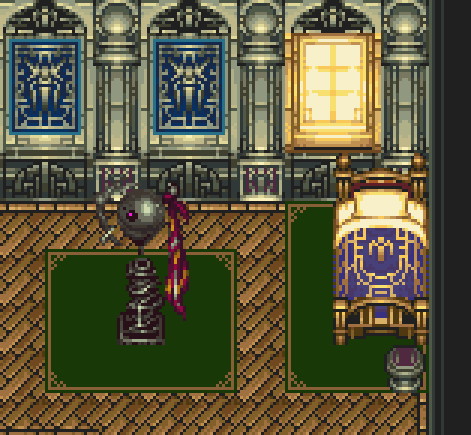
Just look at those duvet covers. So stylish, so refined, the elegant red and gold colour scheme married perfectly to the comforting fluffiness that they no doubt possess. They lose a couple of points for having a picture of a world-dooming energy siphon machine thing embroidered on them, but you can just pretend that's an angel or something if it really bothers you.


Don't like them in red? Have one in purple! Purple, the colour of royalty. Also gold, the colour of, um, gold. It doesn't get much more regal than that, folks.
Seriously, I would very much like some bedding that looks like that. Maybe I'll set up a Kickstarter to raise the cash to make some. Your reward for pledging ten pounds is a thirty-second video of me sleeping under said bedcovers. Pledge a thousand and you'll receive my old bedcovers. Well, I won't be needing them any more, will I?

16/02/2012

GYNOUG / WINGS OF WOR (GEN)

You know what the Megadrive had plenty of? Horizontally-scrolling shoot-em-ups. Here's another one! It's Masaya's 1991 winged-avenger-em-up Gynoug, also known as Wings of Wor.

First things first - how do you pronounce that title? Guy-noog? Jinnog? The Japanese characters transliterate as something like "Jinougu", so should it sound like "Jinoog"? Who knows, and indeed who cares? It's not important, because as far as I can see the word "Gynoug" has no connection to the game whatsoever and might well be six tiles plucked from a Scrabble bag. It's how they named Q*Bert, after all.

You're not told the plot, either, at least not by the game itself. One minute you're looking at a muscular winged warrior in skintight blue leggings and then bang, you're playing the game and facing off against... whatever these things are.

Experiments have proven that you can cross-breed garden gnomes and bicycle handlebars, but the resulting offspring are disturbing at best. Perhaps someone at Masaya misinterpreted the phrase "Star of David" - that does rather look like the face of British naturalist David Bellamy.
That pointy weirdo might have tipped you off as to why I'm talking about Gynoug in the first place. Like I said, the Megadrive / Genesis has plenty of scrolling shooters, and Gynoug isn't exactly packed with innovation. What it does have is weirdness, with plenty of enemies and bosses that are very different from the usual spaceships and mecha, and really that's all I'm interested in for today.

I mean, look at this guy. He's the first stage's mid-boss and already the biology of your opponents has become completely unfathomable. I think there's a bit of turtle DNA in there somewhere. Also some rocks. Rock-turtles are hardly an uncommon enemy type in videogames, but this one has the added touch of a face that'd give the Cenobites nightmares. Look at all those holes! Who knows what could be lurking in there? I doubt it's puppies. Or, like, they're puppies but with insect legs where their eyes should be and their fluffy little tails constantly secrete a corrosive slime.

I know I'm focusing on the art design, but don't get me wrong - Gynoug's gameplay is more than up to scratch, it's just not very original. You fly through the stages, shooting everything that moves and collecting power-ups to help you shoot said moving things. The weapon system is probably the most unique aspect of Gynoug's gameplay. Our hero fires blue energy pellets, and this main weapon rather unusually has two separate power bars. Collecting red gems increases the power of your shots, while each blue gem you gather increases the spread and therefore screen-coverage of your attacks. One hit is, as per bloody usual, all it takes for you to lose a life but unlike games such as Gradius you don't revert back to your painfully-weak starting state when you die- instead you lose a red and a blue orb. The power level of your weapon is indicated by the blue and red bars at the top of the screen.

You can also pick up magic scrolls to equip you with a limited-use sub-weapon. In the picture above, our hero is using the Energy Ball. It's not really a ball, but it can be extremely useful because it negates the enemy's bullets / plasma orbs / caustic bodily fluids / whatever it is they're supposed to be firing at you.
Weapon system aside, Gynoug is very straightforward. Luckily, it's still a lot of fun to play thanks to sharp controls and a difficulty curve that starts at "challenging" and ends up in the region of "may God have mercy on your soul" but does so in a smooth, balanced manner. Enough about that, though, and back to the madness. Here's the boss of the first stage!

Clive Barker's re-imagining of Thomas the Tank Engine really is something. You've got to fight a train with the face of a man, or possibly a man with the body of a train, and the whole thing raises some disturbing questions. Questions like "is it sentient?" and "why would you build that, it seems terribly impractical and I fail to see how it improves on existing locomotive designs." It rather reminds me of the work of British artist John Blanche, who you might be familiar with through the art he produced for Games Workshop.

Stage two throws you something of a curveball, because those are just seagulls, right? I mean, obviously they're seagulls with the ability to fire some kind of deadly projectile from an unidentified orifice, but they're still just seagulls. Disappointing. The second part of the stage takes place beneath the ocean waves which means we must be in for some real oddities - after all, the sea is where all the truly weird-looking creatures live.

Coelacanth? Pretty cool, but hardly a soul-rending, utterly alien horror from the stygian depths. Even the mid-boss is only a giant whelk. Has Gynoug lost its way already, its creative juices spent after the first stage? Well, why don't we ask the end-of-stage boss?

It's a pirate ship with a human face that vomits deadly orbs at you. That's better! See, I know Gynoug was just holding out on us... Wait, there's more?

Turns out it wasn't a pirate ship with human face, it was just a hat belonging to an even bigger head. My mistake! You might have noticed by now that a lot of the enemies in this game are faces. Floating faces, faces attached to vehicles, faces that live under the sea and wear galleons as hats: it all rather makes you wonder about the art designer's personal issues. A former mask salesman, possibly? Maybe they just really hate faces, which seems like it'd be a condition that'd really impede your day-to-day life, as well as setting up the gimmick for some Batman-style villainy.

The next stage sees us firmly back into the realms of the bizarre as our winged avatar heads through a castle filled with coffins that dispense slime-mummies, bunches of floating skulls and the creatures pictured above. I think they're brains that hop around on a single leg, which not only makes an interesting enemy for a shoot-em-up but would also be my top pick to be introduced into the next generation of Pokemon.

Here's one of the slime-mummies now. Aren't they adorable? Like humanoid blobs of semi-solidified barbeque sauce. Our hero cares not for adorability though, and he blasts them back to whatever hellish condiment-dimension they came from. Why he does so is something of a mystery - the game itself certainly doesn't contain any plot. According to the manual for the US version, you're playing as Wor, a "winged battle master" whose home planet of Iccus has been corrupted by a virus that creates hideous mutants... although these mutants also have a leader, known as The Destroyer. So was this virus all part of Destroyer's plan? Or did he just notice that a ready-made army of face-shaped mutant warriors had appeared and thought "hang on a minute, I could use this rag-tag bunch of grisly abominations to take over the planet"? None of this is ever explained, although I have my doubts that this is the way the story originally went.

Enough about the nonsensical story! It's time to fight another man-faced train! This one's got a flame-thrower for a tongue, and it actually one of the hardest parts of the entire game. I forgot to get a screenshot, but the man-train here likes nothing more than filling the screen with bullets and then producing his volcanic tongue, giving you very little room to manoeuvre. Your job is made harder still by the fact you can only hurt him when his mouth is open. Luckily Wor is quite nippy and easy to control so dodging his attacks never feels impossible, but it's a long, difficult fight that feels claustrophobically frustrating.
Another boss that's a vehicle with a human face. I'm predicting it now: the next boss will be Budgie the Little Helicopter and The Destroyer is actually Brum.

Stage four starts with a change of pace, as you have to steer Wor through the narrow corridors of an industrial area, all while blasting away at the obstacles in your path and the occasional hovering wizard.

Of course, touching the floor or the ceiling or pretty much anything will cause you to explode and die. Don't forget that Wor is the "battle master" of this planet. Iccus is not a planet of great champions.
I like that the stages are getting more and more visually interesting as the game progresses. I'd have hated to have been stuck in those dreary caves that made up the first stage for the whole adventure, and it also gives you something to look forward to. What strange landscape will we happen upon next? Well, you'll have to beat the stage four boss to find out.

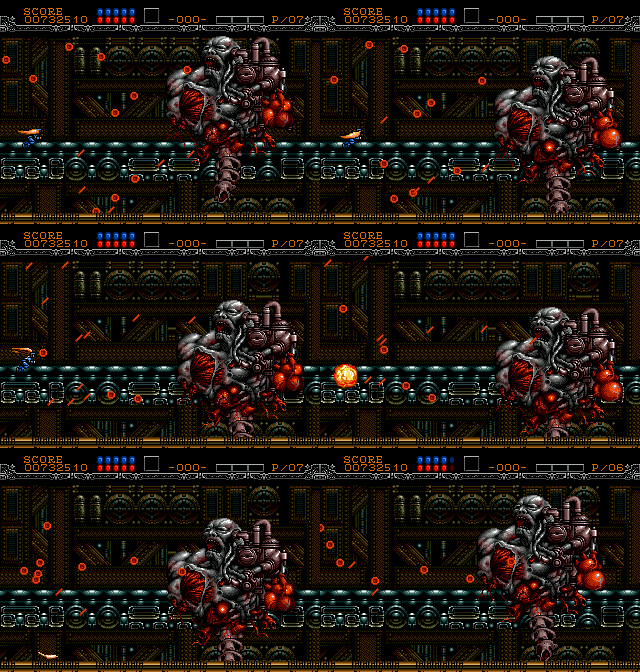
When steampunk costuming goes horribly wrong! Hang on, this guy isn't vehicle with a face. In fact, his face only makes up a completely reasonable percentage of his total area! I can't feel too hard done-by, though: this monster is still so tough he uses a steam boiler as a Walkman. He also attacks by firing red blood cells at you, which doesn't make any sense - they should be white blood cells. Also he's a floating torso with his heart on the outside fighting against a hawk-man. His external heart points to his possible origin as a collaboration between Umbrella and British Gas - an attempt to produce a self-maintaining boiler, maybe (and bio-weaponry, of course). It's also his weak spot, unsurprisingly.
In all seriousness, this boss is great. It looks fantastic, a combination of an interesting design with excellent graphics, and the fight itself is fun. He's got the same tendency to fill the screen with projectiles as the previous boss, but there's more space to move around in and as a result the battle feels more tense and exciting than tedious and frustrating.

For stage five, Wor takes a detour and ends up in Salamander. We're supposed to be saving the planet Iccus, right? I can see why Iccus would have caves and oceans and industrial districts, but organic meat-tunnels? It must be that virus' doing, and the virus also filled the place with floating skulls, monocular space-limpets and vicious amoeba towers.

Also faces. "One face is not enough," said Masaya, "so here's a monster made of loads of faces stuck together." I particularly like the upside-down face at the top, who must be hoping that the seagulls from stage two don't reappear and drop their "payload" into his upturned nostrils.

As for the mid-boss, well, he's just a naked man floating around in a sitting position, occasional sneezing out deadly blue pellets that spilt into several smaller yet equally deadly blue pellets. As far as Gynoug goes, this seems almost quaintly pedestrian. Not so much with the end-of-stage boss.

I tried several times, but there's no way I can talk about this boss without mentioning that his entire lower half appears to be an enormous, bleeding, ventricle-covered alien penis. How did that one slip by the censors? "What do you mean 'It looks like a penis'? That's just his mutated leg. If you're seeing dicks everywhere that's your problem, pal." Thankfully, he doesn't fire from the tip of his, erm, lower appendage. Just everywhere else.
This seems like a good time to mention that Masaya also developed the infamous Cho Aniki series, a series best known for its homoerotic depictions of bodybuilders, vehicles with faces and generally bizarre (and sexual) tone. It would seem that the same graphic designer worked on both Gynoug and Cho Aniki: this does not come as a huge surprise.
Once the mutant wang-beast is defeated, Wor arrives at the final stage of the game.

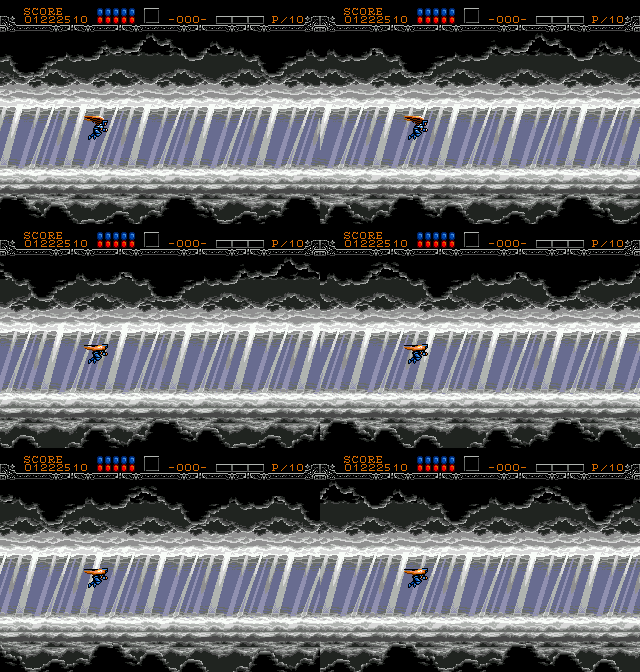
First things first: check out that parallax scrolling. That's a really lovely touch in a game that acquits itself well in the graphics department. It has the occasional mis-step - it can be difficult to see what's going on amidst stage five's veiny bio-nightmare, for example - but on the whole it makes excellent use of a muted color palette, unusual art design and some nice effects like the rotating caverns and these clouds. Sadly, the clouds are the only positive in this stage, and that's because it's a boss rush.

Yawn. Over the time I've been writing these articles, I've come to possess a substantial pool of hatred for boss rush levels and the unimaginative tedium that they bring. I'm fine with having a recurring boss, or a boss rush as a separate game mode, or even including the boss rush as a post-game bonus stage like in Konami's Crime Fighters series. It's just that when it takes up an entire stage - essentially reducing an already short game from six stages to five - it seems like a lazy and ultimately disappointing way of padding out the game.

Speaking of disappointing, here's the final boss. His actual physical form isn't so bad. I can get behind a demonic caterpillar foetus as a final boss, even if he is sorely lacking in the face department. No, he's a letdown simply because he's so tedious to fight. His only attack is to unleash a swarm of what I think are mint imperials into the air. These things float around aimlessly, getting in your way and acting like a slow-moving obstacle course. You can only hurt the boss by shooting him in the eye, and that's fine - the eye is a staple weakpoint of shooter videogames. If you're looking at him and thinking "but he doesn't have any eyes", that's because his eye is that brown sphere in his stomach. You can't hurt it when it's closed, but every five seconds or so it opens for a split-second (and I do mean a split-second) so you can get a hit in. That'd be a difficult enough set of defences to break through, but his hovering golf balls block your shots and they sure do like to congregate around his eye.

His orbs aren't really all that difficult to avoid, so the epic final conflict between good and evil becomes a rather dull war of attrition, with the Destroyer's plan apparently being to bore you so thoroughly that you lose concentration and fly into an orb. It's a real shame, because Gynoug had been a very enjoyable game up until the final stage.
If you have the patience you'll eventually get enough hits in to finish him off and the planet Iccus will be saved, because destroying the Destroyer also removes all trace of the terrible virus. Somehow.

The short ending shows Wor returning to his pedestal and turning into a statue. See, this is where my suspicions that the story presented in the American manual does not correspond to the original Japanese version. I wouldn't be surprised if Wor is actually an angel, summoned out of statue-based storage to fight a demonic evil, hence the final stage taking place in a rather heavenly setting and the hellish tone of the enemies. Of course, this might all be rubbish and the truth is that Wor's reward for saving Iccus is to be turned into a roosting spot for the local pigeons.

Despite the final stage, Gynoug / Wings of Wor has to go down as a good game. I'm by no means an expert on what constitutes a good shoot-em-up amongst the hardcore fans of the genre, but I can say that I enjoyed playing it. It's not just the graphics and the weird artistic stylings, although that certainly helps - it's just a fun and simple game that controls well and is very challenging but never treats you with outright contempt. If you like shooting things in the face, you should get professional help, but in the meantime this might tide you over. Plus, that guy was totally wearing a pirate ship as a hat.

VGJUNK Archive

Search This Blog

Followers