Please note: this article is in no way approved or endorsed by the Coca-Cola Company. I wrote it off my own bat and I am definitely not being paid to talk about the taste and refreshment that only Coca-Cola-brand soft drinks can provide. Death to the Pepsi-drinkers. I mean, uh, here's Aspect and Sega's 1994 Game Gear title Coca-Cola Kid!

He is a kid who loves Coca-Cola, a kid who apparently served as Coke's mascot in Japan for a while and a kid who presumably has no teeth. That's okay, you don't need teeth when you've got buckets of mid-nineties attitude and a pair of bell-bottomed shorts.
Released only in Japan for Sega's battery-chomping handheld, the game's full title is Sassou Shounen Eiyuuden Coca-Cola Kid, which I think translates as something like Dashing Boy Saga: Coca-Cola Kid. If you drank as much carbonated sugar-water as the Kid here you'd spend a lot of time dashing to the bathroom, so we know where the title comes from. To my great surprise this vaguely videogame-shaped cola advert does not have much in the way of a plotline, so you wouldn't be missing much if you don't read Japanese, but I'm playing a version translated into English by someone called "Filler" which means we get the full impact of the game's story.
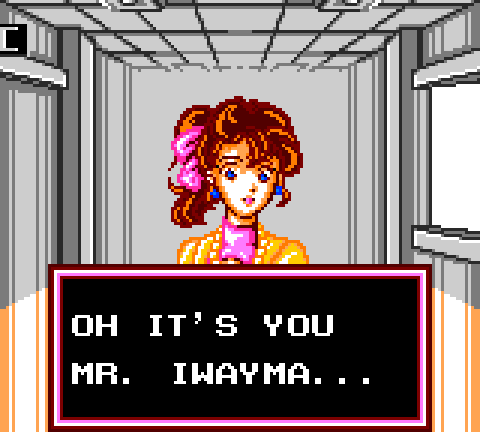
This is Miss Sakurako, Coca-Cola Kid's teacher. She's got a bit of a Barbie vibe to her, despite being a brunette. One of School Teacher Barbie's classroom assistants with a name like Chrissie or Melinda, maybe.

Yes, yes he does.

Mr. Iwayma does that thing where someone takes their glasses off to reveal that they're really beautiful, except instead of being attractive he looks like an early boss from a side-scrolling beat-em-up. He hits Miss Sakurako with the pow-gas, possibly a euphemism for cracking her over the head with a cosh, and then kidnaps her.

CC Kid hears the commotion and, distraught that his teacher has been abducted, sets out to rescue her. That doesn't seem a very likely reaction from a child who's just been handed some free time off school, but then I went to the kind of school where sending your teacher a thank-you card would probably get you a swift kicking after class so I might not be the best person to judge.

The Kid begins his adventure downtown, and if you've ever played a platformer before you'll immediately be comfortable with what's going on. You can run, you can jump, you can kick things, you can jump and kick things at the same time. Coca-Cola Kid falls into that category of platformers that lets you grab on to ledges and pull yourself up, so if that kind of thing excites you then you're in for a treat. Kid can also cling to and leap from vertical walls, just like Mega Man X. Holding down and attack charges up a dashing move for extra speed, longer jumps and the power to smash through enemies. It's a full-featured set of controls, certainly more intricate than I was expecting, and all Kid's moves are intuitive enough that you should have no problem exploring the areas ahead of you.

"Exploring" is a more apt description for the gameplay of Coca-Cola Kid than many other platformers of the era, especially handheld ones, and each stage has a variety of routes you can take by climbing up high or kicking through secret walls. There are a lot of secret wall you can kick through in this game, and while they're never marked as long you slam your foot into every dead-end you come across you'll uncover most of them. Don't worry about the Kid's feet, judging by the size of his trainers he wouldn't feel a nuclear bomb go off it it landed on his laces.

Thorough exploration leads to rewards in the form of power-ups, mostly coins and the occasional pick-up that replaces your kick with a frisbee. Having a projectile attack sounds useful but in almost every situation the jumping kick is better because it covers a larger area, so generally you want to stick with the melee attacks. This makes sense to me. I'd much rather get hit by a frisbee thrown by a child than have said child slam his foot into my face. Something that makes less sense is that in this Coca-Cola game you get power-ups by smashing Coca-Cola advertising, but what the hell do I know? I'm no marketing expert, which is one of the reasons no-one reads this site. Maybe focus groups remember a product more clearly once they've rammed their foot through it.

Speaking of ramming your foot through things, the enemies in this first stage have no thematic connection to either Coca-Cola or the downtown setting. You're kicking robot birds and, for some reason, boxers who roam the streets looking for children to punch. It's a narrow tightrope, this advertising lark - I know for sure that the next time I drink a Coke, I'm going to remember that time I watched a boxer punch a little kid, and hopefully now you will too. Even if it is only a tiny pixel child, I don't think that's the kind of association the Coca-Cola Company were after.

Don't worry if you get hit, because you can always drink some great-tasting Coca-Cola that will restore your health and definitely not contribute to any problems with diabetes later in life. I'm not sure you'd get away with that nowadays, not with "real" products anyway. It's a shame videogames weren't around in the thirties, I could be looking back on games where packs of cigarettes refill your health bar and a radium enema makes you temporarily invincible.

Here's a screenshot of CC Kid performing a kickin' rad skateboard jump. Enjoy it, because it's the only one I've got - the skateboards only appear in the early stages and this was the only time I managed to travel for more than three seconds with hitting something that caused the skateboard to disappear. Once again, jumping kicks are proven to be the most expedient and most effective means of travel.

After two short stages of platform-hoppin', soda-quaffin' action, the Kid faces off against the punk from the intro in what I suppose is a boss battle despite it being the easiest part of the game thus far. The boss throws a couple of projectiles at you - projectiles which look a lot like they're made from cola - and then runs towards you, eager for a kick in the head. Jump over the cola hadoukens, kick the boss a couple of times and the first world is over.

Why, how terribly helpful of you. I will do just that. I hope your comrades in the League of Sinister Villainy don't mock you too hard for getting your ass handed to you by a schoolboy half your size.

Between worlds you can spend any coins you collected at this vending machine. I strongly recommend you buy the life-ups before anything else. Coca-Cola Kid is not a difficult game: I never needed to use a continue, especially not at the start of the game, and purchasing some extra health is a much better use of your CokeBucks.

Despite being a Japanese game starring Coke's Japanese mascot, Coca-Cola Kid must be set in America because the second area is Central Park. I can understand that - after all, there's nowt so American as Coca-Cola. This version of Central Park is a collection of floating grassy blocks patrolled by fat men who can curl up into a ball and ram you like angry woodlice who have indulged in too much of a competing brand of soft drink, so we're not looking at a realistic depiction of New York here.

There's an increased emphasis on jumping in this stage, or rather there's now the consequence of immediate death from falling off the bottom of the screen to contend with. This is a shame, because jumping is by far the weakest part of Coca-Cola Kid, with a strange physics engine that's strongly affected by momentum and, more infuriatingly of all, a noticeable delay between pressing the jump button and Kid deigning to, you know, jump. There are a lot of jumps, especially later in the game, that require you to be right at the edge of a platform to complete them and thanks to the input lag it's far too easy to run off the end of platforms instead of gracefully leaping off them.

Central Park is guarded by this guy, who is defying my attempts to describe him. He's some sort of martial artist, obviously - he's wearing a pink karate outfit and Japanese shoes - but he must have learned his combat skills from one of those mail-order karate courses you see advertised in old comic books because his moves consist of running back and forth and throwing sticks at you, a deadly karate technique that most five-year-olds will master by themselves on a trip to the park. Jump over the sticks, kick the boss, repeat until he gives up.

Yes, it is definitely time for you to retire from your job of dressing like an idiot and lobbing twigs at children.

Stage three is set in the Ruins. The ruins of what? I have no idea. It doesn't even look all that ruined, although the Coca-Cola graffiti daubed all over the walls is rather lowering the tone. The enemies give no clue as to the ruins' former purpose, either: for example, at the bottom of the screen you can see a luchador popping out of a manhole to throw bombs at the Kid. Not a feature of any ancient civilisation that I'm aware of, that one.

Also patrolling the ruins are small whirlwinds, revealed to be assassins when you boot them. So, have these assassins been sent specifically to murder the Kid, or has the kid merely stumbled upon a secret society of hired killers amidst these ancient ruins? The ancient ruins which, I should remind you, are within walking distance of Central Park. Skateboarding distance, at the very most. And what does all this have to do with Coca-Cola, besides the Kid really liking Coca-Cola? I really like Jaffa Cakes, but I wouldn't expect "McVities" to be spraypainted around every place I went if I was on a rescue mission.
I have no answers to these questions, or rather I have one blindingly obvious answer - Coca-Cola Kid is a generic platformer with a soft drink license bolted onto it like a dad who starts wearing an earring at forty because he thinks it makes him look hip. I think that explains everything.
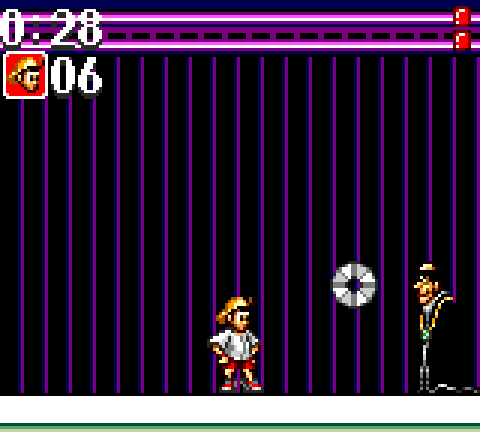
Sticking with the game's theme of having no discernible theme, the boss of the ruins is an Elizabethan minister who attacks by throwing either his neck-ruff or his bald cap at you. All things that I'm sure happened frequently in the royal court of Elizabeth the First, but just when you think you've got this guy figured out he climbs into a big turtle shell and slides around on the floor for a while. I can't add anything to that.

Man, the Kid really did a number on this guy - broke his "helmet," gave him a black eye and knocked all his teeth out. That's what you get for pretending to be a Privy Councillor from the 16th century / a turtle.

The next stage is a steel factory, where the Kid demonstrates the awesome power of Coca-Cola by running across a vat of liquid metal. You don't get that with Dr. Pepper.
You might be thinking that a steel mill is a difficult place to shoehorn references to Coke into, and you'd be right, but it doesn't matter because despite the license the developers don't seem that fussed about pushing the Coca-Cola name. Aside from the first stage, the branding is minimal, limited to having COCA-COLA scrawled on the odd bit of scenery with the level of care and attention normally seen in teenagers tagging a bus shelter with a marker pen. As such, I'd say that of all the games I've played with this kind of tie-in flavour to it, it's the one that's been daubed with the least strokes of the big branding brush.

As I was charging through the level, trying to keep my speed up and get a rhythm going, something suddenly occurred to me. I'm playing as a very "nineties," attitude-having character. The stages are split into two "acts" followed by a single-screen boss fight. There are a variety of routes through each stage. The Kid has a special dash move activated by holding down and pressing a button. This is a Sonic the Hedgehog game! That's why the inertia-heavy jumping physics felt so familiar. I looked it up and Aspect, the developers of Coca-Cola Kid, did indeed make the Sonic games for the Game Gear and Master System.

Here's Coca-Cola Kid alongside the Aspect-developed Sonic and Tails 2, and they are extremely similar. The same scale, look-a-like HUDs and gameplay that feels almost identical means that I'd be very surprised if Coca-Cola Kid wasn't running on a (very) slightly modified Sonic the Hedgehog game engine.

Sadly the boss of the steelworks is not Dr. Robotnik. Instead you have to fight some kind of Cossack with a spear. The Cossack has a spear, I mean. You don't get to use a spear. You just kick things, as always, and avoid the boss when they move across the screen. This boss moves around the screen by rolling into a ball and bouncing, but unless he turned into a three-headed dragon in a beekeeper's outfit who attacks with paperclips he was never going to be as interesting at the previous boss, was he? His main gimmick is staying invincible for ages after each hit, dragging a simple battle out into something that long overstays its welcome.

I guess this final stage won't be a problem then, will it? Not with Infinite Power and all.

The final stage is set in a disco, which sounds like it would be much less dangerous than a steelworks or ancient ruins full of assassins, but if you think that then you haven't taken into account the vicious killer disco balls that fire lasers at the Kid should he get close enough. The glowing figures in the background are nothing to worry about, however. The just fade in and out of sight, the damned souls of clubgoers who were caught drinking rum and Pepsi, the heathens, and thus were banished to a nightmare realm of endless tinny music and flashing lights.

Everything flashes in this stage pretty much all the time - the staircases, the backgrounds, even the Kid himself when he's performing his dashing attack. You'll get a lot of use out of the dash in this stage, along with your wall jumps and your sliding kick. Oh, yeah, Kid can also perform a sliding kick. I forgot to mention it because you need to use it maybe twice in the entire game, and not until this final area. Coca-Cola Kid comes together quite nicely here, cementing its status as an above-average if unimaginative handheld platformer, and if you've played the game this long then you'll hopefully have gotten used to the finickiness of the jumping controls to a degree that lets you enjoy the route-finding, ledge-climbing action.

This is what I mean about the lack of Coke branding. Sure, it says Coca-Cola on the wall but I've seen that so many times I've almost stopped noticing it. Just look at those glass bottles, though - not one of them is in the iconic Coke bottle shape. A missed opportunity, that. Of course, now that I've noticed that I'm worried it means I was supposed to spend my life in (ugh) advertising. What if I have a natural gift for lying to people so they'll spend money on things? Let's test it out - if you donate money to VGJunk, everyone will think you're cool and handsome and the appearance of fine wrinkles will be noticeably reduced.

In keeping with the wholesome family-friendly ethos of the Coca-Cola Company, the final boss of Coca-Cola Kid is a flying dominatrix who tries to whip the Kid from the skies. Hmm. You know, I assumed the plot of this game was going to be about someone trying to steal Coke's secret formula or something, not kidnapped teachers and BDSM enthusiasts. No matter the trials ahead, however, Kid will emerge victorious by kicking all those who oppose him. In this case it's much more difficult than in all the other boss fights, because you have to cling to the sides of the arena first to get the height necessary to hit the dominatrix. She also puts a lot more projectiles into the air than the other bosses, including lightning bolts that travel across the floors and wall and which I only managed to avoid once or twice thanks to their wildly inconsistent hitboxes. Luckily, you only need to avoid them once or twice, because if you avoid the boss' first attack or two and have five hit points remaining you can then forget about avoiding attacks altogether and just trade hits with her because she'll run out of health before you do.

After a few solid blows the boss is defeated and Miss Sakurako is freed from whatever evil organisation had her in their clutches. Overwhelmed with happiness, she almost kills the Coca-Cola Kid by suffocating him with her breasts. I am not making that up.

Wow. Between the mammary asphyxiation and the dominatrix, Coca-Cola Kid has taken on a strange sexual tinge towards the end. Who was that dominatrix, anyway? Just some psychopath who abducts attractive teachers and whisks them away to her discotheque lair? Did she even have anything to do with Coca-Cola? Perhaps she represents the evils of drinking tap water instead of healthy, nutritious fizzy pop. Unlike all the other bosses she has no dialogue when you beat her, and the only other woman in the game is Miss Sakurako, so here's my theory - Miss Sakurako is the dominatrix, and the Kid has simply kicked some sense into her.

Coca-Cola Kid is, on the whole, exactly what you'd expect from a soft drink tie-in platformer for the Game Gear. The giant hand of corporate branding lies relatively lightly upon it, however, and the gameplay has enough extras to keep it interesting for the short play time - the Kid has plenty of moves, the graphics are nice and wall-jumping is always fun. Substandard jumping controls aside, Coca-Cola Kid is an above-average platformer, so if you've played and enjoyed all the Sonic the Hedgehog games then give this a try, and experience the magic of a Sonic game where Sonic is replaced by a kid in a baseball cap who drinks enough cola to dissolve the Statue of Liberty.