Look, I’m getting to be an old man these days so after getting my arse kicked repeatedly in VR Troopers and playing Dark Souls 2 again in my free time, I’ve decided I need a bit of a break. It’s time for something simple, something gentle, something that doesn’t throw my declining reaction times and mental acuity into sharp, grim relief. So, a kid’s game, then. Considering the last time I played an edutainment game starring Mickey Mouse it turned out to be surprisingly not-terrible, I’ve decided to return once again to the House of Mouse with Novotrade’s 1991 Amiga (also available on PC) rainy-afternoon-em-up Mickey’s Jigsaw Puzzles!
With a cheery blast of “Zip-a-Dee-Doo-Dah” issuing from the speakers, Mickey himself appears to greet us. Jigsaw puzzles! With Mickey Mouse! What more do you need to know? I hope the background is not representative of the actual puzzles contained within the game. I was hoping for an easy ride, after all.
With no other preamble, it’s straight into the puzzle-building action. I suppose I’d better show you the first puzzle then, huh? Yeah, I should, but I’m building anticipation. Get a good, clear picture in your mind of Mickey Mouse’s face. You may need to refer to it later.
So you start the game and you’re immediately presented with this. My decision to play Mickey’s Jigsaw Puzzles has paid off in spades, because Mickey’s facial expression gave me the kind of genuine, chest-rattling, wipe-away-a-tear belly laugh that no piece of intentional comedy has in months. It’s just too, too perfect, and represents the closest I’ve ever come to replacing long-time VGJunk mascot Satan Goat in the site’s header. There’s much fun to be had trying to figure out exactly what could cause such an expression, but my two main candidates are that Mickey gambled on a fart and lost, or Donald Duck’s wearing that faux-innocent look because he’s just whacked Mickey square in his mouse-hole with a pipe wrench. Oh yeah, Donald and Goofy are here too, and they haven’t fared much better, art wise. Goofy’s hat now looks makes him look like he should be dealing ecstasy at Glastonbury circa 1998, and given Donald’s bulging eyes I suspect he’s been buying whatever Goofy’s selling. As for the ghost on the right, well, that thing’s just neat. I don’t know if this is the intent, but I can only see it as being swaddled like a baby. A spooky, floating baby.
Okay, fine, the actual jigsawing. You select which picture you want to puzzle out, then you can choose how many pieces the resulting jigsaw will have, from sixty-four all the way down to a mere four. It’s nice to have the option to make things easier for very young children, but as a grown man who has just about managed to stop laughing at Mickey Mouse’s face I’m sure I can handle a sixty-four piece jigsaw.
Nope, I placed Mickey’s eyes down on the puzzle and now I’m laughing again. This might take longer than I had anticipated.
As you can see, it works much as you’d expect it to. Place the piece in the appropriate segment, and if you click in the wrong place the screen will flash so you know to try again. The cursor feels a bit jerky, but other than that I suppose I can’t fault the mechanics.
Because the jigsaw takes up the whole screen, you do have to go to a separate screen to select your piece. That slows things down a little, but I suppose it’s the best compromise available. Could you imagine how much we’d be missing out on if Mickey’s face had been made smaller to accommodate the jigsaw pieces? It doesn’t bear thinking about.
The most interesting feature of MJP is that once you’ve completed a puzzle, you can press the camera button on the right to play a short animation of the displayed scene. For instance, here Mickey opens the chest and bat flies out, the ghost wobbles ominously and the Disney friends talk about how spooky it all is. And I do mean talk, because there are voice samples for the dialogue and it sounds pretty decent for the most part, although Donald’s rasping quacks were always going to be a challenge for a low bitrate sample and as a result he sounds even more like he’s gargling with broken glass than usual.
It’s a shame that this was the very first puzzle that the game shows you, because nothing else in this game is going to live up to it and we’ve already seen most of the gameplay – but I’ve played through it all now, so for the rest of the article we might as well look at all the other puzzles.
Mickey chills out on Mars while a robot servant brings him drinks – drinks that he’s too lazy to even lift his arms to hold, the robot just pops the straw right in his mouth. If I were a political cartoonist I’m sure I could turn this into a panel highlighting the Disney Corporation’s eventual desire to spread their tendrils beyond the Earth itself, but alas I lack the laser-sharp wit and clear thinking of most political cartoonists.
I know his name’s in the title and everything, but a lot of the puzzles seem to go out of their way to remind you that Mickey Mouse is the coolest dude ever and you cannot hope to ever approach even one percent of his incandescent magnitude. Mickey is the alpha and the omega, the standard against which all others are judged and found wanting. That’s why he gets to be the guitarist in the “MM Band” - and you can guess what “MM” stands for. His coolness is rather undercut by the fact he fashioned his guitar from the anchor of Barbie’s Dream Yacht, but he pulls it back with a rather snazzy shirt.
As expected, viewing the animation for this puzzle plays a brief snippet of the band. Mickey and Goofy want to rock, but Donald uses his curiously massive hands to throttle his saxophone into playing a completely unrelated jazz riff. Ever the rebel, is Donald.
Mickey’s also a sports star, naturally – here we seem him on the gridiron, showing some rare fallibility as he fumbles a pass before eventually recovering the ball and presumably scoring both a touchdown and all the mousey cheerleaders. The thing is, these scenes aren’t fully animated, so Mickey’s body stays in place while his limbs awkwardly rotate. Disney is a company that specialises in imagination, which is handy because you’ll need a lot of imagination to believe that Mickey’s actually playing American football.
Mickey’s also good at football, although scoring goals is much easier when there are no other players on the pitch. Unfortunately, no football team in the world (that I know of) wears a kit of pink shirt with a blue band, pink socks and yellow-and-green shorts – I imagine there’s some kind of rule against it to protect the opposition’s eyes – so I can’t pin Mickey down to a particular club.
Oh, and here’s where I realised there’s a different style of puzzle available to you, one where you get items rather than traditional jigsaw pieces and have to place them in the correct blanked-out areas. Obviously this does little to enliven the gameplay, but if you ever wanted to create an image where Mickey Mouse is kicking his own severed head around in from of a crowd of horrified onlookers, now’s your chance.
Mickey Mouse: Radical Skate Dude now, with a deck that’s so intensely of its time that people who are into the whole retro-80s-synthwave aesthetic could only dream of recreating a fraction of its power. Mickey’s also sporting a palm-tree-patterned shirt that I’m sure set him back about two hundred bucks at a fancy boutique.
Yet more sports with a bit of baseball, although once again the focus is on Mickey’s rampant narcissism. Notice how he wrote “I love Minnie” on the fence back there but then wrote his own name at three times the size? And a scrawled self-portrait, too. A show-off and a vandal, that’s Mickey, although thinking back to the places I used to hang out playing football when I was a kid there are a lot worse things he could have graffitied up there. It might still have involved Minnie, but not the word “love.”
Speaking of Minnie Mouse, she’s been notable by her absence so far, but all that will change now that I’m ready to insert disc two and access the second lot of puzzles. I have no shame in admitting that by this point I had resorted to setting all the puzzles to four pieces each, allowing me to complete each jigsaw in an average of eleven seconds. Hey, it means less time waiting around to see fantastic images such as…
...Minnie doing some exercises in a way that cannot be good for her spine. Mind you, she is a rodent and therefore much more skeletally flexible than any human. “Oh, I just love Gymnastics!” says Minnie in a voice so high-pitched that all my neighbours dogs started barking. Given that all she did was flap her hands around a bit, Minnie’s routine is as much gymnastics as me walking over to the kettle and ducking down to get the teabags out of the cupboard is a biathlon.
Minnie plays tennis. Not much else to this one, folks, beside that stray observation that given his proven track record of narcissism, Mickey clearly only loves Minnie because she looks exactly like him.
Back to the exercising – or “mousercising,” as Minnie calls it. The real star in this image is the radio on the shelf. At first you’re like, “how cute, a Mickey-shaped radio” but then you look more closely at those eyes – pink-rimmed, fleshy and wet with tears – and you start to wonder if that radio is entirely mechanical. It also looks more like a koala than a mouse.
Now we’re in Minnie’s boudoir, in a scene that immediately brought back surprisingly strong memories of the Dream Phone board game. By now Mickey’s constant presence should come as no surprise, but if you’re like me you’ll spend a good few minutes trying to figure out the perspective here that allows Minnie to look at the picture of Mickey even though it’s hanging on the wall behind her.
Don’t you bloody well threaten me, Mickey. I don’t care if you are dressed as a skinhead, I won’t be intimidated by a mouse even if said mouse does look like the kid from This is England.
Oh, and I see Goofy’s got his usual hat back. The big hat is just for spooky castles, I guess.
Yep, those are horses. I think. Okay, so I’m not so sure about the one on the right because it’s only got three legs and glowing demonic eyes. Protoplasmic elder beasts that have temporarily assumed a vaguely equine shape, at the very least. As they ride through the desert on a horse with no soul, look at Mickey and remember that in cowboy movies “black hat” is a term for a bad guy because they, well, wear black hats. I rest my case.
I hadn’t really noticed before, but while I’d say the graphics in MJP are mostly okay (although the Amiga could do a lot better) everything does look very rubbery, as though all the characters are encased in PVC. I mean, look at Minnie’s skirt, that’s definitely not fabric.
And finally, just as we’re getting into “Krusty Visits Relatives in Annapolis, Maryland” territory, we reach the final scene. Mickey goes for a swim. For some unknown reason I was expecting something a bit more… climactic. A group shot of all the characters, Mickey ascending to his eternal throne as the Earth’s new ruler, something like that. Instead we get tiny sharks and a weird-looking starfish. The starfish flops around listlessly, and so I feel a certain kinship with it as Mickey’s Jigsaw Puzzles limps over the finishing line.
Well, those were definitely some jigsaw puzzles. No doubt about that, and as such it’s difficult to judge the game as a whole. I suppose it partly comes down to price: if this was sold as a full-price retail game back in the day, a parent would probably feel a bit ripped off even if it did come with a real 24-piece jigsaw (or at least the PC version did). I reckon kids would enjoy it, though. It’s simple enough to be perfectly suitable for very young children, the selectable piece counts and alternate “shadow” mode give it a bit of extra longevity and the sounds and animation are pretty fun. Put it this way: if this game had featured He-Man or The Real Ghostbusters rather than Mickey Mouse, the six-year-old VGJunk would have been all over it. So, I suppose that’s a tentative thumbs up on MJP, although frankly the game could have caused my monitor to squirt skunk spray into my eyes at regular intervals and that Mickey face in the first puzzle would have made it all worthwhile.
Showing posts with label puzzle. Show all posts
12/06/2018
24/09/2015
MOUSE SHOOTER GOGO (ARCADE)
Today, a game of cat and mouse. More accurately: a game of cat, mouse, a bunch of other animals, many familiar videogame mechanics rolled together like so many differently-coloured lumps of Play-Doh, and balls. Lots of balls. It's Metro's 1995 match-and-pop-em-up Mouse Shooter GoGo!
That is, a mouse who shoots, you don't spend the game shooting at mice like a Depression-era ratcatcher. For that experience you'll need to play Hobo Joe: Ratslayer, coming to Steam in 2016. No, this is the game for you if you're into shiny, rubbery cat heads such as you might find on the S&M gear of a sexual deviant who's really into the Pink Panther.
Here are the mice that star in Mouse Shooter GoGo. The unnerving, a-little-too-close-to human mice, the mice that are surely the mascots of a family pizza restaurant franchise in some other universe. They're having a fun time visiting the Bizarro-Cinema, where the screen is behind you and all the seats are leather sofas. What movie are they watching? The Story of These Two Mice, starring these two mice, a moving tale of these two mice trying to impress two classy mouse ladies despite their romantic intentions being severely handicapped by the wrestling singlets they appear to be wearing.
Not to worry, the mice have a plan, and the plan is... hell if I know, they're examining the blueprints for something - something roughly shaped like a cat's head, now I look at it again - and they like what they see. Those mouse girls are going to love whatever this thing is!
Side note: if you have to rip holes in your hats so they fit over your enormous ears, maybe don't bother with hats. Wear a bandanna or something instead, or get a pair of smaller hats, one for each ear. Also, I thought that mouse was winking, but he isn't. His eye is still open, he's just contorting his pupil. I'm starting to dislike these creepy mouse-men.
There are some fairly detailed instructions included in the attract mode, which is always helpful although Mouse Shooter GoGo is simple enough that you'd pick most of it up just by playing the game for a couple of minutes. The basic aim is to throw the ball / severed animal head that your mouse is holding into the balls of the same type that are freely bouncing around the screen. In this case, you can see that the mouse is holding a panda head, so throwing it into that group of four panda heads will cause all the panda heads to disappear. If it hits a non-matching ball, like the pink cat, the blue dog or the golden pig, it will stick to them and make the clump bigger.
I'm not going to lie, I'm immature enough that I laughed when I first read this because it sounds like something you'd overhear on the set of a particularly unpleasant pornographic movie. Why will the balls stick together? There are so many wonderful possibilities! You should discuss these possibilities with your friends and neighbours. Call up your father-in-law and ask him, I'm sure he'll have a few exciting opinions on the subject.
Here's stage one, and you'll see that Mouse Shooter GoGo is a more action-heavy version of Puzzle Bobble with the target-splitting mechanic of Pang thrown in too - if you, for instance, popped the cats and pigs in the middle of this arrangement first then it would split in two and that'd give you twice as many things to avoid. Fortunately your mouse can run wherever you like on the screen and can throw his balls in any of the eight joystick directions: press the second button to switch to "free" aiming" and press it again to lock your firing angle in. This freedom of movement is something that takes a little getting used to - or it did for me, anyway. I was so hidebound by the familiar mechanics of Puzzle Bobble that moving away from the bottom of the screen or firing at an angle that wasn't "straight upwards" felt wrong somehow, which is a bit worrying. Do I really lack the imagination and creative thinking required to play an arcade game from 1995? Christ, I was hoping for a reasonably playable action-puzzle game, not a searing indictment of my own flawed psychological make-up.
Other than exposing my psyche as lacking a certain amount of mental fortitude, Mouse Shooter GoGo works quite well as an action/puzzle hybrid, although as I say the emphasis is definitely on the "action" part of that equation - the only puzzling that needs doing is figuring out which balls you should burst to keep the clump in as few separate pieces as possible. It's a lot easier to dodge two large, slow-moving pieces than it is to avoid a cavalcade of balls flying at you from every angle, as the actress said to the bishop. The colour of the ball in your mouse's hand is randomly generated each time you throw the previous one, summoned from the Decapitated Animal Dimension by the same dark force that twisted these mice's forms into the crude mockery of humanity you see before you, so sometimes you'll find yourself unable to do much with the ball you're given. It's ironic, like ten thousand cat heads when all you need is a snake or a frog or a very unwell Pac-Man, whatever the green things are supposed to be. On the other hand, you're only ever given balls that match the colours still active on the play field, which is a nice concession.
For such a simple concept, Mouse Shooter GoGo has plenty of smaller gameplay elements bolted on to it. There are non-animal-head balls that act as power-ups, giving you extra time or changing large numbers of balls into the same colour. Your mouse dies if a ball touches him, but to defend himself he can use the ball he's holding to bounce away any balls that come at him from the front and blimey, I sure am typing the word "balls" a lot in this article. I'm up to my neck in balls, like a tiny person at poorly-planned orgy. Oh, and if you can create a straight line of ba... bubbles and put a bubble of the same colour at either end, all the bubbles in between will switch to that colour. It doesn't come up very often unless you're shooting for a high score, which is something I've never been all that interested in.
The mouse ladies appear every time you clear a stage. Do their breasts jiggle when they jump? I think you already know the answer to that. I'm not sure which is the more depressing scenario: the artist sitting down and thinking "finally, my chance to share my sexy rodent fantasies with the world!" or a project manager type - in my mental fiction, a fat man wearing suspenders and smoking a cigar - leaning over the artist and saying "no, make them sexier. Sex sells! What do you mean, 'sexier how?' I don't know, give 'em some cleavage, have one of them flash their knickers at the player. You're the artist, you figure it out!"
This stage's background is based on French artist Georges Seurat's painting A Sunday Afternoon on the Island of La Grande Jatte, which I mention for two reasons. One, it's a striking counterpoint to sexy cartoon mice and two, I'm pleased with myself for remembering the artist's name well enough to Google it properly. Sure, I misspelled it as "Serat" but that's close enough for me, and it's nice to know I possess some cultural knowledge beyond videogames and slasher movies.
Not content with cribbing their gameplay from Puzzle Bobble and Pang, Metro decided to squeeze some "inspiration" from one more classic game by including the brick-smashing action of Breakout. It works okay, I suppose, especially in later stages when some balls are precariously contained within a prison of fragile bricks and you're trying to be careful not to release them too early. In fact, Metro deserve some credit for taking so many (possibly over) familiar elements and building a decent game out of them that never feels too overburdened.
A boss battle heaves into view, between our mousey hero and fat cat wearing mittens. Maybe he's called Mittens. Maybe he's the reason Mittens is a common name for cats, although now I'm writing this sentence I just realised that it rhymes with "kittens" so that could have something to do with it. I'm rambling about cat names because there's not really anything to say about this fight - the cat curls up into a ball and rolls towards you, which might be adorable if the cat in question wasn't built like King Hippo. The cat is very slow. You are in almost no danger at any point unless your fingers suddenly drop off and the boss kills you while you're adjusting to controlling the joystick with your teeth. Throw balls at the cat until it's health bar is empty, move on to the next stage. It's basically the worst Tom and Jerry cartoon ever.
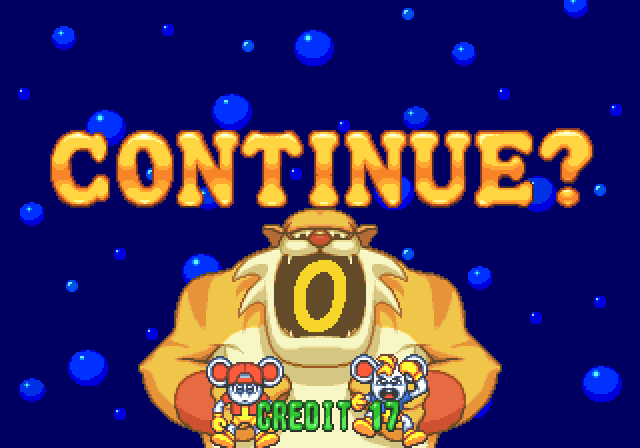
If you do manage to lose all your lives at some point, you're treated to a continue screen showing the mice about to be eaten alive by said cat. The mouse on the right is struggling against this grim fate, but the mouse on the left seems resigned to the fact that reincarnation exists but he can only come back as a hairball.
Not to worry, if you don't insert any more credits the mice drift away to Mouse Heaven, where cheese is plentiful, Rentokil employees are forced into subservience and cats are most definitely not admitted. They go to Cat Heaven instead, which is almost indistinguishable from the normal life of a pet cat with an attentive owner.
And so Mouse Shooter GoGo continues as before, with thirty stages of bubble-bursting antics. The backgrounds change and the bubbles are arranged in different configurations, but that's about it. In this instance they originally spelled out "OK!" but they've drifted around the screen a little. They're not threatening to knock me out or anything.
There's another boss battle half-way through the game, this time against two cats, and they that look much more like cats than the first boss did. That thing looked like the Rancor from Star Wars in a fursuit. The Double Cats are more of a challenge, because there are two of them but mostly because they can throw their own supply of balls at our hero. They're still not particularly difficult to defeat, but they're like a goddamn Dark Souls boss compared to the fat cat, and they provide a welcome break from the usual ball-matching gameplay.
I'll be honest, having this snaggletoothed samurai gunman staring up from beneath me was a bit distracting. I wanted to know what his story is. Whatever it is, there's no way it's less interesting than Mouse Shooter GoGo - like, who gave him that gun? He doesn't look like he could be trusted with a bunch of daffodils, never mind a firearm... although if you look closely, it appears to be one of those "BANG" flag joke guns. This is why you have to be careful about including compelling details that are more interesting than the game they appear in, because I've now lost all interest in popping bubbles and instead have become fixated on who this samurai is and what member of the daimyo's court he's pulling pranks on.
The difficulty level is all over the place, too, with stages wildly varying in challenge from one stage to the next. This is the penultimate stage, which appears simple at first until you realise that removing the black bear heads from play means the big lump will immediately split into ten smaller, independent lumps, and even with the mouse's nimble footwork and ability to push balls away from him it's going to be a real struggle to avoid being pinned down. In the end I spent so long dithering about that I ran out of time, at which point the walls of the stage began to close in. I always enjoy it when games handle their time limit in this manner as opposed to just having you spontaneously drop dead when the clock hits zero as though you're fitted with a combination pacemaker / alarm clock, because it always feels that little bit more special when you manage to win despite the increasingly hazardous conditions.
Then there's the final stage, which is surprisingly easy. It's also Space Invaders: you stand at the bottom and fire upwards at the solitary bubbles that move left-and-right across the screen. Let in never be said that Metro didn't try to learn from the classics. Or steal, steal works fine in that sentence too.
Mouse Shooter GoGo then unceremoniously and abruptly ends, with not even a final boss battle to contend with. It could have been against, get this, three cats! I can't believe anyone would pass up an opportunity like that.
As for the ending, the mice take a celebratory road trip across Mouse Land while the mouse girls pose seductively at the bottom of the screen, Metro being fully committed to the challenge of getting the player to be into that kind of thing. The trouble is, if you ignore their giant satellite dish ears, the mouse girls look more like the results of a DeviantArt search for "sexy Stay-Puft Marshmallow Man" than anything else. Who ya gonna call? Someone who can extract these nightmare visions from my mind, hopefully.
The game closes with the bizarre image of our rodent heroes relaxing on the beach, completely unperturbed by the conga line of crustaceans that is scuttling along their bodies. That's why the mouse girls are nowhere to be seen, they don't want to catch crabs.
Mouse Shooter GoGo may not be an amazing game or a life-changing experience, but it did break this month's streak of me only playing truly awful games, and I ended up enjoying it rather more than I expected to. It's a simple concept executed well, somehow managing to remain simple even as new gameplay elements are added, and I don't have any complains about how the gameplay feels. Presentation-wise it's a mixed bag, with some charmingly-drawn graphics but a soundtrack so forgettable that I only remembered to mention it because I made a note reading "did this game even have a soundtrack?" It's also unusually easy for an arcade game - the first time I played it I made it about two-thirds of the way through on a single credit, and as long-time VGJunk readers will know I am not good at videogames. So, if you're looking for some simple, undemanding arcade puzzle-action gameplay, or if you want to play Puzzle Bobble, Pang, Arkanoid and Space Invaders but are on a tight schedule, then give Mouse Shooter GoGo, ahem, a gogo.
Labels:
action,
Arcade,
metro,
mouse shooter gogo,
puzzle
21/08/2013
MAGICAL ERROR WO SAGASE (ARCADE)
So, this game is called Magical Error wo Sagase, and to be honest I only played it in the hope that it'd be about an accident-prone wizard. You know, always leaving his wizard's staff on the bus, accidentally summoning a basket of summer berries instead of the underworld's most hideous and bloodthirsty demons. Sadly, Technosoft's 1994 arcade offering is not about wizards, clumsy or otherwise. If I tell you that Magical Error wo Sagase translates as Find the Magical Error, that should give you a clue about what the player is expected to do in this game. I hope you've got the eyesight of a hawk - unless hawks are colourblind, in which case even they might struggle.
No matter what the title screen says, you should never, ever insert corn into an arcade cabinet or any electrical device. Not only will you void your warranty, you'll attract electro-rats. I don't care if grains are used as currency wherever you're from, don't insert them anywhere besides the ground or your mouth.
Some Japanese that I can't read appeared. It might have been important, but I was too distracted by the player characters at the bottom of the screen to pay attention. Even for something born from the world of anime, where the eyes are enormous and the noses have receded into nothingness, these kids seem especially anime-ish. I think it's because you can see the whole of their irises, giving them the wide-eyed expressions of someone who has just stepped, barefoot, into something squishy but unidentified. Also, check out that blue-haired kid's eyebrows, he could give Kenshiro a run for his money.
Once the game begins, it immediately becomes clear what's going on - Magical Error wo Sagase is actually Spot the Difference: The Videogame. Two almost-identical pictures are displayed, and it's up to you to move the cursor around the left-hand picture, clicking on any variations between the two images. Find three differences, move on to the next image.
As it's right at the start of the game, the differences in the picture above are all pretty obvious: the dog and bird are different colours, Spherehead-san the Samurai Mannequin has a peach on his headband and best of all that sweet old couple in the background of the left image are transformed into cast members from a geriatric recreation of Reservoir Dogs.
Naturally, the transition from "activity found in children's colouring books" to "arcade game" means that Magical Error can put its own spin on the subtle art of comparing two pictures. For one thing, they're animated. Not too much of a problem with the early, much easier puzzles, but later on all that movement can make things tough. The pictures are also mirrored for some reason, which has the effect of making differences close to the middle much easier to spot than those at opposite ends.
It's the "game" element that's the big change, of course, because you can't release an arcade game that allows the player to carry on indefinitely without pumping in more credits. You have a life bar, and as you can imagine time is your greatest foe - your health gradually ticks down, forcing you to hurry. If you make a mistake and click the picture in a place with no differences, you lose a chunk of your health bar, which raises all sorts of questions. Are those kids wired up to a generator that electrocutes them after each mistake or something? It'd certainly explain their facial expressions. Look at the blue-haired kid in the screenshot above, I've seen people passing kidney stones that didn't look so pained.
Finding errors, magical or otherwise, is what you do in this game, and as such I've already shown you pretty much all there is to it. It gets more difficult as you progress, obviously, with denser images to scan and the required number of differences to spot rising from three to four to five. Some images pan around, showing you only a portion of the whole at time. The early puzzles in each stage work on a grid system, with the joystick moving a box around the screen that highlights one square on the grid, but later on this is replaced by a simple pointer that requires much more accuracy for a successful hit.
Magical Error is all you'd expect it to be and very little else, so why did I decide to dedicate a whole article to it? Well, for one thing I'm fascinated by games that take a simple, quiet pastime and turn it into a flashing, blinking, bells-and-whistles videogame with a competitive edge and the strange dichotomy that brings up. Aryol and Pieces did it for jigsaws, Quiz and Dragons gave pub quizzes the Dungeons and Dragons treatment, and now Magical Error has done it for spot-the-difference. Any day now I'm expecting to play a zombie-apocalypse-themed wordsearch game, where each discovered word causes another undead skull to explode gorily across the screen. Smartphone app developers - there's a free one for you.
The other reason is that I really like the pixel artwork in this game, and a lot of the puzzles are pleasantly daft, so I'm going to talk about a few of them.
Here, a girl is baffled by some extremely small bunting. Maybe she's organising a street party and now she's mortified that the neighbours are going to laugh at her sub-standard decorations.
Don't go down to the beach - a horrifying creature formed from human limbs and leftover bikinis has dragged itself ashore and thirsts for the blood of man! Raw terror lurks amongst the dunes! Nerve-shredding evil hunts along the coastline, although it's always careful to pay attention to the local tide times and plan its attacks accordingly! It's Octobeast, wetly dragging its way onto a cinema screen near you! Rated 12, contains mild peril and comic cryptozoology.
Ah yes, a pervy favourite of Japanese comedy - the old "men try to sneak into the women's side of the hot springs" bit. Except that's a dog climbing over the fence on the right. Why would a dog be so desperate to get over to the other side of that fence? What was going on back there? I think the expression of the man peering over the top clues us in that it was something unpleasant.
What looks at first glance like a simple scene of healthy young men playing basketball falls apart on closer inspection. For one thing, that's a medicine ball, not a basketball. Playing basketball with a medicine ball is going to make throwing three-pointers rather difficult, but it would definitely strengthen the upper body. More confusingly, Number 7 here doesn't seem to be jumping. He's just, like, ten feet tall. Kid's got a bright future ahead of him in the sport, assuming his legs don't collapse under the burden of belonging to an actual giant.
"Yes, Cinderella, you shall go to the ball. Did I mention that the ball is being held at the Playboy Mansion? Also, I amputated one of your legs below the knee. No need to thank me, it's all in a night's work for Fairy Satanmother!"
At one point, you have to spot the errors in a picture of duck-headed biomechanical death-bot. Alright, so maybe not a duck, but definitely some form of aquatic robo-life. It's a jolly little stage which illustrates how mean the game can get towards the end - you see that little blue octopus thing near the main creature's tail? It's an ever-so-slightly different shade of blue in the other image. This is what I mean about the colourblind not exactly being catered for in Magical Error.
That's not the interesting bit, though. Depending on your definition of interesting, a definition that I fully accept this tidbit may fall well outside, you might be interested to learn that this is actually Gargoyle Diver, one of the bosses from Technosoft's Megadrive shooter Thunder Force IV.
He doesn't look quite as cheerful in his original incarnation.
I'll be honest, I was expecting a cameo of this sort at some point in the game, simply because Magical Error is so far outside Technosoft's usual wheelhouse. Technosoft made shoot-em-ups, for the most part. The Thunder Force series is probably their most famous work, and the two Technosoft games I've previously written about, Hyper Duel and Elemental Master, were both about shooting things. Magical Error represents something of a departure for them and I would have been shocked had they made a game that's ninety-nine percent looking at pictures with slipping in some reference to their lasers-and-spaceships foundations.
I say "ninety-nine percent" because after every five puzzles, you get to play a bonus minigame for the chance to fill up your life bar and they require skills separate from those used by the average proofreader.
Skills such as button mashing, which is all the first bonus round consists of. Actually, that might be a little unfair because there's definitely an optimum rhythm to it beyond simply pressing the button as fast as you can. Tap the button to punch down the tower, either rhythmically or as though each time you pressed it another zero was added to your bank balance. That's it.
The girl on the right looks very familiar, but I can't quite place where I think I've seen her before, if indeed I have seen her before. Another cameo, perhaps? If you know, tell me in the comments. There is no prize beyond the warm satisfaction of helping your fellow man.
The second bonus round is a simple memory test, where random items are thrown between what look like two large and intricate slices of Battenburg cake and you have to select the corresponding items from your bingo card of object. The only real difficulty you're likely to face here is that the bunch of bananas and the rubber gloves look very similar, which is probably why all the major supermarkets keep the cleaning products so far away from the fresh fruit. Frustrating when all I came to buy was bleach and ingredients for a fruit salad (which I will later poison with bleach) but if stops just one kiddy from choking to death on a pair of Marigolds then I suppose it makes sense.
Hey look, it's Pop-Up Pirate! Except, you know, with a pig instead of a pirate. Maybe he's illegally uploaded hundreds of shaky camrips of the latest blockbuster movies and that was enough to condemn him to the torture of the barrel-o'-knives. Someone's written "KILL YOU" on that barrel, so they obviously mean business.
Next up, a maze to navigate. You're briefly shown a top-down view of the whole maze before being switched to this tight-focus view, and the idea is that you're supposed to memorize the top-down plan and then translate it to this isometric viewpoint as you make your way to the goal. In practise, you'll just remember roughly what corner of the maze the exit is located in and blindly stumble your way in the general direction. It seemed to work for me.
Lastly, there's a sliding block puzzle. Slide the blocks around to create a path for Mr. Penguin. I hate sliding block puzzles and thus refused to participate, leaving Mr. Penguin stranded on the starting block. Good. I would rather a million boggle-eyed penguins be kept from their goals than have to endure a sliding block puzzle.
Back to the actual game, and now that we're nearing the end Magical Error has redoubled its efforts to give me permanent eye strain by making me peer into a dark and writhing mass of insects. I'm sorry, Technosoft, but if your videogame experience can be replicated by sticking my head into my neighbour's compost bin then you can't be surprised when I lose interest. I don't need to put 100 Yen into the compost bin, now do I? Although funnily enough it would be a perfectly suitable place to Insert Corn.
I did lose interest towards the end, to be frank. If you've spotted one difference you've spotted them all, and as Magical Error reaches its climax the puzzles just about cross the line between "challenging" and "headachey and frustrating." A few items or special events might have livened proceedings up a little, but there's none of that included here: just the same gameplay as the first stage, copied for every other stage. It's to Technosoft's credit that they managed to keep such a slim premise entertaining for more than two or three minutes you'd expect it to bore you in, mostly thanks for the fun animations and charming pixel work.
I mean, who wouldn't be charmed by the Cavalcade of Edible Delights, starring a delirious, cartwheeling onigiri and a chicken whose dark eyes and angry demeanour suggest it might snap at any moment and shoot up the nearest branch of KFC? I'm charmed. Only a little, but just enough.
This Formula One scene was the last puzzle that Magical Error threw at me. It's a good job it was the last one, because after spending so long scouring these pictures for minute differences my eyes were about ready to stage a revolution and exit my skull via my ears. In the end, I resorted to wildly tapping the screen in search of differences - that's what the blue crosses represent. My failed attempts, each mistake costing that poor boy a portion of his very life essence. Then I ran out of time and cleared the scene anyway. Yup, if you run out of time - as opposed to running out of health - you just move on to the next scene or, in this case, the ending.
Magical Error wo Sagase is a game that takes a concept that didn't need to be turned into a videogame and does a decent job of turning it into a videogame. Why? Who the hell knows. Technosoft ran out of ideas for shoot-em-ups, maybe. Perhaps they were on a tight deadline and they figured a spot-the-difference game would be be quick and easy to knock out. Whatever the reasons, we're left with a competent if low-effort title that you could probably have fun with for fifteen minutes / until the inevitable eyeball rebellion.
It's a shame Technosoft didn't try to mix up the gameplay even a little, and some items or special skills might have been a good idea - something to give you the occasional clue, at least, because blindly clicking all over the screen will only rarely work out in your favour. But, hey, spot the difference. I spotted some differences. There were colourful moving shapes to reward my error detection skills. My primitive cave-ape brain was momentarily satisfied. It's over now. Back to the cave. See you next time.
Labels:
Arcade,
magical error wo sagase,
puzzle,
technosoft
Subscribe to:
Posts (Atom)