13/02/2018

FIGHTERS OF THE WORLD: BRITAIN

Sure, why not; let’s have another "Fighters of the World" article, where I take a look at a selection of fighting game characters that all hail from the same country and try to discern which crude stereotypes crop up most frequently. This time, I’ll be covering my own noble nation – the green and pleasant land of Great Britain!


Or maybe it's “England” - "England" in quotation marks because, as demonstrated by the above screenshot from the original Street Fighter, many games use the flag of the United Kingdom to denote England. England has its own flag, thank you very much, although it really only gets a lot of public display when the England football team are involved in a major tournament and it has thus (to me, anyway) become a symbol of disappointment and feeble capitulation. A lot of these fighters are described as being from England but appear under the British flag, so if you want to pretend some of these characters are Scottish or Welsh then go right ahead.

Cammy, Street Fighter


Any given nation’s most famous fighter usually appears in Capcom’s Street Fighter series, and Britain is no exception with Cammy. When she first appeared in Super Street Fighter II, she was a special agent working for the British intelligence agency MI6: later games revealed her to be a clone of the evil M. Bison, who brainwashed Cammy into working as an assassin. Now, far be it from me to criticise MI6’s hiring policies, but giving an espionage job to someone who was once under the mental control of the world’s most evil person seems like carries a certain amount of risk. I guess Cammy’s expertise in kicking people to death outweighed the risk that her “mindless slave under the thrall of the deadliest terrorist ever” persona would re-emerge.
As for being British, I suppose the main trait that Cammy shares with most British fighting game characters is that she’s blonde. Lots of British fighting game characters are blonde, although not as frequently as French fighting game characters. I don’t think that’s necessarily a “British” thing, though, it’s just that most of the characters on this list were designed by Japanese artists and they tend to give blonde hair to most non-Asian characters. Cammy also has one of the two main British videogame accents – the “posh” one, rather than the Dick van Dyke-inspired semi-Cockney one. That’s another of the countless reasons that I love Bloodborne so much: it’s one of the few games to feature a knife-wielding plague doctor with a Yorkshire accent.
Cammy doesn’t have much about her that marks her out as being from the UK, then, but I suppose that’s because she isn’t really from the UK, she’s from whatever country M. Bison’s cloning lab was based in. Maybe Capcom’ll release a game set after Street Fighter Alpha where Cammy undergoes a  My Fair Lady-type procedure to gain her accent. I’d play that.

Birdie, Street Fighter


Cammy wasn’t the first English character in the Street Fighter series, though. That honour goes to the hulking bruiser Birdie. I suppose it also applies to moustachioed stick-carrier Eagle, because both characters debuted in the first Street Fighter game. Birdie’s the more interesting of the two, though, with his mohawk and his leather-punk look. But you might be thinking “I’ve played other Street Fighter games where Birdie looks, erm, different,” and you’re not wrong.


Birdie received a makeover in the Street Fighter Alpha games. The most noticeable change is that he’s black now. I say “now,” Birdie was always black. We know this because one of his Street Fighter Alpha 3 win quotes reveals that he looked pale in the original game because he was ill. I have to commend Capcom’s front in saying “oh yeah, this is totally the same guy,” because why the hell not?
Other than the obvious, the biggest change to Birdie’s later designs is that he’s now even more cartoonishly “punk,” swinging metal chains around and advancing mohawk technology to never-before-seen heights by creating a hairdo with a hole right through the middle of it. I must admit, as a kid I spent more time than I probably should have trying to figure out the mechanics of Birdie’s hair. I came to the conclusion that it should be possible in the real world, and seeing Donald Trump’s hair has convinced me that there are people out there who can work such structural miracles. Of course, Birdie exists in the Street Fighter universe, so he can just get a can of whatever hairspray Guile uses and eliminate all the hard work.
Birdie got yet another revamp for Street Fighter V: he’s still a punk with a mohawk, but he’s become a comedy character who eats all the time and is now overweight. I like it. Street Fighter characters have generally had almost no development even after thirty years, so for Birdie to have had three separate “phases” honestly makes him a bit more interesting to me than some of the classic cast.

Dudley, Street Fighter


Finally for Street Fighter characters we’ve got Dudley, the gentleman boxer. So much of a gentleman and so good a boxer that he was knighted by Queen, even. I’m sure he threw some charity work in there too, that’ll always help to get you on the Honours list. Dudley is the kind of British character I was expecting to see a lot more of on this list: the aristocrat, the toff, the upper-crust type who has a butler and everything. Maybe it’s just a British thing to be obsessed with the class divide, but I’m surprised there weren’t more fighters like this, partly because you often hear that one thing other countries like about Britain is that we’re still clinging to something as “charmingly” outdated as a monarchy.
Of course, there’s a good chance Dudley takes some inspiration from real-life British boxer Chris Eubank, a man who used to get lumbered with the word “eccentric” more than probably anyone else in the British public eye. Eubank liked to dress in an exaggerated “aristocratic” manner, complete with monocle, so I wouldn’t be surprised if Dudley was indeed inspired by Eubank… but given Dudley’s moustache, his striped trousers and alternate Street Fighter IV costume and a couple of his poses, I think there’s also a fair amount of Freddie Mercury in Dudley’s design.

Narcis Prince, Super Punch-Out!!


Moving on to Nintendo’s puzzle-game-adjacent boxing series Punch-Out, a franchise where the character roster is almost entirely composed to crude national stereotypes. He’s where you’d think you’d find a boiled-down idea of how certain Japanese games developers imagine British people, but Narcis doesn’t really fit into any particular category. He’s blonde, of course, but other than that his gimmick is that he’s a pretty boy who hates being punched in his face. Turns out Narcis and I have more in common than I thought we would.
Looking at him, and remembering playing Super Punch-Out as a kid, I’d always assumed that Narcis was supposed to be another upper-class posho type, but that’s only because I never managed to complete the game back then. I couldn’t beat Hoy Quarlow, the cheating old bastard. If I had made it to the ending…


...I would have realised that Narcis is, in fact, common as muck. I’m surprised he’s not saying “cor blimey, guv, you’ve punched me right in me boat race and no mistake!” He’s Danny Dyer with a floppy haircut, that’s what he is.

Steve Fox, Tekken


Here’s another blonde boxer – it’s Steve from Tekken! This makes three boxers in a row (although Narcis Prince doesn’t really count because Punch-Out is a boxing game) and I wouldn’t have been surprised if boxing had emerged as a stronger theme amongst these British fighters. The Queensberry Rules did originate in Britain, after all, and for such a small country we’ve had a lot of successful boxers.
Like so many videogame boxers, Steve was a world champion who had to step out of the ring for one reason or another and enter the violent world of street fighting. Usually it’s for a reason beyond their control, because why else would you give up boxing for street fighting? The sweet science may be a brutal game, but at least there’s a referee there to protect you and you’re unlikely to have your head slammed into the cold asphalt of a dingy back alley by a giant Russian wearing tight briefs. In Steve’s case, he refused to throw a fight for the mafia and now they’re out to kill him. Being away from boxing gives Steve more time to explore the mysteries of his uncertain parentage, eventually discovering that his mother, fellow Tekken fighter Nina Williams, had her eggs harvested while she was in cryogenic suspension. As a result, Steve is about the same age as his own dear mum, so they can batter each other into unconsciousness without anyone raising an eyebrow. Fighting games, eh? What wonderful worlds they weave.

Ivy, Soul Calibur


Ivy’s English, huh? I don’t think I ever knew that. Then again, it took me a long time to realise that the initials of Ivy’s full name, Isabella Valentine, are IV and that’s presumably where "Ivy" comes from.
What can I say about Ivy’s design? I mean, what can I say about Ivy’s design that allows VGJunk to remain relatively family-friendly? Not much, that’s what. And the design pictured above (from Soul Calibur II) is one of Ivy’s more restrained looks, if you can believe it. Whichever designer at Namco keeps saying “no, make her sexier. Sexier!” with each passing game needs to settle down a little, maybe take a cold shower or fifty.
It’s probably pointless to look for any common themes of “Britishness” in Ivy’s design. “Busty 16th century dominatrix with a pirate ghost for a dad” is, if nothing else, a very unique concept. Not particularly British, mind you. Maybe if she spent the entire time she was fighting complaining about the weather, that’d make her feel more English. Mind you, in that outfit you’d probably complain about the weather wherever you’re from.

Arthur, Soul Calibur


Another British Soul Calibur fighter is Arthur. If you’re not a big follower of the franchise you might well be thinking “who the hell is Arthur? When I think of Soul Calibur characters, I think of possessed suits of armour, scuttling, knife-fisted gimps and Darth Vader.” That’s a fair reaction, because Arthur isn't really a “proper” character, although he is quite interesting. You see, one of the stars of the SC franchise is Mitsurugi, a very Japanese samurai. Namco wanted to release Soul Calibur in South Korea. This was a problem, because Korea had (and still does, to an extent) strict laws that banned the importation of culturally Japanese entertainment. Soul Calibur was released at a time when these laws were beginning to be rolled back, but either because they didn’t want to take the risk or because they were specifically told that Mitsurugi wouldn’t fly, Namco changed Mitsurugi from a Japanese samurai to a British, erm, samurai. Yeah, Arthur is just Mitsurugi with blonde hair and an eyepatch but hey – the reasons for his creation are interesting, and apparently his bio reveals he’s from Southampton, making him one of a very small number of British fighters who aren’t Cockney geezers born within earshot of Bow Bells.

Billy Kane, Fatal Fury / King of Fighters


The most famous British character from SNK’s fighting franchises is Billy Kane, right-hand-man to the villainous Geese Howard and you guessed it, he’s blonde. He’s also another “punk” character, what with his leather jacket that must chafe his unprotected nipples something fierce and his general nasty attitude. Billy’s a master of fighting with a staff, because his surname is Kane* and that’s what happens when you share a name with a kind of weapon. Perhaps he lays awake at night, cursing the misfortune of not being born to Mr. and Mrs. Uzi. Terry Bogard might have the Buster Wolf, but six hundred rounds of hot lead a minute might make him think twice about using it.
Personally I don’t think Billy seems especially British, but given Billy’s backstory (a British orphan raised in the USA) it makes sense that he’d lean more towards an American feel, which is what I get from him. That bandana looks far more like the Stars and Stripes – well, the stripes anyway – than the Union Jack, and there’s also Billy’s complete and utter hatred of smoking, to the point of battering anyone he catches having a crafty cig. That strikes me as a much more American reaction. In Britain, we’d just tut at then, maybe thrown in the occasional exaggerated cough.
*The Japanese spelling of Billy’s name implies his surname is pronounced “Kon” but that’s not enough to stop nominative determinism.

Axl Low, Guilty Gear


Guilty Gear’s Axl continues the rapidly-becoming-a-theme punk look, although that’s perhaps to be expected from Guilty Gear – a series where many of the characters take their names from rock and metal music, from Slayer to Freddie Mercury. Axl is obviously based on Guns N’ Roses singer Axl Rose, complete with his trademark bandana and, in later iterations, denim shorts. I must say, I didn’t expect to see so many bandanas when I was putting this article together. Top hats, maybe, or bearskins, but not bandanas. At least you’d have a chance of picking Axl out as a British character, what with his Union Jack shirt, although in the game’s story he’s a time-traveller, pulled into the future from the ancient time known as “the late Nineties”. This does nothing to explain the two enormous zippers hanging from his chest. Axl’s from the turn of the millennium, I could understand it if he had a wallet chain or ridiculously oversized jeans that made a sound like a ship unfurling its sails whenever you got up to take a leak, but those zippers? They just look like they’d be a liability in a fight. Maybe that’s why Axl fights using a long-range sickle-and-chain weapon, it keeps people away from his vulnerable nipple-handles.

Bridget, Guilty Gear


Bridget’s another Guilty Gear character, and one you probably already know something about: Bridget is actually a boy dressed as a girl. The reason for this is that Bridget was born as a twin in an English village where twins of the same sex were seen as a grave omen of misfortune, so one of the kids was sacrificed. Bridget’s parents understandably decided this was a load of horseshit, so they raised Bridget as a girl to protect him from the chopping block. Two points of interest are raised here: the first is that England has become a pretty strange place in Guilty Gear’s future timeline if murderous twin superstitions are making a comeback in remote villages. Secondly, I can’t imagine Bridget’s parents were the first to come up with this cunning ruse, so there must have been some very interesting wedding nights in the village.
With Guilty Gear’s character designs being so out-there, I don’t think there’s much British influence you can take from Bridget’s design. He’s blonde, so there’s that, and maybe the huge handcuff around his waist is a tribute to the pioneering police reforms of Sir Robert Peel.

Jack, World Heroes


I covered Jack a while ago in the article about Jack the Ripper, because Jack is Jack the Ripper as seen through the bonkers lens of the Japanese fighting game. Jack the Ripper had a knife and possible medical training? Well, our Jack is going to have four knives on each hand and we’ll replace his surgical knowledge with a bitchin’ mohawk. Oh, hey, I guess this Jack is another punk. I’m happy enough to have Britain associated with punk music. What’s the alternative, a slew of combat-ready Morris dancers?  Hang on, what am I saying, that’d be amazing. You could make a whole game out of warring Morris dancers: the fast, nimble handkerchief users, the mid-range stick-wielders, the slower but more powerful sword dancers of Yorkshire. But, erm, skip the troupes that wear blackface, yeah?

Jack, Power Stone


Again, Jack from Power Stone is also (even more loosely) based on Jack the Ripper and was covered a while back. However, I’ve learned a few things about Jack since then. He hails from “Manches,” which is presumably the Power Stone equivalent of Manchester and thus from now on I will imagine Jack shouting “all right, our kid?” as he hunts down his victims. Also, he’s fifteen years old. A teenager from Manchester who carries out robberies at knifepoint? I think Jack might have been invented by a Daily Mail journalist.

Lola, Dangerous Streets


We’re getting into really obscure territory with Dangerous Streets, a truly abysmal Amiga fighter that seemingly only exists to give Rise of the Robots some competition as the worst fighting game of the 16-bit era. The British contender in Dangerous Streets is Lola. Lola is supposedly a “top model,” so let’s go ahead and say that her outfit is down to the extravagances of haute couture rather than straight-up kink. And you though Ivy was going to have the most revealing costume on this list. Perhaps it’s not surprising that there are a couple of rather dominatrix-y characters here, though. I don’t know to what extent this is still true, but it certainly used to be the case that Britain had a reputation as the land of the masochist, especially where spanking is concerned. One can only imagine a game developer looking at the list of potential traits for a British character, their eyes darting between “punk rock” and “thoroughly enjoys a damned good thrashing.”

David, Battle Arena Toshinden


I didn’t play much Toshinden during the series’ heyday, because I was limited in what games I could get my hands on and Tekken seemed to be the clearly superior option when it came to 3D fighters. I haven’t played much Toshinden since its heyday, either. However, if I’d known one of the characters was a chap in a trenchcoat with a ridiculous chainsaw I might have given it more of a shot. This is David, he dresses like Rick Deckard, he has a gun in addition to his huge chainsaw and, oh yeah, he’s also fifteen years old. Did I miss the British coming-of-age ceremony where you’re given a deadly weapon on your fifteenth birthday or something? All I got were unlicensed X-Files companion books and socks.
David’s backstory is a dark one; he’s an orphan whose parents died in a fire, only to later discover that this was all the plan of an evil organisation. This causes David to black out and slice up a bunch of people with his chainsaw. On his fifteenth birthday, no less! He’s not the first British teenager to black out on his birthday, but David takes it a step further by getting involved in a fighting tournament. I’ve seen people suggest a chainsaw is a terrible weapon to fight with because it’s easily clogged with gore, it weighs a ton and it requires fuel, but these people overlook the psychological advantage you get with a chainsaw. To paraphrase a boxing maxim, everyone has a plan until a teenager in a flasher mac runs at them with a chainsaw.

Midknight, Eternal Champions


Another character I’ve covered before, Midknight was formerly Mitchell Middleton Knight: scientist, CIA operative and jeet kune do expert who accidentally turned himself into a vampire while developing a chemical weapon. As you do. Midknight then dedicated his life to finding a cure and also to not eating people, although obviously he took the time to workshop a few bad-ass vampire names because no-one’s going to take an undead martial arts master seriously if they’re called Mitchell.

Matlok, Fighter’s History


Appearing in Data East’s Fighter’s History series is yet another British punk. So punk, in fact, that his fighting style is apparently listed as “punks.” I’m not entirely sure what this fighting style would entail, but I assume there’d be lots of spitting and safety pins involved. Matlok’s punk credentials are further enhanced by him being supposedly named after Sex Pistols bassist Glen Matlock. Personally, whenever I see Matlok I can only think of Grandpa Simpson shouting “Maaaaatlock!” and that does little to cultivate the aura of danger and anarchy usually associated with punk music.

Hellstinger, Voltage Fighter Gowcaizer


Finally for today (although this is by no means an exhaustive list of British fighting game characters) is Hellstinger, who appeared in Technos’ Neo Geo game Voltage Fighter Gowcaizer.  Damn, that’s a heck of a title for a fighting game. Anyway, Hellstinger – whose “real” name is the no-less incredible Kash Gyustan – was born to a famous British composer but turned his back on the stuffy world of classical music and became a heavy metal star, complete with prop devil wings and the kind of stage presence that’d make a young Mick Jagger look like Gordon Brown. And then there’s all the fighting he does, for reasons I’m not entirely clear on but hey, he gets to fight using his magical guitar so who cares what the reasons are? These British characters seem to get quite a lot of fun weapons, actually. Killer yo-yos, chainsaws, what appears to be a purple Gibson Explorer, they’re all much more interesting than swords.

When looking at all these British fighters it’s clear that the two strongest themes are blondeness and punk rock, as though Billy Idol was somehow the single most evocative aspect of British culture. The music connection makes sense to me; I’d say that when it comes to world-famous music, Britain definitely punches above its weight. Beyond that, Britain seems to have more diversity in its fighters than some nations, unlike the carnival-beastmen of Brazil or the militaristic Germans. I imagine that’s partly down to the Anglocentric nature of much media and the fact that English is a common second language around the world – or maybe it’s just that the most common stereotypes about Britain don’t translate well into fighting game characters. If I was trying to create a British fighter that encapsulated the nation I know I’d struggle, because you can’t base a combat style around self-deprecation, stiff-upper-lipism and complaining about the weather. There is one type of fighter I’m surprised I didn’t see, and that’s a football-themed character. Then again, given that the first three footballers I thought of in relation to attacking people were Zinedine Zidane, Eric Cantona and Patrice Evra, maybe that character should be French.

02/02/2018

SUPER DUCK (ARCADE)

What makes Superman super? Is it his array of fabulous powers and his invincible strength? Perhaps, but maybe what actually makes him super is his willingness to protect the helpless and defend the innocent. Yes, surely it is Superman’s moral strength that makes him worthy of the title, because he’d still try to save the world even if he could leap tall kerbs in a single bound and the only thing he could shoot out of his eyes was salty water. My point is, please try not to be too disappointed with the powers of today’s game’s eponymous protagonist. It’s Korean developer Comad’s 1992 arcade game Super Duck!


There’s the Super Duck now, looking not much like a duck at all. Barely even bird-like, if I’m honest. If I didn’t already know the game’s title, I reckon I’d have had trouble figuring out that’s supposed to be a bird. It’s all eyeballs and beak! Mostly eyeballs. I can’t help but imagine those swollen eyeballs pressing up against me, and I bet they’d feel like the blister you get when you scald yourself. There, you can have that particular mental image for free.
Okay, so we’re playing as a big-eyed cartoon duck, in an arcade game from 1992. I assume it’s going to be some kind of bog-standard hop-n-bop adventure with a cast of fuzzy-wuzzy woodland creatures, correct? Super Duck saves the inhabitants of Gumdrop Forest from the nasty King Heron by using his rainbow power, and so forth.


Or perhaps not, because Super Duck goes with a real curveball of a plot. An angel and a human woman fall in love, as sometimes happens. She’s attracted to the angel thanks to the innate goodness that comes from being a servant of the Lord God, and she’s willing to overlook both his lack of external genitalia and the fact that he looks like he’s carved from a block of warm lard. The angel is smitten with the woman’s pretty red hair. It’s a match made in… well, not Heaven, exactly. I think God generally frowns on liaisons like this.


Satan is jealous, and kidnaps the woman. Not just any common-or-garden Satan, mind you, but The Satan. He takes her to a terrible Hell, and I’m not sure whether that means an afterlife where the endless torment is particularly brutal or one that’s terrible because they accidentally ordered marshmallows instead of brimstone and it’s all a bit of an embarrassment to the higher-up demons.


“Oh, go on then,” says God. “Go and save her if you must. I don’t want you moping around and bringing the celestial host down. I hope you’ve got a plan to defeat Satan, though.” And the angel does have a plan. Oh boy, does he ever.


He calls down a bolt of lightning that transforms him from an angel into a duck. A super duck, yes, but you’d think he’d do a better job of rescuing his beloved if he had opposable thumbs. The only reason I can think of for this transformation is that a duck, being an animal, is incapable of sin and can therefore enter Hell without being condemned to eternal suffering. Of course there are lots of other animals that the angel could have become, so maybe there’s something about the duck that makes it particularly suited to this mission, like it takes place in a breadcrumb factory.


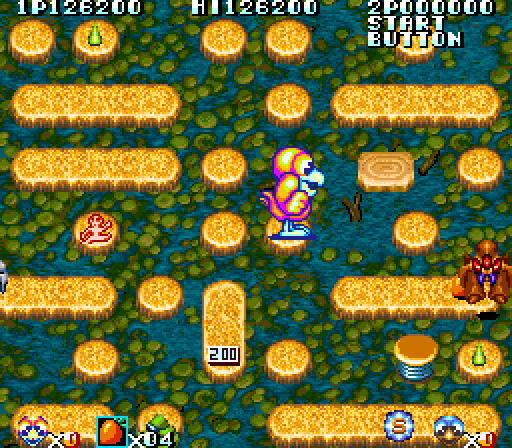
The game begins, and it’s not quite what I was expecting but it’s not a million miles away either. You’re controlling the angel-duck, and your mission is to clear each stage by collecting all the fruits / vegetables in the stage- in this case, those rather succulent-looking strawberries. The play area is a maze constructed from lollipop sticks hovering over a pond, so as you can probably tell most of the gameplay is going to revolve around jumping. You can only walk on the wooden platforms and you have to jump between them. You can only jump across a gap of one “unit,” if you get me – so the duck will clear the jump he’s attempting in the screenshot above, but if he tried to jump directly downwards from his landing point he’d fall to his death because that gap’s two “units” wide.


Wait a minute, fall to his death? I have two main duck-related issues with this. Number one, ducks can fly. Number two, duck are very good at landing in ponds. If there’s any single animal for which the hazards of this stage should prove negligible, it’s ducks.


Okay, so there are also monsters to avoid. They could easily threaten a duck. There are two main categories of monsters in Super Duck: the ones that pop up and fire a deadly projectile roughly in the duck’s direction, or the ones that run around the level without a care in the world, uninterested in what the duck is up to but still deadly to the touch. Whether by design or coincidence, the monsters often seem to congregate on the outer peripheries of the stage. It doesn’t feel particularly intentional, but there are always a few fruits you need to grab at the edge of the level and those are the most difficult to reach so maybe the monsters are supposed to move outwards and block your path.


Once you’ve grabbed every piece of fruit, the stage ends and you’re whisked away to the next one. There’s a different layout of platforms to contend with and the background usually changes, but other than that the gameplay’s the same, and I don’t think it’d be too harsh to say that if you’ve played one stage of Super Duck you’ve played ‘em all. If I was comparing Super Duck to another game I suppose Pac-Man would be the obvious choice, although because both games are about jumping between floating platforms from a sort-of-top-down perspective, Evil Stone would be a more accurate comparison. Thankfully this game never gets anywhere near as frustrating as Evil Stone.


As a lava dragon that I’m sure I once saw in a Gradius game flies around the screen, I’m reminded that this game is called Super Duck. So far I’ve seen plenty of duck but very little super, and I’m definitely not confident about my chances of defeating this dragon. Can the angel-duck even defend himself? Well, not at first, but there are mysterious orbs that appear on each stage and if you collect one of them you do gain a method with which to fight the monsters. Is it laser eyes? The wrathful judgement of Heaven itself? A pointy stick?


You get farts, that’s what. Once you’ve collected the orb you can fart at the monsters, releasing a cloud of gas that paralyses your foes and also lingers wherever you deposit it so that any other monsters that wander into the miasma will also be stunned. You know what? I’ll take it. It beats being completely defenceless, although I feel weaponised flatulence is rather tarnishing the spiritual perfection of the heavenly host. I probably should have asked Uriel if I could borrow his flaming sword before storming the depths of Hell. I should also point out that your farts have limited ammunition. You’d think that “eating all the fruits and vegetables you can” being the point of each stage would take care of that issue, but apparently not.


Stage five is a boss battle, and Super Duck suddenly switches focus from jumping-based maze game to a top-down shooter than feels a bit like Space Invaders except there’s only one enemy and it’s a huge octopus. Your farts aren’t going to cut it during this battle, but not to worry – the duck can now spit fireballs out of his mouth. Only against bosses, mind you. Yes, we’re all disappointed that the duck can’t breathe fire all the time – a power I would definitely classify as “super” - but it would make the non-boss stages far too easy so I can see why they limited it to the boss fights.
As for fighting the boss, it works exactly like you’d expect it to after seeing the screenshot above. The boss fires downwards at you, you fire upwards at the boss. Try to avoid the bosses projectiles, keep hammering the fire button, grumble under your breath a little because the boss’ health bar is just long enough to take the fight into tedious territory.
At least the boss looks cool. It’s hard to go wrong with a massive octopus monster, honestly, although I’m not sure what the two stars on its head represent. Maybe if you gather another six of these things together you can make a wish.


After the boss it’s back to the regular gameplay, and Super Duck continues in much the same vein for the rest of its duration. Collect the fruit, dodge monsters, boss fight every few stages, try to cropdust as much of the stage with your potent duck farts as possible. It’s not bad, if a little generic. A small amount of new elements are added as you rattle through the levels, the most important being collapsing platforms that crumble away if you don’t immediately jump off them, moving platforms and spikes that are deadly to the touch but can be jumped over (presuming you’ve got somewhere to jump to on the other side).


Like I say, it’s not bad. The developers had a very simple concept and they just about managed to pull it off in a way that I can’t complain about besides the obvious complaint that it’s not especially interesting or innovative. I sometimes had trouble landing jumps going “up” or “down” the screen because the duck’s wide sprite can make it a little difficult to judge whether you’re lined up correctly, and your deadly farts can be awkward to use because obviously they come out of the back end of the duck so you have to turn away from enemies to spray ‘em. Other than those minor issues, though, Super Duck works as intended.


This stage has a background composed of either writhing worms or writhing spaghetti. Pasta or worms, whatever it is it’s definitely writhing so maybe the duck has reached one of the uppermost layers of hell already.


Yep, things are getting hellish, what with the skeleton dragon and the skeleton background. This boss is a lot like the octopus except it fires a spread pattern of bones that are far easier to avoid than the octopus’ bubbles, making this a much easier although no less tedious fight. All the bosses are like this. They sum Super Duck up nicely: repetitive, mechanically competent, sometimes interesting to look at.


A lot of the enemies in Super Duck do look interesting, which is one of the reasons I’ve stuck with the game this long. I’ll cut a game a lot of slack if it has fun monster designs, and holy bouncing skeleton on a pogo stick this stage has bouncing skeletons on pogo sticks. Image the noise these things must make. Boing rattle boing rattle, like someone pouring dominoes onto a trampoline.


Also making a real claim on a special place in my heart are the ghosts that you can see in the bottom-left of the screenshot above. Yeah, the ones with the robot face. Not enough robot ghosts in popular culture, if you ask me. Or cyborg ghosts, if you must insist that there has to be a living component that must die before a ghost can be born. It’s such a weird design that I can’t help but be drawn to it, although my affection for the blockheaded spirits is slightly tempered by the fact that their massive noggins can make it difficult to see what’s behind them sometimes.
Also in this screenshot: a tiny blue man, on the right-hand side of the screen. Those aren’t enemies. They’re... items, I suppose. When you step on them, they jump to an adjacent square. If you chase them around for long enough, copying their movements, eventually they’ll turn into… a points bonus. That’s something, I guess. I’d have preferred a cigarette lighter so I could really put the duck’s farts to good use, but points are nice too.


The boss of the ice-themed world is, of course, a hybrid of man and aeroplane that launches snowballs from its shoulder-cannons. As you do. Assuming that all the bosses in this game are demons from Hell, one can only imagine the thousands of years that this demon spent mooching around the pits of the underworld, waiting for the Wright brothers to get their act together so he could finally confront his demonic kin and say “See? See? I told you this’d make sense eventually but nooooo, you were all like ‘grow some horns, dumbass’! Well, who’s laughing now!


The next set of stages are much the same as all the rest, but I did manage to collect a power-up that made the duck invincible. Not just against monsters, either: he’s also immune to gravity when he’s powered up, so you can simply ignore everything, collect as much fruit as possible and jump across otherwise impassable gaps by standing on empty air. I doubt it was intentional but doing this has a real Looney Tunes quality to it, so that’s nice. Also, here’s my top tip: the invincibility you get after losing a life also makes you briefly able to stand on nothingness, so use that to your advantage whenever a monster manages to bump into you.


High above the barren lunar surface, the duck does battle with yet other boss that fights by firing projectiles downwards. This boss appears to be a floating pile of excrement that went to the barbers and said “give me the Albert Einstein, please.” Amongst all of Super Duck’s weirdo enemies, this thing is uniquely unpleasant to look at, especially in the face. Two thumbs up from me, then. Give this thing it's own spin-off game. You might also notice that unlike the previous bosses this thing isn’t confined to the top of the screen, and will instead move down to your half of the screen. This does add a little extra pressure to the fight, but it also means you can move onto the two “prongs” at the sides of the screen and fire sideways, which is often the best strategy for avoiding the boss’ projectiles.


By the way, between each world the game’s been chucking out these reminders of the whole “angel rescuing his beloved from Hell” concept. All of them are some variation of the hero and his lover looking tense and serious, as well you might if you or someone you care about had been kidnapped by The Satan, but you might be thinking that the “hell” bits of the game don’t really mesh with the “cutesy duck eats apples” motif found during the gameplay. Well, I think I have an explanation for that.


This is the arcade flyer for another game by Comad called Hell Out. Let’s get the obvious facts out of the way first: “valuable experiences of hell!!?” might be the greatest tagline ever, and “too much interesting and funny” would be the entirety of my profile if I ever decided to try internet dating. Those facts aren’t important here, though. Take a look at the screenshot on the flyer and you’ll see that it looks a lot like Super Duck. Lots of small platforms, fruit to collect, and even some of the same monsters… although the player characters are dumpy little humanoids instead of ducks. I’ve seen it suggested that Super Duck and Hell Out are the same game, but it’s almost impossible to find any information about Hell Out that isn’t on this arcade flyer so it’s hard to say for certain, but what I think happened was this: Hell Out was the original version of the game, with the same plot and general gameplay… but the theme was later altered for some reason (possibly because of the Korean ratings board or for an overseas release that might not have happened.) If that is the case, there were definitely some big changes to the gameplay because unlike in the screenshot on the flyer, Super Duck’s platforms conform to a grid and the fruit is always on a platform rather than hanging in mid-air. Or perhaps Super Duck is a prequel / sequel. Who know? Maybe one day more information on Hell Out will surface, but for now it will remain a mystery. All I’ll say is that it’s criminal a title as good as “Hell Out” has already been taken.


Speaking of Hell, Super Duck’s final few stages definitely have the look of a classic Hell-themed world to them. Lots of lava, I mean. Molten rock everywhere, fiery chasms, a smattering of spikes. Just what you’d expect, and I’m happy to report that the gameplay hasn’t become hellish. It’s definitely a lot more difficult than it was at the beginning of the game, but on the whole Super Duck has a far more gentle difficulty curve than most arcade games and for that I’ll give it a lot of credit. There are more fruits placed with only one viable pathway to reach them, and more focus on riding the easily-misjudged moving platforms, but in many arcade games I’d expect the action to reach this level of difficulty around the end of the second stage, not just before the final boss. It helps that (as far as I’m aware) Super Duck doesn’t have a time limit, and in most case a lot of the challenges can be overcome by staying patient and waiting for the enemies to scuttle off to a different part of the map.


And now, the climactic battle against Satan himself. He’s a dragon, which is fair enough. Satan gets called "the dragon" all the time, right? Seems like a perfectly acceptable form for the devil to choose, although given the other monsters I’ve been fighting against it’s a little… bland. I’ve spend a lot of time playing a lot of videogames where I’ve fought a lot of dragons, you know? He’s definitely not as engaging as Aeroplane Man or The Floating Turd. Get to the side of his head wherever possible and use your fire breath over and over again until Satan is defeated. He doesn’t put up much of a fight, honestly. Kidnapping this duck’s human girlfriend was little more than a passing fancy, it seems.


And so the lovers are united. Neither of them look particularly thrilled with this turn of events. Maybe it was better to co-rule in Hell than date in Heaven. At least our hero isn’t a duck any more, although this does mean he’ll have to go back to holding in his farts whenever people are around.
Personally I found Super Duck rather interesting, although I’d fully understand if you did not. It’s a very middle-of-the-road arcade platformer in a style that would probably have felt a little bit dated when it was released. There’s nothing exciting about the gameplay but there’s nothing terrible about it either. But it’s also a tale of ducks, jealous devils and flatulence, with some pleasingly bizarre monsters and a mysterious relationship to other, possibly unreleased game, so it ended up holding my interest for longer than I thought it would. Forty minutes rather than ten, that’s quite the achievement!

29/01/2018

THE SIMPSONS: BARTMAN MEETS RADIOACTIVE MAN (NES)

I first heard the order decades ago, but the time has finally come. I can resist no longer. I will, in fact, Do The Bartman. Except this is Imagineering and Acclaim’s 1992 NES game The Simpsons: Bartman Meets Radioactive Man, and it’s all about Bart Simpson’s Batman-spoof alter-ego Bartman. However, the Bartman persona does not appear in the video for the hit 1990 single “Do The Bartman.” I could have sworn that he did, but I guess time makes fools of us all. Obviously I watched the “Do The Bartman” video again and two things stand out: one is that “here’s a group that needs no introduction – your children” is a pretty good joke, and also Bart complains about being grounded for putting mothballs in his family’s food. Jesus Christ, Bart, you’re lucky to be confined to your room and not a psychiatric unit.Where was I? Oh yeah, videogames.


That’s Bartman on the right, Radioactive Man on the left and Fallout Boy at the bottom. Radioactive Man’s sidekick, not the pop-punk band. It’s an all-star superhero team-up, the Simpsons equivalent of Batman joining forces with whatever superhero Radioactive Man is a parody of. A combination of Superman and the Incredible Hulk, I suppose. The Incredible Man! No, hang on, that doesn’t work.


The game’s intro sets the scene – Bart’s reading a Radioactive Man comic in his treehouse but he’s not enjoying it much. The comic’s nearly over, but Radioactive Man hasn’t made an appearance yet!  Yes yes, that’s all very interesting but I can’t stop looking at the front cover of said comic and thinking about how much Radioactive Man looks like he’s got the head of a duck.


Then Fallout Boy shows up and tells Bart that Radioactive Man has been stripped of his powers by the evil Brain-O the Magnificent, which is why Radioactive Man hasn’t, you know, shown up in the comic book yet? So that’s not a Radioactive Man comic but a factual description of Radioactive Man’s life that happens to be in graphic novel format? I’m confused. Bart also seem a bit confused, but then he gets over his confusion, turns into his Bartman person and the game’s ready to begin. Look, just go with it, okay?


Chapter One: Bartman decides not to bother saving the day and pulls his duvet back over his head. Or that’s his cape, I guess. Anyway, to save Radioactive Man, Bart must defeat three supervillains by making his way through their lairs and eventually besting them in mortal combat. First up is the Swamp Hag and where would you go if you were looking for a Swamp Hag? That's right, the junkyard!


Here we go, then. Bartman Meets Radioactive Man is a platformer, and I can tell you now it does almost nothing to differentiate itself from the vast ocean of other, very similar NES platformers. Well, in terms of gameplay, anyway. Being a Simpsons game gives it a certain appeal, because everyone loves The Simpsons. That might not be as true now as it used to be, but you’ve got to remember that this game was released in 1992, when The Simpsons was huge, a genuine cultural phenomenon. Without wanting to sound too cynical, that’s the only reason that this game exists in the first place.


Three steps to the right, and Bart Simpson kicks a dog in the face. What a way to start the game. What a hero. Speaking of, considering we’re playing as Bartman and fighting actual supervillains, it’s very noticeable that Bartman doesn’t have any superpowers. At the beginning of the game he can walk, jump and kick. You might be thinking “hey, technically that’s the extent of Batman’s super powers," but unlike good old Bruce Wayne, Bartman doesn’t have any gadgets, not even a simple slingshot.


The hardest part of writing VGJunk is coming up with different ways to say “hey look, its a platformer, just like all those other platformers.” You jump over obstacles and either kick enemies out of the way (if they’re dog-sized or larger) or avoid them entirely (the recommended tactic when facing rats, because they’re too small to kick). Some pit are bottomless, some have springboards at the bottom like the ones between these tyre stacks, so you can bounce back up. One thing Bartman Meets Radioactive Man’s designers were very fond of including are projectile spitters that fire something dangerous vertically upwards, like these screws popping out of the tires stacks. Sometimes they’re gearwheels, sometimes they’re blobs of lava, but they all work identically and you’ll be spending a lot of time in this game (im)patiently waiting for these traps to settle down enough for you to pass.


At last, Bartman has a superpower. I picked up an item that caused the cryptic message “20 EYES” to appear at the top of the screen. This means I can now press the B button and Bart will fire laser beams out of his eyes. They don’t travel all the way across the screen but they have a lot more range than the stubby limbs of a ten-year-old child and so they’re very useful for eliminating these roaming hunchbacks. If you’re trying to figure out whether these enemies are supposed to a specific Simpsons character, I’d save your energy. At first I thought they might be Kearney, but aside from Bart, Radioactive Man and Fallout Boy I don’t think there are any Simpsons characters in this game so what we’re facing here really is just your basic, everyday junkyard mutant.


So goes the first stage. And goes, and goes, dragging on for much longer than you might expect for the very first area in the game. It all consists of jumping over the same tyre piles and columns of broken televisions, and it’s about as exciting as I’m making it sound. At least it gives you ample opportunity to get used to BMRM’s slightly fussy jumping controls, which feel unusual at first because Bart jumps much more vertically than most NES platform heroes, and you have to make very sure you’re actually moving left or right when you jump because it takes a brief moment for Bart to get moving and if you leap from a standing start you’ll miss ninety percent of the jumps in this game.
That’s all something you’ll get used to as you play, though. Is it fun? No, not really. Personally I judge platformers (consciously or not) on how much pleasure you get from simply moving around, and dragging Bartman’s lumpen carcass from junk pile to garbage mound has the unmistakeable whiff of a chore about it.


One area that mixes things up is the bonus area set in the “Limbo Zone.” If nothing else, the stark “Kirby dots” inspired background makes a nice visual change. The Limbo Zone is a place to stock up on items like extra lives by riding around on the rain of space debris. All the chunks move in the same direction, but when you jump on one of these platforms all the platforms start moving in a different direction. Basically you’re trying to steer an asteroid storm with your feet and it’s by far the most interesting bit of gameplay in BMRM. Naturally it only appears a couple of times and doesn’t last very long, because the developers needed that cartridge space so they could fill it with as much painfully generic platforming as possible.


Having escaped the Limbo Zone and reached the end of the obnoxiously long first stage, it’s into the sewers for a second stage that’s also obnoxious but for a different reason. This time it’s because the sewer pipes are a maze. Not a complicated maze, I’ll grant you, but every screen looks the bloody same and that can make getting your bearings difficult. As for the gameplay… well, if you’re generous enough to call waiting around for slow-moving platforms and equally lethargic dripping water hazards gameplay, then you’ve got a kinder spirit than me.


Also lurking in the sewers: lycra-clad villains who have no problem shooting a child in the head with their laser rifles. Who are these fiends? We may never know. They’re certainly not famous Simpsons characters, because as mentioned aside from Bart and Radioactive Man there aren’t any famous Simpsons characters in this game. This abscene of many of The Simpsons' supporting cast is noticeable if you go back and play most old – early nineties, I mean – Simpsons games. For one thing, back then Bart was assumed to be the show’s main character, so you almost always end up playing as him. I presume that if these games were being released a few years further into The Simpsons’ lifecycle then Homer would be the main character in most of them. In BMRM’s specific case, it’s a shame that it was released well before the “Radioactive Man” episode of the show aired. You know, the one where the Radioactive Man movie is being filmed in Springfield. The goggles, they do nothing, etcetera. I’d find it much more engaging if I was playing as Milhouse, trying to recreate stunts from the movie. Of course, I’m not enough of a maniac to suggest that releasing a Simpsons game with Milhouse as the main character would be a good idea, but it’d be more interesting than this.


Bartman Meets Radioactive Man’s commitment to platformer gameplay elements that were worn-out tropes even in 1992 continues with the never-popular side-scrolling shooter segment. Oh well, at least it’s nice to see Bartman demonstrating some kind of superpower, although now I’m going to be thinking “why doesn’t Bartman use his solidly-established ability to fly to skip all the platforming stages?” “Because that’d make the game really boring,” I hear you cry, but the jokes on you because this game’s already really boring.
The shooter section plays well enough, I suppose. Bartman can collect “cold” power ups (I think they’re supposed to be like Superman’s ice breath) and spit them at the waves of monsters, but you don’t really need to bother and you’ll do just as well by avoiding them.


Okay, I’ve just about caught up with the Swamp Hag, and I might have been hasty when I said there are no other famous Simpsons characters in this game because I think those things that are falling from the sky are supposed to be Blinky, the three-eyed radioactive fish. Yes, I’m aware that they look a lot more like piles of excrement, but bodily waste definitely shouldn’t have that many eyeballs in it unless you’re a character from Bloodborne.
It took me a while to figure this out, but the idea here is that you use the freeze power on the fish as they fall, turning them into frozen platforms that you can use to climb up to the treetops.


That’s where the Swamp Hag is hiding, throwing mutant fish on the heads of any who would dare to enter her dominion. Freeze her with the ice power and then jump up there and kick her to death while pondering that as far as Matt Groening characters go, she looks more like Lrrr from Futurama than any Simpsons character.


One boss down, and Radioactive Man has regained his powers of flight. However, he’s still trapped in the Phantom Zone – sorry, Limbo Zone – so I suppose I’d better track down the next villain. Their name is Dr. Julius Crab, and apparently they have a water-logged lair. This is going to be a swimming stage, isn’t it?


Fantastic. I love swimming stages in otherwise land-based platformers, said the world’s most dangerous lunatic as they were remanded to a secure hospital. This is one of the less aggravating examples of the type, to be fair, and mercifully it’s about half the length of the junkyard stage. Bartman swims fairly responsively, and you can avoid most of the dangers of the stage – the naval mines, the octopus tentacles, the clams that fire fish upwards at regular intervals – by slowly swimming along the ocean floor like an unhurried sea cucumber with a day off work.


There’s a piece of “El Barto” graffiti painted on the bottom of this ship, and it’s nice to see some kind of Simpsons reference in a game that feels very divorced from the source material. It would be easy to replace a couple of sprites in this one and have it be completely unrecognisable as a Simpsons game. I know that’s true of a great many licensed NES platformers, but The Simpsons has its own strong visual style that’s been completely ignored in favour of a generic underwater level.


And then BMRM goes and dangles a morsel of something interesting in your face with a stage set in a dark underwater labyrinth. The only light is the torch beam of a deadly sniper, and if you swim across their crosshair you’ll take damage, so you’ve got to use the illuminated patch to determine where the walls of the maze are while avoiding the incoming fire, and you know what? It’s actually quite good fun! I know, I was surprised too. The potential for it to be a frustrating mess was very high, but fortunately the designers realised they they needed to compensate for Bartman’s lack of vision by having less enemies than usual floating around and not placing so many traps on the “floors.” It’s hardly amazing, but it’s so much more engaging than the rest of the game thus far that rather than making BMRM feels like a better game it just makes the rest of the stages seem worse by comparison. Whoops.


It’s also a very brief diversion, and afterwards it’s back to more platforming and more waiting around for slow-moving platforms, because there’s nothing the kids love more in their videogames than the sensation of waiting for a lift that’s stopping at every goddamn floor. At least this one’s enlivened by these octopus creatures that throw fish skeletons at you. They have Nelson Muntz’s face, and I’d much rather be learning about how Nelson got fused with an octopus than turning water jets off by standing on switches, but the simple fact of their existence is cheering me up.
I’m also cheered by this world being far, far shorter than the first. The stretch from the start of the game to the Swamp Hag makes up roughly fifty percent of the game, with the remaining three bosses and their stages crammed into the second half, and it’s an interesting sensation to play through a game where the developers so obviously lost interest after the first couple of levels. Maybe BMRM was rushed out to meet a specific release date. That’d explain why everything after the Swamp Hag battle feels like it was scribbled down on the back of an envelope during the bus ride to work.


Here’s Dr. Julius Crab, mad scientist and potential ancestor to Dr. Zoidberg. Attending medical school must be a family tradition. There’s also a normal, unnamed crab scuttling around in the boss arena, serving as an annoyance who’ll bump into your ankles while you’re trying to fight Dr. Crab. It’s not particularly well communicated by the game itself, but Bartman’s punch attack completely changes during this fight. Pressing attack makes him raise his hand, and what you’re supposed to do is wait for Dr. Crab to jump at your head, catch him in mid-air and then throw the criminal crustacean against the right hand wall. Do that three times and the doctor will get smashed into the next room where you repeat the fight.
There’s the core of a decent boss battle here, but three things conspire to make it a pain in the arse. The first is that unless you already know what you’re supposed to be doing, it’s difficult to figure out how to beat Dr. Crab because standing underneath a videogame boss while it does a jumping attack is the exact opposite of what games have been training me to do for the past thirty years. Then there’s the extremely precise positioning required to catch the boss as he falls: a pixel or two out position and you’ll miss the grab. Finally there’s the small crab, which is only there as a distraction and you just know the developers threw it in at the last minute because they’d made the boss fight too easy without it. However, even taking all these flaws into consideration I declare this battle a triumph because you’re fighting a crab that’s also a mad scientist.


We’ve reached the final set of stages. It starts out with the usual lava area. You’ve seen one lava zone, you’ve seen them all. Don’t fall in the lava, watch out for the volcanic vents that spit out fireballs. The main difference from previous stages is that any wall that isn’t grey will hurt Bartman if he touches it.


That part doesn’t last long, though, and most of this world is made up of this underground village. I don’t think there are any more screens than the previous area, but it takes a lot longer because it’s a maze composed of various doors that teleport you to a different location when you walk through them. Now, this is entirely down to personal preferences but I’m going to declare this the worst stage in the game because I hate screen-warping maze layouts in platform games. You might think they’re fine and that’s okay, I’m not having a go at your videogame preferences but for some reason I cannot stand this type of stage. Is it because my memory is terrible and I’m constantly getting lost? Possibly. Okay, probably. But it’s not just that, because if I’m playing a game specifically based around exploring a maze then I’m fine. My contempt for this kind of gameplay is something of a mystery to me, but as soon as I realised what was going on I reached for a walkthrough because I simply was not willing to figure it out for myself. Look, I’ve never claimed to be a videogame expert.


Having the walkthrough meant I quickly reached Lava Man, the boss of the lava world and unimaginative name inventor. Unlike Dr. Crab, the mechanics of this fight are easy to discern: freeze the water droplets with your ice power when they’re falling towards Lava Man’s head. All Lava Man can do to prevent this is throw two easily-dodged lava balls towards your general position. No wonder he looks so shame-faced down there. “Colossal Lava Beast Cooled Off By Ten-Year-Old Boy” screams the newspaper headline, Lava Man is kicked out of the League of Villainy and has to move back in with his parents, the only work he can find is having water poured on him in a sauna. He’s a disgrace to hulking lava monsters everywhere.


With all his powers restored, Radioactive Man is freed from his cosmic prison and, erm, is it just me or is there something wrong with his proportions? I think it’s the way his right arm reaches down to his ankles, that’s definitely making him look kinda weird. I suppose these are the issues you might face if you get your powers from a concentrated blast of radioactivity.
Now that he’s back in the game, Radioactive Man enlists Bartman’s help in taking down his arch nemesis: the terrifying and squishy Brain-O the Magnificent! I wonder what theme Brain-O’s stage is going to have? Biological horror, as our two heroes make their way through a living body in search of the brain? A deadly cyberscape controlled by a brain-powered supercomputer, perhaps? And will I actually get to play as Radioactive Man?


The answer to all these questions and more is no. Just… no. No stage, no playing as Radioactive Man, no nothing except for the fight against Brain-O that you’re immediately thrown into. For a moment I was disappointed, but then I remembered that I wanted nothing more than for Bartman Meets Radioactive Man to be over, so let’s get on with it.
To damage Brain-O, you have to shoot it with your eye beams. Of course, the metal parts of Brain-O’s tanks are immune to your eye beams, so you have to fire, have the laser ricochet off the hull and up towards Radioactive Man. Then the laser bounces off Radioactive Man and back down onto Brain-O’s glass dome. It’s all about timing your shots so that Radioactive Man is in the right place to catch the ricochet, and not getting run over by the massive brain-tank. Fortunately Brain-O is so big that it can’t crush you if you crouch right in the left-hand corner, so aside from remembering to jump over the projectiles Brain-O fires at you this boss fight is simple enough to deal with.


Radioactive Man offers his thanks, we get to see this image of Bartman one final time and I still think it kinda makes him look like a slug with a child’s head, and Bartman Meets Radioactive Man is over. What are my thoughts? That it’s weird that there was such a focus on the Bartman persona considering that at the time it had appeared in one scene of one episode of The Simpsons. Oh, about the game? Well, it commits the cardinal videogame sin of being boring. For the most part the stages are dull, with no invention or wit to any of the land-based platforming sections, and traversing them isn’t made any more interesting by Bart’s sluggish, leaden controls. There are far too many blind jumps to lower platforms that may or may not have enemies on them, the same enemies and hazards are recycled ad nauseam – the vertical projectile spitters in particular – and for something based on one of the greatest comedies of all time there’s absolutely no attempt to make the game funny.


Bartman Meets Radioactive Man shakes out as yet another standard NES platformer, then. Certainly not bad enough to get upset about, and it even had one or two relatively enjoyable sections amid the tedium… but it’s an absolute no-brainer to say that rather than playing this you should go and watch the Radioactive Man episode of the show again. Yes, I know you’ve already seen it dozens of times but trust me, it’s still funny.

VGJUNK Archive

Search This Blog

Followers