Or maybe it's “England” - "England" in quotation marks because, as demonstrated by the above screenshot from the original Street Fighter, many games use the flag of the United Kingdom to denote England. England has its own flag, thank you very much, although it really only gets a lot of public display when the England football team are involved in a major tournament and it has thus (to me, anyway) become a symbol of disappointment and feeble capitulation. A lot of these fighters are described as being from England but appear under the British flag, so if you want to pretend some of these characters are Scottish or Welsh then go right ahead.
Cammy, Street Fighter

Any given nation’s most famous fighter usually appears in Capcom’s Street Fighter series, and Britain is no exception with Cammy. When she first appeared in Super Street Fighter II, she was a special agent working for the British intelligence agency MI6: later games revealed her to be a clone of the evil M. Bison, who brainwashed Cammy into working as an assassin. Now, far be it from me to criticise MI6’s hiring policies, but giving an espionage job to someone who was once under the mental control of the world’s most evil person seems like carries a certain amount of risk. I guess Cammy’s expertise in kicking people to death outweighed the risk that her “mindless slave under the thrall of the deadliest terrorist ever” persona would re-emerge.
As for being British, I suppose the main trait that Cammy shares with most British fighting game characters is that she’s blonde. Lots of British fighting game characters are blonde, although not as frequently as French fighting game characters. I don’t think that’s necessarily a “British” thing, though, it’s just that most of the characters on this list were designed by Japanese artists and they tend to give blonde hair to most non-Asian characters. Cammy also has one of the two main British videogame accents – the “posh” one, rather than the Dick van Dyke-inspired semi-Cockney one. That’s another of the countless reasons that I love Bloodborne so much: it’s one of the few games to feature a knife-wielding plague doctor with a Yorkshire accent.
Cammy doesn’t have much about her that marks her out as being from the UK, then, but I suppose that’s because she isn’t really from the UK, she’s from whatever country M. Bison’s cloning lab was based in. Maybe Capcom’ll release a game set after Street Fighter Alpha where Cammy undergoes a My Fair Lady-type procedure to gain her accent. I’d play that.
Birdie, Street Fighter

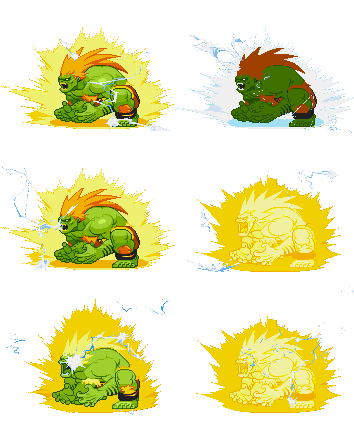
Cammy wasn’t the first English character in the Street Fighter series, though. That honour goes to the hulking bruiser Birdie. I suppose it also applies to moustachioed stick-carrier Eagle, because both characters debuted in the first Street Fighter game. Birdie’s the more interesting of the two, though, with his mohawk and his leather-punk look. But you might be thinking “I’ve played other Street Fighter games where Birdie looks, erm, different,” and you’re not wrong.

Birdie received a makeover in the Street Fighter Alpha games. The most noticeable change is that he’s black now. I say “now,” Birdie was always black. We know this because one of his Street Fighter Alpha 3 win quotes reveals that he looked pale in the original game because he was ill. I have to commend Capcom’s front in saying “oh yeah, this is totally the same guy,” because why the hell not?
Other than the obvious, the biggest change to Birdie’s later designs is that he’s now even more cartoonishly “punk,” swinging metal chains around and advancing mohawk technology to never-before-seen heights by creating a hairdo with a hole right through the middle of it. I must admit, as a kid I spent more time than I probably should have trying to figure out the mechanics of Birdie’s hair. I came to the conclusion that it should be possible in the real world, and seeing Donald Trump’s hair has convinced me that there are people out there who can work such structural miracles. Of course, Birdie exists in the Street Fighter universe, so he can just get a can of whatever hairspray Guile uses and eliminate all the hard work.
Birdie got yet another revamp for Street Fighter V: he’s still a punk with a mohawk, but he’s become a comedy character who eats all the time and is now overweight. I like it. Street Fighter characters have generally had almost no development even after thirty years, so for Birdie to have had three separate “phases” honestly makes him a bit more interesting to me than some of the classic cast.
Dudley, Street Fighter

Finally for Street Fighter characters we’ve got Dudley, the gentleman boxer. So much of a gentleman and so good a boxer that he was knighted by Queen, even. I’m sure he threw some charity work in there too, that’ll always help to get you on the Honours list. Dudley is the kind of British character I was expecting to see a lot more of on this list: the aristocrat, the toff, the upper-crust type who has a butler and everything. Maybe it’s just a British thing to be obsessed with the class divide, but I’m surprised there weren’t more fighters like this, partly because you often hear that one thing other countries like about Britain is that we’re still clinging to something as “charmingly” outdated as a monarchy.
Of course, there’s a good chance Dudley takes some inspiration from real-life British boxer Chris Eubank, a man who used to get lumbered with the word “eccentric” more than probably anyone else in the British public eye. Eubank liked to dress in an exaggerated “aristocratic” manner, complete with monocle, so I wouldn’t be surprised if Dudley was indeed inspired by Eubank… but given Dudley’s moustache, his striped trousers and alternate Street Fighter IV costume and a couple of his poses, I think there’s also a fair amount of Freddie Mercury in Dudley’s design.
Narcis Prince, Super Punch-Out!!

Moving on to Nintendo’s puzzle-game-adjacent boxing series Punch-Out, a franchise where the character roster is almost entirely composed to crude national stereotypes. He’s where you’d think you’d find a boiled-down idea of how certain Japanese games developers imagine British people, but Narcis doesn’t really fit into any particular category. He’s blonde, of course, but other than that his gimmick is that he’s a pretty boy who hates being punched in his face. Turns out Narcis and I have more in common than I thought we would.
Looking at him, and remembering playing Super Punch-Out as a kid, I’d always assumed that Narcis was supposed to be another upper-class posho type, but that’s only because I never managed to complete the game back then. I couldn’t beat Hoy Quarlow, the cheating old bastard. If I had made it to the ending…

...I would have realised that Narcis is, in fact, common as muck. I’m surprised he’s not saying “cor blimey, guv, you’ve punched me right in me boat race and no mistake!” He’s Danny Dyer with a floppy haircut, that’s what he is.
Steve Fox, Tekken

Here’s another blonde boxer – it’s Steve from Tekken! This makes three boxers in a row (although Narcis Prince doesn’t really count because Punch-Out is a boxing game) and I wouldn’t have been surprised if boxing had emerged as a stronger theme amongst these British fighters. The Queensberry Rules did originate in Britain, after all, and for such a small country we’ve had a lot of successful boxers.
Like so many videogame boxers, Steve was a world champion who had to step out of the ring for one reason or another and enter the violent world of street fighting. Usually it’s for a reason beyond their control, because why else would you give up boxing for street fighting? The sweet science may be a brutal game, but at least there’s a referee there to protect you and you’re unlikely to have your head slammed into the cold asphalt of a dingy back alley by a giant Russian wearing tight briefs. In Steve’s case, he refused to throw a fight for the mafia and now they’re out to kill him. Being away from boxing gives Steve more time to explore the mysteries of his uncertain parentage, eventually discovering that his mother, fellow Tekken fighter Nina Williams, had her eggs harvested while she was in cryogenic suspension. As a result, Steve is about the same age as his own dear mum, so they can batter each other into unconsciousness without anyone raising an eyebrow. Fighting games, eh? What wonderful worlds they weave.
Ivy, Soul Calibur

Ivy’s English, huh? I don’t think I ever knew that. Then again, it took me a long time to realise that the initials of Ivy’s full name, Isabella Valentine, are IV and that’s presumably where "Ivy" comes from.
What can I say about Ivy’s design? I mean, what can I say about Ivy’s design that allows VGJunk to remain relatively family-friendly? Not much, that’s what. And the design pictured above (from Soul Calibur II) is one of Ivy’s more restrained looks, if you can believe it. Whichever designer at Namco keeps saying “no, make her sexier. Sexier!” with each passing game needs to settle down a little, maybe take a cold shower or fifty.
It’s probably pointless to look for any common themes of “Britishness” in Ivy’s design. “Busty 16th century dominatrix with a pirate ghost for a dad” is, if nothing else, a very unique concept. Not particularly British, mind you. Maybe if she spent the entire time she was fighting complaining about the weather, that’d make her feel more English. Mind you, in that outfit you’d probably complain about the weather wherever you’re from.
Arthur, Soul Calibur

Another British Soul Calibur fighter is Arthur. If you’re not a big follower of the franchise you might well be thinking “who the hell is Arthur? When I think of Soul Calibur characters, I think of possessed suits of armour, scuttling, knife-fisted gimps and Darth Vader.” That’s a fair reaction, because Arthur isn't really a “proper” character, although he is quite interesting. You see, one of the stars of the SC franchise is Mitsurugi, a very Japanese samurai. Namco wanted to release Soul Calibur in South Korea. This was a problem, because Korea had (and still does, to an extent) strict laws that banned the importation of culturally Japanese entertainment. Soul Calibur was released at a time when these laws were beginning to be rolled back, but either because they didn’t want to take the risk or because they were specifically told that Mitsurugi wouldn’t fly, Namco changed Mitsurugi from a Japanese samurai to a British, erm, samurai. Yeah, Arthur is just Mitsurugi with blonde hair and an eyepatch but hey – the reasons for his creation are interesting, and apparently his bio reveals he’s from Southampton, making him one of a very small number of British fighters who aren’t Cockney geezers born within earshot of Bow Bells.
Billy Kane, Fatal Fury / King of Fighters

The most famous British character from SNK’s fighting franchises is Billy Kane, right-hand-man to the villainous Geese Howard and you guessed it, he’s blonde. He’s also another “punk” character, what with his leather jacket that must chafe his unprotected nipples something fierce and his general nasty attitude. Billy’s a master of fighting with a staff, because his surname is Kane* and that’s what happens when you share a name with a kind of weapon. Perhaps he lays awake at night, cursing the misfortune of not being born to Mr. and Mrs. Uzi. Terry Bogard might have the Buster Wolf, but six hundred rounds of hot lead a minute might make him think twice about using it.
Personally I don’t think Billy seems especially British, but given Billy’s backstory (a British orphan raised in the USA) it makes sense that he’d lean more towards an American feel, which is what I get from him. That bandana looks far more like the Stars and Stripes – well, the stripes anyway – than the Union Jack, and there’s also Billy’s complete and utter hatred of smoking, to the point of battering anyone he catches having a crafty cig. That strikes me as a much more American reaction. In Britain, we’d just tut at then, maybe thrown in the occasional exaggerated cough.
*The Japanese spelling of Billy’s name implies his surname is pronounced “Kon” but that’s not enough to stop nominative determinism.
Axl Low, Guilty Gear

Guilty Gear’s Axl continues the rapidly-becoming-a-theme punk look, although that’s perhaps to be expected from Guilty Gear – a series where many of the characters take their names from rock and metal music, from Slayer to Freddie Mercury. Axl is obviously based on Guns N’ Roses singer Axl Rose, complete with his trademark bandana and, in later iterations, denim shorts. I must say, I didn’t expect to see so many bandanas when I was putting this article together. Top hats, maybe, or bearskins, but not bandanas. At least you’d have a chance of picking Axl out as a British character, what with his Union Jack shirt, although in the game’s story he’s a time-traveller, pulled into the future from the ancient time known as “the late Nineties”. This does nothing to explain the two enormous zippers hanging from his chest. Axl’s from the turn of the millennium, I could understand it if he had a wallet chain or ridiculously oversized jeans that made a sound like a ship unfurling its sails whenever you got up to take a leak, but those zippers? They just look like they’d be a liability in a fight. Maybe that’s why Axl fights using a long-range sickle-and-chain weapon, it keeps people away from his vulnerable nipple-handles.
Bridget, Guilty Gear

Bridget’s another Guilty Gear character, and one you probably already know something about: Bridget is actually a boy dressed as a girl. The reason for this is that Bridget was born as a twin in an English village where twins of the same sex were seen as a grave omen of misfortune, so one of the kids was sacrificed. Bridget’s parents understandably decided this was a load of horseshit, so they raised Bridget as a girl to protect him from the chopping block. Two points of interest are raised here: the first is that England has become a pretty strange place in Guilty Gear’s future timeline if murderous twin superstitions are making a comeback in remote villages. Secondly, I can’t imagine Bridget’s parents were the first to come up with this cunning ruse, so there must have been some very interesting wedding nights in the village.
With Guilty Gear’s character designs being so out-there, I don’t think there’s much British influence you can take from Bridget’s design. He’s blonde, so there’s that, and maybe the huge handcuff around his waist is a tribute to the pioneering police reforms of Sir Robert Peel.
Jack, World Heroes

I covered Jack a while ago in the article about Jack the Ripper, because Jack is Jack the Ripper as seen through the bonkers lens of the Japanese fighting game. Jack the Ripper had a knife and possible medical training? Well, our Jack is going to have four knives on each hand and we’ll replace his surgical knowledge with a bitchin’ mohawk. Oh, hey, I guess this Jack is another punk. I’m happy enough to have Britain associated with punk music. What’s the alternative, a slew of combat-ready Morris dancers? Hang on, what am I saying, that’d be amazing. You could make a whole game out of warring Morris dancers: the fast, nimble handkerchief users, the mid-range stick-wielders, the slower but more powerful sword dancers of Yorkshire. But, erm, skip the troupes that wear blackface, yeah?
Jack, Power Stone

Again, Jack from Power Stone is also (even more loosely) based on Jack the Ripper and was covered a while back. However, I’ve learned a few things about Jack since then. He hails from “Manches,” which is presumably the Power Stone equivalent of Manchester and thus from now on I will imagine Jack shouting “all right, our kid?” as he hunts down his victims. Also, he’s fifteen years old. A teenager from Manchester who carries out robberies at knifepoint? I think Jack might have been invented by a Daily Mail journalist.
Lola, Dangerous Streets

We’re getting into really obscure territory with Dangerous Streets, a truly abysmal Amiga fighter that seemingly only exists to give Rise of the Robots some competition as the worst fighting game of the 16-bit era. The British contender in Dangerous Streets is Lola. Lola is supposedly a “top model,” so let’s go ahead and say that her outfit is down to the extravagances of haute couture rather than straight-up kink. And you though Ivy was going to have the most revealing costume on this list. Perhaps it’s not surprising that there are a couple of rather dominatrix-y characters here, though. I don’t know to what extent this is still true, but it certainly used to be the case that Britain had a reputation as the land of the masochist, especially where spanking is concerned. One can only imagine a game developer looking at the list of potential traits for a British character, their eyes darting between “punk rock” and “thoroughly enjoys a damned good thrashing.”
David, Battle Arena Toshinden

I didn’t play much Toshinden during the series’ heyday, because I was limited in what games I could get my hands on and Tekken seemed to be the clearly superior option when it came to 3D fighters. I haven’t played much Toshinden since its heyday, either. However, if I’d known one of the characters was a chap in a trenchcoat with a ridiculous chainsaw I might have given it more of a shot. This is David, he dresses like Rick Deckard, he has a gun in addition to his huge chainsaw and, oh yeah, he’s also fifteen years old. Did I miss the British coming-of-age ceremony where you’re given a deadly weapon on your fifteenth birthday or something? All I got were unlicensed X-Files companion books and socks.
David’s backstory is a dark one; he’s an orphan whose parents died in a fire, only to later discover that this was all the plan of an evil organisation. This causes David to black out and slice up a bunch of people with his chainsaw. On his fifteenth birthday, no less! He’s not the first British teenager to black out on his birthday, but David takes it a step further by getting involved in a fighting tournament. I’ve seen people suggest a chainsaw is a terrible weapon to fight with because it’s easily clogged with gore, it weighs a ton and it requires fuel, but these people overlook the psychological advantage you get with a chainsaw. To paraphrase a boxing maxim, everyone has a plan until a teenager in a flasher mac runs at them with a chainsaw.
Midknight, Eternal Champions

Another character I’ve covered before, Midknight was formerly Mitchell Middleton Knight: scientist, CIA operative and jeet kune do expert who accidentally turned himself into a vampire while developing a chemical weapon. As you do. Midknight then dedicated his life to finding a cure and also to not eating people, although obviously he took the time to workshop a few bad-ass vampire names because no-one’s going to take an undead martial arts master seriously if they’re called Mitchell.
Matlok, Fighter’s History

Appearing in Data East’s Fighter’s History series is yet another British punk. So punk, in fact, that his fighting style is apparently listed as “punks.” I’m not entirely sure what this fighting style would entail, but I assume there’d be lots of spitting and safety pins involved. Matlok’s punk credentials are further enhanced by him being supposedly named after Sex Pistols bassist Glen Matlock. Personally, whenever I see Matlok I can only think of Grandpa Simpson shouting “Maaaaatlock!” and that does little to cultivate the aura of danger and anarchy usually associated with punk music.
Hellstinger, Voltage Fighter Gowcaizer

Finally for today (although this is by no means an exhaustive list of British fighting game characters) is Hellstinger, who appeared in Technos’ Neo Geo game Voltage Fighter Gowcaizer. Damn, that’s a heck of a title for a fighting game. Anyway, Hellstinger – whose “real” name is the no-less incredible Kash Gyustan – was born to a famous British composer but turned his back on the stuffy world of classical music and became a heavy metal star, complete with prop devil wings and the kind of stage presence that’d make a young Mick Jagger look like Gordon Brown. And then there’s all the fighting he does, for reasons I’m not entirely clear on but hey, he gets to fight using his magical guitar so who cares what the reasons are? These British characters seem to get quite a lot of fun weapons, actually. Killer yo-yos, chainsaws, what appears to be a purple Gibson Explorer, they’re all much more interesting than swords.
When looking at all these British fighters it’s clear that the two strongest themes are blondeness and punk rock, as though Billy Idol was somehow the single most evocative aspect of British culture. The music connection makes sense to me; I’d say that when it comes to world-famous music, Britain definitely punches above its weight. Beyond that, Britain seems to have more diversity in its fighters than some nations, unlike the carnival-beastmen of Brazil or the militaristic Germans. I imagine that’s partly down to the Anglocentric nature of much media and the fact that English is a common second language around the world – or maybe it’s just that the most common stereotypes about Britain don’t translate well into fighting game characters. If I was trying to create a British fighter that encapsulated the nation I know I’d struggle, because you can’t base a combat style around self-deprecation, stiff-upper-lipism and complaining about the weather. There is one type of fighter I’m surprised I didn’t see, and that’s a football-themed character. Then again, given that the first three footballers I thought of in relation to attacking people were Zinedine Zidane, Eric Cantona and Patrice Evra, maybe that character should be French.