Now we know what happened to the fabled city of Atlantis: an aggressive species of giant sentient bats invaded and claimed the city for their own, the former Atlanteans telling people that their home had sunk beneath the waves to avoid the embarrassment of explaining to people they were defeated by bats. Or the title of today’s game is a portmanteau of “battle” and “Atlantis,” if you’re really so afraid to access the wondrous powers of your imagination. Yes, it’s Konami’s 1987 arcade shooter Battlantis!
I’ll be honest, when I first looked at this title screen I thought those tendrils were the angel’s legs and they were rubbing their crotches all over the logo. Also, it looks like I’m already too late to save Atlantis. That rather takes the pressure off our hero, doesn’t it?
Battlantis doesn’t offer the player much in terms of plot. The title implies there’s some kind of battle involving Atlantis, and a bit of poking around informed me that the hero’s name is Cripeuss III and he’s out to stop the “Boss Enemy” Asmodeus. Aside from that, the game does give you a little information about the game’s enemies if you leave the attract mode scrolling for a while, which is something I always like to see. If I’m going to be killing these guys by the dozen then I should at least know their names, right?
So the game begins, but what kind of game is it? Well, it’s Space Invaders, with a pinch of Galaga. A single-screen shooter in which the player shoots rows of monsters as they descend towards their position. That seems like a very strange game to be making in 1987: Space Invaders was almost a decade old by that point, and at the speed videogame trends bloom and die it might as well have come out at the same time as the Magna Carta. Not one to thrill the player with its novelty, then, but that doesn’t necessarily mean it’s going to be a bad game. Maybe Konami have managed to put a fresh twist on the formula? Well, it doesn’t start out feeling that way. It starts out feeling, you know, like Space Invaders. You move left and right along the bottom of the screen, using your slow-firing weapon to pick off the monsters one at a time. There are a couple of barricades in front of you, barricades that can be destroyed by projectiles, that provide either cover or an irritating obstruction depending on the current monster situation. The fantasy setting makes it look a bit different, at least, although in this case the fantasy also includes modern firearms because if you look closely at Cripeuss’ sprite he appears to be carrying a double-barrelled shotgun. Now I’m disappointed that Battlantis isn’t an Army of Darkness tie-in. It would take very little effort to change Cripeuss in Ash and the monsters into Deadites, so someone please get on that. I can’t offer you money for your efforts, just the knowledge that you’re making the world a groovier place.
Shoot all the monsters and a boss of sorts appears, a slightly larger monster carrying a shield that requires multiple shots to destroy. Thankfully the miniboss tends to stand still, throwing easily-dodged Olympic torches at the player. Thus the fight devolves into little more than tapping the fire button and hearing the incredibly weedy plink-plink-plink sound effect of your bullets hitting his shield, occasionally sidestepping the boss’ attacks.
Stage two: The Devil’s Whack-A-Mole. No wonder Atlantis sank, it’s full of holes! Holes filled with winged demons, who attack by flying directly at Cripeuss rather than moving in the regimented downward movements of a traditional Space Invader. They only take one shot to kill, so there’s that, but they’re also quite fast and there’s a veritable swarm of the bloody things.
This leads me to the biggest problem with Battlantis, and that’s the utterly ruthless difficulty level. Now, it’s a well-documented fact (documented by my win/loss record on Street Fighter V, mostly) that I’m not great at videogames, and arcade games are usually more difficult than their console counterparts. However, I don’t often struggle to get past the second stage of any game, but it took me more than a few tries to clear this one. The standard one-hit-kills are in place, and when coupled with a basic weapon with all destructive power of a paper bag filled with the sneezes of tiny kittens, Battlantis is really stacking the odds against the player. Enemies are fast and numerous, many of them fire projectiles and what’s worse is that when they reach the bottom of the screen they can climb up to your castle’s battlements. I know the enemies reaching the bottom of the screen is a pretty standard way to lose a life in games like this, but it feels so much harsher in Battlantis because they’re right there at the side of you and you can’t do anything to stop them because apparently Cripeuss has such severe back problems that he can’t even rotate his goddamn torso. There is a weapon that shoots projectiles sideways, but to use it you have to collect two power-ups at once. That doesn’t sound too bad, but all the power-ups in this game are timed; you don’t get to keep them until you lose a life, you get to keep them for about ten seconds. You can’t hold the button down for continuous fire, so you're in a race to see whether your will to continue or your thumb gives up first. Oh, and you’re limited to five continues by default, so you can’t even credit-feed your way through the game. Just bear the punishing difficulty level in mind for the rest of the article, because I’m guessing it coloured my opinion of Battlantis. See if you can figure out where I gave up and started using cheats.
Stage three has a proper boss in it, and frankly it’s a relief to know that I don’t have to worry about him reaching my castle and attacking from the side. Cripeuss’ complete lack of peripheral vision is usually a real problem, but not against the game's big bosses, and I can concentrate on shooting this thing while avoiding the triple goo-balls it slings around the place. It’s just a shame that the boss isn’t more interesting to look at – its most notable features are the two massive thumb-prints on its shoulders, as though it was made of clay and the sculptor didn’t bother smoothing it off.
Battlantis isn’t much to look at all over, really. Lots of flat colours and basic animations, with few of the enemies having much character. That said, looking closer at the little guys in the red robes, they appear to be carrying rocket launchers. Shoulder-mounted anti-vehicle weaponry is a decent substitute for character, if you ask me.
I take it back. That’s too many rocket launchers. I’m only one man, one man with a double-barrelled shotgun that I very rarely get to power-up into a large crossbow that can pierce through multiple opponents. This is all too much for me.
Ah, this is more like it. Finally, Battlantis throws me a bone and gives me a break from the otherwise relentless tide of death by pitting me against a frog. A really angry-lookin’ frog, sure, but it’s still just a frog.
Then the frog gets hit by lightning and mutates into a monstrous behemoth of a frog, revealing a deep lack of understanding about how frogs work. Put fifty-thousand volts through a frog and all you’re going to get is a very unpleasant mess and an aroma that you’ll never forget. Please note I’m not speaking from experience here. How great would it be if that’s what happened in the game, though? The frog hops out, gets zapped and pops like an overfilled water balloon, Cripeuss moves on to the next stage with a slightly bemused look on his face.
And so Battlantis continues, with Cripeuss defending a castle in a land that I thought was covered in soapy lather at first, perhaps formed when the soap factories of ancient Atlantis began to sink. On closer inspection, I think it’s supposed to be snow. I also collected a power-up that lets Cripeuss throw extremely ugly-looking bottles at the monsters. The bottles explode when they land, allowing you to take multiple enemies out at once, assuming they're kind enough to stand in a clump. As well as this and the slightly more powerful crossbow weapon, you can also collect as speed-up icon and once that makes you invincible. The invincibility power provides the only time in the game you don’t feel like the “before” model from a fifties bodybuilding advert, because you can run into the enemies that scrabble up your parapet, if you’ll excuse the phrasing, to defeat them.
Oh look, a dragon. A dragon that spits pizzas! You don’t see that every day. Unless you work at Domino’s and that’s the dark secret to their success.
There’s a stage set in space, by the way. This sudden change in altitude is never explained. How would you explain it, anyway? The ancient Atlanteans really were spacemen and their city did not sink into the ocean but rather flew back into the cosmos that spawned them? That’s ridiculous, I’m sure no-one could believe that.
Battlantis’ level of difficulty continues to do unfortunate things to my blood pressure, but in the interests of full reportage I should say that at least there’s a consistency to it. The hit detection is a more than a little generous in favour of the enemies, but it’s not unpredictable. One thing that’ll make your life easier is learning the order that the monsters attack in, because there’s a surprising amount of... not strategy, exactly, but needing to know what comes next. In many of the stages, if you don’t defeat the enemies in the right order, you’ll be too far away to get across and deal with the next batch before they reach your castle, so learning attack patterns is almost mandatory if for some reason you’re desperate to see the end of the game. Speaking of which…
Here’s the final boss – Asmodeus himself, one assumes – and he’s a big, ugly lump. He feels very Konami-ish, that’s for sure: I could easily imagine him appearing in a Contra game. In fact, I’m not sure he didn’t. He also reminds me a bit of Smash TV’s bosses, especially because you can blow his eyeballs out. It’s a simple battle in concept – destroy the fleshy sacs on the side so they can’t spawn projectiles, pop his eyeballs and then finish the job by shooting his exposed brain. Is there any greater physical flaw than “an exposed brain”? Testicles so long and pendulous you risk standing on them whenever you walk, maybe, but that’s a weakness that unlikely to appear in a Konami arcade game, so instead it’s the brainmeats that take the punishment. A bloody good job, too: this fight is long enough, I dread to think how long it’d have dragged on if Asmodeus was in possession of a fully-formed and eminently sensible skull.
I get the impression that it’s a very difficult fight. Asmodeus puts a lot of projectiles into the air, including ghosts that can land on your castle. I can see how that would be a challenge. You know, if I wasn’t already deep into the “screw this, time for cheats” portion of my playthrough.
With Asmodeus defeated and Atlantis free to fall into the ocean in its own sweet time, Battlantis draws to a close. Your reward for suffering though it is a rather cute picture of the development team, which is nice. I’m not sure why they’re pictured kneeling in a flowerbed, but it goes to show that bizarre decisions at Konami are not a recent development.
There’s something else to note here. A message that read “more stages to go.” That’s right, Battlantis has a second loop. It’s fair to say I felt a lot of trepidation in hitting the start button, but I managed to summon up the courage somehow.
The backgrounds are the same as before but somehow, against all the odds, Konami managed to make the game even harder. More enemies, tougher enemies, multiple minibosses to be fought at the same time: grinding through it is an exercise in masochism that I would not recommend. It’s not as though there are any new bosses or anything.
There is a stage where the monsters are arranged in a swastika. Okay, so it’s the manjji symbol rather than a Nazi thing, but it still took me a back the first time I saw it. I expected the monsters to be evil, but not, like, Nazi evil.
Anyway, I played all the way through Battlantis again. You get a slightly different ending, and when I say “slightly” I mean in the way that having nine of your fingers ripped off in a terrible combine harvester accident is slightly better than having all your fingers ripped off. Would you like to see this one extra screen, the sum total of your reward for suffering through Battlantis two more times than anyone ever should?
Thanks, but I knew that already.
Battlantis, then. A game that’s not quite bad enough to hate, but one which feels lazily composed and with a difficulty level that sucks all the fun out of proceedings with the efficiency of your parents standing in the doorway and giving thumbs-up during your first romantic encounter. There’s nothing to thrill the imagination here, folks, and that means it’s not worth slogging through the hugely-outdated-even-in-1987 gameplay. On the plus side, the art on the arcade flyer is pretty rad, to use the parlance of the time.
Straight from a Dungeons and Dragons expansion, this one, with some great monster illustrations. However, things get a bit weird if you look at Cripeuss for too long. At first glance he appears to be wearing nothing but golden underpants that leave absolutely no room for any external genitalia, but on closer inspection you can see folds near his, erm, intersection. So, he’s either wearing trousers that match his skin tone or he has a very unfortunate skin condition. Then there’s his cape. Nothing wrong with the cape itself, it’s the fact that he’s attached it by clamping it directly onto his pecs that troubles me. He also has a shield. I wish I’d had a bloody shield in the game. Anything to make Battlantis a little easier would have helped to make it more enjoyable, but as it stands we’re left with the videogame equivalent of assembling flat-pack furniture in the dark: fiddly, not much fun and unnecessarily difficult.
19/08/2016
17/08/2016
CRAZZY CLOWNZ (ARCADE)
No, I haven’t broken the Z key on my keyboard, today’s game really is called Crazzy Clownz. Released in 2001 by Leisure and Allied Industries – a company name that just screams fun – Crazzy Clownz is a ticket-dispensing arcade machine featuring clownz of varying degrees of crazziness. Whether the extra Zs are supposed to denote heightened levels of craziness or a game so boring it’ll put you to sleep is yet to be revealed, although I’ve got a strong guess about which one of those is the case. Something that definitely won’t put you to sleep, and indeed may eliminate the very concept of sleep from your psyche, is the title screen.
For pity’s sake, clown, you’ve got company. Put a shirt on or something. Notice that this clown has no eyelids, presumably having sliced them off with a razor so he can see all things at once, never resting for a moment. He looks bad enough as a still image, but just wait until you get a load of him in motion.
Dear Lord, that’s not pleasant. Someone sat down and made that, you know. Human effort was expended on its creation. Mankind has wrought some truly bizarre things during the course of history – the Sphinx, a financial crash based on tulips, the career of Jedward – and this clown is right up there with the most baffling. Why has he replaced his hair with a crystalline candy floss substitute? Why does he only have one tooth? Has he been eating his own rock-candy hair, and that’s why he’s only got one tooth? There are no answers to these questions, of course. Normally this is where I’d describe how sinister this clown is, but honestly he’s so ugly that I just feel sorry for him. That’s not to say there’s nothing sinister about Crazzy Clownz, mind you: I managed to find a sales brochure for the game and two of its selling points are listed as “design that attracts children” and “luring circus theme music,” so if you’re looking for a hook for your horror novel then there you go.
Here’s the gameplay. It’s your standard Breakout / Arkanoid clone with a circus twist: the bricks are balloons, the paddle is a trampoline and the ball is replaced by a shirtless clown in hideous trousers, a phrase that also works as my plan to make the sport of golf more interesting. The balloons have points on them, and the more points you get the more tickets the machine will give you at the end, because Crazzy Clownz is a redemption game. You know the kind, it gives you tickets that can then be exchanged for prizes if you take them to a small booth staffed by a bored teenager with a name like Ricky or Shannon. The gameplay is just about okay, in an ultra-basic kind of way, and you’ve got some degree of control over where the clown flies depending on which part of the trampoline he lands on. You don’t lose a life if the clown misses the trampoline or anything, you just lose a bit of time as you wait for him to recover from shattering his coccyx and climbing back into action. The most notable thing about the gameplay is that you control the trampoline with a physical steering wheel for no real reason that I can discern. If you told me the developers had a surplus of small steering wheels kicking around the office, I’d have no trouble believing you.
The only other thing to pay attention to are the special “TICKETS” balloons. Each one’s got a letter of the word “tickets” written on it, and if you collect all the letters you get a jackpot bonus and some extra tickets. I’m sorry I don’t have anything more interesting to say about this aspect of Crazzy Clownz.
I thought I’d done okay, but my efforts (my efforts to stay awake, mostly) only netted me a measly three tickets. What the hell can I get with three tickets, beside a look of contempt from Ricky in the prize booth? One of those plastic moustaches that you clip to your septum in a manner that’s both uncomfortable and unhygienic? Half of a pencil eraser shaped like an ice cream? You know what, forget this – I’m going back in and I’m not coming out until I’ve collected all the “TICKETS” balloons and won the jackpot.
It turns out I had to cheat by giving myself some extra time in order to win the jackpot. Funnily enough, the final letter always seems to appear just as the timer runs out. There’s a random element to the placement of the letters and I’m sure it’s set up in such a way that every now and then they appear at a rate that allows you to collect them all, but I sure as hell wasn’t going to play Crazzy Clownz long enough for that mythical moment to roll around. Not because the gameplay is boring and unchanging, although it is, and not because I have better things to do with my time, because let’s be honest, I don’t, but because the game plays “Entrance of the Gladiators” on a constant loop even during the never-more-inaccurately-named attract mode. I could feel the music making me a worse person with every iteration. Any further exposure, and I’d have been finding out what happens when you forego “guilty” or “not guilty” and enter a plea of “clown music” during a murder trial.
There, I won the jackpot. Now I can afford a light-up yo-yo that doesn’t light up or an oversized novelty pencil. I am satiated.
And there you have it, that’s the entirety of Crazzy Clownz. A mediocre Breakout knock-off with only one stage, a repellent coating of clownosity and the vague feeling that you’re being cheated while you’re playing it. Why did I even bother writing about it? It’s an equal mix between believing that all games should be remembered even if they’re ugly, joyless nonentities, a strange fascination with the not-really-videogames nature of redemption machines and the chance to say “look at this clown, he’s ugly as balls.” I’m sure I’ll write about a “proper” videogame next time, but I had fun delving into the existence of these crazzy clownz and sending my spellchecker into fits in the process. I did learn some things about Leisure and Allied Industries, the creators of this game: they’re based in south-east Asia and Australia, which explains why the clown in the game has an Australian accent. They operate a chain of family fun zone places, referred to on their website by the almost heart-stoppingly exciting title of “video amusement facilities,” called Timezone. They also put out another ticket game called Ripper Ribbit. I will never be playing that game, because it cannot possibly live up to my mental image of a cartoon frog stalking his victims through the foggy streets of Victorian London.
For pity’s sake, clown, you’ve got company. Put a shirt on or something. Notice that this clown has no eyelids, presumably having sliced them off with a razor so he can see all things at once, never resting for a moment. He looks bad enough as a still image, but just wait until you get a load of him in motion.
Dear Lord, that’s not pleasant. Someone sat down and made that, you know. Human effort was expended on its creation. Mankind has wrought some truly bizarre things during the course of history – the Sphinx, a financial crash based on tulips, the career of Jedward – and this clown is right up there with the most baffling. Why has he replaced his hair with a crystalline candy floss substitute? Why does he only have one tooth? Has he been eating his own rock-candy hair, and that’s why he’s only got one tooth? There are no answers to these questions, of course. Normally this is where I’d describe how sinister this clown is, but honestly he’s so ugly that I just feel sorry for him. That’s not to say there’s nothing sinister about Crazzy Clownz, mind you: I managed to find a sales brochure for the game and two of its selling points are listed as “design that attracts children” and “luring circus theme music,” so if you’re looking for a hook for your horror novel then there you go.
Here’s the gameplay. It’s your standard Breakout / Arkanoid clone with a circus twist: the bricks are balloons, the paddle is a trampoline and the ball is replaced by a shirtless clown in hideous trousers, a phrase that also works as my plan to make the sport of golf more interesting. The balloons have points on them, and the more points you get the more tickets the machine will give you at the end, because Crazzy Clownz is a redemption game. You know the kind, it gives you tickets that can then be exchanged for prizes if you take them to a small booth staffed by a bored teenager with a name like Ricky or Shannon. The gameplay is just about okay, in an ultra-basic kind of way, and you’ve got some degree of control over where the clown flies depending on which part of the trampoline he lands on. You don’t lose a life if the clown misses the trampoline or anything, you just lose a bit of time as you wait for him to recover from shattering his coccyx and climbing back into action. The most notable thing about the gameplay is that you control the trampoline with a physical steering wheel for no real reason that I can discern. If you told me the developers had a surplus of small steering wheels kicking around the office, I’d have no trouble believing you.
The only other thing to pay attention to are the special “TICKETS” balloons. Each one’s got a letter of the word “tickets” written on it, and if you collect all the letters you get a jackpot bonus and some extra tickets. I’m sorry I don’t have anything more interesting to say about this aspect of Crazzy Clownz.
I thought I’d done okay, but my efforts (my efforts to stay awake, mostly) only netted me a measly three tickets. What the hell can I get with three tickets, beside a look of contempt from Ricky in the prize booth? One of those plastic moustaches that you clip to your septum in a manner that’s both uncomfortable and unhygienic? Half of a pencil eraser shaped like an ice cream? You know what, forget this – I’m going back in and I’m not coming out until I’ve collected all the “TICKETS” balloons and won the jackpot.
It turns out I had to cheat by giving myself some extra time in order to win the jackpot. Funnily enough, the final letter always seems to appear just as the timer runs out. There’s a random element to the placement of the letters and I’m sure it’s set up in such a way that every now and then they appear at a rate that allows you to collect them all, but I sure as hell wasn’t going to play Crazzy Clownz long enough for that mythical moment to roll around. Not because the gameplay is boring and unchanging, although it is, and not because I have better things to do with my time, because let’s be honest, I don’t, but because the game plays “Entrance of the Gladiators” on a constant loop even during the never-more-inaccurately-named attract mode. I could feel the music making me a worse person with every iteration. Any further exposure, and I’d have been finding out what happens when you forego “guilty” or “not guilty” and enter a plea of “clown music” during a murder trial.
There, I won the jackpot. Now I can afford a light-up yo-yo that doesn’t light up or an oversized novelty pencil. I am satiated.
And there you have it, that’s the entirety of Crazzy Clownz. A mediocre Breakout knock-off with only one stage, a repellent coating of clownosity and the vague feeling that you’re being cheated while you’re playing it. Why did I even bother writing about it? It’s an equal mix between believing that all games should be remembered even if they’re ugly, joyless nonentities, a strange fascination with the not-really-videogames nature of redemption machines and the chance to say “look at this clown, he’s ugly as balls.” I’m sure I’ll write about a “proper” videogame next time, but I had fun delving into the existence of these crazzy clownz and sending my spellchecker into fits in the process. I did learn some things about Leisure and Allied Industries, the creators of this game: they’re based in south-east Asia and Australia, which explains why the clown in the game has an Australian accent. They operate a chain of family fun zone places, referred to on their website by the almost heart-stoppingly exciting title of “video amusement facilities,” called Timezone. They also put out another ticket game called Ripper Ribbit. I will never be playing that game, because it cannot possibly live up to my mental image of a cartoon frog stalking his victims through the foggy streets of Victorian London.
Labels:
Arcade,
clowns,
crazzy clownz,
leisure and allied industries
11/08/2016
DEAL OR NO DEAL (GAME BOY ADVANCE)
It is with great... hang on, what’s the opposite of excitement? Indifference? Okay, it is with great indifference that I present for your reading pleasure an article about Gravity-I’s 2007 Game Boy Advance version of Deal or No Deal! Wait, where are you going?
Oh, you decided to stick around, did you? Because I wouldn’t have blamed you if you’d left. Well, here you are and yes, it’s a Game Boy Advance recreation of the world’s premier television show about opening boxes and anonymous phone calls. There’s a two player mode! Imagine the incredible odds you’ve have to overcome to find another person with a Game Boy Advance and a copy of Deal or No Deal, never mind a person who met those criteria and was willing to play Deal or No Deal. You’ve got more chance of finding Lord Lucan in your underwear drawer.
Here’s the game’s title screen, but who the hell is this man? He looks like a nightclub hypnotist with a string of restraining orders and unpaid bar tabs. The villain from a bootleg James Bond movie with a title like Target: Silverfire. A man whose YouTube channel is a fifty/fifty split between the clear intellectual superiority of atheism and pick-up artist techniques. A harsh assessment, maybe, and unfair accusations to level at someone I’ve never met, but I’d avoid him if he tried to talk to me in a bar.
Okay, so I looked it up and his name is Howie Mandel and he hosts the US version of Deal or No Deal. He seems like a decent enough bloke. He’s got an extreme irrational fear of germs, apparently to the extent that he built another house next to his house that he can live in when one of his family is sick. It’s a bloody good job for him that he’s a wealthy celebrity then, isn’t it? Otherwise he’d have to build some kind of decontamination tent out of Tesco carrier bags and packing twine. The reason I didn’t recognise Howie Mandel is that the UK version of Deal or No Deal is presented by bearded nutjob Noel Edmonds, a cosmic-ordering peddler of “magnets that cure cancer” pseudoscience bullshit and the man responsible for inflicting Mr. Blobby on an unsuspecting world. I would take Mandel over Edmonds any day of the week.
The first thing you see when you start the game is this lengthy (and unskippable) text crawl which reminds the player that, amongst other things, they’re playing a game and that no real money is involved. Well, that’s one award Deal or No Deal has in the bag: Most Patronising Videogame. It does make you wonder whether the developers have had trouble with this situation before, though. Maybe they knocked out a Who Wants to be a Millionaire game and people kept turning up at their offices with photocopies of their GBA screens and demands for a massive cheque.
You know when I said Howie Mandel looks like a Bond villain? Yeah. A villain who wants revenge on 007 for supergluing his fingers together. “No, Mr. Bond, I expect you to fetch me a bottle of nail polish remover.”
Howie then unleashes his rather unnerving army of faceless mannequins, each of them carrying a numbered case. He refers to them as his “26 better halves,” which by my calculations means there are thirteen and a half Howie Mandels out there. That seems like too many Mandels for one planet to sustain.
Now I have to pick a case. I went for number thirteen in defiance of superstition, and because I felt sorry for lady number thirteen because she doesn’t quite fit on the screen. Deal or No Deal is a good illustration of the differences between the cultures of the USA and Britain: the US version has shiny metal cases presented by a group of glamorous women, where as in the British Deal or No Deal the boxes are plain red cubes controlled by bog-standard members of the public. We are but a simple island nation, after all.
So, how does Deal or No Deal work, then? Essentially, it’s a guessing game. Each case contains a cash value, and your goal is to leave with as much money as possible. What happens is that you pick some cases to open, and the cash values contained within are eliminated from the game. After a while, the mysterious banker will call you on a special telephone and make you an offer, based on the values still in play. So, you want to eliminate the lowest values first, pushing up the average of the remaining values so that the banker offers you a more lucrative deal. Or you can just open all the cases and stick with what’s in the case you chose if you’re feeling especially brave. Showing the lack of imagination that’s plagued me for my entire life, I elected to start with case number one.
Well, that couldn’t have gone much better, could it? The lowest possible value, eliminated with my first pick. The banker must be bricking it.
And so on it goes, with the player picking six boxes to open in the first round and enjoying – sorry, enduring – the case-opening animation every time. I’m going to go out on a limb and say that the person responsible for this game’s graphics did not work as hard as perhaps they might have. I mean, it’s a videogame, you’re freed from the restrictions of television and limited only by your imagination! Instead of a case, you could have placed the number inside the abdomen of a giant space lizard and had an astro-barbarian hack his way to the number with his laser-axe. Okay, that’s just a first draft, but you get the idea. If I’d wanted to see this many cases being opened I’d have applied for a job at airport security.
The first round is over, and it went rather well. All the biggest numbers are still in play, so I’m in line for a good result. Time to hear the banker’s offer, then.
That’s one heck of a telephone, arriving in 2007 after a time-portal opened up during the filming of a Duran Duran video. I would unashamedly have that telephone in my house.
The banker’s offer was a derisory $34,000. What’s worse, the game actually does that bloody “pause for dramatic effect” thing that TV shows do in these situations. Well screw you, Deal or No Deal, because I’m playing this on an emulator with a fast-forward feature, so I win this round. As much as anyone who’s playing a GBA version of Deal or No Deal can be considered a winner, anyway.
Obviously I didn’t take the deal, so that means another few cases to open before the banker makes a new offer, the cycle repeating until my incredible box-choosing skills meant I’d played just about the perfect game of Deal or No Deal. Trust me, I’ve got my legal team going through that disclaimer at the start with a fine-toothed comb, searching for a way that I can leverage my talent for guessing into cold, hard cash.
In the end, I made a deal for $330,000. Turns out my box only contained two hundred bucks. How thrilling.
That’s about it for the main “Deal or No Deal” game mode. My conclusions? It’s about as accurate a videogame version of the game show as you could hope for. It plays Deal or No Deal. If you want to play Deal or No Deal for non-fabuolous imaginary cash prizes while sitting on the toilet then this is a perfectly acceptable way to capture that experience – although I’m sure there must be a mobile phone version, that’d probably be easier these days. At least you’d be able to see the screen properly, something certainly not guaranteed when using a GBA.
As for the non-gameplay stuff, it’s a mixed bag. One impressive feature is that there’s a lot of digitised speech from Howie Mandel crammed into the cartridge, and it’s very crisp and easy to hear. You could argue it’s easy to get that much speech in there when the game itself must surely take up next to no space, but still. As for the graphics… well, you’ve seen them. They’re pretty horrendous, grainier than a year’s subscription to Wheat Farmers Weekly magazine and lacking any kind of flair. Particularly challenging on the eye is Mandel’s 3D model, especially in motion.
There is something genuinely unnerving about the way his facial features slide around on his egg-like head, as though his expressions are formed by a highly-coordinated colony of amoebas that are always on the move.
The fun doesn’t stop there, though! There are two other game modes included, in the incredibly unlikely event that you somehow become bored with the main game. The first is the Vault Game, the goal of which is to crack the combination to said vault. You pick three numbers – represented, of course, by the cases from the main game – and you’re then told whether each number was higher or lower than the correct combination. You use this information to make another, more informed guess, until you arrive at the correct code to open the vault. The amount of money you win (and, just to make this perfectly clear, this is not real money and the developers will not give you any real money) decreases with each unsuccessful guess. Is it any fun? As a tiny lockpicking minigame in a different, better game it would be okay, but as a standalone thing it’ll keep you interested on a timescale usually only used by scientists tracking subatomic particle interactions.
The other minigame is High or Low. Open a case, then guess whether the next case's cash value will be higher or lower than the previous number. It’s one hell of an achievement to keep making games that are each more boring than the last considered the level they started at, but Deal or No Deal is extraordinary in that regard. You don’t even get a special congratulations screen if you manage to guess correctly for every single case in High or Low, something which I managed to do on my very first attempt. I put this down to spending so long trying to scrounge up cash in God Hand via the video poker game.
I don’t think I’ve ever written about a game with so little need for a concluding paragraph, but I’d feel weird not including one, so here it is. Deal or No Deal is a game that perfectly recreates the mechanics of the game show but without any of the tension and potential schadenfreude that comes from seeing someone gamble away the chance at winning a life-changing sum of money. If you like Deal or No Deal enough for that concept to excite you then hey, this is the game for you, although I will point out you can recreate the game yourself at home by using folded bits of paper and having someone shout a number at you every now and then. It also gets extra points for not including Noel Edmonds.
Oh, you decided to stick around, did you? Because I wouldn’t have blamed you if you’d left. Well, here you are and yes, it’s a Game Boy Advance recreation of the world’s premier television show about opening boxes and anonymous phone calls. There’s a two player mode! Imagine the incredible odds you’ve have to overcome to find another person with a Game Boy Advance and a copy of Deal or No Deal, never mind a person who met those criteria and was willing to play Deal or No Deal. You’ve got more chance of finding Lord Lucan in your underwear drawer.
Here’s the game’s title screen, but who the hell is this man? He looks like a nightclub hypnotist with a string of restraining orders and unpaid bar tabs. The villain from a bootleg James Bond movie with a title like Target: Silverfire. A man whose YouTube channel is a fifty/fifty split between the clear intellectual superiority of atheism and pick-up artist techniques. A harsh assessment, maybe, and unfair accusations to level at someone I’ve never met, but I’d avoid him if he tried to talk to me in a bar.
Okay, so I looked it up and his name is Howie Mandel and he hosts the US version of Deal or No Deal. He seems like a decent enough bloke. He’s got an extreme irrational fear of germs, apparently to the extent that he built another house next to his house that he can live in when one of his family is sick. It’s a bloody good job for him that he’s a wealthy celebrity then, isn’t it? Otherwise he’d have to build some kind of decontamination tent out of Tesco carrier bags and packing twine. The reason I didn’t recognise Howie Mandel is that the UK version of Deal or No Deal is presented by bearded nutjob Noel Edmonds, a cosmic-ordering peddler of “magnets that cure cancer” pseudoscience bullshit and the man responsible for inflicting Mr. Blobby on an unsuspecting world. I would take Mandel over Edmonds any day of the week.
The first thing you see when you start the game is this lengthy (and unskippable) text crawl which reminds the player that, amongst other things, they’re playing a game and that no real money is involved. Well, that’s one award Deal or No Deal has in the bag: Most Patronising Videogame. It does make you wonder whether the developers have had trouble with this situation before, though. Maybe they knocked out a Who Wants to be a Millionaire game and people kept turning up at their offices with photocopies of their GBA screens and demands for a massive cheque.
You know when I said Howie Mandel looks like a Bond villain? Yeah. A villain who wants revenge on 007 for supergluing his fingers together. “No, Mr. Bond, I expect you to fetch me a bottle of nail polish remover.”
Howie then unleashes his rather unnerving army of faceless mannequins, each of them carrying a numbered case. He refers to them as his “26 better halves,” which by my calculations means there are thirteen and a half Howie Mandels out there. That seems like too many Mandels for one planet to sustain.
Now I have to pick a case. I went for number thirteen in defiance of superstition, and because I felt sorry for lady number thirteen because she doesn’t quite fit on the screen. Deal or No Deal is a good illustration of the differences between the cultures of the USA and Britain: the US version has shiny metal cases presented by a group of glamorous women, where as in the British Deal or No Deal the boxes are plain red cubes controlled by bog-standard members of the public. We are but a simple island nation, after all.
So, how does Deal or No Deal work, then? Essentially, it’s a guessing game. Each case contains a cash value, and your goal is to leave with as much money as possible. What happens is that you pick some cases to open, and the cash values contained within are eliminated from the game. After a while, the mysterious banker will call you on a special telephone and make you an offer, based on the values still in play. So, you want to eliminate the lowest values first, pushing up the average of the remaining values so that the banker offers you a more lucrative deal. Or you can just open all the cases and stick with what’s in the case you chose if you’re feeling especially brave. Showing the lack of imagination that’s plagued me for my entire life, I elected to start with case number one.
Well, that couldn’t have gone much better, could it? The lowest possible value, eliminated with my first pick. The banker must be bricking it.
And so on it goes, with the player picking six boxes to open in the first round and enjoying – sorry, enduring – the case-opening animation every time. I’m going to go out on a limb and say that the person responsible for this game’s graphics did not work as hard as perhaps they might have. I mean, it’s a videogame, you’re freed from the restrictions of television and limited only by your imagination! Instead of a case, you could have placed the number inside the abdomen of a giant space lizard and had an astro-barbarian hack his way to the number with his laser-axe. Okay, that’s just a first draft, but you get the idea. If I’d wanted to see this many cases being opened I’d have applied for a job at airport security.
The first round is over, and it went rather well. All the biggest numbers are still in play, so I’m in line for a good result. Time to hear the banker’s offer, then.
That’s one heck of a telephone, arriving in 2007 after a time-portal opened up during the filming of a Duran Duran video. I would unashamedly have that telephone in my house.
The banker’s offer was a derisory $34,000. What’s worse, the game actually does that bloody “pause for dramatic effect” thing that TV shows do in these situations. Well screw you, Deal or No Deal, because I’m playing this on an emulator with a fast-forward feature, so I win this round. As much as anyone who’s playing a GBA version of Deal or No Deal can be considered a winner, anyway.
Obviously I didn’t take the deal, so that means another few cases to open before the banker makes a new offer, the cycle repeating until my incredible box-choosing skills meant I’d played just about the perfect game of Deal or No Deal. Trust me, I’ve got my legal team going through that disclaimer at the start with a fine-toothed comb, searching for a way that I can leverage my talent for guessing into cold, hard cash.
In the end, I made a deal for $330,000. Turns out my box only contained two hundred bucks. How thrilling.
That’s about it for the main “Deal or No Deal” game mode. My conclusions? It’s about as accurate a videogame version of the game show as you could hope for. It plays Deal or No Deal. If you want to play Deal or No Deal for non-fabuolous imaginary cash prizes while sitting on the toilet then this is a perfectly acceptable way to capture that experience – although I’m sure there must be a mobile phone version, that’d probably be easier these days. At least you’d be able to see the screen properly, something certainly not guaranteed when using a GBA.
As for the non-gameplay stuff, it’s a mixed bag. One impressive feature is that there’s a lot of digitised speech from Howie Mandel crammed into the cartridge, and it’s very crisp and easy to hear. You could argue it’s easy to get that much speech in there when the game itself must surely take up next to no space, but still. As for the graphics… well, you’ve seen them. They’re pretty horrendous, grainier than a year’s subscription to Wheat Farmers Weekly magazine and lacking any kind of flair. Particularly challenging on the eye is Mandel’s 3D model, especially in motion.
There is something genuinely unnerving about the way his facial features slide around on his egg-like head, as though his expressions are formed by a highly-coordinated colony of amoebas that are always on the move.
The fun doesn’t stop there, though! There are two other game modes included, in the incredibly unlikely event that you somehow become bored with the main game. The first is the Vault Game, the goal of which is to crack the combination to said vault. You pick three numbers – represented, of course, by the cases from the main game – and you’re then told whether each number was higher or lower than the correct combination. You use this information to make another, more informed guess, until you arrive at the correct code to open the vault. The amount of money you win (and, just to make this perfectly clear, this is not real money and the developers will not give you any real money) decreases with each unsuccessful guess. Is it any fun? As a tiny lockpicking minigame in a different, better game it would be okay, but as a standalone thing it’ll keep you interested on a timescale usually only used by scientists tracking subatomic particle interactions.
The other minigame is High or Low. Open a case, then guess whether the next case's cash value will be higher or lower than the previous number. It’s one hell of an achievement to keep making games that are each more boring than the last considered the level they started at, but Deal or No Deal is extraordinary in that regard. You don’t even get a special congratulations screen if you manage to guess correctly for every single case in High or Low, something which I managed to do on my very first attempt. I put this down to spending so long trying to scrounge up cash in God Hand via the video poker game.
I don’t think I’ve ever written about a game with so little need for a concluding paragraph, but I’d feel weird not including one, so here it is. Deal or No Deal is a game that perfectly recreates the mechanics of the game show but without any of the tension and potential schadenfreude that comes from seeing someone gamble away the chance at winning a life-changing sum of money. If you like Deal or No Deal enough for that concept to excite you then hey, this is the game for you, although I will point out you can recreate the game yourself at home by using folded bits of paper and having someone shout a number at you every now and then. It also gets extra points for not including Noel Edmonds.
Labels:
deal or no deal,
game boy advance,
game show,
gravity i,
licensed
09/08/2016
ALIENS (COMMODORE 64)
Today’s game is all about those acid-bleeding, multi-mouthed terrors from beyond the stars, the xenomorphs. By my counting this will be the seventh article I’ve written about games related to the Alien franchise, from bonkers lightgun adventures to plodding Game Boy borefests to one of the best beat-em-ups ever made. This time it’s the turn of the Commodore 64, and Activision’s 1986 express-elevator-to-hell-em-up Aliens!
This Aliens is not to be confused with the other C64 Aliens, which was released by Electric Dreams in 1987 and is a completely different game. This one is sometimes referred to as Aliens: The Computer Game, but that doesn’t to much to minimise confusion because I've also seen the Electric Dreams version referred to as, you guessed it, Aliens: The Computer Game.
I’m sure you’ve all seen Aliens before, and if you haven’t then you should probably go and fix that. If you still don’t know about Aliens – maybe you’re offended by internet strangers telling you what to do and are refusing to watch the movie on principle – here’s a quick recap. Ellen Ripley, sole survivor of the first Alien movie, travels back to the planet LV-426 with a squad of colonial marines. The colony on the planet has been overrun with xenomorphs. The marines think they’ll be able to easily defeat the aliens, but the stealthy creatures overwhelm the technologically superior marines for all your “Vietnam war analogy” needs. Ripley fights the alien queen in a glorified forklift and then leaves the planet with the few survivors, including a small girl she found hiding in an air duct. Honestly, I’m not sure why I bothered telling you all that, because the game itself does a fairly thorough job of explaining what’s going on.
Yes, unlike Konami’s arcade version of Aliens, a game that takes the basic premise of the movie and then says “yeah, but what if Ripley was Space Rambo and we just made up a load of new mutant aliens?” this game sticks very closely to the plot and dialogue of the movie. So closely, in fact, that this opening text is copied directly from the film’s script. “The stars shine like the love of God” wasn’t the game’s programmers getting poetic in an effort to jazz up the intro, that’s a line from the script’s opening paragraph. Actually, the line in the script is “The stars shine like the love of God – cold and remote.” I wonder why they left that bit out? For space reasons, or an attempt to avoid offending religious sensibilities? Maybe they just thought it was a bit too flowery. If you’re the person responsible, please get in touch.
Before the game begins, you’re treated to this low-res recreation of the scene from Aliens where Ripley briefs the marines on the xenomorph threat, with the dialogue taken word-for-word from the script. The image is at once ugly and charming in its simplicity, although even with the blockiness it’s still immediately recognisable as the scene it’s supposed to be. I instantly heard Hudson’s lines in Bill Paxton’s voice with perfect clarity, I know that much. As much I have enjoyed some of the wilder takes on the universe in other Aliens game – I can’t imagine there’s anyone who wouldn’t be enamoured of Capcom’s decision to give Arnold Schwarzenegger a giant robot arm in AvP – it’s nice to have a game that sticks so faithfully to the source material. I cannot express enough my genuine love for the first three Alien movies and the universe they created, which is one of my all-time favourite fictional worlds. I’ve seen the movies dozens of times, as a kid I read the novelizations almost every week, I had the toys, played the games and literally bought the t-shirt. My point is, you should probably expect a hefty portion of bias in this article.
Here we see a fine selection of the colonial marines’ arsenal. Not pictured: nukes, knives, sharp sticks. Like an anxious parter on the eve of an overseas holiday, Aliens: One of the Computer Games Called Aliens tasks you with making sure you know where everything is before you depart on your mission. The name of a piece of equipment appears, you click on the corresponding item, then repeat until you’ve identified them all. It’s very straightforward, and you can puzzle them out even if you’ve never seen Aliens before. Of course, being the youthful Aliens dork that I was, I had a copy of the Colonial Marines Technical Manual so I’m more than prepared for this minigame. I think this might be the fastest I’ve ever cleared any section of any videogame, honestly, and that includes entering my name on high-score tables. Well, in that situation there’s the tough decision to make between BUM and POO, isn’t there?
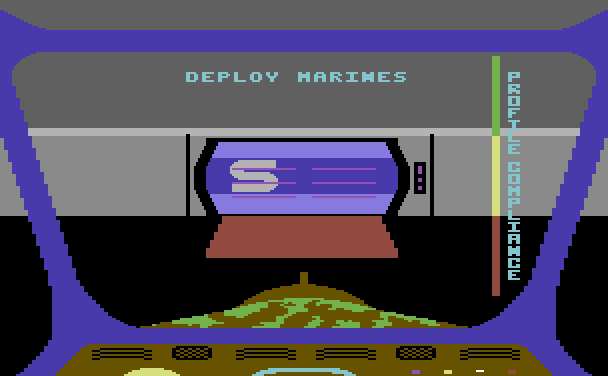
The first “proper” action of the game sees you piloting the dropship from the USS Sulaco down to the planet’s surface. To do so, you have to fly through a course made of floating rings: fly outside the rings and the compliance meter drops, and if the meter hits red you fail and have to try again. The course itself is very twisty-turny, which is strange. Like, there’s a clue in the word “dropship.” I shouldn’t need to do this much piloting just to fall straight downwards. The lack of any visuals other than the rings is disappointing, but the “3D” effect on the rings themselves, the sense that you’re flying “into” the screen, is actually quite impressive.
Going back to the Colonial Marine Technical Manual for a moment, I remember that in said book the fully-loaded dropship is described as “handling like a drunken cow,” and while it’s not quite that bad in this game it does feel very heavy. You need to start turning well before the next bend and towards the end, when your route would resemble spaghetti in a blender if you mapped it out, learning the course becomes almost mandatory. It’s a surprisingly difficult start to the action. In fact, it’s probably the hardest part of the whole game, so try not to be too discouraged if your first few attempts at flying the dropship prove deadlier to the marines than any amount of xenomorphs.
Landing accomplished! Ooh-rah, and so forth. The entrance to the colony of Hadley’s Hope might look a little more “futuristic parking garage” than “futuristic space colony,” but that fits with the bleak industrial setting of the movie. The marines are indeed deployed, but sadly there’s no scene where you get to drive the Armoured Personnel Carrier around.
In fact, the game skips forward to the marines’ first contact with the aliens. As you can tell by this text, it doesn’t go particularly well for them. Please, no swearing in the Commodore 64 version of Aliens. There might be children present. Now, while in the movie the aliens tear through the marines like a combine harvester careening through a puppy farm, the game gives you a chance to save the marines during the next gameplay segment.
You see the tiny man in the upper-left corner of the screen? The one with the brown overalls and what appears to be Princess Leia’s haircut? That’s you, that is. Well, it’s the marine you’re controlling, anyway, and the aim of this stage is to make your way through the maze-like colony and back to the safety of the APC.
There’s the APC now. I know it doesn’t look like much, but it’s such a safe haven that you don’t even need to climb aboard in order to be protected, you just have to be on the same screen and you’re safe from harm. Of course, getting to the APC isn’t so easy. For starters, you have control over four different marines, each of them located in a different part of the maze after everyone got separated when the spurting acid hit the metaphorical fan. You switch between them with the function keys, and the more marines you guide to safety the more lives you’ll have in the later stages. The things to keep an eye on are the monitors at the bottom of the screen: if they start flashing red, that means a marine is in danger.
Oh no, Corporal Dietrich has been ambushed by some slightly unconvincing aliens! Once the xenomorphs appear, you can’t leave the screen until you’ve fought them all off in a simple wave-shooter section that you could say is like Smash TV, if you were feeling extremely generous and Smash TV was a much more mediocre game. You press the fire button to fire your gun, quelle surprise, and you can move around while firing in a fixed direction if you hold the button down. The aliens attack from all angles, their usual lightning pace slowed to an arthritic hobble by the power of the C64, and your goal is to mow them down without letting them touch you. It works about as well as you'd expect, with the real problems coming when an alien appears at a diagonal to your current position. You can only fire in the four cardinal directions and the aliens move at about the same speed as your marine, so lining yourself up for a shot without getting grabbed can be difficult, and I sometimes ended up with a veritable conga line of skeletal star-beasts following me around as I tried to get into a good firing position. It’d help if you knew what directions the aliens were going to come from, which makes it a damn shame that your motion tracker does bugger all except provide a bit more atmosphere.
Here, Private Frost is being attacked by two aliens at once, but in their boundless exuberance they’ve run head-first into each other like an especially dark scene from a Chuckle Brothers show. Ha ha, no, I’m kidding, Frost is being dragged away to act as an incubator for a chestburster. That’s how the aliens operate, but there is a way to prevent this terrible fate: the xenomorphs will only attack a marine who’s on their own, preferring as they do to pick off their targets one at a time. Thus, one way to get through this section is to try to keep all the marines as close together as possible while they move through the maze. That way if a red “aliens are coming to ruin your day” warning starts blinking, one of the other marines can quickly dash to the same screen and prevent the attack. It’s an interesting set-up, and while it can be slow going as you inch each marine forward in turn that’s preferable to them all dying. There’s a surprising amount of tension to it as well, with the threat of a new alien ambush increasing with each screen you traverse, forcing you to gamble on whether or not to make a dash for the APC.
Also, I feel like I should mention that Frost is black in the movie but in this game he’s got the same pink skin tone as the other marines. It feels like a real oversight in a game that’s otherwise so accurate to the source material, but perhaps I’m asking too much of a movie tie-in on the C64.
The next gameplay section is completely different. I mean it plays differently, it’s still about a marine trying not to be killed by aliens, it’s not like you're suddenly thrust into the dark world of political machinations in fifteenth century Venice or anything. How this one works is that you control the lone marine on the right of the screen. The aliens move in from the left, and you have to move up and down so that you’re on the same plane as the onrushing aliens and then fry them with your flamethrower. If an alien gets past you, it kills one of the other marines. You can see the other marines at the bottom of the screen, patiently queueing up as though they’re waiting for a bus rather than a horrifying death via extreme pregnancy. The aliens start off at a pace you might describe as “dawdling” in another, less terrifying species, but gradually increase their speed until they’re setting new land speed records, and it all gets terribly frantic. One nice touch is that if the aliens get right up to you, they actually back off because they’re scared of the flamethrower’s pilot light, but more than anything it feels like a Game and Watch game. I could very easily see this as an LCD game from Tiger Electronics, possibly contained within an incredibly uncomfortable-to-hold plastic case shaped like a xenomorph’s head.
Oh hey, would you look at that. I got the shape of the unit wrong and you shoot vertically rather than horizontally, but otherwise I was pretty close. I’m not sure if this LCD game was ever released: it’s based on the cancelled Operation: Aliens kid’s cartoon (which I’ll never get tired of mentioning, because it was a kid’s cartoon based on Aliens) and was supposedly never released as a result, but the instruction manual can be found online, so who knows? All I know is that I want one.
After the simplistic but entertaining early stages, Aliens: The Computer Game rather shits the bed with the next level. It’s a maze, presumably intended to depict the remaining survivors making their way through the air vents. The white square is Ripley and the marines, the red dots are aliens and it’s so visually boring that it’s difficult to actually look at without your eyes swivelling around just to give themselves something to do. The gameplay’s not any better, either: there’s only one way out of the maze, so once you’ve learned the route the entire stage becomes trivial. Until then, it’s a tedious tip-toe through the ductwork, with lots of waiting for nearby aliens to wander off somewhere else, because the restrictive nature of the tunnels means you can’t go around them. If an alien grabs you – by which I mean if your white dot touches a red dot – you can order one of the marines to blow themselves up with a grenade, taking out the alien and giving you a chance to escape. This is why you need to keep as many of them alive in the early stages as possible – so you can use them as ambulatory land mines.
Next up, it’s Ripley’s turn to get in on the xeno-blasting action (I think she might have had xeno-blasting action in the Aliens toy line, come to think of it) as she heads deep into the aliens’ nest to rescue Newt. It’s pretty much the same as the “get the marines to the APC” stage, although it has a couple of quirks that make it much more difficult. For starters, Ripley’s pulse rifle only has 99 rounds of ammo, which is frankly not enough. Luckily you can leg it past a lot of the aliens, and you’ll have to because Ripley couldn’t find room in her pockets for a few extra magazines. She doesn’t even have a flamethrower gaffer-taped to her pulse rifle like she does in the movie, so I’m deducting some Authenticity Points. There’s also a time limit now. It says seventeen minutes, but it runs faster than real time so it’s more like ten minutes.
The most challenging new aspect, however, is that you’ve got to find Newt and then get back to the elevator you started at. This is not easy when the aliens’ nest is a vast grey labyrinth of identical corridors, but there is one thing you have that can help: pressing space makes Ripley drop a flare on the ground. Do not forget to do this regularly. I did forget. Look, I was being harassed by deadly space creatures, forgive me if this Hansel and Gretel shit slipped my mind.
Ah ha, I must be getting close – I’ve found the room where the aliens store all the bishop’s mitres they’ve collected.
Oh good, I found Newt. Having a tracking device that tells me how close I am to Newt certainly made that a lot less painful then it could have been. Now I’ve just got to retrace my steps. Okay, sure, my brain was determined not to remind me to drop flares, but I’m sure I can remember which way I came.
I’m fairly certain the queen alien wasn’t here before. That’s the kind of thing you would remember. You know what? I think I’ll find a different route. Sorry to disturb you, your highness.
So I did find a different route, and I managed to guide Newt to safety by running past all of the aliens I saw and praying they wouldn’t realise my gun was drier than Stewart Lee doing stand-up in the Gobi Desert. Of course, those of you who’ve seen Aliens will know that’s not the end of the story, and there’s one final confrontation left.
In the wild, a feral powerloader will often spread its arms as wide as possible in order to create a larger, more intimidating silhouette. Coupled with its vocal warning cries, this is often enough to scare away predators. However, this does not always work, and in this case a battle for survival ensues.
That’s right, it’s Aliens’ climactic final scene, where Ripley climbs into a powerloader and wrestles with the alien queen. The queen’s sprite is mostly decent – it could have done with a bit more colour – but it’s very difficult not to be distracted by the face. The weird, boxy face. It has very prominent eyes, which is odd because one of the defining features of the xenomorphs’ design is that they don’t have eyes, and especially not ones that look as though they could do double duty as letterboxes. Standards of verisimilitude are slipping, but it’s hard to care when I’m fighting the alien queen in a powerloader.
Oh yeah, the fighting. Well, you control the powerloader’s claws, and you can move them up or down and side-to-side. If you move one claw up, the other one moves down, and when you’ve got a claw extended it’s a simple matter of bashing the queen over the head with it. I found the easiest way to do this was to wait until the queen was between the edge of the screen and the “outside” of your claw. Once you’re in that position you can repeatedly slap the queen with the back of your giant metal hand.
After enough slaps, the queen’s health will be depleted and you can grab her with the powerloader’s claw, dropping her out of the airlock and into space. Is the queen dead? Probably not, but she’s someone else’s problem now and that’s all that matters. And so, Aliens: The Computer Game is complete.
Thanks, Bishop. I’m proud to have exceeded your expectations vis-a-vis the capability of a human to destroy the universe’s most fearsome killing machine. Now crawl over there and fetch your legs, they’re making the place look untidy.
The game ends with Ripley and Newt settling down for a well-deserved hypersleep. I’m not sure why Ripley shaved off most of Newt’s hair before they got into bed, but I’m sure it’s a vital step in the cryogenic process.
As yet another game that’s a compilation of smaller, underdeveloped games, Aliens suffers from the same problem as always: it spreads itself too thin rather than expanding on the interesting stuff. Most of the games aren’t bad, the pipe maze being the exception, but the levels where you’re exploring the colony are easily the most interesting and so you’re left wondering what could have been if they were more fleshed-out. An entire game about controlling a squad of marines, one that ramps up the tension already found in those section as you struggle to keep everyone alive, could have been a very interesting experience. That’s sort of what the other C64 Aliens game is like, except that one’s a first-person shooter. But that’s enough of dreams and maybes: this is the game that exists, and it’s pretty okay. Perhaps a little too limited to be really enjoyable in the modern age and it leans a little too hard on memorisation at points, but it’s not the worst Aliens game I’ve ever played and it’s buoyed by its faithfulness to the source material. Plus I got to control a powerloader. That’s all I really wanted. Honestly, I think that’s all I’ve really wanted since I was about 12.
This Aliens is not to be confused with the other C64 Aliens, which was released by Electric Dreams in 1987 and is a completely different game. This one is sometimes referred to as Aliens: The Computer Game, but that doesn’t to much to minimise confusion because I've also seen the Electric Dreams version referred to as, you guessed it, Aliens: The Computer Game.
I’m sure you’ve all seen Aliens before, and if you haven’t then you should probably go and fix that. If you still don’t know about Aliens – maybe you’re offended by internet strangers telling you what to do and are refusing to watch the movie on principle – here’s a quick recap. Ellen Ripley, sole survivor of the first Alien movie, travels back to the planet LV-426 with a squad of colonial marines. The colony on the planet has been overrun with xenomorphs. The marines think they’ll be able to easily defeat the aliens, but the stealthy creatures overwhelm the technologically superior marines for all your “Vietnam war analogy” needs. Ripley fights the alien queen in a glorified forklift and then leaves the planet with the few survivors, including a small girl she found hiding in an air duct. Honestly, I’m not sure why I bothered telling you all that, because the game itself does a fairly thorough job of explaining what’s going on.
Yes, unlike Konami’s arcade version of Aliens, a game that takes the basic premise of the movie and then says “yeah, but what if Ripley was Space Rambo and we just made up a load of new mutant aliens?” this game sticks very closely to the plot and dialogue of the movie. So closely, in fact, that this opening text is copied directly from the film’s script. “The stars shine like the love of God” wasn’t the game’s programmers getting poetic in an effort to jazz up the intro, that’s a line from the script’s opening paragraph. Actually, the line in the script is “The stars shine like the love of God – cold and remote.” I wonder why they left that bit out? For space reasons, or an attempt to avoid offending religious sensibilities? Maybe they just thought it was a bit too flowery. If you’re the person responsible, please get in touch.
Before the game begins, you’re treated to this low-res recreation of the scene from Aliens where Ripley briefs the marines on the xenomorph threat, with the dialogue taken word-for-word from the script. The image is at once ugly and charming in its simplicity, although even with the blockiness it’s still immediately recognisable as the scene it’s supposed to be. I instantly heard Hudson’s lines in Bill Paxton’s voice with perfect clarity, I know that much. As much I have enjoyed some of the wilder takes on the universe in other Aliens game – I can’t imagine there’s anyone who wouldn’t be enamoured of Capcom’s decision to give Arnold Schwarzenegger a giant robot arm in AvP – it’s nice to have a game that sticks so faithfully to the source material. I cannot express enough my genuine love for the first three Alien movies and the universe they created, which is one of my all-time favourite fictional worlds. I’ve seen the movies dozens of times, as a kid I read the novelizations almost every week, I had the toys, played the games and literally bought the t-shirt. My point is, you should probably expect a hefty portion of bias in this article.
Here we see a fine selection of the colonial marines’ arsenal. Not pictured: nukes, knives, sharp sticks. Like an anxious parter on the eve of an overseas holiday, Aliens: One of the Computer Games Called Aliens tasks you with making sure you know where everything is before you depart on your mission. The name of a piece of equipment appears, you click on the corresponding item, then repeat until you’ve identified them all. It’s very straightforward, and you can puzzle them out even if you’ve never seen Aliens before. Of course, being the youthful Aliens dork that I was, I had a copy of the Colonial Marines Technical Manual so I’m more than prepared for this minigame. I think this might be the fastest I’ve ever cleared any section of any videogame, honestly, and that includes entering my name on high-score tables. Well, in that situation there’s the tough decision to make between BUM and POO, isn’t there?
The first “proper” action of the game sees you piloting the dropship from the USS Sulaco down to the planet’s surface. To do so, you have to fly through a course made of floating rings: fly outside the rings and the compliance meter drops, and if the meter hits red you fail and have to try again. The course itself is very twisty-turny, which is strange. Like, there’s a clue in the word “dropship.” I shouldn’t need to do this much piloting just to fall straight downwards. The lack of any visuals other than the rings is disappointing, but the “3D” effect on the rings themselves, the sense that you’re flying “into” the screen, is actually quite impressive.
Going back to the Colonial Marine Technical Manual for a moment, I remember that in said book the fully-loaded dropship is described as “handling like a drunken cow,” and while it’s not quite that bad in this game it does feel very heavy. You need to start turning well before the next bend and towards the end, when your route would resemble spaghetti in a blender if you mapped it out, learning the course becomes almost mandatory. It’s a surprisingly difficult start to the action. In fact, it’s probably the hardest part of the whole game, so try not to be too discouraged if your first few attempts at flying the dropship prove deadlier to the marines than any amount of xenomorphs.
Landing accomplished! Ooh-rah, and so forth. The entrance to the colony of Hadley’s Hope might look a little more “futuristic parking garage” than “futuristic space colony,” but that fits with the bleak industrial setting of the movie. The marines are indeed deployed, but sadly there’s no scene where you get to drive the Armoured Personnel Carrier around.
In fact, the game skips forward to the marines’ first contact with the aliens. As you can tell by this text, it doesn’t go particularly well for them. Please, no swearing in the Commodore 64 version of Aliens. There might be children present. Now, while in the movie the aliens tear through the marines like a combine harvester careening through a puppy farm, the game gives you a chance to save the marines during the next gameplay segment.
You see the tiny man in the upper-left corner of the screen? The one with the brown overalls and what appears to be Princess Leia’s haircut? That’s you, that is. Well, it’s the marine you’re controlling, anyway, and the aim of this stage is to make your way through the maze-like colony and back to the safety of the APC.
There’s the APC now. I know it doesn’t look like much, but it’s such a safe haven that you don’t even need to climb aboard in order to be protected, you just have to be on the same screen and you’re safe from harm. Of course, getting to the APC isn’t so easy. For starters, you have control over four different marines, each of them located in a different part of the maze after everyone got separated when the spurting acid hit the metaphorical fan. You switch between them with the function keys, and the more marines you guide to safety the more lives you’ll have in the later stages. The things to keep an eye on are the monitors at the bottom of the screen: if they start flashing red, that means a marine is in danger.
Oh no, Corporal Dietrich has been ambushed by some slightly unconvincing aliens! Once the xenomorphs appear, you can’t leave the screen until you’ve fought them all off in a simple wave-shooter section that you could say is like Smash TV, if you were feeling extremely generous and Smash TV was a much more mediocre game. You press the fire button to fire your gun, quelle surprise, and you can move around while firing in a fixed direction if you hold the button down. The aliens attack from all angles, their usual lightning pace slowed to an arthritic hobble by the power of the C64, and your goal is to mow them down without letting them touch you. It works about as well as you'd expect, with the real problems coming when an alien appears at a diagonal to your current position. You can only fire in the four cardinal directions and the aliens move at about the same speed as your marine, so lining yourself up for a shot without getting grabbed can be difficult, and I sometimes ended up with a veritable conga line of skeletal star-beasts following me around as I tried to get into a good firing position. It’d help if you knew what directions the aliens were going to come from, which makes it a damn shame that your motion tracker does bugger all except provide a bit more atmosphere.
Here, Private Frost is being attacked by two aliens at once, but in their boundless exuberance they’ve run head-first into each other like an especially dark scene from a Chuckle Brothers show. Ha ha, no, I’m kidding, Frost is being dragged away to act as an incubator for a chestburster. That’s how the aliens operate, but there is a way to prevent this terrible fate: the xenomorphs will only attack a marine who’s on their own, preferring as they do to pick off their targets one at a time. Thus, one way to get through this section is to try to keep all the marines as close together as possible while they move through the maze. That way if a red “aliens are coming to ruin your day” warning starts blinking, one of the other marines can quickly dash to the same screen and prevent the attack. It’s an interesting set-up, and while it can be slow going as you inch each marine forward in turn that’s preferable to them all dying. There’s a surprising amount of tension to it as well, with the threat of a new alien ambush increasing with each screen you traverse, forcing you to gamble on whether or not to make a dash for the APC.
Also, I feel like I should mention that Frost is black in the movie but in this game he’s got the same pink skin tone as the other marines. It feels like a real oversight in a game that’s otherwise so accurate to the source material, but perhaps I’m asking too much of a movie tie-in on the C64.
The next gameplay section is completely different. I mean it plays differently, it’s still about a marine trying not to be killed by aliens, it’s not like you're suddenly thrust into the dark world of political machinations in fifteenth century Venice or anything. How this one works is that you control the lone marine on the right of the screen. The aliens move in from the left, and you have to move up and down so that you’re on the same plane as the onrushing aliens and then fry them with your flamethrower. If an alien gets past you, it kills one of the other marines. You can see the other marines at the bottom of the screen, patiently queueing up as though they’re waiting for a bus rather than a horrifying death via extreme pregnancy. The aliens start off at a pace you might describe as “dawdling” in another, less terrifying species, but gradually increase their speed until they’re setting new land speed records, and it all gets terribly frantic. One nice touch is that if the aliens get right up to you, they actually back off because they’re scared of the flamethrower’s pilot light, but more than anything it feels like a Game and Watch game. I could very easily see this as an LCD game from Tiger Electronics, possibly contained within an incredibly uncomfortable-to-hold plastic case shaped like a xenomorph’s head.
Oh hey, would you look at that. I got the shape of the unit wrong and you shoot vertically rather than horizontally, but otherwise I was pretty close. I’m not sure if this LCD game was ever released: it’s based on the cancelled Operation: Aliens kid’s cartoon (which I’ll never get tired of mentioning, because it was a kid’s cartoon based on Aliens) and was supposedly never released as a result, but the instruction manual can be found online, so who knows? All I know is that I want one.
After the simplistic but entertaining early stages, Aliens: The Computer Game rather shits the bed with the next level. It’s a maze, presumably intended to depict the remaining survivors making their way through the air vents. The white square is Ripley and the marines, the red dots are aliens and it’s so visually boring that it’s difficult to actually look at without your eyes swivelling around just to give themselves something to do. The gameplay’s not any better, either: there’s only one way out of the maze, so once you’ve learned the route the entire stage becomes trivial. Until then, it’s a tedious tip-toe through the ductwork, with lots of waiting for nearby aliens to wander off somewhere else, because the restrictive nature of the tunnels means you can’t go around them. If an alien grabs you – by which I mean if your white dot touches a red dot – you can order one of the marines to blow themselves up with a grenade, taking out the alien and giving you a chance to escape. This is why you need to keep as many of them alive in the early stages as possible – so you can use them as ambulatory land mines.
Next up, it’s Ripley’s turn to get in on the xeno-blasting action (I think she might have had xeno-blasting action in the Aliens toy line, come to think of it) as she heads deep into the aliens’ nest to rescue Newt. It’s pretty much the same as the “get the marines to the APC” stage, although it has a couple of quirks that make it much more difficult. For starters, Ripley’s pulse rifle only has 99 rounds of ammo, which is frankly not enough. Luckily you can leg it past a lot of the aliens, and you’ll have to because Ripley couldn’t find room in her pockets for a few extra magazines. She doesn’t even have a flamethrower gaffer-taped to her pulse rifle like she does in the movie, so I’m deducting some Authenticity Points. There’s also a time limit now. It says seventeen minutes, but it runs faster than real time so it’s more like ten minutes.
The most challenging new aspect, however, is that you’ve got to find Newt and then get back to the elevator you started at. This is not easy when the aliens’ nest is a vast grey labyrinth of identical corridors, but there is one thing you have that can help: pressing space makes Ripley drop a flare on the ground. Do not forget to do this regularly. I did forget. Look, I was being harassed by deadly space creatures, forgive me if this Hansel and Gretel shit slipped my mind.
Ah ha, I must be getting close – I’ve found the room where the aliens store all the bishop’s mitres they’ve collected.
Oh good, I found Newt. Having a tracking device that tells me how close I am to Newt certainly made that a lot less painful then it could have been. Now I’ve just got to retrace my steps. Okay, sure, my brain was determined not to remind me to drop flares, but I’m sure I can remember which way I came.
I’m fairly certain the queen alien wasn’t here before. That’s the kind of thing you would remember. You know what? I think I’ll find a different route. Sorry to disturb you, your highness.
So I did find a different route, and I managed to guide Newt to safety by running past all of the aliens I saw and praying they wouldn’t realise my gun was drier than Stewart Lee doing stand-up in the Gobi Desert. Of course, those of you who’ve seen Aliens will know that’s not the end of the story, and there’s one final confrontation left.
In the wild, a feral powerloader will often spread its arms as wide as possible in order to create a larger, more intimidating silhouette. Coupled with its vocal warning cries, this is often enough to scare away predators. However, this does not always work, and in this case a battle for survival ensues.
That’s right, it’s Aliens’ climactic final scene, where Ripley climbs into a powerloader and wrestles with the alien queen. The queen’s sprite is mostly decent – it could have done with a bit more colour – but it’s very difficult not to be distracted by the face. The weird, boxy face. It has very prominent eyes, which is odd because one of the defining features of the xenomorphs’ design is that they don’t have eyes, and especially not ones that look as though they could do double duty as letterboxes. Standards of verisimilitude are slipping, but it’s hard to care when I’m fighting the alien queen in a powerloader.
Oh yeah, the fighting. Well, you control the powerloader’s claws, and you can move them up or down and side-to-side. If you move one claw up, the other one moves down, and when you’ve got a claw extended it’s a simple matter of bashing the queen over the head with it. I found the easiest way to do this was to wait until the queen was between the edge of the screen and the “outside” of your claw. Once you’re in that position you can repeatedly slap the queen with the back of your giant metal hand.
After enough slaps, the queen’s health will be depleted and you can grab her with the powerloader’s claw, dropping her out of the airlock and into space. Is the queen dead? Probably not, but she’s someone else’s problem now and that’s all that matters. And so, Aliens: The Computer Game is complete.
Thanks, Bishop. I’m proud to have exceeded your expectations vis-a-vis the capability of a human to destroy the universe’s most fearsome killing machine. Now crawl over there and fetch your legs, they’re making the place look untidy.
The game ends with Ripley and Newt settling down for a well-deserved hypersleep. I’m not sure why Ripley shaved off most of Newt’s hair before they got into bed, but I’m sure it’s a vital step in the cryogenic process.
As yet another game that’s a compilation of smaller, underdeveloped games, Aliens suffers from the same problem as always: it spreads itself too thin rather than expanding on the interesting stuff. Most of the games aren’t bad, the pipe maze being the exception, but the levels where you’re exploring the colony are easily the most interesting and so you’re left wondering what could have been if they were more fleshed-out. An entire game about controlling a squad of marines, one that ramps up the tension already found in those section as you struggle to keep everyone alive, could have been a very interesting experience. That’s sort of what the other C64 Aliens game is like, except that one’s a first-person shooter. But that’s enough of dreams and maybes: this is the game that exists, and it’s pretty okay. Perhaps a little too limited to be really enjoyable in the modern age and it leans a little too hard on memorisation at points, but it’s not the worst Aliens game I’ve ever played and it’s buoyed by its faithfulness to the source material. Plus I got to control a powerloader. That’s all I really wanted. Honestly, I think that’s all I’ve really wanted since I was about 12.
Labels:
activision,
aliens,
commodore 64,
licensed,
minigames
Subscribe to:
Posts (Atom)