09/05/2018

WORLD GAMES (NES)

While the UK swelters in the kind of unseasonably hot weather than makes you worry about the survival of humanity, let’s take our minds off ecological disaster with some sports. Not physical sports, of course. It’s far too hot for that. Instead, it’s another compilation of sports minigames in Epyx and Rare’s 1989 NES version of World Games!

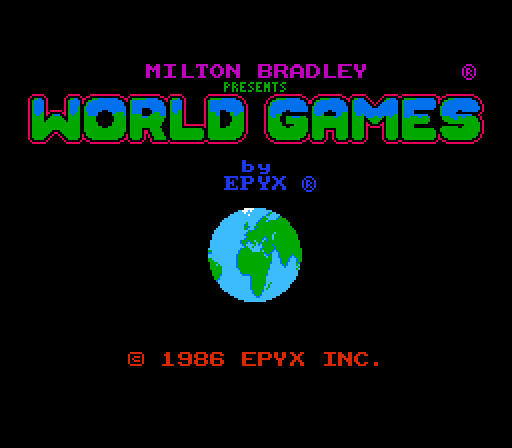
Here’s the world now, in all its glory. Yep, that’s a globe. All kinds of continents and what-have-you. Look, it’s a really boring title screen, okay?
As you might have surmised, World Games is part of Epyx’s famous “Games” series of multi-event sports titles, a series mostly known for its home computer iterations that began with 1984’s Summer Games and continued with such well-known releases as Winter Games and California Games. As far as I’m aware, World Games is expansive as the series’ premise ever got, which is a shame. We missed out on Universe Games, featuring such events as Algolian Laser Swords or The Death-Dance of Crenulex-7 – but World Games is what we got, so get ready to jump off things and throw logs around!


World Games features the usual choices between practising a single event or running through them all in sequence, with multiplayer madness being the obvious selling point. However, I’ll be playing alone, because most of the events in World Games are about one competitor taking on a challenge rather than a “versus” situation. Also because friends don’t make friends play thirty-year-old NES sports games. So, with my name and nationality entered – complete with a blast of your chosen country’s national anthem – it’s on to the sporting action.


But wait! First there’s some background information about the sport you’re about to attempt. It’s quite interesting the first time you play World Games but utterly redundant after that, so it’s nice that you can turn these screens off before you start playing.
As you can see, event number one is weightlifting, the second-most basic of all sports (after running, of course). We’re told that weightlifting is more than just a test of strength, and I can believe that. You need balance, and willpower, and a very strong girdle. Where it loses me is the assertion that weightlifting is a sport of strategy. Does it mean the strategy behind picking the weight of the barbell you’re going to attempt to lift? If that’s the case then the strategy aspect really doesn’t apply to me, as we shall see.


Naturally the goal here is to lift the heaviest set of weights that you can manage, and you begin by selecting the weight you want to attempt. Then you begin your lift by hang on, what the hell is that?


“VITA MINS” says the terrible creature, a balding golem of boiled ham, a muscular Phil Collins formed from Billy Bear meat and raw, unflinching terror. The blue pinpricks of distant starlight sunk deep into what must be considered his “face” see nothing but the sin of those who don’t supplement their nutritional intake with a variety of easy-to-swallow vitamin pills. His favourite vitamin is P – vitamin Pain, which the body needs in order to survive that which is coming. And it is coming.


That’s enough about the VITA MIN Man. More than enough, in fact. Back to the weightlifting, and get this – you don’t lift the weights by hammering the buttons as fast as possible to build your strength! I know, I was surprised too, and World Games actually requires no button mashing. Plenty of joystick (or joypad, in the case of the NES version) waggling, mind you. I know this because I’ve played enough multi-event sports games to learn that you should always read the manual beforehand. There’s bound to be some bizarre, unfathomable control schemes at work, and while World Games isn’t too bad on that front I’m definitely glad I looked up the manual. It would have taken me a long time to work out the weightlifting otherwise.
How it works is you press down on the d-pad to grab the bar, then up to start lifting, then down to “snatch” the weights, up again to hold the bar over your head and finally, once the judge’s lights have lit up, down again to put the weights down.


That’s the control scheme for the first three lifts – the “snatch” portion – anyway. Then you move on to the clean and jerk, which adds in a couple of extra ups and downs to the mix. Two things to discuss here: the first is that all this up and down means I’ve now got this song stuck in my head. The other is that the challenge here is all about the timing of your button presses, which was a surprise for a weightlifting challenge. The more weight on your, erm, weights, the tighter the timing required for a successful input. It’s also really bloody difficult, and I didn’t manage a successful lift of anything more than the second-lightest bar. The manual claims this event is all down to practise, but I tried it about fifty goddamn times and could never get a handle on the right timings. There’s a lack of feedback about what you’re doing wrong, I think that’s the issue, but at least it’s all very nicely animated, with smooth sprites that really look like they’re struggling even when I was cack-handedly trying to lift the empty bar just to get any kind of score.


Next it’s off to Germany for that famous(?) traditional(??) German activity of Barrel Jumping. You control an ice skater who gets their tracksuits at the same place that Little Mac buys his training gear, and you have to jump over some barrels. How many barrels? That’s up to you! How many do you dare face? After the weightlifting debacle, I thought it best to start with as few barrels as possible.


This event is thankfully much, much easier than the weightlifting, possibly because it feels much more like a “traditional” computer games sports event. You rhythmically waggle the joypad back and forth to build up speed, and then press a button to jump. It’s… well, it’s pretty much every computerised version of the long jump ever, except you’re wearing a romper suit and failure means a meeting with the unforgiving ice rather than the gentle embrace of a sandpit.


Headline: man’s coccyx shoots up body, replaces left lung.
The barrel jumping does exactly what it says on the tin, it controls smoothly, it’s not obnoxiously difficult and even if you do fail there’s much comedic potential in seeing your character spreadeagled across the barrels like they’re participating in a Donkey Kong-themed photoshoot. Thumbs up on the barrel jumping, then.


Now we’re off to sunny Mexico for the madman’s gamble that is Cliff Jumping, a “sport” for people whose mothers said “if all your friends were jumping off a cliff would you to that too?” one too many times. You select the height from which you’d like to hurl yourself off a cliff, although there seems little point in not jumping right from the top, and then you jump.


As you soar majestically through the azure sky, you have to nudge your character away from the cliff face – although not too far, because you get more points the closer you are to the cliff – and press down on the d-pad to position yourself in a diving stance rather than the belly-flop that’s going on in the screenshot above.


My first attempt did not go well. “Fault,” says the game, which is a hilariously euphemistic way of saying “you’ve just turned your spine into dry porridge, whoops.”
I did get the hang of the cliff diving quite quickly, and the risk-reward gameplay of skimming the cliff edge is pretty enjoyable once you get into it… but it’s not like there’s much here to hold your interest once you’ve gotten good at it. Not if you’re playing alone, at least


Next up: slalom skiing, which surprisingly didn’t feature in Epyx’s previous Winter Games. Ski between the flags as you travel down the hill, with a time penalty for missing a gate and the ever-present threat of slamming face-first into the trees or the barriers and thus ending your run prematurely.


Yeah, like that.
Another relatively uncomplicated event, this one, but yet again the controls are sharp and your characters movements are smooth. The manual says that holding the A button “increases your turning sensitivity,” but I couldn’t really see (or “feel”, I suppose) much difference. It’s all about predicting where you’re going next and making small movement to preserve your forward momentum, because turning too hard will slow you right down. That’s not necessarily a bad thing, though. Slowing down and making sure you don’t miss any gates seemed to be a better strategy that prioritising speed. The hearts of the judges are as cold as the snow that is their dominion, and they will not be impressed by your devil-may-care attitude to proper gate navigation.


Canada’s contribution to this cavalcade of sporting excitement is the lumberjack log rolling event. Thanks, Canada. Watching a lot of cartoons as a kid made me think that flailing your legs to keep your balance on a floating log was going to be a bigger feature of adult life, but this is one of the few times it’s come up. The general idea is simple enough – don’t fall off the log or you’ll die – but sadly this is one of the least well-executed of World Game’s events. Supposedly it’s all about changing the direction of the log’s rotation and trying to second-guess the other lumberjack’s movements, but that never seemed to factor into it and all I could do to win was just keep moving the d-pad left and right until the opposing lumberjack fell off the log out of sheer boredom. And then, as I mentioned, presumably died.


The log rolling takes in shark-infested water, which makes you wonder how they got an insurer to sign off on it. This article would have been out a bit quicker if I hadn’t gotten distracted by reading about Canada’s native shark species. Maybe this one is a salmon shark.
Oh, and if you were expecting a joke about Monty Python’s Lumberjack Song I’m afraid that’s not possible… because the soundtrack for this event is a chiptune version of The Lumberjack Song. Unlicensed, I assume.


Yeehaw, cowpokes – the USA event is the rootin’, tootin’, potentially animal crueltyin’ rodeo! Pick a bull from the selection of five that have been conveniently sorted by how ornery they are and then try to stay atop the bull for eight seconds. The available bulls are called Bob, Ferdinand, Elmer, Tornado and Earthquake. I’m not sure about Bob, but I’m guessing that Ferdinand was named for the children’s story and Elmer because Elmer’s Glue has a bull on its logo. I was going to say Earthquake and Tornado were named after the famous WWF tag-team the Natural Disasters, but that was Typhoon, not Tornado. I hope you accept my shame-faced apology for this mistake.


I was surprised by how easy the bull riding turned out to be, and I managed to conquer the strongest bull on my second attempt. There are only three commands to deal with, which helps: hold down when the bull is spinning, hold the pad in the direction of movement when then the bull is kicking and hold the opposite direction when the bull comes to a sudden stop. It’s very straightforward, with the only complication being that it can be a little difficult to tell if the bull has started spinning or not. Still, it’s not difficult after even a very small amount of practise.


Moving a bit closer to my neck of the woods for the next event with the Scottish caber toss. Your goal? To throw a very large stick so that it travels end-over-end, although in World Games you also have to throw the caber as far as possible by waggling the d-pad to build up your running (okay, walking, it's a really big stick) speed before tossing the caber. Now, the problem with this is that in real caber tossing distance thrown is not important. It’s all about how straight you can make the caber travel, with the best result being that it lands on its top end and then falls away from the thrower in a straight line. This titbit of knowledge was stored somewhere in my brain, but naturally I went to check that I was right. That’s when I learned that people who throw cabers are called “tossers,” which made the Wikipedia page on the subject unintentionally and immaturely entertaining:


Not my proudest chuckle, but chuckle I most certainly did.
The trick with the caber toss is that you have to hold the A button to throw and release it when the caber is at the optimum angle, making this feel a lot like most javelin / discus / etc. events in other sports games, but I do appreciate the relative obscurity of the caber toss.


Plus, if you really mess up the caber will fall back and hammer your competitor into the ground like something out of a Wile E. Coyote cartoon, which is great. If you nail a really good score on your first attempt, you might as well get some extra value out of World Games by making this happen on purpose.


The final event is Sumo Wrestling, and much like the log rolling I never managed to get a handle on it. I pressed various buttons on the joypad and things happened on screen, but how those two events were related never seemed to make much sense, even after I’d read the manual. It seems like the sumo follows the structure of most home computer fighting games of the time, in that each “joystick” direction performs a certain move, and like most home computer fighting games of the time it all feels terribly random.


Holding the A button seems to make your wrestler grab their opponent’s belt, thus theoretically opening up a whole new set of moves, but in my experience just tapping right and slapping the other wrestler across the ring yielded the best result in what is the weakest of all World Games’ events.


The most interesting thing about the sumo event is this sprite of a fallen wrestler that was seemingly traced from a photo of a plastic baby doll that’d been left on top of a hot radiator.


And that’s your lot. No ending or medal ceremony or anything like that, although perhaps that’s because I was playing on my own. Still, some kind of recognition would have been nice rather than being dumped straight back to the title screen. Oh well, at least I got to see that guy get buried by a caber.


It’s difficult to sum up World Games without saying “yeah, it’s okay” about fifty times. It’s just okay, you see. Better than a lot of multi-event sports games – easier to play, certainly – but I don’t think it’ll keep you hooked for long unless you’ve got an unhealthily competitive relationship with someone who really likes NES sports games. It suffers from the events being uneven in quality and I wish they’d leaned harder into the “weird” events, but it controls well and it’s nicely animated. World Games is definitely a game, in the world. That’s a cast-iron VGJunk guarantee.

03/05/2018

GREMLINS: THE ADVENTURE (COMMODORE 64)

Would I make a good mogwai? I’m always up eating past midnight and taking long showers, although I do shun the natural light of the sun. One out of three ain’t bad. And yes, my antisocial habits are relevant because today’s game is based on the classic horror-comedy movie Gremlins. Have your camera flashes ready and make sure your microwave is plugged in, because here’s the Commodore 64 version of Adventure International’s 1985 Gizmo-caca-em-up Gremlins: The Adventure!


There’s a gremlin now – in fact, it’s Stripe, the vicious “leader” of the gremlins. Did you know there are a bunch of “Mandela Effect” aficionados out there who are convinced that Stripe was originally called Spike? He wasn’t, and this game contains the proof. Of course, knowing this means it’s now almost guaranteed that I’ll accidentally type his name as Spike at some point. Also, Stripe was voiced by Megatron himself, Frank Welker. I feel a little bad saying that, because Frank Welker has voiced hundreds of things and to limit him to one role is rather underselling his range, but he’ll always be Megatron to me.


With no preamble besides the (rather charmingly illustrated) title screen, you’re thrown straight into the action of Gremlins: The Adventure. I’m assuming you’ve all seen the movie, or at least know the general outline? A young man named Billy Peltzer gets a cute lil’ creature as a pet, the critter gets wet and this causes it to spawn an army of destructive, murderous monsters – the titular gremlins. The gremlins then proceed to cause havoc in the quaint little town of Kingston Fall, and it’s up to Billy to destroy the gremlins and save the town. Gremlins: The Adventure kicks off at around the half-way point of the film, once the gremlins are loose. This makes sense: the first half of the film is mostly about Billy suffering the indignities of his crappy job and having an old woman threaten his dog, which might not make for the most engaging gameplay.
As you can see, Gremlins: The Adventure is, well, a graphic adventure. It uses the usual two-word text parser, so you can type in things like GET ITEM or OPEN DOOR and maybe something will happen that lets you advance. This first screen’s most notable features are the flashlight that we’re told is somewhere in the room, and the gremlin on the right who’s chucking darts at us. I know, I’ll use the LOOK command and hopefully Billy will spot something to help us out of this predicament!


Well, that didn’t work. I think that’s a brand new record here at VGJunk – an adventure game death in only one move! The gremlins are efficient killers, if nothing else. Although I wonder how the gremlin killed Billy by throwing a dart at him. Unless the horrible creature is a true master of the oche and possesses enough skill to hit Billy right in the eye, it seems unlikely that a single dart would be enough to cause instant death. Darts aren’t that big. This gremlin must have an arm like a goddamn cannon.


As it turns out, the solution is to immediately move “down” and into the living room. Any other action results in death by dart. At first I thought it was a little cruel that G:TA is so willing to kill the player so quickly, but on reflection it’s no more unfair than a lot of other graphic adventure deaths. At least “run away from the gremlin” makes sense.
Once you’ve arrived downstairs, another gremlin is waiting for you, but this one is unarmed so you’re free to GET SWORD from the wall and live out your Highlander fantasies by lopping its head clean off.


The gremlin’s head flies across the room and lands in the fireplace. The graphics are even updated to reflect this, a gruesome little touch that I really appreciate. Try not to think too much about what that would smell like.


Then it’s into the kitchen, where despite the obvious and very temping lure of a gremlin standing inside a blender like a big idiot, I struggled to figure out how to proceed. KILL GREMLIN didn’t work, even though it did on the previous screen, and the game didn’t recognise USE or TURN ON. The solution was to use the all-in-one mega-remote created by Billy’s inventor father, but even that took me a while to get to grips with because you have to repeatedly use the phrase PRESS BUTTON. Each press makes something different happen – microwave on, microwave off, blender on, blender off, laundry chute opens and then closes, the kitchen drawer opens and closes… fortunately the gremlins are content to stand there while you type PRESS BUTTON over and over, and by the end you’ll have one well-cooked gremlin, gremlin purée and a couple of open doors.


Inside the laundry chute is “cute,” “loveable” Gizmo, the unwilling father of this hideous gremlin progeny. His adorability levels have taken a knock during the transition to C64 graphics, his usual “walking cuddly toy” vibe replaced by a vague air of pugnacious threat, like he’d glass you in a Wetherspoons if you spilled his pint.
Once you’ve found Gizmo, he follows you around for the rest of the game although he doesn’t seem to do anything. Maybe I should have tested this further by leaving him locked up in the laundry chute, but as far as I can tell the only thing Gizmo does is add “GIZMO the little MOGWAI” to the description of every scene hereafter.


Once you’ve picked up the knife from the kitchen drawer, you can go back upstairs and kill the gremlin on the first screen by entering, well, KILL GREMLIN. Presumably the extra confidence that Billy gets from holding a massive knife means he’s now able to avoid the gremlin’s previously lethal darts. It’s like Dumbo’s magic feather, only stabbier.


And then it’s out onto the streets of Kingston Falls, where you can explore the town and begin trying to establish a mental map of the various locations. They’re mostly familiar if you’ve seen Gremlins the movie, with Billy being able to visit the YMCA pool, the department store, the cinema and noted gremlin hang-out Dorry’s Tavern, which is where we’re going first.


Ye gods, the gremlins are smoking cigars and spitting! Disgraceful. Is that more uncouth than murdering people? Maybe. Spitting is pretty terrible habit. The gremlins are having a rare old time, getting paralytic and being uncouth, and I have to give a special mention to the gremlin at the back swinging from the ceiling. It’s a very simple sprite but it’s so charmingly sketched that it does a great job of getting across the innate anarchy of the gremlin species.


Less charming is the flasher gremlin behind the bar, and sadly there’s no Phoebe Cates in this game to kick the flasher gremlin across the room like she does in Gremlins 2. Weirdly, no human characters show up in G:TA, and I’m just assuming we’re playing as Billy because he’s the main character, although he’s clearly taken on the roles of the movie’s other characters – for instance, it’s Billy’s mum that microwaves a gremlin. G:TA is one of those movie tie-ins that tries to adapt the plot of the movie fairly literally rather than using it as a springboard for something like an action platformer, which is something of a double-edged sword when it comes to solving the game’s puzzles. If you’ve seen Gremlins, some of the solutions are going to make sense like here, where you can get a camera from behind the bar and use its flash to scare away the gremlins. But then later solutions play out differently than in the movie, simply because there aren’t that many things in the movie that could work as computer game puzzles.


Here’s something that definitely is in the movie – the local cinema, which is playing Snow White and the Seven Dwarfs. I appreciate that the artist on this game went to the effort of just including the very bottom of the words “The Seven Dwarfs” on the marquee when it would have been easier to crop it out entirely.


You can head to the projection room and start the show, and upon doing so the gremlins will all gather together in the cinema for ninety minutes of classic wholesome Disney fun, although you do worry that the film’s going to give the gremlins ideas about poisoning apples and carrying pickaxes.
The cinema is vitally important to your success in G:TA, because if left to their own devices the gremlins will eventually gang together and start following you around. Waste too much time by making the wrong moves while trying to figure out the puzzles and the gremlin swarm will descend on you, killing Billy and condemning the wider world to the scaly green menace. The cinema, then, acts as a distraction, clearing the streets of gremlins for a while as you try to accomplish your goal of… wait, what is my goal? Killing all the gremlins, I suppose. In the movie most of the gremlins are destroyed when Billy blows up the cinema, but that’s not how things work here.


Then I stepped out of the theatre and got run down by a snowplough. Game over. I loaded my save game, tried going somewhere else, made it a screen or two and then bam, run over by a snowplough. Aargghh!! I’m DEAD! Indeed. Everywhere I went, the relentless snowplough chased me down and grit the road with my smeared entrails and that was no fun, let me tell you. I ended up doing what I always do when playing old computer adventure games, and that’s finding a walkthrough.


It turns out I managed to miss the snowplough in the garage next to Billy’s house. Whoops. After a certain point in the game – possibly after you’ve made a set amount of “moves” - the gremlins will steal the snowplough and good luck getting around Kingston Falls after that’s happened. To prevent this, you have to make it your priority to find some welding gear in a nearby petrol station… but you’ll also need the igniter, which is in Billy’s kitchen drawer. However, the igniter only appears if you search the drawer twice, and of course the game doesn’t tell you that there might be something else of note inside once you’ve searched it the first time. But if you manage to collect all the gear and figure out the specific process for opening the torch’s valve and lighting the flame, you can weld the snowplough’s controls and render it gremlin-proof.
Now, I’m not good at graphics adventures. Never have been. I definitely perform better in more action-oriented games, where my lack of problem-solving skill are less of a stumbling block because the problems are usually “aliens” and the solutions are almost always “guns.” That said, I feel like most people would struggle to figure this out because welding the snowplough to make it inoperable seems like such a weird solution when you could steal the keys or pour sugar in the petrol tank or hang a “No Gremlins Allowed” sign on the door… and this isn’t even the most baffling puzzle in the game.


Here’s something that makes a bit more sense. The gremlins reproduce via water, so draining this swimming pool before the gremlins find it will probably help. I had to drop all my items before I could enter the water and pull the plug, which added some pointless busy work but did reveal that Billy’s been running around with a lit welding torch in his pocket since I fixed that snowplough.


With the snowplough deactivated and the knowledge that, like a bunch of rowdy four-year-olds, the gremlins can be kept busy by putting some cartoons on, I can get on with the job of designing a death-trap for the little buggers. The department store will be my killing field, because I noticed that when using the camera to scare away the gremlins they run into the ventilation shafts…


...and there are lot of suspiciously weld-able looking vent covers throughout the building. So, weld most of the exits shut, scare the gremlins into the vents, seal the last exit and then blow the whole place up. Simple enough, except I don’t have anything to weld over the holes. I need some metal plates! That’ll do the trick! And so I scoured the game world, looking for some sheet metal that I could use to trap the gremlins and… nothing. Couldn’t find so much as roll of tin foil. Back to the walkthrough, then, where I was presented with a frankly astonishing solution.


You have to find this mailbox. Stripe the gremlin is hiding inside; notice that it says “Stripe” and not “Spike” right there, Mandela Effect forum posters. You can get rid of Stripe by mailing your flashlight. Then you simply have to cut the mailbox into metal plates.
I don’t think this is necessarily any stranger than a lot of other graphic adventure puzzles I’ve “solved” over the years – is it any more nonsensical than the Incredible Hulk plugging his ears with wax or using a rat to short out an electrical machine? Probably not, but dismantling a postbox is going to going to live long in my memory as a puzzle it would have taken me a long, long time to figure out on my own.


Most of the rest of the game is spent welding the mailbox chunks over the department store’s air vents. I must admit I did not expect to spend so much of this Gremlins-themed adventure doing metalwork. Please don’t do what I did, and get so carried away that you thwart your own plans by sealing all the vents before the gremlins arrive. You don’t even get the consolation prize of seeing the flash-blinded gremlins run head-first into a freshly-welded metal plate.


Once all the gremlins are trapped in the air ducts – the WAIT command was very helpful here, because I had to wait for the latest screening of Snow White to finish before the gremlins would reappear – you have to find some pipe, drill a hole in the nearest vent and start pumping gas in before retreating to a safe distance and WAITing for the town of Kingston Falls to receive a fun new crater and a comprehensive, inch-thick coating of green slime.


But wait! Stripe has escaped the carnage, so there’s one final gremlin to deal with before the game is over. Desperate to spawn more of his gruesome brood, Stripe runs for the nearest source of water and dives right in…


...however, you might recall that I already drained the pool. Now I’m really disappointed that G:TA doesn’t have more animation, because seeing Stripe hurl himself head-first into the deep end of the empty pool would have been a) hilarious and b) very much in keeping with the Looney Tunes-inspired nature of the Gremlins movies.
With Stripe “dazed” (read: concussed, possibly brain-damaged), I had one more stumbling block between me and victory. The game told me that the sun had risen, so I assumed I’d just have to wait for the sunlight to do its work and kill Stripe. Apparently not, because waiting allowed Stripe to regain his composure and run off to find a different source of water. I bloody well bet he checked what he was diving into this time.
No, you can’t wait for the sunlight to come to Stripe – you have to take him to the sunlight by picking him up while he’s dazed and going outside.


Stripe melts into “putrefying remains,” Billy celebrates the death of all the gremlins and Gremlins: The Adventure draws to a close. My biggest disappointment? No C64 version of the Gremlins theme tune. I’m only being a little flippant there, because I suppose Gremlins: The Adventure is a perfectly acceptable example of the genre, no worse or better than many of its contemporaries. Chopping up a mailbox still seems like a ludicrous puzzle to me and while having to distract the gang of roaming gremlins is a fine idea in concept, regularly breaking off from whatever you’re doing to walk back to the cinema and turn the projector on again gets a bit wearying. I’m trying to see it from a 1985 perspective, when I would have been willing to spent more time figuring out the intricacies of the game, perhaps writing down the solution as I went and trial-and-erroring my way through it – but I definitely don’t feel bad about turning to a walkthrough so quickly. I know deep in my heart that here in 2018, I was mostly playing Gremlins: The Adventure so I could see some low-res pixel art of gremlins, and on that front it delivered. I got my gremlin fix, so now we just sit back and wait for the inevitable Gremlins reboot that I’m sure will be along any day now.

25/04/2018

OPERATION SECRET STORM (NES)

If there’s one medium well-equipped to handle the ethical and socio-political ramifications of armed conflict in the middle east, it’s unlicensed NES games, right? So, get ready for a serious and balanced examination of the Gulf War with Color Dreams’ 1992 desert-storm-em-up Operation Secret Storm!


Or, you know, a cartoony action game about a lone American soldier fighting his way through Iraq on a mission to defeat a caricature of Saddam Hussein. If you’re assuming that the Saddam-a-like is given a jokey name, like Sodamn Insane or something, then you’re almost right: a look at Operation Secret Storm’s instruction manual reveals that he’s called “Saddam Insane.” I guarantee there was a designer at Color Dreams who woke up one morning after the game had shipped and shouted “oh crap, ‘Saddam’ sounds a bit like ‘so damn,’ we’ve really missed a trick there!”


Also in the manual is the revelation that you’ll be playing as George, a top CIA agent. George is presumably a spoof of George Bush, (the first one,) who was president at the time of the Gulf War (the first one). George Bush was the head of the CIA for a year in the seventies, so his credentials check out. Just keep the inspiration for the player character in mind when you see him in action.


Here’s the between-stage map screen. You start off on the Kuwaiti border and make your way into Iraq, destroying military installations, liberating oil refineries and fighting camels in what I’m sure will be a perfectly respectful and non-stereotypical manner.


The game begins. George finds himself surrounded by… tubes? It’s either the mid-point of a factory line that makes all those oil drums for beate-m-ups, or it's an avant-garde sculpture park. Atop one of the pillars is what appears to be a set of screwdriver bits in a protective rubber holder, but is actually ammunition for George’s gun. I’d recommend jumping up there and collecting it before taking on your first opponent – the generically “Arabian” chap on the right.


Hey, get back here! Clearly the raw power of George is enough to scare Saddam’s forces into submission, but I’m not going to let this guy get away. I need a chance to get the hang of the controls, for starters. Said controls are mostly as you’d expect them to be: one button to jump, one button to attack. If you’ve got some bullets, pressing attack will fire your gun. If you don’t have bullets then George will throw a punch. As far as I could see throwing a punch is the only way to tell if you have any bullets, because there doesn’t appear to be any kind of ammo counter on the screen. Nice to see Operation Secret Storm is going for the hardcore realism eschewed by most modern shooters, what with it forcing the player to rmember how many bullets they've fired.


Once you’ve beaten the first guy, a new opponent appears. It’s a naked man with two sticks! Far more menacing than a naked man with one stick, slightly less menacing than a fully clothed man with three sticks. Here I realised that you can do a jumping kick, and in true videogame fashion this is the most effective move in George’s arsenal. You can move while jump-kicking, it has more range than your punches and it seems to have a bigger hit-box than all your other attacks, making it even more effective than shooting someone with your gun. The fact that sometimes your bullets will pass straight through an enemy without harming them definitely detracts from the gun’s effectiveness, but there are no such issues with the jumping kick. You can also hold down on the d-pad and press attack to make George perform a strange, short hop / kick combo that lacks the advantages of the jumping kick and simultaneously offers no benefits. Look, just stick to the jumping kick, okay?


Then a boss of sorts wings its way over the horizon, a giant bird that will defend Iraq from the imperialist American invader by kinda flapping back and forth aimlessly. I don’t know what kind of bird this is supposed to be. Halfway between a buzzard and an eagle, perhaps. A beagle. No, wait.
All you have to do to win is to chase the bird down and kick it in the beak whenever you get a chance. However, you get that chance less often than you should thanks to OSS’s leaden controls. George is a leisurely sort who will not be rushed, and when you press a button he’ll get around to preforming the associated action in his own time, thank you very much. This makes climbing up to the bird’s perch more laborious than it should be, but at least it doesn’t take much of a kicking to defeat.


After that it’s straight onto the next stage, where the same pattern of clearing a screen of enemies before moving onto the next screen of enemies repeats. That’s really all there is to Operation Secret Storm: drop-kicking Arabian stereotypes across a selection of vaguely middle-eastern backdrops. At least the enemies are different in this stage. You’ve got barely-threatening barefoot kickboxers and blokes in keffiyehs who pose more of a challenge because they’re carrying bloody missile launchers and if you’re not careful they can trap you in the corner with a barrage of rockets that knock you over repeatedly.


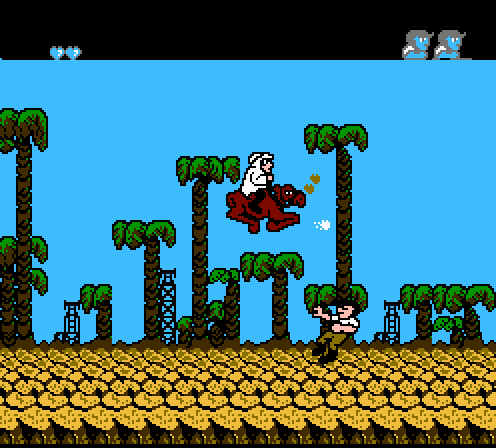
Time to fight an attack camel now. The camel seems to posses the power of flight. It also launches a constant stream of projectiles at you, which I must conclude represent the camel’s infamous ability to gob on people it doesn’t like (which is everyone). These saliva salvoes are almost impossible to avoid when you’re trying to get into camel-kicking distance – the camel can spray spit like a garden sprinkler – so this fight boils down to little more than a race to the bottom of your respective health bars. Pay no mind to the man on the back of the camel. He might as well not be there, unless he’s acting purely as ballast to keep the camel from floating away.


And so it goes on. The same turgid, lumpen gameplay with new locations and slightly different enemy sprites. The naked man from earlier returns, and the reason for his nudity is revealed: we interrupted him before he could finish putting on his medieval executioner’s costume. Then it’s off down the local nature park for a spot of LARPing, followed by a glass of warm shandy and a rant about the optimum axe-grip position for lopping off a treasonous cur’s head.


This stage introduces holes that George can fall down, because if there’s one thing this game needed  it was more jumping. In the screenshot above you can see that I figured out a new jumping technique: holding attack lets you run, and jumping while you’re running makes George somersault across the screen in a low, barely-controllable arc that serves no practical purpose but makes George look like he’s animorphing into a pretzel.


It was while I was fighting against this levitating genie, growing ever more frustrated that the stiff, unresponsive controls and George's sluggish movements made dodging the genie’s homing magic an irredeemable chore, that I realised something. Operation Secret Storm is basically the same game as Color Dreams’ earlier NES shitshow Menace Beach, aka Sunday Funday. They both have the same “fight a couple of guys, move on” gameplay, the same unappealing graphical style, the same controls that make you feel like you’re controlling your character by sending them hand-written instructions about their next move via second-class post. The two games must surely share a game engine, because writing two separate game engines that both feel like wading through hot asphalt seems very unlikely.


The next stage features Satan himself, the lord of evil having popped in to see what tips on casting misery upon the human race he can find in Color Dreams’ games. It's gonna be a real goldmine for him, let me tell you. Naturally, Satan is a bit grumpy and reacts to George’s presence by throwing boulders at him, but I responded by throwing grenades. I had been saving the grenades, which hit all enemies on screen, for a tricky section. I think fighting the devil counts as tricky.
Also, I presume that sign saying “accidental petroleum” is a pun on Occidental Petroleum and not a teaser for Color Dreams’ upcoming Beverly Hillbillies game.


George finds himself in Saddam’s missile facility now, pursued by chaps who might be distant relatives of Chelnov, the Atomic Runner. Or perhaps they’re simply big fans of oven mitts. The different enemy designs are really the only thing worth mentioning about OSS at this point, because it’s a game that commits the cardinal sin of the art-form by being boring. Dull combat on flat planes or dull combat on screens that have a couple of awkward-to-navigate platforms, that’s all you’re getting out of this one. The overwhelming superiority of the jumping kick to all your other attacks (barring possibly the hand grenades) means that’s the only move worth using, further simplifying the fighting.


Bear in mind that this is a videogame where you have to destroy a helicopter by ramming your foot Bruce Lee-style into its cockpit and it’s still boring.


The best stage is definitely this one, and again that’s entirely down to the enemies it features. In this case it’s ghostly skeleton warriors who have wandered away from a different, more interesting game and accidentally become trapped in OSS, the poor bastards. I didn’t really notice this while I was playing the game, but they appear to have pincers coming out of their backsides, so not only are they ghosts and skeletons, they're also earwigs. Radical.


While iconic movie slasherman Michael Myers does a cartwheel at the edge of the screen, let’s take a moment to enjoy these background objects that my brain keeps trying to tell me are trucks despite the evidence of my eyes. I think this is akin to countries building fake airfields and such to fool reconnaissance planes during the Second World War, although an eagle-eyed observer might be suspicious of the trucks having square wheels.


For the final stage of the game, Color Dreams did at least attempt something different. Sadly, that thing was constant missile attacks, with rockets flying in from the right-hand side of the screen that force you to keep moving forward (and thus underneath the arcing projectiles) or you’ll die. Just for a bit of extra fun, there are wasps sitting on the desert sands. It is exactly as tedious as it sounds, and even playing as a character who didn’t control like all their synapses have been replaced by wet spaghetti would do little to make it more enjoyable.


The final boss is, of course, Saddam. He’s got a gun that fire explosion, explosions that are just big enough to make jumping over them a right pain in the arse. As if that wasn’t enough, Saddam can also transform himself into a bomb-dropping helicopter, complete with a puff of smoke. You’ll have to take my word for it, because I didn’t manage to get a screenshot of that. You see, the first time I did this stage, I managed to beat Saddam but accidentally moved too far to the left, causing him to respawn a la the enemies in the Megaman games. This seemed to confuse the game, as well it might. So I went through it again, this time with a Game Genie code enabled that let me kill enemies in one hit. As something that made Operation Secret Storm not only easier but far, far shorter, this Game Genie code deserves some kind of special recognition, maybe a fifty-foot solid gold statue in honour of the time and frustrated muttering that it saved me.


I did manage to get a screenshot of the ending. You’re looking at it. The barely legible phrase “game over” printed atop the same map you’ve been seeing for the whole game, that’s the entirety of your reward for slogging through Operation Secret Storm. There could be no ending more appropriate.
As you’ve probably gathered by now, I didn’t think much of OSS. The NES library is full of side-scrolling action-platformers, and this is definitely one of the very least of the bunch. Its only redeeming feature is the occasional strangeness of the enemies, and every aspect of its gameplay is slow, ponderous, the 8-bit equivalent of stirring up a muddy pond with a stick. For a moment – a brief, fleeting moment – a wondered if maybe I was being a little harsh on a game that does admittedly “work” on a technical level, but then I remembered the bit where the rocket-launching “Arabians” kept stun-locking me until I fell down the bottomless pits. That really sharpened my focus, you know?

VGJUNK Archive

Search This Blog

Followers