Showing posts with label unlicensed. Show all posts

25/04/2018

OPERATION SECRET STORM (NES)

If there’s one medium well-equipped to handle the ethical and socio-political ramifications of armed conflict in the middle east, it’s unlicensed NES games, right? So, get ready for a serious and balanced examination of the Gulf War with Color Dreams’ 1992 desert-storm-em-up Operation Secret Storm!


Or, you know, a cartoony action game about a lone American soldier fighting his way through Iraq on a mission to defeat a caricature of Saddam Hussein. If you’re assuming that the Saddam-a-like is given a jokey name, like Sodamn Insane or something, then you’re almost right: a look at Operation Secret Storm’s instruction manual reveals that he’s called “Saddam Insane.” I guarantee there was a designer at Color Dreams who woke up one morning after the game had shipped and shouted “oh crap, ‘Saddam’ sounds a bit like ‘so damn,’ we’ve really missed a trick there!”


Also in the manual is the revelation that you’ll be playing as George, a top CIA agent. George is presumably a spoof of George Bush, (the first one,) who was president at the time of the Gulf War (the first one). George Bush was the head of the CIA for a year in the seventies, so his credentials check out. Just keep the inspiration for the player character in mind when you see him in action.


Here’s the between-stage map screen. You start off on the Kuwaiti border and make your way into Iraq, destroying military installations, liberating oil refineries and fighting camels in what I’m sure will be a perfectly respectful and non-stereotypical manner.


The game begins. George finds himself surrounded by… tubes? It’s either the mid-point of a factory line that makes all those oil drums for beate-m-ups, or it's an avant-garde sculpture park. Atop one of the pillars is what appears to be a set of screwdriver bits in a protective rubber holder, but is actually ammunition for George’s gun. I’d recommend jumping up there and collecting it before taking on your first opponent – the generically “Arabian” chap on the right.


Hey, get back here! Clearly the raw power of George is enough to scare Saddam’s forces into submission, but I’m not going to let this guy get away. I need a chance to get the hang of the controls, for starters. Said controls are mostly as you’d expect them to be: one button to jump, one button to attack. If you’ve got some bullets, pressing attack will fire your gun. If you don’t have bullets then George will throw a punch. As far as I could see throwing a punch is the only way to tell if you have any bullets, because there doesn’t appear to be any kind of ammo counter on the screen. Nice to see Operation Secret Storm is going for the hardcore realism eschewed by most modern shooters, what with it forcing the player to rmember how many bullets they've fired.


Once you’ve beaten the first guy, a new opponent appears. It’s a naked man with two sticks! Far more menacing than a naked man with one stick, slightly less menacing than a fully clothed man with three sticks. Here I realised that you can do a jumping kick, and in true videogame fashion this is the most effective move in George’s arsenal. You can move while jump-kicking, it has more range than your punches and it seems to have a bigger hit-box than all your other attacks, making it even more effective than shooting someone with your gun. The fact that sometimes your bullets will pass straight through an enemy without harming them definitely detracts from the gun’s effectiveness, but there are no such issues with the jumping kick. You can also hold down on the d-pad and press attack to make George perform a strange, short hop / kick combo that lacks the advantages of the jumping kick and simultaneously offers no benefits. Look, just stick to the jumping kick, okay?


Then a boss of sorts wings its way over the horizon, a giant bird that will defend Iraq from the imperialist American invader by kinda flapping back and forth aimlessly. I don’t know what kind of bird this is supposed to be. Halfway between a buzzard and an eagle, perhaps. A beagle. No, wait.
All you have to do to win is to chase the bird down and kick it in the beak whenever you get a chance. However, you get that chance less often than you should thanks to OSS’s leaden controls. George is a leisurely sort who will not be rushed, and when you press a button he’ll get around to preforming the associated action in his own time, thank you very much. This makes climbing up to the bird’s perch more laborious than it should be, but at least it doesn’t take much of a kicking to defeat.


After that it’s straight onto the next stage, where the same pattern of clearing a screen of enemies before moving onto the next screen of enemies repeats. That’s really all there is to Operation Secret Storm: drop-kicking Arabian stereotypes across a selection of vaguely middle-eastern backdrops. At least the enemies are different in this stage. You’ve got barely-threatening barefoot kickboxers and blokes in keffiyehs who pose more of a challenge because they’re carrying bloody missile launchers and if you’re not careful they can trap you in the corner with a barrage of rockets that knock you over repeatedly.
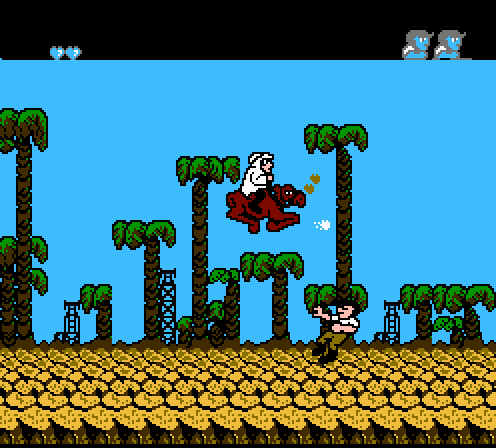

Time to fight an attack camel now. The camel seems to posses the power of flight. It also launches a constant stream of projectiles at you, which I must conclude represent the camel’s infamous ability to gob on people it doesn’t like (which is everyone). These saliva salvoes are almost impossible to avoid when you’re trying to get into camel-kicking distance – the camel can spray spit like a garden sprinkler – so this fight boils down to little more than a race to the bottom of your respective health bars. Pay no mind to the man on the back of the camel. He might as well not be there, unless he’s acting purely as ballast to keep the camel from floating away.


And so it goes on. The same turgid, lumpen gameplay with new locations and slightly different enemy sprites. The naked man from earlier returns, and the reason for his nudity is revealed: we interrupted him before he could finish putting on his medieval executioner’s costume. Then it’s off down the local nature park for a spot of LARPing, followed by a glass of warm shandy and a rant about the optimum axe-grip position for lopping off a treasonous cur’s head.


This stage introduces holes that George can fall down, because if there’s one thing this game needed  it was more jumping. In the screenshot above you can see that I figured out a new jumping technique: holding attack lets you run, and jumping while you’re running makes George somersault across the screen in a low, barely-controllable arc that serves no practical purpose but makes George look like he’s animorphing into a pretzel.


It was while I was fighting against this levitating genie, growing ever more frustrated that the stiff, unresponsive controls and George's sluggish movements made dodging the genie’s homing magic an irredeemable chore, that I realised something. Operation Secret Storm is basically the same game as Color Dreams’ earlier NES shitshow Menace Beach, aka Sunday Funday. They both have the same “fight a couple of guys, move on” gameplay, the same unappealing graphical style, the same controls that make you feel like you’re controlling your character by sending them hand-written instructions about their next move via second-class post. The two games must surely share a game engine, because writing two separate game engines that both feel like wading through hot asphalt seems very unlikely.


The next stage features Satan himself, the lord of evil having popped in to see what tips on casting misery upon the human race he can find in Color Dreams’ games. It's gonna be a real goldmine for him, let me tell you. Naturally, Satan is a bit grumpy and reacts to George’s presence by throwing boulders at him, but I responded by throwing grenades. I had been saving the grenades, which hit all enemies on screen, for a tricky section. I think fighting the devil counts as tricky.
Also, I presume that sign saying “accidental petroleum” is a pun on Occidental Petroleum and not a teaser for Color Dreams’ upcoming Beverly Hillbillies game.


George finds himself in Saddam’s missile facility now, pursued by chaps who might be distant relatives of Chelnov, the Atomic Runner. Or perhaps they’re simply big fans of oven mitts. The different enemy designs are really the only thing worth mentioning about OSS at this point, because it’s a game that commits the cardinal sin of the art-form by being boring. Dull combat on flat planes or dull combat on screens that have a couple of awkward-to-navigate platforms, that’s all you’re getting out of this one. The overwhelming superiority of the jumping kick to all your other attacks (barring possibly the hand grenades) means that’s the only move worth using, further simplifying the fighting.


Bear in mind that this is a videogame where you have to destroy a helicopter by ramming your foot Bruce Lee-style into its cockpit and it’s still boring.


The best stage is definitely this one, and again that’s entirely down to the enemies it features. In this case it’s ghostly skeleton warriors who have wandered away from a different, more interesting game and accidentally become trapped in OSS, the poor bastards. I didn’t really notice this while I was playing the game, but they appear to have pincers coming out of their backsides, so not only are they ghosts and skeletons, they're also earwigs. Radical.


While iconic movie slasherman Michael Myers does a cartwheel at the edge of the screen, let’s take a moment to enjoy these background objects that my brain keeps trying to tell me are trucks despite the evidence of my eyes. I think this is akin to countries building fake airfields and such to fool reconnaissance planes during the Second World War, although an eagle-eyed observer might be suspicious of the trucks having square wheels.


For the final stage of the game, Color Dreams did at least attempt something different. Sadly, that thing was constant missile attacks, with rockets flying in from the right-hand side of the screen that force you to keep moving forward (and thus underneath the arcing projectiles) or you’ll die. Just for a bit of extra fun, there are wasps sitting on the desert sands. It is exactly as tedious as it sounds, and even playing as a character who didn’t control like all their synapses have been replaced by wet spaghetti would do little to make it more enjoyable.


The final boss is, of course, Saddam. He’s got a gun that fire explosion, explosions that are just big enough to make jumping over them a right pain in the arse. As if that wasn’t enough, Saddam can also transform himself into a bomb-dropping helicopter, complete with a puff of smoke. You’ll have to take my word for it, because I didn’t manage to get a screenshot of that. You see, the first time I did this stage, I managed to beat Saddam but accidentally moved too far to the left, causing him to respawn a la the enemies in the Megaman games. This seemed to confuse the game, as well it might. So I went through it again, this time with a Game Genie code enabled that let me kill enemies in one hit. As something that made Operation Secret Storm not only easier but far, far shorter, this Game Genie code deserves some kind of special recognition, maybe a fifty-foot solid gold statue in honour of the time and frustrated muttering that it saved me.


I did manage to get a screenshot of the ending. You’re looking at it. The barely legible phrase “game over” printed atop the same map you’ve been seeing for the whole game, that’s the entirety of your reward for slogging through Operation Secret Storm. There could be no ending more appropriate.
As you’ve probably gathered by now, I didn’t think much of OSS. The NES library is full of side-scrolling action-platformers, and this is definitely one of the very least of the bunch. Its only redeeming feature is the occasional strangeness of the enemies, and every aspect of its gameplay is slow, ponderous, the 8-bit equivalent of stirring up a muddy pond with a stick. For a moment – a brief, fleeting moment – a wondered if maybe I was being a little harsh on a game that does admittedly “work” on a technical level, but then I remembered the bit where the rocket-launching “Arabians” kept stun-locking me until I fell down the bottomless pits. That really sharpened my focus, you know?

08/11/2014

CASTLE OF DECEIT (NES)

If I was forced to guess I'd have said Castle of Deceit was a He-Man playset that I never owned as a child - Skeletor's summer house, perhaps - but apparently it's an unlicensed NES game, released in 1994 by a developer called Bunch Games. Well, I'm here now, I suppose I should take a look at it.


The reason for the Castle of Deceit's name is revealed - far from being an actual fortified structure, it's a sandcastle someone's built atop a stack of old tractor tyres. That's definitely deceitful. You can't say "come over to my place, I live in a castle" and then take your date back to a pile of sand sprinkled over worn-out rubber.


Good lord, what a horrendous typeface. That's what I'd imagine the Stay-Puft Marshmallow Man's handwriting would look like, only squashed down and pixellated. This text box is all the in-game information about Castle of Deceit's plot that you're going to get, and it's the usual stuff: evil is rising, scattered magical items can stop the evil, collect the items and save the day. Then it ends with the rather curt order to "BEGIN NOW." I'm doing it, okay? Geez, there's no need to be rude about it.
There's apparently a bit more backstory in the games manual, revealing that the main character's name is Cebo, who must defeat the living hallucinations of the once-powerful mystic Phfax. Nice to see that Castle of Deceit's creators used the classic fantasy fiction method of naming characters by dropping a sack of nails onto a keyboard, although for that true sword-and-sorcery flavour they should have added in a few unnecessary hyphens and apostrophes. Ce-Bo and Ph'fax would have been much better, don't you think?


Wow. Cebo the wizard is not quite the imposing master of the arcane arts that I was hoping he would be. If it wasn't for the fact he can shoot a sparkly little projectile out of his wand I wouldn't believe he was a wizard at all and not just some unfortunate child on his way to a costume party who was press-ganged into destroying the forces of evil, forces such as those terrifying, blood-curdling floating doilys. But Cebo can launch magical bolts, and he can jump, which tells you pretty much everything you need to know about the core gameplay of Castle of Deceit - it's a platform-hopping, monster-zapping adventure, with added key-collecting and door-opening bits.


It's all very straightforward. Don't fall down pits, because Cebo only knows one spell and it sure as hell ain't "levitate," pick up the keys and move through doors until you reach the boss. There are plenty of enemies about, too, and they represent Castle of Deceit's biggest departure from normal NES action-platforming tropes because some of them dodge your attacks. It sounds ludicrous to be surprised by bad guys trying to not get killed, but think about it: in all the famous NES action franchises - Super Mario, Mega Man, Castlevania and so on - the enemies make no attempts at self-preservation. They either follow set patterns or make a bee-line for the hero. Medusa Heads don't fly around Simon Belmont's whip, Goomba's don't dodge to the side when they see Mario's boot hurtling out of the sky. The only enemy with this kind of behaviour that springs to mind is Red Arremer from Ghosts n' Goblins, so there's a neat encapsulation of Castle of Deceit's combat for you - imagine a version of Ghosts 'n Goblins where Red Arremers make up 60% of the enemy troops.


Sometimes you can use the enemy's desire to not be murdered to your advantage, like in the case of these flying eyeballs. They move vertically through the platforms and if you try to shoot them they'll zip out of the way, but if you jump up and fire above them they'll flee far enough downwards that you can make your way past. Had this idea been fleshed out a little more, with Cebo using his magic to corral monsters into safer areas rather than having to kill them, it could have made for an interesting twist on the genre, but sadly while these opportunities for spook wranglin' do exist they're few and far between, and Castle of Deceit spends a lot of it's time trying to kill Cebo with floods of enemies that can pass straight through walls and floors.


The stages in this game aren't big, and this first one is only a few screens across (although you do have to go from one end to the other and back again) so it's not long before you encounter boss number one: a bug. A flying bug that attacks by either firing paisley swirls or, if it's feeling particularly sassy, tiny little skulls that must have been harvested from the faerie folk of the forest. The big change in the boss fight is that Cebo is firing upwards / into the screen instead of horizontally, and a warm round of applause goes to Bunch Games for making Cebo fire constantly if you hold down the button, but there's not much to this or any other boss fight in the game: clamp your thumb down on the fire button and try to keep Cebo out of harm's way as much as possible. Don't linger at the bottom of the screen, however tempting that may seem, because the boss will fly down and crash into you. Once the bug has been dealt with, don't stop paying attention because any projectiles left on the screen will still be there after the boss has disappeared and it would be very upsetting to die during the small window of time between killing the boss and walking through the exit door, he said with an air of bitter knowledge learned through personal misery.


Stage two is the Castle of the Moons. An appropriate name, given that there are multiple moons in the background, but Bunch Games missed an opportunity to fully exploit their non-licensed status by not calling this stage Castle of the Bastard Moths. You can see three of them in the screenshot above, the horrible things whose blue-and-orange colour scheme is the visual equivalent of drinking orange juice after brushing your teeth. The moths are an object lesson in why videogame enemies follow set patterns - because the alternative, to have them bumbling around the screen semi-randomly, is extremely annoying. The moths circle around Cebo in unknowable ecliptical orbits, and so defeating them doesn't feel like a triumph of the player's skill but a momentary confluence of luck, the situation made worse by Cebo not having a period of invincibility after being hit so the moths can park their revolting furry bodies right inside you to sap your health in moments.


At least the brevity of Castle of Deceit's stages means you never have to put up with any enemy for too long, and soon I'd reached the second boss. It's a mantis whose most recent sexual partner got a bit confused after mating and ate his body rather than his head. Thanks, Mrs. Mantis, not I've got a flying mantis head to deal with. No, that wasn't sarcastic: this guy is laughably easy to beat. I stood in the middle of the screen and held the fire button down until it died. I think I may have actually laughed.


Stage three is a little more involved, with Cebo having to make his down through the three levels of the stage by travelling through the various doors and avoiding the cobwebs that, for some bizarre reason, fire projectiles at you when you walk past. There's no indication given that the cobwebs might hurt you or even that they aren't just background scenery, which is nice. Real thoughtful game design, that. See, that time I was being sarcastic.
Despite the webs, stage three is redeemed by it's selection of wonderful enemies, including the always-welcome floating skulls, that thing on the right that looks like someone found an ugly red frog and replaced it's legs with cardboard tubes and the fabulous ghosts.


I mean, just look at this guy! Sorry I didn't know about you last month, buddy, I would have written an article about hooded spectres just to give you the exposure you deserve, and I don't mean exposure to an exorcism. His posture screams "I'm fed up of this shit," throwing his rot-blighted hands up in the air and wailing "oh my god, another baby wizard, Jesus Christ I've had enough of this!" Yeah, I've had enough of this too, my ghostly friend - only three stages in and already Castle of Deceit is wearing out its welcome against the grindstones of repetitive gameplay, frustrating enemies and horrendous sound effects that sound like R2-D2 licking a plug socket.


Still, I can't complain about having a giant skull as a boss, even if it is functionally identical to the previous two bosses. I'm shallow, I admit it. Dragonflies and mantis heads will elicit nothing more than a shrug of the shoulders from me, but skulls? I'm there, man, although my initial excitement has faded now that I've taken a closer look at the boss and realised that it's actually a white bicycle seat with a crude face carved into it. Credit to the developers, that does sound like the result of a mad old wizard's hallucinations.


Things go a bit off-piste here in the Castle of Winds, where multiple factors combine to drain any and all fun out of the game entirely. First and foremost are the eyeball ghosts, tenacious swine that follow Cebo around the level like a Super Mario Boo that's overcome its crippling shyness issues and take multiple hits to kill. That latter thing would be less of an issue if Cebo's projectiles weren't slow and travelled in a straight line instead of a wave pattern. The art of wizardry must really be in the gutter if Cebo is considered its best student.
Then there's the wind that gives the stage its name. Can you see any wind? No, you can't. While that might not be a problem in the real world, we're dealing with a videogame here and if something is going to fling my character across the screen or stop them from moving past a certain point I'd like to be able to see what that something is, please. Some jumps are affected by the wind, some aren't, and only trial, error and memorisation will allow you to figure out which are which, a process not helped by the constant presence of the ghosts, hovering around the player with the unnerving air of the village drug dealer waiting for his underage girlfriend at the school gates.


If wouldn't be so bad if Cebo's jumping physics were good, but - and it may shock you to learn this about an unlicensed NES platformer - they are not good. Rather than moving in a smooth arc, Cebo's jumps tend to take him upwards, move him horizontally and then have him drift back down to the ground. They're not consistent, either: sometimes he'll clip his stupid pointy hat on a ledge and cease all forward motion, but other times he'll float through the corners of the scenery like it's not there.
Watching Cebo's awkward, jerky motions and underanimated leaps, I realised I'd seen it before, only not in a videogame. Then it hit me: Castle of Deceit is an actual, working version of a videogame made up for a nineties TV show. Imagine an episode of The Simpsons where Bart plays  the latest wizard-based platform game - that game would look identical to Castle of Deceit.


"Okay team, we need to come up with a boss for this wind-themed stage. Anyone got anything appropriately windy?"
"How about a purple boulder with a face carved onto it, a face that wears an expression of such abject misery that you expect the rock to end its own suffering at any moment?"
"Perfect, I love it. Good work, Johnson."


My habit of unintentionally choosing to play platform games that have pointless, dull shoot-em-up levels artlessly wedged into them continues. This is Castle of Deceit's latest and most successful effort to make me hate it, an underwater forced-scrolling section devoid of both entertainment and challenge, which is surprising considering the other stages contained enemies that were more than capable of giving me a hard time. The biggest threat in this stage are the bubbles, because this is a videogame and videogame bubbles are deadly more often than not. Look, I don't make the rules, all right? Bubbles: don't touch 'em. You should stay away from cotton wool and puppies, too, just in case.
Cebo can hold his breath forever, by the way. Is that a magic spell? What kind of wizard school did you go to where the first two spells they taught you were "unspectacular projectile" and "waterbreathing"? Was your tutor Bubble Man? Cebo, you are the worst.


And then you're attacked by a writhing mass of rubbery grey tentacles with the clearest, bluest eyes I've ever longingly gazed into. Seems like we're getting into Phfax's more erotic hallucination material now. Hey, the guy's a magician whose head was stuffed so full of the esoteric mysteries of black magic that it started to leak living delusions, the guy's not going to be interested in the usual grot.


There's a fire themed stage, because there always is, and it's very similar to the first stage only with a warmer, more Autumnal colour palette (and lava). It even contains the same enemies, with minor modifications: the doilys are back but now they're made of asbestos (I assume) and the flying eyeballs are on fire. That's how you vaccinate yourself again molten magma, you see, you set yourself on fire a little bit to build up a resistance to lava.
As ever, the gameplay consists of methodically zapping the monsters and moving through the stage's doors. What do you mean, you don't see any doors? There are two in the above screenshot, c'mon. Do you need some help?


There, I've circled them for you. If you squint, you can just about see the three vertical lines that mark the edges and middle of the door. It's a good job I stumbled upon one of these doors through the combination of blind luck and fat fingers that made me accidentally press up on the joypad while I happened to be standing in front of one, otherwise you and I would never have been able to witness the wonders the wait deeper within the Castle of Deceit.


Wonders like the game's least interesting boss. Congratulations, fireball, you're the least engaging point in an adventure that's most remarkable feature is how forgettable it is.


According to the pre-stage text, this is the Castle of Deceit itself. It's only three screens wide and all you have to do to clear it is to engage in some of the most basic platforming "action" ever brought to life by Nintendo's 8-bit powerhouse. But there's a twist! Sometimes the clouds you have to jump across hurt you when you touch them. I didn't say it was a good twist. If I was a less genteel and restrained person, I might describe this twist in language that would make even the average 13-year-old Call of Duty player blush, but instead I'll draw your attention to the decoration above the castle door. Yeah, the one that looks like an Easter Island statue experiencing an uncomfortable bowel movement, that decoration.


There's no boss guarding the previous stage, so instead you're immediately whisked to the Maze of Possibilities. The most likely possibility is that this maze is going to be a poorly thought out and needlessly opaque slice of gameplay that will represent one more nail in Castle of Deceit's coffin lid, but let's put our cynicism to one side for a moment as I walk though one of these doors.


Nope, reactive the Cynicism Matrix and calibrate the Bullshit Gauge to maximum, because this whole stage consist of these five identical doors that you have to walk through in a specific order to reach the end. Does the game give you any hints or clues as to that order? Does it tell you when you've messed up so that you may learn from your mistakes? Did Bunch Games really manage to cock up every single element of this game in the laziest, most half-arsed manner possible? The answer to all those questions is yes. After ten minutes or so I stumbled across the correct sequence of door, and even that didn't feel like a victory because I knew that all it would lead to is more of this game.


Another stage. A very familiar stage, because it's almost identical to stage three but with a different colour scheme. That said, I think it looks really nice - the purple brickwork and the blue-green vines work well together and it seems a much more suitable home for that awesome ghost. It reminds me a little of Kid Icarus, but nicer looking, so a least one thing about Castle of Deceit is better than the same thing in a different game, which is a surprise.


We're into final stretch now, and while it might look intimidating thanks to the plethora of enemies, they start far enough away from Cebo that if you keep firing they'll all drift into your attacks and die before they get close. The real struggle is negotiating the moving platforms - if you try to jump onto them you fall straight through them 90 percent of the time, so instead you have to step delicately onto them when they reach the edge of the pit. The moving platforms also have wings. Did one of the developers think that a floating brick was just too unbelievable in a game about wizards fighting flying eyeballs? Go ahead, slap some wings on it, that'll really help with my immersion.


At last, it's Castle of Deceit's final boss and it really does look like a hallucination so full marks on that front. With the body of a rattlesnake, the tiny, disturbingly human hands of an otter and the expression I make when I wake up in an unfamiliar place and for a moment I can't remember where I am, this boss is unlikely to ascend to the pantheon of legendary NES bosses like Bowser and Ganon, but I am definitely not going to forget him. I will mostly remember him for his snout, which I am unable to see as anything other than two skeletal Pac-Men kissing. The boss' nostrils are their eyes, you see.
Once you've figured out that the boss requires slightly different tactics than the previous end-of-stage "challenges" - you have to shoot off its tail, then its hands and finally its eyes - it's just as easy to defeat as all the others and soon Cebo will have accomplished his goal of, erm... what was I supposed to be doing again?


Oh yeah, restoring the runes that control space and time. I did that, apparently, and for my reward I get this ending. Normally I'd complain about an ending that's 60% black, empty screen space, but honestly I'm just glad that Castle of Deceit is over. No ending sequence could be sweeter than that.


This is an odd game. A bad game, to be sure, but one that's bad in a specific way: it takes the common elements of any given NES hop-n-bop platformer and then gets them all subtly wrong. On a basic level it's almost competent, weird jumping physics aside, but as soon as anything else is added to the mix it flies off the rails. Pseudo-randomly-moving enemies, hazards that you can't see, doors that are almost indistinguishable from the backgrounds, a maze that can't be mapped - all of these things are so close to being viable elements of videogame, but the developer managed to find the factor that makes them enjoyable (or even just bearable) and remove it every time either through a lack of talent or a misguided desire to make Castle of Deceit different from its contemporaries in the most aggravating ways possible. It wasn't quite as bad as I was expecting from an unlicensed NES game, although that side-scrolling stage made it a close call, but I would strongly recommend that if you want to deal with the hallucinations of a mad wizard then you should read an Alan Moore comic instead of playing this.

26/03/2014

HELL FIGHTER (NES)

I feel I should be up-front about this, so here we go: in the game Hell Fighter, you're playing as someone who's fighting against Hell rather than controlling a fighter from Hell. I know, we're all disappointed about it and if you decided to leave now I wouldn't blame you. If you're sticking around, thank you and get ready for some kung fu-fighting, orb-collecting, sprite-flickering madness in Thin Chen Enterprise / Sachen's 1991 NES game Hell Fighter!


I know what you're thinking - this game has "Hell" right there in the title, in clear defiance of Nintendo's NES-era policy of "no hell, no crosses, nothing that anyone might conceivably take offence at". That's because Hell Fighter is an unlicensed game, so I'm riding the razor's edge of rebellious bad boy-ism to bring you this article. If Nintendo's secret police drag me away to their primary-coloured fun-prison for exposing this information, please send me a cake with a file in it. Oh, who am I kidding, I wouldn't last five minutes on the inside, let alone long enough to scrape my way through the bars of my cell. Plus they probably build the restraints from old Game Boys, and you know how durable those things are. There would be no escape.


Thin Chen Enterprise (AKA Sachen, AKA Commin, AKA Joy Van) were a prolific developer of unlicensed games, which gives me a sliver of hope that Hell Fighter won't be completely terrible because surely if you produce enough output then some of it has to be good, right? Hell Fighter is off to a reasonable start, because what's not to love about a snaggletoothed demon doing a bit of crystal ball fortune telling in his bathrobe?


I suppose you probably wouldn't love it if you lived near this volcano that the demon's attempts at carnival clairvoyance seems to have caused to erupt. I think that's what's happening, anyway. It's not very clear. What this game needs is a nice long piece of text that explains the events of the game in a clearly written and concise manner.


Would you look at that: here is the text crawl of my dreams, unless I was asked to diagram these sentences in which case it would be the stuff of nightmares. Brought to you in full, and divorced from the image of two blokes sitting in a circle of candles which only confused the otherwise perfect clarity of the message, here is Hell Fighter's intro text. Ahem:
"In the dark and cold Hades here live with an ambitious Satan who is anxious and intend to control the whole world of human being. He has no way to reach the horrible plan until the Devil Crystal Ball fallen into his hands.
On the day the Devil Crystal Ball fell, the world changes with the evil power of the crystal ball Satan made the world chaotic. In the critical moment the wise old man has found a man with Chinese kungfu. The old man trained him the uncanny power for saving the world. Finally, the young man is on his way to destroy Satan and the devils......."


Well, that's cleared things up nicely. I'm already rooting for Satan, because I can relate to him - he's ambitious, but anxious. Does his anxiety prevent him from achieving his full potential, like that time I some guy I know could have met Bruce Campbell but was too nervous to break into his house while he slept? I bet it does. Also, nice work turning to Chinese martial arts when the world needs saving from the dread power of the Dark Lord Satan. I mean the Book of Revelations is kinda exciting, I guess, but you can't argue that it wouldn't be improved if Jesus defeated The Adversary using his mastery of the Praying Mantis Fist. Of course he'd use used Praying Mantis style. He is Jesus, after all.


What all this meticulously-crafted storytelling leads into is a familiar-at-first-glance NES adventure - move A Man With Chinese Kungfu from left to right, avoiding the bottomless chasms and killing the many demons that stand in his way by throwing knives at them. You can just about see one of the knives on the far right of the screenshot above. It's the brown thing that both our hero and the blue minotaur in the y-fronts are staring at intently. We'll be seeing a lot more of them. The knives, not the minotaurs in their pants.


Then a skeleton fell from the sky and lightly brushed against our hero, who promptly died. One-hit kills are the order of the day, and yet again I am vindicated in my belief that a mastery of kung fu leaves you woefully unprepared in the event of a skeleton attack. Upon his death Mr. Kungfu immediately became a skeleton himself, so maybe the skeleton that killed him was just looking for some company.


Pictured above: some platforming. The coloured bars move back and forth seemingly at random, but you've got plenty of control over your character while he's in mid-air so it's not too difficult, and the skeleton fish beneath you can't summon the energy required to jump high enough to bite you. Even if they could jump this high, those two nearby blue orbs would protect our hero as they rotate around him, because he had the good sense to collect some power-ups. Hell Fighter's power-ups come in the shape of orbs that cycle through four different colours, with the effect of the power-up dependant on what colour it is when you collect it. Yellow orbs increase the power of your knife attack, green orbs change your knives into slower-firing fireballs that have the benefit of being able to travel through scenery, blue orbs give you a protective satellite orb (up to a maximum of three) and red orbs do... something. I think. I'm not entirely sure - I think collecting red power-ups might be connected to gaining extra lives somehow but whatever they do, the effect of the red orbs is mysterious, vague and easy to ignore.


The power-up system might seem like it adds a slight degree of strategy to the gameplay as you assess which skills will help you to survive the skeleton bombardment, but no, that's not how it works. There is only one way to collect power-ups, and that's to make sure you get two yellow orbs as quickly as possible. Upgrade your knife once and it becomes a three-way shot, and if you've played Contra you'll know how useful that can by. Upgrade it twice and it Mr. Kungfu's arm seemingly transforms into a hose that sprays homing knives as long as you hold down the fire button, allowing you to walk forward and spew forth an endless stream of deadly knives that head towards their target without your intervention. You can see this happening in the screenshot above, where one of my knives has made a ninety degree turn to head straight upwards and into the tailbone of the right-hand skeleton.
Having homing knives quickly goes from being "useful" to "mandatory for your continued survival" as the game progresses, so the first moments of each new stage are a mad scramble to collect two yellow orbs as quickly as possible. After that? Get the blue orbs for added defence but avoid the green ones because if you accidentally switch from homing knives to slow, non-homing fireballs in the middle of an enemy swarm you'll be back to the last checkpoint quicker than you can say "you could argue that these homing knives are trivialising the challenge posed by Hell Fighter's enemies, and also for a kung-fu master I'm not doing much kung-fu, am I?"


Of course, your weapons won't help you negotiate the platforming sections, but they're composed of the same cliches you've seen time and again - retractable spikes in the ceiling and floor, lava geyers, fireballs. It's a relief that the jumping mechanics in Hell Fighter are solid, if a little floaty... aside from the fact that you keep jumping if you hold the jump button down. It's not a major thing, because really, how often do you hold down the button after you've jumped, but it just feels wrong. I'm sure there are other platform games where you'll jump every time your feet touch solid ground if you hold down the button, but I can't think of any off the top of my head and the phenomenon definitely contributes to the feeling of slightly wonky other-ness that only unlicensed games seem to possess.


The first boss lumbers into view, and this skeleton is fooling nobody because that's obviously a fake muscle suit. He looks like he's about to challenge me to a duel using those inflatable sumo costumes. In the end, the boss just walked back and forth, graciously jumping every now and then so I could walk underneath him. For my part, I just held down the fire button and filled the screen with homing knives until he was dead. It didn't take long.


Stage two, and I wasted a good five minutes trying to figure out how I'd be able to get past these falling water droplets without touching them. The answer is simply to jump though them, because they're not fatal. You can't blame me for thinking that they'd kill me, right? This is a NES game, anything that drips from the ceiling should be approached with the same caution you'd exercise when dealing with spilled plutonium or raw footage from Celebrity Big Brother.


Here's a visual representation of our hero's kung-fu powers. See, he's doing a kick! Granted the kick can't actually hurt enemies, but it can sure as hell knock chunks out of the floor! Sometimes power-ups are hidden within the landscape, you see, and stomping on the ground like a five-year-old who's just been told that they're leaving Toys 'R' Us is one way to free them. The other is to bash your head against them, Super Mario style. There don't seem to be any rules about which floors you can or can't stomp your way through, but this potentially infuriating lack of consistency is tempered by the fact you can usually see the orbs through the scenery.
While I'm discussing Hell Fighter's controls, here's a fun tidbit - pressing Select causes you to die instantly. Does this mean it's possible to stomp your way into an inescapable pit, leaving suicide as your only option for escape? Probably, but as there are generally enough easily available pick-ups around to get you up to "endless stream of heatseeking throwing knives" levels of power, digging in the mud for extra orbs is not something I often had to do.


The boss of stage two is a dragon. He's all the way on the right, I'm all the way on the left, so it's a contest to see whether his fireballs can reach me before my knives destroy them all and embed themselves in his mythical face. I don't see any fireballs on screen, just a conga-line of flying knives, so I guess that answers that question.


The next stage is set high in the clouds, but also somehow in a cave? Those definitely look like stalactites up there. There are birds everywhere, which lends credence to the "in the sky" theory, but also many dogs and quite a lot of buildings, things that aren't traditionally part of the sky unless you're in The Jetsons.
There's a lot going on up/down here, which gives me a chance to talk about Hell Fighter's graphics. This isn't the prettiest NES game around - the background are minimal, the animation is crude and the purple and green scenery ought to be investigated by scientists in order to isolate its migraine-causing potential - but with this much going on at once it's impressive that the game doesn't just grind to a halt. There's some screen flickering, quite a lot in places, but slowdown is at a minimum and it all clips along rather nicely. Thin Chen even included a few weather effects. In this stage it's either snowing or there's a tiny meteor shower going on.


A couple of things in this stage struck me as being kinda neat, or at least whatever is a few rungs down from "kinda neat" on the interesting scale. "Not instantly forgettable," maybe. For one thing, stage three is full of these clouds that move horizontally through the sky. When they collide, lightning shoots down from them, and because they're ubiquitous you have to keep an eye on them for the whole stage. The clouds provide a constant threat without ever becoming frustrating, so congrats to the developers because that's not an easy thing to pull off.


Also, there's a bit where a skeleton boatman paddles you across a lake. It's nothing fancy, I just think he's adorable. He's wearing a big hat! To prevent sunburn, naturally, and sunburn would be an even greater concern than usual as we're in the sky and therefore closer to the punishing rays of our hateful sun. Except there's a lake up here, and rocks. Where the hell am I? A game about a kung fu master throwing knives at Satan's minions, and this is the logical inconsistency that's annoying me the most.


Speaking of annoying, trying to get a clear screenshot of the boss was a nightmare because the three-faced pain in the arse was either floating off the edge of the screen or obscuring his features by vomiting up an endless supply of birds and red stick... things? I don't know what those are. I'd say they look like barely twist sweets if that didn't make me sound old enough to be your grandfather.
Oh yeah, the boss. Just hold down fire and casual walk to the other side of the platform if he gets near. That's if you've got the homing knives, at least. If you're stuck with the three-way spread or, god forbid, you changed to the fireballs; well, remember how I said pressing Select immediately kills you? I think that might be your best option.


Stage four has more of a platforming slant, complete with a pair of floating logs that you have to keep pace with as they travel through the level. Kung fu teaches many things, but not the breaststroke.
All this platform-hopping action is assembled in such a way that I'm not sure it I could say it's fun or not. I've played worse NES games, that's for sure, and for an unlicensed game Hell Fighter is extremely playable but there's just not much to it. The level design is functional but hardly thrilling, and then there's the boss battles. I have defeated all the bosses thus far by standing still and holding down the fire button. Dark Souls this ain't, but there's still time to turn it around. What about stage four's boss?


Somewhat miraculously, Captain Snips, Crab of the Devil broke free from the usual pattern of Hell Fighter's bosses by being unfazed by my homing knives. My homing knives also seeming unfazed by Captain Snips, deciding that he posed such a minimal threat that they refused to home in on him. That wasn't helpful, and I have to let myself be killed so I could collect the fireball power-up and even then I actually had to pay attention in this fight because you need to jump over the crab's claws when he swings them at you. Don't get me wrong, I've had more difficult times trying to eat a packet of biscuits, but at least I needed to be awake to defeat this crab. Well done, Captain Snips, you're the most threatening boss in the whole game, and considering one of your attacks is to blow spit bubbles I think that's a real achievement.


A Man With Chinese Kungfu heads into the forest for the penultimate stage, a dark and cluttered corner of Satan's domain where the things that are trying to kill you are more indecipherable than ever. For instance, I bet you saw that flapping blue thing there and assumed it was a bat. Well, take a closer look and I'm sure you'll agree that it's really a cat with fake wings glued to it. A large meatball hangs from the ceiling, ready to fall on anyone foolish enough to walk beneath it, while on the ground several smaller meatballs have formed a symbiotic relationship and become a bizarre worm-like creature intent on attacking our hero's feet. Jokes on them, his feet have disappeared in this picture.


Stage five's most super-funnest new gimmick - if you're a masochist, anyway - is that sometimes the floor disappears when you walk over it. In another game I'd be complaining that this breaks up the flow of the action as you inch through the level, trying to activate the crumbling floors before you walk on them, but Hell Fighter is such a weird mish-mash of platforming styles, negligible enemy threats and floor-stomping that there's no flow to interrupt and instead it ends up feeling like just another part of this game's weird tapestry.


The boss is a dragon who stands proudly atop his fortress of cream crackers, puking up fireballs onto any adventurers unfortunate enough to stand nearby. Is this another boss that cannot be defeated by the honourable tactic of standing in place and firing knives out of my palm?


No, not if you dig yourself a little cave in the side of the dragon's easily-damaged home / pile of chocolate cereal pieces and hide inside. The overhang protects you from the dragon's fire,  your homing knives do the rest and we all learn a valuable lesson about how kung fu isn't always about using your strength to defeat your foes - sometimes you must use your mind, and take advantage of their lack of foresight when choosing building materials.


At last, the final stage, and if this is Hell then Hell looks a lot like a stage from a Mega Man game. Conveyor belts, giant spiked maces and arcade claw machines that have gone rogue and are trying to kill you by dropping rocks on your head are all out in force, plus a squadron of kamikaze robot turkeys. Did any of the Mega Man games have robot turkeys in them? Maybe in Pilgrim Man's stage. Get equipped with Thanksgiving Buster! I'd tell Capcom they can have that Robot Master idea for free but let's be honest, they're never going to make another Mega Man game.


This is a much shorter stage than all the others, and it's also easier than the rest, maybe because there's less of it and maybe because turkeys are terrible at killing people even if they have been turned into cyborgs. Your knives solve most problems before they even come into view and the only real challenge posed by this stage is that you have to get so close to the right-hand side of the screen to get it to scroll that it's easy to be killed by spiked balls you couldn't see coming.


If you manage to survive the unhelpful scrolling, eventually you'll reach Hell Fighter's final boss and the very thing from Hell that you have been sent to fight - Satan himself! Or maybe it's not Satan - I had assumed that the demon from the intro, the one with the volcano-triggering crystal ball, was Satan. Another reason that I suspect this boss may be a different entity all together is that Satan is rarely described as a huge robotic skull with Mario Bros. pipes feeding into it that's constantly crying blood.


Whoever it is, this boss has a strong case for putting up the toughest fight in the game. Second toughest after that crab, anyway. That's right, you have to move slightly while holding down fire in this one! Satan's Bloody Tears Cyberskull Playset only has one attack, which is to send a small satellite to hover over your head. After a while the satellite fires in eight directions, but the only direction you need to worry about is straight down, and taking a step to the side will cause the attack to miss. Constantly throwing knives and moving two inches to the left or right every now and then is more than enough to foil the machinations of Lucifer, Lord of Darkness and Prince of Lies. Or his novelty Halloween drinks fountain, whichever one this is.


After much struggle and some frankly disgusting language each time I accidentally collected the fireball power-up, the Devil Crystal Ball is in front of me. It's totally evil and brimming with arcane power, you guys. The fact that the symbols on the base look like shapes from a Play-Doh Fun Factory is inconsequential, this thing is a catalyst for pure terror.


Then our hero smashes the crystal ball by shooting it with an arrow, something which seems like a lot of unnecessary effort when he could have just thrown it at the floor. Hang on, an arrow? Have I been firing arrows through the whole game but calling them knives like a massive idiot? I took a closer look at them and they don't look like arrows, but then again they don't really look like knives, either. They look more like goldfish than anything else. Yeah, let's go with that. A Man With Chinese Kungfu saves the world by throwing goldfish at a big robot skull. I think that fits nicely with Hell Fighter's overall mood.


This game certainly was an experience. As an unlicensed NES game from Taiwan, I was expecting something borderline unplayable, but Hell Fighter is surprisingly competent in terms of raw game mechanics - it controls well (weird rapid-fire jumping aside) and occasionally it's technologically impressive - but it feels strangely empty. The level design is uninspired, the backgrounds are dull and the music feels like a punishment for a crime I don't remember committing. The biggest flaw with this game, however, is the the homing knives. Without them, Hell Fighter is too hard, too overwhelming and just not much fun. With them it's often ridiculously easy, particularly the bosses, and there's no middle ground. I'm glad that Hell Fighter exists, because otherwise the world wouldn't be home to that amazing intro text, but I can't recommend you play it unless you're really into throwing knives at things and there are no vacancies for knife-throwers at any the local circuses.

VGJUNK Archive

Search This Blog

Followers