08/09/2017

DEMON BLUE (AMIGA)

Today’s game is an Amiga platformer called Demon Blue, released in 1992 and developed by a company called Hirographics, and I’m going to guess the design process was “I’ve drawn a bunch of weird creatures. Well, better make an Amiga game about them!” Also, the name Demon Blue makes me think of Scottish pop-rock band Deacon Blue, who are probably most famous for their 1988 single “Real Gone Kid.” Then again, I might just think that’s Deacon Blue’s most famous song because it was on those Boots adverts. Hang on, where was I? Oh yeah, Demon Blue. Is it named after Deacon Blue? Who knows, but what I do know is that you spend the game playing as a small blue demon head.


This demon head, to be precise. Good lord, this thing’s hard to look at. Not because it’s especially ugly, although it is – it looks like a facial prosthetic from a particularly bad episode of Star Trek grew feet and tried to escape – but because of the expression it’s wearing. I feel like the demon head is judging me, somehow. That’s the diabolic visage you see when you’re in Hell’s waiting room and the demon in charge of new arrivals is checking out your internet search history.


Before we get to the gameplay, I’d just like to say I like the vaguely M. C. Escher-ish look of the game’s logo, and there’s almost as much fun to be had trying to parse exactly how these letters are shaped as there is in playing Demon Blue.


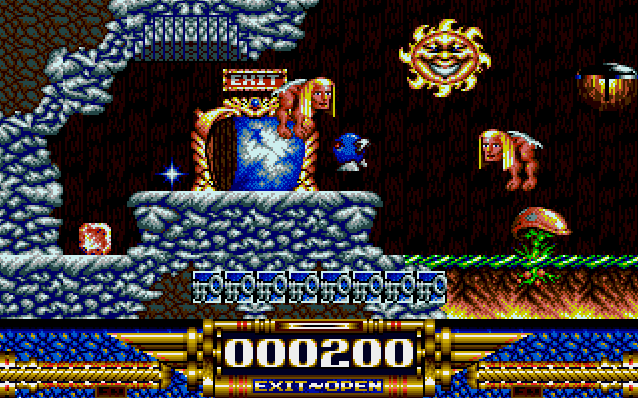
Here we are at the very fist screen of the game, and it’s weird. You can see that it’s weird. Lantern-jawed angels with dangling, fleshy hoof-feet? That’s weird. Eyeball monsters riding atop oversized mushrooms? Also weird, but admittedly less weird than the angels. At least Demon Blue himself doesn’t look quite as intimidating as he did on the title screen. His expression has softened into a smirk, and now he resembles a bootleg Kirby more than anything else. Will his brightly-coloured platforming antics be as much fun as those found in a Kirby game? No, of course not. Don’t be ridiculous.
Oh, and please note that even though this is the very first screen of the game, that door says “EXIT” on it. This will be important later, so if you do decide to play Demon Blue make sure you remember where this door is.


As for the gameplay, I said Demon Blue was a platformer and I meant it, because jumping is all that our hero can do. No special moves, no different running speeds, no climbing or swimming, just jumping. You do a lot of jumping in this game, so it’s unfortunate that Demon Blue shouts “ey!” every time he jumps. It’s an annoying noise when you first start playing; by the end of the game it’ll have you browsing Amazon for ear protectors.


As I say, all you can do in this game is jump, but you might have noticed that there are enemies all over the bloody place. Does this mean that our friend Blue has no way to fight back against those who would oppress him? Well, yes and no. There are three basic types of monster in this game. The first are the ones that stand or hover in place, maybe bobbing up and down a little. The angels fall into this category, as do the carnivorous plants. There’s no way to harm these enemies (at least, not that I could figure out) and they’re really more obstacles than enemies. Touching them will drain a bit of your health, and thankfully Demon Blue give you a fairly generous health bar.
Enemy type number two is typified by the creature on the right of the screenshot above. The one that looks like a tongue sticking out of an arse with googly eyes perched on top. Yeah, that thing. These enemies can be defeated simply by jumping into them. You touch them, they explode and you don’t lose any health… so I guess they’re not really enemies at all, are they?
Then there’s the third kind, an example being the red M&M up above our hero or the giant wasps that patrol certain screens. These enemies will make an effort to come and kill you, tracking you down so they can rub their deadly bodies against your character, and there’s nothing you can do to stop them. They can’t be killed. They can’t be bargained with, they can’t be reasoned with. They don’t feel pity, remorse or fear, and they absolutely will not stop, ever, until you are dead. It makes sense that wasps would fit into this category.


In short, the answer to the question “does Demon Blue contain combat?” is no, unless you’ve got a very flexible definition of what constitutes “combat.” I say it’s a platformer, but I suppose you could equally call it an avoid-em-up, because most of the gameplay revolves around making your way through the maze-like environment while touching as few things as possible.


The goal of all this wandering is to find the eight keys that are scattered around the map. Once you’ve got all eight, that exit door on the first screen opens up, and you can walk through it to freedom. Here’s a key now (the first one I managed to find, even) and this gives up an opportunity to play a little game I call What’s Killing Demon Blue? Some of the thing on this screen will hurt you if you touch them, while others will not. Try to guess which ones are harmful. The angel is a "free space" kind of deal, because I already mentioned that they’re deadly and it makes sense that they’d be trying to harm Demon Blue because he’s, you know, a demon. Okay, do you have your answers ready? If you said “I think that large blue wyvern that seems to be throttling itself with its own tail looks dangerous and also a bit kinky,” then you’re wrong. That thing’s safe, and you can even use it as a platform. “What about that sword, then?” you say, but no, that’s also safe. However, those squatting gargoyles – the things that look for all the world like immobile statues that exist as decoration – those will drain your health, and because the gap between the ceiling and the gargoyles is so narrow you’re definitely going to get hurt here.


Thus, the first thing you have to do when you start playing Demon Blue is learn what will kill you and what won’t. As a general rule of thumb, if it moves, it’s deadly, although that doesn’t always hold true. At least this large woman with the sunglasses is safe to stand on. Just… don’t try to figure out the anatomy of her torso, okay? Even I, a loner who spends his time writing about forgotten Amiga games, know that a woman’s breasts don’t grow directly out of her armpits.


Once you have figured out what’s deadly, you can concentrate of the real meat of the Demon Blue experience, and that’s the exploration. The eight keys are scattered far and wide over a gameworld that’s not only fairly large but often has multiple different exits on each screen, some of which can only be reached by approaching them from a different screen. If you’re planning on finishing Demon Blue without resorting to cheats then drawing a map is a must, something that’s doubly true because all the screens look the same – that is, like the illustrations from a cheap pack of tarot cards came to life and tried to found a society based upon the great and noble theme of hovering platforms. There are no new backgrounds or enemy types to be seen once you’ve travelled beyond the first ten or so screens, so keeping track of where you’ve been can be a bit of a pain.


On top of that, Demon Blue will throw the occasional bit of pure bullshit at you, like these pillars that have invisible pathways through them. Well, some of them do. Most of them are solid. I’d recommend you make Blue jump into every single tower of unblinking eyes that you see, but that would mean you’d have to hear him shout “ey!” even more than necessary so you’re going to be having a miserable time no matter what you do.


Is Demon Blue a miserable time, though? Once you get down to actually playing the game, I mean? I’ll be honest, it’s not great. Considering the game consists almost entirely of jumping between platforms and avoiding enemies placed in ways that give you almost no room to manoeuvre, the fact that your character handles like a carrier bag filled with jack-in-the-boxes does not make for the most engaging gameplay experience. Demon Blue is an awkward jumper, and a lot of the time your movements feel fuzzily defined. Will you land on the edge of a platform? It’s often hard to tell, especially when you’re jumping between screens, and because a missed jump often means falling for several screens or landing in a pit full of monsters, this lack of precision can become annoying.


It doesn’t help that Blue keeps jumping as long as you hold the button down, and there was more than one instance of me making a short jump and not letting go of the button quickly enough, causing our hero to leap straight off the platform I just landed on. Oh, and getting Demon Blue to jump straight up is a pain, too: if there’s a platform to your side, you’ll automatically jump diagonally towards it even if you’re not pushing the joystick in that direction, which obviously hampers your ability to hop over enemies or scope out the next screen. I also had a real problem with Blue banging his head (or, erm, his body, I guess) on the lip of platforms just above him, which causes him to fall straight down. You know, now that I’ve gotten around to writing this down the flaws in Demon Blue’s core mechanics sound game-breakingly bad, but they’re perhaps not quite as terrible as all that. It was an occasionally frustrating experience, but I didn’t hate it or anything, perhaps because when I got the jumping right it felt smooth and the platforms were laid out in interesting patterns without it ever being unclear about how to get from point A to point B.


I thought I’d be more pissed off about the relentless enemies and lack of safe screen space meaning that you’re constantly taking damage that you can’t avoid. I usually hate being forced to take damage that can’t reasonably be avoided, and it does become a bit wearying in Demon Blue when you walk on to a screen like the one above and see a dozen things that are going to hurt you because Blue’s jumps have all the aerial precision of a piano falling from a helicopter. However, scattered around are energy bottles that give you all your health back, and it felt to me like if you were dedicated enough to learn Demon Blue’s tricks and traps thoroughly enough to beat the game, then you’d know where all the energy bottles are and they’re spaced in such a way that you’d always be able to keep your health topped up. Think of them less as health refills and more as fuel for Blue’s cybernetic innards, that’ll soften the blow.


More than anything, Demon Blue is a good argument for videogames having some sense of structure to them. It’s all well and good saying “here’s a big map and a vague goal, now go and explore,” but when it’s done too loosely you end up with a saggy, uninspiring mess. The Metroid games make a similar formula succeed by always giving you something to work towards – the next boss to defeat, a new item to collect which in turn unlocks new areas. Games like Demon Blue don’t have that, and as a result it’s hard to get excited about slogging through a barely-changing warren of tunnels for which the only reward is more barely-changing tunnels.


I did have some fun playing Demon Blue, though. More than anything, it’s enjoyable as a sort of digital safari, and by far the most compelling reason to keep moving through it is to see what weird creatures you might happen across. For example, I dropped down a chasm and landed in a room which has all the hallmarks of being a boss fight but without any of the actual fighting. As far as I saw this monster is a one-off, a bouncing creature made from beetle legs and an old lightbulb that stomps around in this pit, trying to crush Blue. Naturally Blue can’t fight back so all you have to do is climb those platforms and escape, but finding a strange new monster was worth the health I lost. It’s only on reviewing these screenshots that I noticed the monster has a teeny-tiny face right at the bottom, which is sad: I had though it was a nightmarish amalgam of random insectoid parts, but now I can see its head I have to assume it knows what a grotesque freak it is, the poor thing.


It helps that the graphics are nice. Sharply detailed, colourful and possessing a sense of genuine strangeness when it comes to the creature designs, Demon Blue is definitely visually interesting enough to soften the blow of the mediocre gameplay. That said, it may look nice but it also looks familiar. Hmm, what could this be reminding me of?


Here’s a snippet from Hewson’s 1989 Amiga action game Stormlord. Now, I’m not saying that Demon Blue’s creators ripped off the “fairy women arching their backs and bulbous mushrooms” aesthetic from Stormlord, but that’s definitely what it was reminding me of and I’m glad I figured that out. It would have been driving me mad for weeks if I hadn’t.


After I’d been wandering around for a while, gathering up the odd key here and there, it struck me that I had no idea what was going on. Like, what even is this demon I’m controlling? What is it the demon of? Based on the title screen I’d guess it’s a demon that inflicts one minor but very specific annoyance. The demon of the headache you get from staring at a computer screen for too long, that sort of thing. So I thought I’d check out the game’s manual to see if I could learn a bit more, and I was not disappointed.


It turns out that I’m controlling the demonic reincarnation of a dead Scottish child who drowned while bunking off school. I’m not sure that playing hooky is a spiritual defilement so severe it deserves the punishment of being transformed into a limbless, grunting football, but here we are. God is truly wrathful, and apparently he bloody hates fishing. The thing is, the manual also suggests that “Harrison” can be reborn on Earth by finishing this game. The theology here is baffling, it really is.


I don’t really want to make a dabbing reference, but I know that if I don’t others will so yes, that statue kinda looks like it’s dabbing.
After a couple of hours spent exploring, dying, turning on a cheat for infinite health and exploring some more, I managed to collect all the keys. If you’re going to play Demon Blue, I would highly recommend giving yourself infinite energy. Overcoming the challenge of the gameplay isn’t nearly as much fun as wandering around unimpeded, gawping at the décor.

Here we go, then. I’ve got all eight keys, the door is open and Harrison can return to the land of the living, presumably forever bearing deep mental scars after his ordeal. We don’t get to see any of that in the ending, mind you. Is there an ending at all? Sort of. Grammar pedants may want to look away now.


*You’re.
And so Demon Blue ends on a poetical note, with a cheeky rhyme that promises the developers next game will kick your, well, I’m sure you get it. I have no idea if that’s true, because I don’t know what the developer / coder’s next game was, but I hope it was better than Demon Blue. It’s not that this is a bad game, per se – it’s just that the majority of the fun you’ll get from it doesn’t come from the gameplay but from the bizarro monsters and strange setting. Honestly? That’s good enough for me. There are plenty of good platformers out there, but it’s rare that I get to traverse platforms that look like Santa Clause with a bad spray tan.

05/09/2017

VIOLENT SHOOTING / CYCLE SHOOTING / BRONX (ARCADE)

oday’s article is all about a 1986 arcade game from Taito. No, not Bubble Bobble. Not Arkanoid, either. This game is called… well, it gets a bit complicated. In Japan it was released as Violent Shooting, which raises questions about whether there can be a game about shooting guns that isn’t intrinsically violent. Then it came west, where it was called Cycle Shooting. A slightly more descriptive title for the contents, because you definitely have to shoot at some (motor)cycles. Then there was a bootleg version called Bronx, which is technically the version I’ll be playing today because both Violent Shooting and Cycle Shooting seem to be unemulated a the moment. As far as I can tell, the only difference between Bronx and the official versions of Violent Shooting is the title screen, so I figured that’s close enough.


Here’s the brand-new title screen that the creators of this bootleg went with. One might argue that they shouldn’t have bothered. I don’t know about you, but I can’t help seeing it as “the square root of bron,” and I have no idea why you’d even call this game Bronx because it has nothing to do with that particular part of New York.


What is does have is a strangely-proportioned young lady running down the middle of a road while being harassed by a gang of hooligans on motorbikes. I know she’s all geared up like she’s on her way to her mid-week roller derby match, but she’s not wearing skates. Even if she was I doubt they’d give her enough to speed to outrun the thugs who, of course, kidnap her. Oh yes, Violent Shooting is ferreting through the bottom of the “rescue the abducted female” barrel for a storyline, and now it’s up to you – the nameless, gun-toting hero – to save this woman.


It turns out that the “shooting” part of this game’s many names is accurate, because hey look, it’s a lightgun game. A very basic lightgun game, at that. You point the attached gun (if you’re playing on an actual arcade cabinet, anyway) at the screen and shoot the bad guys. This makes Violent Shooting’s gameplay quick to describe, and in fact I’ve already covered all the salient points. There’s no reloading, no special weapons or screen-clearing grenades and no shrieking hostages that you’re supposed to not shoot despite their arm-waving, attention-grabbing antics. As I say, it’s about as basic as a lightgun game can get.
I should also mention that while this “Bronx” version of the game is emulated, it’s not emulated well and there are plenty of issues that popped up while I way playing. They were mostly graphical errors, especially with sprites appearing on the wrong layer of the playfield, and normally I wouldn’t write about a game when I can’t get a feel for what it’s really like but despite the rather bland gameplay Violent Shooting was interesting enough for me to play through it anyway.


So here we are, shooting at a motley crew of mohawk-wearing shoulderpad aficionados in a post-apocalyptic wasteland. Some of them have motorcycles, some of them have cars and a couple of them even have small personal helicopters, because as always these post-apocalyptic survivors are forever bleating on about the lack of fuel but there’s always enough to keep roving gangs of motorbike psychos on the move. As always in these situations, we must decide whether the aesthetics are influenced more by Hokuto no Ken / Fist of the North Star or Mad Max. You might think that’s a moot point, because Fist of the North Star is hugely inspired by Mad Max in the first place, but there’s a subtle distinction – Mad Max drives a car and uses a gun, but Fist of the North Star’s Kenshiro punches people until they explode. Like I said, it’s a subtle distinction. I’m leaning towards Mad Max because of, you know, the shooting, but those ruined buildings back there look very much like a Fist of the North Star backdrop.


Halfway through the stage, the punks were replaced by a swarm of floating, grinning balloons that grant points when shot. While the bad guys in Violent Shooting are hardly the roughest, toughest looking bunch of hombres, it’s a bit jarring to suddenly be shooting at something that seems to have drifted in from Hugsy Smileington’s Adventures in Balloonland.


I do like these punks, mind you. Even though they’re trying to kill you (and succeeding) they’ve got the air of bumbling losers, especially when you shoot their motorcycles and they comically roll along the asphalt with goofily exaggerated expressions rather than having all their skin sheared off. It’s a fun look, and it's about as close as we’re ever likely to get to a Mad Max / Fist of the North Star lightgun game so I’m having a nice time even if the gameplay is very one-note.


Moving on to stage two, and rather than the scrolling roadway of the first stage it’s a static screen showing a petrol station overrun by, you guessed it, a biker gang who took full advantage of the local boutique’s “buy a pair of shoulder pads, get a free eyepatch” offer. The most notable new addition here is the cutesy cartoon cat that scampers around the screen. Aww, isn’t it adorable? All fuzzy and cute. Shame I had to shoot it to collect the points bonus it was carrying, really.


You spend your time on this stage shifting between shooting gang members and fuzzy critters, and it’s fairly important that you shoot both kinds of target. I was rather taken aback when I started playing Violent Shooting and realised I only started with two blocks of health in my life bar, a measly amount that is quickly shredded should you miss a shot on even a single enemy. In fact, it was a real challenge just to get past the first stage, so quickly was my health bar depleted whenever I didn’t take out a single punk in time (which was a lot, because I’m bad at videogames.) My two top tips for Violent Shooting success, then: shoot the balloons and animals because they give you extra health when you collect enough points, and don’t hammer the fire button because your gun fires in a “bang-bang, bang-bang” two-shot rhythm which can leave you vulnerable between those two shots. Of course, this is all theoretical, because most of the time I lost health it was due to an enemy I couldn’t even see. As in, there was no enemy sprite there at all. I’m going to put this down to emulation issues, because surely even a mid-eighties arcade game wouldn’t be cruel or greedy enough to have invisible enemies.


This stage has a boss at the end, but it’s not just any boss – it’s Arnold Schwarzenegger himself! Specifically, it’s John Matrix from Commando, if the body paint and rocket launcher are any indication. He operates as a pretty typical lightgun game boss. Keep shooting him so he can’t shoot you, only adjusting your aim to shoot down the rockets he occasionally fires at you. I’ve fought a thousand lightgun game bosses like him before, but happily this one has the advantage of being a super-deformed cutesy version of Arnold Schwarzenegger: something you don’t see very often, and probably for good reason. Taito definitely pulled off the look, though. Immediately recognisable as Arnie, an engagingly silly design and some bright red high-heeled boots just to spice things up a little.


Once I’d managed to shoot the boss enough times, he died. That’s to be expected. Less expected was the row of bullet wounds that appeared across his chest and the blood oozing from his mouth. It’s still presented in a cartoonish manner, but it’s a little gorier than I thought Violent Shooting was going to get. In fact, one of the most noticeable things about this Taito game is how un-Taito-y it feels. I know they’ve got a wide range of different genres and aesthetics under their belt, but whenever I think of Taito arcade games I think of Bubble Bobble and Rainbow Islands, not eighties action movie stars leaking blood like an oversaturated sponge.


Onward to stage three, which is a lot like stage one except it takes place in a tunnel of some kind. Violent Shooting’s biggest problem is that it becomes repetitive almost immediately. Most lightgun games are, by nature, rather basic in terms of gameplay design but they (the good ones, anyway) keep things interesting with new enemies, hazards and locations. Not so with Violent Shooting, because you’ll be blasting away at the same set of hairspray-hogging punks for the entire game, the action set against backdrops that you could hardly call exciting. The only new feature in this stage is that the punks will now throw bundles of dynamite at you, which must be shot out of the air.


I thought that the sound that exploding dynamite makes had long been settled on. Bang, boom, kaboom, all acceptable onomatopoeia. “Krash” is a new one on me, unless they’re chucking the dynamite through a plate glass window before it explodes.


Another day, another single-screen stage populated by the same villains. Sometimes they ride up and down in the elevator on the side of the building, so that’s new. Also new are the strange fuzzy chicks that wander around the screen, disconsolate that Taito didn’t choose them to star in New Zealand Story and desperate for the player to end their miserable existence. “Go on, do it.” their fluffy little faces seem to say, “You’ll need those points.”


Yes indeed, I will need those points and the precious life energy they bring, because this stage has a fight against two bosses at once. They’re punks, but bigger and with even more extravagant shoulder pads. If they had a running start and jumped off a cliff, they could glide for miles on those things, obviating the need to terrorise the innocent post-apocalyptic survivors during their relentless quest for petrol. Maybe that’s why they spend this fight leaping around like kangaroos with tasers stuffed into their pouches, they’re trying to figure out their own aerodynamics.
Anyway, the fight is simple in concept but difficult in practise, because Violent Shooting is hard enough without having two fast-moving targets gunning for you at once. I managed to triumph, however. I’m not sure whether it was through luck, design or poor emulation, but one of the bosses decided to wander away for a significant portion of the fight, leaving me with only one target. I don’t know how or why it happened, but I’ll take it.


Another scrolling stage now, this time a jaunt through the irradiated wasteland with a large tanker for company. I assumed I was supposed to be protecting it – and I’m pretty sure that is the case – but obviously I shot it a few times just to see what would happen. Nothing, is the answer. Nothing happened. I mean, I lost a life because I was too busy shooting at the truck to get rid of the punks, but nothing happened to the truck itself.


The action then moves on to this series of wooden bridges, which are naturally infested with gang members on motorcycle. A bloody ton of them, even. They just kept coming, wave after wave, with no end in sight no matter how many of them I reduced to red smears on the road. I began to worry that the game was broken somehow – more broken that it already was, I mean – and that I was trapped in an endless loop of logs and punks.


Then I accidentally shot one of those grey blocks, and it exploded. So those are bombs, then? Okay, so I have to shoot enough bombs to destroy the bridge. Well, that’s something a bit different, at least. It’s not fun, not when the bombs whizz by at a speed that makes them far harder to blow up than it feels like it should be, but having a concrete goal to aim for is nice.


Now we’re at the final stage. You can tell it’s the final stage, because the kidnapped lady from the intro is tied up at the top of the screen. Much like the tanker, I had to try shooting her too, just to see what would happen. She made a noise. I don’t think it was the noise she was supposed to make, because it sounded like R2-D2 stubbing his toe. Maybe there’s meant to be some digitised speech in there. “Cut it out, you berk,” something like that.
As for the stage itself, well, you shoot some punks. That’s it. Violent Shooting is a very short game even by the standards of the lightgun genre, and that’s definitely for the best. It doesn’t have the energy to sustain itself for the stages it does have.


The final boss appears, and I was not expecting it to be some kind of armoured cherub, an enemy I’m pretty sure I fought during Bayonetta. I was expecting it to be a punk, but bigger. RoboPutto is what we’ve got, though, so I got down to the shooting only to discover that the boss is carrying a large, bulletproof shield and the only way to land a hit is to fire during the very brief window when the boss lowers their shield to fire at you. This is easier said than done, because the boss runs around the screen pretty quickly, but it’s a decent-enough set-up for a boss fight in a lightgun game.


Eventually I landed enough shots to knock off the boss’ helmet and reveal that – gasp – I’m fighting against a lady! I think. No, hang on, she’s got armoured boobs, it’s definitely supposed to be a woman. This would be more interesting if the boss had any backstory or motivations to speak of, but I suppose it’s still better than fighting yet another gang member.


A few hits later, and the boss is defeated by the power of embarrassment as our hero shoots all her armour off. You even get a couple of frames of full-frontal, single-pixels-for-nipples nudity to keep all you perverts out there happy. What a way to end a strange little game.


As far as an ending goes, you get to see our hero in the flesh. He looks a lot more like Max Rockatansky than Kenshiro, so I guess that clears up the whole Mad Max / Fist of the North Star influence debate. Not that he looks that much like Mad Max, mind you. I don’t remember Max wearing a tweed jacket with leather elbow patches. Not-Max and his lady friend get their revenge by tying the villain up at the top of the screen – poetic justice, if the poet in question is someone scrawling a dirty limerick on a toilet wall – and Violent Shooting / Cycle Shooting / Bronx comes to an end. Except it doesn’t, it loops back to the first stage with increased difficulty, but as far as I’m concerned it’s done.
Normally I’d try to come to some kind of conclusion here, but because I can’t be certain about what Violent Shooting is really like when it’s all working correctly I think it’d be kinda unfair to do so. That said, from what I’ve played it seems like a technically competent but very limited game. There’s not much here to keep you coming back for more, you know? On the plus side, the setting is a weird enough take on a very familiar world to make it interesting to play through once or twice, and it’s hard to argue with that tiny Arnie boss. Maybe one day it’ll be fully emulated and I’ll go back to check up on it, but for now I’ll go back to trying to figure out a way to cryogenically preserve myself until the Yakuza Fist of the North Star game is released and I can get my post-apocalyptic thug-fighting thrills that way.

01/09/2017

NINJA GRANNIES (ZX SPECTRUM)

They’re not turtles or mutants and they’re definitely not teenagers, but they are ninjas. Well, that’s what the game would have me believe, but I’m not sure I buy it. Ninjas don’t tend to carry handbags. Brace yourself for the hip-shattering, pension-collecting pugilism of Clockwize’s ZX Spectrum brawler Ninja Grannies!


Here’s a ninja granny now. Her name’s Mabel, and she’s the particular pensioner you’ll be controlling while you play. As you can see, she’s got some moves. Kicking a walking stick in half is the OAP equivalent of karate chopping through a plank of wood, I guess. I like the use of typical “old people” things like zimmer frames and wheelchairs on those banners, although I’m not sure about the walking stick with a snake wrapped around it. Maybe I’m going to fight a retired doctor at some point.


On Ninja Grannies’ title screen, a scrolling text window gives you some hints about your upcoming battles. “Watch out, there’s a gran about,” it says, and I assume it’s referring to Mabel herself. She’s clearly a violent thug who roams the streets, post offices and bingo halls of the land looking for people to fight. Some foes will use weapons, apparently, and there’s also the ominous promise that your opponents will include “the likes of Edith.” Dear god, not Edith. Hopefully I’ll have had plenty of practise before I go up against Edith the Eliminator.


As you can see, Ninja Grannies is a one-on-one fighting game built around the gag that rather than kung fu masters and villainous dictators, all the fighters are grannies and grandpas. It’s called Ninja Grannies and not Kung Fu Geriatrics presumably because ninjas were big in the eighties, and it fits in nicely with the plethora of other ridiculous “ninja” games of the time like BMX Ninja, Ninja Hamster and Ninja Scooter Simulator.
Anyway, you’ve both got a health bar, you attack each other and whoever runs out of health first loses. You can only play as Mabel, which is a bit of a shame because there’s a fair variety of oldsters in the game. First amongst them is Berty, a cantankerous old geezer who will fight Mabel to the death for the right to occupy the chair nearest the radiator.


Don’t let Berty’s age fool you: he’s got some serious combat skills, as evidenced by the way he roundhouse kicked Mabel halfway across the room. That’ll teach her to call him a “Last of the Summer Wine-looking piece of trash.”


Not to worry, though, Mabel can fight back with her own arsenal of attacks, including a flying kick that belies her advancing years. Sadly you can’t move forward while jump-kicking, Mabel just leaps straight upwards with her leg outstretched, but the power of the falling heel drop is still enough to be a useful tool when the time calls for it.


Mostly, though, I went with the tried-and-true old lady strategy of smashing Berty in the face with my handbag whenever I could. It’s got a decent amount of range, it comes out quickly and it isn’t nearly so rough on poor Mabel’s hips.
If you’ve read any other VGJunk articles about Spectrum or Commodore 64 fighting games, then you’ve probably already got a good idea about how Ninja Grannies’ controls work. The joystick lets you move back and forth or jump, and moving the joystick while pressing the fire button is how you attack. The jumping kick, for instance, is up and fire, while the handbag slap is right and fire. You can also block high or low by holding up or down and back on the stick and pressing fire, and there are a few other moves like a hefty kick in the shin and a powerful but slow-moving roundhouse kick performed by holding back and pressing fire. It’s not the greatest control scheme in the world, just as it wasn’t the greatest control scheme in any of those other home computer fighting games, but it gets the job done and for the most part the moves correspond to sensible directions on the joystick so you won’t forget what motion performs which move.


After smashing Berty in the face with my handbag so many times that his false teeth have been replaced by crumpled tissues and Werther’s Originals, the fight ends with Mabel as the victor. She’s “on the road to ninja stardom” now, apparently. Is this going to be like The X Factor, and Mabel’s the token old person who comes on the show as a “life-affirming” reminder that, like, age is only a number, man? I hope so, because then it might end with Mabel drop-kicking Simon Cowell.
After you’ve waited for it to load, it’s on to Ninja Grannies’ next fight. And then the next, and the next, until all your challengers have been vanquished. Nothing much changes between fights – even the background only changes after every three fights – and there are no bonus rounds to mix up the action so if you were hoping for a minigame where you mash the fire button until Mabel can wrench the lid off her heart pills, you’re out of luck. However, Ninja Grannies does feature quite the cast of sinister septuagenarians, so I’ll make sure you get to see them all.


Next up is Edith herself, and good god what is wrong with her head? She looks like a partially deflated basketball wearing sunglasses.


After the build-up she got in the intro, I was a little worried that Edith was going to wipe the floor with me, and doubly so when she ran at Mabel and tried to stove her head in with a walking stick. It all worked out okay, though – somehow I managed to block most of this ferocious assault entirely by accident. You can block in this game, clearly, but as with pretty much every home computer fighting game I’ve ever played blocking is not something you can rely on. Most enemy attacks come at you too fast for you block in response, and it’s not like a Street Fighter or what-have-you where a successful block will push your opponent away a little and give you some breathing room. No, even if you are managing to block their attacks, the other fighter will right next to you and keep on attacking until you either stop blocking or they kick you in your unguarded feet. In Ninja Grannies, offence is definitely the best form of defence.


Fighter number three is Bessy, a vicious-looking fishwife type with a headscarf and a desire to ram her slippers deep into Mabel’s ear canal. There’s not much else to say about Bessy, because she’s basically the same as Mabel but with a different sprite. In fact, all the characters are the same in terms of moves. They’ve got a jumping “kick,” a sweep, a spinning roundhouse of some variety and so on. What most of them do have, though, are different sprites that at least try to disguise the fact that they’re all the same under the hood.


Moving on, and the next combat arena is the post office. Back when Ninja Grannies was created (some time in the mid-eighties, although I’m not sure on the exact year) the post office was well-known as being a gathering place for the elderly, especially on pension day when they’d all shuffle down there to collect their money. Nowadays your pension generally gets paid straight into your bank account, though, so the post office isn’t quite the local hotbed of OAP activity that it used to be.
Your first opponent in this locale is Ralph. At first glance, Ralph looks like a kindly old man, with his receding hair and his argyle pullover. You know that’s not true, though. He’s here to fight. He’s put his life on the line for the sake of the secret pensioner combat deathmatch. He’s here to win, not to watch cricket and tousle the hair of his grandchildren, and his violent ways were revealed when he ran over to Mabel and showed her his backside with a sly grin on his face, as you can see above. Then he headbutted her right in the face. Ralph is not to be trifled with.


The next challenger is Rosie. She’s very similar to Bessy, except she’s carrying the favoured weaponry of angry matriarchs the world over -  a rolling pin. I wouldn’t be surprised if she’d hammered a few nails through it, too.


Things get a bit strange with the next fight, because it’s not against a fellow granny. Instead you’re rumbling with Hughy, and Hughy’s a punk. Specifically, he’s a videogame side-scrolling beat-em-up punk: no shirt, hair in a mohawk, attempting to batter Mabel with a chain. I say “attempting” because Hughy could have the biggest chain from the biggest bicycle in the world and it wouldn’t stand up to Mabel’s furious handbag assault. It’s weird that Hughy’s such a change from the other fighters, and he’s the only one that’s not a granny / grandpa. Were they holding auditions for Streets of Rage in the next room and he got lost? Maybe it’s supposed to be implying that Hughy is trying to steal Mabel’s pension, in which case you fucked with the wrong grandma, asshole.


Moving on the high street, and a battle against Molly. Molly’s gimmick is that she’s brought her pet dog with her, and as gimmicks go I’m fully on board with it. The dog even gets involved with the fighting, leaping at Mabel during certain attacks: for instance, where most characters would have a low kick, Molly gets her dog to bite at your ankles. This is Ninja Grannies’ biggest strength. They only had one joke, but by god they stuck to it and made a real effort to make the characters feel unique even if they all fight the same, and there’s a lot of charm to be found in two old ladies fighting outside a launderette, one of them using a terrier as an offensive weapon.


Another example of this is Joe, who fights while riding on a mobility scooter. A bloody good mobility scooter, too, considering it gives him the mobility to a) get down to the shops and b) perform spinning attacks.


Hey, look, there’s another dog in the background. I’m going to assume it’s related to the Bay Area dog from Final Fight.
At this point I’m more than halfway through Ninja Grannies, and I feel like I’ve got a handle on it now. To be fair, I could have said that after the second fight, because nothing really changes – the fights don’t seem to get any more difficult as you progress, even – and every fight will play out the same way. I’m glad that I realised the handbag slap was the best move early on, because that’s how I got through the game. Trying to use all the moves at your disposal and blocking incoming attacks isn’t going to work: the game’s controls are simply not responsive enough for that, coupled with the CPU characters’ ability to pin you in place if you’re blocking. Instead, here are my tactics. Take a swipe with you handbag. If it’s blocked, wait a second or so and try again. If it lands, step forward and handbag again. A lot of the time you opponent will try to react with attack of their own only to feel the force of Mabel’s purse, and often you can catch them in a loop. You hit them, they try to hit back but you’re already using your next attack, repeat. Eventually you’ll knock them all the way across the screen, and when that happens you just walk backwards a bit and start again. It’s not a foolproof method by any means, because sometimes they’ll jump out of it or Mabel herself will lag behind a bit, but on the whole it seems like the most consistent way to win. You get all your health back between fights, too, so you can get away with turning the fights into a war of attrition until you get the loop going.


The last street fighter is Amoss, the dirty old git. I say that because his main attack is to thrust his groin towards Mabel, his trenchcoat bulging as he does so, so I have to assume he’s supposed to be a flasher. The worry here is that he might want Mabel to clobber his unmentionables.


And now, the final stage – the bingo hall. Of course it’s a bingo hall, where else could be a more fitting gladiatorial arena for a senior citizen’s death match? John Wick thinks he’s so tough with his pencil, he should try it with a bingo dabber.
Mabel’s first foe in the bingo hall is Billy. With his full beard and woolly jumper, Billy has the air of a real ale aficionado, an effect that’s increased when he attacks using the bottle he’s carrying.


After that, it’s a battle against Dot, who you can see above getting a kick in the head. Sure, Ninja Grannies’ central joke is a dumb one, but there’s definitely something entertaining about seeing two little old ladies acting like Ryu and Ken. Dot’s most notable feature is that she attacks with, appropriately enough, a granny trolley. At least, that’s what I and the people I know call those shopping baskets on wheels.


Last but by no means least is Annie, Mabel’s final competitor for the coveted crown of Most Ninjaest Granny. Annie’s in a wheelchair, perhaps so she can play the “you wouldn’t hit someone in a wheelchair” card, but Mabel’s not about to fall for that. It’s not just any wheelchair, either: the foot rest can extend to smash Mabel in the shins, something that I’m sure would hurt a lot. As someone who’s spent a fair amount of time pushing wheelchairs around, I can assure you that you wouldn’t want to fight one. Especially those solid, old-fashioned ones they have at the hospital. If one of those things rolls over your foot, you’re going to know about it.
Of course, Annie isn’t any more difficult than all the other combatants and the “fighting” “skills” you’ve honed throughout the game should be enough to see you through to your final triumph.


Here’s your ending. What were you expecting, a montage of Mabel’s sickest flying kicks set to a specially-composed rock-n-roll score? C’mon, this is a ZX Spectrum game, you’re lucky to get this bit of text. “You can now claim to be the world’s best martial arts pensioner,” it says.


Well, you can make that claim for a few more years, at least.
I had fun playing Ninja Grannies. There, I said it. Not because the gameplay is particularly fun or anything – I mean, I’ve definitely played worse 8-bit computer fighting games, but there’s still not much to excite in this one, gameplay-wise. It’s repetitive, blocking is pointless, movement is slow and sometimes Mabel won’t attack when you tell her to. However, the setting and the graphics offer some good, dopey (and very British-feeling) fun, with just about enough entertainment to be gained from clobbering flashers and being attacked by tiny dogs to see you through the game. It’s a shame, then, that Ninja Grannies was never commercially released. That’s right, it never made it onto shop shelves, but if it had I think it would be remembered as something of a cult classic. Now that I’ve played it and put more pensioners in hospital than pneumonia, I shall remember it fondly and probably never play it again.

VGJUNK Archive

Search This Blog

Followers