If I was putting together a list of animals most suited to defending a planet from demonic, interstellar invaders, I’d imagine I’d put the humble rabbit somewhere down near the bottom. When the Carrot People of Brocculon 7 start getting belligerent then sure, it’s rabbits all the way but otherwise I’d go with, I dunno, gorillas with guns. However, if you make the rabbit a flying mechanical suit with destructive fists and a rapid-fire laser gun then hey, now you’ve got the concept of today’s game: it’s Video System’s 1987 arcade shooter Rabio Lepus!
Yes, it’s Rabio Lepus, with a rather nice calligraphic logo and the words “Rabio Lepus” written below a second time, just in case you forgot the title of the game after reading the logo. Lepus is, of course, the Latin word for “hare” and helps make up the taxonomical name for bunnies, and Rabio is… well, it’s a made up word but it definitely feels rabbit-ish. It also sounds like Scooby-Doo meeting Fabio.
On the rabbit planet, where the inhabitants are human and merely dress as rabbits to varying degrees, the king and the two princesses have been kidnapped by the bad guys. Why? Who knows. All I know is that the villains are leaving behind a perfectly good castle, and I find it more amusing than perhaps I should that this fairytale castle has a paved asphalt road leading up to it.
Off goes Usagi, the robotic rabbit fighter, to save King Fursuit and his daughters Wedding Rabbit and Playboy Bunny. That’s who we’ll be playing as. If these character looks familiar to you, you might have spotted them in other Video System games such as the Sonic Wings series, where Rabio Lepus’ characters pop up in playable or cameo appearances. Space-travelling robobunnies feel very much in keeping with Video System’s slightly weird design philosophy. I think the last Video System game I played was Lethal Crash Race, and that definitely had its fair share of weirdos.
You know what I love? When videogame map screens mark locations with extremely redundant labels. “Spaceship”? Thanks, for a second there I thought it was vinyl copy of the Elvis Costello album Armed Forces.
Don’t be fooled by this map: it might look like there are only three stages (spaceship, asteroid base and planet) but there are a lot more than that, as we shall see.
Here we go, then. Rabio Lepus is a side-scrolling shooter that I’m going to compare to Gradius, even though I feel a little bad that I always compare side-scrolling shooters to Gradius. I know there are other shooters out there, but the way the first conga line of enemies flew towards Usagi genuinely did make me think of Gradius.
As with most side-scrolling shooters, you shoot the enemies with your weapon – in Usagi’s case, a relatively fast-firing laser cannon - and try not to collide with the bad guys or their projectiles. So far so typical, although Rabio Lepus does give you a health bar rather than having you explode into rabbity chunks at the slightest mishap. That’s what the red blocks at the bottom of the screen are. Each block represents one of your three lives and acts as an individual health bar.
Onwards flies Usagi, pew-pewing his way through an enemy armada composed mostly of nondescript robotic lumps and more interesting scuttling creatures that look like walking microchips. It all plays out much as you’d expect. Usagi handles quite well, although he is something of a marshmallowy target, being fairly large and with a hitbox I never really managed to get a concrete handle on. Then a voice sample shouted “Destroy enemy master!”
A boss? Already? Blimey, that was quick. I’ve barely warmed up my trigger finger; stage one had only been going about a minute and a half before this robotic bull appeared. Usagi’s powers of flight give him the advantage in this battle, with the boss being confined to the bottom half of the screen, although Usagi’s main weapon can only fire straight ahead so you will have to get in front of the boss to damage it. That’s dangerous, because the boss has the ability to fire a deadly plasma beam ahead of itself, as well as charging head-first along the bottom of the screen. Look, you don’t build a robotic bull and not give it the ability to gore things with its titanium horns. Erm, unless it’s one of those mechanical bar-room bulls that were popular for a while. Maybe this boss is an early prototype of one of those things, banished into outer space for trampling the more tone-deaf patrons during karaoke night.
So, stage one was very brisk and the rest of Rabio Lepus follows the same template of short stages – never more than a couple of minutes long – with a boss at the end. Stage two is no different. Another mechanical background as we fly through the big spaceship from the map screen and more uninspiring robot shapes to shoot at. For a moment I thought these things were supposed to be I Ching mirrors but no, they’re just pissed-off octagons. So far I’m not really feeling Rabio Lepus’ visuals – the graphics themselves are quite nice on a technical level, considering this game is from 1987, but so far they’ve been a little generic and if they were going for an amusing contrast between stark metal militarism and Usagi’s undeniable cuteness it’s not really working for me.
The fact that this stage’s boss is “three robots” isn’t exactly changing my opinion. I like robots as much as the next person who grew up watching Transformers and Voltron, but these aren’t even especially interesting robots. They’re… Gundam Lite, I suppose. They also threw a lot more lasers at me than I was expecting, which is why Usagi is dying in the screenshot above. Eventually I realised that the quickest way to beat this (and any other) boss battle is to fire all of Usagi’s secondary weapon ammo as fast as possible. At the very bottom-left of the screen you can see a row of icons that represents the ammunition for your missile launcher, a limited-use subweapon that fires a barrage of homing missiles in a manner that would feel quite Macross-esque if they weren’t spewing out of a rabbit wearing little red bootees. The missiles are extremely useful and will eliminate even bosses quickly and efficiently, but their limited ammo makes them a valuable resource so I’d recommend saving them for the end-of-stage battles.
This is more like it – some interesting enemies, at last! These morose grey faces definitely caught my interest, although I couldn’t stop think about the way they’re facing out of the screen meaning that Usagi is destroying them by pouring hot laser death directly into their ears. They also remind me of Tetris creator Alexey Pajitnov. And if you thought these disembodied faces were fun…
… then get a load of this chap. I like his expression of mild consternation, a remarkably subdued reaction from someone who’s been cracked open like a boiled egg at breakfast time. “Did I just see a flying robo-rabbit, or was it merely a side-effect of my exposed brain matter?” the face seems to be wondering. What I’m wondering is whether this face is based on Peter Weller in RoboCop, because that’s the vibe I’m getting from it.
This battle combines the “animal” and “multiple robots” theme of the previous two bosses to bring us multiple robot panthers. They’re reminding me of the Konami arcade game Black Panther, which is a shame because that game is not very good. I’d better launch all my missiles at them, then.
That plan rather backfired when I moved on to stage four, which is purely a boss battle. A boss battle I don’t have any missile ammunition for. This wouldn’t be so much of a problem if you could upgrade Usagi’s main laser, but you can’t. Unlike almost every other shoot-em-up ever made, you’re stuck with the same piddly blaster for the entire duration of the game, with no power-ups to change to a new weapon or even increase your firepower. This does mean that you avoid the common shoot-em-up problem of losing all your power-ups and being woefully underpowered whenever you die, but that’s the only advantage to a system that keeps the gameplay very samey and quite dull for the duration of the game – and by this point, Rabio Lepus has become difficult enough that you feel woefully underpowered anyway.
As for the boss, it’s okay. It looks a bit different, at least. I assume it’s the spaceship’s central computer and the figure sticking out of the side is the hyper-advanced mainframe equivalent of a hood ornament.
The Playboy Princess is saved, so even should Usagi fail in his mission the royal bloodline will live on. I’m half-tempted to call it a day here. Playboy Princess seems like the most level-headed of the three royals. Sure, she’s wearing a bunnygirl suit, but surely that’s better than the king’s mascot costume or the other princess eternally wearing a wedding dress like some long-eared Miss Havisham?
Now we’ve moved on to the asteroid base, where the Rabio Lepus thrill-ride continues with exciting new backgrounds (rocks) and equally exciting new enemies (also rocks). During this lull, I’ll take a moment to explain Usagi’s third weapon – his pummelling fists. If you get close enough to an enemy, pressing the fire button won’t launch a laser but will instead cause Usagi to punch. It’s a very powerful attack, but obviously the range is extremely small. So small, in fact, that I didn’t manage to get a decent screenshot of it because I kept flying into the thing I was trying to punch and dying. The punches are an interesting concept (and a spaceship with arms was presumably “inspired” by Konami’s TwinBee) but the execution is sorely lacking. If your punches had a little more range, that’d make them far more enjoyable to use; if they were activated by a separate button, they’d be even better. However, the punches do not work like that and later in the game there are so many bullet-sponge enemies that you have to punch your way through and it all gets rather frustrating. That didn’t stop Bally-Sente renaming the game Rabbit Punch when they localised it for overseas release, mind you. The pun was right there, it’s not like they could ignore it.
The boss is More Rocks, this time with additional demonic head. If you've seen one shoot-em-up boss where your target is surrounded by a spinning circle of destructible objects, you’ve seen ‘em all.
The next stage is caves again, but this time they’re a bit more interesting thanks to the leaping mecha-piranhas that jump out of the water. As we all know, a school of mecha-piranhas can strip a robo-rabbit down to the endoskeleton in minutes, so it’s annoying that they’re located right next to all the power-ups I need. That’s what the can on the bottom-right of the screen is. Shooting the cans open reveals items such as missile ammo, health-ups or temporary invincibility, but if you touch the cans without shooting them they fall off the screen and the power-up is lost. This feels like a particularly mean addition to a game that has already become very difficult thanks to the density of the enemies, their tendency to appear right next to you with no warning and Usagi’s limited offensive capabilities, and it’s hard enough to feel at odds with Rabio Lepus’ often cutesy art-style. When combined with the “my first shooter” power-up system, I ended up with the impression that Rabio Lepus’ developers couldn’t decide whether they wanted to make a game for a slightly younger audience or regular arcade shooter fans.
The stage – and perhaps the entire game – is redeemed by this boss, a hovering sheet ghost with a variety of expressions scrawled across the (possibly literal) canvas of its face. The boss doesn’t do anything especially interesting – it summons formation-flying turtles and spits the odd projectile – but just look at that goddamn face. I think it’s those eyebrows. They look like my eyebrows, or at least they would if I ever trimmed my eyebrows.
Well I’m glad someone found the time to gussy up this asteroid base a little. Can you even call it a base if it isn’t decorated with bikini angels? I think not. The ceiling-statues showing the T-1000 morphing into an octopus in what could have been Terminator 2’s greatest scene are a nice touch, too.
Please also note the diamond-shaped blocks, because they deflect your laser at a ninety-degree angle when you shoot them and in a better game that could have provided the impetus for some fun semi-puzzle shooting. In Rabio Lepus, however, they just get in the way.
The boss is a black-and-white photocopy of a yoga master, hovering around on his mystical boulder and spewing forth a barrage of fire from which there is no escape. Of all the bosses in the game, this is the one where “fire all your missiles and pray” felt like the only viable tactic, so I did that.
The rock demon from the earlier boss fight is back, only now he’s got an extreme intestinal parasite that can’t wait to pop out and say hello! After the bullshit fire wizard this fight is a nice change of pace and the last respite you’ll get before the end of the game, so take a moment to enjoy it. Then shoot the demon in its mouth. I assume it will be glad to be put out of its misery.
The king has been saved. Sorry, Princess Playgirl, but you’ve just been demoted back down to second in line for the throne. A typical aristocrat, the king starts whining and expects the common man – erm, rabbit – to solve his problems without even attempting to help. I’d watch out, your highness, I doubt that fursuit is guillotine-proof.
We’ve now reached the planet’s surface for another round of fairly generic shoot-em-up action. I just wanted a few cool guns to use, but that was apparently too much to ask. So we shoot some more stone faces and flying robots and avoid the background elements like the pillars. The most interesting thing about this stage is that I had to pause it for a couple of minutes, because it was bothering me that I couldn’t remember what game it reminded me of. Then it hit me: the background was making me think of classic Amiga graphics showcase Shadow of the Beast.
Oh dear – won’t someone please help this unfortunate dragon? It’s managed to get itself stuck inside a bin bag, which as we all know are to dragons as plastic beer rings are to seagulls. It probably crawled into the bag looking for gold to add to its hoard, the poor sod. Never mind, noble creature, I will set you free. After all, lasers shouldn’t have any trouble cutting through a plastic bag.
By the time I reached the ice level, I must confess I’d about had enough of Rabio Lepus. It’s kinda boring, that’s the thing. Enemies are being recycled, the stages aren’t adding any new mechanics or exciting set-pieces and I’ve been using the same laser gun for the entire game. It’s reached that combination of genericness and annoying difficulty that you often find in sub-par shoot-em-ups, although I admit part of the problem might be that I simply don’t enjoy shoot-em-ups all that much. There are a few I like – Lifeforce / Salamander on the NES springs to mind – but on the whole it is not a genre I get much pleasure from. That’s one of the reasons I don’t write about many of them, I suppose.
This boss is an evil elephant. If it wasn’t constantly firing energy pellets at me, I’d have a hard time believing it wasn’t just a regular elephant. It’s kind of a shame that elephants can’t fire deadly projectiles in all directions, honestly. Poachers would really have to step up their game.
On the subject of the elephant’s projectiles, I’d like to meet the person who thought having them turn light blue against a light blue background was a good idea so I can give them a firm handshake around the neck.
It is with a real jaw-breaker of a yawn that I must report the penultimate stage is a boss rush. At least I get to see the ghost again, this time wearing the same facial expression as I was when I got hit by the elephant’s barely-visible projectiles. Apparently this boss, whose name is Tenukie Chaudo, appears in a bunch of other Video System games and that’s great, because he definitely deserves better than Rabio Lepus.
Now we face the final boss: an enormous axe-wielding demon whose lower extremities (or lack thereof) are begging me to make a Rob Liefeld joke. The demon wants to chop Usagi with its axe, so I fired all my missiles and blasted away with my laser while avoiding the demon’s fairly clumsy swings, only to find that nothing was happening. No damage was registered, I ran out of missiles and despite landing hits on every part of the demon’s body – yes, including right in the loincloth – I couldn’t make a breakthrough. Then I noticed the cracked wall in the background, and you don’t play though all the Zelda games without learning what a cracked wall means.
Surprise! There’s a shrivelled, robe-wearing cadaver slumped in a chair behind the wall. Aside from the “bricked up behind a wall” part that’s as good a description of me while writing this article as you’re likely to see, but I didn’t let our common ground stop me from blasting the boss. No, instead I was stopped by the screen-filling diamond blocks and deadly projectiles that were constantly spewing, wave after wave after wave, from the back of the room because I took too long figuring out how the boss fight worked. In the end I simply had to die a few times and use the brief period of invincibility to get right up to the corpse and shoot it as fast as possible. That did the trick, and Rabio Lepus comes to an end.
Everyone is saved and the kingdom is restored to normality: Usagi goes back filing his teeth down by gnawing anything he can find, the king changes into his fancy, jewel-encrusted bunny suit to meet a visiting head of state, that sort of thing.
Usagi gets a statue. Because his front limbs aren’t touching the ground, I believe that means he died in battle.
Rabio Lepus, then. Not a great game, in my humble opinion. A good game? No, not that either. It’s definitely a game, let’s go with that. It feels like a test run for Video System’s wackier (and much more interesting) later shoot-em-ups, and you should probably play those games instead because outside of a few interesting moments like the ghost boss and exposed-brain-maybe-RoboCop wall decorations if feels like there’s little to recommend Rabio Lepus. I might be wrong, though. I often am, and as I said I’m not a big shoot-em-up fan so I don’t feel as qualified to judge Rabio Lepus as I might if it were a beat-em-up or a Halloween-themed hidden object game. I will give it one further bit of praise, though: “Rabio Lepus” is really fun to say out loud. Go on, try it. Now stop, you look weird.
Showing posts with label video system. Show all posts
02/03/2018
04/08/2017
LETHAL CRASH RACE (ARCADE)
Today I’m going to put my pedal to the metal, feel a little bit annoyed that “pedal” and “metal” don’t rhyme and then crash a sports car into the side of some poor bugger’s house – it’s time for Video System’s 1993 arcade racer Lethal Crash Race!
First things first, that title is 33% a lie. I crashed plenty of times during this game and no-one died. There’s definitely racing and crashing, though. In fact, that’s about all there is to the game, which I suppose is what you want from an arcade racing game. I can’t imagine a coin-op version of Gran Turismo would be that much fun, not when you can’t spend all that time fiddling with your wheel camber or spoiler angles. Speaking of Gran Turismo, I think my favourite part of those game was using the car wash. There was something very satisfying about that. Anyway, back to Lethal Crash Race – obviously you’re going to need some cars to race in, so what does this game have to offer in terms of vehicles?
How about the Dadge Vipre? It’s a sleek and sporty number, with impressive acceleration and a name like someone trying to say “Dodge Viper” with a wet flannel wedged in their mouth.
Or maybe you prefer the classic flair of an Italian supercar, like the Lanborjini Daiblo? It’s got vented disc brakes, who could say no to that?
So yeah, Lethal Crash Race features real cars with their names changed juuust enough to make a mockery of trademarks, and there are plenty of Hontas, Pheraris and Mursedes-Banzes to choose from. I do enjoy such flagrant disregard for brand names; it certainly makes the names quite fun to say out loud. Which I did, several times, alone in my house. Don't judge me.
Each car has a driver, naturally, so there’s a colourful cast of characters for you to choose from. My mind was made up the second I noticed one of the drivers was a large man with a monocle and a vampire cape. What are the rest of the characters like? Who cares, I’m playing as a large man with a monocle and a vampire cape. His name’s Alfredo von Gourmand, and he drives a Porsche 959. Sorry, I mean a “Borsche 969.” He also flicks out his unnaturally long tongue and eats a fly when you select him, so he’s a Dracula and a Renfield.
Then it’s off to “Korea” for the first race. The game doesn’t specify which Korea, but I’m going to assume South. I can’t imagine the Dear Leader would have much truck with illegal street racing, which is what Lethal Crash Race is all about. It’s you against one CPU opponent in a race to the finish line, with no in-built special abilities or weapons to contend with – although you’re not totally defenceless.
The race is underway, and Alfredo and his Borsche immediately takes a healthy lead over his rival because, well, it’s the first stage in the game and thus it’s not really all that difficult. As you can see, Lethal Crash Race is a vertically-oriented racer, which makes sense. Video System (and the later developer Psikyo which was founded by former Video System staff) are most famous for their vertically-scrolling shoot-em-ups, notably the Sonic Wings / Aero Fighters games, so it’s not surprising that they’d put their knowledge of that genre to use when creating Lethal Crash Race.
My rival did manage to catch up to me near the end of the race, thanks to my insistence on driving through all the roadside patio furniture so I could watch it be scattered around the screen. I say “roadside,” someone’s clearly set up a cafe in the middle of the road and that’s not going to end well.
It doesn’t take long to get into Lethal Crash Race’s groove, and the actual gameplay is very easy get a handle on once you realise that two out of the three control buttons are superfluous. As well as using the joystick to steer, you’ve got one button to accelerate (very important) and two other buttons: brake and honk your horn. I cannot think of a single instance in this game where using the brake would be a good idea. Lethal Crash Race is not a game that requires what you would traditionally describe as good driving skills. As for honking your horn, I don’t think it has any practical applications, but it is fun to beep at your rival when you overtake them so the horn is still more useful than the brakes.
The first race ends with Alfredo’s victory, and the startling revelation that beneath his cape he has the body of a Greek god and the underwear of a male stripper. He’s half vampire, half hen night entertainment. He’s a Chippendracula!
And so goes the life of a lethal crash racer. You win a race, travel to another country and meet its resident weirdo – in this case Brazil, and a chap who looks like a cross between Jet from Cowboy Bebop and Popeye. Then you race them and move on. There’s no grand tournament at work here, no grand prix season or glittering prize, you just turn up in different countries and challenge random people to a street race.
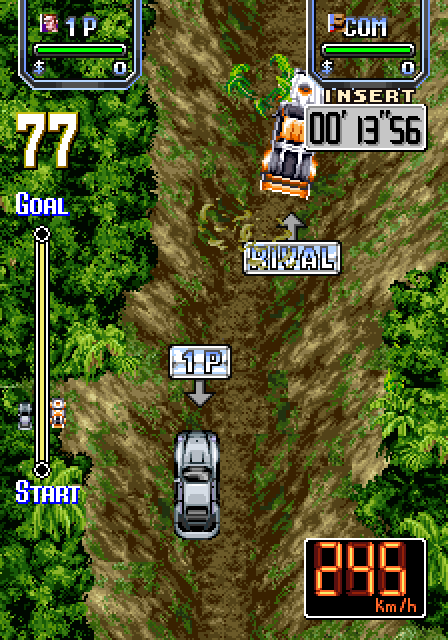
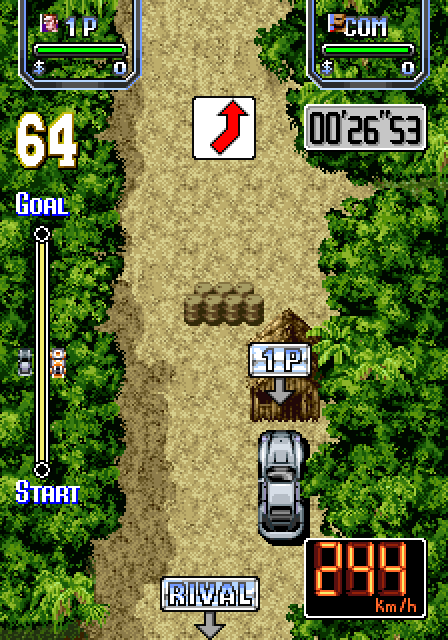
Okay, it's not just “street races,” because they don’t all take place on the streets. This one covers the jungles and dry riverbeds of Brazil, for instance. This should give my rival the advantage, because I’m trying to off-road in a precision-engineered sports car and he’s driving a much more sensible truck, but I was willing to discard the stuffy etiquette of the racing driver, so that levelled the playing field a little. One of the nice things about Lethal Crash Race is that your rivals are just as susceptible to the “crash” part of that title, so you can nudge them into nearby cars or other obstacles to slow them down. In this case, I managed to shunt my opponent to the side a few times so they missed the ramps that jump over the speed-reducing swamps, bogging them down just long enough to allow me to take the lead. The way collisions are handled in LCR seems a bit strange at first: they’ll slow you down, but nothing ever really stops you, so you’re constantly barrelling forwards even if you’re ploughing into roadside buildings.
As for the car-to-car collisions, personally I think they’re really well implemented. There’s not so much impact that each hit sends you careening around the course, which could have rapidly become frustrating, but you’ve got just enough grunt to nudge your rivals into hazards and give yourself a bit of breathing space.
The next stage is set in England, and I do always like to see how Japanese game developers have decided to depict my home country. In this case, a lot of it is duck ponds, complete with quacking sound effects. You know what? I’m happy with that. There are a lot worse things for your country to be associated with that the gentle, relaxing scene of a duck pond. Plus I’ve got two duck ponds with a five minute walk of my house, so clearly it’s a very accurate portrayal of England.
Okay, so later on it does get a bit more stereotypically British, with the wrought-iron lampposts and cobbled streets, plus a large collection of the Queen’s Guard. I suspect this entire race was simply a test of the Queen’s Guards famous resolve by lining them up on the finish line and seeing whether they flinch when a racing car drives straight at them.
Now that I’ve had a few races to get to grips with LCR, I’ve come to the conclusion that it’s really good fun. It’s definitely fast, which helps, and tearing through the tracks and smashing through obstacles is enjoyable in exactly the kind of way that an arcade racer should be. It doesn’t really feel all that much like a racing game, truth be told. Not many of the usual hallmarks of a racing game are present. You never have to brake, there’s not much of a “racing line” to adhere to – it’s really all about reactions, and taking the opportunity to mess up your opponent’s race by leading them into other road users.
Plus, it’s all presented in a graphical style that I really like, with that small-yet-detailed look that’s something of a Video System (and later Psikyo) hallmark. Everything’s crisp, there’s a good level of detail that provides fun backdrops without being too busy or confusing when you’re blasting through them at two hundred miles an hour, and you can tell someone had a lot of fun drawing all the cars.
Something I’m not so keen on is the game’s music. It’s not horrendous or anything, just a set of fairly bog-standard techno tunes that have all the impact of a moth’s fart. What makes it worse is that if there was ever a game that could have benefited from some ludicrously cheesy guitar rock, it’s this one. If I play it again, I’ll probably listen to the F-Zero X soundtrack at the same time.
I managed to lose the race against Alfredo’s doppelganger, but LCR is generous with its continue system and you can try the race you failed again. You can even select a different character: I went with the duo of Ellen and Cindy / Cincia, who you might recognise from their later appearances as playable pilots in the Sonic Wings series. The thing is, there doesn’t seem to be much point picking a different character, because all the cars are disappointingly similar. Some might have slightly higher straight-line speed or marginally smoother handling, but really they’re all much of a muchness. The only car that I did notice a difference with was the Mercedes-Benz, and that difference was that I crashed into a lot more things because the car’s bloody massive.
As Lethal Crash Race moves towards its latter stages, one thing I noticed is that a lot of the tracks feel very similar, as though they’re assembled from a limited pool of pre-made sections. Quick chicanes are very common, as are sections where the road narrows, but thankfully you’ve got a rally-style “upcoming corner” indicator to let you know what you’re about to crash into. There are also some corners where the entire track “rotates” - think of a top-down SNES racer using Mode 7 effects – but on the whole they can feel a bit samey. This isn’t necessarily a complaint, though, mostly because the races in LCR only take a couple of minutes at most, so you don’t have much time to get burned out on them.
Oh, and your sodding car can explode. It took me until the final third of the game to realise this. You’ve got a damage bar at the top of the screen and everything. Too many collisions and whoops, I guess the name Lethal Crash Race is accurate after all. The damage is cumulative, too, and it’s not automatically repaired between races. There are repair item that appear on the track sometimes, but after a few races your car is almost certainly going to take enough damage to blow up. I’m not sure how I feel about this as a gameplay mechanic: on the one hand, it adds a bit of tension and collecting repair kits gives you something else to focus on beside winning the race, but smashing through every single roadside object and pinballing around the sides of the track like a hyperactive child in a soft play area is what LCR is all about, and it doesn’t feel right that I’m being punished for driving like a lunatic.
Forget what I said about the F-Zero X soundtrack: now that I’m driving down the highway in a red Ferrari, trying to overtake a yellow car with a big RIVAL indicator over the top of it, it has become clear that I should actually be listening to the OutRun 2006: Coast 2 Coast soundtrack instead. I mean, that statement’s true in any situation, really. Speaking of, I haven’t mentioned it for a while so here’s a reminder that the song “Night Flight” from the OutRun 2006 soundtrack includes the lyric “this is paradise / and it’s very nice,” which is simultaneously the best and worst lyric ever written.
Also fun: the opportunity to race against Bebop from Teenage Mutant Ninja Turtles, before he became a mutated warthog creature.
The final race took me through the streets of a Japanese city and then some kind of temple, which served as a reminder that there’s a good reason people don’t generally hold motor races in temples. There’s just too much stuff to crash into. LCR has had a particularly smooth difficulty curve up to this point, with the races definitely becoming harder to win as you progress but without any obnoxious spikes in difficulty, so that by the time you reach the end it’s pretty goddamn difficult to hold onto a lead but it never feels unfair. Like, I had to try the race a few times but each time I felt as though I was getting a little better until I managed to win. An honest victory! At the end of an arcade game! Who would have thought it possible?
I switched back to Alfredo at some point, which means I get to see Alfredo’s ending. And what an ending it is, especially if you’re a big fan of chiselled abs, restrictive underwear and inappropriate amounts of exposed flesh.
So inappropriate, in fact, that Alfredo is hauled away on charges of indecent exposure. Seems reasonable to me, there’s no way he managed to do all that aggressive driving and subsequent victorious flexing without at least one of his nuts falling out of his posing pouch. Maybe it’s an Al Capone type situation: they couldn’t bust him for illegal street racing, so they had to arrest him for outraging public decency.
It’s always nice when I can unreservedly recommend a game I’ve written about, especially when it’s something that most people probably haven’t played, so I’m happy to report that Lethal Crash Race is definitely worth your time. It’s simple and straightforward in the best possible way, a real arcade-style experience packed with high-speed racing and almost constant stimulatory overload that’s a blast to play mostly because it refuses to play much like a racing game at all. The relatively samey tracks and cars mean it might not keep you hooked for hour after hour, but I’m sure LCR will become a game I return to whenever I’m in the mood for a quick fix of complete automotive insanity. Now I’ve just got to figure out whether Alfredo’s get-up of a cape and only a cape is enough to include him in my own personal category of “vampires that are Draculas.”
First things first, that title is 33% a lie. I crashed plenty of times during this game and no-one died. There’s definitely racing and crashing, though. In fact, that’s about all there is to the game, which I suppose is what you want from an arcade racing game. I can’t imagine a coin-op version of Gran Turismo would be that much fun, not when you can’t spend all that time fiddling with your wheel camber or spoiler angles. Speaking of Gran Turismo, I think my favourite part of those game was using the car wash. There was something very satisfying about that. Anyway, back to Lethal Crash Race – obviously you’re going to need some cars to race in, so what does this game have to offer in terms of vehicles?
How about the Dadge Vipre? It’s a sleek and sporty number, with impressive acceleration and a name like someone trying to say “Dodge Viper” with a wet flannel wedged in their mouth.
Or maybe you prefer the classic flair of an Italian supercar, like the Lanborjini Daiblo? It’s got vented disc brakes, who could say no to that?
So yeah, Lethal Crash Race features real cars with their names changed juuust enough to make a mockery of trademarks, and there are plenty of Hontas, Pheraris and Mursedes-Banzes to choose from. I do enjoy such flagrant disregard for brand names; it certainly makes the names quite fun to say out loud. Which I did, several times, alone in my house. Don't judge me.
Each car has a driver, naturally, so there’s a colourful cast of characters for you to choose from. My mind was made up the second I noticed one of the drivers was a large man with a monocle and a vampire cape. What are the rest of the characters like? Who cares, I’m playing as a large man with a monocle and a vampire cape. His name’s Alfredo von Gourmand, and he drives a Porsche 959. Sorry, I mean a “Borsche 969.” He also flicks out his unnaturally long tongue and eats a fly when you select him, so he’s a Dracula and a Renfield.
Then it’s off to “Korea” for the first race. The game doesn’t specify which Korea, but I’m going to assume South. I can’t imagine the Dear Leader would have much truck with illegal street racing, which is what Lethal Crash Race is all about. It’s you against one CPU opponent in a race to the finish line, with no in-built special abilities or weapons to contend with – although you’re not totally defenceless.
The race is underway, and Alfredo and his Borsche immediately takes a healthy lead over his rival because, well, it’s the first stage in the game and thus it’s not really all that difficult. As you can see, Lethal Crash Race is a vertically-oriented racer, which makes sense. Video System (and the later developer Psikyo which was founded by former Video System staff) are most famous for their vertically-scrolling shoot-em-ups, notably the Sonic Wings / Aero Fighters games, so it’s not surprising that they’d put their knowledge of that genre to use when creating Lethal Crash Race.
My rival did manage to catch up to me near the end of the race, thanks to my insistence on driving through all the roadside patio furniture so I could watch it be scattered around the screen. I say “roadside,” someone’s clearly set up a cafe in the middle of the road and that’s not going to end well.
It doesn’t take long to get into Lethal Crash Race’s groove, and the actual gameplay is very easy get a handle on once you realise that two out of the three control buttons are superfluous. As well as using the joystick to steer, you’ve got one button to accelerate (very important) and two other buttons: brake and honk your horn. I cannot think of a single instance in this game where using the brake would be a good idea. Lethal Crash Race is not a game that requires what you would traditionally describe as good driving skills. As for honking your horn, I don’t think it has any practical applications, but it is fun to beep at your rival when you overtake them so the horn is still more useful than the brakes.
The first race ends with Alfredo’s victory, and the startling revelation that beneath his cape he has the body of a Greek god and the underwear of a male stripper. He’s half vampire, half hen night entertainment. He’s a Chippendracula!
And so goes the life of a lethal crash racer. You win a race, travel to another country and meet its resident weirdo – in this case Brazil, and a chap who looks like a cross between Jet from Cowboy Bebop and Popeye. Then you race them and move on. There’s no grand tournament at work here, no grand prix season or glittering prize, you just turn up in different countries and challenge random people to a street race.
Okay, it's not just “street races,” because they don’t all take place on the streets. This one covers the jungles and dry riverbeds of Brazil, for instance. This should give my rival the advantage, because I’m trying to off-road in a precision-engineered sports car and he’s driving a much more sensible truck, but I was willing to discard the stuffy etiquette of the racing driver, so that levelled the playing field a little. One of the nice things about Lethal Crash Race is that your rivals are just as susceptible to the “crash” part of that title, so you can nudge them into nearby cars or other obstacles to slow them down. In this case, I managed to shunt my opponent to the side a few times so they missed the ramps that jump over the speed-reducing swamps, bogging them down just long enough to allow me to take the lead. The way collisions are handled in LCR seems a bit strange at first: they’ll slow you down, but nothing ever really stops you, so you’re constantly barrelling forwards even if you’re ploughing into roadside buildings.
As for the car-to-car collisions, personally I think they’re really well implemented. There’s not so much impact that each hit sends you careening around the course, which could have rapidly become frustrating, but you’ve got just enough grunt to nudge your rivals into hazards and give yourself a bit of breathing space.
The next stage is set in England, and I do always like to see how Japanese game developers have decided to depict my home country. In this case, a lot of it is duck ponds, complete with quacking sound effects. You know what? I’m happy with that. There are a lot worse things for your country to be associated with that the gentle, relaxing scene of a duck pond. Plus I’ve got two duck ponds with a five minute walk of my house, so clearly it’s a very accurate portrayal of England.
Okay, so later on it does get a bit more stereotypically British, with the wrought-iron lampposts and cobbled streets, plus a large collection of the Queen’s Guard. I suspect this entire race was simply a test of the Queen’s Guards famous resolve by lining them up on the finish line and seeing whether they flinch when a racing car drives straight at them.
Now that I’ve had a few races to get to grips with LCR, I’ve come to the conclusion that it’s really good fun. It’s definitely fast, which helps, and tearing through the tracks and smashing through obstacles is enjoyable in exactly the kind of way that an arcade racer should be. It doesn’t really feel all that much like a racing game, truth be told. Not many of the usual hallmarks of a racing game are present. You never have to brake, there’s not much of a “racing line” to adhere to – it’s really all about reactions, and taking the opportunity to mess up your opponent’s race by leading them into other road users.
Plus, it’s all presented in a graphical style that I really like, with that small-yet-detailed look that’s something of a Video System (and later Psikyo) hallmark. Everything’s crisp, there’s a good level of detail that provides fun backdrops without being too busy or confusing when you’re blasting through them at two hundred miles an hour, and you can tell someone had a lot of fun drawing all the cars.
Something I’m not so keen on is the game’s music. It’s not horrendous or anything, just a set of fairly bog-standard techno tunes that have all the impact of a moth’s fart. What makes it worse is that if there was ever a game that could have benefited from some ludicrously cheesy guitar rock, it’s this one. If I play it again, I’ll probably listen to the F-Zero X soundtrack at the same time.
I managed to lose the race against Alfredo’s doppelganger, but LCR is generous with its continue system and you can try the race you failed again. You can even select a different character: I went with the duo of Ellen and Cindy / Cincia, who you might recognise from their later appearances as playable pilots in the Sonic Wings series. The thing is, there doesn’t seem to be much point picking a different character, because all the cars are disappointingly similar. Some might have slightly higher straight-line speed or marginally smoother handling, but really they’re all much of a muchness. The only car that I did notice a difference with was the Mercedes-Benz, and that difference was that I crashed into a lot more things because the car’s bloody massive.
As Lethal Crash Race moves towards its latter stages, one thing I noticed is that a lot of the tracks feel very similar, as though they’re assembled from a limited pool of pre-made sections. Quick chicanes are very common, as are sections where the road narrows, but thankfully you’ve got a rally-style “upcoming corner” indicator to let you know what you’re about to crash into. There are also some corners where the entire track “rotates” - think of a top-down SNES racer using Mode 7 effects – but on the whole they can feel a bit samey. This isn’t necessarily a complaint, though, mostly because the races in LCR only take a couple of minutes at most, so you don’t have much time to get burned out on them.
Oh, and your sodding car can explode. It took me until the final third of the game to realise this. You’ve got a damage bar at the top of the screen and everything. Too many collisions and whoops, I guess the name Lethal Crash Race is accurate after all. The damage is cumulative, too, and it’s not automatically repaired between races. There are repair item that appear on the track sometimes, but after a few races your car is almost certainly going to take enough damage to blow up. I’m not sure how I feel about this as a gameplay mechanic: on the one hand, it adds a bit of tension and collecting repair kits gives you something else to focus on beside winning the race, but smashing through every single roadside object and pinballing around the sides of the track like a hyperactive child in a soft play area is what LCR is all about, and it doesn’t feel right that I’m being punished for driving like a lunatic.
Forget what I said about the F-Zero X soundtrack: now that I’m driving down the highway in a red Ferrari, trying to overtake a yellow car with a big RIVAL indicator over the top of it, it has become clear that I should actually be listening to the OutRun 2006: Coast 2 Coast soundtrack instead. I mean, that statement’s true in any situation, really. Speaking of, I haven’t mentioned it for a while so here’s a reminder that the song “Night Flight” from the OutRun 2006 soundtrack includes the lyric “this is paradise / and it’s very nice,” which is simultaneously the best and worst lyric ever written.
Also fun: the opportunity to race against Bebop from Teenage Mutant Ninja Turtles, before he became a mutated warthog creature.
The final race took me through the streets of a Japanese city and then some kind of temple, which served as a reminder that there’s a good reason people don’t generally hold motor races in temples. There’s just too much stuff to crash into. LCR has had a particularly smooth difficulty curve up to this point, with the races definitely becoming harder to win as you progress but without any obnoxious spikes in difficulty, so that by the time you reach the end it’s pretty goddamn difficult to hold onto a lead but it never feels unfair. Like, I had to try the race a few times but each time I felt as though I was getting a little better until I managed to win. An honest victory! At the end of an arcade game! Who would have thought it possible?
I switched back to Alfredo at some point, which means I get to see Alfredo’s ending. And what an ending it is, especially if you’re a big fan of chiselled abs, restrictive underwear and inappropriate amounts of exposed flesh.
So inappropriate, in fact, that Alfredo is hauled away on charges of indecent exposure. Seems reasonable to me, there’s no way he managed to do all that aggressive driving and subsequent victorious flexing without at least one of his nuts falling out of his posing pouch. Maybe it’s an Al Capone type situation: they couldn’t bust him for illegal street racing, so they had to arrest him for outraging public decency.
It’s always nice when I can unreservedly recommend a game I’ve written about, especially when it’s something that most people probably haven’t played, so I’m happy to report that Lethal Crash Race is definitely worth your time. It’s simple and straightforward in the best possible way, a real arcade-style experience packed with high-speed racing and almost constant stimulatory overload that’s a blast to play mostly because it refuses to play much like a racing game at all. The relatively samey tracks and cars mean it might not keep you hooked for hour after hour, but I’m sure LCR will become a game I return to whenever I’m in the mood for a quick fix of complete automotive insanity. Now I’ve just got to figure out whether Alfredo’s get-up of a cape and only a cape is enough to include him in my own personal category of “vampires that are Draculas.”
Labels:
Arcade,
bakuretsu crash race,
lethal crash race,
racing,
video system
Subscribe to:
Posts (Atom)