Showing posts with label prototype. Show all posts

21/06/2018

LED STORM: RALLY 2011 (ARCADE)

It feels like it’s been a while since I covered a really arcade-y arcade game. I’m still not sure exactly what I mean by arcade-y, but I know it when I see it and I’ve seen it in Capcom’s 1988 top-down racer LED Storm: Rally 2011. So, let’s take a look at it, then, and enjoy the predictions that Capcom made about road conditions in the distant future / recent past of 2011.


I am at a loss to explain what “LED” means in this context. I thought maybe it was a corruption of “lead,” intended to conjure up images of heavy metal and, erm, leaded petrol, but that doesn’t feel right. Some of the artwork and advertisements for the game’s home computer versions claim it stands for “Lazer Enhanced Destruction,” but that explanation wilts in light of the game’s complete lack of lazers (or even lasers.) I suspect it was chosen simply to sound cool, much like how “vanishing” apparently became associated with fast cars in Japanese media.


As for the plot, two chaps challenge one another to a cross country race. The winner presumably receives the large pile of cash, although no prize is ever explicitly mentioned so maybe they’re a couple who just won the lottery and decided to embark on a futuristic cyber-race as a means of spending their new-found wealth. Hopefully this attempt to keep the ennui of the ultra-rich at bay will also keep their relationship alive and healthy.


Here’s the world map, showing the nine stages we’ll be racing through as we head from Capital to SkyCity.009. Oh, and your car talks to you because it’s the future. Looks like Capcom predicted SatNav with this game, although rather than a soothing female voice asking you to turn left in three hundred yards, you get a squawking robot constantly pestering you about energy. The voice identifies itself as “Mac.” Possibly. The voice sample’s a little muddy, so it could be Zack, but given that it says “MC” at the bottom of the screen I’m sticking with Mac.


And then you’re racing, blasting across the elevated highways of Capital City, bumping the other road users out of the way and – I hope – collecting every petrol can and energy pick-up along the way. You’re going to need them. You can see the rival blue car towards the bottom of the screen, although (perhaps surprisingly) you don’t actually need to beat your rival to the finish line. They’re mostly there to get in your way, often re-appearing towards the end of the stage to nudge you off the course. Probably not your romantic partner, then, what with you racing a couple of miles above the distant city below and all.


Being a highly advanced robo-car, you’ve got a couple of tricks up your wheel arches. The main one is jumping, which you can perform either with a button press or by hitting one of the ramps that litter the track for a much higher leap. The game’s attract mode calls them “jumping slopes,” but that’s an unnecessarily grandiose title to be applied to something that’s barely more technologically advanced that the bike ramps you’d build as a kid from the planks you nicked from a building site.
Jumping is an important skill to master in LED Storm. You can squash other cars by jumping on them, and there are frequent gaps in the tracks or patches of speed-reducing mud or gravel that must be hopped over. However, the most vital use of the jump is in collecting extra fuel, because most of the time energy pick-ups gently drift across the course while suspended from balloons. With all the complaints that increased regulations have made Formula 1 less interesting to watch, hopefulyl the pit lanes will be replaced by helium balloon in the near future. That ought to liven things up.


The jumping is so important that when a small squad of skinny golden mechanoids – distant relatives of Crow T. Robot, perhaps – jumps onto your car and hangs on for dear life, it is in your best interests to shake them off as quickly as possible by veering from side-to-side because you can’t jump while they’re on there. It’s a really nice touch, and right from the off LED Storm has a lot of charm in its futuristic cityscapes, sci-fi vehicles and cavorting, capering, spoiler-grabbing robots.


Oh, and you can transform your car into a motorcycle at the press of a button, complete with a really nice transformation animation situation. My personal high watermark for vehicular transformations is Inspector Gadget’s car, and LED Storm’s car-to-bike switch is approaching that level so I spent a lot of time switching back and forth when I might have been better served by trying not to crash.
However, there doesn’t seem to be much point to the transformation. Having played all the way through this game a couple of times with a roughly fifty/fifty split between car and bike, I could see almost zero differences between them. The car mode might be slightly more robust when it comes to collisions, but it’s a very subtle difference if a difference even exists at all. I had thought that the narrower sprite of the bike might make it better for squeezing through small gaps, but the hitbox of the car and bike seems to be the same size. The transformation aspect is kinda redundant, then, but that doesn’t stop it looking cool.


As you’d expect, the first stage is relatively straightforward, and after slaloming through a convoy of trucks, our plucky little car-bike rockets across the finish line of the first stage without running out of fuel. I managed to collect plenty of energy capsules along the way, which meant I never got low on fuel but it did have the drawback of Mac shouting “energy!” every time I fuelled up, his voice sample carrying the unmistakeable cadence of someone who’s starting to get frustrated about having to explain energy to someone who just doesn’t get it.


Mac likes to complain. He’s a whiner, a whinger, and his wheedling voice piping up with “you’re running out of energy!” will become an annoyingly common occurrence as the game continues.


The second stage is the Netwood Forest, presumably named for these large net-like trees that conveniently allow any passing cars on a cross-country race to be seen through their sparse foliage. This time, the creatures hanging from the car are hopping, rabbit-like creatures, so I felt a little bad about shaking them off my car at 250 kilometres an hour. In my defence, without being able to jump I would have run out of energy and thus had to hear more of Mac’s complaining, so I’m sure the rabbits will understand and accept my actions.


This stage is far more open than the first, lacking clear roads a lot of the time, and so you’re free to move around horizontally much more than before while enjoying the robotic wildlife and trying not to plough face-first into a tree. It’s fast-paced, constantly driving the player forward into a stream of colourful opponents and hazards that zip by with impressive smoothness. That said, the main thing that caught my attention in this stage was the music. Here, give stage two’s theme a listen and see if it reminds you of anything.


There’s a riff in there that sure sounds a lot like the Dr. Wily Castle theme from Mega Man 2, huh? As it turns out, LED Storm’s composer is none other than Takashi “Ogeretsukun” Tateishi, who also created the music for Mega Man 2 – and given the 1988 date on both games it seems likely he was working on both soundtracks at around the same time and a bit of cross-pollination set in. On the whole the soundtrack is quite good, with plenty of high-energy tracks, although some of them do feel like they belong in a different game – one that’s a traditional platformer or something rather than a futuristic racing game.


Heading back to actual (if dangerously under-maintained) roads for the Coral Sea stage, where the tranquil blue waters provide a stark contrast to the huge robot woodlice that sit right in the middle of the bloody road, requiring a lot of nimble manoeuvring to get past. Sadly, your vehicle doesn’t do nimble manoeuvring. Not well, at least. Often times, I found the vehicle’s hitbox would clip things behind you, obstacles I felt I’d completely avoided, which made for the occasional frustrating moment in what is otherwise a game that plays perfectly adequately.


I think there’s an explanation for some of the rough edges to be found in LED Storm: Rally 2011. You see, I’ve actually covered this game before, sort of. Many years ago I wrote about another top-down arcade racer from Capcom, a game that was called Mad Gear (yes, like the Final Fight villains) or, in some markets, LED Storm. As it turns out, LED Storm: Rally 2011 is actually an earlier version of that game. Capcom weren’t happy with the way the Rally 2011 version was turning out, so according to former Capcom designer (and co-creator of Street Fighter II and Final Fight) Akira Nishitani, he was tasked with changing things around to ultimately produce the Mad Gear version of the game.


The changes that were made are a little strange. Most of the gameplay is identical, as is the soundtrack, and while the stages were reworked and shuffled around a bit they’re mostly the same. One of the biggest changes is that the transforming car of the Rally 2011 version was replaced by a selection of three vehicles – a Porsche, a Formula 1 car and a lorry – that the player could pick from. Another is that the futuristic, sci-fi designs of the cars, helicopters and other vehicles were replaced with more realistic vehicles and frankly this seems like a major downgrade. The original version of LED Storm has some really appealing vehicle designs – long-legged bug-shaped cars that look like moon rovers from a sixties comic book, bulbous TNT-carrying trucks, galloping cyber-ostriches – and the idea that replacing them with regular cars would somehow be more appealing to arcade players is baffling to me.


Fortunately most of the interesting scenery was kept intact, with things like the lava-dwelling dinosaurs and giant stone heads that must have crept in from a Konami game helping to keep things interesting. I mean, whatever vehicle you’re driving, you can’t argue with a section spent escaping from the collapsing skeleton of a colossal dinosaur. That could even make a unicycle look cool.


Halfway through the game, and Mac pops up with some encouraging words. I think they’re encouraging, anyway. Reading them again I’d accept that they could also sound like Mac is simply resigned to his fate.


Here in Million Valley, where the vast stone walls loom around the player and someone forgot to close the back of this truck and oh no now there are highly advanced future-containers all over the road, I came to the conclusion that LED Storm has a problem with difficulty. It’s not just that it’s hard, although it is a difficult game, but it's that the difficulty level fluctuates wildly from stage to stage. Maybe less time spent redrawing all the vehicle sprites and more effort putting the stages into a more sensible order would have helped the game.


This is definitely one of those arcade games I’d recommend playing on the easiest difficulty setting, though. This is entirely down to the rigmarole of having to collect fuel. The fuel acts as a timer, because it depletes even when you’re not moving, and it drains so quickly that missing a few energy capsules in a row means that there’s little you can do to stop yourself from grinding to a halt. I know the fuel limitations are there to increase the amount of money people were pumping into the arcade cabinet, but that was back in 1988. That was then and this is now, and at this moment in time I don’t feel the need to prove myself to a thirty-year-old racing game. Having to concentrate on collecting fuel detracts from the enjoyment of the high-speed action and the vibrant, character-packed scenery, so anything that helps to keep the fuel gauge at bay comes with my highest recommendation.


So LED Storm: Rally 2011 is a prototype of sorts, but the question is was it ever released? Perhaps. I suspect that it was put out for location testing at the very least because (a) that’d explain why Capcom though it required a rework and b) there are home computer ports of LED Storm and they’re all based on this version, futuristic cars and all. The home ports are quite good, by most accounts, although even in the Amiga version the graphics suffered a significant downgrade and the colour and vibrancy of the action is probably LED Storm’s strongest suit.


Going back to the start of the article, and I’d have to say that yes, LED Storm is a very arcade-y game. You might well disagree, but for me the top-down racer has always been a genre I associate with the arcades in particular for reasons I can’t adequately explain. Maybe I played a lot of them on my rare childhood visits to the arcades, although my arcade memories are mostly of Capcom fighting games and Side Pocket.
But LED Storm feels arcade-y in other ways, too, even if it lacks the sense of overblown, screaming bigness that makes games like Konami’s Teenage Mutant Ninja Turtles or Operation Wolf feel like quintessential arcade games. LED Storm does have those bold colours, graphics that handily surpass the home consoles of the time, it’s got voice samples that impress even as Mac’s constant greedy clamouring for fuel grates on the nerves like a screaming baby on the bus. Yep, feels like an arcade game to me.


None of that matters if the game isn’t any fun to play, but I’m happy to report that LED Storm is an enjoyable little title. In fact, I think I enjoyed it more this time around than I did when I played Mad Gear. The extra interested generated by all the cars looking like vehicles from a non-existent eighties toyline about hot-rod gangs from Neptune helps, but I think it’s more that I happened to be in a state of mind where a simple, uncomplicated arcade racer was just what I fancied. The relentless pace of the gameplay keeps you invested and makes a short run-time feel packed with incident rather than disappointingly brief, and the fact you don’t lose lives (just fuel) for falling of the track or crashing into a huge truck helps prevent the obstacle-strewn courses from becoming too frustrating.


As the red car and the blue car scream over the finishing line, I’m left with the knowledge that I’m going to have this old Milky Way advert stuck in my head for the next few weeks. Oh, and also LED Storm: Rally 2011 is pretty good! It’s got flaws, especially with the fuel system and the refills that often float off the side of the course where you can see them but can’t reach them, and the sometimes hard-to-predict hitboxes. On the whole, though, a fun time was had by all.


The game ends in the same way as the Mad Gear version: with a heartfelt message from Mac about his treasured memories of falling off elevated highways and running out of fuel in the middle of the desert. Capcom changed a lot of the graphics and even the font for the Mad Gear version, but not the spelling – Mac is still “vary giad” to have been with the player. I wish I could say the feeling was mutual, Mac.

15/10/2016

ASYLUM (ARCADE)

The Halloween season is an especially appropriate time to be poking into dark and forgotten corners, and with that in mind here’s a game that’s about obscure as they come: Leland Corporation’s 1991 arcade game Asylum! If you haven't heard of it, that’s probably because it was never actually released. Will that turn out to be a tragic loss to the arcades of the world, or are we lucky that Asylum never saw the light of day? Let’s take a look and find out!

Even if I hadn’t just told you that Asylum was developed in 1991, one look at this title screen is all it would take to let you know this game is thoroughly, one hundred percent nineties. The three playable characters even look like the stars of a failed Saturday morning cartoon from the era, a cartoon that was possibly a gritty reboot of the Troll Dolls. From left to right our heroes are Rip, Rak and Rol, and they are colourful characters both figuratively and literally. I’m going to assume Rak is the leader, because he’s standing in the middle and he’s dyed his hipster beard in a shade called “Riddler’s Delight.” Rol appears to have stuffed a bunch of cardboard boxes up his shirt to form the illusion of muscles, and Leland were kind enough to draw erect nipples on Rip, just to make sure you don’t forget she’s the sexy female character. I’ll be playing as Rip during this playthrough, because she’s the designated player one character and because she’s wearing the smallest, most useless belt.


Asylum has a weird set-up in the sense that, as far as I can tell, the heroes didn’t really have any intention of being in the game. There’s no mention of a heroic quest, no dreams of glory or vengeance. The three amigos are simply standing around near the titular asylum when a floating goat-skulled spirit appears and zaps them with magic that teleports them into the asylum. Why? For what reason are they subjected to the horrors that lurk with, aside from the obvious answer of “crimes against fashion”? I suspect we may never know.
By the way, the hovering spectre is the game’s antagonist, the macabre Mr. G. I’m choosing to believe he’s G from House of the Dead after one too many zombie outbreaks.


The game begins with your character (or multiple characters, because Asylum features simultaneous co-op) being chucked in a dumpster. Without wanting to spoil too much of the Asylum experience just yet, I would say that by the end of the game I’d decided that the dumpster was the best place for them.


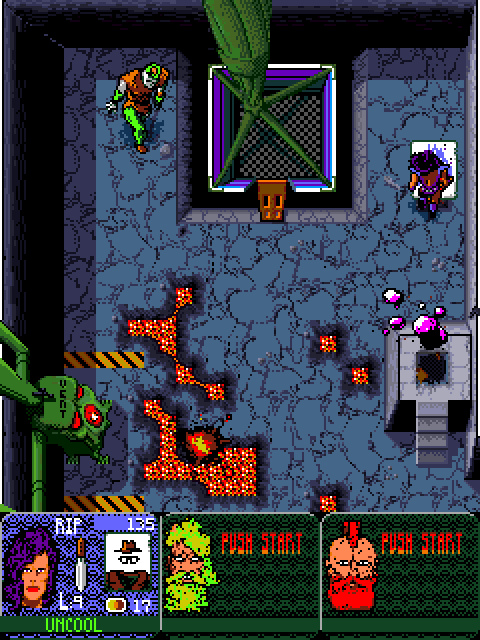
Rip gets back on her feet and the action begins! The closest comparison I can think of here is Gauntlet, because Asylum is a top-down run-n-gun monster-slaying romp. Your character can move in eight directions and attack in those eight direction, by throwing knives in Rip’s case, and you’ve got to move through the levels, killing monsters until you reach the exit. Unlike Gauntlet, you can jump in Asylum, so I’m sure there’ll be some super-enjoyable platforming to do later. For now, though, it's all flat floors and disgusting ghouls. These ghouls attack by tearing their own arms off and throwing them. How do they keep attacking after they’ve thrown the first arm? I think we can rely on the wisdom of The Simpsons here and say that a wizard did it. In this case, it’s probably true. Mr. G is clearly some kind of wizard.


Unable to prevent himself from meddling, Mr. G pops out of the wall to tell Rip that this toilet is “way uncool.” I think I would probably have guessed that for myself, Mr. G, what with the puddle of piss and the complete lack of privacy. Except this toilet isn’t way uncool, it’s actually very useful because it restores your health when you use it. This is explained during the game’s attract mode which describes them as “magic toilets,” further evidence that a wizard really did do everything in this game and also giving me the name for my next Dark Souls character. Thankfully there’s no animation for Rip sitting down and relieving herself, which is surprising considering the lack of restraint the rest of the game shows when it comes to grossness.


A few screens later, just past the haunted boiler that spits flames at all those who approach it, waits the elevator that will take Rip to the next level. Conspicuous in its absence is any kind of end-of-stage boss, which did surprise me: Asylum seems the kind of game that would have revelled in the chance to come up with some extremely putrescent boss monsters, but there’s nothing stopping Rip from walking straight into the elevator. Well, there are all the regular enemies, I suppose, but you can mostly run past them in these early stages.


I don’t think this is going to be the usual “fight loads of enemies that drop into the elevator” situation. It’s a little intimate, if any enemies were crammed in then Asylum would be looking at an X rating.
You have to ride the elevator at the end of each stage, and it always works the same way: the lift goes up, but after a while the cable snaps and the elevator begins to plummet. While it’s falling, you can press left or right to nudge the elevator to the left or right of the shaft, the idea being that you can use this ability to avoid the bundles of dynamite that are attached at intervals to the side of the shaft.


However, I never managed to avoid the dynamite. Not once. I put this down to the shocking collision detection, which is so vague that it implies the dynamite has a motion sensor around it the fills up the entire bloody lift shaft. The thing is, it doesn’t seem to make any difference whether you avoid the explosives or not. You always move on to the next stage regardless. You might lose a life – you’d think you would lose a life, given that your character falls three hundred feet and lands on a pile of dynamite – but it’s hard to keep track of how many lives you’ve got, for reasons that will become clear later.


Now we’re in the torture chambers now, and it’s this kind of environment that made me pick Asylum for a place in this year’s Halloween Spooktacular, and a victim of the rack whose torture has caused his legs to pop off like well-cooked chicken drumsticks is surely worth a point or two on the Halloween-O-Meter.
Rip’s managed to power up her attack, so now she can throw a spread of three knives. If there’s one thing Asylum isn’t short of it’s power-ups, which litter the stages like bad review scores on a modern Sonic game. Upgrades to weapon power, changing your attacks into fireballs, speed-ups, invincibility, rotating shields that protect you from projectiles, screen-clearing smart bombs, one called “Death Touch” that lets you destroy enemies by walking into them and point bonuses: Asylum has all these and more, the effect of which is that you’re fighting in your basic, un-upgraded state for a surprisingly small portion of the game.


One power-up that you only get to use once – and thank god for that – is this torch that does absolutely nothing to illuminate this dark area. Asylum’s got plenty of ideas, but it frequently struggles to nail those idea down in a form that isn’t infuriating.


Somewhere in the darkness, there’s a dragon. You can see the shape of it, mostly, and you can definitely see its fiery and instantly-fatal breath. What I couldn’t see was a way to get past it, and like any dragon worth its salt it responds to having knives lazily thrown at its face with disdain and, you know, the deadly fire breath. It took me longer than I’d like to admit to figure out that you’re supposed to jump onto the dragon and clamber across its back to get past it. Hah, take that, yon foul wyrm! It’s always nice to outwit a dragon, I thought to myself as I slide down the dragon’s back and off the tip of its tail. Then it slapped me with its tail on the way out, killing me instantly. There’s a lesson about hubris in there somewhere.


Oh look, there is some platforming. What joy. Okay, so it’s not too terrible in this case, because you’ve got a decent amount of control over Rip while she’s in mid-air and you’re jumping across a flat plane. Later on, things become much less enjoyable because you’re jumping between multiple height levels and the game’s perspective makes it difficult to tell exactly where you’re jumping.


In my haste to clear a path to the end-of-stage elevator, I managed to smash through a secret wall! I’m sure there’ll be lots of helpful goodies in the wall cavity.


Or some kind of giant lava slug and rain of deadly Rubik’s cubes, they might be in there too. Asylum has plenty of hidden areas and power-ups stashed away in hard-to-reach areas, but most of the time these areas are so lethal that they’re not worth the effort of traversing. I mean, sure, I’m glad I came into this room because two-headed lava slugs are always something I want to see, but from a gameplay perspective it’s all risk for too little reward.


The next stage rolls around, and as Rip considers jumping into her own grave and pulling the turf over her head for a very appealing and permanent nap, I’ve had a bit of time to contemplate Asylum’s gameplay and unfortunately it’s somewhat on the dismal side. It’s just not very well put together, with countless minor irritations and a few major ones to boot. Movement is sluggish, especially when you’re turning, and it sometimes take what feels like an ages just to spin around and face the enemies. The strange thing is, your movement speed isn’t consistent, so sometimes you’re wading through treacle but other times you’re merely tiptoeing across a sticky nightclub floor. Everything feels kind of doughy and loose, and on top of that the screen scrolling often forces you to be awkwardly close to the edge of the screen before it’ll pan across.


Asylum also wants you dead. It wants you dead all the time, without any warning, repeatedly. Almost every screen on the game has some kind of instant death trap, most of them completely without any kind of warning. Take this mud, for instance – it looks exactly the same as all the other mud in this stage but if you step on the wrong part of it you’re sucked into some quicksand and it’s goodbye to that particular life. That’s why I had so much trouble keeping track of how many lives I had and how many I’d used, especially when you sometimes respawn in a location that means you’re going to instantly die again – right in front of that fire-breathing dragon is a good example. Even for an arcade game, Asylum leans far too heavily on sudden, unavoidable death to create challenge. You could play the game repeatedly until you’ve learned where all the murder zones are, but Asylum isn’t fun enough for that to be likely so you end up with a game that actively discourages the player from exploring.


I got to the end of the stage and this happened. Some honest-to-goodness side-scrolling platforming, in a game that wasn’t doing a convincing job with the top-down platforming it tried earlier. It ends up being about as fun as it sounds, but I did manage to hop along the moving clouds until I reached the pinnacle of the tower.


Then I fell straight through the final cloud and this winged skull swooped down and grabbed me. I have no idea whether falling through the cloud was a scripted event or wonky programming, but the thought that Rip’s guardian angel takes the form of a screaming bonebox with bat wings sticking out of its temples is a heartwarming thought indeed.


The first chunk of the next stage takes place in these dull, featureless corridors, and marks the low point of Asylum. It brings home just how uninteresting the combat is on its own: if you’re fighting one enemy it’s ridiculously easy because your attacks are fast enough to pin the monster in place, but against two or more enemies it’s a pain in the arse trying to keep them under control thanks to the uncooperative movement controls. Thankfully the preponderance of power-ups – you can see a smart bomb in the screenshot above – and the fact you’re fighting things like flying eyeballs, severed hands and normal people who transform into werewolves if you leave them alone too long goes some way to papering over the cracks in the gameplay.


Previous area aside, something Asylum definitely has going for it is the sheer amount of detail included. The developers were clearly having a blast when they put this world together, and there are countless little flourishes in the graphics and level design to keep you engaged. Here, for instance, is a small waiting room where some people have obviously been waiting a very long time. There’s a scrolling message on the reception desk that tell people without appointments to “park it over there.” In the next stage there’s a restaurant area, complete with walk-in freezer stocked with body bags. When Mr. G pops out of the wall to harass you, which he does with some frequency, there’s a little note on his fold-out section of wall that says “Stand Clear..." except the last letters have been scrawled over so it says “Stand Close.” It’s little flourishes like that which kept me interested in Asylum even when the gameplay was taking the high-speed express to Frustrationberg.


The closest Asylum gets to a boss fight is this little arena, where you’re thrust into combat against clones of the three playable characters. Your mission is to kill these clones, and just to make sure you don’t forget what you’re doing and sit down for a frank discussion of the geopolitical ramifications of global warming or something, someone has handily written “KILL THE CLONES” on the floor in blood. I assume it’s blood, at least. It could be ketchup, but given the grisly themes in the rest of the game I think blood is a safe bet.
As for the actual battle, there’s not much to it because the clones are just as crap at fighting as you are. The real struggle comes afterwards, when you have to jump out of the pit you’re in. You can only jump out on the left-hand side and not along the top edge, despite the ledges clearly being at the same height.


The rest of the stage has an office building feel to it, complete with a boss who throws darts at you as you pass and a coffee machine that has overflowed and created a relaxing water feature in the middle of the office. Not a water feature. A coffee feature, I mean. You move faster for a while once you’ve waded through the coffee, promoting the theory that Rip is actually some kind of plant who absorbs liquids and nutrients through her leg-roots.


I walked too close to this toilet and a fat bald man appeared – the ghost of a fat bald man, even, one who shuffled off this mortal coil in the same manner as Elvis. The apparition then proceeded to whip Rip on the backside with a towel, which strikes me as a shocking misuse of spectral powers. You could be off creating murderous videotapes or earning an honest crust as part of a carnival ghost train, but instead you’re wallowing in these petty juvenile pranks. What a waste of ectoplasm! That stuff doesn’t grow on trees, you know. Apart from ghost trees, obviously.


The next (and final) level begins in that dankest, most miserable of dungeons: the bowling alley. It’s good to see that Mr. G has made space for a bit of R&R in his towering edifice of pain and suffering, although as someone with noodly arms and an aversion to public places the bowling alley is indistinguishable from the rest of the asylum’s horrors.
If any of you do play Asylum and somehow manage to get from one end of the bowling alley to the other without taking damage, please let me know how you managed it because as far as I can tell this section is here for no other reason than to whittle away at your health without there being a bloody thing you can do about it.


Mr. G eats his dinner at a massive table shaped like the letter G. That was a custom order, one assumes. I don’t think Ikea sell a “Huge Letters” range of tables, probably because they know that I and many others would buy them in bulk to spell out messages for the ever-watching extraterrestrial spacecraft, urging them to bring a swift end to the misery of human existence.


After a while, I unceremoniously blundered into Mr. G’s command room / demonic summoning ritual. I must have arrived earlier than Mr. G was expecting, because he hasn’t even had time to finish assembling the robot Frankenstein in the corner. Maybe that thing could have put up more of a fight than Mr. G, who is even less effective as a boss than the three clones were. Just like every other single enemy in the game, once you get Mr. G in your metaphorical crosshairs, there’s nothing he can do as knife after knife pins him against the wall and slowly chips away at his health bar. An encounter embarrassing in its simplicity, you might think, and mostly you’d be dead right… except Mr. G keeps coming back to life when you kill him. This might have been a problem had I not noticed that the doors on the right of the room were open, so I simply ignored Mr. G and walked out of his secret lair.


I then proceeded to steal his extremely green rocket ship, which was nice. By this point I was more than ready to blast out of Asylum at supersonic speeds.


The asylum explodes, as things tend to do when you fly a rocket ship through them. Did our three heroes make it out alive? Who knows, or indeed cares.


The game ends on this unusual note: the chance to win an Asylum t-shirt! The catch is that you have to complete Asylum five times (in a row, presumably) to reveal Mr. G’s true name. I guess once you’d got the whole name you’d ring up Leland and tell them the answer to receive your free shirt. However, after one play-through I’m informed that the first two letters are GN and there are six letters in total, so Mr. G’s real name is almost certainly “Mr. Gnarly.” I’m not just pulling this out of my backside, am I? It has to be Mr. Gnarly, just look at how nineties the rest of the game is.
With Asylum over and no free t-shirt for my troubles, I’d say that it not being released is hardly a major blow for the world of videogames. It’s sluggish, stodgy and frustrating to play, a game that doesn’t seem to have much interest in whether the player’s having fun or not. The thing is, I reckon that with some changes – some small, some much more extensive – Asylum could be a pretty decent game. If it controlled as smoothly and played with as much gusto as, say, Nitro Ball, it’d probably be quite good fun. Certainly, there are plenty of amusing moments and fun details in Asylum, and an overall sense of glee in the disgusting and macabre, that it might have been worth trying to salvage. Sadly, that was not to be, and we’re left with the Asylum we have: unreleased, unloved and unable to stop me from wishing I was playing Smash T.V. instead.


As tradition dictates we head over to the Halloween-O-Meter, and seven feels like a reasonable score to me. It’s too heavily focussed on “gory” rather than “spooky” to ascended to the upper reaches, but six would be too low for a game that does remind me a lot of the trashy eighties / nineties horror B-movies that I spend every October (and every other month) watching.

VGJUNK Archive

Search This Blog

Followers