If I could fly to the animals, shoot at the animals, launch hot plasma blasts at the animals - alternate lyrics that saw me forcibly removed from my junior school production of Doctor Doolittle, but also a decent summary of what's going on in today's game - Scitron's 1987 Famicom game Attack Animal Gakuen!

That's Attack Animal Academy, or Attack Animal Campus. Something along those lines, anyway, although the only piece of the game that's related to education is that the main character is a schoolgirl. Did I mention this game's from Japan? I'm also going to apologise in advance for the almost inevitable occasions when I write the game's title as Animal Attack Gakuen, a word order that makes so much more sense to my feeble brain that I keep using it by accident.
There are no scene-setting intro sequences here, just a rolling field of chequerboard grass, so let's jump right into the big question: what is Attack Animal Gakuen?

Attack Animal Gakuen is Space Harrier. There's no beating around the bush on this one. I'd say it's one of the most blatant rip-offs I've ever seen, but "rip-off" is being a bit too generous - it implies that there are at least some differences from the source material. "Clone" might be a more accurate description. Yeah, that sounds about right. Attack Animal Gakuen is a clone of Space Harrier that was hatched from the incubation pods a little too early and covers up its deformities by changing the enemies into cutesy animals and casting the player in the role of a flying adolescent.

This does mean that the gameplay in Attack Animal Gakuen will be easy to explain, because many of you will have played Space Harrier before. If not, your character - her name is Nokko, I believe - flies forwards, "into" the screen, while enemies and obstacles move towards you, all of it displayed using the pseudo-3D effect of sprite scaling. AAG actually goes one step further than this by offering an honest-to-god stereoscopic 3D mode that can be toggled on and off by pressing Select. Sadly I lack the necessary eyewear to give you a full report on how well this mode works, but I don't think I'm going out on too fragile a limb by saying it's probably pretty cool but a bit gimmicky. You know, like all 3D effects.
Shooting things is the other big component of the game, and Nokko has a big gun that rather annoyingly doesn't have an auto-fire mode, so you have to tap the fire button throughout the entire game. Whether Nokko is a flying girl who has a gun or is a normal girl desperately clinging onto a flying gun as it hurtles around the screen is never made clear, but the latter is the more entertaining option so I'm going with that.

As the title suggests, most of the enemies are animals. You can see some disinterested-looking kangaroos in the previous screenshot, while just above this paragraph there's the much more charming sight of a jetpack-equipped alligator wearing sunglasses and a leather swimming costume. No reason is given in-game for why all these animal are out to kill you, but in the alligators' case I think it's obvious: you can't dress a prehistoric killing machine like that and not expect dire consequences.
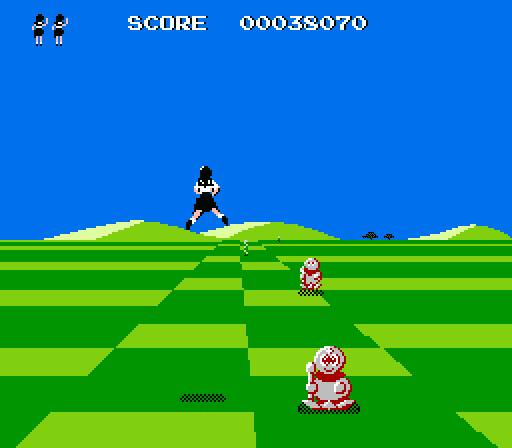
These Jizo statues aren't enemies, they're power-ups. That doesn't stop you from being able to destroy them, though. Don't do that. Each stage only give you one chance to collect some power-ups, and without them Nokko's gun borders on useless. In it's un-powered state it can only have two projectiles on screen at once and it doesn't even have the power to shoot down the trees that litter the first stage, which lead to a few inauspicious early deaths as I sent Nokko flying face first into a tree at one hundred miles an hour, naively thinking my plasma bolts would be able to dislodge a few shrubs.
I never really figured out how the power-ups work, either. Collecting them definitely increased the number and power of my projectiles, as well as making Nokko move around the screen faster, but the exact relationship between the statues I grabbed and the power I received remains a mystery to me.

Attack Animal Gakuen didn't just copy the core elements of Space Harrier's gameplay, either. Many of the enemy movement patterns will feel familiar if you've ever played Sega's game, and then there's this. A trio of tougher-than-usual enemies (that look like rejected Pokemon designs) who fly around in a triangle taking pot-shots at you. This same enemy pattern appear in the first stage of, you guessed it, Space Harrier, although in that game their toughness is because the can only be damaged when their invulnerable outer shells open up. In AAG you just have to shoot them a bunch more than any other enemy.

Any other enemy besides the end-of-stage boss, that is, and here he is now. It's a tommy gun-wielding koala gangster! I think it's supposed to be a gangster, anyway. I'll concede that its collar makes it look a bit like a priest, but come on, a gun-toting marsupial clergyman? That's just silly. No, I'm stick with gangster. I've already come up with a "Don Koaleone" pun, and there's no way I'm letting that one go to waste.
The koala kingpin spends the entire battle firing at you, so Nokko has to be constantly moving around the screen because to stay still means getting hit and getting hit once means death, and there are no continues neither. You could simply keep travelling around the screen in a circle to avoid the koala's gunfire if it weren't for the shield of smaller enemies that constantly spin around him, sometimes moving into the foreground so that you crash into them, and you end up needing a certain amount of luck to triumph. If you manage to destroy a few of the minions early on as you flap around the screen in a panic, then you'll probably be okay as long as you remember to never stay still. The koala isn't the greatest marksman in the world, but he is relentless.

If you hit the koala enough times, the C4 he apparently had stuffed into his pouch explodes and Nokko can move on to stage two, a desert area populated by cacti in pork pie hats. Well, if you're going to be out in the sun for an extended period of time you should always wear a hat.
From here on out, the stages of AAG follow the pattern laid out by the first: Nokko flies or runs forwards, enemies attack, there's a boss at the end, I die yet more embarrassing death by swooping into stationary objects. I didn't expect anything else, and while AAG might not be original it's at least a competent Space Harrier knock-off. The controls are slick, the pace is brisk and there are skeletons in sunglasses.

It's funny, you see, because they're wearing shades but they don't have any eyes to protect! Ha ha, their eyeballs have long since been pecked away by vultures as their bones bleached under the relentless desert sun. Cause of death? Their tiny vestigial pelvises could no longer support the weight of their upper bodies.

The cause of my death continued to be cacti even once I'd learned to fly over them, because later in the stage they launch themselves into the air in an attempt to catch Nokko in their prickly embrace. I definitely preferred the skeletons.

Stage two's boss is... something. Something with clear lizard-like attributes but a very odd body shape, like a gecko that's swallowed a bowling pin and is relishing the culinary challenge, if its unsettling smirk is anything to go by.
The boss fires at you constantly and is surrounded by a spinning shield of minor enemies. If this sounds a lot like the tactics of the previous boss, that because they're exactly the same. Curiously, the lizard seemed easier to beat, either because the skeletons are bigger targets and therefore easier to hit, or because it fires less frequently. Whatever the quirks of this boss, I'm glad of the practise. It'll come in handy when I face every other boss in the game, all of which follow the same battle plan.

Stage three is the obligatory fire zone, and to cope with the searing heat Nokko has taken her skirt off. That's just good common sense, really. Every time I'm about to enter a volcanic caldera I always whip off my trousers for that added layer of protection.
I'm not sure what these animals are supposed to be, mind you. Are Space Hoppers based on a real animal?

Here's Nokko getting killed by some crows. A murder of crows, if you will. Seeing Nokko die is something I experienced a lot, because Attack Animal Gakuen is a very tough game. Enemies move quickly, often appearing without warning from the edges of the screen, and while it's generally easy to gauge the "depth" of an enemy's on-screen position is can be hard to tell if they're on the same plane as you without looking at their shadows. A bigger problem is that it's quite hard to actually shoot things in this game. Nokko seems to have quite a narrow area of attack, and it can get frustrating trying to figure out where she's aiming, especially when you can only fire a couple of shots at a time. In practise I ended up avoiding most of the enemies until they either got bored and flew off screen or I ran past them. These crows? You can call me Noah, because I only got two of them.

Another boss that follows the already well familiar pattern, stage three's guardian is another indecipherable lump of mildly menacing pixels. He's got an almost Russian feel to him. I think it's his shirt. The most notable thing about him is that his left hand constantly jerks back and forth in a vaguely masturbatory gesture. I think it's part of his plan to distract you from the crows. Well, it worked. They killed me a bunch of times.

Oh good, the next stage is set underwater. Crows can't swim, right? Excellent. There are plenty of jellyfish around, but they pose nothing like the same threat as the flap dopily through the sea. I like that Nokko swims through this stage as opposed to flying. It's a nice little touch. I'd accuse the developers of trying to shoehorn in some fanservice, what with Nokko losing her skirt and now being in a swimsuit, but as she's only about ten pixels wide I don't think it makes much difference if she's dressed in a skimpy bikini or full plate armour. Also, "fan"service would imply that Nakko had fans to, erm, service.

Also in this stage: squid that are packed with smaller squid, and they explode when you shoot them, sending the smaller squid flying towards your face like my dream seafood buffet.

Finally, a boss I can understand: a turtle! It is a turtle, right? Yeah, it must be. Maybe a tortoise. A massive tortoise with a frog's head. Look, it's definitely some kind of large, shelled reptile with a head that may or may not have once belonged to a frog or toad, and no matter how many sea urchins it surrounds itself with it will inevitably fall under Nokko's deadly and seemingly waterproof weaponry.

Stage five is the Dark Area, a sombre plain packed with spooky trees that wear an apologetic expression. They're not proud about what they do, but they've got to make a living somehow.
Also, Nokko is dressed as an air hostess now for some reason. Actually, the reason is fairly obvious: her usual black-and-white outfit would be difficult to see against this background.

The Dark Area features enemies that are traditionally horror themed, like the spooky trees, snakes and bats. These bats are not very spooky. Honestly, I'm not even sure they're bats, they could easily be owls wearing unconvincing Halloween costumes. A lot of the animals in Attack Animal Gakuen suffer from this condition of not looking quite right, as though the whole game is being orchestrated by a Dr. Moreau who doesn't have the confidence to go all-out with his blasphemous gene-splicing experiments and instead just makes minor, goofy changes.

That is very obviously a spider, mind you. A particularly aggravating enemy, the spider fall from the top of the screen at great speed and without any warning, so if you happen to be standing in the spot where they're going to land then congratulations, you get to lose a life without having a chance to react or fight back. Always a fun scenario, that one. No, wait, not "fun", I meant "extremely frustrating".

The boss is a larger spider. He's wearing sunglasses. There's a lot of that in this game, although I didn't expect to see it in a place specifically called the Dark Area. Maybe the spider is blind. I have nothing more interesting to add on the the subject of this boss battle, because it's the same as all the others.

The last level is the Sky Area, where Nokko is harassed by sticks of chalk and some angry but ultimately ineffectual walking rocks. Attack Animal Gakuen is by now so firmly entrenched in the same rut of gameplay that it's liable to cut itself in half, but it's been a fun little adventure even despite the grinding difficulty.

It's a bit disappointing that there are no new enemies to fight in the Sky Area, though. No, I don't count the sticks of chalk. They're school supplies, not villains.

Then I reached the final boss, and all those times that I pondered what animal an enemy was supposed to be seem insignificant next to the unfathomable blob that serves as your final opponent. Is it a two-headed lizard that's recently been involved in a road traffic accident? A weird, oversized amoeba? A terrifying fusion of snake and boomerang? Oh man, that would be horrible, imagine trying to catch a snakearang when it came flying back at you.
I shot at the boss for a while, attempting to decipher exactly what the hell it is, but before I could come to a conclusion - I was leaning towards "kid's drawing of a forgotten He-Man villain" - the boss exploded and that was that.

It seems that Nokko went through all this trouble to rescue her friend. Well, it's more interesting than the usual hero-rescues-princess ending, I'll give it that. Of course, Nokko's friend is clearly lying in the first area of the game, so I wasted all that time travelling through the other stages when my goal was right there in stage one all along.

"Happy End," says the game, as Nokko repeatedly fires her gun at the player. Thanks, Nokko. I'm starting to worry about you, and your newly-rescued "friend" doesn't look very comfortable with the situation either. Luckily I won't have to deal with you any more, because Attack Animal Gakuen is over and I never have to see Nokko's face, or the single pixel the developers used to depict her underwear, ever again. The one-pixel panty shot, folks - you thought making a game where you can see up a schoolgirl's skirt was the saddest thing, but no, doing so in way that it's completely abstracted by technological limitations is somehow even sadder.
The game itself isn't bad, though. If you've played Space Harrier to death but you still want more, or you're a fan of really hard Famicom games, then Attack Animal Gakuen is a relatively jolly experience with plenty of zip. If you play it, maybe you'll succeed where I failed - in figuring out what the final boss is supposed to be.