Showing posts with label maze. Show all posts

18/02/2018

PUNCH AND JUDY (COMMODORE 64)

Today’s game is going to take us where the brass bands play tiddly-om-pom-pom, where the air is thick with the aroma of ocean brine and fried food, where children to gather to watch violent puppet stick-fights. I’m talking, of course, about the Great British seaside, as depicted by Clockwize’s 1989 Commodore 64 swazzle-em-up Punch and Judy!

I’ve seen so many health bars and magic meters over the years of doing VGJunk that it’s nice when something a bit different pops up. As status indicators go, sausage supply, empty bag and tide timetable are definitely different. We’ll get to see how these fascinating variables play into Punch and Judy once the action gets started, but before that let’s receive a little instruction.


Okay, that seems simple enough. Take the tent parts to the beach. It’s always good to have a clear, concise goal, especially in an old home computer game where things can often get a bit obscure. Yes, the tent parts might look like a slice of zebra, but that just makes them easier to see against the sunny, seaside backdrops.


And here those backdrops are, with the first screen of the game. There’s Punch on the right, with his jester’s motley and his face like an anal fistula. That’s who you’ll be playing as during your mission to build a tent on the beach. The setting is Bridlington, which might produce a pang of familiarity in a section of VGJunk’s British readership who may have spent a childhood holiday there. I know I have, along with such exotic east-coast locales as Cleethorpes, Ingoldmells and Skegness. Yes, I am a well-travelled sophisticate and yes, Bridlington is a real place. It’s very much a traditional coastal town that lives off tourism during the summer months, in that it’s got a promenade, a beach and a faint air of grey desperation. One nice touch is that Punch and Judy’s gameplay is framed as postcard, which is why “Bridlington ‘89” is written at the bottom-right corner of the play area.
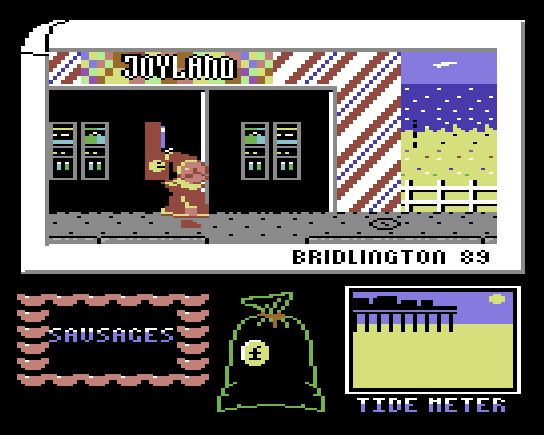

And off we go, controlling Punch as he makes he way through town. Bridlington is laid out on a grid, so you can go left or right, or up and down at certain spots like the barely-visible gap in the pavement at the bottom of the screenshot above. There are walls that block your horizontal movement in some places, and some screens don’t let you travel up and down so there’s a slight maze-like quality to the town, but it’s not a huge map and once you’ve figured out where certain landmarks are it’s simple enough to navigate. For instance, the beach is the top-right-most screen of the grid, and as long as you know that it’s a simple matter of moving up and right until you get there.


Here’s the first piece of the stage, laying where the pavement meets the sand. Each piece of the stage appears, one at a time, at random in a different part of the map, so there’s the main focus of the gameplay for you: wander around town looking for pieces as fast as you can, because the tide’s coming in and if it gets all the way up the beach then the performance will have to be cancelled unless the kiddiwinks have spontaneously developed gills.  Fortunately this first piece is on the screen directly next to the beach and I think the first piece might always spawn here, so that saves you a bit of time.


Here’s the beach. The first piece of the stage has been laid in place, so just another six or seven left to find. It’s all got a rather picture-postcard look to it, as you might expect from a game set at the British seaside. I was a little surprised that this never expanded into the kind of raunchy, end-of-the-pier humour that is so associated with the seaside, especially given the appearance on the beach of the overweight woman / knobbly-kneed, knotted-hanky-wearing bloke pairing that appears in a lot of those “saucy” seaside jokes. I suppose Punch and Judy is (appropriately) shooting for a younger audience.


Now it’s time to wander the beachfronts and back streets of Bridlington in search of the missing stage pieces. There’s not much to say about the gameplay, because all you’re doing is walking Punch from screen to screen, but I’m definitely enjoying the backgrounds. They’ll likely cause a swelling of nostalgia in any British players of Punch and Judy, capturing as they do the essence of the seaside town: amusement arcades, gift shops laden with buckets and spades and, yes, fish and chip shops.


You can even enter some of the chip shops, although sadly you cannot fully recreate the holiday experience by asking for a cone of chips that’s fifty percent salt, forty percent vinegar and ten percent crunchy brown things that may have once been a potato in the distant prehistory of man. These stores act as screens in their own right and can be used to travel “up” or “down” the grid in places, but the important thing to remember is the items you’re looking for can sometimes be found indoors. I mention it because it took me a while to realise this, despite "inside a chip shop" being a really obvious place to investigate during the game's second section.


Of course, it’s not all strolling along the promenade and checking out the back walls of the seedier gift shops, where they keep the replica weapons, “tobacco” paraphernalia and cigarette lighters with naked women on them. Punch has a couple of obstacles to avoid. The first and most persistent is the constable, who you can see chasing Punch in the screenshot above. Given that they have the exact same face I assume they’re related, but the policeman’s adherence to the law will not be swayed by familial ties and if he catches Punch you’re dragged away to the police station. This causes you to drop any piece of the stage you’re holding, which means a run-in with the old bill causes wasted time and allows the tide to creep ever higher up the beach. If you’re wondering what crimes Punch is being busted for, we’ll get to that soon enough.


Your other major foe is, naturally, the crocodile. Punch’s hated enemy scuttles around the game world, and if you come into contact with the crocodile you tide meter takes a big jump upwards, making the crocodile easily the most dangerous impediment to Punch (literally) getting his act together. There are two ways to deal with the crocodile: the first and probably most effective is to simply avoid it, although this can be difficult if the crocodile ends up near the beach itself because there’s only a single path and thus you can’t go around.


The other tactic is to drop a sausage on the ground. If the crocodile touches the sausage it’ll be momentarily rendered harmless while it gorges itself on the reward it has spent its entire existence trying to obtain. The problem here is that the crocodile is so long there’s not much space on the screen to set up your sausage-baited trap, and you’ll often end up accidentally touching the crocodile’s hitbox anyway. Also, you have a limited supply of sausages, although if you run out you can go to the butcher’s shop and buy some more, which is what the coins are for.
Frankly I’m impressed that the developers have done such a good job of incorporating the elements of a Punch and Judy show into the game – when I first found out there was a Punch and Judy game I assumed it would revolve around keeping the sausages away from the crocodile, but this is a much more interesting take even if the actual gameplay isn’t especially exciting.


It suddenly occurs to me that to any non-British readers, the concept of this game might seem completely insane. To those of us who grew up with it, the merry adventures of a grotesque hunchback fighting a crocodile over a string of sausages while a policeman tries to break it up is a familiar one, but I don’t think Punch and Judy shows are widely known outside Britain, are they? Maybe in Italy, because Punch is an evolution of Italian commedia dell’arte. Anyway, here’s a quick overview: Punch and Judy shows are a traditional form of puppet theatre most often associated with the seaside. Mr. Punch is the star, and most of the show revolves around Punch whacking people with his stick, from his wife(?) Judy to the local constabulary to a baby. To be fair, Punch generally doesn’t beat the baby in modern performances. He just subjects it to more general neglect when asked to look after it. Then Punch gets his sausages out for dinner but the crocodile turns up to steal them, the crowd does the old “he’s behind you” bit, they fight, more people get clobbered by Punch’s stick and in the end he emerges as the only survivor. It’s all perfectly acceptable entertainment and definitely not as weird as as I’m making it sounds. Oh, all right, it is weird but of course children think it’s hilarious because it’s about puppets clobbering each other. Like any performance piece that’s been codified over hundreds of years of repeated performance, the Punch and Judy show is full of strange quirks such as the puppeteers being called “professors” and Punch’s trademark voice being produced via a reed instrument called a swazzle that is placed in the back of the mouth. Imagine someone who’s swallowed a kazoo, that’s what a swazzle sounds like: in fact, according to tradition you can only be considered a true Punch and Judy professor once you’ve accidentally swallowed your swazzle a few times.


And that’s Punch and Judy. I swear I didn’t make any of that up. Perhaps you might think, as I did, that there’s not much there to build a computer game around and… well, there isn’t and Punch and Judy is a rather slight experience but as I say, it does an impressive job of incorporating a lot of aspects of the puppet show into what is little more than a maze-chase.


Now that the stage is built, it’s time for… erm, more of the same gameplay, except now the pieces you have to find are the other cast members. Okay, sure. that’s fine. I just need to find Judy, the baby, the dog and whichever of the Punch and Judy show’s stock characters this is supposed to be.


The Clown, maybe? I can’t think who else it would be; everyone else is accounted for, but this character looking nothing like a clown threw me off a little. Whoever it is, they’re coming with Punch as he drags them back to the now-constructed stage. When you first find the characters they won’t follow you, so you have to "persuade" them by pressing the fire button to give them a few whacks from Mr. Punch’s slapstick. Once clonked, they’ll follow Punch around and the game follows the same “avoid the long arm of the law (also crocodiles)” pattern of gameplay as before. However, any clobbered character will soon forget the beating they recently received and will wander away, forcing you to hit them again to regain their attention.


What this all boils down to is that yes, this is a game where you have to corral a baby by beating it with a stick. Imagine me reaching up to a high shelf in my cavernous library, taking an enormous, dusty tome down, dipping my quill into a pot of ink and carefully inscribing “Baby Wrangling (With Stick) at the bottom of the list of Things I’ve Experienced Via Videogames.


Forget the baby, though – the real test of your cudgelling skills is the dog, because it’s faster than all the other characters and even faster than Punch himself, so you have to try to trap the dog in a corner before gaining its obedience by thrashing it and wow, that is one heck of a sentence. Another problem with the dog is that it always seemed to break free of my control when I was right next to an exit to another screen, so the dog kept disappearing from sight the instant it could by running to a different area. Factor in the crocodile having taken up permanent residence on the beach by this point, and getting the dog to the stage ran close to being genuinely frustrating. Then I realised I was beating a dog into submission with a character who is carrying a string of sausages. Come on, man, the solution to your problems is right there in your hand! Or your pocket. Or wherever you’re storing your sausages. Somewhere deeply unhygienic, I suspect.


The tide meter might suggest it was a close call, but the only reason the water level got so high is that I simply ran through the crocodile at the end, while I momentarily had the dog’s full attention. With the cast assembled, the stage built and the tidal waters lapping at the audience’s feet, it’s time for the last part of Punch and Judy: the show itself.


These characters don’t look any more appealing when you get up close, do they? Faces like someone dropped a bowling ball onto a ham hock, yikes. Anyway, the show. Like any good Punch and Judy routine, the goal is to hit everyone with your stick while avoiding the policeman. Judy and the constable wander across the stage – the policeman seemingly having some programming that compels him to head towards Punch but with a lot of random, twitchy movements – and while Punch can slowly move left and right, his main trick is to switch to the other side of the screen by pulling down on the joystick. This makes him pop up in the opposite corner, and he’s invincible while doing so, so the gameplay flow is to keep switching sides until the constable is at the other end of the screen, getting some hits in on your target (Judy, in this case) and then switching again when the constable comes near.
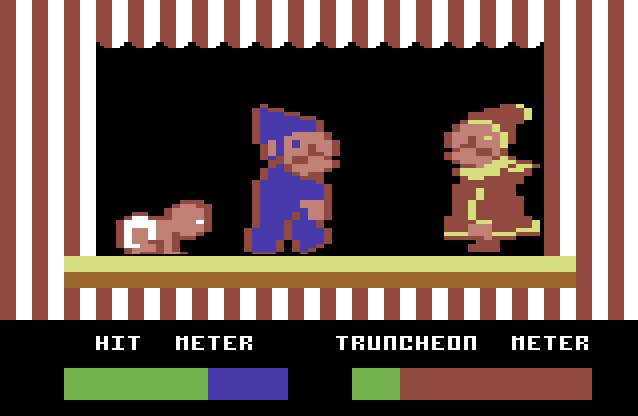

You have to deplete each of the four characters’ health bars – yes, including the baby – while protecting your own solitary health bar from the constable’s blows, but once you’ve realised that the only skill you need to win is patience it all becomes very simple and, if I’m honest, a bit boring. I sure hope I don’t get involved in any legal troubles soon, because “I grew bored of beating the baby with a stick” probably won’t go down well with a jury.
All four characters work in exactly the same way (they walk back and forth) and nothing else changes, so it’s not long before everyone lays vanquished before you and all the kids are thoroughly entertained.


Truly, I am a puppet wonder. Except this Punch isn’t a puppet, he wandered around town without someone’s hand shoved up him, he built the stage himself, he’s a living creature of some kind. A gremlin, perhaps.
I rather enjoyed Punch and Judy, you know. The gameplay’s hardly stellar but it all works nicely enough and very rarely becomes obnoxiously difficult or frustratingly vague, plus the map falls into a nice level of complexity where it’s fairly large but still small enough and consistent enough to be mentally mapped. I appreciate the effort expended in getting the Punch and Judy elements into the game and it’s hard to dislike any game that lets you feed sausages to a crocodile. However, I think my favourite thing about it is the low-res, eight-bit depiction of a British seaside town. It certainly got the ol’ nostalgia centres pumping, and captures that look remarkably well, albeit without the screeching seagulls and complaints about the lack of parking spaces I associate with a British seaside holiday. It gave me the same feeling I always had as a kid whenever we’d go to Scarborough or Skegness or, yes, Bridlington – that it must be really weird to permanently live in a seaside resort town, and now I can’t stop thinking about it. So, good job, Clockwize – it turns out that if you want to get me interesting in your seaside-based Commodore 64 game, that’s the way to do it.

08/12/2017

CRAZY BURGER (GAME BOY)

I won’t lie to you, there’s a very strong chance that I decided to write about today’s game because I was hungry while I was scrolling through the list of possible candidates. Mind you, that’s no less scientific than how I usually decide what to cover next. Here it is, then: Sachen’s 1991 Game Boy yo-yo-diet-em-up Crazy Burger!


At first glance, this burger does not seem to have earned the “crazy” moniker. It’s got buns, it’s got fillings, and while there is a small flag sticking out of it that makes this burger dangerous to eat near a golf course, it’s not like the burger is so crazy that it has cybernetic implants or is trying to convince you that the moon landings were faked. Then you look a big closer and you realise the burger is filled with what look like fat, white maggots. Well, guess I’m not hungry any more.


Bang, here’s the gameplay. Are you excited? You probably shouldn’t be, because this is an unlicensed Game Boy game from notorious garbage merchant Sachen, creators of such titles as Hell Fighter and Silent Assault. My hope is that the obvious simplicity of Crazy Burger, which seems to be a Pac-Man-esque maze chase, will prevent it from being too awful.


The basics, then: you play as the twig-limbed chap in the centre of the screenshot above. I rather like his simplistic design, you know. The reason for our hero’s very basic form will be revealed soon enough, but for now let’s figure out what’s going on. You can walk around, moving through the narrow corridors… and that’s where I got stuck. There are no obvious exits, no switches to flip, and I spent an embarrassingly long time just not getting it until I finally caved and went to look up what I was supposed to be doing.


Okay, now I’ve got it. Each stage contains a number of boxes. You have to collect all the boxes and then get rid of them by throwing them into the fire-pit pictured above. At the most basic level, this is all you do in Crazy Burger – you burn trash, presumably without a permit, amidst a labyrinth made from chairs, tables and small sections of brick wall with eggs perched delicately atop them. Forget the eggs, the eggs aren’t important. Focus on gathering the boxes, which is easier said than done: you can only carry up to three boxes at a time, and every box you’re carrying makes your character move more slowly. At first I had assumed the boxes were empty and you’re supposed to be tidying up, but having them slow you down means there must be something in them. My leading theory is that they contain damning evidence concerning our hero’s upcoming trial.
In my experience, it was best not to carry more than two boxes at once. Otherwise you become too slow to safely avoid… the food.


Oh god, there it is. While racing to collect that box at the bottom-left, our hero is trapped by a wandering soda cup and menacing french fries and man, those really sound like enemies from a Mother game. Anyway, the foods are a bit like Pac-Man’s ghosts, in that they wander around the maze trying to harm you. Unlike Pac-Man’s ghosts their movements are random, as far as I could tell, and you don’t die if you touch the food. Well, not right away.


What happens is that you start getting fat. This implies our hero ate the food, either because they can’t control their raging hunger or because the food forced itself down his throat. Neither scenario is all that pleasant to think about, but unfortunately I couldn’t avoid the food forever and now our hero is looking a little chunky. That’d be fine, but the bigger you are the slower you move, and it stacks with any boxes you’re carrying so a few poorly-chosen steps can mean that you immediately go from svelte and speedy to a lumbering lummox, dragging yourself through the stage  with agonisingly slowness. You can survive “eating” four times, gradually becoming slower and more rotund with each meal consumed, and eating a fifth morsel will cause your body to give out entirely and you’ll lose a life. When you do start packing on the pounds, my advice is this: drop any boxes you’re carrying, because you can leave them on the floor where you’re standing and come back for them later. Then make your way to the Exercise Cube.


Don’t worry, the evil foodstuffs cannot penetrate the walls of the Exercise Cube, so get in there and pump some iron. Tap the button to lift the weights, do it for long enough and our hero will shed those extra pounds and get back to a running speed that’ll allow you to collect the boxes without a seven-foot hot dog inserting itself directly into our hero’s arteries. I’m impressed our hero can even lift the weights with those noodly arms, but I suppose if his only other options are a catastrophic heart attack or a horrifying, unthinkable future where boxes remain unburned then he’ll find the strength from somewhere.


That’s about it for the gameplay. Once you’ve burned all the boxes, you move on to the next stage (or “Place,” as the game calls them) and do it all again with a different maze layout and more food to avoid.


One thing I did learn is that you have to be careful when exercising. If you mash the weightlifting button too fast, the exertion becomes too much for our hero and his heart explodes. He dies, which is bad, but if this screenshot is anything to go by he also turns into a genie, so clouds and silver linings and all that.


It turns out that making the player out of featureless shapes was a clever idea, because it’s a lot easier to turn a rectangle into a circle than it is to completely re-sprite an actual character into a series of fatter and fatter forms. I do like the character’s porkiest form, it’s pretty charming and the fact that sweat flies from its brow when it's “running” engenders a certain feeling of camaraderie.


Half the fun – okay, more like ninety percent – of Crazy Burger comes from trying to figure out what the hell the backgrounds are supposed to represent. They’re a strange mix of the obvious, like the chairs from earlier, and segments that are so abstract as to be unrecognisable. For instance, here we’ve got the fast food restaurant that the food spawns from, and that’s obviously what it’s supposed to be thanks to the famous Monochrome Arches sticking out of the top... but it’s set amidst a forest of indecipherable cylindrical lumps and I have no idea what those are supposed to be. Tree stumps? Extremely weathered litter bins? I don’t have a clue, and I don’t have time to investigate the matter because I’m being chased by a vicious boiled sweet that wants revenge for the thousands of mint humbugs I have consumed over the years. Joke’s on you, pal, my repeated trips to the dentist were penance enough.


“’Scale’? Who gives a crap about scale?! The hotel’s doors are as tall as the neighbouring bungalows where I live, are you saying I live in an incomprehensible nega-zone where the laws of physical reality hold no dominion? Look, if it bothers you that much I’ll throw in a few more walls with eggs on top, okay?”


What? The gameplay? Yeah, sure, Crazy Burger has some of that.
Oh, you wanted more information, VGJunk said to the non-existent person he’s talking to right now. Okay then. Crazy Burger’s gameplay is okay, I suppose. I didn’t hate it, although I did hate bits of it. The core concept of avoiding enemies in a maze is fine, and the gathering of boxes is also fine. The whole “eat and grow fat” part is more of a mixed bag. I do honestly like the concept of gaining and losing weight, and of having to visit the Exercise Cube. It’s a fun gimmick that you don’t see all that often (it kinda cropped up later in Data East’s Diet Go Go) and seeing your character gradually go from On The Waterfront Marlon Brando to Island of Dr. Moreau Marlon Brando is neat. There’s a surprising amount of character there, packed into something made from geometric shapes.


The weight gain is also one of Crazy Burger’s biggest failings, though, mostly because of the slowing down of your movement speed. Crazy Burger’s not exactly a fast-paced game to start with, and once you get past the early, easier stages you spend so much of your play time burdened by both boxes and girth that the slowness of your character stops being an inherent challenge of the gameplay and becomes, well, boring. It’s not much fun trying to avoid the deadly food when your character runs like me twenty minutes after my Christmas dinner, and repeatedly dragging yourself back to the Exercise Cube feels like watching a glacier getting out of bed on a Monday morning.


The killer foodstuffs themselves are another issue. Their movements are completely random, as far as I could tell. They might be slightly biased to moving towards the player, that could easily be me seeing things that aren’t there. This means that the food will often occupy the narrow corridors between you and the boxes, wandering around aimlessly and getting in your way without any means of luring them somewhere else. There is a drink bottle on each stage that acts like a Power Pellet and lets you eat the food with no weight-gain, but it doesn’t last long enough for you to clear out the stage and the food respawns anyway. Too much waiting around for a roaming chicken drumstick that may or may not decide to shift its calorific arse can bring the game to a screeching halt, and later stages especially can become tedious.


Speaking of screeching, would you be surprised to learn that every second of Crazy Burger’s gameplay is accompanied by a twenty-second loop of the same god-awful music over and over again, a brain-scrapingly painful tune composed by someone whose relationship to melody and tone could be described as “antagonistic and hateful?”
At least you don’t have to hear the music for that long even if you do decide to play through all of Crazy Burger, because there are only fifteen stages. Once they’re done, we can sit back and enjoy the rather confusing ending.


Here’s the text in full. Perhaps you can make more sense of it than I did.
For the sacrifice of great hamburger burger town finally returns to tranguil. Hamburger stores close down for lack of raw material. And now people can walk on the street fearlessly, they don’t have to worry about the attack of mad hamburgers. However, the fat are still fat. The only thing changed is that no one in burger town dares to eat fast food any more.


So… those weren’t metaphorical killer hamburgers, then? Deadly foods really were patrolling the streets and slaughtering anyone who opposed them. And I guess the boxes I was burning were full of… fast food ingredients? No wonder the food was so angry, I was essentially murdering their children. It feels like Sachen were trying to make a point about the rampant consumption of quick and easy but harmful foods, only their point was poorly thought out and doesn’t make much sense. You know, just like Sachen’s games.


It’s a little sad to be saying this, but I think Crazy Burger might be the “best” Sachen game I’ve played. It’s amazingly mediocre, split almost down the middle between its good ideas like the weight mechanic and weird setting and its bad ones, such as the music and the fact that game can get incredibly slow. For an unlicensed Game Boy title that I think might have only ever been released as part of a four-in-one multicart, though, it’s a goddamn masterpiece. Now, I’m off to find the menu for my local takeaway place and see if they can deliver me a burger the size of a small house.

31/08/2016

CAESAR THE CAT (ZX SPECTRUM / COMMODORE 64)

You’re all familiar with Julius Caesar and Augustus Caesar, but get ready for the fresh and furry stylings of Catulus Caesar, the cutest, fuzziest, most snuggly-wuggly leader in all of Ancient Rome! Thrill as he directs his legions from the comfort of a cardboard box! Be amazed as a video of him conquering Gaul is uploaded to YouTube and gets a million hits because he does a little sneeze at the end! Oh, all right, today’s game isn’t about a cat that leads the Roman Empire, as wonderful as that would be. He’s simply a cat named Caesar, in Andromeda Software and Mirrorsoft’s 1984 vermin-control-em-up Caesar the Cat!

This is the loading screen for the ZX Spectrum version of the game, which is the one I’ll be looking at first. There’s not much to say about it, other than that Mirrorsoft was a publishing arm owned by the Mirror Group, producers of the British tabloid The Daily Mirror. I don’t know why, because it’s a business venture like many others, but the idea of a newspaper company also publishing computer games just seems strange to me. For non-UK readers, The Mirror is the newspaper that used to employ the enormous gasbag and multi-year winner of the World’s Most Punchable Face award, Piers Morgan. If you’re American, I speak on behalf of my country when I say I’m sorry he spends so much time in your fine nation.


Here’s the title screen, where the endless battle between irreconcilable foes is once again joined. It’s cat versus mouse, and you’re the cat. There’s Caesar at the top of the screen, sitting around and not doing much like all good cats should. There are also mice, one of which is eating the game’s title. Caesar lets the mouse do its thing, saving his energy for the game itself, and I let the title screen run for a while to see what would happen when the mice ran out of text to gnaw on.


Gah! I was not expecting the sudden appearance of Caesar’s huge disembodied head. The numbers are either some kind of score total you need to keep Caesar happy, or a countdown until he unleashes his doomsday weapon.


“My cat has no nose.”
“How does he smell?”
“He can’t, he doesn’t have a nose. It’s very sad.”


The game begins, and you’re presented with Caesar, some mice and a packed larder. The rodent infestation is hardly surprising with all this uncovered food knocking about. At least put some cling film over it, jeez. There’s a real feast on display here: suspiciously-coloured cheese, red and black food logs and what I took, at first glance, to be a rosary hanging from the top-left corner. I think it’s actually supposed to be a string of sausages and the cross is attached to the lid of the bottle underneath. Would it be sacrilegious to suggest that the Catholic Church start looking into edible rosary beads? Oh, and remember that red jar, it’s important later. Anyway, you control Caesar on his mission to rid the pantry of mice, and controlling the cat is as simple as using the joystick – no other buttons to worry about with this one, folks. The larder is split into four horizontal rows, and Caesar can go up and down to move freely between them. It’s a maze game without the walls, in a way.


Catching a mouse is, in theory, as simple as walking on top of it. As you can see above, Caesar delicately picks the mouse up in his mouth, and you then have to carry it to the door that appears somewhere on the screen (it’s the red-and-blue rectangle at the top-right, in this case.) I assume the mice are removed in this way to spare the player the grisly sight of Caesar batting the mouse around for a while before moving in for the kill. It’s a good compromise, in my book. Having a cat walk all over your food is unhygienic enough without the room being splattered with mouse innards.


However, Caesar the Cat is much less forgiving than the premise might lead you to expect, turning a cutesy romp into a surprisingly tense race against time. The most important thing to remember about catching mice is that if you move on to the same horizontal level as them, they’ll disappear. The way to catch them is to approach from a different row and only make your move when you’re directly above or below them. However, you can’t take too long about it because your score is constantly running down, and if it reaches zero it’s game over. So, speed is of the essence, but don’t get too over-zealous in your joystick wranglings – if you accidentally try to move Caesar beyond the confines of the screen, he bangs his head into the wall and you’re docked a chunk of points for your tacit endorsement of animal cruelty. The mice disappear and reappear pretty quickly, so you might think that a good idea would be to sit in place and wait for the mice to come to you. Don’t do this. I did, and I couldn’t figure out why I was getting almost immediate game overs. It turns out that if Caesar stays still for more than a couple of seconds, the rate at which your score decreases multiplies about ten-fold. I’m allergic to cats and have as little to do with them as possible, but even I know that constant frantic scurrying goes against the very essence of cat-ness.
If that wasn’t enough obstacles on your road to a pest-free pantry, there are also some jars on the shelves – the pink one on the right, the blue one in the middle and the previously-mentioned red jar. If you move up or down while touching the jars, they fall off the shelves and break. Two of them cost you a points penalty if you smash them, but if you break the red one…


That’s the jar in which Caesar’s owners store the smallpox samples they smuggled out of a Soviet virology lab during their escape from behind the Iron Curtain, and smashing it is an immediate game over, complete with vaguely threatening message. When you do get a game over, the game plays a beepy version of Auld Lang Syne, the main effect of which is to make you realise how weird it is to hear Auld Lang Syne on a day other than New Year’s Eve.


If you manage to survive all these pitfalls and catch enough mice, the screen is reset and the black mice are replaced by blue mice. The opening screen also implies the existence of rare and elusive red mice, but I can’t confirm that because I didn’t manage to get past the blue ones. The problem is that they eat all the food really, really quickly, and every time a piece of food is devoured, you guessed it, you lose a bunch of points. How much faster are the blue mice than the black when it comes to sating their relentless appetites? Put it this way: I didn’t even notice that the black mice were eating the food but the blue mice get through this enormous buffet like, well, I get through an enormous buffet. So, the red mice will go forever unwitnessed aside from that brief glimpse on the title screen. Caesar the Cat is a fun little game in short bursts, but the dedication – and luck with the mouse’s positions – required for mastery is no justified by the amount of entertainment on offer.


Here’s the Commodore 64 version, and it must be said that this game (in all its forms) is cute as heck. There was a BBC Micro port, too, which looks much the same as this C64 version but with a more garish colour palette.


The C64 version plays identically, although the playfield looks a little different and the generic smashable jars of the Spectrum version have been replaced by stacks of cups and a fancy teapot. The teapot is this version’s “instant failure” breakable, so let’s assume it’s a priceless family heirloom. Also of note is that someone appears to have racked up a game of pool in the bottom-right corner.


There’s nothing to choose between the different versions in terms of gameplay, and while part of me wants to say that the gentler colours and larger objects make the C64 version the superior one, I have to say I think I prefer the Spectrum Caesar for one simple reason: the seeds in the watermelons make it look like they’ve got grumpy jack o’lantern faces. I do like the graphics in both versions, though. The C64 version especially has a nostalgic “’early reader’ kids book from the seventies”  aesthetic that reminds me of half the books in my junior school’s library, thanks to the semi-abstract food illustrations and the yellowy-brown colour palette.


It lacks a real hook to keep you coming back and it’s random enough that it probably won’t hold your attention if you were aiming for true mastery in the way something like Pac-Man might, but for a tiny little game about cute animals that controls well and moves quickly Caesar the Cat is a fun way to spend ten minutes, and sometimes that’s all you need.

VGJUNK Archive

Search This Blog

Followers