Showing posts with label core design. Show all posts

21/02/2017

CHUCK ROCK (MEGADRIVE / GENESIS)

It’s a shame that most videogame-to-movie adaptations are terrible, because I think a big-screen version of today’s game would be worth making. Of course, that’s only because then you’d be able to use the tagline “Fun is just a stone’s throw away” on the posters. It’s the 1992 Megadrive version of Core Design’s prehistoric platformer Chuck Rock!


Originally released in 1991 for the Amiga and Atari ST, Chuck Rock was soon ported to a wide number of different platforms. So why the Megadrive version? No real reason, it just looks very close to the original but is controlled with a pad with extra buttons.
So, the title screen, then. There’s a band playing. I’m sure we’ve all already made a mental “rock band” pun, so let’s skip that and say hey, the animations of the band are actually synced up to the music somewhat, which is a nice touch. From left to right you’ve got a dinosaur in a wig, a drummer with the Virgin logo on his kit, (because Virgin published this version of the game,) Chuck Rock himself (who is also wearing a wig, as we shall see in a moment) and Chuck’s, erm, buxom wife Ophelia. The Megadrive version goes straight into the action when you press start, although other versions do have an introductory cutscene. The story is that Ophelia is kidnapped and Chuck sets out to rescue her. So far, so exactly the same as 90% of other 16-bit platformers. However, the cutscene shows that Ophelia was abducted by the band’s drummer, whose name is Gary Gritter. Yes, he’s named after and is physically based on former glam-rock singer and current incarcerated paedophile Gary Glitter, making this the second game I’ve played in the past few months to feature the same bit of extremely unfortunate celebrity caricature.


Chuck Rock is a platformer, that much is clear. You jump a lot in this game, as well as avoiding enemies where you can. There are a couple of twists to the formula: for starters, there don’t seem to be any bottomless pits for you to fall into. Some of the pits are filled with lava or spikes, but they all have a bottom. Chuck can also attack, either with a jumping kick or, if he’s standing on solid ground, by thrusting his fat gut at the bad guys. Whether the enemies perish from sheer disgust as a sweaty caveman’s belly rubs up against them remains unconfirmed, but the problem with this attack is obvious: it has almost no range. Like, Chuck’s a fairly chunky chap but even his prodigious gut doesn’t reach as far as his fists would. And anyway, what kind of caveman doesn’t carry a club? You’re a disgrace to the uniform, Chuck.
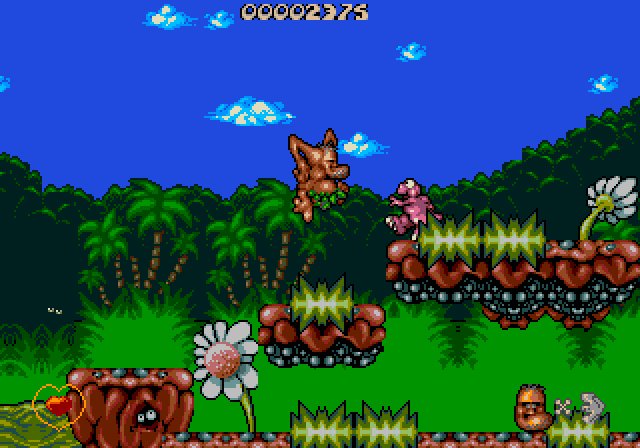

The look of Chuck Rock is unmistakeably European, isn’t it? Cartoonish without a hint of manga influence, like an alternate version of The Flintstones that started in the pages of The Beano. It’s a good look, though. Nice and colourful, pleasingly solid and detailed sprites, it definitely looks the part.


And now, the secret of Chuck Rock’s title is revealed: he’s called Chuck Rock because he can chuck rocks. Pick ‘em up, set ‘em down, carry ‘em around and throw them at dinosaurs and other dangerous fauna. Rocks: nature’s Swiss Army knife. There are two sizes of rock, small and big, and each kind slows Chuck down either a little or a lot while he’s carrying them. The benefits of carrying a rock, not including “a great upper body workout,” are that when they’re over Chuck’s head they can protect him from aerial attacks, and if a flying enemy crashes into them they will die. Plus you can throw them at things, which is generally much more effective than the gut-bounce. As well as that, the rocks can be used as platforms, either for a little extra height when reaching distant platforms or as a stepping-stone when placed on hazardous floors. It’s a very welcome bit of extra gameplay in what would be a pretty by-the-numbers platforming adventure otherwise.


Not all the creatures are out to kill Chuck. Some of them are actively helpful, like this pterodactyl that carries him across the screen. Now, a confession: I have, in the past, mentioned Sega’s “Cyber Razor Cut” series of TV ads for the Megadrive, and specifically I’ve said that the line “hitch a lift on a pterodac-bird” is one of the worst attempted rhymes I’ve ever heard. However, having listened to the ad again in slightly better quality, I concede that the actual line might be “pterodactyl,” only the pronunciation of the word has been cruelly, viciously mangled in an attempt to get it to rhyme with “world.” It does not rhyme. I think I preferred it when I thought it said “pterodac-bird.”


As I say, the Megadrive version of Chuck Rock is mostly identical to the original computer games, but here’s something that’s different: in the Amiga version, this huge dinosaur tried to take an actual shit on Chuck’s head when he walks underneath it. I remembered this from having played the Amiga version as a kid, and when you are a kid a massive dinosaur taking a dump on your character is the kind of thing that sticks in the memory. Sadly, this does not happen in the Megadrive version, and I can only assume it was removed for reasons of perceived good taste.


And so on you go, guiding Chuck through the jungle setting dispatching dinosaurs with his paunch and occasionally throwing boulders onto crocodile’s heads so you can use them as see-saws to propel you upwards. Unfortunately the crocodiles don’t say “it’s a living!” when you do this, probably because you’ve just dropped a rock on their heads.
It’s all very jolly, and certainly feels as though it’s had a little more craft put into it, a little more love and affection spent, than you might find in the slew of generic run-n-jump platformers of the time. Apart from Chuck having a slight (but manageable) delay on his jumps, it all controls very nicely and hits a good balance of simple, obvious challenges you need to clear in order to progress and hidden areas that require a bit more exploration and boulder-stacking to access. You only really get point items from these side areas, but it’s still fun to see where you can get to.


After a while, Chuck stumbles upon the first boss. It’s an angry triceratops, charging back and forth along the bottom of the screen. There’s a rock down there, too, and your task becomes clear: jump down while the triceratops is at the far end of the screen, grab the rock, climb back up the platforms and then throw the rock onto the triceratops from above like a moronic yob throwing bricks off a motorway bridge onto the cars below. It’s an easy task to accomplish, so it’s a shame that you have to do it a bunch of times to defeat the triceratops. Yes, this fight falls into my least favourite category of boss fight – the one where you do the same basic action over and over. The triceratops doesn’t change its attack patterns or anything like that, so basically the fight is saying “sure, you dropped a rock on a dinosaur once, but can you do the exact same thing ten times?!” Yes, Chuck Rock, yes I can. If I take any damage, it’s because I got bored and my mind started to wander.


Stage two takes place in some caves, every surface covered in slimy, gloopy mud. I sincerely hope it’s mud, anyway. The caves feature many of the cave-based hazards you might expect from a 16-bit platformers, like dangerous stalagmites, falling rocks and scuttling spiders, as seen above. These spiders remind me of the monster version of Drutt from the “Nasty Stuff” episode of classic kid’s claymation show Trap Door, a reference so specific even I’m surprised it sprang to my mind.


Halfway through the stage there’s a lava section, because of course there is. Interestingly, Chuck responds to falling into molten rock the same way Mario does in the 3D Super Mario games – rather than being immediately incinerated, he leaps back out of the magma with a yelp and an accompanying loss of health, furthering Chuck Rock’s status as a platformer that is completely disinterested in killing the platformer by having them fall into bottomless chasms.


There are a few elevators in this stage, powered by dinosaurs running around treadmills, and once you’re off the lift the dinosaurs lie down and have a kip. There are quite a few fun little flourishes like this in Chuck Rock, all of which help elevate it above the average in terms of presentation if not gameplay.


Boss number two is a sabre-toothed tiger. A fearsome foe indeed, made all the more dangerous by the lack of any rocks in the arena that you can chuck at it. This means you have to rely on Chuck’s jumping kicks and belly-bounces, both of which have a range measured in nanometres and are thus ill suited to fighting something with teeth bigger than your head. Most of the damage you’ll take in this fight comes from being unable to halt Chuck’s forward momentum as he attacks, often propelling him straight into the tiger. On top of that, the tiger can also roar, which momentarily freezes Chuck in place through sheer terror. His jaw drops and his skin grows pale, which again is a lovely little touch.
The tiger runs around the arena in a loop, lunging at Chuck when he gets near. My strategy? I didn’t really have one until I managed to get behind the tiger and trap it against that small lip of rock on the left of the screen. Once it was there, I mashed the attack button as far as I could, grinding the tiger to death between a rock and soft, flabby place. A flukey victory, sure, but I’ll take it.


Oh joy, it’s an underwater stage, everyone loves those. A completely different set of physical rules to grapple with, the action rather hampered by the Megadrive’s lack of transparency effects? What’s not to love? Okay, I’m being too harsh there. The swimming portions of Chuck Rock aren’t that bad. It certainly helps that Chuck still moves pretty quickly when he’s submerged, which keeps the game flowing, and half of the stage takes place on land anyway. It’s a lot more awkward to defeat enemies while you’re underwater, as you can probably imagine, but we should commend Chuck for his bravery. He’s not afraid to kick a Portuguese man-o-war to death with his bare feet, whereas I feel queasy if I step on spilled shampoo in the shower.


While the underwater sections aren’t terrible, it’s still preferable to ride over them on the back of a friendly whale.


One annoying facet of Chuck Rock’s level design is that it features far too many blind jumps. Here, for example, the only way to progress was to jump off a cliff (a phrase that looks weird now I’ve written it out) into the water below. The thing is, you can’t see the water below, which is why Chuck’s about to take damage from landing on a jellyfish. Each stage seems to include at least a couple of blind jumps, and the longer I write about videogames the more irritating I find this situation. I like to delude myself that if I can see the danger, I can use my skill to avoid it, even if that’s rarely true.


Stage three follows up some not-especially-inspired level design with an absolutely terrible boss in the form of this plesiosaur. If the Loch Ness monster was a huge dork, this is what it’d look like, snorkel and all. All it does is bob up and down and occasionally blow bubbles at you. These are videogame bubbles and therefore they hit with the force of a .44 magnum round, but they’re still easy to avoid and all you need do to defeat this boss is find the precise distance from which you can float in place and kick it repeatedly without bumping into it. It feels less like a fight and more like synchronised swimming, and even more like a waste of everyone’s goddamn time.


Stage four combines the swimming sections with the almost mandatory ice stage, complete with slippery platforms and frozen enemies. It’s a testament to the overall craft of Chuck Rock that the combination of these two tropes, probably the least-loved of all platformer level types, somehow remains fairly fun to play. It’s not perfect, and in a lot of ways it’s a backward step from earlier areas: there seems to be less emphasis on creative rock throwing, and the increased difficulty level comes from packing more and more creatures into each screen rather than through thoughtful level design. Still, it looks really nice, and I love these ice-crystal backgrounds and the dinosaurs that attack by sliding across the platforms while encased in massive ice cubes.


I also love these snowball-throwing dinosaurs, because they are utterly adorable, slinging their snowballs with a real sense of childlike innocence. It’s a real shame what Chuck’s about to do to it with this large rock, honestly.


This stage also has a brief outdoor section, complete with snowmen that I’m going to assume were made by those same dinosaurs that throw the snowballs. A bunch of them got together and built a snowman, and it’s cute as heck. “If they’re dinosaurs, why didn’t the build a snow-dinosaur, then?” I hear you ask, and the answer is because making a snow dinosaur would be a lot more difficult, especially if you don’t have opposable thumbs, obviously.


Atop a cold and snowy mountain, Chuck faces off against a woolly mammoth in a fight that’s quite similar to the underwater one but vastly improved by taking place on land. The mammoth charges, so you jump up and kick it right in the face. Sometimes it’ll use its trunk to fire snowballs or to suck you towards it, vacuum-cleaner style. I’m standing by my statement that this is a better boss fight than the last one, but it’s still not good, and none of Chuck Rock’s end-of-stage encounters are much fun to endure. They’re the weakest part of the game, that’s for sure, at once boringly simply yet made frustrating by the incredibly short range of Chuck’s attacks.
Let’s look on the bright side, though. All this snow and ice implies that if I just hang around for a while, I won’t have to fight any more dinosaurs. After all, as a giant Austrian once said “what killed the dinosaurs? The Ice Age!


Oh. Wow. I didn’t expect all the dinosaurs to actually die. I mean, I know Chuck’s thrown rocks at a lot of them, but not enough to cause the mass extinction event that makes up the final stage. It really must be the Ice Age’s doing.


There are even dinosaur graves, complete with dinosaur headstones, just in case you though this cheerful cartoon romp was getting a bit too cheerful. Chuck is too respectful of the dead to pick up the gravestone and throw it, which is disappointing because I like the irony of beating someone to death with a tombstone.


As with the previous stage, this boneyard suffers from an overabundance of enemies packed into each screen, which makes progressing just enough of a slog that you begin to wonder whether you’re still having fun. At least the enemies themselves are fun, with rattling skeletons and dinosaur mummies charging around the place, and the enemy designs are definitely one of Chuck Rock’s strong points. I especially like the way basic enemies change as you make your way through the game: for instance, the hostile pterodactyls behave in the same way throughout the game, but in the snowy levels they gain a little scarf and in this stage they’re skeletons, and that goes a long way towards making them feel less repetitive.


Here, Chuck breaks the cardinal rule of the Caveman Code by walking directly into a dinosaur’s mouth. Don’t worry, though, the dinosaur is already dead, or at least extremely unwell. All its teeth fall out when you approach it, so there’s no worries about being chewed to death.


This means the next area takes place inside a dinosaur, which is great even if it is full of these disturbingly cheerful hearts. There are dozens of the bloody things in here, so they can’t be the dinosaur’s heart and are presumably a species of parasitic organism that invades other living creatures until their innards resemble the bins behind Poundland on the day after Valentine’s.
I’ve always loved videogame levels that take place inside a living creature, you know. I think it’s the cross-pollination of the bio-organic settings of my beloved Alien franchise, the NES version of Life Force / Salamander and the “In The Flesh” level from Blood. Chuck Rock gets an extra point from me for including such a stage.


Then, with surprising suddenness, the final boss appears. Notice that I am no longer inside the dinosaur. I assume Chuck managed to leave the corpse via the, ahem, most obvious exit. I think by this point it’s fair to say that Chuck has been through some (literal) serious shit, so a dinosaur wearing boxing gloves and a super-sized version of Sir Arthur’s boxers is unlikely to faze him. I do like the dinosaur’s little crown, mind you.
Anyway, the dinosaur will try to attack you in different ways depending on which platform you’re standing on, either with punches or by biting. You’d think the punches would be the least effective of these attacks, what with the boss having stubby little T. Rex arms, but I had far more success on the top platform. The boss comes in for a bite, Chuck boots it in the snout, repeat until the game finishes. Did I mention boss battles aren’t exactly Chuck Rock’s strong point?


Thus the game ends: Chuck is reunited with his wife, and… hang on, so that dinosaur is Gary? I thought I was after the human kidnapper Gary Gritter? What the heck is going on? In search of answers, I checked out the ending to the Amiga version, where I noticed this:


If you look at the ending image without the text in the way, you can see that someone has been crushed by the dinosaur’s falling body. I guess that’s Gary, then. You can understand my confusion, given that Gary doesn’t appear in the final boss’ room or anything, but apparently he was there the entire time. What a lame ending, made worse by the fact I was momentarily led to believe I’d just fought a T. Rex called Gary only to have such a wonderful notion cruelly snatched away from me.
Before we leave Chuck Rock for good, take another look at the ending text, specifically the line about how “Chuck can not wait to get home and out of his leaves.” A couple of points: for starters, the first time I read it I assumed “get out of his leaves” was a euphemism for getting extremely drunk. You know, “Chuck necked a bottle of scotch and got absolutely out of his leaves, started a fight with a bouncer and dropped his kebab,” that kind of thing. Sadly that’s not the case, “his leaves” actually means the foliage Chuck’s wearing as under (and indeed outer) wear. Also, in the console versions it says he’s going on vacation after this ordeal, which is fair enough. However, in the original versions it’s strongly implied that he’s going home to have sex with his wife, which is also fair enough but apparently far too racy for the Sega Megadrive.


Amid the great morass of cartoony 16-bit platformers, Chuck Rock can stand tall as one that’s distinctly above average, especially for one based on a computer game. Sadly it doesn’t quite reach the top thanks to the dull boss battles, too-frequent blind jumps and a rock-throwing mechanic that’s underutilized in the later stages. Presentation-wise it’s very good, with lots of charming (and charmingly weird) monsters and backdrops, plus an enjoyable soundtrack that’s been expanded from the single tune of the original to a track for each level. I’m especially fond of the eminently hummable and extremely bouncy stage two theme. Overall, then, time with Chuck Rock was time well spent. Okay, maybe not well spent. I could have done a lot of chores instead of listening to Chuck shout “unga bunga!” but it was, mostly, fun. I’m still disappointed that dinosaur wasn’t called Gary, though.

05/07/2013

ASTERIX AND THE GREAT RESCUE (MEGADRIVE / GENESIS)

Paf! That's the sound of a small French man punching a Roman soldier. Get used to it, because it'll be cropping up a lot in today's game - Core Design's 1993 Megadrive these-Romans-are-crazy-em-up Asterix and the Great Rescue!


For those of you who don't know about Asterix - most European readers can skip this bit - it's a French comic book series, created by René Goscinny and Albert Uderzo, that chronicles the adventures of the last village in ancient Gaul to remain unconquered by the Roman empire.


The indomitable village remains unconquered because Getafix, the village's druid, can brew a magic potion that grants anyone who drinks it superhuman strength. This is helpful for battering Romans, and the majority of the Roman-battering action falls to the village's two heroes, Asterix and Obelix.


Asterix (the little one) is shrewd, brave and gets the job done using a combination of brains and potion-infused brawn. Obelix (the big one, but definitely don't call him fat) fell into a cauldron full of the potion as a baby, and as a result is permanently super-strong. He's also super-dense, but well-meaning and cheerful. Together they travel the ancient world from Britain to Egypt, meeting the likes of Julius Caesar and Cleopatra while engaging in all manner of hi-jinks, comical adventures, Latin jokes and repeated brutality against this one really unlucky group of pirates.


I adored Asterix as a kid, where it served as an excellent bridge between kid's books and adult reading, with a wonderfully delicate English translation and beautiful artwork. Hell, even into adulthood I've been known to cry "come to my arms!" when sufficiently liquored up.


So, it's an early-Nineties console game based on something I loved as a kid. There is no way this is going to end without me being lacerated by the cruel shards of my broken dreams, is there?


Here's the map screen, and as you can see Asterix and Obelix will be travelling all over Europe in order to... hang on, what's happening? Oh, right, Getafix has been kidnapped and our heroes are out to rescue him. Not quite as compelling as saving a princess, but I suppose we have to keep that magic potion flowing.
Something else you might notice on the map screen is Asterix's portrait, where he he looks positively demonic.


I don't know why he's leering out of the screen like a street punk from an eighties exploitation film, but I think I'd better put him in front of some Romans before he starts taking his sinister urges out on poor Obelix.


This is the opening stage, and at first glance there are reasons to be optimistic. It's a colourful and accurate representation of the Gaulish village, Asterix himself looks hale and hearty and there's a Roman inexpertly disguised as a tree, just waiting to get paf-ed. So I walked from left to right, jumped around a bit and punched the Roman until he flew off screen because yes, shockingly enough Asterix and the Great Rescue is a platformer. Well, at least that means I shouldn't have any problems figuring out what I'm supposed to be doing, he said like a great fat idiot.


Indeed, the first stage posed no problems, and almost as soon as it had started I had reached the potion that marks the stage's goal. I really do mean "as soon as it started," too, because this first area is only about four screens long and you can get through it in the time it takes to let out an unusually brief sneeze.


Huts? Rooms? I have no idea what's going on, but let's press ahead and give Obelix a chance to shine in the second stage.


Platforms, chasms, leaping fish, collectable coins, crabs that have seen something in the sky that's shocked them into mid-snip paralysis - all things that are immediately familiar to anyone who has ever played a platform game before, and at the start that seems to be the well-worn path that Asterix and the Great Rescue is meandering along. Soon, however, the game's quirks become apparent.


Firstly, there are magic potions for our heroes to collect and use. Not the magic potion, because Asterix seems to have super-strength all the time and Obelix is, you know, Obelix, but a variety of other magical unguents to help them traverse the stages. The one pictured above creates a small cloud that can be used as a platform when thrown against a solid object, and there are exploding potions for breaking walls and attacking enemies, potions that make your character float and a potion that disguises Asterix for a few moments so that enemies won't bother him.
That's fine with me, it adds in a bit of a puzzle element. That'll hopefully break up the tedium of the platforming, which I can already tell after one and a half stages is going to be functional, solid and utterly unexciting.


Another point of interest: these stages are short. Really short, with some of them giving you as little as a minute to complete them. Every stage is timed, and they are not generous with the clock. That's okay, though, because the puzzling seems to be on the light side and I'm Obelix so I can just batter all the Romans aside while collecting their helmets and commenting on how crazy they are.


That's what would happen in theory, anyway. As it turns out, both Asterix and Obelix's punches have all the range of an anvil being fired from an elastic band, as you can see in the picture above. To hit anything you have to be so close to it that many cultures would consider you a married couple afterwards, and as the Romans tend to move around a lot you're going to be taking a lot of collision damage simply because your punches require split-second timing to connect.


Like a distant oil tanker spilling its cargo into the sea, you can see that these problems are quickly going to congeal into an unpleasant, sticky mess of a game, and so it proves about six stages in when the game produces such a vast, vertiginous wall of difficulty that even the most experienced Sherpa would look at it and say "fuck that." Having apparently left the Gaulish village and ended up in a huge brick building where the Romans store all their man-sized flaming torches and faulty iron-smelting equipment, Asterix and Obelix are tasked with making it through this maze of a stage under a ridiculously strict time limit and no opportunity for forward planning.


To progress, you must learn the exact route you need to take, and then follow that path precisely and without falling into one of the many traps that line the route, because any lost time will cause you to fail and lose a life. You won't pass it first time, that's for sure, and I nearly gave up playing Asterix and the Great Rescue after I ran out of time with the final potion in sight.


Maybe switching to the other character will help, I thought, but then I quickly discounted such notions because Asterix and Obelix are functionally identical. They can jump the same height, they take and dish out the same amount of damage, their walking speeds are equally slow and leaden and come on the exit's right there you lazy French bastards. They're not identical, though. Asterix is small enough to walk through some passages that Obelix has to crawl through. There is no reason to ever play as Obelix, unless you get some kind of perverse amusement from seeing a man of his grand stature taking damage from a dandelion seed. Yes, really.


The problem isn't that the game is difficult - the problem is the way that it's difficult. All the basic errors that make an action game frustrating to play put in an appearance, from blind jumps to new mechanics being thrust upon you without any hint about how they work, to elements that behave differently each time you interact with them. Is this platform going to fall or not when you jump onto it? Who the hell knows. You'll just have to try it and remember the outcome. Then do that for every platform in the stage. Then do it for each of the fifty-or-so stages in the game. Then tear your clothes off and run screaming out into the rain, railing against the pointlessness of it all even as the police tase you over and over again.


Enough ranting for now, because it's time for the first boss. It's the village bard, Cacofonix! Those of you who used your knowledge of linguistics to deduce from Cacofonix's name that he's a bloody awful bard, congratulations. He is indeed a painfully bad singer, and that makes up the core of his boss battle. Cacofonix stands at the top of the screen, singing his deluded little heart out, and you have to avoid the deadly musical notes he spews out until a man carrying a shield runs by, allowing you to stand on the shield and throw fish at Cacofonix until he shuts up. See what I mean about new mechanics just being thrown at the player? I never had to throw a fish before, and I never will again. Still, compared to some of the later area this is wonderfully intuitive and I had no trouble stopping Cacofonix's mad warbling with a haddock to the face.


That's how Asterix and the Great Rescue works, then. Six "worlds" made up of several short, semi-puzzle-like stages with a boss fight at the end. I suppose I had better show you around the rest of them, starting with the Roman Encampment that Asterix and Obelix are so gleefully destroying.


Ah yes, that famous architectural style found in Roman fortifications throughout the empire. You know, the one they copied from a Sylvanian Families play set.
Alright, so that's a little harsh. One thing I can't fault this game for are the graphics, which are clean and bouncy throughout. I wouldn't go as far as saying they're like the comic books come to life or anything, but they're above average.
Also finding itself in the crosshairs of the VGJunk Praise-Cannon is world two's music, a pleasingly goofy march (complete with footsteps) that honestly does a good job of capturing the slightly dopey militarism of the Romans of Asterix, sounding both triumphal and also like the soundtrack to a overweight clown in full makeup walking to the dole office.


In fact, the soundtrack as a whole is one of Asterix and the Great Rescue's better features, maybe even its best feature, and that alone made the painful experience of playing the bloody thing just about worth it.
An example of the above: just as I was warming to the game, thanks to the much lower difficulty level than the previous stages and the music, I encountered a catapult.


Well, this is easy enough to figure out - jump into the catapult and be propelled across the level. Great! Hop in, Obelix!


The catapult duly launches you into the air, up to a previously unreachable platform. That platform on the bottom right, in fact. Can you see a problem with that platform? That's right, there's a bloody legionary on it, and as you can't alter the path of your flight once you're in the air, there's no way to avoid hitting him and taking damage. I tried it several times, both with Asterix and Obelix, and each time I was unavoidably docked some health simply for using the mandatory catapult. Unavoidable damage is really starting to become a pet peeve of mine, but it seemed even worse in this case. That legionary just had Obelix fly through the air and land on him. He should be dead, not poking me with his spear.


I never thought I'd be writing this, but I've already made a joke about The Castle of Otranto in a different article, so I'll have to settle for saying "blimey, I'd hate to see the Roman who needs a helmet that big." Obelix is looking miffed because he can't add it to his collection. I'm miffed because I know I'm going to end up falling into that lava.


Did I mention that the collision detection in this game is of... variable quality, to say the least? The kicking horses animations seem to have nothing much to do with where their hitboxes are, and the Roman soldiers frequently seem to take up much more space than their sprites imply. I can't say I'm surprised by this, given that Core seem to have managed to get every other aspect of the gameplay just that little bit wrong.


At least the boss works as intended. No big surprises here - the fort in the background catapults boulders at you, and you have to stand beneath them and punch them back at the fort. You'll notice that even the boss fights have a time limit, so there's no time to wait for the perfect opportunity. You've really got to get in there and throw yourself upon the mercy of Asterix and Obelix's extremely short-range punches. Will you get flatted by a rock or will you swat it back? Who the hell knows. All I know is that I'm ready to move on to...


...The Forest! That's right, a platform game that didn't start with a forest level. I take back everything I said about Asterix and the Great Rescue's lack of originality, this is a shining moment of innovation in the sixteen-bit era.


Pictured here: Obelix about to take damage from a dandelion seed. I know, I know, Superman Syndrome, it's hard to transfer Obelix's characteristics directly into a videogame and all that, but Core could have at least used this kind of thing to make Asterix and Obelix play anything other than identically. Asterix could have been faster and more agile, while Obelix has more health and cannot be harmed by drifting spores. Nothing like this was included in the game.


Here's an example of the kind of unavoidable, unknowable bullshit that Asterix and the Great Rescue will throw at you. See those three blue flowers? They're platforms. Two of them are stable, but one of them will plummet off-screen the moment you set foot on it. Can you tell which one will fall? No, that's right, you can't, and I'm faced with I Wanna Be The Guy levels of frustration before I can escape this forest.


Oh look, a stage where you ride floating leaves through a world of cobwebs and cartoon spiders. I know what you're thinking, and I'm thinking it too - this level was much more fun when I played it in Castle of Illusion.


It probably goes without saying, but Castle of Illusion is a far superior game to this.
Then, just as I think that I've seen all the bad decisions that the developers had up their sleeves, I'm dropped into the boss fight. Literally dropped, and then instantly killed. Drop in again, die instantly again. The problem here is logs.


That GIF is a real-time representation of this boss fight. You're dropped onto the log, which immediately, and with no clue what you're supposed to be doing, flies off screen and kills you. Nothing in the preceding stages has worked anything like this, and in the end I actually had to look up what to do in order to continue. It turns out for that for this boss fight and this boss fight alone, the game turns into Track and Field. To win, you have to hold right on the D-pad and hammer the buttons as fast as possible. Then you'll move to the right and win, assuming you've dedicated your life to training the muscles of your right arm through a gruelling exercise regime. Again, this is not explained to you anywhere in the game. I'll cut Core some slack if it's mentioned in the manual somewhere, but even so it's poor form.


I managed it eventually, and once I'd taken an hour or two to let my fingers recover I pressed on into Germany. I didn't need this screen to tell me I was in Germany, because Core kindly scattered plenty of visual clues around the stage.


Clues like these rotating Iron Crosses. Good job there's not a stage set in Britain, it'd be even harder to navigate platforms in the shape of spinning tea cups and crumpets. Oh, and because this is Germany, there's a stage made entirely from sausage.


I wouldn't say it's the wurst stage, but that might be the most painful pun I've ever made.
That's pretty much it for Germany. It only has five stages, compared to the twelve-or so of most worlds, and it doesn't even have a boss.
According to it's title screen, the next world takes place on a Roman galley, a galley of course being a type of ship.


Yep, that definitely looks like a Roman galley. It's the snowman that does it.
By this point, Asterix and the Great Rescue has lost any pretence of cohesion, the developers seemingly getting as bored of it as I am and slapping random levels together on a wildly varying difficulty curve and with no apparent theme. I'm convinced that this snow stage was supposed to be part of Germany and Core accidentally put the world transition in the wrong place.


There are at least a few areas set on a boat. That eagle's putting one hell of a shift in, lifting Obelix like that. I should probably forgive it for dropping me down a hole with no warning. Poor thing probably had a massive coronary in mid-flap.


The boss is a crocodile who pops up out of the water and tries to eat you. To defeat it, you have to get behind it and punch it in the back of the head. In fairness, this sounds exactly like something Obelix would do, and the nonchalance with which he smacks the croc is nicely in keeping with the source material.


The final world is Rome, the Eternal City, cradle of European civilisation and base camp for a race of intergalactic settlers who have disguised themselves as mopeds in order to blend in. Mark my words, Italy will be the first to fall when the Scooterians rise up to claim our planet.


Rome is probably the best of the worlds, the most enjoyable to play with a few interesting stages and a more stable difficulty level. The middle worlds feel superfluous and disjointed, but Rome does seem to have a consistent theme and even some things that are just plain, well, Roman, like the aqueduct in the first stage.


Another interesting stage is this one, which takes place on a banquet table. I have no idea whether Asterix is supposed to have been shrunk, or whether those are some truly enormous Romans throwing food at me, but it's a nice change of pace. It's also possibly the easiest stage in the game beside the very first one, which should give you an idea of just how unbalanced the difficulty level is.
Speaking of difficulty, there's a Game Genie code out there that lets you freeze the timer. If you plan to play this game, use that code. It make the experience a hundred times more enjoyable, turning the game from a crazed dash to beat the clock into a relatively respectable platforming romp, albeit one full of baffling design decisions.


Here's the final boss, and Julius Caesar himself has turned out to watch two tigers try to take on Asterix. Much like the crocodile fight, you just have to wait for them to poke their heads out and then punch them. I don't care what game it is, I can't be completely negative about a game that lets you punch a tiger in the mouth. That kind of thing is what videogames are made for.


Getafix is rescued, and your reward is this shot of the Gauls celebrating with a feast. Cacofonix is, as always, tied to a tree lest he start singing. All is well in the indomitable Gaulish village, which is fine for Asterix and Obelix but I feel terribly drained after all this. Asterix and the Great Rescue is a tiring experience, a fairly decent platform game suffocating under a heavy blanket of awful design decisions, incoherent aesthetics and some truly pulverising difficulty spikes. Turn the clock off and take it slowly and you'll get more fun out of it, but there are plenty of Megadrive platformers more deserving of your attention.

VGJUNK Archive

Search This Blog

Followers