15/02/2014

GANDALF THE SORCERER (COMMODORE 64)

As much as I enjoy writing three-and-a-half-thousand word articles about arcade games that are nearly a quarter of a century old - and I do, I really do - I have to admit that doing so takes a lot of time and a fair amount of effort. Time and effort that could perhaps be more fruitfully spend bettering myself as a person, crying in the shower over my lack of personal betterment or even getting started on the bloody VGJunk book. With that in mind, here's an article about a game so small and inconsequential that I surely can't wrangle more than, ooh, two thousand words out of it - Tymac's 1984 Commodore 64 wizards-are-immoral-dickbags-em-up Gandalf the Sorcerer!


With a title like that, I think it's safe to say this one's about wizards.


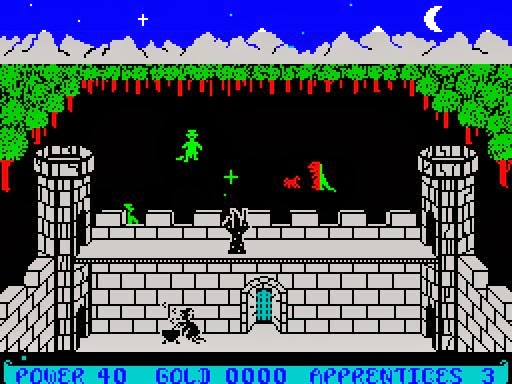
The wizard in question is Gandalf. I'm going to assume it's the Gandalf, because a lot of what goes on in this game is more enjoyable if I imagine Ian McKellen's doing it with his usual avuncular twinkle. After destroying Sauron and giving the hobbits a lift home on his magic horse - I'm not 100 percent on what happens in Lord of the Rings, I'm not a fan - Gandalf has bought himself a nice castle in the woods. That's Gandalf in the middle of the screen, the white lump standing on the battlements and surveying his front lawn. Gandalf's front lawn is infested with Tyrannosaurus Rexes. I really do hope that sentence has never been typed before, but part of me knows that there's almost certainly Lord of the Rings / Jurassic Park crossover fanfiction out there, and a smaller, more terrified part of me knows it's probably sexy fanfiction.


The instructions say they're dragons when they're quite clearly T. Rexes, but it doesn't matter either way because Gandalf can't be doing with them roaming around near his house. They keep trying to open the gate and abduct his apprentice, the figure on the bottom-left stirring the cauldron, for starters. So, Gandalf uses his magic to destroy the dinosaurs, a task that takes the form of a crosshair shooter. Drag your cursor over a dinosaur and press fire to blow it up with a small nuclear explosion, a description that I hope has made at least one of you run out and make an appointment at a place that airbrushes things onto the sides of vans.
The dragon-shooting works okay. The crosshair is dragged back down towards Gandalf when you let go of the joystick, which is annoying, but it's tempered by your magic's lock-on abilities - each magical bolt is like a goddamn Sidewinder missile, and once you have managed to wrangle your crosshair over a target that target is toast.


What else is there to do? Well, magical energy doesn't grow on trees, you know. It comes from the sky instead. When a sustained bout of dragon-zapping, or a collision with the spider that sometimes scuttles around the battlements, has drained his sorcerous essence, you have to take Gandalf to the top of the tower where fresh MP streaks from the sky and into his wand. So magic is like lightning, and my wand is actually a lightning rod, then?


Yes, your wand is very much like a lightning rod. Here it has been hit by lightning, turning Gandalf into a skeleton. He's filled with the wisdom of the ages, but not the wisdom to avoid climbing up to the highest nearby place and pointing a stick towards a stormy sky.


The gameplay continues in this vein for a while, the simple task of detonating dinosaurs being enjoyably complicated by the need to duck into the towers to avoid the roaming energy-draining spiders and to restore potency to your magic wand, as it were. However, no matter how much of a marksman you are the dragons will inevitably manage to open the gate and storm your castle, and once they do they drag your poor apprentice away. These dragonosauruses have yet to evolve manners and they leave the gate open on their way out, but that's for the best because it means you can move onto phase two of Gandalf the Sorcerer - heading into the lands beyond your castle.


There goes your apprentice, dragged into the woods by a Godzilla wannabe for who knows what nefarious purpose. Maybe the dragons have a cauldron that needs stirring, too. Naturally you assume that Gandalf has braved this gauntlet of fearsome beasts in order to rescue his young charge, but you're forgetting our hero's two most famous character traits: his complete contempt for the lives of those around him and his insatiable greed.
You see, Gandalf's magic spell doesn't just destroy dragons - it turns them into gold. That's what the dots are on the ground, small piles of gold that you can collect by walking over them. The "Dragons to Gold" spell seems like an awfully specific one, so specific that you have to wonder how it came to be discovered. My guess is that Gandalf was working on the old lead into gold bit, his incantation went awry - perhaps thanks to a senior moment he shouted "dinodragonsaurus!" instead of "lead!" - and a nearby lizard was transmuted into ten Middle-Earth Bucks worth of bullion. "Close enough," thinks Gandalf, and thus the scene is set for this game.


Accumulating gold is the real aim of the Gandalf the Sorcerer. Collecting a certain amount allows you to move onto the next scene, and so choices have to be made. Do you face death by attempting to rescue your apprentice, a risky proposition thanks to their distance from the castle's gate and the dragon's instantly-fatal fire-breath, or do you grab as much gold as you safely can before returning to the castle, stuffing your ears with coins in the vain hopes that they'll block out the distant screaming of your former pupil but they don't, nothing can stop the tortured moans from ringing in your head?


I mostly went for the coins. It was a decision born more from a desire to stay alive than to get rich, because freeing your apprentice isn't easy: the dragons move quite quickly and your magic spell has changed from being a long-distance bolt of sparkly death into a hex that creates a  landmine wherever your cursor is. You can only have one mine placed at a time, too, leaving you completely defenceless as you wait for the dragon carrying your student to step on your magical IED. If you misplace your mine, an easy thing to do when the cursor is being gravitationally dragged back towards Gandalf the whole time you're controlling it, give up on your apprentice and get back to the castle as fast as your skinny wizard legs will carry you.


Secure enough wealth and the game moves on to the next horde, where the Tyrannosauruses are faster and a different colour. Sometimes an ostrich runs across the screen. I think it was an ostrich, anyway: it moves at a speed that makes Sonic the Hedgehog look like a fat kid on a treadmill, so I couldn't really see it, let alone get a screenshot.
Nothing much changes in the world of Gandalf the Sorcerer, aside from the dinosaurs gradually getting harder to hit until by round six they might as well not be there for all the luck I had trying to blow them up. I didn't get to the ending of this one... except I did, because I looked it up and the game just stops when you clear horde six. I'm glad about that. It means I don't feel so bad about not trying harder to complete it.


I was pleasantly surprised by how much enjoyment I got out of Gandalf the Sorcerer. It wasn't a huge amount - it is still just a two-screen C64 crosshair shooter, when you get down to it - but while it lasts it's a fun little timewaster with a charming sense of immorality to it. The only major problem with it is the crosshair being sucked back towards you, a strange decision that makes it feel as though Gandalf's arms are just really, really tired. I supposed they could be. He's an old man, after all. The graphics aren't great but they're clear and easily distinguishable (beside the blink-and-you'll-miss-it rocket-ostrich) and the in-game tune is just bouncy enough to be engaging with making you want to tape cushions over your ears.


Before I leave the Commodore version behind, I just want to mention my favourite thing about the cover art, and that's the promise of "realistic sound". The realistic sound of what, precisely? Dragons being turned into gold? The only sound in this game you could make a case for as being "natural" is the sound of the thunderstrikes, but it sure as hell doesn't sound realistic. It sounds like a thunder sound effect produced by a Commodore 64, or a robot's flatulence.


In 1986, Bug-Byte Software converted Gandalf the Sorcerer to the ZX Spectrum. They also changed the name to Sodov the Sorcerer. Because it sounds like "sod off," you see. Okay, so, the image of a wizard standing the parapets of his castle and shouting "SOD OFF!" at a dragon so hard it explodes got a chuckle from me. I'm assuming the name change was down to legal issues with the Tolkien estate, who I can't imagine would've been happy with one of old JRR's most famous characters being portrayed as a greedy psychopath with no regard for those who die thanks to his lust for gold.


The Spectrum version plays almost identically to the Commodore version, as you would expect, although to me it felt noticeably inferior. The collisions aren't handled as well, I spontaneously died a couple of times with seeing what dealt the fatal blow and worst of all I couldn't get the joystick to work and was therefore stuck with the insufferable keyboard control method of using Q and A to go up and down, O and P for left and right and any button on the bottom row for fire. Try getting your hands into a comfortable position for that one.


There are a few extra graphical details that I enjoyed in this version. The dragons look more like dinosaurs than ever, although I'll admit my appreciation of that is down to personal preference. Sodov's newly star-spangled robe looks good, and your apprentices get a little "HELP!" speech bubble when they're being carried away, but it's not enough to recommend it over the Commodore original, so if you are going to play Gandalf the Sorcerer - and I can think of a lot worse home computer games from 1984 - that's the version to go for. Just remember that lightning can strike the same place twice, that spiders will drain your magical mojo and that greed, even in Middle-Earth, is good.

12/02/2014

CRUDE BUSTER / TWO CRUDE (ARCADE)

If there's something evil, and it needs a slap, who ya gonna call? Crude Buster!


That's right, today I'll be looking at Data East's 1991 arcade muscles-and-mutants-em-up Crude Buster, know in the West as Two Crude and possibly familiar to you through its Genesis / Megadrive port, which was called Two Crude Dudes. I think I'm going to stick to calling it Crude Buster for this article. Two Crude Dudes implies that I'd be playing the game in two-player mode, and I don't have the required amount of friends for that.


In the futuristic year of, erm, 2010, New York is destroyed in a nuclear cataclysm. The opening text kindly lets you know that "the city was thrown into chaos," just in case you didn't figure that out from the huge atomic fireball engulfing Manhattan.


As if that wasn't bad enough for the residents of the Big Apple, twenty years later the government's attempts to restore the city are thwarted when it's overrun by an evil organisation with the distinctly unthreatening name of "Big Valley". When naming your ruthless band of genetically-altered killers, try to avoid names that sound like the titles of interminably dull black-and-white western movies. Consider that my advice to any fledgling gangs that might be reading this.


Fighting for truth, justice and the fat stacks of cash promised to them by the American government are "Crude Buster," a pair of mercenaries with the bodies of two Schwarzeneggers and the dress sense of a thug from a Mad Max movie. Yes, these men are somehow the heroes of the game and their mission is to "enter the ruins secretly and defeat Big Valley," but luckily for us their idea of secrecy involves throwing cars at people. Onward, Crude Buster, to smack a thousand terrorists in the chops!


At it's core Crude Buster is the usual single-plane, walk-right-and-hit-things arcade title that you've seen a million times before, but it's also furnished with a few extra twists on the theme. The most noticeable of these is that as well as the standard punch and jump buttons there's a button dedicated to picking things up, like the dustbin I have hoisted above my head in the previous screenshot. The stages are littered with grabbable items, from girders to streetlights to billboards, all of which can either be thrown at your enemies or used as improvised cudgels.


You can pick up the Big Valley troops too, assuming you can get close enough to them without being beaten to a pulp. I am a big fan of this mechanic, as it provides further options for causing carnage as well as giving the player a sense of power - the intro may tell you you're a Crude Buster, but you don't really feel like one until you've lifted a hunchback off the ground and thrown him head-first into his comrades. Throwing things should always, always be your first method of attack, because it's both efficient and satisfying.
Something else Crude Buster has is graffiti, and lots of it. In the first few stages almost every flat surface has some kind of barely-legible scrawl on it, and I could probably have written a whole article just about this background vandalism - my favourite is the phrase in the background of the first mid-boss fight that read "choose betweel deth and disglot!" and no, I didn't have a stroke while I was typing that.


Speaking of the mid-boss, he's a man with a flamethrower and a sensible choice of fireproof clothing. His asbestos suit won't do much to protect him when that oil drum I've rolled at him collides with his shins, but once I've run out of things to chuck at him the fight gets a whole lot harder. As is so often the case in games such as this jumping kicks are a safe but extremely tedious way to chip away at the mid-boss' health, but if you're feeling adventurous you can roll along the floor by pressing down and jump, hopefully passing beneath his stream of fire so you can land a hefty kick on his ankles.


I'm only one stage in, but already Crude Buster has endeared itself to me immensely. "Chunky" seems to be the only word suitable to describe the action, and everything is pleasingly big and solid: the Crude Busters themselves, the cartoon sound-effect bubbles that pop-up when you hit an enemy, the crunching thuds of the soundtrack's drum samples, the simple but effective "platforming" element that only consists of moving vertically between the different heights of the background terrain but which still provides a surprisingly large amount of mobility and scope for luring enemies into good clobberin' positions.
It's the aesthetics and presentation that really charmed me, though. You're playing as someone who looks like a Fist of the North Star villain who realised there was more cash to be made working for the government than in terrorising innocent villagers. The post-catastrophe NYC looks great. The enemies have been relatively sober so far, but they hint at greater insanity to come. I threw a car at someone. So far, it's all thumbs up for Crude Buster. Hopefully the appearance of the first boss won't dampen my enthusiasm.


Boss Name: Jake "The Snake" Roberts During His Time in a KISS Cover Band.
Crudeness Rating: Swearing in church.
I'd say using a snake as a whip is pretty goddamn crude. They're living creatures, you sick bastard. As you can see, the first boss has a snake theme, which is combined with a Seventies glam-rock theme. That's the only explanation I have for his silver trousers and platform boots, at least. It's the snakes that are the true threat here, whether they're slithering at you along the ground or wrapping themselves around you so that you have to hammer the buttons to escape, but if you can quickly dispose of his pets whenever they appear this boss isn't too much of a challenge.


Our hero celebrates his victory with a few squats and a winning smile. Lady Liberty seems unimpressed, but then she always looks like that. The presence of the Statue of Liberty in a part of New York that seems to be fairly inland has lead me to believe that Big Valley are trying to conquer the ruins of the city so they can get rich off the salvageable parts of the wreckage. A very rough calculation tells me there's about £90,000 worth of copper in the Statue of Liberty alone! Also, if you're a government person monitoring my web traffic - I looked up copper prices for a joke in an article about an old videogame, I'm not planning on stealing cable from the train lines or anything.


Stage two continues in much the same vein as the first. Just in case I didn't emphasise enough just how much stuff there is lying around for you to pick up and use as weaponry, this screenshot ought to do the trick.


New enemies include these leotard-wearing strongmen, who have a range of alternately hilarious and terrifying facial expressions that put Jim Carrey to shame, and vicious dogs. The dogs are, for some never-explained reason, wearing metal bikinis. Well, the intro did say that Big Valley had access to "the most bizarre weapons" and there's definitely something odd about a dog dressed up like a female warrior from a Conan story. Their armour doesn't protect them from being hit with the pole from a street sign. I felt a bit guilty about that, until one of them jumped on our hero and tried to rip out his throat. That kind of behaviour will do a lot to eliminate sympathy.


I had enough sympathy left over to feel a twinge of sadness for the mid-boss, a grotesque woodlouse man who drew the short straw at Big Valley's genetic engineering facility. The poor sod looks absolutely crushed by what he has become, the battles he must face and the fact that his diet now consists solely of rotting wood and leaf mulch. He can curl into a ball, as you'd expect, but it didn't do much to protect him from Crude Buster's fists and he was soon defeated. It was a mercy killing, really. But what of the stage's true boss?


Boss Name: Jimmy Pickles, the Man with the Sickles
Crudeness Rating: belching at the diner table.
The boss is the... thing at the bottom-right of the screen, not the multicoloured bikers charging skull-first into a meeting with my lead pipe. He's got scythes for arms, which seems underwhelming when you consider earlier Big Valley troops had flamethrowers, but he can also shoot sonic booms at you so I guess he doesn't need a gun. He can be an pain in the arse to fight, with multi-hit attacks that slice through your health like a mutated hand-scythe through butter, but once I lured him over to the stairs and repeatedly crouch-kicked him from the middle step he lost some of his menace.


Crude Buster exceeds the promise of its title in the third stage, where an enemy has climbed the wall so that he can vomit on me from above. That's not crude, that's sociopathic, and if you'll just come down from that wall I'll counter your sociopathy with a little of my own by whipping you with an electric power cable.


As if the barfing weirdos weren't bad enough, I now have to deal with Quentin Tarantino throwing grenades at me. Not to worry, I'll just pick up one of those metal boxes and throw it at him. I'll enjoy it, too, as I've been enjoying the whole game up to this point. It's simple and familiar, but its unique features give it just the right amount of edge to make it stand out from something like, say, My Hero, but even if it wasn't as interesting to play I'd still be enjoying it thanks to the presentation - there's a sense of humour to it, the feeling that Data East weren't trying to be cool or "zany" and that they just built a world they thought would be fun. It's impossible not to warm to the Crude Busters themselves, too: their sprites are packed with character and speech samples abound, like their between-stage cries of "let's fight" and the weary resignation in their voice as they say "what a day!" when getting up after being knocked down. My favourite's when you die and continue they say "we're ba~ack!" in a sing-song voice which, if I was the kind of villain who vomits on people, would put the absolute fear of god into me.


Boss Name: The Galloping Goofball
Crudeness Rating: Using the wrong fork at a Buckingham Palace luncheon.
Stage three has a boss. He runs back and forth, trying to stab you with his face. There's not much I can say to jazz this one up, folks. Just kick him when he runs towards you, as you would a rabid fox or small child.


It's Christmastime in stage four. I can tell because Crude Buster sings "jingle bells, jingle bells" when the stage begins, and what kind of madman would sing carols outside of their appropriate festive season? In the spirit of giving, I have brought these thugs the gift of metal-bar-induced concussions. Ho, ho, ho.


It looks like my ho ho ho-ing has had the unfortunate side-effect of summoning Santa Claus himself. Enjoy your Christmases while you can, kids, because according to Crude Buster at some point in the near future jolly Saint Nick is going to be replaced by a cyanotic goblin whose idea of Yuletide cheer is grabbing fistfuls of grenades and knives out of his sack and throwing them at anyone who happens to be nearby. Normally beating the crap out of Father Christmas would be an unforgivable crime, but this version? This guy we can live without.


You also face a much less interesting miniboss just before Santa. He's got an extending arm and a utilikilt, and I'm only mentioning him because we'll be seeing him again later. Crude Buster is not shy about reusing enemies, even ones that are as annoying to fight as blokes with stretchy arm attacks that you can't avoid by rolling.


A mercenary employed by the US government holds a Billy Idol lookalike over his head during a snowstorm. Neither man is dressed appropriately for the inclement weather. The phrase "I WANT YOU" is spray-painted onto a nearby wall in an hideous shade of unhealthy piss yellow. The mercenary grins from ear to ear as he slams his victim onto the concrete. This is Crude Buster.


Boss Name: Billy Idol Werewolf
Crudeness Rating: wiping your nose on a fellow rail commuter's shoulder.
After taking some damage, the Billy Idol lookalike transforms into a werewolf thing, although on closer inspection I think there's more lion in there than wolf. There's no messing about with this one, the boss just tries to claw you to death and it does a damn fine job of it, too - this is the point where Crude Buster's difficulty level starts becoming an issue, with all the bosses and most regular enemies from here on out being about to take huge chunks of your health bar away with attacks you can't really defend against. I can't offer much useful advice for defeating this were-lion, but if you're playing Crude Buster in the 21st century you're probably doing so via a method that allows you infinite continues, so you'll get there in the end.


Stage five takes you underground, through a disused subway station and into Big Valley's headquarters via the basement. Many of the mid-bosses you fought before have returned to try again, only this time in greater numbers. Here you can see a regular convention of flamethrower troops, and if you give them a chance they'll bathe most of the screen in purifying fire, so try to throw them into each other so they can't surround you. What's the collective noun for pyromaniacs, anyway? A barbecue of pyromaniacs?


While Crude Buster has reached the point at which it's happy to recycle earlier mid-bosses as common grunts, it does still conjure up new ones, like this headless robot. The robot is headless because it has just thrown its head at our hero, further cementing Crude Buster's place in the top five games about throwing things at other things. It turns out that robot heads don't make for great projectiles when thrown one at a time, because our hero can simply punch them out of the air. It's not quite as satisfying as grabbing them out of the air and throwing them back would have been, but I'll take it.


Boss Name: My legal team informs me that I can't tell you the name of this half-spider, half-man creature lest Marvel Comics' lawyers get involved.
Crudeness Rating: drawing a cartoon penis on the wall of a toilet cubicle.
After a minute or so spent lurking at the top of the screen, occasionally trying to grab our hero - an attack that leads to instant death if not avoided - stage five's multi-armed arachnid boss lands on the ground and immediately launches into fearsome sumo combat. He makes for a strikingly effective sumo wrestler, too, thanks to his many arms which he waves around while running forward, the grey and chitinous result of a teleporter accident involving E. Honda and a particularly aggressive tarantula. His flailing hands will tear through your health bar in seconds, but surely that's far preferable an attack based around him firing sticky webs from his mutant spinnerettes, right? The rolling-low kick combo proved effective here, possibly because as a spider he's used to eating flies and thus has problems attacking downwards.


At last, the Crude Buster has reached Big Valley's high-tech base. The base is packed full of mid-bosses from previous stages, so I hope you like the "what a day!" voice clip as much as I do because you're going to be hearing it a lot - it seems like every other attack here knocks you to the ground, and it has the potential to get frustrating. It's a shame, and this final stage is Crude Buster's weakest point. As the difficulty increases but your options for destroying the bad guys don't, the game's desire to do nothing but rip cash from your pocket becomes extremely apparent, even by the standards of the early nineties arcade game. I'm still enjoying it, but I doubt I would be if I was playing Two Crude Dudes, the Megadrive port. You only get three continues in that version, a limitation that is tempered somewhat by your ability to regain health between stages, but still - three continues doesn't seem like nearly enough, especially if you're as crap at videogames as I am. No, if you're going to play Crude Buster / Two Crude, (and I recommend that you do,) it's in your best interest to play a version that allows for infinite continues. Also, bring a friend a play two-player. Not only does it lower the challenge to a more reasonable level, it also means that the Western title makes sense.


This stage won me over a little by having a section set on a moving lift. A lift with no barriers, in a game where I can pick up enemies and throw them. It's going to be a long trip down for this goon I'm carrying around. I'm sure he'll use the time to contemplate his poor life decisions up to this point.
Also, considering it was hit by a nuclear bomb New York is looking pretty healthy back there.


The Satanic symbol on the wall serves as a warning that I'm entering that most heinous of arcade experiences - the end-of-game boss rush. Oh, joy. All the bosses you fought before, (apart from the scythe monster, for some reason,) assembled for you to fight again, in a row, one after the other. You'll forgive me for my lack of excitement. I'm sure Crude Buster has something just around the corner that'll make up for dumping such a gauntlet of dullness in my path.


Boss Name: Doctor
Crudeness Rating: Zero. Crying in public is more unseemly than crude.
I knew I could count on you to pull something out of the bag, Crude Buster. In a scene that's going to go down as one of my very favourites in all of arcade gaming, Big Valley's leader is revealed to be a small, elderly scientist. After briefly weeping over the corpse of one of his fallen mutants - a mutant that you corpsified, naturally - the Doctor runs over to our hero and bangs his feeble fists against Crude Buster's leathery and impenetrable hide. Punch the Doctor in the head, or pick him up and throw him to the ground, and he just gets up and flings himself at you once more with no regard for his personal safety. You have made this old man very angry.


Boss Name: Doctor Satan
Crudeness Rating: Telling the Dalai Lama a dirty limerick while waggling your eyebrows suggestively.
The Doctor is so angry, in fact, that he mutates into a big green devil. Unlike the Devil himself, this broccoli-hued imposter spends his time running back and forth across the screen and doing flying kicks. There's very little strategy you can employ in this fight, because this is a final battle without fairness, without a challenge that can be beaten through skill and without even being fun, if I'm honest. I got most of my hits in during the periods of invincibility you get when you die. If you come up with a more effective battle plan be sure to let me know, but I was happy enough to chip away at Big Green's life bar during the rare moments that he wasn't doing an unavoidable, highly damaging, screen-filling attack.


Even if you do manage to destroy his mutant body the doctor escapes anyway, taunting you with some broken, Yoda-style text that promises he will return to once again cause havoc. They're empty words, because as far as I know Crude Buster never got a sequel and the Doctor is floating out there somewhere in the endless Void of the Forgotten IPs.


With New York's ruins purged of evil, the Crude Busters receive some literal sacks of cash as a reward. That's pretty good, as rewards go. Our heroes decide to go and get a drink, and I'm left with the vague feeling that maybe I'm going too easy on Crude Buster because while I really do like it, it's hardly amazing in terms of its gameplay. The throwing mechanic is good, sure, but overall it's sort of, well, crude, especially in the later stages where avoiding enemy attacks becomes almost impossible and repetition begins to gnaw at your sense of enjoyment... but the setting, the presentation, the personality of the characters, it all comes together to leave me with a big smile on my face and I have no hesitation in recommending that you at least give it a try.


Then this screen pops up and my position feels justified. Truly wonderful, and not just in an "amusingly poor translation" way but also because it seems so earnest: "they are the men of fighting" may not sound quite right, but you still know what it means, and that the Crude Busters will be travelling the world and beating things up for many years to come because it's all they know.


So, I'm saying that Crude Buster, (or Two Crude or Two Crude Dudes or whatever you want to call it,) is something you should play. I also don't expect it to be universally loved. It's not good enough for that, but it's good enough for me.

07/02/2014

BANISHING RACER (GAME BOY)

Have you ever thought to yourself "yeah, Super Mario Bros. is good, but wouldn't it be better if instead of controlling a moustachioed Italian man with a mushroom fixation, you played as a car?" If you have, I've got two things to tell you: firstly, no, that would not be better, as we shall see. Also, congratulations! You'd fit right in at Jaleco, if their 1991 Game Boy title Banishing Racer is anything to go by.


Banishing Racer? What an odd name. Nothing gets banished in this one, except maybe your desire to play remarkably average Game Boy platformers. Thanks to the mix-ups that can happen when transliterating the letters B and V from Japanese into English - as seen in the previous article with the Biggs/ Vicks confusion - I suppose this could be called Vanishing Racer, but that still doesn't make sense because nothing vanishes either. Well, except maybe your desire to play remarkably average Game Boy platformers.


Banishing Racer's opening scenes don't do anything to explain the name, but they do provide an answer about how you're playing as a living car, and that answer is magic. Abandoned and forgotten in a scrapheap somewhere, a big-eyed cartoon car sheds a single tear.


This somehow calls a fairy down from space, who fixes the car up with a wave of her wand. People are struggling, suffering, dying all over the world and their prayers go unanswered, but one hatchback gets all mopey and divine intervention can't get down there fast enough to fix him up? Disgraceful. Of course, I made a mistake in the previous paragraph and the car was alive all along - alive enough to cry, at any rate - so maybe we're looking at a Cars-style human-free universe populated entirely by anthropomorphised vehicles. If that's the case, why was the car in a scrap yard? Is that this universe's equivalent of an old folk's home, or some kind of long-term palliative care ward?


Whatever dismal existence the car was previously suffering through, the fairy's wish has given him a new lease of life which he uses to embark on a road trip across America. On this road trip, you will be controlling the car as he moves from left to right, jumping over some things while jumping onto other things.


No racing, not even any horn-honking - the Game Boy's dearth of buttons sees to that - just platforming of the big 'n' chunky Game Boy type. One button makes the car jump, and the other give it a short burst of speed. Even automobiles follow the platforming game rules, so you can jump onto enemies to get rid of them, with the added bonus that you can use them as platforms. It's all terribly familiar, with the only immediately apparent difference from every other platformer being that you can't turn around. Your car is always facing right, but it doesn't make much of a difference to the gameplay because really, how often are you going to be jumping to the left in this one? I'll tell you: not very.


Here we can see two vehicles about to mate. In nine months, the bottom car will dig a hole in the gravel of a dealership's forecourt before laying her eggs, eggs that will later hatch into a wide variety of two-door coupés and sensible family saloons.
No, of course not, that's me jumping on another car to kill it. Some cars move towards you, some jump into the air every now and then, but none of them are really a threat.


Much more of a threat is the giant bomber that blows up the bridge you were cheerfully driving across mere moments ago. As we're in San Francisco, I can only assume it's the Golden Gate bridge that has just been destroyed. What are the chances that it's one of the many, many other bridges in San Francisco area? I'd say slim to none, but t's all the same to the bomber. Just look at its expression, it'd bomb its own mother if you told it to, and it'd do it with a smile on its face / cockpit.


Speaking of flying, once you reach stage 1-2 your car sprouts wings and takes to the skies, where it is harassed by parrots. I know San Francisco is in sunny California, but between all the palm trees and parrots the developers seem to have confused "California" with "that tropical island where every cartoon pirate buries his treasure".
Somehow, controlling a flying car is less interesting than the basic "driving around on the ground" kind from the previous stage. Just keep tapping jump to maintain your height and try not to think about how much it feels like an underwater stage from Super Mario.


Next you're trying to squeeze past these sinister lorries in a claustrophobic tunnel, which is easily the most engaging of the three stages in the first world because you have to plan your leaps in advance, lest you bounce off a bad guy and into the spikes that line the ceiling. The spikes will kill you in one hit, but then again so does everything else in this game. The fairy may have returned the animating spirit of life itself to our four-wheeled hero, but she imbued him with all the toughness of a wet paper towel and making contact with anything that isn't the floor will cost you a life.


Every city you visit during your road trip is made up of three stages. Some of them have a boss at the end and some of them don't. San Francisco is home to a mini Godzilla creature, which you have to defeat for some reason. No, really, try to come up with a series of events that culminate in a sentient car jumping on the head of a seven-foot-tall dinosaur with fire breath. It'll be a good creative writing exercise for you. Was this the fairy's plan all along? Did she bring rebirth to our heroic vehicle not out of the goodness of her heart but because she needed someone to destroy her enemies? Am I just a patsy in some unseen war for the very heart and soul of America?
Whatever the case, I jumped on the dinosaur's head a few times to defeat it. I tried just bouncing in place on its head, but Jaleco obviously saw smart-arses like me coming and made Godzilla Lite fire straight upwards every time you hit it in order to discourage that very behaviour. Still, it was hardly a difficult fight to suss out and once it's over I can head to Las Vegas.


I can tell I'm in Vegas, because there are roaming slot machines that are trying to kill me. There you go, folks: we've had Planes, but the next sequel to Cars will be Slots, a heartwarming tale in which a young condom dispenser dreams of breaking free of his humdrum life to become a glamorous slot machine at one of Las Vegas' top casinos. Starring Jaden Smith as Johnny the condom machine, Tom Waits as the grizzled craps table who helps him achieve his ambitions and Ray Liotta as the king of the slot machines who will do whatever it takes to keep this young punk in his place. That's Slots, coming to a cinema near you as soon as Pixar lift their restraining order on me so I can stuff the script into their mailbox.


More than anything else Banishing Racer is giving me flashbacks to Jaleco's own City Connection. They're both platform-hopping adventures where the player controls a car that's trying to avoid touching other cars, with Banishing Racer feeling like a pseudo-sequel to City Connection where the gameplay has been stretched along a more traditional hop-n-bop axis than the puzzle-like feel of the original. This is to Banishing Racer's detriment, because where City Connection feels fairly fresh and charming even now, Banishing Racer is Just Another Platform Game with little to recommend it over its competitors.


Then I was killed by a familiar monkey. I had a little trouble parsing his face at first - I kept seeing his mighty gorilla pectorals as some kind of inflatable throat-pouch - but there's only one ape with this barrel-throwing pedigree and I eventually recognised him as Donkey Kong. Nintendo's lawyers clearly didn't, but I know DK when I see him. I'd hesitate call him the boss of Las Vegas, partly because all you have to do is drive past him without getting hit but mostly because calling an ape the "boss of Las Vegas" makes me wish this was a game about a gorilla who's also a Mafia don and I can't handle the disappointment of that not being the case.


Onward to world three and... Denver. I'm sorry, my American cousins, but after the glittering metropolises of San Francisco and Las Vegas it's a little hard to get worked out about Denver, Colorado. Even the game doesn't make much effort to spice up the experience: it's all farms, fields and rocks.


There's another flying stage that's notable only for the appearance of these retracting spikes which just scream Mega Man 3 to me. They don't literally scream that, of course. It's beyond the capabilities of the Game Boy's hardware, and if they were going to scream anything it'd be "die die die" as they slide towards the car's unprotected underbelly.


Sometimes a UFO will try to abduct you, and I will confess that this goes down in the "pretty cool" column of my mental notebook. For all it's unoriginality and occasionally frustrating nature, Banishing Racer does have just about enough fun little moments to keep me interested, like the high-kicking cowgirl sign in the Vegas stage or this attempted extraterrestrial kidnapping. I like that the saucer's under-domes look like huge goofy teeth. Forget my earlier pitch, Pixar: make UFOs your next vehicular film and have the main character be a dopey interstellar redneck and I will buy one hundred tickets.


Denver's guardian is a bulldozer, and like the dinosaur before it you just need to jump on top of it a few times to claim victory. However, it spends most of the fight with its plow raised to protect it's weak spot, only lowering it in order to throw rocks at you. That's what I learned from this game - that Denver is composed of farms and rocks in pretty much equal measure. Anyway, I recommend bouncing on the bulldozer's projectile rocks before going for the weak point. It keeps you out of trouble as well as giving you much-needed practise for an upcoming battle.


World four is set in Detroit, which seems appropriate considering I'm playing as a car, and while there is a factory in the final stage most of Detroit is made up of fluctuating water levels and seagulls that drop rocks on you. I hope they're rocks, anyway, and not the other stuff that seagulls are known to drop on people. Given the size and solidity of their projectiles, these seagulls could do with some senna supplements.


There's an underwater level, which works exactly the same way as the flying stages except your car is rather adorably dressed in a snorkel. His charming appearance goes some way to deflating my anger about being underwater when in the previous stage I lost a life if my front tyres got so much as a light spritzing. There must have been a between-stage rustproofing scene I inadvertently skipped. That bootleg squid, clearly inspired by Super Mario's Bloopers, is fun too. Between that and my automotive scuba gear I'd say this is the best of the "flying" stages.


On to the factory, which is where Banishing Racer starts getting difficult, for a variety of reasons. It's partly down to the usual upwards surge of any platform game's difficulty curve - there are more enemies about, more obstacles to avoid and narrower margins of error in which to avoid them. However, the difficulty is amplified by the quirks of the game's physics. For one thing, it's sometimes hard to tell if your car is going to make contact with the platform you're slinging it towards. I've mentioned this before in the Beethoven's 2nd article, but it's a problem that arises when your character is longer than they are tall: where is their contact point with the ground? It's difficult to judge when you're playing as something that doesn't have feet, and in Banishing Racer's case you can just about say it's your back wheels that have to land in the right place, but it's a fairly nebulous part of your sprite and often you'll fall off a ledge you could have sworn you'd landed on.


Your little car can also "dash" very briefly for a little extra speed, and I'm not sure if this was down to my own incompetence or the game's controls but I seemed to have frequent problems with getting my car to jump after a dash. A much better use for the dash is to use it after you've jumped, in which case it propels you further forward than a jump alone would. I'm not complaining about this mechanic - it makes a nice change from the norm and it helps with bouncing from enemy to enemy without touching the ground, which not only is the best way to earn extra lives but they're also the moments when Banishing Racer is most fun. It's just that it's so contrary to the usual videogame "dash, then jump" technique that it requires some getting used to.
Oh, and did I mention that you die in one hit from anything? Because that quickly becomes tiresome, especially when the small screen of the Game Boy gives you little chance to react to oncoming traffic. It's not something that ruins the game, but if it was a touch more forgiving I think I'd enjoy this adventure that little bit more.


Our hero has reached the final world and his final destination: New York, where things look more like City Connection than ever before, as this screenshot shows.


Surely there has to be some connection, no pun intended, between the two games? I wonder if they shared some production staff, because the alternative is that there were multiple people at Jaleco who separately thought that cars avoiding other cars while driving along girders was an idea that could sustain a videogame.


Okay, so it's not just cars you're avoiding. There are also Pac-Men on springs that bounce across the scenery. Coming soon from the people who brought you Cars and Planes - Pac-Men on Springs! Okay, enough Pixar pitches for today. I'll gather them all together and offer them to a mockbuster-producing company like The Asylum once I've finished this article, but first our car needs to take a trip on the subway.


Yep, a car taking the subway. That all seems logical. I like that you have to jump over the ticket barriers. It's not just Grand Theft Auto that's warping our children's minds with its brazen displays of criminality.
It might seem ridiculous to have a car getting on the underground, but you're missing the point. This is all an excuse to get out hero beneath the surface of New York. And who else lives underneath New York?


The Teenage Mutant Ninja Turtles! Or their bootleg allies the Young Adult Judo Tortoises, an organisation that decided nunchucks were the superior weapon and so outfitted all their members with a pair. After this, I think you'd be well within your rights to describe Banishing Racer as "that game where you run over the Ninja Turtles with your car". Call it a lazy pop-culture reference if you like, but I'm always happy to see the Ninja Turtles.


Okay guys, that's enough with the Ninja Turtles now.


Here's the final stage, where Banishing Racer somehow manages to be both at its best and its worst. It's a forced-scrolling stage featuring multiple paths, many of which lead to extremely challenging switchbacks that have to be taken as fast as possible, leading to gameplay that's more about memorisation than skill... but when you have figured out which routes to take, the game flows together in a satisfying way as you try to quickly bounce from enemy to enemy in order to clear the road to victory and a confrontation with the final boss.


Said boss is a tank that transforms into a bipedal armoured chicken-bot. Or maybe it's an eagle, and the fairy repaired this car so it could travel across America and defeat the ultra-nationalistic Eagleborg 3000 before it can start punishing people from not displaying the Stars and Stripes or lacking interest in the Superbowl.
As ever, launching your car onto the boss' head is the way to win. I hope you got plenty of practise in using the bulldozer boss' rocks as platforms, because you'll be doing the same thing here only with missiles instead of boulders. If you had a health bar then this fight would be a breeze, but because you die in one hit the battle is balanced somewhere on the line between "tense" and "frustrating." It only took me a couple of tries so it can't be that hard, and once Robobeak is neutralised the game is over.


The car flies into space at the end. I can't see a reason why this would happen, but then again I also fought the Ninja Turtles and grew wings on occasion so it's perhaps best to not think too hard about these things.


Banishing Racer is an average game, but what did you expect? It was made by Jaleco, and they only ever made average games. I'd say it's on the higher end of average, mind you - despite the drawbacks created by the controls, lack of originality and unpredictable difficulty spikes, there's just about enough here for you to get some fun out of a playthrough. The graphics are charming in a simplistic way and the gameplay is serviceable, occasionally reaching "rather diverting" on the Pleasure Barometer, especially when you've got a bit more freedom to put car-squashing chains together. Plus it makes a great trivia question answer: which was the only game to feature Donkey Kong, the Teenage Mutant Ninja Turtles and a swarm of Pac-Men with springs wedged up their backsides? That's Banishing Racer, only from Jaleco.

VGJUNK Archive

Search This Blog

Followers