oday’s article is all about a 1986 arcade game from Taito. No, not Bubble Bobble. Not Arkanoid, either. This game is called… well, it gets a bit complicated. In Japan it was released as Violent Shooting, which raises questions about whether there can be a game about shooting guns that isn’t intrinsically violent. Then it came west, where it was called Cycle Shooting. A slightly more descriptive title for the contents, because you definitely have to shoot at some (motor)cycles. Then there was a bootleg version called Bronx, which is technically the version I’ll be playing today because both Violent Shooting and Cycle Shooting seem to be unemulated a the moment. As far as I can tell, the only difference between Bronx and the official versions of Violent Shooting is the title screen, so I figured that’s close enough.
Here’s the brand-new title screen that the creators of this bootleg went with. One might argue that they shouldn’t have bothered. I don’t know about you, but I can’t help seeing it as “the square root of bron,” and I have no idea why you’d even call this game Bronx because it has nothing to do with that particular part of New York.
What is does have is a strangely-proportioned young lady running down the middle of a road while being harassed by a gang of hooligans on motorbikes. I know she’s all geared up like she’s on her way to her mid-week roller derby match, but she’s not wearing skates. Even if she was I doubt they’d give her enough to speed to outrun the thugs who, of course, kidnap her. Oh yes, Violent Shooting is ferreting through the bottom of the “rescue the abducted female” barrel for a storyline, and now it’s up to you – the nameless, gun-toting hero – to save this woman.
It turns out that the “shooting” part of this game’s many names is accurate, because hey look, it’s a lightgun game. A very basic lightgun game, at that. You point the attached gun (if you’re playing on an actual arcade cabinet, anyway) at the screen and shoot the bad guys. This makes Violent Shooting’s gameplay quick to describe, and in fact I’ve already covered all the salient points. There’s no reloading, no special weapons or screen-clearing grenades and no shrieking hostages that you’re supposed to not shoot despite their arm-waving, attention-grabbing antics. As I say, it’s about as basic as a lightgun game can get.
I should also mention that while this “Bronx” version of the game is emulated, it’s not emulated well and there are plenty of issues that popped up while I way playing. They were mostly graphical errors, especially with sprites appearing on the wrong layer of the playfield, and normally I wouldn’t write about a game when I can’t get a feel for what it’s really like but despite the rather bland gameplay Violent Shooting was interesting enough for me to play through it anyway.
So here we are, shooting at a motley crew of mohawk-wearing shoulderpad aficionados in a post-apocalyptic wasteland. Some of them have motorcycles, some of them have cars and a couple of them even have small personal helicopters, because as always these post-apocalyptic survivors are forever bleating on about the lack of fuel but there’s always enough to keep roving gangs of motorbike psychos on the move. As always in these situations, we must decide whether the aesthetics are influenced more by Hokuto no Ken / Fist of the North Star or Mad Max. You might think that’s a moot point, because Fist of the North Star is hugely inspired by Mad Max in the first place, but there’s a subtle distinction – Mad Max drives a car and uses a gun, but Fist of the North Star’s Kenshiro punches people until they explode. Like I said, it’s a subtle distinction. I’m leaning towards Mad Max because of, you know, the shooting, but those ruined buildings back there look very much like a Fist of the North Star backdrop.
Halfway through the stage, the punks were replaced by a swarm of floating, grinning balloons that grant points when shot. While the bad guys in Violent Shooting are hardly the roughest, toughest looking bunch of hombres, it’s a bit jarring to suddenly be shooting at something that seems to have drifted in from Hugsy Smileington’s Adventures in Balloonland.
I do like these punks, mind you. Even though they’re trying to kill you (and succeeding) they’ve got the air of bumbling losers, especially when you shoot their motorcycles and they comically roll along the asphalt with goofily exaggerated expressions rather than having all their skin sheared off. It’s a fun look, and it's about as close as we’re ever likely to get to a Mad Max / Fist of the North Star lightgun game so I’m having a nice time even if the gameplay is very one-note.
Moving on to stage two, and rather than the scrolling roadway of the first stage it’s a static screen showing a petrol station overrun by, you guessed it, a biker gang who took full advantage of the local boutique’s “buy a pair of shoulder pads, get a free eyepatch” offer. The most notable new addition here is the cutesy cartoon cat that scampers around the screen. Aww, isn’t it adorable? All fuzzy and cute. Shame I had to shoot it to collect the points bonus it was carrying, really.
You spend your time on this stage shifting between shooting gang members and fuzzy critters, and it’s fairly important that you shoot both kinds of target. I was rather taken aback when I started playing Violent Shooting and realised I only started with two blocks of health in my life bar, a measly amount that is quickly shredded should you miss a shot on even a single enemy. In fact, it was a real challenge just to get past the first stage, so quickly was my health bar depleted whenever I didn’t take out a single punk in time (which was a lot, because I’m bad at videogames.) My two top tips for Violent Shooting success, then: shoot the balloons and animals because they give you extra health when you collect enough points, and don’t hammer the fire button because your gun fires in a “bang-bang, bang-bang” two-shot rhythm which can leave you vulnerable between those two shots. Of course, this is all theoretical, because most of the time I lost health it was due to an enemy I couldn’t even see. As in, there was no enemy sprite there at all. I’m going to put this down to emulation issues, because surely even a mid-eighties arcade game wouldn’t be cruel or greedy enough to have invisible enemies.
This stage has a boss at the end, but it’s not just any boss – it’s Arnold Schwarzenegger himself! Specifically, it’s John Matrix from Commando, if the body paint and rocket launcher are any indication. He operates as a pretty typical lightgun game boss. Keep shooting him so he can’t shoot you, only adjusting your aim to shoot down the rockets he occasionally fires at you. I’ve fought a thousand lightgun game bosses like him before, but happily this one has the advantage of being a super-deformed cutesy version of Arnold Schwarzenegger: something you don’t see very often, and probably for good reason. Taito definitely pulled off the look, though. Immediately recognisable as Arnie, an engagingly silly design and some bright red high-heeled boots just to spice things up a little.
Once I’d managed to shoot the boss enough times, he died. That’s to be expected. Less expected was the row of bullet wounds that appeared across his chest and the blood oozing from his mouth. It’s still presented in a cartoonish manner, but it’s a little gorier than I thought Violent Shooting was going to get. In fact, one of the most noticeable things about this Taito game is how un-Taito-y it feels. I know they’ve got a wide range of different genres and aesthetics under their belt, but whenever I think of Taito arcade games I think of Bubble Bobble and Rainbow Islands, not eighties action movie stars leaking blood like an oversaturated sponge.
Onward to stage three, which is a lot like stage one except it takes place in a tunnel of some kind. Violent Shooting’s biggest problem is that it becomes repetitive almost immediately. Most lightgun games are, by nature, rather basic in terms of gameplay design but they (the good ones, anyway) keep things interesting with new enemies, hazards and locations. Not so with Violent Shooting, because you’ll be blasting away at the same set of hairspray-hogging punks for the entire game, the action set against backdrops that you could hardly call exciting. The only new feature in this stage is that the punks will now throw bundles of dynamite at you, which must be shot out of the air.
I thought that the sound that exploding dynamite makes had long been settled on. Bang, boom, kaboom, all acceptable onomatopoeia. “Krash” is a new one on me, unless they’re chucking the dynamite through a plate glass window before it explodes.
Another day, another single-screen stage populated by the same villains. Sometimes they ride up and down in the elevator on the side of the building, so that’s new. Also new are the strange fuzzy chicks that wander around the screen, disconsolate that Taito didn’t choose them to star in New Zealand Story and desperate for the player to end their miserable existence. “Go on, do it.” their fluffy little faces seem to say, “You’ll need those points.”
Yes indeed, I will need those points and the precious life energy they bring, because this stage has a fight against two bosses at once. They’re punks, but bigger and with even more extravagant shoulder pads. If they had a running start and jumped off a cliff, they could glide for miles on those things, obviating the need to terrorise the innocent post-apocalyptic survivors during their relentless quest for petrol. Maybe that’s why they spend this fight leaping around like kangaroos with tasers stuffed into their pouches, they’re trying to figure out their own aerodynamics.
Anyway, the fight is simple in concept but difficult in practise, because Violent Shooting is hard enough without having two fast-moving targets gunning for you at once. I managed to triumph, however. I’m not sure whether it was through luck, design or poor emulation, but one of the bosses decided to wander away for a significant portion of the fight, leaving me with only one target. I don’t know how or why it happened, but I’ll take it.
Another scrolling stage now, this time a jaunt through the irradiated wasteland with a large tanker for company. I assumed I was supposed to be protecting it – and I’m pretty sure that is the case – but obviously I shot it a few times just to see what would happen. Nothing, is the answer. Nothing happened. I mean, I lost a life because I was too busy shooting at the truck to get rid of the punks, but nothing happened to the truck itself.
The action then moves on to this series of wooden bridges, which are naturally infested with gang members on motorcycle. A bloody ton of them, even. They just kept coming, wave after wave, with no end in sight no matter how many of them I reduced to red smears on the road. I began to worry that the game was broken somehow – more broken that it already was, I mean – and that I was trapped in an endless loop of logs and punks.
Then I accidentally shot one of those grey blocks, and it exploded. So those are bombs, then? Okay, so I have to shoot enough bombs to destroy the bridge. Well, that’s something a bit different, at least. It’s not fun, not when the bombs whizz by at a speed that makes them far harder to blow up than it feels like it should be, but having a concrete goal to aim for is nice.
Now we’re at the final stage. You can tell it’s the final stage, because the kidnapped lady from the intro is tied up at the top of the screen. Much like the tanker, I had to try shooting her too, just to see what would happen. She made a noise. I don’t think it was the noise she was supposed to make, because it sounded like R2-D2 stubbing his toe. Maybe there’s meant to be some digitised speech in there. “Cut it out, you berk,” something like that.
As for the stage itself, well, you shoot some punks. That’s it. Violent Shooting is a very short game even by the standards of the lightgun genre, and that’s definitely for the best. It doesn’t have the energy to sustain itself for the stages it does have.
The final boss appears, and I was not expecting it to be some kind of armoured cherub, an enemy I’m pretty sure I fought during Bayonetta. I was expecting it to be a punk, but bigger. RoboPutto is what we’ve got, though, so I got down to the shooting only to discover that the boss is carrying a large, bulletproof shield and the only way to land a hit is to fire during the very brief window when the boss lowers their shield to fire at you. This is easier said than done, because the boss runs around the screen pretty quickly, but it’s a decent-enough set-up for a boss fight in a lightgun game.
Eventually I landed enough shots to knock off the boss’ helmet and reveal that – gasp – I’m fighting against a lady! I think. No, hang on, she’s got armoured boobs, it’s definitely supposed to be a woman. This would be more interesting if the boss had any backstory or motivations to speak of, but I suppose it’s still better than fighting yet another gang member.
A few hits later, and the boss is defeated by the power of embarrassment as our hero shoots all her armour off. You even get a couple of frames of full-frontal, single-pixels-for-nipples nudity to keep all you perverts out there happy. What a way to end a strange little game.
As far as an ending goes, you get to see our hero in the flesh. He looks a lot more like Max Rockatansky than Kenshiro, so I guess that clears up the whole Mad Max / Fist of the North Star influence debate. Not that he looks that much like Mad Max, mind you. I don’t remember Max wearing a tweed jacket with leather elbow patches. Not-Max and his lady friend get their revenge by tying the villain up at the top of the screen – poetic justice, if the poet in question is someone scrawling a dirty limerick on a toilet wall – and Violent Shooting / Cycle Shooting / Bronx comes to an end. Except it doesn’t, it loops back to the first stage with increased difficulty, but as far as I’m concerned it’s done.
Normally I’d try to come to some kind of conclusion here, but because I can’t be certain about what Violent Shooting is really like when it’s all working correctly I think it’d be kinda unfair to do so. That said, from what I’ve played it seems like a technically competent but very limited game. There’s not much here to keep you coming back for more, you know? On the plus side, the setting is a weird enough take on a very familiar world to make it interesting to play through once or twice, and it’s hard to argue with that tiny Arnie boss. Maybe one day it’ll be fully emulated and I’ll go back to check up on it, but for now I’ll go back to trying to figure out a way to cryogenically preserve myself until the Yakuza Fist of the North Star game is released and I can get my post-apocalyptic thug-fighting thrills that way.
Showing posts with label taito. Show all posts
05/09/2017
13/03/2017
RECALHORN (ARCADE)
At VGJunk today: a game with a title that sound like someone being ordered to remember a brass instrument. It’s also an unreleased Taito arcade game, so that’s got to be worth a look, right? It’s the 1993 Dr.-Doolittle-em-up Recalhorn!
I only understand fifty percent of “Recalhorn” as a title. The main character can attack with a musical instrument so I guess that’s where the “horn” part comes from, but as for the “Recal” bit, I haven’t got a clue. Does he have to recalibrate his horn after every attack? Was his horn recalled from the market after the mouthpiece was found to be made of asbestos and used bandages? We may never know. The logo’s constructed from musical notes, which might leave you to believe there’s a musical theme to this game, but there really isn’t besides the main character being so bad at playing the horn that the sound can kill animals.
There’s nothing in the way of plot at the start of Recalhorn, although I suspect that might be down to the game’s prototype status. There are a couple of screens of information about the game’s various pick-ups and mechanics, but they’re very dryly presented on a plain green background which suggests to me they’re more of a placeholder than anything. So, we’re left to imagine our own plot for the game. Why is this kid – let’s call him Horn – setting out across the world of Emerald Forest? Obvious contenders would be kingdom-saving and princess-rescuing, but let’s give Taito some credit and say they mixed up the usual formula by having Horn travel to a music shop so he can buy a horn that doesn’t murder wildlife. A noble goal indeed, so let’s get into the action!
The game begins, as is only reasonable, with round one of area one. The game is split into four “worlds” that each contain a couple of stages, and for this exciting introduction to the adventure of Recalhorn, Taito have gone with… a forest stage. Maybe they’re saving all their innovation for the later stages.
Of course, there’s not much Horn can do while he’s up on this cliff, so how’s he going to get down into the fray?
He’ll just jump right off the sodding cliff, that’s how. It’s an easy way of informing the player that they don’t have to worry about fall damage, I suppose, and it gives Horn a bit of character. That character is that he’s a reckless idiot, sure, but there’s nothing wrong with that when it comes to videogame heroes.
Now that the game’s underway, we can see that it’s a platformer, and a very platformer-y platformer at that. Horn can run and jump through the fantastical landscape of, erm, trees and rocks, collecting gems and defeating the hostile animals by either tooting his flute at them or by jumping on them. I’d recommend the latter, for several reasons. The horn is a little difficult to aim because it doesn’t travel horizontally and, as we shall see, you won’t be in a position to use it for much of the game anyway. Jumping on things, however, is much more fun and also allows you to bounce up off the enemies to reach higher platforms and treasures. It’s a perfectly acceptable system, even if Horn does feel a little heavy especially in this horizontal movement, and while my immediate impressions were that things seemed a little generic so far, I was cheered by the really lovely flock of flamingoes that fly past in the background when you reach this point. A prototype game this may be, but it’s almost entirely complete and the developers obviously lavished a lot of time on it.
The rest of the opening stage is a pretty by-the-numbers affair. You ride some hovering platforms, you bounce on some springy mushrooms, you get chased down a hill by some falling debris. I reminds me of a slower-paced Sonic the Hedgehog more than anything, right down to the hero wearing pointy red shoes. I say “the hero”, although I’m not convinced that Horn is in charge of this situation. You see that rabbit-thing he’s wearing on his head? If you look at the lives counter at the bottom-left, it clearly indicates that the rabbit-thing is actually the player, and he’s merely controlling Horn’s body like a fuzzy-wuzzy cordyceps infestation.
Things get a bit more interesting at the start of the next stage. Horn spots something in a cage, and precedes to beat the everloving shit out of said cage in traditional cartoon melee style. Whatever’s inside that cage, it has caused Horn to fly into a violent rage, unless he’s simply infuriated by the very concept of cages.
Oh, there’s a monkey inside. Now it makes sense. The rabbit-thing has ordered Horn to break open the cage so it can spread its parasitical infection to a new host species. This is why the monkey is now under my control and can be summoned to do my bidding. However, monkeys are a notoriously mercenary genus of animal and will only cooperate in exchange for either bananas or gold coins. Luckily I have collected a large gold coin, so I can not only summon this ape to aid me, but I can ride him around!
This, then, is Recalhorn’s true gimmick: the ability to befriend and ride a few different animal companions, starting with this monkey. You can switch animal whenever you like by hitting a button to open a menu and choosing to spend one of the gold coins you’ve accumulated during your adventure. This is why the “horn” part of Recalhorn’s name quickly becomes redundant, because you can’t use your horn when you’re riding and after this point in the game there are very few situations when you won’t be riding an animal because their advantages are too useful to ignore. For example, the monkey can jump far higher than Horn can on his own, and it can hang from certain vines and ropes and carry itself along hand-over-hand. When you’re on the monkey your horn might be useless but the monkey can still attack, with a spinning vertical jump that’s excellent for taking out the game’s many airborne enemies. All in all, the monkey represents a significant increase in Horn’s abilities, even if the increased bulk of a rabbit-thing riding a kid riding a chimp means it’s now a bit more difficult to land on platforms accurately.
I thought it was very rude of Sonic the Hedgehog to show up and try to stop me collecting this monkey coin, though. You’d think he’d have a bit of solidarity with a fellow platforming hero, but he seems to be in a foul mood. Maybe it's because Horn has copied his trademark footwear, or maybe he’s pissed off that Horn gets a capable, dependable monkey helper and all Sonic gets is Tails.
With the help of my simian companion, the rest of the stage was a breeze, even if I did lose a bit of health trying to get a closer look at those bootleg Sonics. It’s appropriate that those hedgehogs make an appearance, because as I say Recalhorn definitely has strong Sonic the Hedgehog vibe to it. The way the stages are divided up feels a lot like Sonic’s Zones and Acts, and take this scene at the end of each stage – you run past these flowers, and for every flower bud you touch a new blossom blooms and you get some extra points. Even better than that, though, is that if you time it so you’re doing an attack or jumping around when the clock stops, you get bonus points for your cool posing abilities. I loved it when when you could do it after bosses in Castlevania: Harmony of Dissonance and I still love it here.
The next area takes place in some flooded caves, and just after the beginning of the stage where you push a boulder into a spike pit so you can use it as a stepping stone – something I’d hesitate to call a puzzle because the solution is “walk right” - Horn meets his second animal friend. It’s a seal, and I’m sorry, monkey, but you’re out on your ear. The seal’s main advantage is, unsurprisingly, that it can swim. This comes in very helpful in later underwater stages. It’s not that the monkey can’t breathe underwater or anything, it’s just easier to get about when you’re evolutionarily honed for aquatic action. The seal also has a low-to-the-ground horizontal spinning attack, useful for ploughing through groups of land-based enemies and traversing narrow passageways alike, and I might be wrong about this but the wider horizontal “base” of the seal seemed to make it easier to land on top of enemies. Plus the seal is the cutest of the animals, so I feel confident in naming it my favourite.
The seal’s pretty handy out of the water, too. It can’t jump as high as the others, but all the platforms in this (very nicely drawn) waterfall grotto are low enough that it can flop between them easily enough. It should have any trouble dealing with the combined threat of the blobfish and the armadillo you can see above. I say “combined” threat, I think the blobfish offers exactly zero percent threat to that particular equation. That armadillo, though – those are the eyes of a creature with nothing left to lose, and there’s nothing more dangerous than that.
No sooner had I got a handle on seal-wrangling than a spout of water spat me out of the cave and into the first boss battle. It’s a bull. A bull wearing green leggings? Quite possibly. It’s good that it could find some leggings with space for its tail. Anyway, to defeat the boss, you have to jump on its head a bunch of times. Not too difficult, considering all the boss does it run back and forth across the screen. The only challenging aspect is reacting when you do jump onto the boss’s head, because there’s no telling which direction you’re going to rebound in. Maybe you’ll continue bouncing in the direction you're travelling, a la Super Mario. Maybe you’ll bounce straight up and can land on the boss’s head again without touching the ground. Or maybe you’ll hit the narrow area of contact that causes Horn and his steed to rocket across the bloody screen in an almost horizontal arc, usually sending you straight into the dangerous bramble patch at the edge of the screen. It’s a mystery I certainly never managed to decipher, and by the end of this game I’d had plenty of practise.
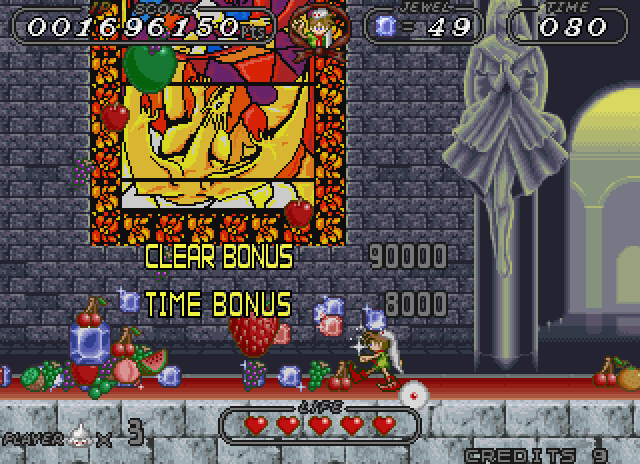
With the bull defeated, Horn is showered with a wealth of points items that show Taito are still obsessed with giant fruit. From Bubble Bobble to Rainbow Islands to Liquid Kids, you can always rely on Taito for a level of dedication to oversized produce rarely seen outside the world's most hardcore allotment owners.
World two of Recalhorn begins one a treacherous mountain pathway, where Horn meets a lion. Not a mountain lion, oh no, that would make too much sense. It’s your regular old plains-of-Africa type lion, and it’s the third and final of your animal friends. The lion’s strengths are speed and, well, strength. It’s got a lunging bite attack that makes you almost invincible while you’re using it, and it’s got the foot speed to outrun any hazard that might be chasing you. However, the lion’s most prominent feature is that the horizontal distance of its jumps are ridiculous. If you’ve built a bit of speed up, you can jump across multiple screen in a single bound. That sounds great, and it does have its uses, but mostly it makes the lion an absolute nightmare to control. Trying to get a large animal that moves like buttered lightning to traverse any series of platforms is far more hassle than it’s worth, especially with a stack of monkey coins burning a hole in Horn’s pocket, and consequently I used the lion far less than the other two.
That’s not to say the lion is all bad: its charging attack means getting through groups of enemies is a complete breeze, for one thing. It also has a cheerful expression of very cat-like contentment, plus it’s braided its mane and put beads in there so you know it’s a stylish lion. Still, once I’d endured multiple failed attempts at getting the lion across these collapsing pumpkin platforms I knew it was time to switch to a different animal.
As an ice cave was up next, the seal seemed like a good choice. It certainly seems to be effective against this moose, I’ve jumped on that poor thing so hard that its head appears to be exploding like Hitler's at the end of Bionic Commando (only less satisfying.)
The best thing about this stage (which I sadly missed getting screenshots of) is that you’re harassed by a group of weird-looking snowmen with slightly inflated faces that aren’t entirely dissimilar to the blobfish from earlier. If you jump on these snowmen enough times to knock them apart, a cutesy little fox emerges from the pile of snow, looks shocked for a moment and then scampers off into the depths of the stage. It’s a lovely and wonderfully pointless creative flourish, and for a game that was (as far as I can tell) never released beyond location testing Recalhorn is packed with moments like these. There are things like the aforementioned points bonus for posing at the end of the stage, or the way the seal does a little flip when it jumps out of the water, or that the flowers that act as mid-stage checkpoints have an air bubble around them in the underwater stages. There’s a level of polish to Recalhorn that really sells the action, which is mostly above average but rarely excellent.
Now I’m going to ruin all those pleasant vibes by showing you what the monkey looks like when you ram a massive ice spike up his ape-hole.
The boss of this world is a mammoth with a monk’s haircut. You might think having the same hairdo as Francis of Assisi is the weirdest thing about this mammoth, but then you look down and realise it’s got human feet. It’s Frankenstein’s Mammoth! No amount of human appendages can protect it from the lion’s ferocious assault, however, so I just jumped into the mammoth’s face repeatedly. It’s the same fight as the previous bull battle, except that the mammoth can sometimes make icicles fall from the sky. The lion can jump though those, too. Looks like you should have stayed extinct, pal.
Now we’ve reached world three, which begins with a seaside feel. Lots of big blue skies, the gently lapping waves, the convenient grabbable rope bridges for the monkey to swing along. As with the rest of the game thus far, it’s jolly enough and quite good from a gameplay perspective but I still can’t shame the feeling that it’s all a bit… underwhelming. Animal-riding aside, Recalhorn is just a hop-n-bop platformer, and while Taito have clearly devoted an endearing level of care and attention to it, that doesn’t stop the game from being the usual round of jumping on the bad guy’s heads in a forest or an ice cave or at the beach.
This stage is also working hard to justify my comparisons to Sonic the Hedgehog.
Actually, having said that, Recalhorn also reminds me of Bubsy. No, really. Imagine if you can (and I don’t blame you if you can’t) a version of Bubsy that isn’t a frustrating, tedious mess to play. Recalhorn shares a similar sense of speed, a similar fondness for slightly awkward jumps between small, densely-packed platforms, a similar sensation that you’re playing a game that owes perhaps a little too much to its earlier competitors. It’s probably just me that thinks this, and don’t get me wrong: Recalhorn is a much, much better game than Bubsy, but that’s what it reminded me of.
Most of the rest of this world takes place underwater, so it’s a good job I’ve befriended / enslaved a seal. There are narrow passageways of sharp coral to navigate and dive-bombing manta rays to deal with, and it’s just the change of pace the game need to keep things interesting.
Obviously the seal is very helpful in this stage, but it’s not like you have to ride it. The lion’s probably not worth the hassle of flying off the screen and into the automated spike traps of a sunken pirate ship, but the levels are designed so that the monkey is perfectly capable of making it through the stages. One thing Recalhorn does well is providing the player with multiple alternate routes through each stage, most of them tailored to the strengths of a particular animal, and even when they’re as simple as “the higher-up route has fewer enemies but more challenging platforming” it helps to make the stages feel more expansive and enjoyable to explore.
Then you get to the sunken pirate ship’s interior, and that’s where Recalhorn reached the point that made me think “oh yeah, this game’s starting to get kinda difficult now.” Not in an obnoxious way or anything, there are just a lot of enemies about and traps that require a bit of patience and forward planning to negotiate. The only problem with that is that I nearly ran out of time. I nearly ran out of time! In an arcade game! I can’t remember the last time I played an arcade game that wasn’t specifically about beating the clock where I nearly ran out of time. The timers in most game, and especially games like Recalhorn, almost never have any bearing on the gameplay, so that came as something of a shock.
The next boss slops and slithers into view, and it’s an octopus with the cold, dead eyes of a postal worker in the week before Christmas. Do you bounce on it’s face to defeat it? Of course you do. Recalhorn’s not one for providing much variety in its end-of-world boss battles. Because the octopus is constantly birthing a stream of smaller, flying octopuses, if you’re good enough you can get through most of this fight without even touching the ground by bouncing off them. I was not good enough to do this – probably because I felt guilty about battering this octopus during the magical experience of childbirth – but I still didn’t have any trouble beating it and moving on to the final world.
It’s time for Horn’s assault on the hitherto unseen villain’s castle stronghold, a labyrinth of mechanical moving platforms and spiked death-traps, patrolled by axe-throwing knights whose martial prowess is no match for a seal belly-flopping onto them from a great height. You enter the stage by jumping into a fountain just outside the castle and sliding down through the plumbing until you reach the castle itself, and you know what? It reminded me a lot of Castlevania, and not just because I wrote the word “castle” a bunch of times in this paragraph.
I mean really, I cannot be blamed for having this music pop into my head when I reached the “ridiculously overcomplicated clock mechanism” part of the stage.
Honestly, I pity the clock repairman who has to navigate through a million cubic miles of utter mechanical madness, only to find out that the cause of the problem is a long-dead monkey wedged between two gearwheels.
There’s a miniboss in this stage, which I wasn’t expecting. I was expecting any future bosses to be a large animal. I wasn’t expecting it to be a bear with a deadly extending morningstar. It’s been a real rollercoaster of expectations, I can tell you.
To beat the bear, you have to use your animal’s special attack to knock the spiked part of the mace back and forth like a deadly game of tetherball, taking into account the position and momentum of the mace’s oh who am I kidding, you just jump on the bear’s head a bunch of times.
I don’t want to harp on about this stage’s similarity to a Castlevania level too much, and I’m sure some of it is down to me liking Castlevania so much I want to see Belmonts where there are only kids riding monkeys, but as I approached the final boss’s chamber by climbing a long, red-carpeted staircase high into a moonlit sky such comparisons become inevitable.
And here is the final boss. The bastard is stealing all my animal coins! That’s right, for the final battle Horn is stripped of all his money and therefore must fight without his animal friends, thus proving that they were only in it for the cold, hard cash.
As for the boss himself, I haven’t played Undertale yet but as I hang around in the videogame part of the Internet I’ve seen plenty about Undertale over the last couple of years. Apparently some people think the goat lady is very sexy. Well, more power to ya, pal. Anyway, the final boss of Recalhorn sure does look like Asgore from Undertale, right?
An evil version of Asgore, admittedly, but I think the similarities are there. I’m sure it’s nothing more than coincidence, but I thought it was worth mentioning.
As for the fight itself, it’s more head-bouncing. Horn has something of a one-track mind when it comes to this sort of thing, and giving this boss the ultimate flattop is the only way to free the kingdom(?) from this villain’s (??) evil schemes (???). Without the power of your animal friends to call on, Horn can’t actually jump high enough to land on the boss’s head, but fortunately there’s a flying skeletal hand in the room that you can use as a platform. It is never revealed why the hand is helping you. Maybe the boss has been using it to carry drinks around or something and it simply wants revenge.
As expected from the final battle in an arcade game, beating this boss is no easy feat. I wasn’t doing too badly during the first half of the fight, but once you’ve pummelled him for a while the boss will start setting fire to the floor, making it very difficult to achieve a safe landing when you’ve spanged off his head along some unpredictable trajectory.
I got there in the end, though (by cheating). Horn’s reward: a do-it-yourself fruit salad kit big enough to feed the entire population of mid-sized city.
Now that Recalhorn is over, we can sit back and enjoy the ending, which will hopefully explain something about what’s been going on this whole time.
Hmm, yes, I see. The empty castle represents Horn’s feelings of abandonment and isolation after he realised the animals were only helping him so they’d get paid. Or the ending’s broken. Yeah, it’s definitely the latter. There’s definitely supposed to be something going on, but all the graphics that are supposed to be on the “front” layer of the screen are actually placed “behind” the background, so all you get to see is a sequence of various location shots and the occasional flicker of sonmthing happening in the distance. I have no idea whether this is down to an emulation error or because, as a pre-release version of a game, Taito simply didn’t fix the ending because they assumed no-one would ever see it, but it means that the mysteries of Recalhorn may never be solved.
The biggest mystery about Recalhorn is why it was never fully released. As far as I can gather it performed poorly during location testing and was subsequently quietly shelved, which is a shame because this is a well above-average platforming adventure. It suffers a little from occasional bland patches in both the theme of the stages and the level design itself, but it’s mostly very enjoyable. The animal helper system is a welcome addition, and the game does a great job of providing alternate routes for whatever situation you find yourself in – I know I wasn’t keen on the lion, but if you put the time into really mastering how to use it I bet there’s all kinds of game-breaking pro strats that could be squeezed out of having a big cat that can fly across stages like it’s been fired out of a howitzer. On top of that it’s a nicely polished game, with tons of charmingly pointless flourishes and a good soundtrack. The only reason I can think of that it might have fared poorly during focus testing is that it very much feels like a console game. You could easily imagine a SNES port of Recalhorn, and I imagine that it all felt a little pointless to arcade players as a result.
I’d say that Recalhorn has to go down as a real missed opportunity, then – close to, if not greatness, then at least very pleasant fun times. Unless you’ve got a real problem with jumping on animals’ heads, that is.
I only understand fifty percent of “Recalhorn” as a title. The main character can attack with a musical instrument so I guess that’s where the “horn” part comes from, but as for the “Recal” bit, I haven’t got a clue. Does he have to recalibrate his horn after every attack? Was his horn recalled from the market after the mouthpiece was found to be made of asbestos and used bandages? We may never know. The logo’s constructed from musical notes, which might leave you to believe there’s a musical theme to this game, but there really isn’t besides the main character being so bad at playing the horn that the sound can kill animals.
There’s nothing in the way of plot at the start of Recalhorn, although I suspect that might be down to the game’s prototype status. There are a couple of screens of information about the game’s various pick-ups and mechanics, but they’re very dryly presented on a plain green background which suggests to me they’re more of a placeholder than anything. So, we’re left to imagine our own plot for the game. Why is this kid – let’s call him Horn – setting out across the world of Emerald Forest? Obvious contenders would be kingdom-saving and princess-rescuing, but let’s give Taito some credit and say they mixed up the usual formula by having Horn travel to a music shop so he can buy a horn that doesn’t murder wildlife. A noble goal indeed, so let’s get into the action!
The game begins, as is only reasonable, with round one of area one. The game is split into four “worlds” that each contain a couple of stages, and for this exciting introduction to the adventure of Recalhorn, Taito have gone with… a forest stage. Maybe they’re saving all their innovation for the later stages.
Of course, there’s not much Horn can do while he’s up on this cliff, so how’s he going to get down into the fray?
He’ll just jump right off the sodding cliff, that’s how. It’s an easy way of informing the player that they don’t have to worry about fall damage, I suppose, and it gives Horn a bit of character. That character is that he’s a reckless idiot, sure, but there’s nothing wrong with that when it comes to videogame heroes.
Now that the game’s underway, we can see that it’s a platformer, and a very platformer-y platformer at that. Horn can run and jump through the fantastical landscape of, erm, trees and rocks, collecting gems and defeating the hostile animals by either tooting his flute at them or by jumping on them. I’d recommend the latter, for several reasons. The horn is a little difficult to aim because it doesn’t travel horizontally and, as we shall see, you won’t be in a position to use it for much of the game anyway. Jumping on things, however, is much more fun and also allows you to bounce up off the enemies to reach higher platforms and treasures. It’s a perfectly acceptable system, even if Horn does feel a little heavy especially in this horizontal movement, and while my immediate impressions were that things seemed a little generic so far, I was cheered by the really lovely flock of flamingoes that fly past in the background when you reach this point. A prototype game this may be, but it’s almost entirely complete and the developers obviously lavished a lot of time on it.
The rest of the opening stage is a pretty by-the-numbers affair. You ride some hovering platforms, you bounce on some springy mushrooms, you get chased down a hill by some falling debris. I reminds me of a slower-paced Sonic the Hedgehog more than anything, right down to the hero wearing pointy red shoes. I say “the hero”, although I’m not convinced that Horn is in charge of this situation. You see that rabbit-thing he’s wearing on his head? If you look at the lives counter at the bottom-left, it clearly indicates that the rabbit-thing is actually the player, and he’s merely controlling Horn’s body like a fuzzy-wuzzy cordyceps infestation.
Things get a bit more interesting at the start of the next stage. Horn spots something in a cage, and precedes to beat the everloving shit out of said cage in traditional cartoon melee style. Whatever’s inside that cage, it has caused Horn to fly into a violent rage, unless he’s simply infuriated by the very concept of cages.
Oh, there’s a monkey inside. Now it makes sense. The rabbit-thing has ordered Horn to break open the cage so it can spread its parasitical infection to a new host species. This is why the monkey is now under my control and can be summoned to do my bidding. However, monkeys are a notoriously mercenary genus of animal and will only cooperate in exchange for either bananas or gold coins. Luckily I have collected a large gold coin, so I can not only summon this ape to aid me, but I can ride him around!
This, then, is Recalhorn’s true gimmick: the ability to befriend and ride a few different animal companions, starting with this monkey. You can switch animal whenever you like by hitting a button to open a menu and choosing to spend one of the gold coins you’ve accumulated during your adventure. This is why the “horn” part of Recalhorn’s name quickly becomes redundant, because you can’t use your horn when you’re riding and after this point in the game there are very few situations when you won’t be riding an animal because their advantages are too useful to ignore. For example, the monkey can jump far higher than Horn can on his own, and it can hang from certain vines and ropes and carry itself along hand-over-hand. When you’re on the monkey your horn might be useless but the monkey can still attack, with a spinning vertical jump that’s excellent for taking out the game’s many airborne enemies. All in all, the monkey represents a significant increase in Horn’s abilities, even if the increased bulk of a rabbit-thing riding a kid riding a chimp means it’s now a bit more difficult to land on platforms accurately.
I thought it was very rude of Sonic the Hedgehog to show up and try to stop me collecting this monkey coin, though. You’d think he’d have a bit of solidarity with a fellow platforming hero, but he seems to be in a foul mood. Maybe it's because Horn has copied his trademark footwear, or maybe he’s pissed off that Horn gets a capable, dependable monkey helper and all Sonic gets is Tails.
With the help of my simian companion, the rest of the stage was a breeze, even if I did lose a bit of health trying to get a closer look at those bootleg Sonics. It’s appropriate that those hedgehogs make an appearance, because as I say Recalhorn definitely has strong Sonic the Hedgehog vibe to it. The way the stages are divided up feels a lot like Sonic’s Zones and Acts, and take this scene at the end of each stage – you run past these flowers, and for every flower bud you touch a new blossom blooms and you get some extra points. Even better than that, though, is that if you time it so you’re doing an attack or jumping around when the clock stops, you get bonus points for your cool posing abilities. I loved it when when you could do it after bosses in Castlevania: Harmony of Dissonance and I still love it here.
The next area takes place in some flooded caves, and just after the beginning of the stage where you push a boulder into a spike pit so you can use it as a stepping stone – something I’d hesitate to call a puzzle because the solution is “walk right” - Horn meets his second animal friend. It’s a seal, and I’m sorry, monkey, but you’re out on your ear. The seal’s main advantage is, unsurprisingly, that it can swim. This comes in very helpful in later underwater stages. It’s not that the monkey can’t breathe underwater or anything, it’s just easier to get about when you’re evolutionarily honed for aquatic action. The seal also has a low-to-the-ground horizontal spinning attack, useful for ploughing through groups of land-based enemies and traversing narrow passageways alike, and I might be wrong about this but the wider horizontal “base” of the seal seemed to make it easier to land on top of enemies. Plus the seal is the cutest of the animals, so I feel confident in naming it my favourite.
The seal’s pretty handy out of the water, too. It can’t jump as high as the others, but all the platforms in this (very nicely drawn) waterfall grotto are low enough that it can flop between them easily enough. It should have any trouble dealing with the combined threat of the blobfish and the armadillo you can see above. I say “combined” threat, I think the blobfish offers exactly zero percent threat to that particular equation. That armadillo, though – those are the eyes of a creature with nothing left to lose, and there’s nothing more dangerous than that.
No sooner had I got a handle on seal-wrangling than a spout of water spat me out of the cave and into the first boss battle. It’s a bull. A bull wearing green leggings? Quite possibly. It’s good that it could find some leggings with space for its tail. Anyway, to defeat the boss, you have to jump on its head a bunch of times. Not too difficult, considering all the boss does it run back and forth across the screen. The only challenging aspect is reacting when you do jump onto the boss’s head, because there’s no telling which direction you’re going to rebound in. Maybe you’ll continue bouncing in the direction you're travelling, a la Super Mario. Maybe you’ll bounce straight up and can land on the boss’s head again without touching the ground. Or maybe you’ll hit the narrow area of contact that causes Horn and his steed to rocket across the bloody screen in an almost horizontal arc, usually sending you straight into the dangerous bramble patch at the edge of the screen. It’s a mystery I certainly never managed to decipher, and by the end of this game I’d had plenty of practise.
With the bull defeated, Horn is showered with a wealth of points items that show Taito are still obsessed with giant fruit. From Bubble Bobble to Rainbow Islands to Liquid Kids, you can always rely on Taito for a level of dedication to oversized produce rarely seen outside the world's most hardcore allotment owners.
World two of Recalhorn begins one a treacherous mountain pathway, where Horn meets a lion. Not a mountain lion, oh no, that would make too much sense. It’s your regular old plains-of-Africa type lion, and it’s the third and final of your animal friends. The lion’s strengths are speed and, well, strength. It’s got a lunging bite attack that makes you almost invincible while you’re using it, and it’s got the foot speed to outrun any hazard that might be chasing you. However, the lion’s most prominent feature is that the horizontal distance of its jumps are ridiculous. If you’ve built a bit of speed up, you can jump across multiple screen in a single bound. That sounds great, and it does have its uses, but mostly it makes the lion an absolute nightmare to control. Trying to get a large animal that moves like buttered lightning to traverse any series of platforms is far more hassle than it’s worth, especially with a stack of monkey coins burning a hole in Horn’s pocket, and consequently I used the lion far less than the other two.
That’s not to say the lion is all bad: its charging attack means getting through groups of enemies is a complete breeze, for one thing. It also has a cheerful expression of very cat-like contentment, plus it’s braided its mane and put beads in there so you know it’s a stylish lion. Still, once I’d endured multiple failed attempts at getting the lion across these collapsing pumpkin platforms I knew it was time to switch to a different animal.
As an ice cave was up next, the seal seemed like a good choice. It certainly seems to be effective against this moose, I’ve jumped on that poor thing so hard that its head appears to be exploding like Hitler's at the end of Bionic Commando (only less satisfying.)
The best thing about this stage (which I sadly missed getting screenshots of) is that you’re harassed by a group of weird-looking snowmen with slightly inflated faces that aren’t entirely dissimilar to the blobfish from earlier. If you jump on these snowmen enough times to knock them apart, a cutesy little fox emerges from the pile of snow, looks shocked for a moment and then scampers off into the depths of the stage. It’s a lovely and wonderfully pointless creative flourish, and for a game that was (as far as I can tell) never released beyond location testing Recalhorn is packed with moments like these. There are things like the aforementioned points bonus for posing at the end of the stage, or the way the seal does a little flip when it jumps out of the water, or that the flowers that act as mid-stage checkpoints have an air bubble around them in the underwater stages. There’s a level of polish to Recalhorn that really sells the action, which is mostly above average but rarely excellent.
Now I’m going to ruin all those pleasant vibes by showing you what the monkey looks like when you ram a massive ice spike up his ape-hole.
The boss of this world is a mammoth with a monk’s haircut. You might think having the same hairdo as Francis of Assisi is the weirdest thing about this mammoth, but then you look down and realise it’s got human feet. It’s Frankenstein’s Mammoth! No amount of human appendages can protect it from the lion’s ferocious assault, however, so I just jumped into the mammoth’s face repeatedly. It’s the same fight as the previous bull battle, except that the mammoth can sometimes make icicles fall from the sky. The lion can jump though those, too. Looks like you should have stayed extinct, pal.
Now we’ve reached world three, which begins with a seaside feel. Lots of big blue skies, the gently lapping waves, the convenient grabbable rope bridges for the monkey to swing along. As with the rest of the game thus far, it’s jolly enough and quite good from a gameplay perspective but I still can’t shame the feeling that it’s all a bit… underwhelming. Animal-riding aside, Recalhorn is just a hop-n-bop platformer, and while Taito have clearly devoted an endearing level of care and attention to it, that doesn’t stop the game from being the usual round of jumping on the bad guy’s heads in a forest or an ice cave or at the beach.
This stage is also working hard to justify my comparisons to Sonic the Hedgehog.
Actually, having said that, Recalhorn also reminds me of Bubsy. No, really. Imagine if you can (and I don’t blame you if you can’t) a version of Bubsy that isn’t a frustrating, tedious mess to play. Recalhorn shares a similar sense of speed, a similar fondness for slightly awkward jumps between small, densely-packed platforms, a similar sensation that you’re playing a game that owes perhaps a little too much to its earlier competitors. It’s probably just me that thinks this, and don’t get me wrong: Recalhorn is a much, much better game than Bubsy, but that’s what it reminded me of.
Most of the rest of this world takes place underwater, so it’s a good job I’ve befriended / enslaved a seal. There are narrow passageways of sharp coral to navigate and dive-bombing manta rays to deal with, and it’s just the change of pace the game need to keep things interesting.
Obviously the seal is very helpful in this stage, but it’s not like you have to ride it. The lion’s probably not worth the hassle of flying off the screen and into the automated spike traps of a sunken pirate ship, but the levels are designed so that the monkey is perfectly capable of making it through the stages. One thing Recalhorn does well is providing the player with multiple alternate routes through each stage, most of them tailored to the strengths of a particular animal, and even when they’re as simple as “the higher-up route has fewer enemies but more challenging platforming” it helps to make the stages feel more expansive and enjoyable to explore.
Then you get to the sunken pirate ship’s interior, and that’s where Recalhorn reached the point that made me think “oh yeah, this game’s starting to get kinda difficult now.” Not in an obnoxious way or anything, there are just a lot of enemies about and traps that require a bit of patience and forward planning to negotiate. The only problem with that is that I nearly ran out of time. I nearly ran out of time! In an arcade game! I can’t remember the last time I played an arcade game that wasn’t specifically about beating the clock where I nearly ran out of time. The timers in most game, and especially games like Recalhorn, almost never have any bearing on the gameplay, so that came as something of a shock.
The next boss slops and slithers into view, and it’s an octopus with the cold, dead eyes of a postal worker in the week before Christmas. Do you bounce on it’s face to defeat it? Of course you do. Recalhorn’s not one for providing much variety in its end-of-world boss battles. Because the octopus is constantly birthing a stream of smaller, flying octopuses, if you’re good enough you can get through most of this fight without even touching the ground by bouncing off them. I was not good enough to do this – probably because I felt guilty about battering this octopus during the magical experience of childbirth – but I still didn’t have any trouble beating it and moving on to the final world.
It’s time for Horn’s assault on the hitherto unseen villain’s castle stronghold, a labyrinth of mechanical moving platforms and spiked death-traps, patrolled by axe-throwing knights whose martial prowess is no match for a seal belly-flopping onto them from a great height. You enter the stage by jumping into a fountain just outside the castle and sliding down through the plumbing until you reach the castle itself, and you know what? It reminded me a lot of Castlevania, and not just because I wrote the word “castle” a bunch of times in this paragraph.
I mean really, I cannot be blamed for having this music pop into my head when I reached the “ridiculously overcomplicated clock mechanism” part of the stage.
Honestly, I pity the clock repairman who has to navigate through a million cubic miles of utter mechanical madness, only to find out that the cause of the problem is a long-dead monkey wedged between two gearwheels.
There’s a miniboss in this stage, which I wasn’t expecting. I was expecting any future bosses to be a large animal. I wasn’t expecting it to be a bear with a deadly extending morningstar. It’s been a real rollercoaster of expectations, I can tell you.
To beat the bear, you have to use your animal’s special attack to knock the spiked part of the mace back and forth like a deadly game of tetherball, taking into account the position and momentum of the mace’s oh who am I kidding, you just jump on the bear’s head a bunch of times.
I don’t want to harp on about this stage’s similarity to a Castlevania level too much, and I’m sure some of it is down to me liking Castlevania so much I want to see Belmonts where there are only kids riding monkeys, but as I approached the final boss’s chamber by climbing a long, red-carpeted staircase high into a moonlit sky such comparisons become inevitable.
And here is the final boss. The bastard is stealing all my animal coins! That’s right, for the final battle Horn is stripped of all his money and therefore must fight without his animal friends, thus proving that they were only in it for the cold, hard cash.
As for the boss himself, I haven’t played Undertale yet but as I hang around in the videogame part of the Internet I’ve seen plenty about Undertale over the last couple of years. Apparently some people think the goat lady is very sexy. Well, more power to ya, pal. Anyway, the final boss of Recalhorn sure does look like Asgore from Undertale, right?
An evil version of Asgore, admittedly, but I think the similarities are there. I’m sure it’s nothing more than coincidence, but I thought it was worth mentioning.
As for the fight itself, it’s more head-bouncing. Horn has something of a one-track mind when it comes to this sort of thing, and giving this boss the ultimate flattop is the only way to free the kingdom(?) from this villain’s (??) evil schemes (???). Without the power of your animal friends to call on, Horn can’t actually jump high enough to land on the boss’s head, but fortunately there’s a flying skeletal hand in the room that you can use as a platform. It is never revealed why the hand is helping you. Maybe the boss has been using it to carry drinks around or something and it simply wants revenge.
As expected from the final battle in an arcade game, beating this boss is no easy feat. I wasn’t doing too badly during the first half of the fight, but once you’ve pummelled him for a while the boss will start setting fire to the floor, making it very difficult to achieve a safe landing when you’ve spanged off his head along some unpredictable trajectory.
I got there in the end, though (by cheating). Horn’s reward: a do-it-yourself fruit salad kit big enough to feed the entire population of mid-sized city.
Now that Recalhorn is over, we can sit back and enjoy the ending, which will hopefully explain something about what’s been going on this whole time.
Hmm, yes, I see. The empty castle represents Horn’s feelings of abandonment and isolation after he realised the animals were only helping him so they’d get paid. Or the ending’s broken. Yeah, it’s definitely the latter. There’s definitely supposed to be something going on, but all the graphics that are supposed to be on the “front” layer of the screen are actually placed “behind” the background, so all you get to see is a sequence of various location shots and the occasional flicker of sonmthing happening in the distance. I have no idea whether this is down to an emulation error or because, as a pre-release version of a game, Taito simply didn’t fix the ending because they assumed no-one would ever see it, but it means that the mysteries of Recalhorn may never be solved.
The biggest mystery about Recalhorn is why it was never fully released. As far as I can gather it performed poorly during location testing and was subsequently quietly shelved, which is a shame because this is a well above-average platforming adventure. It suffers a little from occasional bland patches in both the theme of the stages and the level design itself, but it’s mostly very enjoyable. The animal helper system is a welcome addition, and the game does a great job of providing alternate routes for whatever situation you find yourself in – I know I wasn’t keen on the lion, but if you put the time into really mastering how to use it I bet there’s all kinds of game-breaking pro strats that could be squeezed out of having a big cat that can fly across stages like it’s been fired out of a howitzer. On top of that it’s a nicely polished game, with tons of charmingly pointless flourishes and a good soundtrack. The only reason I can think of that it might have fared poorly during focus testing is that it very much feels like a console game. You could easily imagine a SNES port of Recalhorn, and I imagine that it all felt a little pointless to arcade players as a result.
I’d say that Recalhorn has to go down as a real missed opportunity, then – close to, if not greatness, then at least very pleasant fun times. Unless you’ve got a real problem with jumping on animals’ heads, that is.
Labels:
Arcade,
platformer,
recalhorn,
taito,
unreleased
Subscribe to:
Posts (Atom)