What do you get if you cross a jack o’lantern with a spring? In my experience, a warning from the police for having something dangerous and distracting attached to the roof of your car. Another answer might be today’s game – it’s All Hallows: Rise of the Pumpkin, a ZX Spectrum platformer created by John Blythe of Rucksack Games and released in… 2018!?
That’s right, All Hallows is a brand-new ZX Spectrum game released mere weeks before the writing of this article. You can download it for free at Rucksack Games’ website if you’d like to try it out for yourself. Personally, I knew I had to give it as go once I’d seen the loading screen. Multiple pumpkins, dark castles, a flock of bats, it’s got Halloween Spooktacular written all over it. I’m something of a jack o’lantern purist and I prefer the eyes of my carved gourds to be empty voids, but this pumpkin’s determined gaze is not to be ignored. It’s also a brave move to make a game about pumpkins on the ZX Spectrum, a system which does not include orange in its colour palette – but the dithering effects make it work and you’re unlikely to mistake this pumpkin for an inferior squash such as a disappointing marrow.
The story of All Hallows is that familiar tale of an evil creature breaking free of its imprisonment and the plucky, carved hero that must re-seal the dread force. In this case the evil creature is the Forest Lord, and the Moonstones that hold him captive in the dark castle are weakening. Only the touch of a magical creature can restore the Moonstones, and what could be more magical than a sentient pumpkin? Not much, if you ask me. So that’s the goal of the game: rub a pumpkin on some rocks. Let’s get to it.
Oh yeah, that’s the stuff. All the things we were promised by the loading screen are here, although the bats are green now and consequently easier to see. That’s good, it’ll hopefully make them easier to avoid. You can see platforms and spike pits, so I’m sure you’ve already got a good idea of All Hallows’ general gameplay – although controlling your pumpkin takes some getting used to. Remembering the actual controls isn’t difficult, because there are only two of them. You’ve got left, and you’ve got right. That’s it. You might notice there’s no jump button. The pumpkin doesn’t need one, because like a sugared-up child waiting at a bus stop it’s always bouncing.
Hypnotic, isn’t it? The pumpkin is forever bouncing up and down on the spot, and you move it left and right, timing your movements with the bounces to traverse chasms and sproing over enemies. “Sproing” is a verb now, you heard it here first. All Hallows being a game about a very bouncy pumpkin means it will obviously draw comparisons to Cauldron 2, and the creator himself says Cauldron 2 was an inspiration, but I think we can all agree that there is room in this world for more than one game about an elastic jack o'lantern.
There’s a Moonstone on the second screen of the game, the rock with the pentagram on it. Unfortunately it’s all the way up there and my pumpkin’s not that bouncy. Looks like I’ll have to go the long way around, taking care not to touch the roaming skull because that’ll result in the instant loss of a life. You also have a health bar that is drained when you touch bats or certain fires, and it’s represented by your pumpkin juice. I’ve never really thought about it before but there must be people out there who drink pumpkin juice, right? A pumpkin smoothie, at the very least. I did quickly look it up and apparently “Pumpkin Juice” is also a Harry Potter thing and thus my eyes glazed over almost immediately.
You can replenish your juice by parking yourself in the flaming pots. No, not the red flames, the blue flames. The red flames hurt you. Here, I’ve come up with a simple memory aid: if flames be red, you’ll end up dead, if flames be blue, refill your goo. Presumably the otherwise strange decision to have some fire be deadly and some not was based on saving space by reusing sprites, but I would have preferred it if the health refill areas were cauldrons or tiny pumpkin day spas or something.
It might have been released this year, but All Hallows is still a ZX Spectrum game and is therefore still pretty darn difficult. It’s certainly not pitched at the usual Spectrum difficulty level – that is, somewhere between “vicious” and “sadistic” - but there are plenty of one-hit kills and controlling a character that is constantly springing up and down like a malfunctioning whack-a-mole game presents its own challenges.
The pumpkin’s unusual movements are the game’s greatest strength, however. Learning the intricacies of the control scheme, tuning in to the rhythm of your bounces and figuring out which bits of the scenery you can use as a perch is where the fun comes from. I’m sure we’ve all played plenty of explore-em-up platformers with fireballs over flame-pits and switches that unlock unseen doors and that’s exactly what All Hallows is, but learning to control this rubbery gourd makes it a different enough experience that I found myself wanting to stick with it.
My only issue with the controls is ladders. You’ve got to climb ladders sometimes, and you do that by bouncing into them. This makes the pumpkin rocket up the ladder, because it jumps again as soon as it touches the next rung up and, as you can see, the rungs are very close together. This is fine when you want to climb a ladder. You’re the goddamn Usain Bolt of ladder climbing. The thing is, sometimes you want to go past a ladder and this requires far more accurate timing than you’d expect, because as soon as you touch a rung you start moving upwards so you’ve got to move into the ladder at the lowest part of your arc and hope you’ve got enough horizontal momentum to get past the ladder before you’re propelled to the top. I probably lost more lives due to accidentally climbing ladders right into the toothy embrace of a wandering skull than via any other misfortune. It’s the weak link in All Hallows’ gameplay… but it’s hardly insurmountable, so things could be a lot worse.
The “Second Worst Thing” award goes to this little section where you have to get past the skull on the small platform and on to the ladder beyond, a segment I had tremendous trouble with. I suspect this is more to do with me being crap at computer games than anything else, mind you. Fortunately the sight of the pumpkin’s squished-up animation frame as it hits the ground is preventing me from getting angry about it. It's just that charming.
There’s not much else to say about All Hallows, really. It’s a simple game with an interesting movement system and enough charm that I wish there was more of it. It’s not a long game, and once you’ve mastered the pumpkin’s controls and you know where you’re going you could probably finish the whole thing in about ten minutes but, hey, it’s one man’s work and it’s a free ZX Spectrum game in 2018 so that’s not exactly a criticism.
I will say that I love the way this game looks. Detailed without being too fussy, smooth animations and absolutely dripping with Halloween-ness. I’ve said before that the ZX Spectrum is a natural fit for spooky games thanks to most backgrounds being black and everything else being portrayed in garish colour, and that’s very apparent throughout All Hallows. It looks like the game from an early-nineties movie about a computer game that possesses children on Halloween and uses its malicious influence to make the kids murder their parents, and I think that might be the highest possible praise I can give a computer game’s visuals.
One thing introduced in the latter half of the game are three coloured blocks that you have to collect. They’re keys, basically, or maybe more like the Switch Palaces in Super Mario World, because grabbing them will make certain blocks appear or disappear, granting you access to new areas.
Here, for instance, the stone creates a pathway over this lava pit. The pumpkin seems pleased by this. To be fair, the pumpkin seems pleased by everything. That’s just the way it was carved, man. Actually, is this the first time in the history of VGJunk where I’ve covered a game with a playable pumpkin as the main character? I think it might be. Wow, it only took me, what, eight years?
With all the Moonstones nuzzled, all that remains is to reach the top of the castle’s tower, where the Forest Lord is caught mid-emergence and presumably embarrassed and chastened to have been bested by a hero with no limbs. The Forest Lord’s last, final gambit is to chuck a load of bats at you, but all you need to do is bounce over to the left of the screen and drop into the conveniently pumpkin-sized chute to re-seal the Forest Lord and finish the game. If you’re on your last life and you’re low on pumpkin juice then this could be a problem; otherwise it’s a victory lap. Revel in your triumph, young pumpkin! No pies or spiced drinks in your future, although we might chuck a few tealights inside you for celebratory purposes.
And that’s that, evil sealed away and the buck passed one thousand years hence. “Until next time pumpkin,” it says, and I hope there is a next time because All Hallows: Rise of the Pumpkin was a short but very enjoyable blast of Halloween fun with an unusual movement mechanic and a visual style that has made me want to buy some square stencils and some very bright paint so I can give my bedroom a bold new look.
As for the Halloween-O-Meter, what else could a game where you guide a pumpkin through a haunted castle score but a full ten out of ten? It’s called All Hallows, for pity’s sake.
Showing posts with label platformer. Show all posts
18/10/2018
05/10/2018
SEIKIMA II: AKUMA NO GYAKUSHUU (FAMICOM)
They say that heavy metal is the Devil’s music, which I’ve never really understood: Satan is supposed to be the great deceiver, so favouring very loud songs about how great sin is seems like it’d go against his MO. But what do I know? I’m not a theologian. Perhaps for answers we should turn to someone more knowledgeable on such matters, like the star of today’s game - and that game is ISCO’s 1986 Famicom ghost-grabber Seikima II: Akuma no Gyakushuu!
The first part of the title is pronounced “seikimatsu” - “seikima-two,” you see – a pun on the Japanese word meaning “end of the century.” Seikima II is also the name of Japanese metal band, and yes, what we’ve got here is a Famicom platformer based on a Japanese metal band.
Seikima II formed in the early eighties and enjoyed a lot of success until 1999 when, in a display of real commitment to their “end of the century” bit, they disbanded at the stroke of midnight as the millennium arrived. Their whole shtick was that they were demonic emissaries from an alternate universe who came to Earth to work as Satan’s hype-men, and they seem to have stuck to this concept rigidly and with a straight face so again, you can’t fault their commitment. Having checked out some of their videos, I think the best description of Seikima II is “Japanese Kiss.” They even had a guitarist called Ace.
You can see the band pictured at the bottom of the title screen. In the centre is Seikima II’s front man and this game’s playable character, Demon Kogure. So, is Kogure out to topple the golden throne of heaven and establish Satan’s dominion over the Earth?
Of course not, this is a videogame from 1986. Demon Kogure’s task is to rescue all his kidnapped band members. I suppose it makes a change from rescuing princesses.
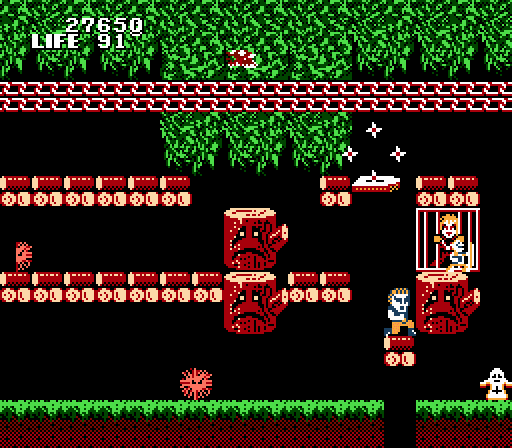
The first world is a haunted forest. Those logs on the right certainly seem to be haunted by their past regrets, that’s for sure. Demon Kogure is down at the bottom, represented by what I’d say is a rather good sprite. Kogure’s wide slicks of black eye make-up and his towering blonde hair make for an easily-caricatured look, which helps.
As for gameplay, Seikima II is a platformer with a very arcade-y feel. Each world is split into several short zones that are one screen tall and three or four screens wide, and your goal is to collect everything. The exits won’t open until Kogure has grabbed every last apple, money bag, severed head and curiously placid upside-down-cross-displaying ghosts. Yep, those ghosts are items rather than enemies, which makes a kind of sense. You’d expect the forces of evil to be on Demon Kogure’s side, after all.
There are enemies to fight, of course, and in this first world they take forms as diverse as floating moai statues, smiling sea urchins and that most terrifying of all creatures, the remorseless butterfly. Kogure can defeat these foes by chucking rocks at them, because if there’s one thing that says “you’re in control of the demonic vanguard of Beelzebub’s unholy army” it’s throwing pebbles at butterflies. Not quite the devilish powers I was expecting to command, I must confess.
It didn’t take long to encounter something truly hellish in Seikima II. Unfortunately the nightmare in question is the game’s jumping controls, which were surely concocted by Lucifer himself during a particularly fertile creative period. You press the jump button to jump, which is fair enough, but Kogure’s airborne movements are twitchy and inconsistent to say the least. Holding left or right while jumping performs a sideways hop with very little vertical height, so to jump up to higher platforms – an action that makes up a good eighty percent of the gameplay – you have to hold the button and then press left or right while you’re in mid-air. However, even the faintest contact with an obstacle during your jump cancels your upward momentum and you fall back down. As a result, all the platforming in this game is a constant struggle with the jumping mechanics, with you inevitably using the wrong kind of jump half the time, a problem compounded by the constant waves of respawning enemies and the fact the many of the stages are set up ass a one-way system so if you mess up a jump and fall down you have to trek the long way around rather than just jumping back up to where you fell from. It's difficult to convey how horrible all this feels in words, but if it was a sound that sound would be "huuurggghlle."
While trying and failing to get a handle on the jumping mechanics, I accidentally touched an ominous hovering eyeball. Normally touching an ominous hovering eyeball results in being stricken by a terrible curse or unintentionally bringing a demon over to our dimension, but in Seikima II’s case it’s a shop. Of course it is. Inside you can use the moneybags you’ve collected to buy red potions that restore some of your health, a knife that upgrades your projectile attack and a guitar. The guitar has no gameplay function, more’s the pity, but you only get the “good” ending if you manage to get all your bandmates’ instruments out of hock.
Despite the best efforts of the jumping mechanic to convince me otherwise, Seikima II is very straightforward game. Grab all the items like some demented version of Supermarket Sweep, avoid or defeat the enemies, spend your hard-earned cash on musical equipment. There are a few caveats to this simple format, mind you; for one, your health is constantly draining at a rapid rate and not just when you collide with an Easter Island statue gone walkabout. The other is that there’s a minor element of exploration to be done, because the areas within each world don’t follow a linear path. There are seven areas in each world to empty of items before the eighth and final area opens up, and you might be able to travel from zone one to zone two but not from zone two to zone three, so you have to go back to zone one and find another exit (in this case “exit” means a hole in the floor). They’re not hugely complex labyrinths so you’re unlikely to get lost, but the result is that Seikima II feels like it’s stuffed with pointless, energy-sapping backtracking.
Once you do make it down to the final zone, you’ll encounter a boss of sorts. Go on, see if you can spot it in the screenshot above. Give up? There’s a tiny knight standing in front of the cage holding the imprisoned member of the band. I was expecting a more imposing foe from a game with a subtitle that translates to “Demon’s Counterattack,” but instead we’re tasked with defeating a living Playmobil figure that’s hopelessly out of its depth. You can only harm the knight by hitting it in the back, because it blocks your attacks with its shield otherwise, and the knight can attack by throwing arcing rings of sparkly magic into the air, but overall it’s very easy to defeat if you remembered to purchase the knives.
Seikima II’s commitment to tedious busy work continues, because defeating the knight isn’t enough to free your bandmate. You also have to make your way around the zone and touch all of these floating objects, which are either tombstones or very gothic surfboards. The last one will have a key inside. Once you’ve picked that up, then you can open the cage and move on to world two.
Given how much of a pain in the arse it was to manoeuvre Kogure through the first world, I would strongly suggest that the band slim down from a five-piece to a duo.
My suggestion was not taken on board, so here we go with world number two. I know, I know, it’s not very Halloween-y. I was disappointed too but hey, at least Kogure gets to fight some more thematically-appropriate enemies in the form of these lil’ angels. Granted, they appear to be the angels of deceased gingerbread men, but I’ll take it.
Visuals aside, world two is very similar to world one and indeed the entire game follows this template. You’re still collecting all the items, with the ghosts and money bags returning but with the addition of the latest abducted band member’s disembodied head and also pot plants. Given the dark, sinister themes of Seikima II, I must concluded that they are spider plants.
Along the way I managed to upgrade my weapon again, and I gotta say that throwing battle axes at angels is definitely more what I expected from this game that flinging stones at insects. You know what else I expected from a game based on a band? In-game music that didn’t make me want to squirt a tube of decorator’s caulk down each ear. Yes, I must sadly report that the music in this game is utterly terrible, with each world having one track of squeaky, unmelodious noise that repeats on a four-bar loop. Now that’s the Devil’s music.
The boss is, once again, a very small knight. There he is, hiding amongst the foliage. His guerilla tactics don’t make him any more difficult to defeat, although because the platform he’s walking back and forth on is longer than in the first encounter he does spend longer stretches of time with his shield facing towards you. He's still easy to beat, and while my pleasure at my victory was momentarily wiped away by the reminder that, oh yeah, I’ve got to touch all these gravestones to find the key it was soon onwards to world number three.
I don’t think I need to tell you how this one plays out. The pot plants are swapped out for candles and the environment has a much more Halloween-appropriate “ancient ruins” theme, complete with spiders and snakes. Kogure still jumps like his boots are filled with vicious robot crabs. The music? Heinous.
As the game progress, the areas are set up more and more often to be single-route challenges. They often look quite open at first glance, but appearances can be misleading. For example, you can only head to the right here, because Kogure can’t crouch and he’s two “blocks” tall, making him unable to squeeze through either of those gaps to his left. I suppose it’s not a terrible design decision, but a bit more freedom to approach each area might have been nice. More aggravating is Seikima II’s tendency to place items in such a way that you have to climb up to reach the topmost one and then fall back down to collect items that are hanging in the air, forcing you to repeat the same bits of platforming to collect all the items. My top tip for countering this is to take advantage of Kogure’s Mega Man-like ability to stand on empty space so long as at least one pixel of his toe is touching a platform: this can sometimes help you to wriggle up though platforms that otherwise might force you to go the long way around.
I was starting to feel a bit sorry for the tiny knight by this point. Then I remembered how horrible the jumping feels and I lost all ability to feel compassion for others, so that was fun.
Now we’re talking – the final world has that real Halloween je ne sais quoi, as landscapes made entirely from human bones and patrolled by mummies tend to. It’s amazing how much more amenable to Seikima II’s gameplay I was feeling once I was scaling Skull Mountain. I suppose that having gotten as used to the jumping controls as possible was also helping.
When a bat hits a priest and he ends up deceased, that’s Kogure. Yes, I’ve purchased the strongest weapon in the game and it’s an endless supply of throwable bats. The developers really shouldn’t have hidden this particular light under a bushel, should they? If you’re making a game where you’re playing as a guy who calls himself Demon Kogure who can throw trained bats at the priests who have presumably come to exorcise him, that stuff should be front-and-centre, stage one gameplay.
There’s an area in the final world where the platforms and items spell out “CBS SONY,” who produced the game. Stay turned to VGJunk for more fascinating videogame tidbits like this. Look, what else do you want me to say, “then Kogure fights that bloody knight yet again?”
Guess what, that’s exactly what I’m going to say. Then Kogure fights that bloody knight yet again, although at least this time we can actually get a good look at him as he patrols his platform, flanked by priests. Yep, that’s definitely a tiny knight with wee little matchstick legs that would surely buckle under the weight of full plate armour. No wonder defeating the knight is the easiest part of Seikima II.
The band’s back together, but before they can get back on stage and resume their mission to corrupt the minds of humanity, there’s one last mission for Kogure. He must travel to the Zeus Zone and engage in the final battle against Zeus. The Greek god Zeus. Zeus.
Except that is quite clearly Jesus Christ. He’s got a halo, he attacks by throwing glitter in the same way as the knight rather than the more impressive and more Zeus-ian method of massive great lighting bolts. The game might be telling me it’s Zeus, but think about it this way: who do you think Kogure, Satan’s best pal and avowed devil-worshipper, is more likely to be fighting - Zeus or Jesus? I rest my case. What’s that? The programme for Seikima II’s 1988 “The Greatest Black Mass” tour specifically says the band were imprisoned for thousands of years by the mightiest god Zeus? All right, fine, it’s Zeus. I still think the Jesus angle makes more sense, though.
As for the actual fight, it’s basically the same as the battles against the knights except Zeus will jump over your attacks if you throw them at his body. Jump and attack and they’ll be too high for Zeus to leap over, though, so do that. If you’ve managed to purchase the bats – and why wouldn’t you, because the game gives you plenty of cash to buy all the instruments and every weapon upgrade - it only takes about eight hits and Seikima II: Akuma no Gyakushuu is over.
The ending sees the reassembled band play a show for an audience of appreciative ghosts, which is about as good an ending as I could have hoped for. Shame about the horrendous music, but there was an updated MSX version of the game that featured actual Seikima II songs, so I probably should have played that version. Whoops.
Seikima II: Akuma no Gyakushuu is a game I don't hate, even though I think I probably should. It certainly isn’t much fun to play, thanks to the stiff, frustrating controls that are only exacerbated by the back-tracking and the constant health drain. In a game where the monsters are forever respawning right above your head, it’d be nice to be able to take things slowly and cautiously but you can’t do that while your health’s dwindling away like my will to live during a long dental procedure. It’s very much a game that missed its time, still beholden to the early arcade game design philosophies: considering it was released after Super Mario Bros. forever altered the playing field, it didn’t really stand a chance.
Yet there’s still something about it that charmed me. it’s probably just the concept of playing as a Satanist who has to take time off from his black crusade to rescue his band, throwing bats at priests as he goes. There’s something very appealing about that, especially when Demon Kogure’s in-game sprite is such an adorably chubby little lump. And hey, I learned something else: Kogure had a character based on him in the Fist of the North Star anime, so he must be cool.
I’ve given Seikima II a six on the Halloween-O-Meter, which is a shame because it was close to getting a much higher score. If only the enemies had been more monsters and ghouls than butterflies and birds, but alas. The final skull level definitely earned it an extra point, that’s for sure.
The first part of the title is pronounced “seikimatsu” - “seikima-two,” you see – a pun on the Japanese word meaning “end of the century.” Seikima II is also the name of Japanese metal band, and yes, what we’ve got here is a Famicom platformer based on a Japanese metal band.
Seikima II formed in the early eighties and enjoyed a lot of success until 1999 when, in a display of real commitment to their “end of the century” bit, they disbanded at the stroke of midnight as the millennium arrived. Their whole shtick was that they were demonic emissaries from an alternate universe who came to Earth to work as Satan’s hype-men, and they seem to have stuck to this concept rigidly and with a straight face so again, you can’t fault their commitment. Having checked out some of their videos, I think the best description of Seikima II is “Japanese Kiss.” They even had a guitarist called Ace.
You can see the band pictured at the bottom of the title screen. In the centre is Seikima II’s front man and this game’s playable character, Demon Kogure. So, is Kogure out to topple the golden throne of heaven and establish Satan’s dominion over the Earth?
Of course not, this is a videogame from 1986. Demon Kogure’s task is to rescue all his kidnapped band members. I suppose it makes a change from rescuing princesses.
The first world is a haunted forest. Those logs on the right certainly seem to be haunted by their past regrets, that’s for sure. Demon Kogure is down at the bottom, represented by what I’d say is a rather good sprite. Kogure’s wide slicks of black eye make-up and his towering blonde hair make for an easily-caricatured look, which helps.
As for gameplay, Seikima II is a platformer with a very arcade-y feel. Each world is split into several short zones that are one screen tall and three or four screens wide, and your goal is to collect everything. The exits won’t open until Kogure has grabbed every last apple, money bag, severed head and curiously placid upside-down-cross-displaying ghosts. Yep, those ghosts are items rather than enemies, which makes a kind of sense. You’d expect the forces of evil to be on Demon Kogure’s side, after all.
There are enemies to fight, of course, and in this first world they take forms as diverse as floating moai statues, smiling sea urchins and that most terrifying of all creatures, the remorseless butterfly. Kogure can defeat these foes by chucking rocks at them, because if there’s one thing that says “you’re in control of the demonic vanguard of Beelzebub’s unholy army” it’s throwing pebbles at butterflies. Not quite the devilish powers I was expecting to command, I must confess.
It didn’t take long to encounter something truly hellish in Seikima II. Unfortunately the nightmare in question is the game’s jumping controls, which were surely concocted by Lucifer himself during a particularly fertile creative period. You press the jump button to jump, which is fair enough, but Kogure’s airborne movements are twitchy and inconsistent to say the least. Holding left or right while jumping performs a sideways hop with very little vertical height, so to jump up to higher platforms – an action that makes up a good eighty percent of the gameplay – you have to hold the button and then press left or right while you’re in mid-air. However, even the faintest contact with an obstacle during your jump cancels your upward momentum and you fall back down. As a result, all the platforming in this game is a constant struggle with the jumping mechanics, with you inevitably using the wrong kind of jump half the time, a problem compounded by the constant waves of respawning enemies and the fact the many of the stages are set up ass a one-way system so if you mess up a jump and fall down you have to trek the long way around rather than just jumping back up to where you fell from. It's difficult to convey how horrible all this feels in words, but if it was a sound that sound would be "huuurggghlle."
While trying and failing to get a handle on the jumping mechanics, I accidentally touched an ominous hovering eyeball. Normally touching an ominous hovering eyeball results in being stricken by a terrible curse or unintentionally bringing a demon over to our dimension, but in Seikima II’s case it’s a shop. Of course it is. Inside you can use the moneybags you’ve collected to buy red potions that restore some of your health, a knife that upgrades your projectile attack and a guitar. The guitar has no gameplay function, more’s the pity, but you only get the “good” ending if you manage to get all your bandmates’ instruments out of hock.
Despite the best efforts of the jumping mechanic to convince me otherwise, Seikima II is very straightforward game. Grab all the items like some demented version of Supermarket Sweep, avoid or defeat the enemies, spend your hard-earned cash on musical equipment. There are a few caveats to this simple format, mind you; for one, your health is constantly draining at a rapid rate and not just when you collide with an Easter Island statue gone walkabout. The other is that there’s a minor element of exploration to be done, because the areas within each world don’t follow a linear path. There are seven areas in each world to empty of items before the eighth and final area opens up, and you might be able to travel from zone one to zone two but not from zone two to zone three, so you have to go back to zone one and find another exit (in this case “exit” means a hole in the floor). They’re not hugely complex labyrinths so you’re unlikely to get lost, but the result is that Seikima II feels like it’s stuffed with pointless, energy-sapping backtracking.
Once you do make it down to the final zone, you’ll encounter a boss of sorts. Go on, see if you can spot it in the screenshot above. Give up? There’s a tiny knight standing in front of the cage holding the imprisoned member of the band. I was expecting a more imposing foe from a game with a subtitle that translates to “Demon’s Counterattack,” but instead we’re tasked with defeating a living Playmobil figure that’s hopelessly out of its depth. You can only harm the knight by hitting it in the back, because it blocks your attacks with its shield otherwise, and the knight can attack by throwing arcing rings of sparkly magic into the air, but overall it’s very easy to defeat if you remembered to purchase the knives.
Seikima II’s commitment to tedious busy work continues, because defeating the knight isn’t enough to free your bandmate. You also have to make your way around the zone and touch all of these floating objects, which are either tombstones or very gothic surfboards. The last one will have a key inside. Once you’ve picked that up, then you can open the cage and move on to world two.
Given how much of a pain in the arse it was to manoeuvre Kogure through the first world, I would strongly suggest that the band slim down from a five-piece to a duo.
My suggestion was not taken on board, so here we go with world number two. I know, I know, it’s not very Halloween-y. I was disappointed too but hey, at least Kogure gets to fight some more thematically-appropriate enemies in the form of these lil’ angels. Granted, they appear to be the angels of deceased gingerbread men, but I’ll take it.
Visuals aside, world two is very similar to world one and indeed the entire game follows this template. You’re still collecting all the items, with the ghosts and money bags returning but with the addition of the latest abducted band member’s disembodied head and also pot plants. Given the dark, sinister themes of Seikima II, I must concluded that they are spider plants.
Along the way I managed to upgrade my weapon again, and I gotta say that throwing battle axes at angels is definitely more what I expected from this game that flinging stones at insects. You know what else I expected from a game based on a band? In-game music that didn’t make me want to squirt a tube of decorator’s caulk down each ear. Yes, I must sadly report that the music in this game is utterly terrible, with each world having one track of squeaky, unmelodious noise that repeats on a four-bar loop. Now that’s the Devil’s music.
The boss is, once again, a very small knight. There he is, hiding amongst the foliage. His guerilla tactics don’t make him any more difficult to defeat, although because the platform he’s walking back and forth on is longer than in the first encounter he does spend longer stretches of time with his shield facing towards you. He's still easy to beat, and while my pleasure at my victory was momentarily wiped away by the reminder that, oh yeah, I’ve got to touch all these gravestones to find the key it was soon onwards to world number three.
I don’t think I need to tell you how this one plays out. The pot plants are swapped out for candles and the environment has a much more Halloween-appropriate “ancient ruins” theme, complete with spiders and snakes. Kogure still jumps like his boots are filled with vicious robot crabs. The music? Heinous.
As the game progress, the areas are set up more and more often to be single-route challenges. They often look quite open at first glance, but appearances can be misleading. For example, you can only head to the right here, because Kogure can’t crouch and he’s two “blocks” tall, making him unable to squeeze through either of those gaps to his left. I suppose it’s not a terrible design decision, but a bit more freedom to approach each area might have been nice. More aggravating is Seikima II’s tendency to place items in such a way that you have to climb up to reach the topmost one and then fall back down to collect items that are hanging in the air, forcing you to repeat the same bits of platforming to collect all the items. My top tip for countering this is to take advantage of Kogure’s Mega Man-like ability to stand on empty space so long as at least one pixel of his toe is touching a platform: this can sometimes help you to wriggle up though platforms that otherwise might force you to go the long way around.
I was starting to feel a bit sorry for the tiny knight by this point. Then I remembered how horrible the jumping feels and I lost all ability to feel compassion for others, so that was fun.
Now we’re talking – the final world has that real Halloween je ne sais quoi, as landscapes made entirely from human bones and patrolled by mummies tend to. It’s amazing how much more amenable to Seikima II’s gameplay I was feeling once I was scaling Skull Mountain. I suppose that having gotten as used to the jumping controls as possible was also helping.
When a bat hits a priest and he ends up deceased, that’s Kogure. Yes, I’ve purchased the strongest weapon in the game and it’s an endless supply of throwable bats. The developers really shouldn’t have hidden this particular light under a bushel, should they? If you’re making a game where you’re playing as a guy who calls himself Demon Kogure who can throw trained bats at the priests who have presumably come to exorcise him, that stuff should be front-and-centre, stage one gameplay.
There’s an area in the final world where the platforms and items spell out “CBS SONY,” who produced the game. Stay turned to VGJunk for more fascinating videogame tidbits like this. Look, what else do you want me to say, “then Kogure fights that bloody knight yet again?”
Guess what, that’s exactly what I’m going to say. Then Kogure fights that bloody knight yet again, although at least this time we can actually get a good look at him as he patrols his platform, flanked by priests. Yep, that’s definitely a tiny knight with wee little matchstick legs that would surely buckle under the weight of full plate armour. No wonder defeating the knight is the easiest part of Seikima II.
The band’s back together, but before they can get back on stage and resume their mission to corrupt the minds of humanity, there’s one last mission for Kogure. He must travel to the Zeus Zone and engage in the final battle against Zeus. The Greek god Zeus. Zeus.
Except that is quite clearly Jesus Christ. He’s got a halo, he attacks by throwing glitter in the same way as the knight rather than the more impressive and more Zeus-ian method of massive great lighting bolts. The game might be telling me it’s Zeus, but think about it this way: who do you think Kogure, Satan’s best pal and avowed devil-worshipper, is more likely to be fighting - Zeus or Jesus? I rest my case. What’s that? The programme for Seikima II’s 1988 “The Greatest Black Mass” tour specifically says the band were imprisoned for thousands of years by the mightiest god Zeus? All right, fine, it’s Zeus. I still think the Jesus angle makes more sense, though.
As for the actual fight, it’s basically the same as the battles against the knights except Zeus will jump over your attacks if you throw them at his body. Jump and attack and they’ll be too high for Zeus to leap over, though, so do that. If you’ve managed to purchase the bats – and why wouldn’t you, because the game gives you plenty of cash to buy all the instruments and every weapon upgrade - it only takes about eight hits and Seikima II: Akuma no Gyakushuu is over.
The ending sees the reassembled band play a show for an audience of appreciative ghosts, which is about as good an ending as I could have hoped for. Shame about the horrendous music, but there was an updated MSX version of the game that featured actual Seikima II songs, so I probably should have played that version. Whoops.
Seikima II: Akuma no Gyakushuu is a game I don't hate, even though I think I probably should. It certainly isn’t much fun to play, thanks to the stiff, frustrating controls that are only exacerbated by the back-tracking and the constant health drain. In a game where the monsters are forever respawning right above your head, it’d be nice to be able to take things slowly and cautiously but you can’t do that while your health’s dwindling away like my will to live during a long dental procedure. It’s very much a game that missed its time, still beholden to the early arcade game design philosophies: considering it was released after Super Mario Bros. forever altered the playing field, it didn’t really stand a chance.
Yet there’s still something about it that charmed me. it’s probably just the concept of playing as a Satanist who has to take time off from his black crusade to rescue his band, throwing bats at priests as he goes. There’s something very appealing about that, especially when Demon Kogure’s in-game sprite is such an adorably chubby little lump. And hey, I learned something else: Kogure had a character based on him in the Fist of the North Star anime, so he must be cool.
I’ve given Seikima II a six on the Halloween-O-Meter, which is a shame because it was close to getting a much higher score. If only the enemies had been more monsters and ghouls than butterflies and birds, but alas. The final skull level definitely earned it an extra point, that’s for sure.
Labels:
CBS Sony,
famicom,
halloween,
ISCO,
licensed,
NES,
platformer,
seikima ii
18/09/2018
FANCY WORLD: EARTH OF CRISIS (ARCADE)
I’m tired of this dismal planet, this grubby orb of shame and regret. We need a better world, a brighter world - dare I say it, a fancy world. I’d love to tell you that Korean developer Unico can offer that world with their 1996 arcade game Fancy World: Earth of Crisis, but this is merely a sub-par arcade platformer and will do little to help forge the world we deserve.
If there’s one thing I associate with the word “fancy” it’s rainbow-coloured balloons spelling out words so please don’t ask me to plan you a fancy wedding, you’ll regret it. The fact that this is also an Earth of Crisis is rather underplayed by the title screen. Accentuate the positives, I get it, but it’s the crisis I’ll be battling against rather than the fanciness. So what is the crisis at hand?
Oh, you know, the usual. A mad scientist with a vaguely Colonel Sanders vibe appears with nefarious plans in mind and a Trebor Extra-Strong Mint glued over his eye. “You are my obey orders,” he says. Look, his doctorate is in Mad Science, not English, okay? The villain never actually explains what these orders are, but until we obey them he’s going to hold the Earth hostage.
I mean that literally. He’s holding a gun to the Earth’s head, having presumably created an unfathomably huge space cannon that he built in the shape of a revolver because what’s the point of being a global tyrant if you don’t have panache? The world looks understandably worried, so it’s up to our plucky heroes to saves the day by doing… something? I’ll be honest, I never really figured out what’s going on in this one, folks.
To save the Earth one must travel the Earth, visiting each of these world in the hopes that somehow this will make the bad guy halt his evil plan. Each flag is a world consisting of five stages and sometimes a boss battle. Do you think each world will feature a stereotypical version of whatever country they take place in?
Well, the first country is “England” and the background is a big picture of Tower Bridge so yes, that’s exactly what’s happening. It’s always Tower Bridge or Parliament, isn’t it? C’mon, devs, give us a game set outside a Lidl in Hull or something.
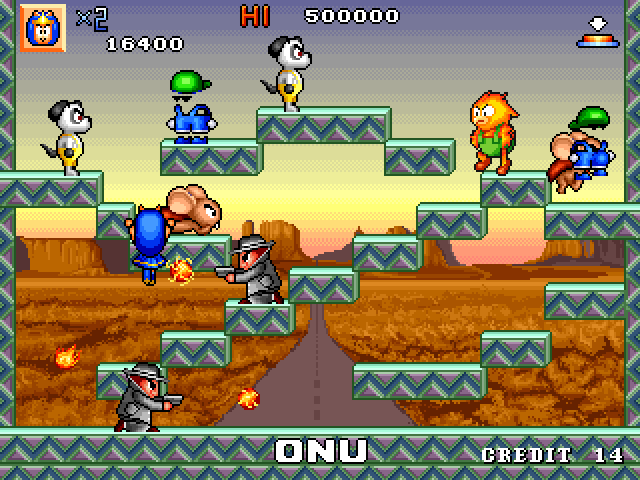
Oh, right, the gameplay. You’re in control of the blue-haired, cat-eared Amazon princess type at the top-left of the screenshot above, and it’s her job to clear each stage of monsters. I say monsters, this stage is filled with chickens. Large chickens, I grant you, chickens wearing shoes, but hardly monstrous chickens. They still need dealing with, though, and Fancy World fits neatly into that genre of single-screen arcade action games that I think of as “Bubble Bobble Games.” There are dozens of the things, from the aforementioned Bubble Bobble to Snow Bros. and lesser known examples like Funky Jet or Diet Go Go. They’ve all got their own unique quirks, most often relating to how you defeat the monsters, so what’s Fancy World’s gimmick?
It, erm, doesn’t have one. No climbing on bubbles, no rolling the enemies up in snowballs, no nothing. You attack by throwing energy balls horizontally at the enemies; hit them three times and they’re defeated. That’s it. Fancy World is about as basic as this type of game gets, and as I jump between the platforms and tap the fire button to throw my projectiles I’m already starting to regret covering this game.
We must hope that the enemy designs will keep us entertained until the gameplay sparks into life and hey, these dogs are pretty neat. They’ve got a projectile attack where they dig up bones and flick them towards you, that’s fun. Not sure why they’re wearing dungarees, but I suppose a fancy world deserves fancy dogs.
After clearing five stages of very straightforward dog-and-chicken-bothering action, the first world is complete. Your reward is a picture of a woman in a vinyl suit who gives off a “circus ringmaster” aura, surrounded by floating bubbles filled with a bloke in a headband poking himself in the eye. Th-thanks? I guess?
World two has windmills, so it must be The Netherlands, famed as the home of superhero mice and blue hedgehogs, a character design that’ll never catch on. Speaking of character designs, I’m not sure why the developers decided to have the main character’s default expression be one of open-mouthed petulance, but I think it works quite well. She's as fed up of this bullshit as I am. The gameplay remains the same, but you probably guessed that already.
I did manage to grab a couple of power-ups along the way. Fancy World gives you lots of items to collect, most of them being points-scoring items ranging from small coins to, erm, big coins. There are some food items to gather up too, and even some negative items like the bottle of whiskey that reverses your controls. I’ve never understood games that equating being drunk with reversed controls – if anything, being drunk in a videogame should just add a bunch of input delay to your actions, or possibly take control away from the player entirely and force their character to visit a kebab shop.
One of the power-ups I found was a special item that, when used, freezes all enemies on-screen, which is helpful but not as good as the power-up that changes your orb projectiles into a massive laser beam that defeats all monsters in a single hit.
At the end of every second world waits a boss, beginning with the best boss of them all: a flying jack o’lantern! I didn’t know Holland was renowned for its pumpkins, and this isn’t the most interesting pumpkin design I’ve ever seen, sure, but I’ll take what I can get.
Unfortunately the boss fight is crap. Up until this point Fancy World has been a real breeze of a game, with your bulky, fast-firing projectiles easily clearing out the monsters as long as you manage to reach the low levels of concentration required to not jump directly into an enemy projectile. Then the boss shows up and fills the entire screen with exploding orbs that are difficult to avoid and protect the boss from your orbs. It all feels like a bit of a random mess, frankly.
Oh, so you get a picture of an anime girl after every stage, huh? Seems to be a bit of a theme with the Korean arcade games I’ve played recently. This one looks as though she’s real sad about the kung-fu ass-kicking she’s about to deliver. Perhaps she’s being forced to beat up a kitten against her will.
Things pick up a bit in Australia, with a batch of new creatures that move a little faster and have more readily available projectile attacks. They’re an eclectic bunch. You’ve got deadly snakes, because of course you have, it’s Australia. Actually, I’m surprised that the enemies aren’t more heavily inspired by the stages that they inhabit. You get the odd one or two that fit the geography but it could have been laid on much more thickly – imagine being chased around the Netherlands stage by a possessed clog, or facing off against a kangaroo with an improvised explosive device stuffed down its pouch. Instead we get green spear-wielding creatures that my brain keeps telling me are rabbits even though they clearly are not, and fly-winged ladies with sprites copied from the main character who sometimes stop and bend over, flashing their arse at the player. It’s not an attack or anything, they’re just rude. Oh, and some unfortunate “bone-through-the-nose aboriginal savage” enemies that aren’t pictured here, blergh.
After Australia is Greece, and the same enemy types are repeating now, which is very disappointing. The stages themselves are getting a bit more complicated, mostly through the addition of double-thickness platforms. You can drop down “through” the single-thickness platforms but not the double-thickness ones, meaning you have to pay a bit more attention to where you’re going.
No idea what the bells are all about, though. Perhaps the villain's grand plan is to turn the Earth into the universe’s biggest fruit machine.
This world’s boss is a pound-shop version of Air Man from Mega Man 2, an ambulatory fan that has two moves: slide from left to right, and slide from right to left. This is dangerous, because your character dies in one hit and takes a surprisingly long time to jump between the levels of the stage, so you’d get crushed a lot even if the stage wasn’t stuffed with murderous chickens. Hey, maybe the villain is Colonel Sanders. It’d explain all the chickens.
All of Fancy World’s boss battle suffer from the same problem, in that the developers clearly couldn’t come up with any interesting mechanics for the boss fights so they overcompensated by filling the arena with hordes of annoying enemies. The chickens add nothing beyond nuisance value, but fortunately about half-way through the fight the boss suddenly stopped being able to hit me if I was standing on the bottom-most floor. A glitch? Probably, but I’ll take it.
Onward to Brazil, where the chicken quotient is further increased with the addition of fire-breathing chickens. Or maybe the developers had just read that dinosaurs had feathers and so it stands to reason that dragons would also have feathers. Just ask the Aztecs, they know all about feathered serpents. Also, Christ the Redeemer looks on with disappointment but also, you would assume, with the compassion needed to forgive Fancy World for being so uninteresting.
Next up is the USA. The USA’s most famous landmark is “dirt” and the most dangerous enemies here are blokes with guns. Cruel burn on the USA from Unico, there. There are also invisible children, or possibly invisible dogs. This is a world where either species is free to wear dungarees, after all.
There are lots of enemies about and the platforms are small and fiddly to negotiate, so it seems like a good time to mention that not only is Fancy World boring on a core level, it doesn’t play very well. You’re in control of a real lummox of character, with movements that feel just heavy enough to make getting around a chore, especially the delay between pressing jump and actually jumping. I also struggled with getting off platforms, because you have no momentum when you walk off a platform and fall down. Rather than continuing to move forward slightly as you fall, you drop vertically downwards like someone filled your shoes with bricks, further increasing the leaden sensation of your character’s movements.
Moving upwards is equally annoying thanks to the often vague platform boundaries. See the screenshot above for an example – I’m sure it’s not just me that thinks our heroine should land on the platform below her but no, she’s not far enough to the left and she’ll fall straight back through. This happens a lot in Fancy World, and it’s bad enough when you’re moving around a fairly empty stage – as soon as there are a few enemies and projectiles around, simply getting from one platform to the next becomes far more of a chore than it should be.
The boss is a big pair of legs with a powerful cannon dangling below. Small wonder it has such a mischievous grin. It also has the ability to, you guessed it, spawn dozens of enemies. Just landing a hit on this bloody thing is a real accomplishment, because those enemies are more than willing to lay their life on the line for their leader and keep diving in front of your attacks.
As we reach Easter Island, the small amount of steam that Fancy World had generated has well and truly run out, along with my patience and the oversized mug of coffee I was using to keep myself awake while wading through the swarms of recoloured enemies. It’s all just so charmless, without the precise controls and more in-depth gameplay mechanics of similar games to keep it interesting.
Even the between-world anime girls have reached a nadir, with this one having a spinal configuration that I can’t explain but which has left me feeling rather uncomfortable. Seeing her did encourage me to stand up and stretch before getting back to my regular “hunching over my computer” activities, so that’s good, I suppose?
I’m skipping the completely uninteresting preceding stage to get straight to this world’s boss, a double-headed dragon that offers a tiny oasis of fun in an otherwise barren desert of killer chickens. It’s actually cute, can you believe, wobbling its twin heads around and breathing fireballs in a manner that feels like a sensible, decent, god-fearing videogame boss battle… but then loads of enemies spawn in and ruin the whole thing. You were so close, Fancy World, so close.
Here’s Canada. It’s cold, boring and empty, and this stage isn’t much fun either. I’m kidding, Canadian readers, you’re all right by me.
I can’t believe I’m saying this, but I would have liked the ice platforms in this world to be slippery. Your character controls like crap anyway, but if they controlled like a different kind of crap for a while, that’d be something at least.
The final world takes place in the clouds. There are red lines on the clouds so you can see where the platforms actually begin and end, a feature that is welcome but which should have probably tipped the developers off that their platform-creating system needed a complete overhaul. All the different kinds of enemies are here. This is heaven, and I have chased them up to the celestial cloudscape so I can kill them all over again. That’s my story and I’m sticking with it, because if I don’t some up with something the crushing tedium will send me to sleep. I’m sorry for covering this one, folks – it’s easily the most boring game I’ve played in a long time. What the hell was I thinking? “Oh well, I’ve played most of it now, I’m sure I’ll be able to come up with something to say about Fancy World?” Pure hubris. I deserve everything I get.
If you were looking forward to seeing the final boss of Fancy World, perhaps in the vain hope that it might be interesting enough to redeem the rest of the game – tough shit. There is no final boss. You just fight all the previous bosses a second time. They are not any more enjoyable this time around. I’m very tired now. So tired.
Hang on, so that wasn’t a metaphor for the Earth being held hostage that we saw in the intro? It was actually a small creature shaped like the Earth? And I saved it? Is this thing the Fancy World of the title, a special little fancy boy? I don’t have the energy to crack this code, I’m afraid. As our heroine relaxes on the beach, I reckon I need a similar recuperative experience – although I don’t like the beach, so I’ll probably just go to bed with the Nightmare on Elm Street DVD box set. It’s getting to that time of year…
Fancy World: Earth of Crisis is a videogame. That much is clear. However, it’s a generic videogame, a Tesco Value videogame, the supermarket own-brand equivalent of Bubble Bobble or similar and as such it has washed over me in a grey wave of mediocrity. It’s nowhere near bad enough to get worked up about, although it isn’t great either: the poor controls and repetitive gameplay see to that. It’s just really boring. It was nice to see a pumpkin as a boss, but as mental nourishment goes that was less a three-course-meal and more chewed gum from under a bus seat. Next time I will try to pick a more interesting game to cover. On of those ZX Spectrum railway management games, possibly.
If there’s one thing I associate with the word “fancy” it’s rainbow-coloured balloons spelling out words so please don’t ask me to plan you a fancy wedding, you’ll regret it. The fact that this is also an Earth of Crisis is rather underplayed by the title screen. Accentuate the positives, I get it, but it’s the crisis I’ll be battling against rather than the fanciness. So what is the crisis at hand?
Oh, you know, the usual. A mad scientist with a vaguely Colonel Sanders vibe appears with nefarious plans in mind and a Trebor Extra-Strong Mint glued over his eye. “You are my obey orders,” he says. Look, his doctorate is in Mad Science, not English, okay? The villain never actually explains what these orders are, but until we obey them he’s going to hold the Earth hostage.
I mean that literally. He’s holding a gun to the Earth’s head, having presumably created an unfathomably huge space cannon that he built in the shape of a revolver because what’s the point of being a global tyrant if you don’t have panache? The world looks understandably worried, so it’s up to our plucky heroes to saves the day by doing… something? I’ll be honest, I never really figured out what’s going on in this one, folks.
To save the Earth one must travel the Earth, visiting each of these world in the hopes that somehow this will make the bad guy halt his evil plan. Each flag is a world consisting of five stages and sometimes a boss battle. Do you think each world will feature a stereotypical version of whatever country they take place in?
Well, the first country is “England” and the background is a big picture of Tower Bridge so yes, that’s exactly what’s happening. It’s always Tower Bridge or Parliament, isn’t it? C’mon, devs, give us a game set outside a Lidl in Hull or something.
Oh, right, the gameplay. You’re in control of the blue-haired, cat-eared Amazon princess type at the top-left of the screenshot above, and it’s her job to clear each stage of monsters. I say monsters, this stage is filled with chickens. Large chickens, I grant you, chickens wearing shoes, but hardly monstrous chickens. They still need dealing with, though, and Fancy World fits neatly into that genre of single-screen arcade action games that I think of as “Bubble Bobble Games.” There are dozens of the things, from the aforementioned Bubble Bobble to Snow Bros. and lesser known examples like Funky Jet or Diet Go Go. They’ve all got their own unique quirks, most often relating to how you defeat the monsters, so what’s Fancy World’s gimmick?
It, erm, doesn’t have one. No climbing on bubbles, no rolling the enemies up in snowballs, no nothing. You attack by throwing energy balls horizontally at the enemies; hit them three times and they’re defeated. That’s it. Fancy World is about as basic as this type of game gets, and as I jump between the platforms and tap the fire button to throw my projectiles I’m already starting to regret covering this game.
We must hope that the enemy designs will keep us entertained until the gameplay sparks into life and hey, these dogs are pretty neat. They’ve got a projectile attack where they dig up bones and flick them towards you, that’s fun. Not sure why they’re wearing dungarees, but I suppose a fancy world deserves fancy dogs.
After clearing five stages of very straightforward dog-and-chicken-bothering action, the first world is complete. Your reward is a picture of a woman in a vinyl suit who gives off a “circus ringmaster” aura, surrounded by floating bubbles filled with a bloke in a headband poking himself in the eye. Th-thanks? I guess?
World two has windmills, so it must be The Netherlands, famed as the home of superhero mice and blue hedgehogs, a character design that’ll never catch on. Speaking of character designs, I’m not sure why the developers decided to have the main character’s default expression be one of open-mouthed petulance, but I think it works quite well. She's as fed up of this bullshit as I am. The gameplay remains the same, but you probably guessed that already.
I did manage to grab a couple of power-ups along the way. Fancy World gives you lots of items to collect, most of them being points-scoring items ranging from small coins to, erm, big coins. There are some food items to gather up too, and even some negative items like the bottle of whiskey that reverses your controls. I’ve never understood games that equating being drunk with reversed controls – if anything, being drunk in a videogame should just add a bunch of input delay to your actions, or possibly take control away from the player entirely and force their character to visit a kebab shop.
One of the power-ups I found was a special item that, when used, freezes all enemies on-screen, which is helpful but not as good as the power-up that changes your orb projectiles into a massive laser beam that defeats all monsters in a single hit.
At the end of every second world waits a boss, beginning with the best boss of them all: a flying jack o’lantern! I didn’t know Holland was renowned for its pumpkins, and this isn’t the most interesting pumpkin design I’ve ever seen, sure, but I’ll take what I can get.
Unfortunately the boss fight is crap. Up until this point Fancy World has been a real breeze of a game, with your bulky, fast-firing projectiles easily clearing out the monsters as long as you manage to reach the low levels of concentration required to not jump directly into an enemy projectile. Then the boss shows up and fills the entire screen with exploding orbs that are difficult to avoid and protect the boss from your orbs. It all feels like a bit of a random mess, frankly.
Oh, so you get a picture of an anime girl after every stage, huh? Seems to be a bit of a theme with the Korean arcade games I’ve played recently. This one looks as though she’s real sad about the kung-fu ass-kicking she’s about to deliver. Perhaps she’s being forced to beat up a kitten against her will.
Things pick up a bit in Australia, with a batch of new creatures that move a little faster and have more readily available projectile attacks. They’re an eclectic bunch. You’ve got deadly snakes, because of course you have, it’s Australia. Actually, I’m surprised that the enemies aren’t more heavily inspired by the stages that they inhabit. You get the odd one or two that fit the geography but it could have been laid on much more thickly – imagine being chased around the Netherlands stage by a possessed clog, or facing off against a kangaroo with an improvised explosive device stuffed down its pouch. Instead we get green spear-wielding creatures that my brain keeps telling me are rabbits even though they clearly are not, and fly-winged ladies with sprites copied from the main character who sometimes stop and bend over, flashing their arse at the player. It’s not an attack or anything, they’re just rude. Oh, and some unfortunate “bone-through-the-nose aboriginal savage” enemies that aren’t pictured here, blergh.
After Australia is Greece, and the same enemy types are repeating now, which is very disappointing. The stages themselves are getting a bit more complicated, mostly through the addition of double-thickness platforms. You can drop down “through” the single-thickness platforms but not the double-thickness ones, meaning you have to pay a bit more attention to where you’re going.
No idea what the bells are all about, though. Perhaps the villain's grand plan is to turn the Earth into the universe’s biggest fruit machine.
This world’s boss is a pound-shop version of Air Man from Mega Man 2, an ambulatory fan that has two moves: slide from left to right, and slide from right to left. This is dangerous, because your character dies in one hit and takes a surprisingly long time to jump between the levels of the stage, so you’d get crushed a lot even if the stage wasn’t stuffed with murderous chickens. Hey, maybe the villain is Colonel Sanders. It’d explain all the chickens.
All of Fancy World’s boss battle suffer from the same problem, in that the developers clearly couldn’t come up with any interesting mechanics for the boss fights so they overcompensated by filling the arena with hordes of annoying enemies. The chickens add nothing beyond nuisance value, but fortunately about half-way through the fight the boss suddenly stopped being able to hit me if I was standing on the bottom-most floor. A glitch? Probably, but I’ll take it.
Onward to Brazil, where the chicken quotient is further increased with the addition of fire-breathing chickens. Or maybe the developers had just read that dinosaurs had feathers and so it stands to reason that dragons would also have feathers. Just ask the Aztecs, they know all about feathered serpents. Also, Christ the Redeemer looks on with disappointment but also, you would assume, with the compassion needed to forgive Fancy World for being so uninteresting.
Next up is the USA. The USA’s most famous landmark is “dirt” and the most dangerous enemies here are blokes with guns. Cruel burn on the USA from Unico, there. There are also invisible children, or possibly invisible dogs. This is a world where either species is free to wear dungarees, after all.
There are lots of enemies about and the platforms are small and fiddly to negotiate, so it seems like a good time to mention that not only is Fancy World boring on a core level, it doesn’t play very well. You’re in control of a real lummox of character, with movements that feel just heavy enough to make getting around a chore, especially the delay between pressing jump and actually jumping. I also struggled with getting off platforms, because you have no momentum when you walk off a platform and fall down. Rather than continuing to move forward slightly as you fall, you drop vertically downwards like someone filled your shoes with bricks, further increasing the leaden sensation of your character’s movements.
Moving upwards is equally annoying thanks to the often vague platform boundaries. See the screenshot above for an example – I’m sure it’s not just me that thinks our heroine should land on the platform below her but no, she’s not far enough to the left and she’ll fall straight back through. This happens a lot in Fancy World, and it’s bad enough when you’re moving around a fairly empty stage – as soon as there are a few enemies and projectiles around, simply getting from one platform to the next becomes far more of a chore than it should be.
The boss is a big pair of legs with a powerful cannon dangling below. Small wonder it has such a mischievous grin. It also has the ability to, you guessed it, spawn dozens of enemies. Just landing a hit on this bloody thing is a real accomplishment, because those enemies are more than willing to lay their life on the line for their leader and keep diving in front of your attacks.
As we reach Easter Island, the small amount of steam that Fancy World had generated has well and truly run out, along with my patience and the oversized mug of coffee I was using to keep myself awake while wading through the swarms of recoloured enemies. It’s all just so charmless, without the precise controls and more in-depth gameplay mechanics of similar games to keep it interesting.
Even the between-world anime girls have reached a nadir, with this one having a spinal configuration that I can’t explain but which has left me feeling rather uncomfortable. Seeing her did encourage me to stand up and stretch before getting back to my regular “hunching over my computer” activities, so that’s good, I suppose?
I’m skipping the completely uninteresting preceding stage to get straight to this world’s boss, a double-headed dragon that offers a tiny oasis of fun in an otherwise barren desert of killer chickens. It’s actually cute, can you believe, wobbling its twin heads around and breathing fireballs in a manner that feels like a sensible, decent, god-fearing videogame boss battle… but then loads of enemies spawn in and ruin the whole thing. You were so close, Fancy World, so close.
Here’s Canada. It’s cold, boring and empty, and this stage isn’t much fun either. I’m kidding, Canadian readers, you’re all right by me.
I can’t believe I’m saying this, but I would have liked the ice platforms in this world to be slippery. Your character controls like crap anyway, but if they controlled like a different kind of crap for a while, that’d be something at least.
The final world takes place in the clouds. There are red lines on the clouds so you can see where the platforms actually begin and end, a feature that is welcome but which should have probably tipped the developers off that their platform-creating system needed a complete overhaul. All the different kinds of enemies are here. This is heaven, and I have chased them up to the celestial cloudscape so I can kill them all over again. That’s my story and I’m sticking with it, because if I don’t some up with something the crushing tedium will send me to sleep. I’m sorry for covering this one, folks – it’s easily the most boring game I’ve played in a long time. What the hell was I thinking? “Oh well, I’ve played most of it now, I’m sure I’ll be able to come up with something to say about Fancy World?” Pure hubris. I deserve everything I get.
If you were looking forward to seeing the final boss of Fancy World, perhaps in the vain hope that it might be interesting enough to redeem the rest of the game – tough shit. There is no final boss. You just fight all the previous bosses a second time. They are not any more enjoyable this time around. I’m very tired now. So tired.
Hang on, so that wasn’t a metaphor for the Earth being held hostage that we saw in the intro? It was actually a small creature shaped like the Earth? And I saved it? Is this thing the Fancy World of the title, a special little fancy boy? I don’t have the energy to crack this code, I’m afraid. As our heroine relaxes on the beach, I reckon I need a similar recuperative experience – although I don’t like the beach, so I’ll probably just go to bed with the Nightmare on Elm Street DVD box set. It’s getting to that time of year…
Fancy World: Earth of Crisis is a videogame. That much is clear. However, it’s a generic videogame, a Tesco Value videogame, the supermarket own-brand equivalent of Bubble Bobble or similar and as such it has washed over me in a grey wave of mediocrity. It’s nowhere near bad enough to get worked up about, although it isn’t great either: the poor controls and repetitive gameplay see to that. It’s just really boring. It was nice to see a pumpkin as a boss, but as mental nourishment goes that was less a three-course-meal and more chewed gum from under a bus seat. Next time I will try to pick a more interesting game to cover. On of those ZX Spectrum railway management games, possibly.
Labels:
Arcade,
fancy world,
platformer,
single screen,
unico
Subscribe to:
Posts (Atom)