17/01/2013

SKULL (ZX SPECTRUM)

The foot bone's connected to the ankle bone, the back bone's connected to the shoulder bone and the head bone is connected to... nothing at all! Dear Lord, what fresh species of horror is this?! Well, I'll tell you: it's Games Machine's 1984 ZX Spectrum title Skull. Skull?


Yep, Skull. That's a skull and no mistake. Very nice it looks too, although closer inspection does bring to light certain anomalies. For one thing, skulls don't come with gemstones in the eye sockets. Someone has added those later, they won't grow there naturally, you know. The other thing is that this skull appears to have a sparse moustache. Like gemstones, facial hair is something that doesn't generally sprout from the skull itself. See, already this game is engendering a sense of mystery! I'm excited, I can't wait to see what the game is about and how the skulls with the John Waters facial topiary fit in. The skull appears to be guarding a set of pieces from Connect Four, so maybe it's a lethal take on that classic children's game.


I'll be honest, that hasn't really answered any of my questions. I'll try moving around a bit, maybe that'll help.


Oh hey, it's a 3D maze game. Well, that's good to know and is hardly surprising - the 3D maze game seems to be one of the most common types of ZX Spectrum game. I know that's probably not true and there are far more games in the "extremely basic platformer" or "hellish descent into one man's madness" genres, but that's how it feels to me. Think ZX, think wire-frame labyrinths full of... full of what?


Treasure, in Skull's case. The Connect 4 counters that I mentioned earlier are actually gold and bronze coins, and from what I can tell of the scale, they're coins with a diameter of about a foot. That's a lot of gold, so it's no wonder that our hero came down here. There are keys, which give you points as well as working as, quelle surprise, keys, and there are neon-green crosses that also give you points.
Your mission, should you choose to accept it - and I suggest you do accept it because the only alternative is to curl up into a ball and await your inevitable death - is to raid this blank-walled labyrinth of modernist architecture and avail yourself of the treasures contained within.


The maze isn't only made up of plain white walls, and there are a few architectural features that'll keep you on your toes. Sometimes a portcullis will block your way, and you have to use a key to open them. This costs, as you might expect, one key to use, but it also removes seven points from your score. I have no idea why, but my current theory is that whatever sadistic bastards dropped you into this maze are not impressed that you managed to get yourself stuck behind a gate, and they are deducting points from the scorecard of their mad, twisted game.


Wait, what was that? Hmm, well, I'm sure it was nothing.
Other the other main pitfalls you'll encounter are actual pitfalls, a fancy term for "hole." Some holes are uncovered, and stepping onto them will cause you to fall down to the next level and lose a life in the process. Some holes have trapdoors over the top, which may or may not give way when you walk over them.


Pictured here: a bronze coin not worth taking the risk over. According to the instructions, the trapdoors have a one-in-five chance of opening and plunging you to your grisly end, but in the game I'm either extremely unlucky or the likelyhood is much higher because seemingly every time I gambled, I ended up one life down. The only way to safely get to... hold on, I heard something...


Must have been my imagination. Anyway, to safely move to the next level, you have to find the ladder. Take the ladder down, harvest as much treasure as you can, find the ladder on that level and repeat. That's it. That is the totality of Skull's concept, and there's really nothing else for you to oh god don't move.


As long as I stay perfectly still, the hovering skull will be unable to detect my presence.


Oh shit, no, that's dinosaaaargh!
You see, the skull was so terrifying that just to look upon it caused my forehead to explode. That's how the skull killed me without actually touching me, causing blood to cascade down over my eyes.
Yes, my sudden death has revealed the shocking truth behind Skull: it has skulls in it! Six-foot-tall hovering ones with rubies for eyes, skulls with a fondness for peeking shyly around corners, skulls that relentlessly pursue you through this endless maze. Okay, that last bit's not true - they don't do much active pursuing, they just kind of float around a bit like the new kid who's just been forced into a playground game of football and doesn't have the confidence to really get involved.


They're not just any disembodied floating skulls, either - they must be vampiric disembodied floating skulls, because they're scared of crosses. The crosses are Skull's equivalent for Pac-Man's power pellets, and picking up a crucifix will temporarily make the skulls vulnerable. You can tell when a skull's vulnerable, because it will have gems in its eye sockets. Gems that would look great in the collection of a treasure hunter such as yourself... and once you've collected a cross you can indeed run up to the skull and steal its eyes. This adds to your score, destroys the skull and scores you a nomination for the "Ballsiest Adventurer" category at this year's Dungeon Explorer Awards.


That counter at the bottom of your treasure list? That's how many eyes you've harvested. As videogame stats go, it definitely beats things like "experience points" and "magic defence" and other such metrics, which now seem so pointlessly banal.
Those are the skulls, unsurprisingly the best feature in a game called Skull and pretty much the entire reason I wanted to write about this game in the first place. There's just something cool about them, an enemy that comes from a traditionally "spooky" background but which also has the unsettling strangeness of being huge, hovering and totally silent. It seems almost a callback to Walpole's The Castle of Otranto and its enormous helmet, intended to connect this wireframe explore-em-up to the dawning of the Gothic literature movement. Sorry, no it doesn't, I mean to say that giant floating skulls are a) cool and b) metal as hell.


While the head-bones are undoubtedly the most memorable part of Skull, the game itself does a few things to lift itself above most of its first-person dungeon-exploring peers. The map is handled nicely - it's displayed at the start of each new level, but it quickly begins to crumble to dust and will soon be gone. You can spend those first few moments trying to memorise it, but if that doesn't work you can always spend 25 points to reveal it again. Or I suppose you could do what I did and blindly stumble from corridor to corridor, hoping to find a ladder but more often falling though a trapdoor.
You also have a skull-sensor to warn you of impending bony doom. It's the charm bracelet - I'm not being facetious, that's what it's called in the instructions - at the bottom left, with each skull in the maze represented by a charm on the chain. If the skulls are cyan then you're relatively safe (I say relatively, because I believe I've already mentioned the bloody trapdoors) but as the skulls draw near they change colour, with red meaning that the skull is right next to you, ready to pounce, Or, if you've picked a cross, ready to have its eyes removed. It's a safety device and a hunting tool!


Technically, Skull is an impressive achievement. The screen is redrawn quickly, movement is a smooth and the randomly-generated levels are almost always mazey enough to be interesting but not completely baffling or unsolvable. Once or twice I did get stuck when a portcullis closed behind me and locked me in a dead end, and that is definitely irritating, but if you can make it past the first two or three floors without that happening then you should have enough keys to see you through.
Skull's big problem is its simplicity. Collect treasure, descend through the levels, get the highest score you can. That's all there is to do. I know that's how a lot of games worked back then, but to get a high score on a game like Galaga or Donkey Kong you needed two things: memorisation and skill. Neither of these things will help you in Skull, because of the random nature of the game, so if you do set a high score you feel like you're beating the odds rather than beating the game.


The furthest I managed to get without cheating was floor eight. In theory you could reach the end of the game - the manual says that Skull consists of 9,999 levels - but that's not really an option. You die a lot, for one thing, and with only four lives and no way to replenish them that's a big limiting factor. Also, I died right at the ladder at the end of stage eight, so let's say I cleared it. To reach that point took me four minutes and thirty seconds. If my maths is right, and there's a considerable chance it's not, at that rate of progress it'd take me roughly 93 and three-quarter hours to reach the end of Skull. Time is precious, dear reader, and four days of it should not be sacrificed to Skull. Only small children and effigies of the Unnameable Dark Gods should receive that honour.


I enjoyed it, though. Not enough to keep at it for long, but enough that I took more pleasure from it than just seeing those skulls. They are pretty great, though, and as I'm missing Hallowe'en already seeing a jewel-eyed skull peering out, half-concealed, from behind the wall of an endless labyrinth fills me with a degree personal pleasure that might make me sound a bit weird. Really, what else can you ask from a 28-year-old computer game?

15/01/2013

ELIMINATOR BOAT DUEL (NES)

In the beloved children's classic The Wind in the Willows, Ratty famously suggests that there is nothing half so much worth doing as simply messing about in boats. He's a liar, of course - he's not even a rat, for starters - but while his estimation of the pleasure of boating may be somewhat exaggerated  it is something I've never investigated here at VGJunk and as I am dedicated to exploring the full gamut of possible human experiences (in retro videogame form, at least) then I shall hit the waterways with today's game. It's Sculptured Software's 1991 NES not-quite-as-interesting-as-racing-on-land-em-up Eliminator Boat Duel!


Nobody ever gets eliminated, really. Let's get that out of the way right now, let it be known that alligator will be going hungry today. But there are definitely boats. Well, there are only two boats: yours and your opponents. That's presumably why this is described as a "boat duel," because there is definitely no fencing or standing on opposite prows and shooting at eachother with flintlock pistols.
Eliminator Boat Duel doesn't waste any time getting down to business. Once you've selected your mode, either one of the single-player dificulty levels or the two-player mode, then you're thrown straight into a confrontation with this guy.


Aquarius Rex, your first opponent. He's a hippy, and not, as his name may suggest, a species of as-yet undiscovered undersea dinosaur. You can tell he's a hippy because he says things like "groovy guru vibes" and "Jupiter is aligned with Mars" and "my vessel and I are now an unstoppable fusion of man and machine." Wait, that last one hardly sounds in the best tree-hugging-Mother-Gaia traditions of hippydom, but integrating your boat into your physical flesh-body is surely going to be more effective than chanting some mantras and listening to Jefferson Airplane.


This is the first course. I'll be racing past alligators, a swarm of what are either buoys or green-headed flamingoes, and a mermaid with no head at all, just a wild mane of hair that grows directly from her neck.


Races start, as seems reasonable, on the starting line. Two boats that rather put me in mind of Monopoly houses bob patiently in place, waiting for the bikini girl to drop the flag and send us on our way. I'm the red boat. This is good, because as we all know red ones go faster.


So fast, in fact, that I shot my proverbial bolt far too early and was fined two thousand bucks for a false start. I blame the system that lets the race be started by some girl with a flag. That's much too imprecise for such a keenly-honed mind as mine, I need the mechanical certainty of a countdown or a fat guy in denim overalls sounding an air horn.
Second time around I managed to keep my powder dry, only accelerating when the flag girl's animation was well and truly complete. My reward was a sudden and shocking change of perspective.


Now it's a top-down racer, which was what I was expecting when I came into this game knowing nothing but the title. This is all very obvious: you hold down the accelerator, or whatever speedboats having instead of accelerator pedals... it's some kind of throttle, right? Whatever it is, lock it open and steer through the course as best you can, trying to overtake the other racer while avoiding damage to your own boat.


It's boat racing! From a top-down perspective! Wait, I already said that. Well, that's what this is and there's not much else to it, really. You can collect and use nitros to give you an extra burst of speed, although as ever the nitros seem to do little but send my boat pointy-end first into the nearest solid object.
Upon seeing the above screenshot, many people of around my age will have found their thoughts drawn straight to one particular racing franchise - Codemasters' Micro Machines.


That's the NES version of Micro Machines pictured above and yes, they are very similar. The major differences so far are that Eliminator Boat Duel only features powerboats and not the range of different vehicles found in Codemasters' title, and the races in EBD don't take place in a bubble bath. Both games were released in 1991, so the odds of this being a shallow rip-off of Micro Machines are slim, but if you need a game to compare EBD to then Micro Machines would be the one.


Until you reach the end of the swamp, that is - then the game decides that two different racing perspectives simply aren't enough and the camera switches to a behind-the-boat view. Well, I can't fault the desire of the developers to give a varied gameplay experience.
Although, it's not that varied. You're still in a boat, it's just that you only have to move from side-to-side now. There are pairs of buoys lining the route, and while it's not mandatory that you sail between them it is highly recommended. Power-ups like the nitros and cash bonuses only appear between the buoys, for one thing, but more importantly trying to go on the outside usually means you'll spend the whole time crashing into the poles over and over again, losing all your accumulated speed, wrecking your boat and allowing your rival to cruise ahead. So, uh, don't do that.


I managed to win my first race through repeated and over-zealous use of my nitros, burning enough chemicals in the final stretch of the race to exterminate every living creature in the swamp, which frankly is doing a great service to anyone else who'd like to race here because I hit a lot of alligators on the way to the finish line.
My ecological carnage is justified by the look on that angry hippy's face, though, and it seems that my character agrees - he's completely ignoring the blonde in the bikini in favour of crowing about his victory. That trophy seems a bit extravagant, too. I've only won one race, and there are a lot more to go before I can claim the title of... top boat racer? Heavyweight Speedboat Champion of the World? Poseidon, Lord of the Oceans? It doesn't matter to me; I'm just in it for the cold, hard cash.


Money that you need to repair and upgrade your boat between races. This is hardly surprising, because it feels like this era in the evolution of videogames was when developers really embraced the idea of customization, of improving yourself through the spending of dollars or yen or astro-credits rather than simple power-ups, a concept which has parallels with the RPG elements that were being incorporated into many adventure games of the time like Castlevania II or The Adventure of Link. What this boiled down to for most racing games of the time was simple - earn money, spend it doing up your car. Or boat, in this case.
There are a few options you can go for, the one you'll be using most frequently being the "please repair my boat because I drive like a blind cave salamander with spatial awareness issues." It's cheap, which is handy, and you'll want to keep your boat in top condition at all times because the more damaged it is, the slower it is. Other possible upgrades are what you'd expect - a more powerful engine, stronger hull, quicker acceleration - and they're much more expensive but they are permanent, unless you really manage to smash your boat up.


Once you've souped up your boat as thoroughly as you can afford, you head back out onto the water for another race... and that's just about the entire Eliminator Boat Duel experience. Once you've beaten the same opponent three times the next challenger will arrive, and so on until you've either beaten them all, realised that EBD isn't for you and started playing something else or been overcome by seasickness. Do you want to see the next challenger? Of course you do, she's a real charmer.


Oh man, if I had a pound for every time someone had shouted that first line at me, I'd be... well, I wouldn't be sitting here in my dismal oubliette of gaming. Okay, so I would still be sitting here, but I'd be sitting in a more comfortable and more expensive chair.
Possible responses to Vicious Vicky's questions include "I was looking at your hair, although I regret doing so now" and "yes, but never a lady with a mouth so vast and gaping that you could slot a breezeblock into it sideways and still have room to spare."


Would it shock you to learn that Vicky is a slightly tougher opponent than Aquarius Rex, and that the competitor following Vicky is slightly tougher still? I hope not, otherwise I fear this videogame-based discussion is going to fly way over your head.


When I started playing Eliminator Boat Duel, I was expecting a simple 8-bit racing title, probably with some boat-upgrading mechanic bolted on, and that the word "duel" being in the title would allow me to make joke about old-timey duellists. That's exactly what I got, but I wasn't expecting it to be so... what's a step up from "competent," but not quite at the level of "impressive"? I suppose it's "good." Yeah, I was not expecting EBD to be this good.
On the basic gameplay level, it ticks all the boxes for a jolly little racing title with no pretensions towards simulation or realism - at least I hope it's not supposed to be realistic, because if it is the developers have been severely misinformed about how easy it is to use an alligator as a ramp. The controls are spot-on, with a nice amount of "give" to them so that you don't just feel like you're racing on land. Particularly impressive is the way the steering upgrades are handled: it's a very subtle improvement each time you upgrade it, but if you've been using the souped-up version for a while and then have to return to the entry-level steering you'll wonder how you ever coped with it in the first place.


The difficulty curve is as smooth and unobtrusive as you like, and best of all there's almost none of the kind of cheating AI behaviour that plagues many games of this vintage. You can actually win by outracing people, and there can even be some strategy involved, although that's partly down to one of the game's big flaws and I'll discuss that in a while.
If the gameplay is better than expected, the presentation is perhaps not quite up to the same standard. It's not terrible, I suppose: the music is too bland to summon any emotional response unless "aural ennui" is an emotion, and the graphics are serviceable, occasionally dipping down to "grotesque" whenever a new challenger is introduced. I mean, just look at this guy.


This is Surfer Bob, and he looks like the product of a miraculous conception between Bill Pullman and Guile from Street Fighter. The genetic impossibility of this union is probably what accounts for his head being made from a giant yam.


While the graphics behind them are solid rather than extraordinary, Eliminator Boat Duel also managed to win over a tiny pocket of my black, shrivelled heart with a few little touches and superfluous flourishes that give the game a bit of much-needed personality. Things like giving each racer a unique portrait for when they've lost a race, that's a nice detail.


Not a nice picture, of course. Surfer Bob looks more grotesque than ever, like he just performed facial transplant surgery on himself using a pizza cutter, but Sculptured Software could have very easily not bothered. Although, while we're on the subject of presentation and surfers, my main disappointment with this game is that they didn't make a NES version of this to serve as Bob's theme music.
There's even some crowd interaction. If the result of the race is too close to call, the spectators - a crowd who are made up entirely of women found in Hugh Hefner's rolodex - demand a slow-motion replay.


Who could argue with a demand like that? Certainly not the race organisers; their hearts were moved by seeing the confused swimsuit models filled with a desperate need to know who won the speedboat race, and so a slo-mo replay is quickly made available.


It's pretty cool, I've got to say. Well, it's cool when you win - seeing your boat lose by millimetres in agonising super-slow-motion isn't much fun, although in my case it did seem to strengthen my resolve to spend the next race trying to ram my opponent's vehicle into dust.


The girls also get very excited if the start of the race is particularly close, jumping around with the kind of carefree abandon that only young women in revealing swimming costumes can. They're the the most naturally happy kind of people! I'll warn you, though - don't go to a real-life speedboat race and expect the crowd to look like this. In fact, don't ever expect anyone to look like this. Identical quintuplets are extremely rare.


It simply feels like Eliminator Boat Duel had more care expended upon it than many other games that would be placed in the same genre. These touches aren't vital to the game, and if they weren't there at all you wouldn't stop to wonder why there are no slo-mo replays or tiny-yet-detailed trackside obstacles like exploding oil drums or, um, drowning people that you can run over with your boat for no apparent gain. No gain for either of us, really. Makes you wonder why I kept purposefully crashing into their helpless, soggy bodies.
Speaking of helpless bodies, let's meet the other racers that you'll be facing if you decide to battle for the... did we decide what the title we're aiming for is yet? No? Okay, we'll go with Boat Race Fastest Guy. Who's up after Surfer Bob, then?


It's Weird Willy, so named because his head is shaped like a weird, y'know, Chia pet. He mentions a flux capacitor! And lima beans! Oh, he's a wacky sort, this one. He's worried about the men in white in white coats finding him, but if I was Weird Willy I'd be more concerned that my head looks like it's perpetually being viewed in a funhouse mirror.


This is Mangler Mike - name of a wrestler, head of a plumber. A head shaped like a Tragedy mask designed to look like an Italian-American stereotype. A head whose eyebrows, mustache and eyes seem to have become interchangeable strips of coarse black hair. Mike, you're much weirder than Willy and far more likely to overcharge me for a simple plumbing job.


Veronica Alabaster is next, and her dialogue reads like the developers were going to make her talk only in sexual innuedo but, ah ha ha, pulled out at the last moment. She's called Alabaster because that's what her bouffant hairstyle is carved from, but I'll give her a break because she's much nicer than the other competitors, congratulating you on your victories and letting you know that you're ready to face the champ.


Disaster Don is the current ruler of the powerboat world. "Disaster" is an ironic nickname, you see. Don is what you'd get if the Fonz drank Dr. Jekyll's potion and started making his own sunglasses from discarded shards of plastic he finds in the dump. Don's tough-guy persona is just a facade which he hides behind due to his bizarrely-shaped mouth. Go on, take a look at the alignment of his lips, chin and teeth and try to figure out what he must look like when he's eating spaghetti. My guess? Like a mop covered in tomato sauce being forced into a paper shredder.


The final set of races are a long, gruelling challenge that require a high level of skill and a great fat dollop of luck to beat... or at least they would if it wasn't for the way the races are structured. You see, each races is split into several section, the change from section to section generally being marked by the changing of the viewpoint. The row of dashes in the HUD show what section you're currently on - the curved bar in the screenshot above means I'm in part three. When you start a new section, you start with a lead based on how well you did in the previous area. A slight lead. No matter where you finished in the last section, you always start near your opponent.


This means that there's no point trying to get into the lead until the final section, so you're best off taking the rest of the race slowly and carefully, trying to keep your opponent in sight (not a difficult task) while collecting as many nitros and cash prizes as you can. Once you've got plenty of nitros, you can even bait the computer into using all theirs up before the end of the race: if you use a turbo, particularly during the behind-the-boat sections, the computer will almost always immediately use one of their own to catch up. If you have more nitros than they do, you can get the computer to waste all its speed-boosts and just blitz past them at the finishing line.


Yes, you should consider retirement. I know I am, I finished the final race with hundreds of thousands of dollars in the bank and I reckon I can get a couple more grand if I melt down all those massive trophies I won.
The real reward for winning the championship is receiving the plaudits from your defeated rivals, and all the other characters come out with a few words in support for your boat racing skills. Weird Willy says something about turtle fins, because he's the wacky one. Vicious Vicky tries to flirt with you, badly. Surfer Bob - who makes me think of Killer BOB from Twin Peaks more each time I write his name - and Mangler Mike do the whole "you can say that again, oh wait you actually said the same thing again" gag and it's so grimly unfunny that I can't help but smile.


Finally, the sun sets on your racing career as you enjoy a romantic sunset voyage in the company of Veronica Alabaster. Her dress may bring to mind a joke about motorboating but hush, let's not spoil this beautiful moment.
Eliminator Boat Duel: well, this one came out of nowhere. I judged the metaphorical book by its cover and was slapped for my insolence, but it was a playful slap with a sense of fun behind it. This is a fun game! A fun game where boats race, so if you like games where things race then this is a good example of an 8-bit one of those. The different viewpoints could have been gimmicky and confusing but instead they help to break up what could otherwise have been a somewhat tedious set of races.


It's not quite some overlooked masterpiece lurking in the dark corners of the NES' back catalogue, and it does have flaws - the lack of motivation to win each section of the race, for one, and while the music and graphics aren't terrible they're certainly nothing special, either - but on the whole Eliminator Boat Duel is worth a go. Still, there's nothing more pleasurable than messing around in boats? Really? You've lived a shallow life, Ratty.

11/01/2013

SIDE POCKET, POCKET GAL AND ME

After writing that long - some would say too long, and they might be right - article about the all-guns-blazing carnival of death and department stores that is Riot, I figured it's time to take it down a notch. I'm off on a trip down memory lane, a hazy path with a couple of gaming landmarks that shine as brightly as the neon sign outside a seedy pool hall. Today I'm going to talk about Data East's Side Pocket series and what it means to me.


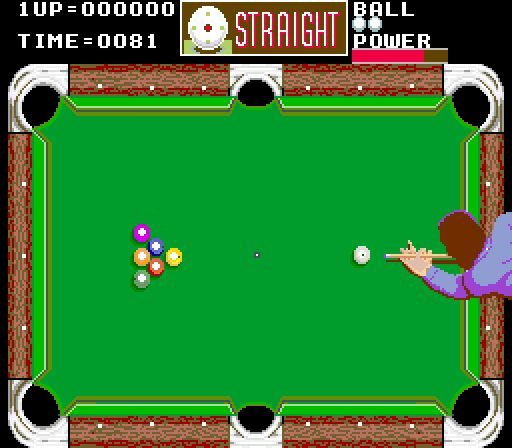
Side Pocket is a series of pool sims that started in the arcades in 1986, a recreation of the game that takes a lot of inspiration from the wave of golf videogames that were released around the same time. You aim your shot with the help of a dotted line, you enter the power by pressing a button to start a gauge moving and pressing the button again to stop it at the desired level, you can apply spin by choosing where you hit the cueball. It's straightforward, inutitive and quick to pick up - very important for an arcade game.


I've always been slightly confused by the point of arcade pool games, truth be told. I think this is because I'm British. I'm not saying we're easily baffled by the flashy-blinky-upright-boxy-game-pods of the mid-eighties, although I imagine there were more than a few gruff northern men who wondered what on Earth had happened to the world the first time someone explained Pac-Man to them. No, it's just that when I think of places you might have found an arcade cabinet in Britain in 1986, I don't really think of "arcades," per se, not in the "big rooms full of videogames" sense. I think of seaside resorts, pubs, leisure centres: when I was a kid, that was where arcade games lived. Of course, now that I'm an adult they don't live anywhere, unless they have a plastic gun attached to them or require some kind of undue physical exertion to operate, in which case you might see them in the foyer of a larger cineplex.


Maybe I'm entirely wrong - back then I was hardly of an age to be attending nursery school, let alone an arcade - but that's how it felt to me. That's where arcade games were found, which undermined the point of video-pool because they were places that also often contained pool tables. Actual, physical ones, real tables that usually cost less to play than the arcade equivalent and didn't hurl a "Game Over" screen at you if you missed three shots in a row like Side Pocket does.
Okay, so maybe I'm being a little disingenuous. I can see the appeal of the arcade pool title. It takes up less space than a real pool table, there are fewer pool cues available for drunken louts to crack people over the head with, with and a videogame allows you to do things that aren't feasible in real pool. Things like cartoon girls who are ready and willing to take their clothes off if you're half-decent at the game.


This is Pocket Gal, a slightly improved version of Side Pocket that hit the arcades in 1987 and has one major difference over its predecessor: babes. Okay, so maybe "babes" is pushing it a bit. Blocky cartoon anime lumps, while more of a mouthful, is probably more accurate.


The aim of Pocket Gal is to score enough points to clear each round, which isn't as simple as potting all the balls. That won't net you a high enough score, so you have to get extra points by potting balls in a row, or in the correct order, or by knocking them into specially-marked bonus pockets.


If you meet the score requirement, you'll move to the next stage, but not before the girl you've just beaten takes all her clothes of in a display of incredibly tame pixel titillation that has all the raw eroticism of a egg salad sandwich.


Pictures of breasts are still pictures of breasts even when they're composed of less pixels than half a Tamagotchi, so I had to censor them. You get the idea, though, and I'm sure you'll agree that these girls are hardly likely to set your loins ablaze with unfettered desire. It's their expressions that  fascinate me - they look, if not quite bored, then at most wryly amused. Frankly, this is a big step up from kind of tearful, ashamed, "please don't look at me" vibe the Japanese often seem to employ in situations like this, and it's quite heartening to see the girls not being upset about the whole thing. "Yep, I sure did lose that game of pool. Well, time to take my dress off," their faces seem to say, and they stand there in the nip for a moment before you jet off to the next pool-playing locale. I assume the reason is that Data East didn't want to draw any more faces for them.
It might sound like I've been thinking about Pocket Gal too much, and that's true. Thing is, I've been thinking about it for nearly twenty years now.


My memory is not great. It's got more empty patches than the cabinet Steven Seagal built to hold his Oscars. There are birthdays, Christmases and whole years of secondary education that I have no recollection of. Like I say, it gives sieves a bad name. However, of the few memories from my youth that remain clear and bright even as I shuffle into middle age, there's one that revolves around Pocket Gal.
When I was a kid, no more than eight or nine, we went on a family holiday to the English seaside resort of Great Yarmouth. As I've mentioned, seaside resorts meant nothing more than arcade games to me, and at some point on the holiday I found myself in the "amusements," gawping at the arrayed cabinets and trying to find a machine that'd give me a game for ten pence. At the back, on a row of cabinets that ended with a fire door thrown open to the summer sunshine, was Pocket Gal.


It was ten pence a go, so I played a very short game of video pool, and for some reason the memory of this event has been permanently seared into my mind. First day at school? Not a thing. Half my childhood birthdays? Couldn't tell you what happened. Hell, I barely remember what happened last week, but this one youthful encounter with a soft-porn pool simulator that was outdated even back then? I can't shake the memory of it, and I don't know why. It's not like I'd never played an arcade game before - better, more impressive arcade games, titles like After Burner that were far more deserving of a permanent spot in the VGJunk memory banks - and the thing is, I didn't actually see the cartoon boobs. That's the kind of thing that'd imprint on a young child's mind and form a memory that lasts through the tumult of their lives, but Pocket Gal isn't an easy game and I wasn't good enough to see any digital flesh. I didn't even find out there was nudity in Pocket Gal until I played it years later via emulation. I was surprised, but I also did a kind of mental shrug as I realised why you'd keep a digital pool game around in the first place.


So that's my story about Pocket Gal and the fact that I remember it so vividly even though I have no reason to, and I'm sorry for rambling on about it, but I'm not quite finished. The Side Pocket series eventually moved out of the arcades and onto a wide range of home consoles (where a pool sim, to my mind, makes a little more sense) such as the Megadrive, NES and Game Boy.  Here's the title screen from the SNES version.


Classy, right? That guy might be contemplating driving his car into the bay to escape from his crippling gambling debts, but he looks stylish while doing it.
The SNES version of Side Pocket is much the same as the original, only polished to a shine and with no trace of nudity. Where the original suffered from only having a fairly narrow range of possible aiming angles and limited control over the cueball, the 16-bit ports offered a much smoother experience. I can't claim to be an expert on the snooker, pool and billiards titles of the early nineties, but I feel pretty confident in saying Side Pocket has to be one of the better ones.


In fact it's so much fun that my best friend and I played it quite a lot during out university days. It became, for a while at least, a mini-tradition, particularly before going out - drink far too much cheap Tesco vodka, play Side Pocket and spend the rest of the night drunkenly humming the soundtrack. Okay, it was only me that did that last bit, but then I love SNES Side Pocket soundtrack - it's smooth, jazzy, the kind of soundtrack you could only ever hear in a Japanese pool simulation from 1993.


It was composed by Emi Shimizu, by the way. Just in case she ever happens to read this, I'd just like to say thanks for the fine soundtrack and for giving me a new way to irritate my friends by half-singing along with words I made up on the spot, full of the happy yet slightly queasy fuzz that only cheap liquor can bring, while they try to take their shot.


In conclusion, Data East's Side Pocket series has given me a lot of memories - far more memories than you might expect from a not-especially-famous, occasionally pornographic line of bar-room game simulators. And if you read all this, thanks for sticking with me as I gabbled on in a very uncoordinated kind of way. Normal service will be resumed next time.

VGJUNK Archive

Search This Blog

Followers