Where would videogames be without ninjas, eh? What disposable warriors would all the muscleheaded Schwarzenegger-alikes to plough through? From where would we get our fill of throwing stars and flowing headbands? Sub-Zero and Scorpion would have to be feuding accountants or something, and Vega from Street Fighter would be a regular matador instead of a ninja matador. It doesn’t bear thinking about, but don’t worry, we’ve got plenty of ninjas today. Perhaps all the ninjas. Brace yourself for Data East’s 1988 arcade classic Bad Dudes vs. DragonNinja!
Here are the bad dudes now, looking like they’re traced from pictures of Bruce Lee. According to the NES port of the game their names are Blade and Striker, but those names are never mentioned in this arcade original. It’s not like the bad dudes need names, they do all their introductions with their fists and occasionally knives.
The bad dudes’ noble visages are downcast, as well they might be; rampant ninja related crimes weigh heavy on the shoulders of any and all self-appointed upholders of justice. Is this what previous generations of bad dudes fought and died for? For ninjas to strike at the very heart of America itself? When Whitehouse is not the exception, you know times are bad.
Yes, you know where this is going. It’s the lead-in to one of videogaming’s all-time most famous plots. Perhaps even the most famous videogame plot. Okay, okay, let’s get to it.
Bad Dudes kinda passed me by when I was a kid. I never played the NES version and almost never visited the arcades, so I when I was a bit older and got access to the internet I was surprised to learn that Bad Dudes’ plot outline was already a widely-known joke, a proto-meme. It’s not hard to see why. “Are you a bad enough dude to rescue Ronnie?” (or its slightly different NES variation) is such a bizarre yet wholly appropriate-for-the-time way of saying “rescue the president” that it’s impossible to forget. Plus there’s the implied challenge contained within. Are you a bad enough dude? How can you know? Have you been tested in the fires of combat? Has your badness ever been truly been measured? No man can know the extent of their badness until they have been to hell and back. A hell filled with ninjas. So go, young warrior, and rescue President Ronnie!
It’s straight into the action, and as the bad dude does some warm-up thigh stretches the first wave of the Dragon Ninja army runs into his outstretched feet and immediately dies. Man, that is one bad dude.
Bad Dudes vs. DragonNinja is a beat-em-up, then. Single-plane fighting action wherein you help the bad dudes save the day using one button to jump and one button to attack. It’s not a very complex game, and can be best described as a mix of two other games; Irem’s seminal walk-n-kick-em-up Kung Fu Master / Spartan X, and Namco’s swingin’-sixties-inspired Rolling Thunder - although to be fair, the main takeaway from Rolling Thunder is that you can hold up and jump to leap between two different paths. As you can see, in the screenshot above I’ve climbed up to the top of this fence. Part of being a bad dude is having the balance of a circus acrobat, apparently.
And that’s how you play Bad Dudes. Ninjas come at you from all angles, and it’s up to you to kick or punch them out of the way until you reach the end of each stage. Some ninjas have swords, some ninjas have shurikens, some ninjas throw caltrops on the ground to make the bad dudes regret not wearing sturdier ninja-kicking shoes. This is a game of many ninjas. All ninjas all the time, especially if you count dogs as a kind of four-legged ninja.
The amount of ninjas tasked with stopping the bad dudes is so gargantuan that the villains are literally shipping hordes of ninjas into the battle in massive lorries. It must be disheartening to spend years training in the deadly shadow arts of infiltration and assassination only to be told you need to study for an HGV license so you can drive the other ninjas around.
With so many ninjas, it’s a relief that (almost) all of them can be defeated in a single hit. I’ve said before that I don’t like it when brawlers pad themselves out by having enemies with overinflated health bars, much preferring beat-em-ups containing more enemies with smaller life pools. Well, Bad Dudes definitely falls into that category. Each ninja can be dealt with using one well-timed jumping kick or leg sweep. Oh, and you can also attack straight upwards by holding up and attack, which is useful when enemies are dropping down from the upper level. If the enemies all took multiple hits to defeat then Bad Dudes would quickly become a slog, bogged down under the weight of one million ninjas, but by having them be numerous but less durable things flow along at a decent clip. Plus, taking out four ninjas with a roundhouse kick makes you feel like a bad dude.
And what’s that up there, on the billboard? Why it’s a reference to Data East’s sort-of mascot character Karnov, a bald, stocky, fire-breathing Russian who had his own eponymous videogame and lots of other cameos in Data East games (including appearing as “Oddjob” in Sly Spy). I wonder if he’ll appear in Bad Dudes?
Oh, I see, he’s on the next screen. The sign bearing his name was a warning that you’re stepping onto Karnov’s turf, and he’s the boss of Bad Dudes’ first stage. He can breath fire! He’s got the ludicrously muscled torso but strangely small legs of a He-Man action figure! He’s… not all that difficult to beat, honestly. His attacks are slow enough that as long as you don’t get greedy, you can kick him a couple of times and then switch between the top and bottom layers of the stage to avoid Karnov’s retaliation.
With Karnov defeated, the bad dude raises his hands to the sky and exclaims “I’m Bad!” via the medium of sampled speech. So he’s bad, but whether he’s bad enough remains to be seen. Besting Karnov was hardly the sternest test of badness. Also, I assume “I’m Bad” is a reference to Michael Jackson because this game came out in 1988 and everything in 1988 was a reference to the King of Pop. So, the bad dude says “I’m Bad.” I would have also accepted “I’m Dangerous,” although given that I stepped on a lot of caltrops I’d say “I’m Invincible” is inaccurate.
It turns out that there’s an entire fleet of ninja-packed lorries, and that’s where stage two takes place. Moving along the top of the convoy as it travels across the screen is a fun concept and it does give you the rare opportunity to see a ninja surfing a Porsche 911, but by removing the bad dudes’ ability to jump between two different “planes” the play area is further compressed and the game loses a bit of complexity as a result. All you can really do is wait for the next truck to scroll onto the screen, kicking any ninjas foolish enough to leap towards you, and it ends up feeling a little passive.
I did figure out that you can hold the attack button to charge up your punches. As almost all enemies fall to a single hit the charged punches aren’t that useful, but there are one or two places where they come in handy and I’m certainly not complaining about the bad dudes having more ninja-clobbering tools at their disposal.
Stage two’s boss takes the fairly generic form of a ninja with claws. We’ve all seen a ninja with claws before. They’re further down the ninja totem pole than ninjas with sickles, ninjas with swords and ninjas with demon swords that harbour the spirit of an ancient dragon, but claw ninjas are a perfectly acceptable part of the ninja hierarchy. It is a shame that this ninja climbed to a position on the truck’s cab where I could stand slightly below the ninjas and hack away at his shins with little threat of retaliation, really.
Hey. Hey! Wake up! I know this screenshot has the power to immediately send a person into a narcoleptic stupor, but there’s still a whole bunch of Bad Dudes left to go and I’m gonna make sure you see every stage, goddammit.
So yeah, stage three is a sewer level and it is boring. Deeply, painfully boring. Greyer than battleship dock on an overcast day, so tedious to look at that the walls must surely be made of heavily-compacted copies of unsold Jeremy Clarkson books. Why would you do this, Data East? I just don’t get it. Did the developers think players might get distracted from the action if the scenery was any more interesting than this? I’ve seen charcoal briquettes with more joie de vivre than this background. Even a bit of graffiti would have been something; never have I yearned so strongly for a crudely-drawn penis.
The fighting is still the same. You may have noticed that the bad dude picked up a knife along the way, which give his attacks a bit of extra reach. Having the knife makes things kinda weird, if I’m honest. I’ve played a lot of games where I have to stab a bunch of people, but it feels different in Bad Dudes because you don’t feel like you’re fighting so much as hundred of ninjas are running face-first into your knife without much input on your part. I can’t blame the ninjas. I’d be desperate to get out of this joyless catacomb by any means necessary, too.
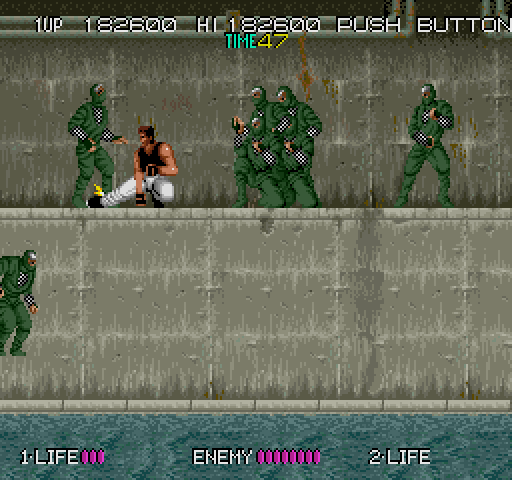
The boss is a multiple man, turning himself into a bunch of ninja clones that must be dealt with to find (and subsequently stab) the core ninja. It’s a more interesting fight than the previous two boss battles, and it’s also where the charge-up punch comes in useful because that attack seems to almost “spread” between nearby enemies when it connects. This means you can smash five or six ninjas across the room at once, and that’s definitely what I’d call playing to Bad Dudes’ strengths.
The next stage is set in the woods. It’s not a very interesting forest to look at in itself, but after the sewers it’s a magical fairy glen where each leaf glitters like liquid emerald. The most startling thing about this stage are the fire ninjas, who run across the screen and try to crash into you. They’re not men made of fire or anything, they’re regular ninjas that set themselves on fire before running across the screen. These ninjas are now so far from being the unseen spies and silent killers of legend that they might as well drop the ninja angle and start parading around with klaxons on their heads and a boombox playing dial-up modem noises under each arm.
Here we see one positive and one negative thing about Bad Dudes. On the plus side, you get to use nunchakus. That’s always fun, and in Bad Dudes they triple the range of your attacks so you can wipe out the ninjas with even greater efficiency. However, you might also see that there’s a dog down there, which means you have to kick dogs sometimes. They make a yelping noise and everything, just in case you didn’t already feel like history’s greatest monster for kicking a dog’s head in.
The boss is a big pro-wrestler type in facepaint and body armour. Gee, I wonder who he could possibly be based on. This is where Bad Dudes’ difficulty level spikes upwards, because the boss has a lot of health and is more than capable of killing you with two well-placed drop-kicks. The challenge is largely dependent on whether you’re carrying the nunchakus, because without their extra range you’re going to be spend a lot of time chipping away at the boss’ health bar and then running away when he so much as looks at you funny.
Now we’re on top of a train, in a stage that plays much like the one with the trucks except, you know, a train. Not much more to say about it, honestly. The by-now-familiar enemies, the kicks, the punches, the scrabbling across the floor to grab one of the health-restoring soft drinks occasionally dropped when a ninja is thumped hard enough like a faulty vending machine. This isn’t to say the gameplay isn’t still fun, though. I’m enjoying it, even if the backgrounds range from “mediocre” to “coma-inducing.” There’s one small touch that helps to keep the combat engaging, and that’s that, to a small degree, it’s context sensitive. Your moves will change depending on how far away the enemies are, but the best example is that attacking behind yourself is really smooth. If an enemy creeps up behind you and you move the joystick toward them and hit attack, your character fluidly performs a turning kick or what have you without having to turn around and then attack. This keeps the combat flowing along nicely, a very important consideration when you’re often surrounded by enemies.
One of the train carriages is emblazoned with the name and likeness of Chelnov, the Atomic Runner: eponymous star of his own Data East game. I was hoping that this’d turn out like the Karnov sign in the first stage and I’d get to fight Chelnov, but sadly that didn’t happen. I did have to fight Karnov again, though. He’s back, with grey skin, so I assume Karnov’s corpse was reanimated using black magic. A Karnov zombie. Zarnov, if you like.
Oh look, here’s one of those ninjas with a sickle that I mentioned earlier. This is the boss of the stage, and he’s got an even bigger health bar than the last boss plus some very far-reaching attacks. He’s about as much fun to fight as I’m making him sound.
More unbelievably dull scenery with this underground cave stage. There’s zombie Karnov over on the left. He’s a regular enemy now. How the mighty have fallen. Speaking of falling, deadly stalactites occasionally drop from the cave’s roof, although like all problems in Bad Dudes they can be dealt with using the tried-and-true method of violence. There’s not much else to say about this stage, folks. It’s not like there’s a spelunking minigame or anything to break up the ninjitsu carnage.
The boss is a Shaolin monk type brandishing a bo staff. One assumes this warrior spent many arduous years training with the weapon and didn’t just pick it up off the ground in surprise because they didn’t expect the bad dudes to get this far. That said, the boss attacks by holding their stick out and spinning around, so make your own judgements. It’s a surprisingly difficult technique to counter, requiring much hopping up to that platform at the back and considerable patience, and it really hammers home the fact that Bad Dudes is one of those games where the world would have been saved much quicker if the heroes had remembered to bring a gun.
The final stage continues the trend of bloody dreadful backgrounds, with a trip through a military base that’s all grey, all the time. Look, even the sodding ninjas are grey now! At least this stage has a couple of mildly diverting background elements, like this stencil on the wall that says “NAMSHIT.” Is this Data East taking a crude swipe at fellow arcade developers Namco? Unlikely, given that Namco published the Famicom versions of several Data East games including Karnov and, erm, Bad Dudes. It’s just rudeness for rudeness sake. Tut tut, Data East, very disappointing.
Then there’s the never-welcome boss rush at the end of the game, where you’re forced to fight all of the game’s bosses again in the kind of tedious padding that I’ve really come to hate during my time running VGJunk. Strangely, we’ve already seen zombie Karnov and the wrestler boss has received a shiny new set of golden armour, but all the other bosses are exactly the same as the first time you fought them. C’mon, Data East, you could have zhuzhed the others up a little bit, given the stick fighter a golden stick or something. Oh well, it’ll have to go down as a missed opportunity.
At last, the final battle against the evil Dragon Ninja himself, complete with his own monogrammed helicopter. He’s got a pretty cool demon-mask look going on, and he attacks by throwing two things at you: fireballs that explode into pillars of flame and dogs. Of course, the obvious way to avoid these (and also avoid the mental anguish of kicking a bunch of dogs) is to jump up to the helicopter and fight the Dragon Ninja mano-a-mano. If you’ve managed to hang on to the nunchakus, this fight is an absolute joke – you can stand there and repeatedly whack the boss from a safe distance and the Dragon Ninja will keep attacking over and over, seemingly unable to figure out that he’s not actually hitting you. If you don’t have the nunchakus then, well, I hope you’re willing to slap a bunch of credits into the machine. I did not have the nunchakus. It was a long battle.
I got there in the end, though, and President Ronnie was freed. Back to the White House he goes. Erm, yay? Hmm. Let’s not get into the ramifications of that and instead focus on the fact that rescuing the leader of the free world is only worth a hamburger. Like, I know the bad dudes didn’t take this mission for the money or the glory, but a hamburger? They’d better at least be getting a large milkshake and as many extra packets of ketchup as they want with that.
It took three thousands words and repeatedly deaths at the hands of a kabuki maniac riding a helicopter, but finally the question of questions has an answer: yes, I am a bad enough dude to rescue the president. I was considerably more bad with a set of nunchakus in my hands, but even fighting bare-handed I managed to summon the requisite amount of badness to get the job done and you know what? I had some fun while I was at it. Bad Dudes vs. DragonNinja does definitely have a solid gameplay core beneath the meme-ified plot and the raw ludicrousness of the title “Bad Dudes vs. DragonNinja.” The fighting’s slick, it controls well, the collectible weapons are limited in number but fun to use and there’s a rare joy that comes from absolutely smashing your way through countless very weak ninja opponents.
That said – and while I couldn’t deny Bad Dudes’ position as a classic of the era and a foundational part of the genre – it’s not that great. The gameplay gets rather repetitive quite quickly and the look of the game is often surprisingly dull. If it had a bit more – more meaningful enemy varieties, more interesting locations, more types of weapons to use – I’d be able to rave about how great it is. However, I’ve got to put Bad Dudes into the “interesting historical artefact” pile rather than the “stone cold masterpiece” drawer. If you love Bad Dudes vs. DragonNinja, please don’t take this analysis personally. I kinda love Bad Dudes too. It’s called Bad Dudes vs. DragonNinja, for heaven’s sake.
Showing posts with label data east. Show all posts
13/08/2018
20/03/2018
HANGZO (ARCADE)
In the interests of keeping things fresh and innovative here at VGJunk, I present a game about ninjas. They use ninja magic and hit things with their ninja weapons. Also shurikens. No wait, come back – did I mention it’s an unreleased ninja game? That’s right, you might never have seen this one before. It’s the mysterious arcade prototype Hangzo!
You might notice that there are no developer credits on the title screen. That is, you might notice it if you’re more observant than me. Personally, I couldn’t stop looking at the ninja on the right who’s horrified that he’s picked the claw out of the big sack of ninja weapons. He really wanted the nunchucks.
So, who did make Hangzo? Apparently it runs on Data East arcade tech, but some places list Hot-B as the developer. A collaborative effort that didn’t pan out, possibly, and it doesn’t feel like the work of a top-tier developer so Hot-B seems as reasonable an option as any other.
Hangzo has a story, but I can’t read it because it’s in Japanese. That said, if the story isn’t “city is taken over by an evil dictator and only the three ninjas of the Hangzo Squad can save the day” then I’ll eat my Shinobi cartridge. Just once I’d like the story to be “why are we taking orders? We’re ninjas, we can conquer the city ourselves and transform it into a paradise of endless shurikens and katana polish!”
There are three playable ninjas to chose from: big blue Hanzo (the veteran of the team at the ripe old age of 20,) Kotaroh with the vertiginous hair on the left and Kasumi, the lady ninja. Naturally I assumed these three characters would fall into the usual arcade game spectrum of the fast but weak one, the slow but powerful one and the average all-rounder, but Hangzo neatly sidesteps this cliché by having all the characters be essentially interchangeable.
And away we go, taking the fight against the evil “Mr. K” onto the city streets. Hanzo uses his sword to cut down the gun emplacement ahead of him and for a moment I’m confused, because I was certain that Hangzo was going to be a typical side-scrolling beat-em-up. It isn’t. It’s a single-plane run-n-slash adventure with some light platforming, much more akin to Ninja Gaiden than Golden Axe. As well as using your sword to attack nearby enemies, you can use the other attack button to sling a shuriken for ranged damage. You can also hold the shuriken button down, and I thought this was Hanzo “charging” his shuriken attack but the projectile doesn’t seem to do any extra damage. Holding the button can still be useful, though, because it allows you to keep a shuriken at the ready so you can release it when an enemy hops into your path.
Oh, and you can jump, too. However, if you double-tap the jump button…
...your character produces a rope from somewhere and proceeds to swing across the screen with their foot extended. A dangerous, deadly foot that can be used to kick enemies to death. With this simple addition, Hangzo has already begun to endear itself to me because I’ve played so many games where the supposed ninja characters play more like people who attended an online ninja school which supplied a diploma, ninja suit and headband all for the low, low price of $899.99 per semester (throwing stars sold separately). I know it’s only one move and swinging into a fight like goddamn Tarzan is the conceptual opposite of the mysterious, shadow-clad assassin, but it feels right.
I mentioned Golden Axe earlier and now you know why it was on my mind: Hangzo offers you the chance to ride these guardian lion / komainu creatures. They look cool and their ability to fire large projectiles out of their mouths definitely comes in handy, but at a terrible cost – their slightly ungainly movements and the vague collision detection on their feet makes it more than likely that you’d ride them straight down one of the bottomless pits that litter this section of the stage.
And so goes the fighting, sometimes against demonic warriors and sometimes against fire-breathing fat blokes. In this case we’re battling in front of a boutique specialising in those hot Blade Runner fashions, and because Hanzo is surrounded I’m going to press jump and attack at the same time to activate his limited-use, screen-clearing ninja magic attack.
Did I mention the overweight chaps who breathe fire? Hangzo feels like it’s suffering from something of an identity crisis, as though it really wants to be a side-scrolling beat-em-up but accidentally became a hack-n-slash platformer instead. It’d score quite highly on the beat-em-up bingo sheet, I know that much. Given that arcade brawlers are one of my favourite genres I’m naturally a little disappointed that Hangzo isn’t that kind of game, but I’m having a good time with it so far. Ninjas in a scuzzy cyberpunk future is a theme that’s always welcome here at VGJunk, and while the action does have problems that we’ll get into later it’s all hanging together quite well in the early going.
Inevitably, there are bosses at the end of each stage. The first one is an enormous mechanical kill-bot whose imposing air of menace is undercut only slightly by it having the same wheels as a shopping trolley. Oh, but it’s got lasers, plenty of ‘em, and most of the fight is spent dodging said lasers and throwing shurikens back at the robot when you get the chance. Eventually the robot will become frustrated with using futuristic lasers that travel more slowly than even the most primitive solid-projectile technology, and it’ll try to punch you. That’s your cue to stab the robot’s hands. It’s not the most complex boss battle.
Moving onward to stage two – the “Disposal Plant” - and it’s Kasumi’s turn to flex her ninja muscles. As mentioned earlier, there’s little difference between the three characters. They all seem to move at the same speed and their attacks do the same amount of damage. They have aesthetic differences, of course – they have unique sprites and while each character’s limited-use super move simply covers the screen in damage-dealing magic, Hanzo summons a whirling wall of flame and Kasumi creates a rain of deadly flower petals, that kind of thing. The only truly unique feature of each character seems to be a special “command” move activated by pressing up and attack at the same time. Hanzo swings his sword in a wide overhead arc that hits enemies both in front of and behind him, whereas Kasumi attacks while backflipping away from whatever you’re attacking. Sadly these attacks are a little too slow to be much use, but Kasumi’s is the best of the bunch as it overs a bit of extra mobility. I’d say Kasumi is my favourite character overall, but that’s almost entirely because she looks enough like Blaze from Streets of Rage that I can pretend Kasumi is one of Blaze’s descendants, carrying on the family tradition of pummelling villains on the mean city streets.
After the relatively standard “dystopian cyber-city” of the first stage, Hangzo moves into a globby, goopy biomechanical flesh-hell vibe with stage two. Gigeresque resin growths coat the walls, multi-eyed slimes patrol the sewers and a distant relative of Zantar the Gelatinous Cube (literally) drops in to exercise his powerful digestive enzymes. I love it. There’s a part of this stage where you’re riding down an elevator and – obviously, because Hangzo is 95% a scrolling beat-em-up – enemies fall into the lift while you’re travelling. One of those enemies is a clump of brightly-coloured pustules that can reform itself into a demonic creature, and if there was ever a monster I wanted to fall into a beat-em-up elevator it would be a vicious puddle of transmogrifying boils. That’s just my kind of thing.
Also my kind of thing – this boss, a hideous fleshy mound so abstract that getting a handle on what it’s supposed to be is nigh impossible. This stage takes place in the sewers, so it’s probably for the best that we don’t know what this thing is. Besides “angry” and “murderous,” I mean. What I will say is that I once had a sinus infection so bad it gave me nosebleeds, and I’d create a clone of this boss every time I sneezed.
Moving on to stage three, where the “elevator that keeps filling with enemies” concept is taken to its logical extreme – it’s an entire stage of elevator that keeps filling with enemies! Okay, so there are actually two elevators and you ride on top of them, and the elevators move up and down independently as the stage goes on. This does help to keep the action more interesting than it might have been otherwise, because you have to move between the two lifts in order to get into advantageous robot-stabbing positions, but after the dripping, ichorous stink-scape of the last stage it’s difficult to get excited about Stairs: The Next Generation.
Oh, and I’m playing as Kotaroh now. That’s not very exciting, either. His basic attacks are slightly more vertically oriented than the other character’s horizontal slashes, maybe? I know, it’s not the kind of thing you’d splash across his advertising blurb, is it?
After that disappointingly mundane stage comes a boss that isn’t bad, per se, but doesn’t really interest me as much as a boss that looks like a verruca you’d catch in Hell’s changing room. It’s a robot dragon / griffon thing, and that’s fine. It attacks pretty much how you’d expect it to (lots of projectiles and swooping) and that’s fine too. I like its very fancy wings. And the actual battle itself was, you know, fine. My major issue was that this boss was reminding me of something and my brain kept trying to tell me I was thinking of the Dinobots from Transformers, particularly Sludge, the brontosaurus Dinobot. You can see why I was confused, because this boss is definitely bird-like and not a dinosaur. I think what it is is that the original Dinobot toys had the same silver and gold colour scheme, and when combined with the four legs and the long neck my brain’s going “I’ve seen enough, that’s definitely Sludge the Dinobot.” Screw you, brain, now I can’t judge this robo-griffon on its own merits and I’m boring anyone who’s reading this.
Stage four is another relatively bog-standard videogame location – the “factory” that builds nothing but electrical death traps and moving platforms – and once again I’m left wishing that Hangzo’s developers had gone all-out on the weirdness front instead of having yet more elevators. It’s very colourful, at least, and I’ve come to the conclusion that whoever did make Hangzo, they were (unconsciously or not) aping Konami’s nineties arcade style. The whole game feels like the first draft of a Konami arcade game, especially the visuals. The neon ninjas that are very reminiscent of Mystic Warriors, or the Contra-esque “robots and Aliens” vibe of some stages.
This stage does feature these impressively strange creatures, enemies so weird that they totally make up for the slightly bland stage design. They’re… gladiators, I think? Those helmets and loincloths are definitely making me think of Roman gladiators, but these enemies also to appear to be moulded from play-doh and they have chainsaws, which would have made the “gladiators versus lions” fights a lot more intense.
Then you hit them a few times and they inflate into grotesque humanoid balloons, with the extra-disturbing detail that only their stomachs are inflated. The rest of their bodies dangle from the back. You might be wondering what advantages this offers over “hitting people with a chainsaw” in combat, but think about it: would you want to keep hitting them in this state? There are only three possible outcomes in that situation. They either revert back to hitting you with a chainsaw, they keep expanding or they burst. None of those options are especially appealing, so you’ll be pleased to know that these enemies can do both the first and last things on that list.
The latter half of this stage features a lot more platforming, and that’s a bit of a problem. Not because the level design is bad, because although it does tend towards the blander side of the spectrum it’s certainly not infuriating or anything. In fact, Hangzo is surprisingly easy-going for an arcade game, with lots of power-ups floating by and the ability to always be throwing shurikens across the screen. No, the problem here is with the grappling and swinging abilities. Portions of this area are set up so that the best way to make progress is to swing between the dangling electric cables, timing each swing so you pass the wires at the lowest point of your swing’s arc. There’s a chance to revel in freedom of movement here, but unfortunately it’s hampered by the actual swinging. Firstly, launching your rope can be a touch fiddly and often resulted in me not swinging when I was sure I would. However, the biggest problem is that it’s very difficult to tell if you’re taking damage while swinging, because you can’t be knocked back and there’s no sound effect, so you might swing your way through an area thinking that your glowing ninja foot is clearing a path through the bad guys, only for you to land on the other side and realise you’ve lost three-quarters of your health bar. Hitboxes feel especially ill-defined when you’re swinging, and because you travel quite a long distance when swinging it can be impossible to avoid enemies that appear when the screen scrolls.
It’s a real shame, because the swinging mechanic is so close to being a lot of fun, but the frustrations and niggling awkwardness of it means that taking things slowly and picking off enemies from a distance is by far the more efficient method of making progress.
Now this boss I do recognise: it’s Final Fantasy V’s recurring superboss Omega! Or a distant relation thereof, at the very least. They get together at murderbot family reunions, which this boss hates because all the other murderbots keep saying things like “Did you hear about your cousin Omega? He’s in them Final Fantasies now! The big time! His parents must be so proud. And how are you doing, Hangzo Boss Unit 04? Still working on that novel about the young college student who falls in love with her older professor who is also a cycloptic murderbot? Well, good for you, buddy.”
The final stage is President K’s Room, and it’s a bit of a cop-out, what with it just being a flat corridor where our heroes are attacked by conveyor belts and the Google Chrome logo. The backgrounds are nice, at least, as they have been for the majority of the game; well-drawn even when they’re just elevators or factories.
President K has an appreciation of fine art, at any rate. Ancient samurai armour is reverently displayed, a calming bamboo grove breathe life into his mansion and he’s even got a Playmobil horse over there on the left.
Go on, admit it. The first thing you though of was Sagat’s stage from Street Fighter II.
The final stage has a “boss rush” feel to it, even though mostly you’re fighting regular enemies, and as the lead-up to the cataclysmic clash of good and evil it’s about as exciting as folding laundry. The swinging mechanic is now totally redundant, the fights are all things you’ve seen before and it feels very rushed and unfinished, which is presumably the reason Hangzo never received a full release.
President K, then. President of what? The United States? His local wine club, which he hates running because it’s all become so pretentious? Who knows. He’s got a big steampunk thing behind his desk that’s making me remember The Chaos Engine and he flaps around the screen, lazily throwing projectiles like a cheap Halloween decoration that had to be recalled because it put some poor kid’s eye out.
After a few hits, President K reveals his true form: a hideous demon with wings, dragon heads as supplementary wings and the furry underpants found on most He-Man action figures. Again, he does little but flap around throwing projectiles only, you know, more dangerously. Not that dangerously, though, and I have to say that Hangzo’s bosses are strange in that they seem to get easier as the game progresses. In my experience, President K just kept trying to summon lightning bolts that you could easily position yourself in between while jumping up to slash at him, so he must have become president thanks to his business and political acumen rather than raw fighting power.
And that’s your lot. Hangzo ends as it began: with the same artwork from the intro of the heroes standing on a rooftop, only this time K’s tower is collapsing. Then you get a brief piece of text and Hangzo is over.
Despite there being a high score table during the attract mode, I was not allowed to enter my initials so obviously Hangzo isn’t worth bothering with.
I’m kidding, of course. Hangzo is worth bothering with, and the fact that it’s available in a playable form at all is fantastic. It’s hardly a fantastic game; it’s a bit too obvious, a touch ramshackle for that, but I reckon all it needed to be a genuinely good game was a bit more time in the proverbial oven. With more time spent on buffing out the problems with the swinging and the hitboxes, a little more care poured into fleshing out the game’s short run-time with more engaging stages and a final level that’s not a flat corridor, I reckon Hangzo could easily fall into the “hidden gem” category. As it stands, it’s simply a fun little romp with some excellent enemy designs that I would recommend playing through with a friend if for some insane reason you’re bored of Capcom’s Alien versus Predator.
P.S.: as I'm in the middle of the miserable experience that is "looking for a job" I hope you'll forgive a rare reminder that you can donate to VGJunk if you like the site. Please only do this if you are an eccentric millionaire.
You might notice that there are no developer credits on the title screen. That is, you might notice it if you’re more observant than me. Personally, I couldn’t stop looking at the ninja on the right who’s horrified that he’s picked the claw out of the big sack of ninja weapons. He really wanted the nunchucks.
So, who did make Hangzo? Apparently it runs on Data East arcade tech, but some places list Hot-B as the developer. A collaborative effort that didn’t pan out, possibly, and it doesn’t feel like the work of a top-tier developer so Hot-B seems as reasonable an option as any other.
Hangzo has a story, but I can’t read it because it’s in Japanese. That said, if the story isn’t “city is taken over by an evil dictator and only the three ninjas of the Hangzo Squad can save the day” then I’ll eat my Shinobi cartridge. Just once I’d like the story to be “why are we taking orders? We’re ninjas, we can conquer the city ourselves and transform it into a paradise of endless shurikens and katana polish!”
There are three playable ninjas to chose from: big blue Hanzo (the veteran of the team at the ripe old age of 20,) Kotaroh with the vertiginous hair on the left and Kasumi, the lady ninja. Naturally I assumed these three characters would fall into the usual arcade game spectrum of the fast but weak one, the slow but powerful one and the average all-rounder, but Hangzo neatly sidesteps this cliché by having all the characters be essentially interchangeable.
And away we go, taking the fight against the evil “Mr. K” onto the city streets. Hanzo uses his sword to cut down the gun emplacement ahead of him and for a moment I’m confused, because I was certain that Hangzo was going to be a typical side-scrolling beat-em-up. It isn’t. It’s a single-plane run-n-slash adventure with some light platforming, much more akin to Ninja Gaiden than Golden Axe. As well as using your sword to attack nearby enemies, you can use the other attack button to sling a shuriken for ranged damage. You can also hold the shuriken button down, and I thought this was Hanzo “charging” his shuriken attack but the projectile doesn’t seem to do any extra damage. Holding the button can still be useful, though, because it allows you to keep a shuriken at the ready so you can release it when an enemy hops into your path.
Oh, and you can jump, too. However, if you double-tap the jump button…
...your character produces a rope from somewhere and proceeds to swing across the screen with their foot extended. A dangerous, deadly foot that can be used to kick enemies to death. With this simple addition, Hangzo has already begun to endear itself to me because I’ve played so many games where the supposed ninja characters play more like people who attended an online ninja school which supplied a diploma, ninja suit and headband all for the low, low price of $899.99 per semester (throwing stars sold separately). I know it’s only one move and swinging into a fight like goddamn Tarzan is the conceptual opposite of the mysterious, shadow-clad assassin, but it feels right.
I mentioned Golden Axe earlier and now you know why it was on my mind: Hangzo offers you the chance to ride these guardian lion / komainu creatures. They look cool and their ability to fire large projectiles out of their mouths definitely comes in handy, but at a terrible cost – their slightly ungainly movements and the vague collision detection on their feet makes it more than likely that you’d ride them straight down one of the bottomless pits that litter this section of the stage.
And so goes the fighting, sometimes against demonic warriors and sometimes against fire-breathing fat blokes. In this case we’re battling in front of a boutique specialising in those hot Blade Runner fashions, and because Hanzo is surrounded I’m going to press jump and attack at the same time to activate his limited-use, screen-clearing ninja magic attack.
Did I mention the overweight chaps who breathe fire? Hangzo feels like it’s suffering from something of an identity crisis, as though it really wants to be a side-scrolling beat-em-up but accidentally became a hack-n-slash platformer instead. It’d score quite highly on the beat-em-up bingo sheet, I know that much. Given that arcade brawlers are one of my favourite genres I’m naturally a little disappointed that Hangzo isn’t that kind of game, but I’m having a good time with it so far. Ninjas in a scuzzy cyberpunk future is a theme that’s always welcome here at VGJunk, and while the action does have problems that we’ll get into later it’s all hanging together quite well in the early going.
Inevitably, there are bosses at the end of each stage. The first one is an enormous mechanical kill-bot whose imposing air of menace is undercut only slightly by it having the same wheels as a shopping trolley. Oh, but it’s got lasers, plenty of ‘em, and most of the fight is spent dodging said lasers and throwing shurikens back at the robot when you get the chance. Eventually the robot will become frustrated with using futuristic lasers that travel more slowly than even the most primitive solid-projectile technology, and it’ll try to punch you. That’s your cue to stab the robot’s hands. It’s not the most complex boss battle.
Moving onward to stage two – the “Disposal Plant” - and it’s Kasumi’s turn to flex her ninja muscles. As mentioned earlier, there’s little difference between the three characters. They all seem to move at the same speed and their attacks do the same amount of damage. They have aesthetic differences, of course – they have unique sprites and while each character’s limited-use super move simply covers the screen in damage-dealing magic, Hanzo summons a whirling wall of flame and Kasumi creates a rain of deadly flower petals, that kind of thing. The only truly unique feature of each character seems to be a special “command” move activated by pressing up and attack at the same time. Hanzo swings his sword in a wide overhead arc that hits enemies both in front of and behind him, whereas Kasumi attacks while backflipping away from whatever you’re attacking. Sadly these attacks are a little too slow to be much use, but Kasumi’s is the best of the bunch as it overs a bit of extra mobility. I’d say Kasumi is my favourite character overall, but that’s almost entirely because she looks enough like Blaze from Streets of Rage that I can pretend Kasumi is one of Blaze’s descendants, carrying on the family tradition of pummelling villains on the mean city streets.
After the relatively standard “dystopian cyber-city” of the first stage, Hangzo moves into a globby, goopy biomechanical flesh-hell vibe with stage two. Gigeresque resin growths coat the walls, multi-eyed slimes patrol the sewers and a distant relative of Zantar the Gelatinous Cube (literally) drops in to exercise his powerful digestive enzymes. I love it. There’s a part of this stage where you’re riding down an elevator and – obviously, because Hangzo is 95% a scrolling beat-em-up – enemies fall into the lift while you’re travelling. One of those enemies is a clump of brightly-coloured pustules that can reform itself into a demonic creature, and if there was ever a monster I wanted to fall into a beat-em-up elevator it would be a vicious puddle of transmogrifying boils. That’s just my kind of thing.
Also my kind of thing – this boss, a hideous fleshy mound so abstract that getting a handle on what it’s supposed to be is nigh impossible. This stage takes place in the sewers, so it’s probably for the best that we don’t know what this thing is. Besides “angry” and “murderous,” I mean. What I will say is that I once had a sinus infection so bad it gave me nosebleeds, and I’d create a clone of this boss every time I sneezed.
Moving on to stage three, where the “elevator that keeps filling with enemies” concept is taken to its logical extreme – it’s an entire stage of elevator that keeps filling with enemies! Okay, so there are actually two elevators and you ride on top of them, and the elevators move up and down independently as the stage goes on. This does help to keep the action more interesting than it might have been otherwise, because you have to move between the two lifts in order to get into advantageous robot-stabbing positions, but after the dripping, ichorous stink-scape of the last stage it’s difficult to get excited about Stairs: The Next Generation.
Oh, and I’m playing as Kotaroh now. That’s not very exciting, either. His basic attacks are slightly more vertically oriented than the other character’s horizontal slashes, maybe? I know, it’s not the kind of thing you’d splash across his advertising blurb, is it?
After that disappointingly mundane stage comes a boss that isn’t bad, per se, but doesn’t really interest me as much as a boss that looks like a verruca you’d catch in Hell’s changing room. It’s a robot dragon / griffon thing, and that’s fine. It attacks pretty much how you’d expect it to (lots of projectiles and swooping) and that’s fine too. I like its very fancy wings. And the actual battle itself was, you know, fine. My major issue was that this boss was reminding me of something and my brain kept trying to tell me I was thinking of the Dinobots from Transformers, particularly Sludge, the brontosaurus Dinobot. You can see why I was confused, because this boss is definitely bird-like and not a dinosaur. I think what it is is that the original Dinobot toys had the same silver and gold colour scheme, and when combined with the four legs and the long neck my brain’s going “I’ve seen enough, that’s definitely Sludge the Dinobot.” Screw you, brain, now I can’t judge this robo-griffon on its own merits and I’m boring anyone who’s reading this.
Stage four is another relatively bog-standard videogame location – the “factory” that builds nothing but electrical death traps and moving platforms – and once again I’m left wishing that Hangzo’s developers had gone all-out on the weirdness front instead of having yet more elevators. It’s very colourful, at least, and I’ve come to the conclusion that whoever did make Hangzo, they were (unconsciously or not) aping Konami’s nineties arcade style. The whole game feels like the first draft of a Konami arcade game, especially the visuals. The neon ninjas that are very reminiscent of Mystic Warriors, or the Contra-esque “robots and Aliens” vibe of some stages.
This stage does feature these impressively strange creatures, enemies so weird that they totally make up for the slightly bland stage design. They’re… gladiators, I think? Those helmets and loincloths are definitely making me think of Roman gladiators, but these enemies also to appear to be moulded from play-doh and they have chainsaws, which would have made the “gladiators versus lions” fights a lot more intense.
Then you hit them a few times and they inflate into grotesque humanoid balloons, with the extra-disturbing detail that only their stomachs are inflated. The rest of their bodies dangle from the back. You might be wondering what advantages this offers over “hitting people with a chainsaw” in combat, but think about it: would you want to keep hitting them in this state? There are only three possible outcomes in that situation. They either revert back to hitting you with a chainsaw, they keep expanding or they burst. None of those options are especially appealing, so you’ll be pleased to know that these enemies can do both the first and last things on that list.
The latter half of this stage features a lot more platforming, and that’s a bit of a problem. Not because the level design is bad, because although it does tend towards the blander side of the spectrum it’s certainly not infuriating or anything. In fact, Hangzo is surprisingly easy-going for an arcade game, with lots of power-ups floating by and the ability to always be throwing shurikens across the screen. No, the problem here is with the grappling and swinging abilities. Portions of this area are set up so that the best way to make progress is to swing between the dangling electric cables, timing each swing so you pass the wires at the lowest point of your swing’s arc. There’s a chance to revel in freedom of movement here, but unfortunately it’s hampered by the actual swinging. Firstly, launching your rope can be a touch fiddly and often resulted in me not swinging when I was sure I would. However, the biggest problem is that it’s very difficult to tell if you’re taking damage while swinging, because you can’t be knocked back and there’s no sound effect, so you might swing your way through an area thinking that your glowing ninja foot is clearing a path through the bad guys, only for you to land on the other side and realise you’ve lost three-quarters of your health bar. Hitboxes feel especially ill-defined when you’re swinging, and because you travel quite a long distance when swinging it can be impossible to avoid enemies that appear when the screen scrolls.
It’s a real shame, because the swinging mechanic is so close to being a lot of fun, but the frustrations and niggling awkwardness of it means that taking things slowly and picking off enemies from a distance is by far the more efficient method of making progress.
Now this boss I do recognise: it’s Final Fantasy V’s recurring superboss Omega! Or a distant relation thereof, at the very least. They get together at murderbot family reunions, which this boss hates because all the other murderbots keep saying things like “Did you hear about your cousin Omega? He’s in them Final Fantasies now! The big time! His parents must be so proud. And how are you doing, Hangzo Boss Unit 04? Still working on that novel about the young college student who falls in love with her older professor who is also a cycloptic murderbot? Well, good for you, buddy.”
The final stage is President K’s Room, and it’s a bit of a cop-out, what with it just being a flat corridor where our heroes are attacked by conveyor belts and the Google Chrome logo. The backgrounds are nice, at least, as they have been for the majority of the game; well-drawn even when they’re just elevators or factories.
President K has an appreciation of fine art, at any rate. Ancient samurai armour is reverently displayed, a calming bamboo grove breathe life into his mansion and he’s even got a Playmobil horse over there on the left.
Go on, admit it. The first thing you though of was Sagat’s stage from Street Fighter II.
The final stage has a “boss rush” feel to it, even though mostly you’re fighting regular enemies, and as the lead-up to the cataclysmic clash of good and evil it’s about as exciting as folding laundry. The swinging mechanic is now totally redundant, the fights are all things you’ve seen before and it feels very rushed and unfinished, which is presumably the reason Hangzo never received a full release.
President K, then. President of what? The United States? His local wine club, which he hates running because it’s all become so pretentious? Who knows. He’s got a big steampunk thing behind his desk that’s making me remember The Chaos Engine and he flaps around the screen, lazily throwing projectiles like a cheap Halloween decoration that had to be recalled because it put some poor kid’s eye out.
After a few hits, President K reveals his true form: a hideous demon with wings, dragon heads as supplementary wings and the furry underpants found on most He-Man action figures. Again, he does little but flap around throwing projectiles only, you know, more dangerously. Not that dangerously, though, and I have to say that Hangzo’s bosses are strange in that they seem to get easier as the game progresses. In my experience, President K just kept trying to summon lightning bolts that you could easily position yourself in between while jumping up to slash at him, so he must have become president thanks to his business and political acumen rather than raw fighting power.
And that’s your lot. Hangzo ends as it began: with the same artwork from the intro of the heroes standing on a rooftop, only this time K’s tower is collapsing. Then you get a brief piece of text and Hangzo is over.
Despite there being a high score table during the attract mode, I was not allowed to enter my initials so obviously Hangzo isn’t worth bothering with.
I’m kidding, of course. Hangzo is worth bothering with, and the fact that it’s available in a playable form at all is fantastic. It’s hardly a fantastic game; it’s a bit too obvious, a touch ramshackle for that, but I reckon all it needed to be a genuinely good game was a bit more time in the proverbial oven. With more time spent on buffing out the problems with the swinging and the hitboxes, a little more care poured into fleshing out the game’s short run-time with more engaging stages and a final level that’s not a flat corridor, I reckon Hangzo could easily fall into the “hidden gem” category. As it stands, it’s simply a fun little romp with some excellent enemy designs that I would recommend playing through with a friend if for some insane reason you’re bored of Capcom’s Alien versus Predator.
P.S.: as I'm in the middle of the miserable experience that is "looking for a job" I hope you'll forgive a rare reminder that you can donate to VGJunk if you like the site. Please only do this if you are an eccentric millionaire.
Subscribe to:
Posts (Atom)