05/10/2018

SEIKIMA II: AKUMA NO GYAKUSHUU (FAMICOM)

They say that heavy metal is the Devil’s music, which I’ve never really understood: Satan is supposed to be the great deceiver, so favouring very loud songs about how great sin is seems like it’d go against his MO. But what do I know? I’m not a theologian. Perhaps for answers we should turn to someone more knowledgeable on such matters, like the star of today’s game - and that game is ISCO’s 1986 Famicom ghost-grabber Seikima II: Akuma no Gyakushuu!


The first part of the title is pronounced “seikimatsu” - “seikima-two,” you see – a pun on the Japanese word meaning “end of the century.” Seikima II is also the name of Japanese metal band, and yes, what we’ve got here is a Famicom platformer based on a Japanese metal band.
Seikima II formed in the early eighties and enjoyed a lot of success until 1999 when, in a display of real commitment to their “end of the century” bit, they disbanded at the stroke of midnight as the millennium arrived. Their whole shtick was that they were demonic emissaries from an alternate universe who came to Earth to work as Satan’s hype-men, and they seem to have stuck to this concept rigidly and with a straight face so again, you can’t fault their commitment. Having checked out some of their videos, I think the best description of Seikima II is “Japanese Kiss.” They even had a guitarist called Ace.
You can see the band pictured at the bottom of the title screen. In the centre is Seikima II’s front man and this game’s playable character, Demon Kogure. So, is Kogure out to topple the golden throne of heaven and establish Satan’s dominion over the Earth?


Of course not, this is a videogame from 1986. Demon Kogure’s task is to rescue all his kidnapped band members. I suppose it makes a change from rescuing princesses.


The first world is a haunted forest. Those logs on the right certainly seem to be haunted by their past regrets, that’s for sure. Demon Kogure is down at the bottom, represented by what I’d say is a rather good sprite. Kogure’s wide slicks of black eye make-up and his towering blonde hair make for an easily-caricatured look, which helps.
As for gameplay, Seikima II is a platformer with a very arcade-y feel. Each world is split into several short zones that are one screen tall and three or four screens wide, and your goal is to collect everything. The exits won’t open until Kogure has grabbed every last apple, money bag, severed head and curiously placid upside-down-cross-displaying ghosts. Yep, those ghosts are items rather than enemies, which makes a kind of sense. You’d expect the forces of evil to be on Demon Kogure’s side, after all.


There are enemies to fight, of course, and in this first world they take forms as diverse as floating moai statues, smiling sea urchins and that most terrifying of all creatures, the remorseless butterfly. Kogure can defeat these foes by chucking rocks at them, because if there’s one thing that says “you’re in control of the demonic vanguard of Beelzebub’s unholy army” it’s throwing pebbles at butterflies. Not quite the devilish powers I was expecting to command, I must confess.


It didn’t take long to encounter something truly hellish in Seikima II. Unfortunately the nightmare in question is the game’s jumping controls, which were surely concocted by Lucifer himself during a particularly fertile creative period. You press the jump button to jump, which is fair enough, but Kogure’s airborne movements are twitchy and inconsistent to say the least. Holding left or right while jumping performs a sideways hop with very little vertical height, so to jump up to higher platforms – an action that makes up a good eighty percent of the gameplay – you have to hold the button and then press left or right while you’re in mid-air. However, even the faintest contact with an obstacle during your jump cancels your upward momentum and you fall back down. As a result, all the platforming in this game is a constant struggle with the jumping mechanics, with you inevitably using the wrong kind of jump half the time, a problem compounded by the constant waves of respawning enemies and the fact the many of the stages are set up ass a one-way system so if you mess up a jump and fall down you have to trek the long way around rather than just jumping back up to where you fell from. It's difficult to convey how horrible all this feels in words, but if it was a sound that sound would be "huuurggghlle."


While trying and failing to get a handle on the jumping mechanics, I accidentally touched an ominous hovering eyeball. Normally touching an ominous hovering eyeball results in being stricken by a terrible curse or unintentionally bringing a demon over to our dimension, but in Seikima II’s case it’s a shop. Of course it is. Inside you can use the moneybags you’ve collected to buy red potions that restore some of your health, a knife that upgrades your projectile attack and a guitar. The guitar has no gameplay function, more’s the pity, but you only get the “good” ending if you manage to get all your bandmates’ instruments out of hock.


Despite the best efforts of the jumping mechanic to convince me otherwise, Seikima II is very straightforward game. Grab all the items like some demented version of Supermarket Sweep, avoid or defeat the enemies, spend your hard-earned cash on musical equipment. There are a few caveats to this simple format, mind you; for one, your health is constantly draining at a rapid rate and not just when you collide with an Easter Island statue gone walkabout. The other is that there’s a minor element of exploration to be done, because the areas within each world don’t follow a linear path. There are seven areas in each world to empty of items before the eighth and final area opens up, and you might be able to travel from zone one to zone two but not from zone two to zone three, so you have to go back to zone one and find another exit (in this case “exit” means a hole in the floor). They’re not hugely complex labyrinths so you’re unlikely to get lost, but the result is that Seikima II feels like it’s stuffed with pointless, energy-sapping backtracking.
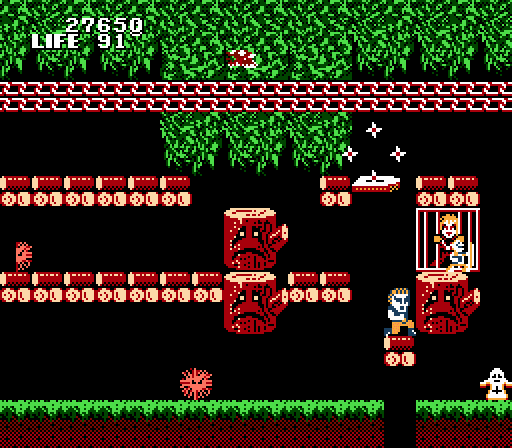

Once you do make it down to the final zone, you’ll encounter a boss of sorts. Go on, see if you can spot it in the screenshot above. Give up? There’s a tiny knight standing in front of the cage holding the imprisoned member of the band. I was expecting a more imposing foe from a game with a subtitle that translates to “Demon’s Counterattack,” but instead we’re tasked with defeating a living Playmobil figure that’s hopelessly out of its depth. You can only harm the knight by hitting it in the back, because it blocks your attacks with its shield otherwise, and the knight can attack by throwing arcing rings of sparkly magic into the air, but overall it’s very easy to defeat if you remembered to purchase the knives.


Seikima II’s commitment to tedious busy work continues, because defeating the knight isn’t enough to free your bandmate. You also have to make your way around the zone and touch all of these floating objects, which are either tombstones or very gothic surfboards. The last one will have a key inside. Once you’ve picked that up, then you can open the cage and move on to world two.


Given how much of a pain in the arse it was to manoeuvre Kogure through the first world, I would strongly suggest that the band slim down from a five-piece to a duo.


My suggestion was not taken on board, so here we go with world number two. I know, I know, it’s not very Halloween-y. I was disappointed too but hey, at least Kogure gets to fight some more thematically-appropriate enemies in the form of these lil’ angels. Granted, they appear to be the angels of deceased gingerbread men, but I’ll take it.


Visuals aside, world two is very similar to world one and indeed the entire game follows this template. You’re still collecting all the items, with the ghosts and money bags returning but with the addition of the latest abducted band member’s disembodied head and also pot plants. Given the dark, sinister themes of Seikima II, I must concluded that they are spider plants.


Along the way I managed to upgrade my weapon again, and I gotta say that throwing battle axes at angels is definitely more what I expected from this game that flinging stones at insects. You know what else I expected from a game based on a band? In-game music that didn’t make me want to squirt a tube of decorator’s caulk down each ear. Yes, I must sadly report that the music in this game is utterly terrible, with each world having one track of squeaky, unmelodious noise that repeats on a four-bar loop. Now that’s the Devil’s music.


The boss is, once again, a very small knight. There he is, hiding amongst the foliage. His guerilla tactics don’t make him any more difficult to defeat, although because the platform he’s walking back and forth on is longer than in the first encounter he does spend longer stretches of time with his shield facing towards you. He's still easy to beat, and while my pleasure at my victory was momentarily wiped away by the reminder that, oh yeah, I’ve got to touch all these gravestones to find the key it was soon onwards to world number three.


I don’t think I need to tell you how this one plays out. The pot plants are swapped out for candles and the environment has a much more Halloween-appropriate “ancient ruins” theme, complete with spiders and snakes. Kogure still jumps like his boots are filled with vicious robot crabs. The music? Heinous.


As the game progress, the areas are set up more and more often to be single-route challenges. They often look quite open at first glance, but appearances can be misleading. For example, you can only head to the right here, because Kogure can’t crouch and he’s two “blocks” tall, making him unable to squeeze through either of those gaps to his left. I suppose it’s not a terrible design decision, but a bit more freedom to approach each area might have been nice. More aggravating is Seikima II’s tendency to place items in such a way that you have to climb up to reach the topmost one and then fall back down to collect items that are hanging in the air, forcing you to repeat the same bits of platforming to collect all the items. My top tip for countering this is to take advantage of Kogure’s Mega Man-like ability to stand on empty space so long as at least one pixel of his toe is touching a platform: this can sometimes help you to wriggle up though platforms that otherwise might force you to go the long way around.


I was starting to feel a bit sorry for the tiny knight by this point. Then I remembered how horrible the jumping feels and I lost all ability to feel compassion for others, so that was fun.


Now we’re talking – the final world has that real Halloween je ne sais quoi, as landscapes made entirely from human bones and patrolled by mummies tend to. It’s amazing how much more amenable to Seikima II’s gameplay I was feeling once I was scaling Skull Mountain. I suppose that having gotten as used to the jumping controls as possible was also helping.


When a bat hits a priest and he ends up deceased, that’s Kogure. Yes, I’ve purchased the strongest weapon in the game and it’s an endless supply of throwable bats. The developers really shouldn’t have hidden this particular light under a bushel, should they? If you’re making a game where you’re playing as a guy who calls himself Demon Kogure who can throw trained bats at the priests who have presumably come to exorcise him, that stuff should be front-and-centre, stage one gameplay.


There’s an area in the final world where the platforms and items spell out “CBS SONY,” who produced the game. Stay turned to VGJunk for more fascinating videogame tidbits like this. Look, what else do you want me to say, “then Kogure fights that bloody knight yet again?”


Guess what, that’s exactly what I’m going to say. Then Kogure fights that bloody knight yet again, although at least this time we can actually get a good look at him as he patrols his platform, flanked by priests. Yep, that’s definitely a tiny knight with wee little matchstick legs that would surely buckle under the weight of full plate armour. No wonder defeating the knight is the easiest part of Seikima II.


The band’s back together, but before they can get back on stage and resume their mission to corrupt the minds of humanity, there’s one last mission for Kogure. He must travel to the Zeus Zone and engage in the final battle against Zeus. The Greek god Zeus. Zeus.


Except that is quite clearly Jesus Christ. He’s got a halo, he attacks by throwing glitter in the same way as the knight rather than the more impressive and more Zeus-ian method of massive great lighting bolts. The game might be telling me it’s Zeus, but think about it this way: who do you think Kogure, Satan’s best pal and avowed devil-worshipper, is more likely to be fighting - Zeus or Jesus? I rest my case. What’s that? The programme for Seikima II’s 1988 “The Greatest Black Mass” tour specifically says the band were imprisoned for thousands of years by the mightiest god Zeus? All right, fine, it’s Zeus. I still think the Jesus angle makes more sense, though.
As for the actual fight, it’s basically the same as the battles against the knights except Zeus will jump over your attacks if you throw them at his body. Jump and attack and they’ll be too high for Zeus to leap over, though, so do that. If you’ve managed to purchase the bats – and why wouldn’t you, because the game gives you plenty of cash to buy all the instruments and every weapon upgrade - it only takes about eight hits and Seikima II: Akuma no Gyakushuu is over.


The ending sees the reassembled band play a show for an audience of appreciative ghosts, which is about as good an ending as I could have hoped for. Shame about the horrendous music, but there was an updated MSX version of the game that featured actual Seikima II songs, so I probably should have played that version. Whoops.
Seikima II: Akuma no Gyakushuu is a game I don't hate, even though I think I probably should. It certainly isn’t much fun to play, thanks to the stiff, frustrating controls that are only exacerbated by the back-tracking and the constant health drain. In a game where the monsters are forever respawning right above your head, it’d be nice to be able to take things slowly and cautiously but you can’t do that while your health’s dwindling away like my will to live during a long dental procedure. It’s very much a game that missed its time, still beholden to the early arcade game design philosophies: considering it was released after Super Mario Bros. forever altered the playing field, it didn’t really stand a chance.


Yet there’s still something about it that charmed me. it’s probably just the concept of playing as a Satanist who has to take time off from his black crusade to rescue his band, throwing bats at priests as he goes. There’s something very appealing about that, especially when Demon Kogure’s in-game sprite is such an adorably chubby little lump. And hey, I learned something else: Kogure had a character based on him in the Fist of the North Star anime, so he must be cool.


I’ve given Seikima II a six on the Halloween-O-Meter, which is a shame because it was close to getting a much higher score. If only the enemies had been more monsters and ghouls than butterflies and birds, but alas. The final skull level definitely earned it an extra point, that’s for sure.

03/10/2018

SPOOKY COMPUTER GAME COVERS, PART II!

Two of my absolute favourite things to look at with my human eyes are old computer game covers and horror-themed artwork, so obviously I had to write another article about spooky home computer game covers. Computer game covers from the eighties and “Halloween” artwork of the kind you might find on an old horror VHS or the packaging for plastic witch fingers – they both draw from a deep well of enthusiastically amateurish illustration which, to me, speaks to the very core of the Halloween season’s appeal. I hope you’re ready for a gaggle of ghosts, some distinctly un-threatening vampires and logos drawn to resemble all manner of bodily fluids!

Haunted House, TRS-80


Oh yeah, that’s the stuff. As much as I enjoy the more over-the-top examples of horror cover art, there’s still plenty of room in my heart for something like this – a straight-forward evil mansion with a Bates Motel flavour and the title “Haunted House” in a dripping, ectoplasmic typeface. Who knows what terrible evil lurks behind the attic window of… the haunted house! Okay, so it’s probably ghosts, what with the haunting and all, but still.
One of the benefits of releasing your spooky computer game way back in the late seventies was that titles as straightforward as Haunted House were still available. The large amount of time I’ve spent playing spook-themed hidden object games tells me that nowadays it’d probably be called Ghostly Residence: Cursed Secrets or Cursed Ghosts: Resident Secrets or something very similar.

13 Ghosts, TRS-80


Also appearing on the TRS-80 is 13 Ghosts, with a cover that is a flat-out lie. There are only nine ghosts on display here. Ten, if you’re willing to believe that’s the ghost of a spider. I don’t mind too much, though, because they’re all pretty great ghosts. Somehow the ghost at the front manages to look extremely French, perhaps because he’s managed to retain his moustache after death. I guess you could call it a boostache, if you didn't care that your thoughtless words might cause physical pain to those that hear them.
Waxworks, Dragon 32 / 64


Johnny Stripedtie was a mild-mannered bank clerk with a steady job and a loving family – until the fateful day when the disapproving ghosts of Lincoln and Shakespeare commanded him to clean out the long-neglected fridge of… the waxworks! Can Johnny defeat the dread menace of a potato salad birthed in some long-forgotten aeon? Also Henry the Eighth is there. Trying to get to the fridge, presumably.

Bubble Ghost, Atari ST


Bubble Ghost is a game about a cute little spectre who has to guide a bubble through a mansion of bubble-bursting hazards by blowing on it. It is a surprise, then, that the game ended up with this cover for its Atari ST release. That’s not a cute ghost at all. That’s an angry ghost, a ghost with cheekbones that’d make a catwalk model jealous, a ghost that may well be constipated. It’s been through the “American Kirby game cover” procedure, except the machine was turned up to eleven and we got a ghost whose head has the same silhouette as a cartoon turd.

The Count, Atari Home Computers


Someone had a fun time with the felt-tipped pens, huh? What a great cover, packed with charming details, like the awful “love at first byte” pun, the castle gate being shaped like Dracula’s face and the hammer and stake lying in the driveway. Erm, I think that stake could have done with a bit more whittling, chaps. It won’t pierce the vampire’s heart, it’ll push it right out through his back. I don’t know if the gift-wrapped package is supposed to be to scale and it’s almost as tall as Dracula’s mailbox, but it does seem to contain a reference to the 1970 movie Count Yorga, Vampire. I haven’t seem that particular film, and now I can’t watch it because I’ll just be disappointed when it’s not about two vampire friends who like to buy each other thoughtful gifts. They don’t need a reason, it’s just nice!

The Count, Atari Home Computers


A different cover for the same game, and the “kid’s activity book” feel of the previous iteration has been replaced by a foreboding moonlit castle and an appearance by The Count himself – a fiendish creature of the night who looks as though he could be defeated by walking away from him at a brisk pace. Even if The Count did manage to catch you, his ridiculously large collar would make it impossible for him to get his fangs anywhere near your neck. I think he’s trying to make himself look big to scare away the other vampires.

The Count, VIC-20


Yet another Count, this time appearing on the cover of the Commodore VIC-20 port and hey, he’s handsome now! His collar’s still big enough that you’d be forgiven for assuming The Count’s in the middle of swallowing a large bat, but he’d definitely have a better virgin-enthralling success rate than the previous Count.

The Munsters, ZX Spectrum


Everyone’s second-favourite family of ooky, kooky weirdos got their own home computer game, complete with a cover that is (mostly) the exact kind of thing I wanted to find when I was putting this little collection together. It’s The Munsters as you know ‘em and love ‘em, although Grandpa Munster seems to have been replaced by Ted Cruz. Nice “Herman smashed through it” detail on the front door, too, and it’s even got a strong “horribly good software” pun. My only problem with this cover – and it’s quite a big problem – is the logo. I know it’s a fairly accurate recreation of the Munsters logo, but that was originally in black and white. On this cover, it’s a revolting shade of yellowy off-white that calls to mind pus leaking from infected wounds, gelatinous subcutaneous fat or, even worse, the custard you’d get with a school dinner. I feel quite ill just thinking about it, no matter how much I try to convince myself it’s supposed to be candle wax.

Spooky Castle, ZX Spectrum


Attempting to ward off a ghost with a crucifix? Oh dear, oh dear. What a blunder, the kind of rookie mistake you wouldn’t expect to see from even the most reluctant monster slayer. Everyone knows crosses are for vampires and you get rid of ghosts with either an exorcism, by completing the unfinished business that tethers them to the mortal realm or by sucking them up with a vacuum cleaner.

Frightmare, Commodore 64


I covered Frightmare last time out, and the original release had a relatively restrained cover that recreated the game’s title screen. Then it got a re-release with some far more obvious – but no less appealing – cover art. It doesn’t capture the essence of Frightmare’s gameplay, nor the unsettling dream-world the game tries to conjure up, but it does have a one-armed zombie and a creepy mansion. Three malformed goblinoids drag themselves out of the dirt, and you just know that they’re a right bunch of little shits. They’ve got that look about them, they’re clearly the hellspawned version of mischievous triplets who are forever pulling pranks, except their pranks probably involve eating kittens or stapling thing to tender body parts. I reckon they used to be quadruplets, but they tricked one of their brothers into swallowing a lit stick of dynamite, hence the explosion.

Elvira II: The Jaws of Cerberus, Commodore 64


I must admit, I included this cover purely for the shallowest of aesthetic reasons but come on – just look at that pumpkin! It’s huge, I wonder what it’s made of? Fibreglass, probably. Imagine all the fun you could have with a massive fibreglass pumpkin, like using it to reserve a seat on the bus or as a cage for especially ungrateful trick-or-treaters. Oh, and Elvira is here too. The kitschy, campy horror host and strong contender for the title of Queen of Halloween appeared in several computer games, all of which had cover art that emphasised Elvira’s, ahem, charms. I’m sorry, but it’s impossible to talk about Elvira without slipping into double entendres. It’s kind of her thing. A few years ago she released a Halloween song called “Two Big Pumpkins” and I’m sure you can imagine what that’s about.

Eric and the Floaters, MSX


Two things – no, this isn’t a game about a bloke called Eric who’s having trouble flushing his toilet, and yes, it does look a lot like the cover for Doom, if Doom starred Indiana Jones. Presumably these demons are the floaters of the title, and they’re all scrabbling at Eric in an attempt to grab the delicious baguette hanging from his belt. Yes, I know, you went to look at his belt but got distracted by Eric’s pronounced bulge. In fairness, it does rather catch the eye.

Chiller, Commodore 64


“The foulest stench is in the air,
The funk of nineteen eighty-five.
A grizzly ghoul with press-on nails
Is rising up to scare females.
No mention of the music nicked
from Michael Jackson’s Thriller,
just zombies grinding teeth upon
the cover of the Chiller!”

James Herbert’s The Rats, ZX Spectrum


It’s a crying shame that there was never a videogame based on Garth Marenghi’s Darkplace. It could have worked in so many different genres, from graphic adventure to first-person shooter, although I would have most liked it to be a side-scrolling beat-em-up in the manner of Night Slashers. Hmm, I don’t know what suddenly made me thinkof Darkplace.

Frankenstein Jr., ZX Spectrum


To create a monster with the mind of a man from the corpses of the dead is cruel. To then send that abomination to school is beyond cruel, it’s the action of a demented sadist. I knew a kid at school who was bullied because he wore a ponytail, god only knows the kind of abuse Frankenstein Jr. would endure the first time his arm dropped off during a PE lesson. You might be thinking “surely Frank would simply crush the skulls of those who mocked him using his unholy strength?” and he could but you know how it is, when you fight back against bullies you’re always the one who gets into trouble.
I actually really like the artwork on this one, with a cartoon style that makes it look very much as though it was based on a kid’s TV show. There was a kid’s cartoon called Frankenstein Jr., but this game has nothing to do with that.


At last, a game that actually has Halloween right there in the title, plus a cover that stars the witchiest witch I’ve seen a long time, the platonic ideal of witchness - the green skin, the pointed nose, the shoes that are eighty percent buckle. My only issues are that a pointy hat covered in stars is more of a wizard thing, and also her pentagram’s upside-down. Or not upside down, depending on how you look at it. Still, she’s a witch if ever a witch there was. I find myself drawn to her facial expression. Neither the typical evil snarl of someone who stuffs kids into ovens nor the gleeful cackle of a witch excited for the dark sabbath, it’s an expression that seems to say “uhh, I found this key, do you want it?”

Ghosts ‘n’ Goblins, ZX Spectrum


This is a weird one, because it captures a lot of Ghosts ‘n’ Goblins’ features well enough – the rising zombies, the carnivorous plants, the hapless knight about to get drop-kicked into an early grave by a demon bastard – but it looks so different from Capcom’s usual art style that to a more console-based gamer like myself it feels like it fell out of a parallel dimension.
It’s the Red Arremer who has seen the most changes, with the artist mistaking the demon’s wings for a cape. Oh, and he’s furry now. Very furry. We’re talking Muppet levels of fuzziness, and as a result the Red Arremer looks like Elmo from some god-awful “dark” re-imagining of Sesame Street.

The Last Vampire, ZX Spectrum


A very Christopher Lee-looking vampire on this cover, and the game’s hero must have spent more time on his evil-fighting studies than the protagonist of Spooky Castle because he’s waving a crucifix at the correct type of supernatural evil. Admittedly he is putting a lot of faith into his tiny cross, which raises a question: are vampires equally affected by a cross regardless of its size, or does a larger cross have a more potent vampire-repelling effect? Could you defeat a nest of nosferatu by making thousands of teeny-tiny crosses out of communion wafers and sprinkling them through the room like confetti, or would that merely give the vampires the same level of discomfort as wearing a heavy woollen jumper in August? Conversely, if you built a hundred-foot tall crucifix, had it blessed by all the cardinals you could muster and air-dropped it into the Transylvanian countryside, would all the vampires in a fifty-mile radius simply explode? These are important questions, people!

The Astonishing Adventures of Mr. Weems and the She-Vampires, Commodore 64


That’s one hell of a title, but I understand why this re-release cover whittled it down to simply She-Vampires. It’s trying to grab customers browsing the shelves, after all, and if the name She-Vampires doesn’t accomplish that then this cover art probably will. I think what we’re seeing here is the life-cycle of a She-Vampire: you start out as a mouldering corpse, enter a genie-like pupal stage and finally emerge as an Ann Summers model. The red basque is mandatory during all stages, and at no point does being a She-Vampire look comfortable. Awkwardly “sexy” outfits aside, the She-Vampires seem to have too many teeth even for, you know, a vampire. Watching a She-Vampire eat spaghetti would instantly destroy any erotic allure they may have once possessed.
Alternatively, you can choose to read this cover as the “complete” She-Vampire using her cape to stop people peeping on her sisters while they get changed, as one might do with a large towel on the beach.

The House on Damned Hill, ZX Spectrum


Because if you are building a house in a place called Damned Hill, you might as well go the whole hog and erect a massive hollow skull to live in. I’m not sure whether the addition of a wooden roof and porch detract from the terror on not, but the idea of someone or something trying to make their skull-house more of a home by adding a veranda is deeply amusing to me. Maybe rain kept getting in through the nasal cavity or something. You can’t tell from this distance, but I’m going to assume there are curtains hanging behind the eye sockets, and there’s nothing you can do to stop me.


“Gee, thanks for helping me dig up this grave, Mr. Werewolf! I knew I’d accidentally buried my favourite sling down there, now I can get back to practising for this year slingshot tournament! You’re the best, Mr. Werewolf!”

I Spy: Spooky Mansion, Macintosh


Finally for today, here’s the French cover for I Spy: Spooky Mansion. A little more recent that I’d usually allow for this kind of article, but if you can think of a better ending for an article about Halloween-y game covers than a plastic toy skeleton posing jauntily in front of a haunted house then I’d like to hear it. No, seriously. Tell me.

01/10/2018

FRIGHTMARE (COMMODORE 64)

Deep below VGJunk Towers, in a mouldering crypt littered with time-softened bones, scurrying vermin and empty biscuit packets, the heavy stone lid of a foetid tomb slowly slides open. From within, the hoarse voice of some ancient creature issues forth, speaking these portentous words: “Bloody hell, is it October already?” Yes, my friends, yes it is, and you know what that means – it’s time for the ninth annual VGJunk Halloween Spooktacular! An entire month featuring games of horror, grotesquerie, spirits, spectres and slime, and frankly we could all use some of the fun kind of horror to distract us from, you know, this garbage world and everything in it. I’m excited, and I’m going to make a real effort to get maximum enjoyment from this, my favourite time of year, starting with a Commodore 64 action game. A risky way to begin a season of fun, I admit, but let’s hope for a pleasant surprise with Cascade Game’s 1988 bad-dreams-em-up Frightmare!


When it comes to Halloween-themed games, you really cannot go wrong with a title like Frightmare, can you? It’s absolutely the kind of punning, unselfconsciously cheesy title that the season is made for, so even if the game itself turns out to be bad at least it’s added to the word “frightmare” to the Cryptkeeper-like assortment of compound words I’ve got in the ol’ memory banks.
The loading screen’s pretty killer, too. An ectoplasmic logo, demonic eyes staring out of the gloom in a manner that I’m certain I’ve seen on the cover of a horror VHS and a poor lost soul trapped in the window of a cathedral. I think that’s supposed to be the player character, or at least a representation of the character’s anguish at being trapped in a frightful nightmare. Because it’s called Frightmare, you see. Okay, okay, let’s get started with the game.


There’s nothing in the way of options, so it’s right into the action and if you have a morbid terror of white picket fences then Frightmare is going to send you into catatonic shock. Not really, those white things are bullets that you can collect. The “you” in question is the white humanoid figure at the bottom of the screen, with the pin-prick eyes and the wasp-like waist.


In testing out the controls, I managed to jump up to the top of this tree in hopes of avoiding the various monsters. This taught me that our hero is a nimble sort, fleet of foot and quite good at jumping. You move left and right with the joystick and press up to jump, with the fire button being reserved for using the various items you’ll pick up on your travels. That includes using the bullets you’ve collected, but there’s one small issue on that front: I haven’t found a gun yet. I suppose I’d better get to exploring, then.


Oh, the gun’s on the second screen. That’s handy. Unfortunately it’s surrounded by more ghosts than your average ruined abbey or fire-damaged Victorian orphanage, and even after only two screens it’s clear that Frightmare is one of those games. You know, the kind where monsters swarm all over the sodding screen, respawning in endless waves and using their lack of corporeal bodies to fly right through the scenery and into your face. It’s a good job the main character is quite easy to handle, then, and to be fair not all the monsters roam freely through the air. The hooded ghosts, for example, appear only on that one platform and move from right to left, and part of a successful run at Frightmare comes from learning which enemies are more like stage hazards and which will dash towards you like an affectionate puppy. The puppy being a baby Cerberus, in this case.


How did a bullet that big come out of a barrel so narrow? It is all down to the twisted logic and shifting laws of the dreamscape, dear traveller – always a classic cop-out for these kinds of situations. I’d love to tell you that now I’m armed I feel more powerful and better equipped to tackle this nightmare, but that would be a lie. For starters, not all enemies can be harmed by the gun, so while these flying monster bonces go down in one shot there are plenty of other creatures that’ll ignore your bullets entirely. Plus you’ve got limited ammo, both in terms of what you can carry at once and also because bullets don’t respawn, meaning there’s a fixed amount of ammunition for the entire game. This means the gun works more as a last-gasp defensive option rather than an offensive mainstay, which I quite like: it fits the idea of Frightmare being a desperate struggle to survive, rather than having you control the murderous hybrid of the Doom Guy and Morph.


Also adding to this feeling is the player character’s spider-monkey-like platforming tendencies. If something in this game looks even a little horizontal, you can stand on it. Individual tree branches, the tops of columns, the middle of columns provided they have a decorative lintel, brickwork, heads impaled on pikes – they all act as platforms, so when you’re moving around each screen there’s a sense that you’re scurrying around, clambering from perch to perch. However, there is a problem with this: you can’t fall down “through” platforms like you can in many other platformers, so you have to move left and right to find a place to drop down and it’s not always clear where those gaps are, as we shall see.


With a handle on the controls, I started getting into the exploration proper. Task number one was figuring out what all the various collectable items do. Some are straightforward pick-ups, like the rings that give you an extra life or the score-increasing chalices. The rest are inventory items with a variety of effects. For example, the cross pictured above can be activated at any time by pressing the fire button. What does it do? It clears the screen of certain types of enemies. Which enemies? Who knows, have fun finding out. You can carry three inventory items at a time and you cycle between them by pressing down on the joystick. This explains why you can’t fall through platforms, and there were plenty of times when I tried to use my gun only to realise I must have accidentally nudged down at some point without noticing, because I was now highlighting a completely different item or even an empty space. I’d say the inventory system works okay. I am unwilling to go any higher than that.


After some exploring and plenty of restarts - because this game is ruthless when it comes to killing the player at the drop of a hat - I found myself in a twisted bio-mechanical cavern with an H.R. Giger-inspired visual style and a squadron of aerial skulls that seem to be mostly minding their own business. What business a huge flying skull might have is a mystery that may never be solved, although I suspect they’re trying to find a way to brush their teeth without arms. Dental hygiene is very important when teeth are all you have.


The world of Frightmare is split into four “zones” that each have their own visual style. We started out in a graveyard area and now we’re in the “we were going to make a game based on Aliens but we changed our minds” portion. I’m claiming the H.R. Giger connection, but honestly this area is reminding me more of ZX Spectrum nightmare generator Soft and Cuddly more than anything else. Frightmare did get a release on the ZX Spectrum, and even a DOS version, but there doesn’t seem to be much between them and the C64 version looks the best, so that’s why I picked it.


And Frightmare does look good. It doesn’t have the most technically impressive sprite work, of course, but it makes up for it in the weirdness of the visual design and the appealingly unpleasant enemies. Your foes are a good mix of familiar monsters and slightly stranger apparitions, ranging from gloopy mud-men and disembodied hands to crowds of praying supplicants and fiery faces that fade in and out of the background. They’re definitely the kind of freaks that you’d want to airbrush on the side of a carnival ghost train, which makes them perfect for the Halloween season.


Now we enter the third zone, the execution grounds. It’s all gallows and guillotines – mental note, write that down as the title for a potential Ghouls ‘n’ Ghosts rip-off – where pitchfork-wielding devils patrol the wooden boards and skulls pile up like empty beer cans after a raging house party. We’re covering a lot of Halloween themes in this one, huh? Maybe the last zone will a cabin in the forest, or the underground farm where they grow each year's crop of new clowns.


I mentioned that it can sometimes be difficult to see where the platforms begin and end, and here’s an extreme example. You can walk atop some of these skulls but not others, leading to lots of wiggling left and right to find the spot where you can drop down. Don’t get me wrong, I still think this is a cool screen – I would not run the Spooktacular every year if a videogame room composed entirely of blood-red skulls didn’t do it for me – but it could stand to be a little easier to navigate.


The final background theme is the mad science lab. Yeah, I’ll take it. Brains in jars, labyrinthine pipework, half-grown mutants sticking out of what look like hyper-advanced toilets. Normal scientists need not apply. Highly skilled plumbers should apply, this place desperately needs them.


You might have noticed – you know, assuming you have eyes – that there’s an ever-changing two-word phrase at the top of the screen. “Fearful Vision,” it says, and buddy you ain’t kidding: I’ve played enough Castlevania games to be fearful whenever I see a hovering Medusa head. This might seem like an important part of Frightmare’s mystery, but it’s just your score. I know, I was a little disappointed too. Every time you gain points by killing monsters or collecting chalices the words fill up and eventually change. There are a bunch of combinations of “word meaning scary” and “word meaning dream,” starting with “Bad Dream” and going through such variations as “Cruel Trance,” “Horrible Vision” and “Evil Illusion,” with the highest score resulting in a title of “Nefarious Frightmare.” So, if you are struggling to find a name for your new fantasy-prog-metal band then just play a bit of Frightmare, you’ll have potential names coming out of your ears in no time.


By now I’ve played a decent chunk of Frightmare and I am having fun with it, although admittedly it feels like I’m enjoying it despite the gameplay. It’s ridiculously difficult, that’s the main issue. I’m used to Commodore 64 games being cruel to the point of sadism, but Frightmare pushes that bar ever upwards with endless swarms of fast-moving enemies that kill you at the slightest contact and often can’t be fought.


I also managed to get myself stuck a few times, trapped in the bowels of the maze where all exits were just out of jumping range, or I’d accidentally grabbed all the items that grant you a super-jump and then wasted them when I suddenly had to dodge a monster. Those things don’t reappear, folks. Getting completely trapped is always extremely frustrating in any game, and it’s especially aggravating in a game like Frightmare where progress all-or-nothing. My advice is to make sure you always have a signpost item in your inventory, because using it will warp you to a different screen. This means that your inventory space is reduced by 33 percent, of course, but it beats twiddling your thumbs at the bottom of the dungeon with only screaming demon faces for company. I can go to the Job Centre for that kind of experience, I don’t need it from my Commodore 64 games.


There’s one question that I’ve neglected to answer, and that’s what we’re supposed to be doing. Travelling around screens that look like four competing dungeon-themed tourist attractions is fun and all, but there has to be a goal, and indeed there is. You have to advance the clock at the bottom-right of the screen to 8:12 in the morning, at which point our hero’s alarm clock goes off and he awakens from this frightmare. Look, they gave me the word “frightmare” and I’m bloody well going to use it, okay?


Each new screen you enter adds six minutes to the clock, so it should be a simple matter of getting as far as you can and visiting as many unique screens as possible until it’s time to get up. However, the clock starts at midnight and, as far as I can tell, the game contains 79 screens. If my maths is correct (and it might well not be) that means you can only get the time up to 7:54. Thus Frightmare is impossible to complete – and here I thought it was being crap at computer games that would prevent me from seeing the ending. Perhaps this was the point, and Frightmare’s never-ending challenge is intended to represent the helplessness you feel when trapped in a nightmare. Maybe the developers did it on purpose to generate a sense of intrigue around the game. Or it’s a bog-standard cock-up. That does feel like the most plausible answer.


With no final goal to aim for and most of the game world explored, I suppose it’s time to wrap Frightmare up. It’s a game of mixed virtues, so let’s start with the positives. It looks nice, as mentioned earlier, and I really like the monster designs. For the first game of this year’s Halloween Spooktacular it certainly packs in more than enough freaks and mutants to keep me happy. I particularly like the large yellow chaps pictured in the screenshot above, who walk around with their palms raised as though they’re on the verge of using a kung-fu palm strike or something. Y’see? Weird.
The basic mechanics of the game are solid, too, with your character controlling fairly well, occasional inventory issues aside, and the gameplay is fast and fluid with the occasional “puzzle-like” room thrown in to break up the regular arcade-style action.


However, Frightmare is badly hampered by the needlessly high difficulty level and the unrelenting waves of enemies, especially when looking back on it from a modern perspective. If it had half the amount of monsters at a time and your gun didn’t take up an inventory space I’d be a lot freer in my praise. Perhaps unsurprisingly my advice is to play Frightmare with a cheat for infinite lives or something, because in my opinion it works much better as a digital safari where the enjoyment comes from seeing what bizarre scenario will appear next, rather than “beating” the game. In that respect it reminds me, again, of Soft and Cuddly. That game will haunt me forever, it seems.


Frightmare gets my qualified approval, then. Obviously it’s a shame that there’s no ending, but what would that ending be? Some bloke sitting up in bed and saying “man, I’ve got to lay off the cheese suppers?” I don’t think we’re missing out on anything earth-shattering there.
That’s the first game of this year’s Halloween season covered, then, but there’s one more thing before I go – that’s right, it’s the return of the VGJunk Halloween-O-Meter!  As always, this rating is not based on how good a game is but rather how Halloween-y it is. It’s a shifting, imprecise rating system based mostly on my personal whims and how many pumpkins are in the game, and I’m going to award Frightmare…


Eight out of ten seems about fair. It’s definitely spooky, and anything less than eight for a game containing so many brains in jars would be criminal, but it’s missing some of the vital Halloween ingredients that would push it right to the top of the scoreboard. The fact that it’s called “Frightmare” very nearly pushed it to a nine but I’ve got to leave myself some room to manoeuvre, you know?

VGJUNK Archive

Search This Blog

Followers