Showing posts with label point and click. Show all posts

27/02/2018

SINISTER CITY (PC)

I am a man of simple tastes, which is not the same as good taste. This becomes clear when you realise how much enjoyment I got out of today’s game. Yes, I’m taking the VGJunk equivalent of a spa day by wallowing in another “horror”-themed hidden object game – this time, it’s Jetdogs Studios’ 2014 what-Twilight-could-have-been-em-up Sinister City!

(click for larger images)
Oh yeah, we’ve got bat-winged logos, the blood-smeared mouths of vampires and some surprisingly prosaic font choices. We’re only on the title screen and Sinister City already has the “low budget spooky hidden object game” looked nailed down tighter than a coffin lid. We’ll meet the mysterious chap in the background later, but don’t get your hopes up when it comes to the sultry vampire lady as she kinda doesn’t appear in the game – although I might have a theory about who she’s supposed to be.


The game begins with a chat from this guy, who introduces Sinister City as being “a behind-the-scenes look at my latest blockbuster: Count Dracula’s Treasures!” Right out of the gate, Sinister City sets up an unusual meta-narrative situation where the events of the game are part of a movie… or rather, they’re about the making of a movie, and also about the star-crossed love that exists between John, our protagonist, and Nina. To claim John and Nina’s passion rivals that of the most classic romantic characters is patently not true, but it’s a statement that makes sense when you consider that we’re talking about someone who’s trying to promote an upcoming movie.


We’ll be controlling John for the duration of the game, helping him on his quest to locate Nina, who has gone missing. The trail has lead him to Sinister City – which, as far as I can tell, is the actual name of the city – and a dingy hotel on the outskirts of town.
Sinister City has eschewed the genre’s usual “protagonist’s point-of-view” approach to the graphics, instead opting for pre-rendered backgrounds with polygonal characters on top. Literally on top, in some cases, and you can see John hovering in front of the hotel in a way that does little to ground him in the game world.


Here’s John up close, looking relatively normal at first glance. However, closer inspection reveals that he seems to be missing his front teeth, and what’s going on with that casual shirt and tie combination? John has the air of an unsuccessful but tolerated host on a hospital radio station, someone who makes a bit of extra cash on the side by DJing wedding receptions and thinking he’s being all cool and ironic by playing “Agadoo.”


John’s trying to book a hotel room but he’s hampered by the receptionist – who looks, like every other character in this game, like he’s been cobbled together from Half-Life 2 mods – who tries to warn him about the evil that lurks in Sinister City. Eventually he agrees to help John out, but only if we find the receipts that are scattered around the hotel lobby.


And that’s where the hidden object gameplay comes in. It’s of a fairly standard type for the genre – a cluttered scene is presented to you, along with a list of items at the bottom. You locate the items on the list somewhere in the scene and then click on them. For example, “dog” refers to the statuette of a dog on the left windowsill. Sometimes items are hidden behind moveable elements of the scene, such as the plates at the top of the wardrobe that can be shuffled aside. These moveable objects aren’t always obvious, but if you can’t find them they’ll eventually begin to sparkle if you wait for a little while. Most of the “puzzles” (as opposed to what I’d call minigames) in Sinister City require you to find X number of a certain object such as hotel receipts, and usually you’re given one for clearing a hidden object scene.


Sinister City does make some unusual design decisions that differentiate it from others in the genre, though. The main one is that not every hidden object scene has a list of small, unrelated items to find. The back of the reception desk seen here is a good example, and all you need to collect in this scene are the receipts themselves. Sinister City also makes the strange decision to not tell you where each hidden object scene is located. A lot of the time you can guess where they are because a screen contains a conspicuous-looking area, like an open wardrobe or cluttered desk, but that’s not always the case. In fact, the way I realised there was a scene behind the reception desk was that I pressed the “hint” button and it showed me the scene behind the desk. I probably would have taken quite a while to figure that out on my own, because my task was to find the lost hotel receipts and I naively assumed that if they were behind the reception desk then they wouldn’t be lost. But the hint button helped me out, and while I really don’t think it was intentional the idea that you can find the correct area by “seeing” it from inside and then having to figure out where it is on the screen works out surprisingly well, especially because the hint button recharges very quickly.


After finding all the receipts and then going though the scenes a second time to locate all the hotel’s lost room keys – yes, the proprietor is really in the wrong line of business – the hotel owner decides to help John out. Not after he’s dropped a sick burn on our hero’s appearance, mind you. It seems that when Nina went missing, John found bat droppings at the scene and naturally assumed that meant she’s been abducted by the foul forces that dwell in Sinister City. I’m going to drop some spoilers here: there are vampires involved in this plot. Shocking, I know. What’s more shocking is that if a vampire did kidnap Nina, this means it transformed into a bat, took a dump on the floor, returned to human form and then carried Nina off because she’s a fully-grown human woman and there’s no way a bat would be able to drag her away.


The hotel owner offers to help by using his hypnosis machine to astrally project John to the dream-world. To me, that sounds like the plan of someone who’s feeling buyer’s remorse over purchasing a hypnosis machine and is desperately trying to get some use out of it. In practical terms, it means John has to locate the spinning disks and energy crystals that power the machine. More hidden object finding transpires, and around this point I realised that there’s precisely zero punishment for mis-clicking when item hunting, so randomly clicking around the screen as fast as you can is a perfectly valid way to make progress in Sinister City.


With some exceptions (like my beloved Halloween Trick or Treat series), most modern hidden object games have a few other elements sprinkled in amongst the item-spotting sections. Usually those elements are inventory puzzles that almost always boil down to “use item on very obvious location” and minigames that provide the kind of rigorous mental workout usually found on the back of cereal boxes. Please don’t take that as a complaint: the reason I enjoy hidden object games is that I find them relaxing, and that wouldn’t be the case if algebra problems or 10,000-piece jigsaws intruded on the game.
Sinister City includes both of these types of interlude, and they’re mostly quite jolly and not at all taxing, like the string-untangling minigame pictured above. However, because these games all draw from the usual shallow pool of tropes I’ll be playing the rest of Sinister City with the constant dread that a sliding tile puzzle is going to lurch out at me at any moment.


The astral plane is a vaguely Dali-inspired, Alice in Wonderland-flavoured area where the goal is to find the parts of a clock so you can speed up time and somehow, I dunno, get a clue about Nina’s whereabouts? The point of the astral plane isn’t explained particularly well, but that doesn’t matter because you spend a surprisingly short amount of time here. I’ve played a bunch of hidden object games that do take place in a twisted dream-world, and I assumed that the rest of Sinister City would take place here, but no – it amounts to little more than an extremely convoluted Skype call.


A phantasmic projection of Nina appears and tells John to stop searching for her. She claims it’s because John would be placed in terrible danger, but she can’t fool me. I’ve seen John, she’s clearly just trying to let him down gently.


Then a vampire appears and threatens to bite John’s foot off. This is Count Orlok, Nina’s captor and  seemingly the very model of the traditional vampire lord. Foot-biting aside, he’s aristocratic, urbane  and he wears cravat, and by this point I was thinking “okay, this all makes sense. Young man’s fiancée is kidnapped by not-Dracula and he fights to get her back. He fights via hidden object challenges, but still, it’s your standard vampire story in the Dracula mould.” That’s what I thought was happening. The actual plot is… quite different, as we’ll see. For now, let’s go back to the hotel and see if any of the guests can help us defeat Count Orlok.


The guy from the intro is here, and as it happens he’s a movie director (and descendent of Louis Lumiere) who wrote a screenplay very similar to the events that are unfolding around John. So, you find the pieces of Lumiere’s missing script and peruse it for any pertinent advice, you collect the garlic, stakes and holy water that form any self-respecting vampire hunter’s arsenal – no magic whips or boomerang crosses, I’m afraid – and get ready to save Nina. Then Lumiere lets you in on a little secret: Sinister City is not the gore-drenched necromantic hellhole that you’ve been led to believe it is. Sure, it’s where all the vampires un-live, but Lumiere tells you the vampires don’t even drink blood any more and that rather than going full Simon Belmont, John might have better luck if he simply talks to Count Orlok. Naturally John is shocked by this revelation that Sinister City isn’t a 24-hour recreation of the rave scene from Blade. He can’t believe that Sinister City is more Hot Topic than Transylvania, until Lumiere tells him to “look at his so-called equipment.”
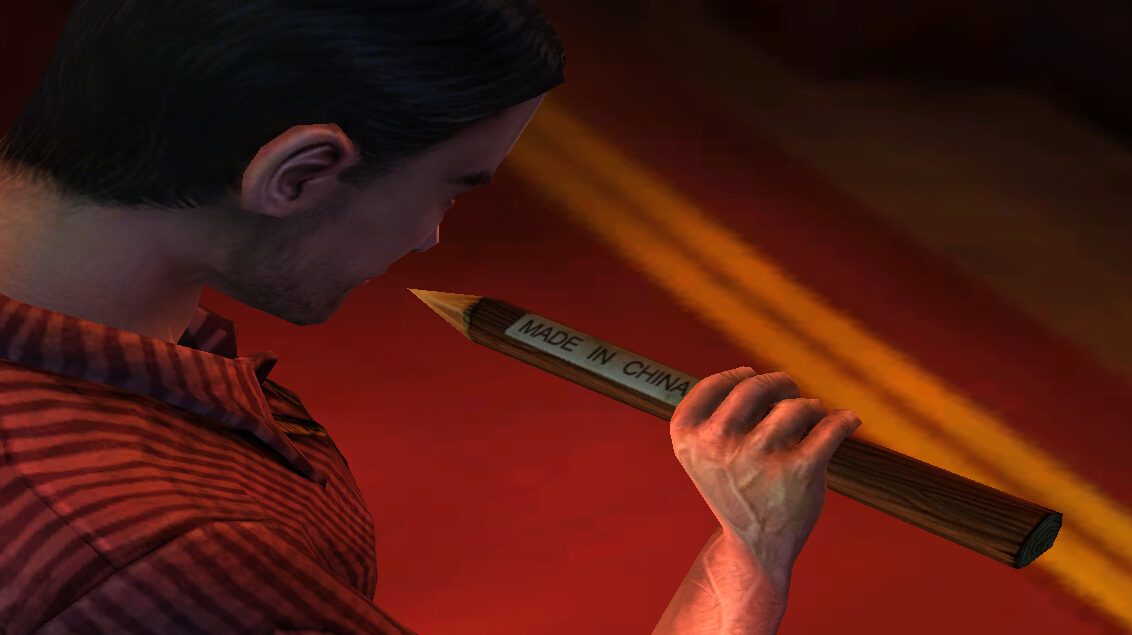

I gotta admit, this got a big laugh from me. I think it was the way John slowly, deliberately, turned to stake to reveal the gag. And so it is also revealed, although there were clues earlier, that Sinister City is not as serious as it first appeared. This is just a glimpse of how weird the game becomes, so let’s move on to the next location.


Travelling is facilitated by the map John has pieced together, thus fulfilling the “jigsaw puzzle” minigame that these games so often contain. Sinister City is proud of its vampiric heritage, with streets named after Bram Stoker and Bela Lugosi. Our target is the big castle at the top right, but please note the burger shops – it’s a little difficult to make out, but I think they’re called “Big Kahoona Burger,” presumably named in homage to the Big Kahuna Burger chain that appears in Quentin Tarantino’s movies.


The outside of Orlok’s castle is as grim and foreboding as you’d expect, although the appearance of a large crane truck keeps it grounded in the mundane realm of man. You need the crane to cross the moat, but of course the crane is broken and the hidden object scenes here revolve around finding parts to get it running again. Oh, and also collecting shiny stones so a bird will trade said stones for the missing gear it’s holding in its beak.
Having played enough examples of the genre to feel that I’ve got an idea about where Sinister City’s gameplay falls on the quality gradient, and I’d say it’s… somewhere in the middle. The scenes can be a little bland, with many of the objects being quite large and easy to spot, and it lacks the extreme kitschiness of my favourite hidden object games. On the plus side, it doesn’t get cynical with hiding its items, never changing their colours or making them semi-transparent, and the minigames are mostly straightforward and easy to figure out. The irony is that, as I mentioned, I like hidden object games because of their relaxing gameplay, but Sinister City’s appeal lies entirely in its bonkers plot and characters and I’d probably be just as happy with it if it was a movie.


Nina is trapped in the castle because, in a shocking plot twist, she’s actually Orlok’s daughter! Orlok doesn’t want his precious daughter marrying a miserable pile of secrets like John, and has instead arranged her marriage to a noble Transylvanian vampire named Ipkis. Until the wedding, she’s locked behind an enchanted gate that only Orlok can open and obviously he’s not going to just let her out, but Nina does have a suggestion: brew a truth potion and get Orlok to drink it, hopefully forcing him to reveal some information that will help them out. Looks like John won’t be needing his cheap, mass-produced Chinese stakes after all. I know Nina says she loves John but those feelings are unlike to hold up if he stabs her dad through the heart.


As you’d expect, making the potion involves going through a few hidden object scenes to find the appropriate ingredients. Once you’ve gathered the necessary items, brewing the potion gets more interesting for two reasons. One is that John was apparently incapable of finding a single pot, bowl or saucepan in the entire castle – and what kind of self-respecting vampire lord doesn’t own a cauldron? - so he has to boil the ingredients inside an upturned Viking helmet. The other is that John decides to make the potion using the fireplace in Orlok’s study, about six feet away from Orlok himself. At no point does Orlok question why a man he recently threatened to kill is standing in front of him, making soup in a helmet.


I suppose these events do help to prepare the player for the next bizarre moment, when Orlok drinks the potion without hesitation or question. Slurps it right out of the helmet, even. Man, this game is great.
Anyway, the potion causes Orlok to reveal that he thinks John is an okay sort really but he wants Nina to marry Ipkis because Ipkis works in showbusiness and he think the marriage will help Nina become a movie star. All right, fine, I guess I’ll go and talk to Ipkis myself. To the TV studio!


While using the map screen to travel across the city, John stops off at the Big Kahoona Burger to grab a snack. Have I mentioned that this game is great?


Here’s the TV studio. That’s Ipkis in the middle, preparing for the 600th broadcast of Vamp Kids, the TV show loved by millions of (presumably literal) ankle-biters around the world. This raises questions about whether vampire children are the offspring of two vampires or children that were turned into vampires, but don’t have time to ponder such matter: John must find the parts required to fix the studio’s generators, as well as locating Ipkis’ many props that he’s left scattered around the place. By now it’s clear that the developers weren’t putting much effort into creating interesting new gameplay scenarios. The “proper” hidden object scenes are fine, but gathering the items needed to progress to the next scene gets a bit tedious when the items are as easy to spot as large, bright red vampire bats but they’re spread across multiple different locations.


I mean come on, this is really stretching the “hidden” part of the hidden object genre.


This is Ipkis. I’ve already helped him out a bunch, but he’s still not ready to talk to me about Nina unless I help him some more, this time by standing in for his camera man. “Any fool can operate a camera” is a turn of phrase that will come back to (oh ho ho) bite me in a moment, but first – do you want to see Ipkis’ television show for vampires? Yes, yes you do.


It’s evil Teletubbies. Evil Teletubbies. Except those full-body mascot suits are expensive, so Ipkis is only wearing the head. At least he went to the effort of changing the shape of Tinky-Winky’s antenna from a triangle to a spread-winged bat, a move that will surely keep he BBC’s lawyers at bay. Now we know why Tubby Custard is pink, it’s got blood in it. Half Ambrosia, half type O. What an incredible scene to see as Ipkis tells his audience a meandering story about a vampire kid whose fangs wouldn’t drop until he started acting like a proper vampire. You know, by drinking potions out of ancient helmets or dressing as a goddamn Teletubby.
During this segment, you’re supposed to keep Ipkis in the centre of the screen by moving the camera left or right, but there was a small problem in that it… didn’t work. None of my inputs would register, so I kept failing the minigame as the camera drifted off to the side and the only thing that fixed it was restarting the game. This is Sinister City’s main flaw – it’s buggy as hell. Several of the minigames didn’t work properly, the trigger for leaving the astral plane couldn’t be interacted with and more than once there was a blank gap in the hidden object scenes where an important item was supposed to be. I managed to get past all these problems by either restarting the game or using the “Skip” button, but they’re there and they’re kind of a pain in the arse, so it’s a good job there are evil Teletubbies to soften the blow.


Ipkis isn’t such a bad guy, as it happens. After helping him out, he admits his relationship with Nina is flawed because a) he doesn’t want to marry her and b) he’s already married, which is going to make the engagement party pretty awkward. His advice for John is that he should go and meet with Orlok’s therapist, who might be able to offer some insight into the workings of the Count’s mind. So, off we go to meet Dr. Seward at the Vampire State Building (a gag you may remember from Futurama.) Unfortunately Dr. Seward refuses to see John, so he comes up with a plan to learn about psychology and then the doctor will, erm, respect his clinical acumen? I seem to have lost the thread of logic tying this section together, especially because John gets his psychiatric learnin’ by collecting and presumably reading multiple copies of the same book. Psychology for Dudes, it’s called, and this neighbourhood news-stand has multiple copies. I tried to pick them up, but John says he’s “many things, but a thief isn’t one of them.” This moral rectitude is rather undercut when John pays for the books using coins he finds on the street without handing them in to the nearest police station.


Somehow this all worked and Dr. Seward let me into her office. She’s a stereotypical neurotic psychiatrist, the Niles Crane of the ever-living undead, and so most of this area consists of you finding the soothing chamomile teabags and migraine-relieving painkillers scattered around her unprofessionally messy office. I had trouble finding one of the tea bags in the scene above, because it’s hidden behind that metal box on the bottom shelf. My problem was that I couldn’t not see that box as the puzzle cube from the Hellraiser films.


On a similar note, this being a psychiatrist’s office means that there is, of course, a Rorschach test and I learned that when viewing ink blots I tend to see them as bones. Pelvises and skulls, mostly. If any armchair analysts want to weigh in and explain what this reveals about my psyche, feel free, although I suspect the true answer is simply that I’m such a dork for all this spooky Halloween crap that what else am I going to see?


Dr. Seward leaves us with a stinging criticism of estate agents and the advice that we should track down Orlok’s wife, as she’s the only person he’ll listen to. Okay, fine, let’s go and do that. I’m sure someone in Sinister City must be able to sell me the mystical bolt cutters that would free Nina from her prison and then we could elope to somewhere less vampire-heavy, but I’m deep into this now so we’ll just see where it leads.


Orlok’s wife is also a vampire. So Nina has two vampire parents but she isn’t a vampire? Did both her parents get bitten after they’d had a child? Although Ipkis’ little television play implies that there are vampire children and the process of gaining your fangs and magical powers works like puberty. I’m getting dangerously close to “corkboard covered in newspaper clippings and red string” territory here, so let’s focus on Orlok’s wife herself. She’s got the kind of short haircut that screams “long hair is difficult to animate,” she doesn’t have a name and is only referred to as “Orlok’s wife” or “mom” and she wants John to collect floppy disks so she can install an accounting program on her computer.


Trying to gain parental approval to marry the woman I love by rummaging through a vampire estate agent’s garbage. This game is amazing. Go back and look at Sinister City’s title screen again, and ponder whether you could have had the slightest clue that this is the direction the game was going to take. Also, I now have to assume that the vampire woman on the title screen is supposed to be Nina,  and that maybe she is a vampire after all.
Once we’ve finished “helping” Mrs. Orlok, she reveals the Count’s greatest weakness: he always wanted to be an actor but he’s too shy to attend any auditions. If only we knew a famous movie director and someone with access to a television studio.


With Mrs. Orlok’s help, John frees Nina and everyone gathers at the TV studio for one of the strangest takes on the “detective unmasks the true killer” scene I’ve ever experienced. At least Ipkis has the decency to remove his Teletubby costume.


The last batch of gameplay involves getting everything ready for Orlok’s impromptu audition, mundane tasks like collecting a big stack of clapperboards and removing all non-vampiric props from the studio. Yes, even the Plan 9 From Outer Space-referencing newsroom has to be spotless before we embark on our cunning ruse and okay, I admit it, I’ve completely lost interest in the gameplay at this point. I’m just clicking around the screen as fast as possible in order to get to the next bit of dialogue, and at last it’s time for the thrilling denoument.


Orlok projects a ghostlyillusion of his giant head into the room and starts ranting about how Nina can never marry John because he’s a feeble mortal, so I guess Nina is a vampire, case closed. Now the plan kicks into gear, and Lumiere commends Orlok on the intensity and gravity of his “performance.” Why, he’d be the perfect actor to portray Dracula in Lumiere’s new movie, Count Dracula’s Treasures! In this case, I think Count Dracula’s treasures might actually be the friendships we made along the way.


John goes in for one final bit of oleaginous praise – for a feeble mortal, Orlok sure seems keen to get John’s opinion – and that’s enough to tip the Count over the edge. He realises that John is perfectly suitable to marry his daughter, gives the couple his blessing and goes off to star in the movie. Everyone’s a winner! Especially Ipkis’ poor unseen wife, who escapes blissfully un-divorced.


As the credits roll and the characters make a few gags, I’m left in the pleasant position of being able to easily sum up the game I just played. Sinister City’s gameplay is decidedly average within the genre it inhabits, the bugs and glitches make it more of a pain to play than it should be, but it is absolutely redeemed by the story and dialogue. It’s occasionally genuinely funny, but even when it’s cracking some pretty lame jokes it has a charmingly groanworthy air of fun and just enough to weirdness to give it a pleasingly surreal edge. This might be partly because Jetdogs Studios are a Finnish company, and being translated gives the game an extra layer of strangeness. I really enjoyed playing Sinister City – although maybe “experiencing” is a more apt word than “playing” - and I hope you’ve enjoyed reading about it.


And then John was a zombie. Erm, vampire.

14/10/2015

MANSION OF HIDDEN SOULS (SEGA CD)

Did you know that lepidopterophobia is the name for the irrational fear of butterflies? If you did, it's probably because you're terrified of butterflies and you have sought out others who share your morbid dread of the usually-beloved little fluttererers, looking for safety in numbers and the chance to bond with people on day-trips that most definitely do not take in any wildflower meadows. If you are scared of butterflies then I have two pieces of advice for you: don't dress as a buddleia plant and don't read about today's game. It's System Sacom's 1993 Sega CD look-around-a-creepy-mansion-em-up Mansion of Hidden Souls (AKA Yumemi Mystery Mansion)!


I'm going to apologise up front for when I inevitably call it Mansion of Lost Souls. "Lost Souls" just sounds more appropriate, you know? "Lost souls" is a phrase in fairly common usage, "hidden souls" makes it sound like it's going entail a sort of Easter egg hunt with a theological twist. Okay, so there is a lot of hunting around for hidden objects in this one, granted, but the souls aren't hidden. They are in plain sight, and very talkative. We'll get to that, though - first, let's set the scene.


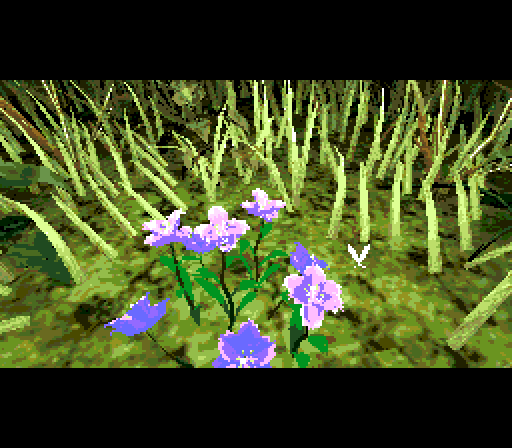
Some flowers grow in the grass, attracting the fell predations of a butterfly. The butterfly is the white v-shaped thing on the right of the flowers, by the way. Difficult-to-see butterflies make up roughly eighty percent of Mansion of Hidden Souls, so get used to it.
As the camera lingers on the flowers, the plot is set in motion by the disembodied voices of two adult actors struggling to sound like children but instead coming across as though they're delivering their lines in the middle of a carbon monoxide leak. The pair, a brother and sister, see the butterfly and spend a moment cooing over the effortless grace of its flight, before the girl announces she wants to follow it. Maybe it'll fly over to the old elm tree, she says. Ah ha, now I've got your attention! The old elm tree, that's what the Sega CD's audience was desperate to see! Except no, the real set up is that the brother warns his sister not to go to the old elm tree because there are ghosts there that will turn you into a butterfly. The sister runs off anyway, saying "I think it would be fun to be a butterfly!" I'm going to throw in a spoiler now by saying that the sister will soon be eating those words, much as she will be eating nectar with her new proboscis.


She went into the spooky mansion. Why do they always go into the spooky mansion? Has your mad lust for looking at butterflies blinded you to the fact that this mansion is so spooky that it wasn't even there earlier? We learn this fact from the brother, who it emerges is the player character. His sister's name is Samantha, and they come from a land where shortening someone's name is punishable by death. Therefore they always refer to each other as Jonathan and Samantha, even in moments of extreme crisis when calling her "Sam" might save valuable seconds. Jonathan then enters the mansion to find his sister and the game begins. I hope he brought a net and a jar with a twig in it.


I'm kinda feeling like I have once again entered the world of survival horror. I know in my heart that there won't be a typewriter at the bottom of the stairs, but I also know I'll end up checking anyway.


Rats. How am I going to save my game without a typewriter?
So, if you haven't guessed yet Mansion of Hidden Souls is a first-person adventure game, in which you control Jonathan as he pokes around the spooky mansion like my grandmother used to on viewing days for houses she had no intention of buying. You gather items, explore the various rooms, talk to the inhabitants and solve puzzles, all with the end goal of finding your sister and getting the hell out of the mansion before the graininess of the FMV graphics sands away your retinas. The controls are simple - apparently this game works with the Sega Mouse, but I played it with the pad and it worked fine. The d-pad turns Jonathan's viewpoint, "snapping" onto set pathways or interesting objects, and pressing up on the pad either moves you forward or makes Jonathan lean in for a closer look. The movement is slow but smooth... a little too smooth, maybe, because I couldn't shake the feeling that I wasn't controlling a human being but rather some snake-like creature that was slithering rather than walking. That said, you never actually see Jonathan, so there's always a chance he is a giant snake-thing, although it seems unlikely. Snake-things aren't generally named Jonathan.


With no directions given, it's time to start blindly stumbling around the mansion and as we do so I'm afraid I'll have to mention the graphics. They're rough. Very rough, as though seen through a pair of spectacles made from incredibly thin slices of wholemeal bread. The smooth movement between viewpoints that the FMV footage allows for is impressive and all, but I think I'd happily sacrifice it for the ability to see more than the vague structure of the room. The lack of graphical definition means that it's often very hard to see objects in the background - and in any case the object is often hidden behind or under things - that the game quickly descends into shoving Jonathan's face down every available viewpoint in case there's something interesting there. Thankfully he'll automatically pick up any items he find while doing so, so at least there won't be too much strain on the old peepers.


This is one of the more obvious items laying around the house, but it's still difficult to decipher its true form from this distance. Is it a box? An envelope? Oh, I know, it's one of those frames full of metal pins that will hold an impression of whatever you press into them, like your face or a hand with a raised middle finger or... actually, I think those are the only two things ever to be pushed into "pinpression" toy.


Never mind, it's a diary. The diary allows you to save your game. "Dear Diary, today I had toast for breakfast and my sister ran into a spooky mansion that will turn us both into butterflies. Weather was good. Well, I'd better go. More tomorrow, unless I have grown wings."


I stumbled into the games room, where I was greeted by a talking butterfly. It seems that the transmogrification process doesn't take away your ability to speak. It even preserves the accent you had in life, which I know because this butterfly has a faintly Eastern European lilt. The butterfly expresses surprise at there being two non-butterfly people in the mansion at once, and then tells Jonathan that he'll never see his sister again. He can definitely hear her, though, and the walls of the mansion must be paper thin because Samantha is distinctly heard talking about being somewhere with lots of flowers. For his part, Jonathan takes the disembodied voice of his sister and the presence of a talking butterfly in his stride. He's unflappable, this kid. Unlike, you know, a butterfly.


Also in the games room is a magic picture frame that gives the merest scrap of a clue about what the bloody hell I'm supposed to be doing. So far I've mostly been forcing Jonathan to walk into walls and enjoying the dull thudding sound that doing so produces, but that's going to get boring after, ooh, two or three hundred repetitions, so I suppose I'd better keep an eye out for this wardrobe, too.


Still checking all the rooms available - there aren't many, as the mansion is only two storeys tall - and Jonathan stumbles into the room for which the word "boudoir" could have been invented. It's like Barbie's 19th Century French Aristocracy Dream House in here, and it also contains the wardrobe from the magic picture. Before I can get to it, though, a different talking butterfly appears and starts chattering away, warning Jonathan that most humans who enter this mansion become butterflies. The game is very keen that you do not misunderstand the salient information about this mansion - that it has the power to turn people into butterflies. You will be reminded of this fact many, many times during the game, as though you might somehow forget. If the butterflies had hands, they'd be using them to shove "So, You're Going To Become A Butterfly" pamphlets into Jonathan's hands.


Looking closely at the wardrobe - an movement that does nothing to dispel my notion that Jonathan is actually some kind of serpentine worm-creature - reveals a key hidden behind a chair. Now I feel like I'm in familiar territory, searching a spooky mansion for keys to unlock other parts of the spooky mansion. I've got this.
The butterfly in the room gets very huffy when you find the key, with the implication that she hid it there in the first place. Given that the key looks to be made of metal and is several inches long, she must have stashed it there while she was still human and she's annoyed because she's never going to be able to move it now. Or she's annoyed because I'm rummaging around her boudoir. She may be a butterfly, but she's still a woman whose privacy should be respected. Mentally, I mean. Physically you could swat her to death with one good swing from a tennis racquet.


The key unlocks an art room, which is home to paintings, key number two and another butterfly, because it's less a Mansion of Hidden Souls and more a Mansion of Talkative Butterflies. The key is the most important thing in the room, but I'm more interested in some of these paintings, especially this one.


I call it "Still Life of a Sugar Puff in Ketchup." Maybe it will look better up close?


Oh good, finally something creepy in this haunted mansion! I can just about make out some teeth and an eye. It sort of looks like the agonised screaming of a flayed teddy-bear. Just to make sure, I'm going to rub Jonathan's face right up against it.


Erm... oops? I'm not sure what's going on. Maybe the painting was a colossal LSD tab and Jonathan licked it by "accident". There never were any butterflies! This is just a regular spooky mansion, not one controlled by "the magic of the moon"!


Never mind, Jonathan was simply being transported to a hidden room. Candles encircle him, and a grumpy moon adorns one wall. There are no doors and I think you're supposed to feel like you're trapped for a while as you puzzle out what to do, but by sheer luck the first thing I did was move towards this candle. That blows it out, and a secret door opens. It felt a little underwhelming, I'll admit. The game's first "puzzle" and I accidentally solved it because I was trying to get a closer look at a grumpy moon.


This leads Jonathan into the library / butterfly corpse storage facility, where yet another butterfly pops up to have a chat. This one is the most interesting of the bunch, and he's primarily engaging because of his atrocious Cockney accent. At least I think it's supposed to be Cockney - it definitely skirts around that area, but sometimes it flies off onto strange new linguistic tangents. The best way I can describe it is to imagine Dick van Dyke's terrible Cockney accent, and then imagine that he's also trying to do a terrible Australian accent at the same time. It's really quite impressive.
Then you take a closer look at pinned butterflies and your new Cockney friend says "I collected them all when they were ugly human figures!" I'm not sure how to process that information, especially because he offers it in such a jolly, offhand manner, and the logistics are even more baffling. Was he a serial killer in his human form, and he carried the corpses of his many victims to the mansion were they turned into butterfly corpses? Or were they humans that came to the mansion only for the Cockney to kill them in his butterfly form, perhaps lulling them into a false sense of security by being a goddamn butterfly? Just as I was pondering these things, the Cockney suddenly started pestering me to turn into a butterfly and I had to make my excuses and leave. I'm not comfortable with these high-pressure sales tactics.


On the way out of the library, there's a book that can be read which gives a big hint as to what you're supposed to be doing next. It's got a picture of the dartboard from the games room, which you can see has a grumpy moon above it. Yes, the darts in the board represent the candle in the moon room, so the next puzzle will be to match the darts and the candles. Of course, this means that someone not only went to the trouble of setting up said puzzle in the first place, but they also had a book with a hint to the puzzle professionally printed and bound to keep in their library. That's the kind of dedication to a bit that will get you many years of contracting work once the Umbrella Corporation starts setting up their own spooky mansions and over-elaborate police stations, Mr. Hidden Souls.


There's one last butterfly to meet before I get to that puzzle. She's found in the music room, and she's a full-on "oh Ah do decleah, Ah believe bein' a butterfly is givin' me the vapors!" southern belle type. She asks if I'm surprised to meet a talking butterfly. Lady, if you'd asked me that twenty minutes ago, I might have been able to feign some shock. She warns Jonathan that he must escape before "The Hunter" finds him. "He will turn you into a butterfly," she says, "after that you will no longer be human." Whoa whoa whoa, hold on a minute - are you saying that if I'm transformed from a human into a butterfly then I will stop being a human and become, in fact, a butterfly?! Why was I not informed of this earlier? I'd better get a move on and solve that candle puzzle!


After finding a book of matches and solving the moon room's puzzle by lighting the candles in the correct order, a secret underground tunnel is revealed. I'm not sure why the underground tunnel is decorated with a statue of a man sitting on the toilet. For ambience, I suppose.
While all this is going on, Samantha's voice can occasionally be heard as she talks to the mysterious Hunter before deciding that she doesn't want to be a butterfly after all. I'm finding it hard to dredge up any sympathy, Samantha. I was perfectly content with not running into the spooky mansion.


My, that's an important-looking item. I'd better walk over there and pick it up!


Oops. Turns out the Mansion of Hidden Souls is also the Mansion of Severe Basement Flooding, and the water is much deeper than it appears. That doesn't explain why Jonathan shoots to the bottom of the lake as though he's got a cinderblock strapped to each ankle, though. I've been picking up a few inventory items here and there, but I don't think a couple of keys and a book of matches are enough to make someone sink like a rock.


That'll be a game over, then. The clock strikes midnight, and Jonathan and Samantha are condemned to spend the rest of eternity as butterflies, flapping around Mansion of Hidden Souls and apparently guarding the staircase, waiting for more unsuspecting humans to wander in so they can badger them into casting off their human forms.


After loading my saved game, it was time to gain access to the flooded orb by solving a puzzle. I say puzzle, it's more like basic housekeeping or the first thing they teach you in florist school - you find a flower, and place it in the one empty vase in a nearby room. See, I'm not sure I'd class that as a "puzzle." I need another word to describe this sequence of events, and "pointless busy work" feels a bit harsh. It makes a nice change from just having Jonathan rub his face up against every nook and cranny of the mansion, I suppose, and with the flower in place the water is drained and I can collect the orb.


Sorry, Jonathan, but your sister is a butterfly now. Good luck explaining that one to your parents. Still, it was nice of the Hunter to put Samantha inside a protective plastic bubble, I can shove her in my inventory without having to worry about accidentally murdering her every time I reach into my pocket.


Just as Jonathan is leaving, the Hunter himself appears! He's, erm, not what I was expecting. I'm not sure what I was expecting, really. I suspect that some deep-down part of me was hoping that a character called "the Hunter" would turn out to be a Crocodile Dundee type in a big floppy hat and a survival vest, but I knew that was never really going to be the case. That doesn't stop it being a disappointment when the Hunter is revealed to be an escapee from a pedestrian crossing signal, though.
As the pivotal figure in this spooky mansion, you'd expect that the Hunter has some important information to relay to the player. He might well do, but sadly I can't tell you what that information is - the audio levelling is so awful during his speech, and the Hunter's voice is so echoey and over-compressed, that his words are almost impossible to decipher. The odd snippet of information does manage to break through the dense soundtrack and the vocal effects to reach your ears, the most pertinent being that Jonathan and Samantha cannot escape the mansion and that "butterflies are the souls of flowers." I thought butterflies were the souls of people? I thought that was the entire premise of the game, that people were being turned into butterflies? My advice to you, Mr. Hunter, is twofold - turn the soundtrack down next time you get to speechifying, and focus up your evil schemes because this whole souls-flower-butterflies thing is all over the place.


As I was leaving the Hunter's chamber, I made the mistake of looking at the statue of the sitting man again. The statue was so perturbed by my gaze that it stood up and soundlessly trampled Jonathan beneath its big stone feet in what was definitely the game's most unsettling moment.


With my butterfly sister ensconced safely in my inventory, it's time to find a way out of the mansion. Talking to the butterflies again can sometimes reveal a hint about what you're supposed to be doing, although I'll admit that I had to look up what my next move was here - finding a candlestick and crawling through the fireplace. Talking to the butterflies also reveals that Samanthafly's wings are still red, which means she can be turned back into a human if she escapes the mansion quickly enough. Blimey, that's convenient. The butterfly curse is like laying cement, it takes a while to set. My solution would be to pitch Samantha's butterfly orb through the nearest window like a baseball and hope that counts as "escaping the mansion," but Jonathan would not entertain such a notion and instead it was back to looking for keys and secret passages.


My habit of making Jonathan walk face-first into walls finally paid dividends when I stepped into this wall. The gentle caress of his skull against the brickwork was enough to dislodge a hidden key, knocking it to the ground where I could collect it. If I hadn't immediately found this key by accidentally holding up on the d-pad long enough for Jonathan to get a mild concussion, I suspect I would be much more annoyed at just how terrible a "puzzle" this is. As it is, I can just sit back and say "that is terrible" in a much more relaxed manner.


The last stretch of the game involves figuring out the deal with this mirror. Other than it being a terrible mirror, I mean, I can't see shit in there. That means another round of looking at every part of the mansion, because there are items you can now pick up even if you've already looked right at them before and nothing happened.


For example, this whacking great crystal. I looked at this crystal earlier and Johnathan didn't think it was interesting enough to collect, but now he can't wait to get his hands on it. It's particularly aggravating because when I saw the crystal earlier I knew it looked important - important enough that the developers made it recognisable even through the kaleidoscopic pixel blizzard of the game's graphics - but I couldn't do anything with it. It's a good job it's sharing a table with a giant cake, because I was always bound to take a second look at the giant cake and hey, now I have a crystal.


I appreciate the game allowing me to shave a few seconds off my time spent trudging around the mansion by jumping over the railing to get to the ground floor. It's useful, because I'm working against the clock now! I know, being timed is usually a real pain in the backside but the time limit is very generous, and one of the more helpful butterflies even tells you to pick up a watch that shows you how long you've got left. Thanks, butterfly. While Mansion of Hidden Souls is not entirely successful as an adventure game, with only a few uninteresting puzzles and a lot of looking at everything multiple times, it does at least have plenty of atmosphere. The music and sound design is very effective, the Hunter sounding like he's speaking from the bottom of a mine shaft aside - and the different butterflies are really the main draw of the game. By talking to them you learn their stories and their foibles: the musician butterfly regrets her metamorphosis, the butterfly collector is creepily keen on you joining the fluttering fold, the artist is baked out of his goddamn gourd, and the whole thing does come together in a fascinating, dream-like bubble of weirdness. It's interesting enough to make me wish the game was better, let's put it that way.


The final puzzle is all about doors with numbers on them. Jonathan travels through a series of rooms with three doors, only one of which leads onwards with the other two spitting you back out into the mansion. The doors all have numbers on them, so I looked around for hints until the butterfly in the games room started telling me about "the number that rhymes with key," in a way that made me want to swat her and say "just say "three", this 'rhymes with key' thing is insulting my intelligence." Of course, I immediately got my comeuppance for thinking this because the knowledge that the number three was important didn't really help me any. It turns out you have to walk through the doors whose digits, when added together, are divisible by three. Before I knew this I made it most of the way through by simply remembering which doors were the dead ends, until I thought "why don't I just look the answer up?" So I did. The doors eventually lead you back to the mirror, and I figured out that you need to use the crystal on the mirror by virtue of it being the only item I hadn't used yet. One mirror/crystal interaction later and voilà, The Mansion of Hidden Souls is complete!


The children escape the mansion's clutches, the Hunter ineffectually shouting "Where are you going! Don't go!" as Jonathan books it out of the house. He seems like a nice young man, but I don't think anyone would begrudge him the opportunity to make a rude hand gesture on his way out. Anyway, Samantha is restored to her human form, and in a shocking twist it turns out she's Alice of "in Wonderland" fame. This is going to harm the believability of her story when her parents ask her where she's been all night, they know she's in the habit of drinking strange mind-altering substances and hanging around with pothead caterpillars.


The Mansion of Hidden Souls is an interesting game. Is it a good game? You know, I honestly can't tell. There weren't enough puzzles or thinking involved for my tastes, and the graphics were occasionally downright punishing, but I never felt bored or infuriated while I was playing it. As I say, it's certainly got atmosphere in plentiful supply, and while the voice acting is admittedly poor that's fine by me because there are few things I love more than bad videogame voice acting. It's worth checking out if FMV games and Myst-a-likes are your thing, but if you're not a fan of the genre then this isn't going to be the game to sway you. As for the Halloween-O-Meter score...


Six feels about right, because it's not traditionally Halloween-y but it does have a bizarre feel all of its own, more of a Dario Argento vibe than a George Romero one. You can add an extra two points if you suffer from lepidopterophobia, too! Also, I'm sorry everyone laughs at you for being afraid of butterflies.

VGJUNK Archive

Search This Blog

Followers