So, “gaiden” means “side-story,” right? Well, here’s a Ninja Gaiden game that actually feels like a side-story and not the main event: it’s Tecmo and Natsume’s 1991 Game Boy ninpo-em-up Ninja Gaiden Shadow! It was released as Shadow Warrior in Europe and Ninja Ryukenden GB in Japan, if you feel like you’ve played it before but don’t recognise the name. It was also apparently renamed “Ninja’s Skyscraper Fight” for the Asian market. It does include a skyscraper, and that definitely wants you dead.

Here’s the title screen. It’s certainly a title screen. A screen with a title on it. That title is Ninja Gaiden Shadow, the title of this game. Bonus points for being concise, Tecmo.

Set three years before the events of the NES Ninja Gaiden, NGS begins in traditional Ninja Gaiden style with a cinematic cut-scene, or at least as cinematic as the Game Boy can handle. A villainous force has risen in New York, and I don’t mean Vigo the Carpathian: It’s Garuda, a dark overlord with the kind of incredibly vague but definitely evil plan you often get with videogame antagonists. He tells us “my power is the fear of mankind,” whatever that means. Maybe his muscles get bigger every time he jumps out in front of someone and shouts “boo!”

There’s despair in the skyscraper. Full of people in tedious cubicle farm jobs, is it?

A man appears from the darkness. Well, he is a ninja. That’s how ninjas are supposed to work.

That makes sense. This is a Ninja Gaiden game, after all. I wasn’t expecting Bob Ross, put it that way. So here he is, Ryu Hayabusa, one of gaming’s most famous ninjas – which is odd, because after the NES Ninja Gaiden games he disappeared for a while before returning on the Xbox in 2004. I guess Ryu is just so cool that people couldn’t forget him. I know I can’t – childhood years spent being unable to beat the NES Ninja Gaiden have seen to that - which is why I always play as him in Warriors Orochi 3. That, and you can replace his sword with a baseball bat.

The action begins with Ryu outside the despair-filled skyscraper, fighting his way through legions of American football players who can command these mounted rocket turrets to discharge their deadly payload at Ryu. That’s what the enemies look like they’re doing, anyway, as they perform their little hand motions. That said, the turrets are happy to fire at Ryu without any input from their comrades, so maybe the footballer players are just making the hand signals for whatever gridiron play they want to do next. That’s a thing that happens in American football, right?

As I saw this scene, with Ryu caught between the moon and New York City, I immediately thought of the song “The Best That You Can Do” by Christopher Cross. You know, the theme from the movie Arthur. Except the weird thing is that I did know – I remembered most of the lyrics and everything – and that’s strange because I’m sure I’ve only heard that song in passing a handful of times and I’ve never seen the movie it comes from. The other day I forgot the area code for my phone number, but this sing is wedged firmly in the old memory banks. How do these things happen? Has someone been piping soft-rock movie themes into my room while I sleep? Here’s my review of “The Best That You Can Do:” super cheesy, rocking saxophone solo, I kind of love it. Obviously I had to listen to it on YouTube to make sure I had remembered the lyrics right, but I left YouTube open, forgetting that it automatically moves on to the next video. I came back an hour later to find all my recommended videos are now tracks by Foreigner and Phil Collins. These are the sacrifices I make to run VGJunk.

Ryu moves into the under-construction parts of the skyscraper – nobody having any windows in their office is probably contributing to all the despair – and hangs from a beam while he waits for that bad guy to make his move. You’ll be hanging from beams a lot in this game. The gameplay is extremely similar to the NES Ninja Gaiden games, with a lot of running around and slashing with the short-range horizontal attacks of your sword. However, things have been scaled back for this Game Boy iteration, and the most obvious casualty is Ryu’s ability to cling to walls. Yes, sadly Ryu can’t hang from or climb up vertical surfaces in this game. No wall-jumping here, then, but the ability to hang from beams – and the gameplay challenges that are based around this mechanic – make up for the loss somewhat. The other thing is that Ryu’s arsenal of ninja magic (his subweapons, basically) have been reduced to just one: the fire wheel, which launches a circle of fire along an upwards diagonal in whichever direction Ryu is facing. The fire wheels are powered by the collectibles you can find by smashing open crystal balls dotted through the stages, and the fire wheels are extremely useful (if not mandatory) in the later stages, so make sure you grab as many as Ryu can fit into his ninja backpack. No, you can’t see Ryu’s ninja backpack. Of course you can't, it’s a ninja backpack.

It doesn’t take long to reach the first boss, a mechanical menace that crawls around on the floor as though it’s searching for a lost contact lens. That’s why Ryu’s on tiptoes in the screenshot above, he doesn’t want to tread on it.

The boss can also scuttle around on the ceiling. His contact lens is unlikely to be up there. I tried to encourage him back to Earth with a couple of fire wheels, but the boss would not be hurried. He’ll fall back down in his own time. In fact, that’s all he’ll do, and the boss’ only attack is to try and fall on Ryu’s head. It sounds kinda lame, and admittedly it doesn’t make for the most exciting boss battle ever, but when you weigh half a ton gravity becomes a perfectly acceptable murder weapon. Still, as long as Ryu keeps moving and gets his hits in when the opportunity arises, you should have no trouble beating the boss.

Your reward for doing so is a brief scene showing Ryu slicing the boss into strips (Nanto Suicho Ken style, for the three of you that might get that reference.) It’s a fun interlude because a) you get to see Ryu being a badass, something that doesn’t always come across in the gameplay and b) you get a more detailed look at the boss you just fought. I mean, you don’t in this instance because I chose the “please help I fell in a very large paper shredder” screenshot, but you get the idea.

I would be filled with despair if I lived in a skyscraper built from gravel, yes. I’m beginning to suspect this isn’t a high-rise at all. Where the stages in the NES Ninja Gaidens (especially the first one) were mostly horizontal, Ninja Gaiden Shadow has a lot more vertically-oriented sections. The result of this is that it almost feels like a Mega Man game in terms of level design. The developers have done an excellent job of cramming the NES game’s action into the Game Boy, and while there are some concessions – Ryu moves a little slower and there’s the aforementioned lack of some of his ninja skills – this feel one hundred percent like a “real” Ninja Gaiden game.

Part of the reason for this is that the game was actually scaled down for the smaller screen rather than simply forcing NES-sized sprites into a system that couldn’t really handle them. You can see by the comparison above that Game Boy Ryu is a few pixels smaller than NES Ryu while still looking very much like Ryu Hayabusa, meaning he’s got more room to move around the screen. I probably wouldn’t have noticed this had I not been watching the excellent Game Boy World series of videos, which you should absolutely watch if you want to hear someone who knows what they’re talking about discuss Game Boy games.

Ryu has one final and very important tool at his disposal – a grappling hook. It can only be fired straight upwards and will only connect to ceilings and platforms that Ryu can hang from, so there’s no Bionic Commando-style swinging antics, but it’s incorporated nicely into a few puzzle-ish sections. It’s not as fun as being able to climb on walls, but I’ll take it.

The grappling hook sometimes allows you to reach places you might not otherwise be able to explore. Usually there are power-ups in these hard-to-reach spots, but in this instance I appear to have found a Ryu Hayabusa commemorative plate. Each Ryu Hayabusa commemorative plate comes complete with 9-carat gold trim and a hand-calligraphed message on the reverse that captures the famous moment when Ryu wondered with whom his father had a duel and lost. Available now for only $99.95, stocks are limited!

There’s a new enemy type in stage two: these large chaps with shields. If they’ve got their shield up, there’s very little you can do to hurt them, and at first I had some trouble getting past them. Getting past them without just running through them and losing some health, I mean. The trick is to turn your back on them, at which point they drop their shields and walk towards you as though they think Ryu has simply gone into a sulk and they want to to reconcile with him. Then you can quickly turn around and stab them while they’re not defending themselves. That’s the real ninja magic right there.

Here are the bosses of stage two, a large man and a much smaller man joining forces to create a boss fight with echoes of the Frankenstein battle from the original Castlevania. Big Man tries to shoulder-barge Ryu, while Small Man cartwheels around the room in a desperate attempt to receive the attention he was denied as a child. Not an especially memorable fight, this one, and the key to success is staying out of the bosses’ way and not being too greedy when you get the chance to land a few hits.

Given the original Ninja Gaiden’s reputation for brutal difficulty, I was surprised by how easily I sailed through the first two stages… but then I remembered the NES version doesn’t really get going until stage three, and the same is true of Ninja Gaiden Shadow. It’s difficult in a slightly different way – the lesser focus on jumping over bottomless pits meant far fewer deaths caused by being knocked into said pits by belligerent birds – but here’s where NGS starts ramping up the difficulty. Rotating jets of fire demand accurate movement, and the enemies are more densely packed and fiendishly placed. The saving grace is that there’s no time limit, so you can calmly survey the scene and plan your route before charging into the fray. This is also a very short game, and while there are no passwords the stages are small enough that once you’ve mastered them you can blast through them in no time.

Yes, it’s definitely easier than the NES games. I know this because not once did I fall down a hole during this stage, despite not being able to cling onto walls. NGS is very forgiving when it comes to horizontal jumps, to the point that sometimes you’ll swear you’ve cocked up your jump and are about to experience five hundred acupuncture sessions all at once, only to somehow pop onto the platform you were aiming for.

As the spiked ceiling comes crashing down, I regret making Ryu stop to pick up another Ryu Hayabusa commemorative plate. I don’t know what I was thinking. What am I going to do with two Ryu Hayabusa commemorative plates? That’s just an extra thing to hide when people whose opinions I care about come to my house.

This stage’s boss is a man with a gun. A very heavy gun, apparently: he can’t lift it any higher than a thirty degree angle, which means he spends the entire fight shooting the floor a few feet in front of him. If he’d invested in a tripod then this boss fight would have ended up looking Murphy’s death scene in RoboCop, but as it stands Ryu simply has to keep his distance. That’s where the problems start, because Ryu’s fabled Dragon Sword is not all that long, and it’s difficult to get close to the boss while he’s spraying bullets all over his feet like a drunk at a urinal. Once again it’s a matter of patience – a vital ninja skill – as you wait for a break in his attacks. That, or you can try to get behind him and stab him in the back. That’s also a vital ninja skill.
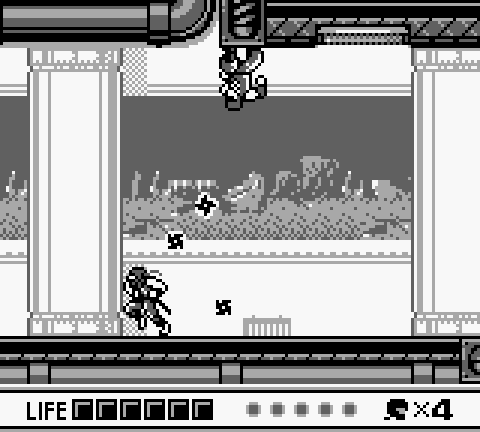
Stage four’s most fearsome foes are these ceiling-dwelling ninjas who can put out a prodigious amount of shurikens. For some reason, Ryu cannot deflect these shurikens with his sword. What kind of a ninja can’t deflect shurikens with their sword!? Yet another example of supposedly mighty videogame ninjas not actually being very good at ninjitsu. Would it have killed Ryu to lean a move where he stabs downwards while jumping, for instance? I could have gotten a lot of mileage out of that.

Halfway through the stage there’s a fun section where the lights intermittently turn on and off. Makes sense to me, evil overlords probably don’t have “get a full check of the electrical system” at the top of their list when they’re building an evil skyscraper. The gimmick of the dark sections is that occasionally a honking great laser beam will appear, but the laser beam can’t pass through platforms. Thus, Ryu must remember where the platforms are during the brief illuminated sections and then use them as cover when things go dark. It’s a well-implemented section, to the point that I was disappointed it didn’t last longer

Not quite as much fun, owing to me not performing well under pressure as much in videogames as in real life, was this area where Ryu must climb up through a cavern while being pursued by a rising tide of lava. Please understand that limitations of the Game Boy’s graphics means that in this case “lava” is simply a placeholder and the deadly liquid could equally be scalding hot chocolate or untreated sewage. Whatever it is, here you can see Ryu about to engulfed by it thanks to me having trouble grappling up the ledges quickly enough. This is not a fault of the game, by the way, just me.

Hang on, this game isn’t taking place in a skyscraper at all! Not unless it’s one of those floating naval skyscrapers, because that’s definitely a ship moored in the background. I feel like I’ve been lied to. Yes, okay, this explains the rising “lava” and walls made of rocks, but still. The title “Ninja’s Skyscraper Fight” is looking pretty embarrassing now, guys.
Oh right, the boss. It’s a flying man with wontons for legs. I think he’s supposed to be an ancient nobleman of some kind, although there’s nothing noble about hanging around the dockyards and throwing things at passers-by. All of the bosses in NGS are heavily pattern-based, but this one in particular feels very constrained by the tactics he’s chosen. Move to the far side of the screen to avoid his shurikens, moving to the other side when he floats above you. When he lands, duck under the fan the throws, stab him a few times and then jump over the returning fan. If you can get this pattern down, you’ll be able to beat him without taking any damage. Naturally I got a bit over-exuberant and ran face-first into his throwin’ fan a couple of times, but that’s why I’m not a ninja.

The fifth and final stage now, where the difficulty is ramped up to maximum and NGS takes its first step over the line from “challenging” to “annoying” with these perpetual flamethrowers. They just keep burning and burning, the evil overlord apparently having hooked them directly to a Russian gas pipeline. Normally the advice to fight fire with fire is not to be taken literally – the other fire will beat you with experience – but in this case it’s a totally valid strategy and Ryu’s fire wheel special will get the job done. I hope you’ve collected plenty of them, because by god you’ll need them.

Flamethrowers aside it’s a fun stage, with plenty of challenge and lots of accurate, well-timed movements and attacks required to progress. This is true of Ninja Gaiden Shadow as a whole, and while it’s not quite up to the standards of its NES forebears, Tecmo and Natsume have done just about the best possible job in getting Ninja Gaiden onto the Game Boy mostly intact. It’s a system where action games can suffer, but not in this instance.

At the end of the stage waits Garuda himself, another flying villain with a propensity for airborne attacks. In this case it’s lightning, for the full “evil emperor” experience. Again, he seems to have trouble getting his death-ray right into the corner of the screen, so use that to your advantage. I mock, but the lighting effect looks neat and somehow the Game Boy’s sound chip manages to make it sound dangerous. As always in these situations, for no obvious reason the boss will fly down to street level so you can hit him. He’s simply feeling generous, I suppose.

Okay, now I get it: he just wanted me to do him enough damage so he could transform into a Gundam. A cunning plan to be sure: Ryu was definitely doing better against the lightning. Garuda V. 2 only has one attack, and it’s as rigid a pattern as all the other bosses, but it’s a real pain in the arse to avoid. He spawns three projectiles that hover around for a few seconds before flying towards Ryu. They always come at you in the order middle, bottom, top, so dodging them is as simple as ducking the first and then jumping over the low one but under the high one. It’s simple in theory, anyway, but in practise you’ve got a very narrow window to avoid the attack, plus Garudabot 5000 is zipping around the screen and getting in your way. A tough final boss was always to be expected in a Ninja Gaiden game, though, so it doesn’t feel unduly punishing (and at least it’s easy to figure out what you’re supposed to be doing.)

I got there in the end, though. It turns out Garuda’s biggest weakness was swords. Who knew! The artist here as done a very good job of capturing the surprised expression of a wizard who transformed into a robot, only to be defeated by a man with a bit of sharpened metal.

Skyscraper my arse, that’s clearly one of Bowser’s castles.
As Ryu strides into the sunset (the castle crumbling behind him as they always do, because villains use their own soul for the foundations) I’m left to reflect on what is really a miniature triumph. Ninja Gaiden Shadow might not be the best in the series – partly because it’s a really good series – but it’s one of the best all-out action games on the Game Boy. The developers took the limitations of the hardware into consideration and produced something that might run a little more slowly and be lacking some ninja techniques but which absolutely deserves to be part of the series. It's well-presented, too, with mini cutscenes, crisp, easily readable graphics and an excellent soundtrack. Like Danny DeVito swimming through treacle, it’s short but sweet, and I’d give it my top ninja recommendation of five shurikens out of five. No, wait four and a half shurikens. It loses half a point because Ryu can’t knock shurikens out of the air with his sword. He must have been pulling a sickie when they covered that at Ninja Tech.