Showing posts with label master system. Show all posts

26/05/2018

SUPER BIOMAN 1 (MASTER SYSTEM)

C’mon, you must know it. It’s the famous catchphrase of one of gaming’s most enduring icons, a jolly red chap who lives in a cartoon world of brick platforms and turtle-stomping. Why not shout it along with me? Ready? “It’s-a me, Bioman!”


Super Bioman 1, no less; an unlicensed Korean Master System game from 1992 that was (perhaps) developer by a company called Hello Soft. Not to be mistaken for a tie-in with the Super Sentai series Choudenshi Bioman, Super Bioman 1 is the story of what appears to be a pudgy alien child in a red babygrow who must travel the land to save a princess. At least, I assume princess-rescuing is the goal, what with Bioman being a complete rip-off of Super Mario.


A rip-off of the all-time NES classic Super Mario Bros. 3, to be precise. This is abundantly clear when you look at Bioman’s map screen, an image that makes you wonder how awkward it must have been for Bioman’s developers to draw on the tracing paper they’d tacked to their TV screens.
It’s got all the elements you’ll be familiar with if you’ve ever played SMB3 (and if you haven’t, go and play it right now, I guarantee you’ll have more fun than reading this article). Numbered stages in a mostly linear progression, bonus areas like the mushroom houses and a castle at the end – all terribly familiar, even when viewed through the extremely bootleg lens of Bioman’s graphics. But will the gameplay adhere to the same Super Mario formula?


Well, yes, obviously. As interesting as it would have been if Bioman’s Mario map screen had lead into a blood-drenched survival horror or something, what we’ve got here is Super Mario but on the Master System and not as good. Bioman can jump, smash blocks with his head, bounce on enemies, collect coins and all that jazz. Of course, Bioman has its own unique quirks, and we’ll get to those in due course.


For now, just take a good look at this off-brand Koopa Trooper. I know it looks like some mad scientist grafted a plucked chicken head onto an army helmet, but this is what passes for Koopa Troopers in Bioman and you can jump on them and kick their abandoned shells around the stage as you’d expect. That said, every time I kicked a turtle shell in Bioman it immediately ricocheted and killed me. I’ll let you decide whether that was down to karmic punishment or Bioman not controlling as nimbly as Mario does.


And so it goes, all the sights of SMB3 recreated in a copyright-infringing way that I honestly find rather charming. Question mark blocks are replaced by “Q” blocks, the coins are dollars rather than the gold-based economy of the Mushroom Kingdom and super mushrooms make Bioman big and cheerful. It all reminds me of a pound-shop toy line, the kind where sure, The Lion King is a Disney movie but there’s nothing to say that there can’t be a different and legally distinct Little King Lion who sings songs about looking forward to becoming a regent with his friends Tumbaa and Pimon. And hey, if you’re going to rip something of it might as well be the best, right?


Thus the first stage ends just as a stage in SMB3 does, with Bioman leaping up to collect one of the random icons in the end-of-stage box. Collect three for a bonus, collect three matching icons for a bigger bonus. I reckon you could make an interesting psychological survey of the split between SMB3 players that patiently try to match the icons and those (like me) who just run towards the goal as fast as possible. Okay, maybe “interesting” is too strong a word.


Here’s stage two, where Bioman has turned purple. It’s because he’s collected a fire flower, you see, and it’s not like they could make him more red. So now he looks grape-flavoured. I’m still at a loss as to what Bioman is supposed to be, honestly. There’s something... familiar about him. He reminds me of some half-remembered mascot character, although that might just be down to the cutesy, chubby style of a lot of Asian mascot characters. I feel like he should be advertising nappies or baby formula, not stomping on turtles.


The third stage is a bit different, because it’s a boss battle! It’s supposed to be the equivalent of the “fort” stages in SMB3 where you fight the mid boss Boom-Boom, but without the stage that precedes the actual fight. Instead you’re thrown straight into battle with this almost indecipherable thing. I once forgot about a bag of potatoes at the back of a cupboard for a couple of months, and it’s nice to see that bag of potatoes went on to get a job in the entertainment business.
With the power to throw fireballs from Bioman’s hands, I went into the battle feeling confident. Just waltz in, sling a few projectiles, claim the easy victory, bask in the cheers of the crowd and so forth. Except you can’t use fireballs in the boss battles. It’s not even that they don’t damage the enemy, either – you simply can’t throw fireballs at all. Let’s put it down to performance anxiety, and resort to jumping on the boss’ head. If that is a head.


Now we’re back to the regular stages, and you might have noticed a few things. One is that all the stages look the same, and yes, apart from the boss battles they all take place in this strange twilight version of the Mushroom Kingdom, where the only light that reaches the ground is the baleful glow of a distant nebula. Again, it’s a look that I do like, but over the course of a whole game a bit more variety would have been nice.
Another thing is that, for a Master System game, the graphics look a bit... crap. On a technical level, I mean. I don’t know much about the Master System hardware, but I believe Bioman is running on an SG-1000 graphics mode. I’m also fairly sure that Bioman was ported from the MSX. There are Bioman games available on the MSX, and as an extra piece of evidence:


I’m pretty sure the Master System doesn’t have a space bar to press. That said, there was a keyboard for the SG-1000, although that definitely wasn’t the intended control scheme for this game.
This is one of Toad’s bonus game houses by the way, now staffed by one of Toad’s distant cousins from the rural backwaters of the Mushroom Kingdom - the kind of place where they keep things in the family, if you get my drift. It’s a slot machine with items as rewards, but the true reward of this screen is that the phrase “god speed you” reminded me to listen to some Guitar Wolf.


At the end of the world is, of course, the castle. Just like the fort there’s no actual stage here, just a boss battle. Bioman replaces Bowser’s Koopa Kids with a grumpy tomato, and it’s definitely a distinct downgrade. Neither of the characters look like they want to be here. I don’t particularly want to be here. The inevitable stomping has taken on the grim air of duty. The tomato offers little resistance as it waddles back and forth along the ground. It yearns for this to end beneath the heel of Bioman’s bootees. In the end, there is only silence.


Holy shit, a talking chair!
I was actually quite surprised that this first world isn’t all there is to the game, but the princess (told you there’d be a princess) isn’t here so there must be more to it. I’m hoping there aren’t eight worlds. Bioman is running out of steam already, it surely cannot sustain itself for another forty-odd stages.  But the talking chair’s unwavering believe in Bioman’s strength gives me the confidence to forge ahead, so let’s see what else the game has to offer.


Well would you look at that, it’s more of the same. I think we all saw this coming.
Now that I’ve cleared the first world, I suppose I should talk a bit about how Super Bioman 1 actually plays. In a word: ehh. Wait, that’s not a word, that’s the noise you make when someone asks you to hang out with people you don’t really know that well. It’s a perfectly suitable noise for describing Bioman, though.


The game works, just about, but it doesn’t work well. There’s a lot of sprite flickering, to the point that it can be difficult to spot enemies sometimes. Bioman himself moves in a fairly slippery manner, often moving a step further than you’d expect when letting go of the directional buttons. Probably the worst aspect of the game is that the left-to-right scrolling is often choppy and sluggish, and not being able to move smoothly from left to right is a real killer for what is essentially a Super Mario game. Weirdly, it never seems to be an issue when moving from right to left, presumably because the game isn’t loading in new sprites and thus slowing things down.


As well as technical deficiencies, Bioman also has some strange quirks in its design. Unlike the set items of Mario games, the contents of each question block are random, which means that if you’re unlucky you can potentially go a long time without finding any power-ups. Then there are changes to enemy behaviour that throw a spanner in the works because I (and pretty much everyone else) am so used to how Mario games work. For instance, in Mario games, if you stand on a pipe that has a Piranha Plant popping out if it, the enemy won’t jump up and bite you on the arse while you’re standing there. Not so in Bioman, and the non-official bitey flowers will keep chomping from right underneath you. Or there are the Boos, which normally won’t move towards Mario while he’s looking at them – but in Bioman the ghosts have overcome their shyness and will move, seemingly at random, whenever they goddamn feel like. Perhaps the most baffling feature is that sometimes the corpses of stomped enemies can hurt you. That’s bad enough, but it gets worse: sometimes harmful enemy corpses will fall out of question boxes, resulting in almost unavoidable death.


If you ever lose sight of what makes the NES Mario games such genre-defining classics, I suggest you go and play a sub-par Mario bootleg. Then you’ll understand. It’s not like Bioman is awful, especially for a pirate game, but there’s enough wonkiness and technical problems to stop it being all that much fun. I do find the graphics quite pleasant in their simplicity and the music – recreations of famous SMB3 tracks, naturally – is quite good.


But by the time I’d reached the end of the second – and as it turns out, final – world, Super Bioman 1 had more than worn out its welcome. More variety would have gone a long way towards keeping things interesting, even if it was just some stages that didn’t take place during an eternal eclipse, but what you get is the same backgrounds, the same simple action and the exact same boss battle before the game limps unconvincingly over the finish line.


I’m glad I got to the ending, though. It’s hard not to be charmed by these thoroughly wrong versions of Mario and Peach. It was kind of the royal jeweller to find such a minuscule crown that wouldn’t draw attention to not-Peach’s tiny, tiny head and hang on, was Bioman supposed to be Mario all along? Or is the plumber just taking all the plaudits for Bioman’s hard work? I say let him have the applause. Judging by the unfortunate shape of his body, iI don't think he's long for this world.
And that’s Super Bioman 1, a Super Mario game on the Master System. It’s certainly something. I’m not the biggest fan of the Alex Kidd games but if you want to stick with those, that’d probably be a good decision.

04/02/2017

MASTERS OF COMBAT (MASTER SYSTEM)

For today’s article, I’ve turned to the Sega Master System for a tale of cybernetically-enhanced warriors – and one chunky bloke with no shirt – who must fight to prove their strength. One of them might even accidentally save the world. It’s SIMS and Sega’s 1993 fighting game Masters of Combat!

Is it just me, or is that a very SNK-looking logo? I could definitely see that typeface appearing on a Neo Geo brawler. But this isn’t the Neo Geo, it’s the Master System, which might cause you to worry about this game’s quality. I think it’s fair to say that one-on-one fighting games for 8-bit consoles are not always entirely successful, to put it kindly. Sometimes it’s down to the consoles lacking the power to smoothly manipulate large, detailed sprites, sometimes it’s because they were released before Street Fighter II reinvented the genre, sometimes it’s because they’re bootleg hack-jobs starring Super Mario characters. Well, I’m happy to announce that Masters of Combat avoids most of those pitfalls and turns out to be a rather enjoyable game. I know, I was as surprised as you are. We’ll get into the gameplay later, but for now let’s set the scene.


I think “landed” is a very generous word to use in this context. “Fell screaming from the heavens and slammed into the Earth, burning and out of control” is more the vibe I’m getting from this artwork.
So, a UFO “lands” near Megalo City, but when people go to investigate no trace of it can be found. Fortunately, the city’s mayor has a plan to distract the populace from these events and maintain civic order.


The fact that this plan took a year to come into force shows that SIMS really understood the tangled bureaucracy of governmental process. This is why every city should have a Mike Haggar in charge. He would never have waited a year, he’d be straight up to the landing site with a plan in mind. Sure, his plan would be “take off his shirt and punch anyone who looks at him funny,” but the voting public loves politicians who take bold, decisive action.
That’s the set-up for the fighting tournament, then. A UFO may or may not have landed nearby, and a year later the mayor declares a round of public bloodsport. I’m sure these two events are in no way related.


Is it that he has no eyes? Probably not, that’s an unfortunate medical condition but it’s not “dreadful.” Whatever his secret is, I’m sure we’ll uncover it as we punch our way through the colourful cast of characters that Masters of Combat has to offer.


Here are those characters. There are only four to choose from, which isn’t many, but hopefully it’ll mean they all feel unique rather than being Ryu / Ken / Akuma / Evil Ryu / Violent Ken / Slightly Under The Weather Akuma / Ryu, But With A Hat types. Their names are, from left to right, Hayate, Gonzales, Highvoltman and Wingberger. None of them have eyes, either. Especially not Gonzales, who looks like a baker formed his eye-holes by pressing their thumbs into a head-shaped lump of fresh dough.


Let’s take a look at Hayate first, because he was on the left of the character select screen. He’s most certainly a ninja, and presumably a cyborg ninja because pretty much everything else in this game has a cyberpunk feel to it. He can throw energy shurikens, and that’s cyberpunk enough for me. Of the four characters, Hayate is the least interesting and the easiest to play as, cementing his role as the Ryu of the game. He seems to have more special moves than all the other characters, for starters: he can throw either one or two shurikens, he’s got a rising vertical elbow attack, a big swing with his katana and a couple of horizontal multi-hit rush attacks. All in all, Hayate seems like the complete package (and he’s fast, too,) so if you’re playing Masters of Combat for the first time he’s a good choice.


Next up is Gonzales, a rebel, a man who takes his own path in life, a man who saw that he’d be kicking robot men and thought “I’m still not going to put any shoes on.” Gonzales is obviously geared towards strength, for one can only get away with wearing purple trousers and matching wrist guards if they are truly powerful. As you might expect from his appearance, Gonzales has the feel of a professional wrestler to him, with body slams, a jumping drop-kick and a flying belly press that underlines his similarity to Karnov at his disposal. Gonzales’ big quirk is that most of his special moves have a delay at the beginning – for example, when you use his charging punch rush he beats his chest before attacking – so to use him effectively you’ve got to have a good knowledge of these various timings. A more technical character than Hayate, then, but also more interesting and fun to use.


I also absolutely love Gonzales’ crouching stance, because it looks like his body is collapsing into itself due to the powerful gravitational effects of his bulk.


Fighter number three, and probably my favourite of the bunch, is Highvoltman. Admittedly this is due in part to his excellent name, a name which prompted a lot of highly enjoyable speculation as to how he chose it. I can only assume that he chose the name “Voltman” at first to complement his electric powers, but then realised that “volt” alone did not convey the furious power of his electrified attacks and it needed a bit more oomph. Either that, or he gained his powers and his compulsive need to fight people after a terrible accident in which he drunkenly pissed on a high voltage cable on his way home from the pub.
Highvoltman doesn’t really fit into a neat fighting game character pigeonhole, and his attacks are a mix of various styles. He has a projectile attack, which comes out very quickly but is also not that powerful and more useful as an annoyance than anything else, but he’s also got a devastating electric punch with a very short range. Like I say, he’s a mixed bag.


Highvoltman has also mastered one of the all-time best fighting game moves I’ve ever seen, in the form of his jumping flip kick. You can see him performing it in the screenshot above. I know it looks like he’s been hit in mid air and is flying backwards but no, it’s supposed to look like that. When you perform the flip kick, Highvoltman leaps into the air with balletic grace, looking for all the world like someone who truly intends to do a flip kick… but then halfway through he stops rotating, contorts into the stance shown above and falls from the sky, landing flat on his back in a manner that seems like it should have a fifty-fifty chance of ending in quadriplegia. The first time I saw it I assumed I’d done something wrong, but no, that’s how the flip kick is actually intended to work. How remarkable. Obviously I used it almost exclusively after I figured this out.


Finally there’s Wingberger, a mechanical man with a welder’s mask for a face and the name of a preppy, upper-crust villain from a high school comedy. As you can see above, Wingberger’s main deal is that he’s got Dhalsim-style extending limbs… although they’re not quite as effective as those belonging to everyone’s favourite yoga master. They don’t stretch that far, and the smaller character sprites (and consequently the large playing area) mean that you’re not going to be kicking your opponent from the opposite corner of the battlefield. Still, they are very useful, especially when employed as a jumping kick.


Perhaps to counterbalance the advantages of having telescopic limbs, Wingberger has fewer special moves than the other characters. He’s got a couple of diving attacks, but best of all he has a mega-cannon that’s so powerful it knocks Wingberger over when he fires it. This makes it especially embarrassing when you fire your cannon and the other player easily blocks it before running over to you while you flop around on the floor like a freshly-landed halibut.


When it comes to playing Masters of Combat, you’ve got two modes: regular old versus battles, and the story / arcade mode. I’m going to run through the arcade mode now, because I will not be satisfied until I find out what the mayor’s evil plan is. I suspect it won’t be about voter fraud or financial mismanagement. I decided to play as Highvoltman, because his name is Highvoltman. My first battle was against, erm, Highvoltman. This means that Highvoltman’s pre-fight trash talk about fighting weak opponents transforms into what I believe the youngsters call a “self-own.”


Good lord, I love that flip kick.
Just by looking at Masters of Combat, you’ll get a good idea of the basic set-up. You hit each other until someone’s health bar runs out, it’s the best of three rounds, that kind of thing. If you’ve played any other fighting games, the same basic concepts apply here. Masters of Combat isn’t a combo-heavy game, so focussing on timing and reacting to mistakes made by the computer are important parts of your march towards victory. In this case, I capitalised on Highvoltman’s mistaken belief that I wouldn’t embarrass myself by repeatedly flopping around using the flip kick. I also used the throw a lot, which works in the usual “get close enough to feel the almost erotic sensation of your opponent’s hot breath on your neck and then press attack” manner. A few flip kicks, a few throws and the occasional projectile launched towards clone-Highvoltman’s face whenever he ran towards me – that was all I needed to seal victory.


“I’ll accept any fighter’s challenge, even if that fighter is me but painted green. Especially if it’s me painted green. There can be only one Highvoltman.”


Fight number two is against Wingberger, who continues the game’s theme of unconvincing pre-fight banter by seemly implying that he’s the worst.


While the basic structure of Masters of Combat is the same as most other one-on-one fighters, when it comes to the controls things get a bit different. The most obvious example of this is that Masters of Combat has one single button dedicated to attacking. That’s it. No light, medium and fierce attacks here: you’ve got a button to punch and kick, and you’ll punch or kick when you press it with the move determined by your character, their position and what direction you’re pressing on the d-pad at the time. For example, Wingberger’s extending kicks are unleashed by pressing the d-pad towards your opponent while you attack. This almost gives MoC’s controls the feel of a “classic” Commodore 64 (or other home computer) control scheme, although thankfully MoC controls far better than any C64 fighting game I’ve ever played.


“But the Master System pad has two buttons,” you might be thinking, “so what does the other one do?” Well, it’s jump, mostly. That’s right, unlike you Street Fighters or your King of Fighterses or what have you, up on the d-pad isn’t jump. I must admit, this took quite some getting used to, but it’s worth it because MoC also uses the jump button for other things. Hold up / up-left / up-right on the pad while you press jump and you’ll, you know, jump. However, left or right and “jump” will make your character dash either forwards or backwards, and down and “jump” will make them slide along the floor. This system is pretty great, and goes a long way to both making MoC’s combat faster and more unique. The dashes work well offensively and defensively, allowing you to scoot out of the way of incoming attacks and punish misses, as well as keeping the pace of the combat up when the widely-spaced combat area might otherwise promote few tactics beyond spamming projectiles.


After stage two, you get a Street Fighter II-inspired – rip-off, I mean – bonus round where you punch a forklift until it explodes. Why? Why the hell not. Maybe the accident that transformed Highvoltman into the warrior he is today happened while he was working a menial warehouse job and the bitterness has stayed with him.
Unlike the car-punching round in Street Fighter II, the forklift can be damaged simply by standing there and punching it. I didn’t do that. I used the flip kick, of course. Well, I wouldn’t want to get rusty during this enforced break.


Hayate’s up next. His stage is some kind of cyberpunk temple and it looks great, as does so much of MoC. The graphics are definitely one of the game’s strong points, with lots of colour and fun, fluid animation that’s detailed enough to give each character a feeling of individuality. There’s some sprite flicker, which is less good, and once or twice it got bad enough that I had trouble seeing projectiles heading towards me, but for the most part it’s not a problem and overall MoC is one of the most visually impressive games I can remember playing on the Master System.


And now, Gonzales hurls himself into the fray, hoping his considerable girth will be enough to overcome Highvoltman’s electric fists. It turns out his hopes were well-placed, because Gonzales proceeded to kick my ass multiple times while I struggled to land a blow on him. Every time I went near Gonzales, he grabbed me and performed an Atomic Drop of such ferocity that Highvoltman’s tailbone assumed a new name, left home, relocated up to his chest and started a new life as a rib. If I stayed away, all I could do was flick Highvoltman’s underpowered projectiles at Gonzales, which was akin to farting at a charging rhino.


At least I could get Highvoltman’s projectile attack to come out with some regularity, which is not true of all the moves in the game. While the special moves in MoC are executed in roughly the same manner as they are in most fighting games – a series of directional inputs followed by a button press – things work a little differently here thanks to the control scheme. Jumping is controlled by a button rather than with up on the d-pad, which frees up the top of the d-pad for use in special move inputs. For example, the command for Highvoltman’s high projectile is up-back, up-towards then attack. After years of Street Fighter and other similar series this took quite a lot of mental adjustment to get used to, both my brain and my fingers having decided that to throw a projectile I should do a “classic” fireball motion and to hell with what the game’s actual controls are. If it was just a case of learning new controller inputs it wouldn’t be so bad, but sadly even when you’re hitting the right combinations there’s no guarantee you’re going to get the result you want. MoC seems extremely fussy about what counts as a “correct” input and frequently – far more than the usual amount that comes from me being bad at videogames – moves just won’t come out when you want them to. The small roster of characters has a decent claim on this title, but I’m going to go ahead and say that the awkwardness of the special moves is the worst thing about Masters of Combat, a game that is otherwise very impressive.


Having eventually managed to beat Gonzales with a combination of jumping kicks and blind luck, the four playable fighters have all been defeated. But wait! They mayor has decided he’s going to get rowdy too. I guess he got caught up in all the excitement. Normally I’d say the mayor’s sudden desire for pugilism springs from the same source as the bloke in the pub who swears he could go a round against the world heavyweight champ despite being an overweight borderline diabetic, but let’s not forget that the mayor has a terrible secret.


The other thing that surprised the citizens was that the mayor burst into flames. He looks pretty happy about it, too. Happier than when he wasn’t on fire, even. That’s definitely not normal.


Surprise surprise, it turns out that the mayor was possessed by an alien. Presumably it’s the alien that landed a year ago, but we have no hard evidence of that. This could be a totally unconnected puppeteer of human flesh from beyond the stars.
The alien set up the fighting tournament so it could locate the strongest human body for it to inhabit. This plan has one large, obvious flaw: the strongest, toughest, most fightingest person is now standing right in front of you as you reveal your plan to steal their body. They're probably not going to acquiesce to that, are they? Think it through, you plum. This also implies that you think you’re stronger than the strongest human, Mr. Alien, which begs the question why do you want a strong human body? If you just wanted to blend in with human society you could pick any human body, and if all you care about is carnage then you might as well just be your natural alien self. The only explanation I can think of is that the alien has travelled across the galaxy to fulfil his one and only desire: to win an Olympic gold medal for weightlifting.


No eyes, elongated head, lived inside a human for a while: yep, I think we can safely say we’ve found another videogame alien inspired by H. R. Giger’s xenomorph.


The Alien looks a lot less like a xenomorph when you see it in full, though. This is mostly because of the wings. Xenomorphs don’t have wings, except in the Aliens toy line. The Aliens toy line also included a praying mantis-based xenomorph, and when you consider the impracticalities of getting a facehugger to attach to a praying mantis I think we can safely discount the toy line from the Aliens canon. They also don’t tuck themselves into a ball and roll at you like Sonic the Hedgehog, which is the boss’ favourite trick. It can even scuttle up the walls and roll from different heights, so get ready to duck if it looks like that’s going to happen.
As fighting game bosses go, The Alien offers an enjoyable level of challenge, a level that the bosses of other punch-em-ups can sometimes miss completely. The Alien’s a more dangerous foe than the other fighters, because it’s faster and more powerful, but it never sinks to “SNK boss” standards of frustrating bullshit. You can outfight The Alien, given enough practise. You’ll probably get beat the first few times, which could have been a problem because MoC only gives the player a small amount of continues – but because there are only four other fighters, it doesn’t take long to get back to the climactic battle.


Of course, the final battle is good because Masters of Combat is, on the whole, a very good game. Okay, so it’s a very good game for a one-on-one fighter on an 8-bit console, at least. Aside from the lack of characters and the occasionally stubborn special move inputs, there really aren’t many negatives. The presentation is good, with excellent graphics and a soundtrack that’s not quite as impressive but still never dips below “decent.” The action is fast and smooth, the dash mechanic keeps things fluid and gives MoC’s combat its own personality. There’s a character called Highvoltman. it’s a game with a lot to recommend it, then, and if it had been released before Street Fighter II (and had it been released in the US at all, which supposedly it wasn’t) it would probably be remembered as a minor classic. However, MoC couldn’t have come out before Street Fighter II, because it is based so heavily on Capcom’s classic, so I suppose that’s a moot point.


In the end, I defeated The Alien through the simple, practical method of learning his attacks and good old-fashioned practise, which is about the most satisfying way a fighting game can end. As Highvoltman looks out over the city he has saved – an ending that’s the same for every character, disappointingly – I’m left to reflect on a game I enjoyed more than I was expecting to. It’s not that impressive when compared to modern fighting games, or even fighting games of the same time period that ran on more powerful hardware, but Masters of Combat is a game I’m glad to have played. If nothing else, Highvoltman’s flip kick is going to stay with me for a long, long time.

11/06/2015

HOKUTO NO KEN (MASTER SYSTEM)

It seems that in every other article I end up saying "this martial artist / violent thug / shoulderpad aficionado sure looks like he was inspired by Hokuto no Ken," so I decided it was probably a good idea to write about an actual Hokuto no Ken game. I may come to regret this, because most retro Hokuto no Ken games are terrible. If I'm lucky Sega's 1986 Master System you-are-already-dead-em-up Hokuto no Ken will be hovering somewhere around "below average," but I'm too much of a pragmatist to hope for anything better than that.


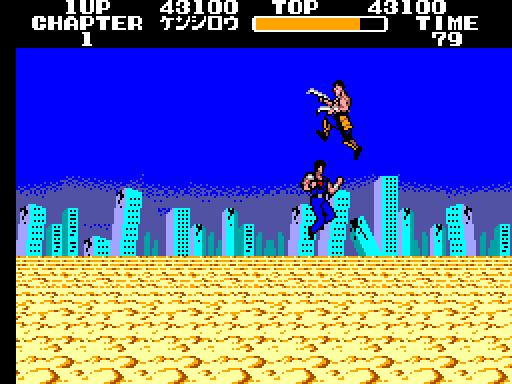
This scowling man, his hair all frizzed up by the electrical discharges in the air around him, is Kenshiro. He's the hero of Hokuto no Ken, also known in the west as Fist of the North Star, a manga and anime franchise about a man who can punch people so hard that they explode. Spoiler alert: he punches people a lot, especially if you include kicks and really violent pokes with a finger as a subset of punches. Actually, this article is going to end up being 90% Hokuto no Ken spoilers, so bear that in mind if you want to watch it for yourself. Kenshiro is the master of and sole successor to the ancient martial art of Hokuto Shinken, which revolves around pressing the pressure points of your victims' bodies to kill them in a variety of interesting ways. It's weaponized acupuncture, essentially. A nuclear war devastates the Earth, and Kenshiro travels the desert wastes, killing bad guys and saving villagers as he searches for Yuria, his lost love who was abducted by the evil Shin.


Kenshiro is the conceptual lovechild of Mad Max and Bruce Lee, all leather jackets and high-pitched kung-fu screams, and I'm big fan of his hyper-violent adventures - they're completely insane, contain a fair amount of black humour and are occasionally, just occasionally, quite touching. Of course, in an eight-bit videogame the only part of Hokuto no Ken that's going to be replicated for the player is all the punching, so let's get on with it.


Within seconds of the game starting, Hokuto no Ken is unmasked as clone of Irem's classic Kung Fu Master. Kenshiro walks along a (mostly) flat plane, defeating the swarms of villains who rush towards him with a limited set of moves. You've got punches and kicks in the usual standing and crouching variants, as well as a jumping kick. As is often the case in this type of game, the jumping kick is best used by jumping, sticking your leg out while in the air and then falling onto the enemy with your outstretched foot, letting gravity do most of the work. Punches have a slightly shorter range than kicks and the cannon-fodder enemies all die in one hit, so I guess I was wrong about there being a lot of punching in this one. No point making things more difficult for myself than they have to be. Let's just hope Kenshiro is wearing his stretchiest jeans.


The graphics well above average for a game of this vintage, too. Your sprite is recognisably Kenshiro, and there's even some decent parallax scrolling going on in the background. Sure, it's a wasteland stripped bare by the horrors of nuclear fire, but at least there's some depth to it. Less convincing is the bad guys' death animation, where the terrifying power of Hokuto Shinken is depicted by having the thugs break into small chunks and float away on the wind. It's a softer, gentler form of explosive death, then: suitable for the home console market and less taxing on the Maser System hardware than having everyone you punch burst open like a gas-filled whale carcass.


After a while, the screen stops scrolling and the first of the stage's four - yes, four - minibosses pops out and attempts to block Kenshiro's progress. He's one of Shin's lieutenants, and his name is Spade. He does not fight with a spade, which is a shame. Instead he throws axes, which Kenshiro can punch out of the air. Aside from that, it's a simple matter of getting close enough to Spade to land a few punches, and punches are recommended because I think they do slightly more damage. Low kicks are right out, because as is the case with so many sub-human gangers from the irradiated wastes, Spade is wearing an extravagant amount of shin armour. Maybe the mutations that allowed these men to become hulking eight-foot-tall slabs of muscle despite the scarcity of food also rearranged their internal organs, moving everything vital into the lower leg.


Next up is Diamond, another of Shin's lackeys. Diamond presumably saw Kenshiro slaughter hundreds of men singlehandedly, as well as Spade, and thought to himself "sure he's tough, but I've got a stick!" Yes, you do have a stick, Diamond. Well done. It's not a very long stick, mind you, and it's easy enough to move Kenshiro back when you attack so he's slightly out of range, before moving in for the kill while you're recovering.
As a sidenote, in the manga Ken defeated Diamond using a move called the "Face-Breaking Fist." The name Face-Breaking Fist is played with a completely straight face, which is sort of why I love Fist of the North Star.


The deck of cards-themed psychopaths keep comin' with the appearance of Club, a man who fights with claws and not a club. It was Diamond that used the club, remember? Try to keep up. Club's gimmick is that he jumps around a lot, which proves to be his downfall because he doesn't actually attack while he's up there. This means you get a free punch to the shins, armour be damned, as he falls back to Earth.


Finally in the roster of midbosses for the first stage and rounding (pun intended) out the card suits theme is Heart. One of the more famous of Hokuto no Ken's lesser characters, Heart is a big fat man whose fighting style is being so big and fat that no-one can hurt him through his blubber, a martial art in which I am close to being awarded a red belt myself. His unmatched durability has earned Heart the nickname Destroyer of Fists, but Kenshiro gets around this problem by not-so-gently nudging Heart's belly out of the way with his foot before dealing the final blow. In the game, this boils down to Heart having more health than all the previous minibosses combined, which makes for a dangerous combination with the powerful kick to the groin that he delivers if you spend too long in close proximity to him. This fight became a straight-up race to the bottom of our respective health bars, and once I'd realised that you can't hurt an enemy if they're too close to Kenshiro - the hitbox for his attacks only covers his hands and feet and not the limbs in between - I managed to whittle away at Heart until I killed him, presumably mere minutes before the catastrophic coronary that would have finished him off anyway.


The bosses battles just keep on coming, but now that I've reached the end of the first stage things are a little different. The camera has moved closer to the action, the sprites are bigger and while Kenshiro still has only the same limited moveset the whole thing feels a little bit more Street Fighter, possibly thanks to the visible health bar for the boss I'm facing.
The boss in question is Shin, master of Nanto Seiken, the rival martial art to Hokuto Shinken. Shin beat beat Kenshiro in a fight prior to the start of the series, horribly wounding him in the process and kidnapping his fiancée Yuria. I know that seems like a lot of baggage to be piling onto the very first real boss fight of the game - putting a stop to your hated enemy and rescuing your girlfriend are usually reserved for the very end of a game - but that's just how Fist of the North Star is, becoming more stretched and convoluted as the franchise goes on.
Shin is dressed like a space stewardess from a 1950's fantasy of what space travel would be like in the future, so you might be worried about going up against him. Anyone who can wear a magenta jumpsuit and still control an army of vicious killers through fear and intimidation must be a truly terrifying foe, right? Well, never fear. Shin likes to act the big I-am with his fancy hand movements and battle poses, but if you calmly walk towards him and punch whenever you're in punching range then you'll emerge triumphant.


Ken finishes Shin off with his trademark Hundred Crack Fist. Ironically, Shin was not wearing shin protectors. Maybe he could have survived if he had been. Anyway, time for Kenshiro to be reunited with his lost love, and the two of them can go off into the sunset together.


Or not, because this is just a doll that looks like Yuria, a fact that escaped Ken's finely-honed senses. Let's give him a break, he was engaged in a battle to the death at the time. Sadly the real Yuria has killed herself already by throwing herself off a balcony. Except she hasn't, and it turns out later that she's still alive. I told you Hokuto no Ken gets convoluted. By the end it's all Dickensian coincidence and long-lost siblings. And punching, there's still quite a lot of punching.


Chapter two sees Kenshiro entering Godland, home to a military organisation who believe they can purge the wastes of the weak and undeserving through military might and jumping around with no shirts on, like a cross between a totalitarian junta and the WWE. Each stage in Hokuto no Ken follows the same pattern - wade through a level full of identikit goons, pausing occasionally to fight a miniboss before reaching the finale, where the action switches to the slightly more detailed "proper" boss fight. It might be a shallow rip-off of Kung Fu Master, but then what other kind of game could Hokuto no Ken really have been? Even for a fighting anime the series itself is set up just like a scrolling beat-em-up: Kenshiro fights to either save his girlfriend or destroy evil, killing cannon-fodder troops until he reaches a boss. He's got special moves, and even (although it didn't make it into the game) a "powered-up" state where he becomes so furious his jacket disintegrates. That definitely sounds like a scrolling beat-em-up to me.


I see oil drums, Hokuto no Ken's beat-em-up status is confirmed.


The first miniboss of the stage is the Major, a very angry man with a whip. I think he's so angry because the nuclear apocalypse destroyed his career as a lion tamer, forcing him to use his whip skills in other, less salubrious ways. He really likes the whip, too. Never stops swinging the bloody thing, and if you let him get too close he can shred Kenshiro's health bar very quickly. So, this becomes a hit-and-run type of battle, the main goal being to preserve as much of you health as you can. You only get one health bar to last you through the entire stage, and aside from a tiny refill when you beat a midboss there are no health-restoring pickups, giving the whole game a sort of "Survival Mode" feel.


Mad Sarge now, his madness apparently not holding him back from promotion to the rank of sergeant. He's mad all right - mad about knives, which he throws around with gay abandon. It's okay, knives are one of the few things that are easy to come by in the post-apocalyptic world, along with shinpads, mohawk gel and super gain protein powder. As for the fight, well, you remember earlier I fought that guy who threw axes? Yeah, it's the same as that.


The end-of-stage boss is the Colonel, a soldier in a red beret who carries a baton and strives to create a soldier's utopia. I think there's a strong possibility that Colonel is the inspiration for Final Fight's Rolento, although Colonel never bounces around on his baton like a pogo stick so Rolento is clearly the superior warrior.
In fact, Colonel doesn't use his baton at all when you fight him, choosing instead to harass the player with many tiny boomerangs like the warrior dwarfs of Australia. Once you've figured out the boomerang's flight pattern, it's a simple matter of jumping over them and clobbering the Colonel, moving away before he throws another. In the manga, Kenshiro finishes the Colonel off with a move that makes his skeleton erupt from his body. This does not happen in the game. If I'd paid money for Hokuto no Ken, I would have demanded a refund.


We're back in the wasteland for chapter three, and here I've made the grave mistake of letting Kenshiro become surrounded by punks who are channelling their disappointment at not being cast in Mad Max: Fury Road into making Kenshiro dead. During the non-boss portions of the game, making sure Kenshiro has plenty of space around him should be your only goal, because if the grunts manage to surround you even they can quickly wipe away big slabs of your health bar. The key to success on that front is not being too impatient: if an enemy appears behind you, make sure you take them out straight away instead of thinking "oh, I'll just murder them when they catch up to me." When enemies start leaping around the level, don't go chasing them. Wait for them to land and kick them when they're defenceless. Slow and steady wins this particular race.


There's only one midboss in stage three. His name is Fox, and wait until you get a load of his secret martial arts technique: he lies in the dirt pretending to be dead, only to spring into the air and decapitate his opponents when they let their guard down / have stopped laughing at his "skills." When every other person is the master of a powerful and ancient fighting style to which there can be only one successor, it was bound to happen that those who turned up late to the party got lumbered with the kung fu equivalent of the toffee penny in a box of Quality Street.


This is Devil Rebirth, the end of stage boss. Even by Hokuto no Ken's ridiculous standards of male largeness, he's a big lad, responsible for the slaughter of hundreds of people and forever imprisoned because he's so tough the multiple execution attempts didn't stick. Despite his impressive credentials, Devil Rebirth ends up being the easiest opponent in the game: wait for him to vomit up a fireball, jump over it and kick him in the face, repeat. You just need to be wary of his jumping attack, because it does massive damage. I can understand that, just look how tiny his feet are and then imagine all his weight being focussed into that small an area as he stomps on you.


In the next stage, Kenshiro breaks into a prison. The prison is guarded by men with axes, and eagles. The many times I've played Knights of the Round means I treated the eagles with a degree of trepidation, worried that I would be struggling to hit them as they pecked away at my health bar with their merciless beaks. Luckily the eagles seem disinterested in their work as prison screws, lazily drifting towards Kenshiro in a dive that's easily sidestepped before flying away. This makes the eagles the most intelligent enemies in Hokuto no Ken.


The warden of the prison is Uighur, a Mongolian man who fights with a whip. Is Uighur a comically overmuscled chap who threatens Kenshiro with an arrogant overstatement of his fighting prowess, only to die in a grotesque manner? You bet your ass he is, because only two kinds of people survived the nuclear war and "overconfident martial artists" are one of them. The other kind is "weak villagers just trying to survive / biker gang magnets."
Unlike the Major, Uighur's whip isn't his most dangerous tool: instead, you have to watch out for his dashing shoulder charge. Did I mention that Ken can perform a super-jump if you press down and then up on the d-pad? Well, he can, and it makes avoiding charging Monoglians easy as well as being handy for putting up Christmas decorations and painting ceilings.


The villains are finally starting to get the hint that sending one person to deal with Kenshiro isn't cutting it, and so our hero comes face-to-face with Zarqa and Qasim, a pair of scimitar-wielding warriors who trap Kenshiro between their spinning blades and slice him to oh, I've beaten them already. That was easy. Thanks to the lack of threat from both the eagles and Uighur, I came into this fight with more than enough health to throw caution to the wind, and once you've taken out one of these guys the other one isn't much of a threat. You even have all of your health restored before the end-of-stage boss, so you might as well walk through a few sword blows if it gets the fight over with more quickly.


In a shocking twist, the final challenge of the stage is a battle against... your own brother! This is Toki, Kenshiro's adopted brother and fellow student of Hokuto Shinken. Toki was meant to be the successor to Hokuto Shinken, but he was exposed to nuclear fallout while saving Kenshiro and Yuria's lives and renounced his claim on the title, dedicating his life to healing people using the non-lethal pressure-point-pressing techniques of Hokuto Shinken. He's karate Jesus, essentially, and now I must do battle with him for some reason.
And quite the battle it is, too - Toki is extremely difficult to hit, and even if you do hit him he generally hits you straight back for the same amount of damage. In the end I managed to claim victory by standing still and trading punches with Toki, which only worked because his health bar hit bottom a fraction of a second before Kenshiro's. Even that victory felt hollow, because it was again a kind and gentle man who is dying from radiation poisoning. It's difficult to feel like a big man after that.


Stage five, and more of the same thug-splattering action. You can stand on a ruined truck in this level. It doesn't add much, I'll be honest.
On the whole, Hokuto no Ken has been exactly the game I imagined it would be: very basic smack-and-walk action with relentless enemies and a difficulty curve that'd look like a plate of spaghetti if you drew it out on paper. I don't have many serious complaints about the mechanics of the game, apart from Ken's jumps being unresponsive, and really, how much better could it have been? More variations in the levels would have been nice, I suppose, but at least you get a surprisingly wide variety of different minibosses to fight. An expansion of the need for accuracy could have made for an interesting spin on the action: Ken's attacks already have to land with a fair degree of precision, so if the gameplay had been zoomed in a little and more focus placed on landing accurate punches I think it could have created a more unique gameplay experience and one that'd fit nicely into the setting - after all, with Hokuto Shinken being a martial art based around hitting pressure points, precision would be a logical thing to focus on.


Stage five has three minibosses, or six minibosses, or one, depending on how you want to look at it, because you fight these two flamethrower-carrying punks three times. Kick one of them to death while avoiding the other, then finish the job. I found a good tactic was to keep jumping up to the top level, waiting for the villains to follow and then dropping back down, giving Kenshiro a free hit as they chase you back down to the ground.


Things get tricky in the boss fight against the Nanto Seiken master Souther, (or Thouzer, or Souzer, or Thouther. He's got some transliteration issues,) because fighting against him in the usual manner will have no effect. Instead, in order to damage Souther you have to hit him with specific moves in a specific order - kick, punch, crouching punch, crouching kick. I'll admit I had to look this combination up, because I doubt I would have figured it out on my own, especially the coup de grace: when Souther is out of health, you have to finish him off by jump-kicking him while he's doing a jump kick, which is by far the hardest part of an otherwise relatively easy (if you know the right sequence, anyway) fight.
All this faffing around is, I assume, an attempt by the developers to recreate Souther's gimmick from the anime. Kenshiro's Hokuto Shinken has no effect on Souther until he discover the mystery of Souther's body - that his internal organs, and thus his pressure points, are a mirror-image of a normal person's. Kenshiro figures this out by sticking his fingers into Souther's chest and feeling the flow of his blood. Is there a word that means both "ingenious" and "disgusting"? Because I think I've found the perfect use for it. Speaking of disgusting, that blue thing in the background is the mummified body of Souther's master and not the expertly-carved ice sculpture that it first appears to be.


Immediately after defeating Souther, Kenshiro is thrown straight into the game's final battle: an earth-shattering confrontation with the mighty Raoh, king of fists! Look, I'm trying to punch this up a little, because the Master System's graphics can't really do justice to Hokuto no Ken's climactic fight. Without some cheerleading, the casual observer might think that this is just a punch-up between a man dressed head-to-toe in denim and a wandering pro-wrestler.
Raoh is also Kenshiro's adoptive brother, a powerful martial artist who seeks to crush all before him and conquer the land with his Hokuto Shinken powers. Why anyone wants the land is a mystery to me - all there is dirt and ruined buildings, with plenty for everyone - but Raoh is bent on conquest through pure might. He does right to choose might over wisdom as his tool of conquest. He's got a lot more of one than the other, as evidenced by the fact that he pretends to murder Yuria just to get Ken extra angry, which is up there with "only hire the most vicious, untrustworthy scum for your personal army" as bad plans go. Yes, Raoh does that too.
Fighting against Raoh was a lot more simple than I thought it would be: I was prepared for more opaque gimmicks after the Souther fight, but aside from having to finish Raoh off with a standing punch this is a straight-up fight... which is not to say it's easy. Far from it, as Raoh knocks massive chunks from your health bar with a single punch and has arms that are much longer than Kenshiro's. In the end it was Raoh's lack of intelligence that did for him, as he got stuck in a loop of trying to jump at me while I hunkered in the corner of the screen, throwing punches at the bottoms of his legs. Somehow this tactic worked, and without giving me time to ponder just how hard you'd have to punch someone in the shins to kill them, Raoh was defeated.


Raoh dies claiming that he has lived a life with no regrets. I'm not sure I believe him. There's no way a life that ends with being punched to death by your younger brother can contain no regrets.


Kenshiro is reunited with Yuria, who is on her second or third faked death by this point, and they walk off into the sunset to live a happy life together. Except she dies for real later, because Hokuto no Ken 2 was in the works and a peaceful, contented Kenshiro is a lot harder to write violent martial arts adventures for than a grumpy Kenshiro.


If you've read this entire article with the nagging feeling that you've played Hokuto no Ken before but in a slightly different form, then you're probably thinking of Black Belt. Yep, Hokuto no Ken did receive a western release after all the characters and graphics were scrubbed clean of their gore-soaked origins, with Kenshiro replaced by a generic karateman called Riki and the title changed to Black Belt.


The gameplay is basically identical, although the hit detection does feel just a little off and there are honest-to-god power-ups in Black Belt, collectible items that can grant temporary invincibility and health restoration. Overall I'd say Hokuto no Ken is the better version, but then again I'm pretty biased, as you've probably deduced.


That's Hokuto no Ken, then: a mostly predictable and fairly unambitious game that does the things it sets out to do in a solid if uninspired manner. The graphics are good, the controls are mostly tolerable and the boss fights mix things up just enough to prevent it becoming too repetitive. Yuji Naka was apparently involved in Hokuto no Ken's development, so that gives it a bit of historical appeal, too. I have played this game with no regrets, as Raoh might say, but there are disappointments: I'm sad there was no appearance from either of the show's two best characters, Kenshiro's other evil brother Jagi or Raoh's massive horse, but the biggest disappointment was the music. The soundtrack is completely average, but they missed a trick by not including an 8-bit version of "Ai wo Torimodose," the anime's theme song and quite possible the best song ever recorded.
On the whole, then, check out Hokuto no Ken if you're a fan of the franchise because it's probably the best Fist of the North Star game that was released before the PS1 era. If you want to supply your own screams of "atatatataaa!" as you fight, then I can confirm the experience will only be enhanced.

VGJUNK Archive

Search This Blog

Followers