Showing posts with label football. Show all posts

05/06/2018

WORLD CUP STRIKER (SNES)

The 2018 World Cup is mere days away, and despite the problems of modern football I cannot help but feel excited about it. The history, the drama, the impassioned arguments about whether England will exit the tournament during the group stage or in the first knockout round (I vote for the latter). A welcome stopgap between Halloweens, then, and in the spirit of the occasion here’s Rage and Elite’s 1994 SNES kickabout World Cup Striker!


If you’re wondering why World Cup Striker’s logo is emblazoned upon the Stars and Stripes – the USA being famously disinterested in the world’s favourite sport – that’s because this game was released around the time of the 1994 World Cup, which took place in the USA. Brazil won, no British nations took part and Diana Ross proved she couldn’t handle the pressure of taking a penalty kick. Hey, it's a stressful situation, okay?


So, a football game, then, or soccer if you prefer. World Cup Striker is part of a series that began on the Amiga with 1992’s Striker, a game that was ported to a wide variety of platforms, including lots of home computers and the SNES. After this the genealogy of the Striker franchise gets a little tricky to navigate, mostly because it seemed to get a completely different name in every region it was sold in. For example, (I think) the original Striker was called World Soccer ‘94: Road to Glory in North America and World Soccer in Japan… but there was also a version, possibly released only in France, called Eric Cantona Football Challenge as a tie-in with Manchester United star and occasional thespian Eric Cantona. Ironically, while Cantona may have been a footballing legend in England, he was never particularly highly-regarded in his own country.
As for World Cup Striker, it’s a very slightly enhanced version of the first Striker – the changes being slight enough that I’m not entirely sure what they are. All the teams include the real player names now, if verisimilitude is your thing. Beyond that, though, it’s hard to see WCS as much more than a re-release of the original.


WCS has a lot of options for a SNES football game, from referee strictness – which is what’s depicted above, not a referee about to be lead in front of a firing squad – and weather conditions to a few more involved changes that we’ll get to later. There’s also a good variety of competitions, from friendly matches and leagues to the World Cup itself, which is the tournament I’ll be tackling today.


My original idea was to recreate the groups for this year’s World Cup and then take control of England and play through the tournament, but I encountered some problems. One is that there are more teams in the World Cup finals nowadays than there were in 1994, so I couldn’t fit all the participating nations into my little tournament. The other is that a bunch of countries aren’t included in WCS, so hard luck to nations like Panama and Iran who battled hard through qualifying and made it to the tournament but then suffered the indignity of being left out of this stupid article about a 20-odd-year-old SNES game. I’m sure they’ll get over it, and I replaced them with other teams roughly chosen by geographical proximity. The USA is fairly close to Panama, right? Cool, they can join England’s group.


Also in England’s group are Belgium, and they’ll be my first opponent. Fortunately this game is from 1994 so the Belgian national team isn’t going to be packed with superstars like it is today – it’s been a long time since I played a Striker game and it’d be hard to get back into the swing of things if I had to deal with the likes of Eden Hazard and Kevin de Bruyne. No offence intended to, I dunno, Lorenzo Staelens, of course.


The action is underway, and the first thing you’ll notice about WCS is that it’s fast. That’s the first thing you’ll notice about the gameplay, at least – for the game as a whole your immediate attention is likely to be captured by the digitised voice that sings “world… cup... striiIIiiker” every five bloody seconds while you’re in the menus. But gameplay wise? Definitely the speed. Players move around at a rare old clip and very smoothly, too, with it never taking more than a few seconds to get from one goalmouth to the other.


As expected from a SNES football game the controls aren’t hugely complex, but they’re still a bit more in-depth than something like Super Soccer. You’ve got buttons for kicking the ball a long way in a straight line, and two short-range kicks that are mostly used for passing. I think one of these passes will sort of automatically guide the ball to one of your other players, in the same way that the passing in modern football games like FIFA works, but if that’s the intent then it’s definitely not very consistent about it and the two short pass buttons become fairly interchangeable.
As for defensive options, you can win the ball back by either bumbling around in front of the opposing player until you come away with the ball at your feet, or you can resort to the ever-popular sliding tackle. Sure, a mis-timed slide is liable to make your opponent’s legs pop like the paper snaps in a Christmas cracker, giving them a free kick and potentially getting your player sent off, but sometimes you’ve got to throw caution to the wind. Plus, on the information screen before each match you’re told how strict the referee is going to be and you should definitely pay attention because it does actually make a significant difference. If the referee’s weak, you’ve got much more freedom to put in the kind of tackles that commentators would call “agricultural” but a judge would call “five to ten years for aggravated assault.”


It didn’t take long for England to make the breakthrough, and after dispossessing the Belgian centre-back the ball was coolly slotted home by all-time Premier League top scorer, incredibly dull pundit and the man who lends his name to the unfortunate ‘Shearer Island’ hairstyle – it’s Alan Shearer, everyone! As you can see, every player in WCS has their own unique stats although unless you’re comparing two players at the far extremes of the scale the stats don’t seem to mean all that much.


You even get an action replay when you score, a nice touch for a 16-bit sports game and especially useful in multiplayer, where you can use the frame-by-frame capabilities to show your opponent exactly where they screwed up.


Eventually England run out two-nil winners, with a second half goal by Carlton Palmer completing the victory. It’s nice to see Palmer in the side. Regarded (wrongly) by some as one of the worst players to ever wear an England shirt, I always like Palmer as a kid thanks to his ungainly but none-more-determined style, his tenacity and his commitment, neatly summed up in a famous quote from one of his former managers: “Carlton covers every blade of grass – but that’s only because his first touch is crap.”


Before moving on to the second group stage match against the USA, I took a more in-depth look at the strategy options available when setting up your team. As expected, you can change your formation. The most useful formation change I discovered was putting an extra player or two up front when facing weaker opposition or teams with a very good goalkeeper, because you can pick up a lot of goals by smashing the ball against the keeper or the post and having one of your now-numerous forwards tap home the rebound.
There’s also a “strategy” setting, with various different (and quite vague) playing styles. You can commit more players forward when on the attack, or force your midfielders to hang back in defence, that kind of thing. There’s also a the “open” option, which moves your players so far apart from each other that they have to resort to carrier pigeons to relay vital tactical instructions. It’s nice that the options are there, and they do have some (albeit limited) practical value, but for the most part a 4-4-2 formation with the standard strategy provides the best balance for your team.


Frustrated by my inability to break down a stubborn USA team, I resorted to violence. “The Ref Needs Glasses,” says the digital scoreboard. Maybe the ref can buy himself a nice new pair of spectacles using the large brown envelope I must have slipped him in the dressing room. I can’t think of any other reason I’m getting away with these challenges.


The game against the USA ended in a one-all draw, and bumper profits for whatever company provides the official World Cup crutches. However, the final group game against Greece went much more smoothly, the path to the group stages being almost assured when Alan Shearer scored a fantastic overhead kick within the first fifteen minutes. World Cup Striker definitely has a sense of style about it, and while it’s mostly presented as a serious football game it knows that things like the occasional diving header or bicycle kick really help to capture the excitement that keeps The Beautiful Game popular the world over.


Now it’s into the knockout stage of the tournament, and England’s next opponents are Morocco. They’re about the same level of quality as the other teams I’ve played so far, so between the last few matches and my resurfacing childhood experiences I can take the opportunity to discuss the quirks of WCS’ gameplay.
WCS occupies a level of complexity somewhere just between earlier console football games like Super Soccer and the more realistic titles that began to appear on the 32-bit consoles, like ISS Pro. WCS can offer a slightly more accurate passing game than the almost rugby-like smash-n-grab gameplay of Super Soccer, but there are no through-balls or one-two passes and, for all its options and strategy settings, the most effective way to play is to get the ball to your fastest player and have them run as far as they can. Dribbling the ball is the most expedient way to get results, especially because tackling is quite difficult – it’s fairly common for one team to dribble the ball the entire length of the pitch, only to be dispossessed by the last defender or goalkeeper, allowing the other team to run the length of the pitch, and so on. When two evenly matched teams are playing, WCS can have a tendency to get stuck in a loop of sprinting that makes the action resemble a relay race more than a football match.


Then there’s the business of actually scoring goals – always an interesting proposition in retro football videogames, because they usually have a few tricks that allow you to score easily and consistently from certain positions. Well, I can say that WCS has a mixed record on that front. If you move towards the goal at an angle and shoot diagonally, you’re much more likely to score – but it’s not 100 percent guaranteed, especially against better teams. The players can head the ball and perform some pretty acrobatic manoeuvres, which makes crossing the ball from wide positions a perfectly viable tactic, and that’s something surprisingly rare for football games of this vintage so be sure to take advantage of it. One of the Striker games’ selling points was that you can put a fairly hefty amount of bend on your shots by pressing left or right on the d-pad when you shoot, and this can definitely help when trying to put the ball just out of the keeper’s reach.
The biggest flaw with the goalscoring in WCS, however, is that it’s nigh-impossible to score from any kind of range. I’m not saying you should be able to consistently bang shots into the top corner from thirty yards, but I tried hundreds of shots from just outside the penalty area and the keeper saved every one of them, no matter who I was controlling or what goalie I was facing. Long shots do serve a purpose, though: I scored the vast majority of my goals by poking in a loose ball that the keeper dropped. Sometimes you’ve just got to take what you can get.


After a quarter-final match where I swept Japan aside with a comprehensive four-nil thrashing, it’s on to the semis and a much sterner test against Cameroon. This is where WCS really begins to shine: with two more evenly-matched teams, the game’s strengths come to the fore, most notably the sheer speed of the action and the desperation that comes with said speed. The last-gasp challenges, the mazy runs, each shot that crashes against the crossbar, they all fold together to form a rich, creamy batter of arcade-style action.


Things took an unfortunate turn when the Cameroonian striker’s shot hit the post, ricocheted into Tony Adams and bounced over the line for an own goal. Conceding in this manner is unfortunate, but we can always score a goal of our own and get back into the game. No, the real damage here is psychological, and I fear the defender will never recover. Just imagine the scene. It’s the World Cup semi-final. The most important game of your career so far. The dreams of a nation rest heavy upon your shoulders when suddenly, through no fault of your own, you score an own goal. You look up, hoping to clear your head, but there on the stadium’s scoreboard is a massive picture of a weeping clown giving you a thumbs-down. A more soul-destroying vision can scarcely be imagined.


The game ended in a draw, which means England face a penalty shoot-out in the semi-finals of a major tournament. You’ll forgive me for lacking confidence.
WCS’ penalty set up is straightforward enough: the white arrow moves back and forth across the goal line, and you press shoot when it’s in the place where you want to kick the ball. Easy to understand, but ultimately pointless because the arrow’s movements are so fast and jerky – plus there’s a massive delay when you press the shoot button – that taking a penalty becomes entirely random. It’s a bit weird, honestly, because the rest of WCS is a quality product and the penalties really aren’t, so I assume they were the last thing worked on and the developers were running out of time.


And finally, it’s the, erm, final. By gripping tightly to the bucking bronco of fortune, I made it through the penalty shootout and into the deciding match against Brazil. Things took a... turn at this point. So far I’d been merrily making my way through the game with little problem, own goals notwithstanding, but now I’m facing Brazil and they are insane. They’re ludicrously fast – we’re talking “the unspeakable offspring of Roadruner and The Flash” fast – so once they’ve got the ball it’s almost impossible to get near them, let alone tackle them. They’re consistently able to nip between your players and steal the ball whenever you try even the simplest of passes, their keeper is a near-impassable wall and if the ball ends up at the feet of legendary forward and current Federal Senator Romario, you might as well put the pad down until he’s scored.


I played this match ten or so times, and each time the result was that I was beaten in the same manner that the dinosaurs were “beaten” by a ruddy great meteor. This sounds like it’d be frustrating, but I never really felt that way. They were exciting games, full of desperate challenges and creative curse-word combinations that’d make a Quentin Tarantino script blush.


Somehow, against all the odds, I eventually managed to win via the most unlikely of sources: former Liverpool right-back Rob Jones took advantage of a slack clearance and stabbed the ball into the Brazilian goal, leading to roughly seventy minutes of sustained defending where Brazil somehow managed to not score a goal, hitting the bar more times that Oliver Reed along the way. With this combination of resolute defending and, yes, pure luck, England managed to win the game and lift the World Cup!


And here’s your reward. A picture of a generic footballer and a crematory urn. Presumably Rob Jones’ reward is that he now gets to live in an alternate timeline where he’s world-famous and fabulously wealthy rather than having to retire at the age of 27 due to knee injuries. Ah, what could have been.
Having played through the World Cup, I’ve covered most of what WCS has to offer, but there are a few things left to see before I’m done.


One is that there’s an edit mode, where you can change each team’s kits and the names of their players, allowing you to either keep WCS up-to-date with all the latest team selections or create you own daft teams in the vein of Sensible Soccer. Naturally I’ve gone with the latter, putting together Silent Hill FC. Pyramid Head’s the big, physical striker – think of Pyramid Head as akin to Diego Costa, although obviously less vicious than Diego Costa. I’ve always loved creating my own teams in football games, and I’m still doing it to this day: a friend and I are playing the latest Pro Evolution Soccer at the moment with a team filled with characters from The Sopranos. Tony “El Buitre” Soprano was player of the season in the Premier League last year, although we had to drop Artie Bucco as our first choice keeper because, appropriately enough, he was a bit rubbish.


With the Silent Hill team assembled and resplendent in what I think is a very appropriate “blood and rust” coloured kit, I tried out one of the Striker series’ other big selling points – the indoor mode. Six players on a team and smaller play areas and goals make for an even more frantic experience than the already amped-up full-size matches, and it’s a lot of fun. The walls around the pitch mean that the ball can’t go out of play, further increasing the pace of the action, and I’m sure anyone who’s played this mode in WCS before will tell you that getting around a defender by kicking the ball against the wall and running around to collect the rebound is intensely satisfying. I can confirm that this is still the case.


The SNES had a host of good football games, and World Cup Striker is definitely one of them. Is it realistic? No, not really. It’s too reliant on pure speed and running the length of the pitch for that to be the case. But it is fun, in a madcap, goalmouth-scramble, occasional overhead kick way, especially when played against another person. In an age where FIFA is pretty much the be all and end all of football videogames, it’s nice to go back to a time when soccer titles had a variety of personalities: Super Soccer’s chunky, robust weirdness, the colourful exuberance and semi-realism of Konami’s International Superstar Soccer series and Striker’s high-energy arcade stylings. Some of the computer teams can be brutally difficult, shots on goal can sometimes be hard to follow as they bounce off other players or the woodwork and the penalty system is rubbish, but those things do little to detract from the overall experience and I can definitely recommend you give World Cup Striker a try. And hey, if England win the World Cup by beating Brazil one-nil in the final, I swear I will use my newly-revealed prophetic talents only for the betterment of mankind.

11/08/2017

FOOTBALL GAME COVERS

The world might seem like a dark and dismal place at times, but here’s a golden ray of sunshine to lighten my mood: it’s the start of the new football season! Ah, what a wonderful time of year – the anticipation of seeing how new signings work out, the excitement of laying bets on how long Daniel Sturridge will be injured for this season, the faint glimmer of hope I allow myself as I set up my fantasy football team despite knowing full well that they’ll be relegation candidates by January. Anyway, to celebrate I‘m going to to look at a bunch of covers from football games. A lot of them are from the eighties, so I hope you like short shorts.

2 Player Soccer Squad, ZX Spectrum


Let’s begin with a pretty typical example of the form, at least when it comes to home computer football games. Ignore the fact that a two-player soccer squad isn’t going to have much luck when football teams are supposed to have eleven players each, and instead focus on the charmingly amateurish artwork, making particular note of just how small the player in red’s shins are. That’s why he’s such a good footballer, the reduced distance means nerve impulses can travel between his brain and feet quicker than other players.

Soccer, NES


Look, I know what you’re thinking but there’s nothing in the rules that says a jockey can’t be a football player.

Sean Dundee’s World Club Football, DOS


If you’ve ever wondered who the least famous footballer ever to endorse a videogame is, then Sean Dundee might be the answer to that question. This game is the footballing equivalent of Guitar Hero: Puddle of Mudd Edition. Dundee – whose dressing room nickname was almost certainly “Crocodile,” knowing footballers - had an okay career in the German Bundesliga before moving to Liverpool in 1998, where he proceeded to do bugger all. Astonishingly, he’s apparently still playing today, turning out at the age of 44 for German amateur team VSV Buchig. And, of course, he lent his name to this game, as well as appearing on the cover in a garish yellow and green number that’s giving me a craving for sour lemon sweets. As a minor collector of (especially hideous) football shirts, I’d love to own one of these but sadly I’m 99 percent sure it doesn’t exist: this image has been manipulated and in the original Dundee was wearing Karlsruher SC’s 1997-98 home shirt. That’s the kind of in-depth analysis that I can only apologise for.

Manchester United Europe, Amiga


Blimey, that’s a face and half, isn’t it? It’s as if Richard Nixon appeared in the video for "Firestarter". You’ve got to be careful, gurning like that. One slip and you’ll bite your own tongue off. Maybe it looks a little less troubling in the original photo?


Erm, no, not really. That’s the late Manchester United keeper Les Sealy, by the way. He died of a heart attack at the shockingly young age of 43, so I feel a little bad about pointing out his unsettling face.

Soccer Director, ZX Spectrum


It turns out that Blofeld didn’t die when James Bond dropped him down that chimney – he crawled out, went to a wig shop and asked for the least convincing toupee they had before entering the exciting world of football directorship. “Die? No, Mr. Bond, I expect you to sign a first-team-quality striker while remaining within our transfer budget for the season!” No, wait, that was Goldfinger’s quote, not Blofeld’s. Screw it, I’m sticking with it.

Football Fever, ZX Spectrum


Ah yes, nothing says “I’ve come down with an incurable case of football fever” like a black-and-white image of a stiff-looking footballer standing next to a goal with an interesting take on the concept of netting. I hope you all realise than my mockery is of the most gentle kind, because I really do love these types of cover art. They speak to a time when budding programmers could create and sell a game without necessarily being artists, and without wanting to sound too “wake up sheeple”-ish it’s nice to see game covers that haven’t been painstakingly composed or focus-grouped into blandness. This is especially true of modern football games, which are entirely dominated by FIFA and Football Manager. “What about Pro Evolution Soccer?!” cries a lone voice from the back of the room, but that voice belongs to a Konami marketing employee and thus can and will be ignored.

Football Director: 2 Player Super League, ZX Spectrum


If you thought that the previous cover was dull, wait until you get a load of this one! “Play Against A Friend” is coming across more as a command than a suggestion, I fear. I sincerely hope this version of Football Director was intended for mail-order sales, because as much as I enjoy these low-rent Spectrum covers I don’t think this one is going to catch the eye of anyone browsing the shelves unless they’ve got chronic insomnia and they’re looking for the cure. And yet, this isn’t even the most boring cover in this article!

Football Pools Program, ZX Spectrum


That honour goes to the cover for Football Pools Program, which is so completely lacking in visual interest that I think it might wrap all the way around to being avant-garde genius. I should point out that Football Pools Program isn’t a football sim where you can only play as Liverpool, Blackpool and Hartlepool, by the way. The pools are a time-honoured British tradition - a way of gambling on the football, with the aim being to pick games that end in score draws. Now that I think about it, betting on something but not betting on the winner seems like a very British way to go about things.

Peter Beardsley’s International Football, Atari ST


Here’s English football legend Peter Beardsley, having a kickabout with his clone on the world’s narrowest football pitch while a computer explodes in the background. You know, as you do. While it’s not surprising that Peter Beardsley starred in his own football game - he was an exciting, skilful player, in his day – I am surprised that the artist included not one but two instances of Peter Beardsley’s face on this cover. If you do an image search for “peter beardsley face,” you’ll see why this is an unusual choice. One of Beardsley’s nicknames was “Quasimodo,” after all.
On the subject of Peter Beardsley, I was lucky enough to see him play in person at the tail-end of his career (during his spell at Hartlepool United,) and I’m a little sad that these days top-flight players go straight into punditry or coaching when they retire and don’t spend a couple of years slumming it at fourth-tier clubs. Who wouldn’t want to see Messi or Ronaldo getting lumps kicked out of them by bitter League Two cloggers?

1st Division Manager, Amiga


More famous faces from British football with this one, a veritable Mount Rushmore of eighties and nineties superstars. At the back you’ve got a very relaxed-looking Brian Clough and the mighty moustache of Graeme Souness, who’s posing like a British tourist trying to get the attention of a waiter during a holiday in Spain. In front of them, from left to right, it’s the troubled Paul Gascoigne, John Barnes performing a can-can routine and noted potato snack peddler Gary Lineker. It’s a sign of this cover’s quality that all these people are immediately recognisable, although poor Gazza has definitely come out worst during the illustration process and now has a touch of the Frankensteins about him. Look at his face and tell me he’s not about to ask John Barnes to build him a female companion from reanimated flesh.

Pet Soccer, PC


Okay, two things: who the hell owns a shark or a polar bear as a pet? Also, why is one of these football players a giant gherkin with googly eyes?  That warty green skin texture is genuinely unpleasant to look at, but I steeled myself for long enough to take a good look at that creature and I’m still not sure what it’s supposed to be. I would have said “a snake,” but it has limbs so, I dunno, a dragon? A football-playing dragon that’s also someone’s pet. Okay, sure, why not.

Club Football: The Manager, Amiga


Fig. 1: Testing begins on electrified benches installed in the dugout. Early results are not encouraging.

Multi-Player Soccer Manager, ZX Spectrum


This one doesn’t seem too bad at first glance, but then you catch sight of the player’s arm. That is not a human arm. It looks like to belongs to one of those sensory homunculi – you know, those models that show what a person would look like if their body parts were proportional in size to the amount of sensory input they receive. If it even is an arm, and not a third, vestigial appendage that the goalkeeper’s had grafted onto his nose. It’s unlikely to help him catch any more shots, but it’ll probably do a good job of distracting the opposing strikers.

Jikkyou World Soccer 2: Fighting Eleven, Super Famicom


Just so you know, there are some really good football game covers out there. This one’s for Jikkyou World Soccer 2: Fighting Eleven, better known to non-Japanese players as the all-time classic International Superstar Soccer Deluxe. The same image is used on the European and US covers, but I think the vertical orientation of the Super Famicom box displays it in a much more appealing way.  A more appropriate way, too, given that it’s a painting and as such it benefits from having a bit more space to breathe. Konami’s decision to go with an impressionist painting is surprising but welcome, and I think it captures of the excitement and energy of a football match excellently – and the fact that there appears to be a couple of blokes made from living fire in the background both hearkens to the passion of the sport and introduces a bit of mystery – do the fire-demons from beneath the Earth’s crust prefer man-to-man or zonal marking? Will the Grand Overseer of the Flame-Men stay off the treatment table long enough to guide Searing Maelstrom of Unimaginable Agony FC to the league title? Sadly we shall never know, because ISS Deluxe only stars regular, non-incendiary players.

World Football Manager, PC


This is former Manchester United and Sheffield Wednesday boss and disgraced pundit “Big” Ron Atkinson, photographed moments after realising he’s just destroyed his career by making racist comments on live television.

Marko’s Magic Football, Sega CD


Not all games with a football theme are strictly about playing or managing a simulation of the sport, of course: for example, here’s Marko’s Magic Football, a platformer about a cartoon child with a magic football and the sadistic killers who try to burn him alive with flamethrowers. When there’s a clown on the cover of a game and it isn’t the biggest threat to a child, you know you’re dealing with something truly messed up.

Rick Davis’ World Trophy Soccer


You know earlier when I said Sean Dundee was the least famous footballer ever to have his name attached to a videogame? Well, I’m willing to admit my mistakes. It turns out that Rick Davis holds that particular honour. He played his entire career in the US, apparently, including a spell at a club called the St. Louis Steamers. That, erm, that’s not the most flattering name, is it? I can’t imagine the fans chanting “Steamers, Steamers!” whenever they run out on to the pitch. Not in a positive way, at least.
As for the actual cover art, Mr. Davis appears to have swung his foot at the ball and missed. It’s not the effect I would have chosen when trying to promote my football videogame, but to each their own.

Crazy Chicken Soccer, PC


It’s chickens… and they’re playing soccer! Now that is crazy, he chuckled, while surreptitiously filming the footballing chickens to see if any of them would be worth signing to shore up Rotherham United’s defence. In today’s world of obscenely inflated player wages, it’d be nice to sign a player who’ll work for chickenfeed. No, that noise you just heard wasn’t a rimshot, it was the sound of me beating myself with kitchenware as penance for that joke.
Now, Crazy Chicken Football isn’t a concept that sprang, unique and wholly formed, from the mind of this game’s developers. Oh no, Crazy Chicken has quite the history. German history, to be precise – you see, in 1999 a game called Moorhuhn Jagd (Moorhen Hunt) was created as a marketing tool for Johnnie Walker whiskey. It’s a very basic point-and-click shoot-em-up, where you shoot down moorhens by clicking on them. However, Moorhuhn Jagd became ridiculously popular in Germany, to the point that it was accused of harming German economic production due to the amount of time people were wasting playing it. I suppose the US equivalent would be Elf Bowling, and just like Elf Bowling the Moorhuhn series grew to include dozens of games (including this football spin-off, pinball and kart racing entries,) plus comic books, a TV cartoon and, god help us all, a German tie-in novelty single. The Moorhuhn games are localised as “Crazy Chicken” outside Germany-speaking regions and, well, here we are.

Street Gang Football, Amstrad CPC


Did you really think we’d get through this article without seeing at least one “street gang” themed football game? Hah, fat chance of that, and here it is. They’re a street gang, and they play football on the streets. No rules, vicious tackles made even more dangerous by the plethora of metal studs on their jackets, oil drums for goalposts, that kind of thing. Given that they’re all carrying bats I suspect they thought they’d signed up for a baseball game, but this gang will never back down from a challenge even if they do look like a Poison tribute band that’s gotten in way over their heads.

Lego Football Mania, PS2


Lego Football Mania is the only game featured here that lets you play as a Lego skeleton, and consequently I hereby award it a rating for ten out of ten, five stars, one hundred percent, best football game ever.

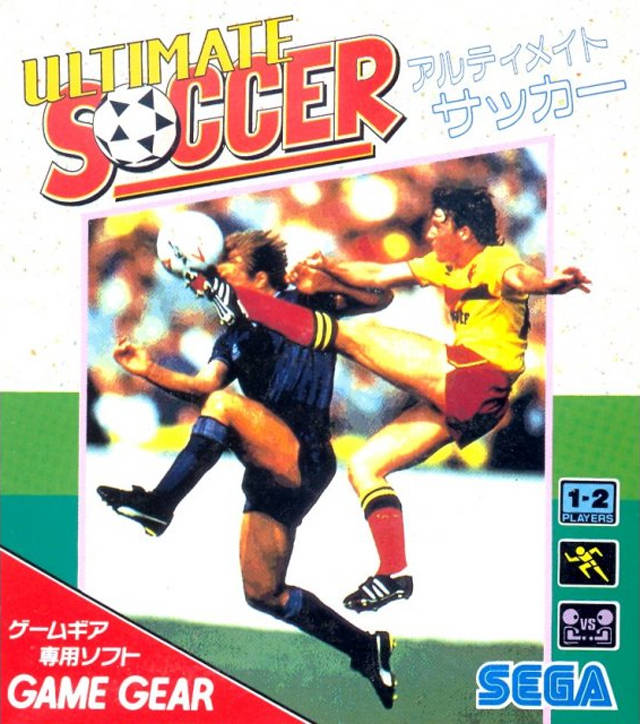
Ultimate Soccer, Game Gear


Here’s a cover that’s just a big picture of someone getting kicked right in the face. That’s the kind of thing that usually gets described as “brave defending,” which I’m sure will be a great comfort to this player as he attempts to cough up his own teeth.

Animal Soccer World, PS2


In which the lion from Disney’s Bedknobs and Broomsticks has fallen on hard times.

Spec Soccer, ZX Spectrum


Finally for today, here’s one last amateur ZX Spectrum cover because I do love ‘em. The shadowy shape reaching for the ball implies that this team has put a sea lion in goal, a bold strategy that seems unlikely to pay off unless the opposition team consists of eleven sardines. It reminds me of the things I doodled in my school exercise books, and as much I’m not one to eulogise about the good old days, there’s definitely something rather heartwarming about that.

13/07/2016

INTERNATIONAL SUPERSTAR SOCCER PRO (PS1)

With my usual impeccable sense of timing, here’s an article about a football game that I’m posting just after Euro 2016 has finished. In my defence, I’ll claim that it’s an attempt to tide those of us who love football over until the new season starts. I mean, what else are you going to watch, sports-wise? The Olympics? No chance. That’s when they gather all the sports no-one cares about into one place in an effort to get people to give a shit about javelin-throwing or walking as fast as possible. Okay, so I might watch the boxing and maybe, yes, the football, but really I’m just waiting for the new season. To help me through this dry patch, I’ve turned to a PS1 classic – Konami’s 1997 beautiful-game-em-up International Superstar Soccer Pro!

That’s “International” because it features national teams rather than clubs, as depicted by the mighty footballing nations of Brazil and Italy tussling it out on the title screen. Brazil were world champions at the time, having beaten Italy on penalties in the 1994 World Cup final, so it makes sense that they’d be the first two teams you see.
ISS Pro is part of the long and somewhat confusing legacy of Konami’s many, many football titles, so here’s a quick attempt at a history lesson. Konami had made football games before, notably Konami Hyper Soccer on the NES, but they really got going in 1994 when they released Jikkyou World Soccer: Perfect Eleven for the SNES, better known overseas as the original International Superstar Soccer. ISS, and especially it’s 1995 update ISS Deluxe, were the best the SNES had to offer in terms of football, with a perfect balance of fast-paced, arcade-y action and more realistic touches. The ISS series continued on the next generation of consoles with games like ISS 64, all the way up to ISS 3 on the PS2. However, in 1996 the series spun off into Goal Storm for the PS1, the first to feature fully 3D polygonal models. This side-series continued with today’s game ISS Pro, before ending on the PS1 in 2001 with ISS Pro Evolution 2. Still with me? Okay. From here, Konami embarked on one of their most successful franchises – and the only “real” videogames Konami still makes – in the Pro Evolution Soccer series, which is still going to this day. I was going to stay still going strong today, but that’s not really true, and Konami’s football games have now been thoroughly eclipsed by the glitz and glamour of EA’s FIFA series. For a long time the two franchises were neck-and-neck in the race to win the hearts of digital football fans, with FIFA having the appeal of being fully licensed and accurate and Pro Evo generally offering slightly more fun gameplay and, most importantly, the ability to create players with giant pumpkins for heads. Even I have jumped ship to FIFA these days, but for many years I was a big cheerleader for the Pro Evo series, and I have spent a lot of time playing them.


That brings me back around to International Superstar Soccer Pro, and the reason I decided to write about it: the chance to wallow in a pit of unadulterated nostalgia like a self-indulgent hippo. ISS Pro was the football game when I was a kid. I have played thousands of matches in this game. In 1997 I probably spent more time with its polygonal superstars than I did with my own family, and I can’t wait to get back into it.
When compared to modern football sims, ISS Pro’s menu reveals that it’s rather lacking in options. You can play a one-off “friendly” match – quotes included because I played against my brother a lot and those friendly matches were anything but – or a penalty shootout, but no management options, no player editing and not even ISS’s trademark Scenario mode, where you’re given tasks such as “it’s the last ten seconds of the match, score from this corner” and challenged to clear them all. The two main game modes are the International Cup, which is a bootleg World Cup because you have to pay to use the World Cup name, and the International League. For this article, I’ll be running through a cup on the “normal” difficulty setting, because getting through a whole league would take  a week or so. I wouldn’t be surprised if I ended up doing a league next time I’ve got a spare week. Maybe I’ll update this article if I do.


Now it’s time to choose which team I’ll be playing as from the 32 countries on offer, from titans of the international game such as Germany and Argentina to relative minnows like Morocco and Scotland. Normally I’d play as England in an attempt to burn off any unwanted feelings of patriotic pride that have built up in my psyche, but after the embarrassment that was England at Euro 2016 I don’t think that’ll be necessary. Instead, I’ll be playing as Denmark. Once again nostalgia comes into play, because I often played as Denmark when I was a kid. Not for any great love of the Danes or admiration for their bacon, but because their kit – red shirts with white sleeves and white shorts – is the closest in appearance to that of my beloved Rotherham United. In later games I’d change the player names to match up with the then-current Rotherham squad. That’s sadly not an option here, but it was always nice to see players of the calibre of Trevor Berry and Leo Fortune-West banging goals in against the likes of Germany. So, the Danish, then. A middling team with no real superstars to call on. Let’s hope for an easy draw in the cup.


Hey, that’s not so bad! France could prove to be a real test, but 1997 was long before Belgium had emerged as a football power and Wales, well, Wales were abysmal. In real life both Belgium and Wales failed to qualify for Euro ‘96, the then-most recent major tournament. In fact, Wales finished rock-bottom of their qualifying group, a group that included such indomitable opponents as Albania and Moldova. I’m not particularly worried about the Wales match, is what I’m saying.


Oh good, my first match is against Wales. That should give me a chance to get back into the swing of things. A nice, easy three points to start the group stage should calm the Danish nerves.


Here are the teams, and there are a few things to discuss. The first is that these are not real players. The ISS and Pro Evo games are often lacking official licenses for things like player names and competitions, so you’re provided with sixteen completely-made up players with names that are roughly appropriate for their country of origin. This is different to some of the later ISS games, where they used players that were clearly meant to be existing footballers but attempted to obfuscate their origins via the often hilarious means of giving them slightly altered names. Thus, Ronaldo became Ronarid and Zinedine Zidane was rechristened Ziderm, which was apparently enough to keep the lawyers at bay.
The other things is the parade of emoticons in various states of excitement. It might give the team sheet the appearance of an overexcited Tweet, but these faces represent each player’s condition, and the better their condition the better they’ll play. For example, most of my team has the yellow face that comes with a middling emotional state,  but the striker Laudrup looks like his wife’s just run away with another man and they ran over a puppy on their way out. Normally this means I’d replace him, but all my back-up strikers were miserable too, so Laudrup will just have to fight through his grief. On the other hand, I found a young lad called Pingel on the bench and he’s definitely up for it, so into the first team he goes. Don’t make me regret giving you a chance, Pingel.


Here we go, then, two teams ready to give their all. Wales will be playing in their “it looks like a dinosaur tried to claw through your chest” away kit to avoid a clash. I should point out that the graphical errors, especially the black dots, are an emulation issue. They mostly appear on red-coloured objects, so it’s a good job I chose Denmark.


The game is underway, and the two teams of blocky, polygonal men try to do the same thing they always do: score more goals than the opposition. For once it’s nice to play a game for VGJunk where I already know all the controls, because they’re the same as they always are in the Pro Evo series (and he first thing I do in any FIFA game is change the controls to match the Pro Evo system.) The most important are X for passing to the nearest team-mate you’re facing, square to shoot – the longer you hold the button, the more powerful your shot – and R1 for sprinting. Defending is a matter of getting in the way, and when you’re close you can press X for a standing tackle or circle for a sliding tackle. I like to think of circle as The Foul Button, and it’s very easy to trip a player so that they go rolling away in a comically exaggerated manner. I’m not saying that’s a particularly good strategy, but seeing your opponent hurtling across the ground like a nitrous-injected armadillo does soften the blow of any incoming yellow cards.


The action is smooth, and unlike many football games of the preceding era flowing, passing football is not only possible but highly recommended. It’s not the fastest game of soccer out there, mind you: the most notable factor that slows things down, and is probably the core gameplay’s biggest flaw, is that players can’t perform one-touch passes. You can shoot first time, but players have to take at least one touch before they can pass the ball on and that does make build-up play and counter-attacks noticeably more restrained.
Still, things are going well. Denmark are enjoying much of the possession, and I’m passing the ball around well in a congested midfield.


Bugger. That wasn’t in the script. Wales have dug deep and somehow come up with a goal, a goal that definitely didn’t come about because I was messing around and tried a back-heel pass on the edge of my own area, allowing Wales’ lurking striker Jenkins to steal the ball and slot it home.


Not to worry, I went straight up the other end and scored when a player broke free and unleashed a drive that the keeper could only parry into his own goal, as you can see in this replay. ISS Pro might not let you view a replay whenever you like, but you get one after each goal and the 3D graphics mean you can rotate and manipulate the camera to see the goal from whatever angle you like. It’s a nice touch, and when you concede it allows you to identify which of your defenders were slacking off. Not that I’ve got anyone to replace them with, my subs are all so miserable that you’d think our manager made then watch The Road instead of giving them a team talk.


The goals are flowing now, and Denmark take the lead. A high ball into the box, a mighty leap from the untested youngster Pingel and a header so ferocious it caused the commentator to shout “that boy must have a steel skull!” Straight into the old onion bag, and it’s two-one to Denmark.
ISS Pro is definitely a goal-heavy game, as you will see over the course of this article. The main reason for this is the relatively small size of the pitch, which means it never takes long to get to the opponent’s goal once you’ve gained possession. Strikers are all fairly good at their jobs, at least from close range, and while the AI of the goalkeepers certainly isn’t terrible they do struggle in one-on-one situations.


The match continued to be a real ding-dong affair, with Wales retaking the lead before another equaliser from Denmark and then, right at the death, a scrappy, toe-poked goal that just about gave me a 4-3 win. A real match for the neutral, then, and after only one game I’m remembering why I loved ISS Pro so much: accurate controls, over-the-top animations, an even closer resemblance to real football than in any of its forebears and goals galore.


Pingel has replayed my faith in him in spades. Spades of goals. Great honking shovelfuls of them. Now I’ve just got to hope he stays happy all tournament, because the players’ mood changes between each match.


France are up next, and this shot of Petersen and his luxurious, cubic mane of hair give me a chance to talk about one really good thing and one bad thing about ISS Pro. The good thing is the inclusion of a dedicated through-ball button – that is, a pass that goes into space for a team-mate to run on to rather than a pass that goes directly to feet. An integral part of real football, the through ball was never really captured adequately until this generation of football games, and ISS Pro was one of the first – if not the first – to map the through ball onto a single button and have it work fairly well. It’s a delicate balancing act, because it’d be easy to make the through ball far too powerful a tool by having the player you’re passing too always know exactly where the ball’s going. ISS Pro reigns this in by making defenders good at cutting out wayward through balls, but it’s still an extremely useful tool when the situation is right for it.
On to the bad, and you see how Pingel is standing next to Petersen, staring at his team mate with ill-concealed lust? Yeah, that’s all he’ll do, despite there being space ahead of him. ISS Pro’s player positioning is very rigid, and your CPU-controlled team-mates will often simple refuse to make any kind of move. If you’re the forward and you’ve got the ball, midfielders won’t make runs ahead of you to provide you with a passing option, forcing you to play it backwards and hope they move into a better position. It’s not a game-breaking problem but it can be frustrating, especially when you can see a great opportunity if only someone would make the effort to shift themselves.


After struggling against Wales, France proved to be much more amenable to letting me tackle them, and in the end I ran out a four-nil winner. I think what’s happening is that all that time spent playing ISS Pro is coming back to me, because France surely can’t be worse than Wales. It didn’t help the French cause that their centre-back scythed Pingel down in the area. Pingel got up and put the resulting penalty away. The kid’s got ice in his veins.


My final group stage game was against Belgium, and a scrappy first half meant I went in at the break with a slender one-goal lead. Then I started the second half by lumping the ball into the Belgian area using R2, a button marked as “centering” which you can use to cross balls into the box or, when you’re elsewhere on the pitch, to smash it up field in the preferred manner of League Two defenders up and down the country. The result of this aerial bombardment was that eventually one of the Belgian players was so overcome with ennui that he turned the ball into his own goal in an attempt to feel something. It didn’t make him any happier. I didn't do much for his identical twin brother’s mood, either.


Having topped their group with three wins out of three – Pingel scoring more goals than England managed in the whole of Euro 2016 along the way – Denmark are into the knockout stages of the tournament and a round-of-16 clash against near neighbours Sweden in a battle for Scandinavian bragging rights.


Another disappointing thing about ISS Pro, albeit a very minor one, is that the “away” team always plays in their change kit even if there’s no clash. It just doesn’t seem right to be playing Sweden and Brazil (spoilers: I beat Sweden and then play Brazil) when they’re wearing blue and not their trademark yellow.


 I made the mistake of underestimating Sweden and overestimating how good my players were at slide tackles, and while the referee seemed to have forgotten to bring his cards and was too embarrassed to admit it – although frankly some of the tackles were so heinous they should have the police looking at them rather than a match official – I was punished when Sweden banged in this free kick. I blame the goalkeeper. What kind of positioning is that?! You’re never going to save anything if you’re in a different bloody postcode. It also didn’t help that only 33% of the wall bothered to jump.


I pulled it around in the end, of course, and a ten-goal thriller ended six-four to the Danes. Pingel wrapped things up with another penalty. Kick it low into the bottom-right corner, that’s how I take all my penalties in football games. It always works, except on FIFA when my tendency to play as shit teams means my penalty takers are usually players with the grace and composure of a nervous chihuahua at a fireworks display. If only I could sign Pingel for my current FIFA efforts to get AFC Wimbledon into the Champions League.


My quarter-final opponents were Brazil: then World Champions, home of some of the greatest talents ever to play the game, the most successful team in World Cup history. This could be a real test for the plucky young Danes.


Never mind, they can’t stand up to Denmark’s bruising, physical style of play. Literally can’t stand up, in this poor sod’s case. He appears to be paralysed from the hair down. The referee has yet to issue Denmark with a single yellow card. Ugly rumours of pay-offs and match fixing begin to circulate and the referee’s parentage is called into question by the fans. The match ends 5-1 and Brazil head home, disappointed but relieved that at least they weren’t beaten 7-1 this time. That’s progress, that is.


Notice that the Brazilians have two people marking Pingel so closely that they could read the label on his underpants if they wanted to. Not that it did them any good, mind you.


His name is Pingel, and he’ll make you tingle. A new icon of world football is born. Going by his current international goalscoring rate, Pingel would be worth about £700 million on today’s transfer market.


It’s Denmark versus Italy for a place in the final. Pingel has a sad condition face. Not the “trapped alone in a black void of nothingness” grey face but the slightly more cheery “oh, I dunno, just a case of the Mondays I guess” blue face. Not that it matters: he could have replaced each of his limbs with a single strand of cooked spaghetti and he’d still be the first name on the team sheet.


I finally managed to receive a booking. I’m glad, I was beginning to suspect either the game was broken or it takes place in a lawless post-apocalyptic future where the only rule is to survive. Given the amount of cynical, hacking challenges that were going unpunished, I began to agree with the commentator every time he said “what a prime example of poor officials.”
Ah yes, ISS Pro has a commentator. While this is a very good game for its time and one that I’m tremendously fond of and am still having fun playing now, I’m only half-joking when I say the commentator is my favourite thing about the game. He is ridiculously over the top, his mood takes huge swings from second to second and occasionally he lapses into complete nonsense. Here, I put together a little video of some of his highlight.


I can’t adequately express just how much I love this commentary. It’s so incredibly dumb, yet utterly unforgettable, the football equivalent of NBA Jam’s famous announcer. Between me and my friend / football game co-op partner, some of his lines have entered that in-jokey lexicon that friends have, particularly his cries of “keeper fumbles” and “goal, goal, SUPER GOAL!” but I think my favourite will always be “SCORCHIO!” Presumably that’s a reference to this sketch from The Fast Show, of all things. Then there’s his varied reading of each country’s name, each one dripping with a different emotion but all of them completely detached from the surrounding sentence. He says “France” like a man struggling to stay awake but his pronunciation of “Mexico” is dense with condescension and “Uruguay” fills him with a sort of rueful amusement. Best of all, as mentioned here, “Nigeria” is said by a completely different person. Incredible.


As the scoreline reaches seven-nil, I’m beginning to regret not playing ISS Pro on the higher difficulty setting. I’m making it look easier than it really is, thanks to squandering several years of my childhood mastering its intricacies, but it’s still not a very difficult game. One thing I’ve noticed is that it’s very easy to waste time, so if you get the lead and decide to simply keep possession and knock it around amongst your defenders there’s very little the CPU team can do about it.


With Italy brushed aside as easily as one might sweep the laundry from the exercise bike you swore you were going to use every day, Denmark have reached the final. Their opponents: Germany. Of course it’s Germany. I’m going to make damn sure this one doesn’t go to penalties, I’ll tell you that much. Fortunately, the Danish team are all in good spirits, so I’ll be playing an attacking 3-4-3 formation with Pingel at the point of the attack. He’s a goal machine, nothing can stop him, although if I’m going to be completely honest whichever player I’d played as the main striker would have ended up scoring all the goals.


An early goal from the oft-overlooked Rasmusse settles the nerves, sending a delightful chipped shot over the German keeper and into the far side of the net. I say Rasmusse is overlooked because he can’t compete with Pingel, but I’m also biased against him because his name reminds me of this song, which was completely inescapable for a while and in turn reminds me of drinking dangerously cheap vodka.


As they always do, the Germans put up some staunch resistance… for a while, at least, but it was all clicking for me and I was having a lot of fun. It’s fair to say that ISS Pro is a very transitional game, a mid-way point between the less involved, sprite-based games of the 8 and 16-bit generations and today’s accurate-as-you-like soccer sims, and it has its flaws, but those flaws do not stop it being very good fun. Once you’re locked into the game's mindset, and you’ve learned what you can and can’t do within the confines of the game engine, it becomes a fast-past, high-action football game that was a step ahead of anything else at the time and… well, I keep just wanting to use the word “fun,” but that’s what it is. A ray of sports sunshine, narrated by a madman.


At the final whistle, Denmark had racked up a score of eight goals to three. The performance was wrapped up, appropriately enough, by Pingel smashing one into the top corner from outside the area. That puts him on about thirty goals for the tournament. If there isn’t a small army of drug testers waiting for him in the locker room, then the anti-doping bodies are not doing their jobs.


That’s it, the tournament is over and Denmark are crowned champions before their adoring fans. Only the first eleven players step up to claim the trophy. That means Pingel, who is still technically a substitute, is not involved in the trophy-lifting ceremony. Never have I seen anything so shockingly unfair in a videogame.


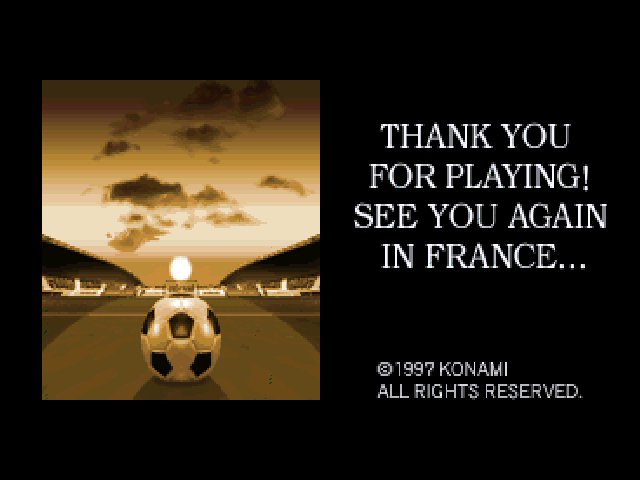
The credits roll, and ISS Pro draws to a close with the promise that they’ll see us again in France. This refers to the 1998 World Cup, which was held in France. Denmark made it to the quarter-finals of that tournament, where they were defeated by Brazil. I think we all know why they didn’t go any further. Starts with P, ends with "ingel."


Its flaws range from big ones, like players being unwilling to move when you’re on the attack and most teams being very similar in terms of ability, to smaller things like not being able to change the length of matches outside the friendly mode, but International Superstar Soccer Pro was a great game in 1997 and is still an enjoyable kickabout even today. FIFA may have grown ever more realistic and all-encompassing, but sometimes it’s nice to take a break from that relentless need to be perfect, to escape from FIFA’s utterly po-faced seriousness, and enjoy some (relatively) simple footballing action. That’s something ISS Pro delivers by the bucket-load, and while it’s not something that I’d recommend to a total non-football fan (and if that’s you, then thanks for making your way through this article) but for quick, no-fuss action, especially against or even in cooperation with a friend, it’s difficult to think of a retro football game I’d rather play. ISS 64, maybe. Oh, or the GameCube version of ISS 2. It’s a good series, that’s what I’m getting at here. Now I’ve just got to get the commentator shouting “Scorchio!” set as my phone’s ringtone.

VGJUNK Archive

Search This Blog

Followers