Showing posts with label fighters of the world. Show all posts

13/02/2018

FIGHTERS OF THE WORLD: BRITAIN

Sure, why not; let’s have another "Fighters of the World" article, where I take a look at a selection of fighting game characters that all hail from the same country and try to discern which crude stereotypes crop up most frequently. This time, I’ll be covering my own noble nation – the green and pleasant land of Great Britain!


Or maybe it's “England” - "England" in quotation marks because, as demonstrated by the above screenshot from the original Street Fighter, many games use the flag of the United Kingdom to denote England. England has its own flag, thank you very much, although it really only gets a lot of public display when the England football team are involved in a major tournament and it has thus (to me, anyway) become a symbol of disappointment and feeble capitulation. A lot of these fighters are described as being from England but appear under the British flag, so if you want to pretend some of these characters are Scottish or Welsh then go right ahead.

Cammy, Street Fighter


Any given nation’s most famous fighter usually appears in Capcom’s Street Fighter series, and Britain is no exception with Cammy. When she first appeared in Super Street Fighter II, she was a special agent working for the British intelligence agency MI6: later games revealed her to be a clone of the evil M. Bison, who brainwashed Cammy into working as an assassin. Now, far be it from me to criticise MI6’s hiring policies, but giving an espionage job to someone who was once under the mental control of the world’s most evil person seems like carries a certain amount of risk. I guess Cammy’s expertise in kicking people to death outweighed the risk that her “mindless slave under the thrall of the deadliest terrorist ever” persona would re-emerge.
As for being British, I suppose the main trait that Cammy shares with most British fighting game characters is that she’s blonde. Lots of British fighting game characters are blonde, although not as frequently as French fighting game characters. I don’t think that’s necessarily a “British” thing, though, it’s just that most of the characters on this list were designed by Japanese artists and they tend to give blonde hair to most non-Asian characters. Cammy also has one of the two main British videogame accents – the “posh” one, rather than the Dick van Dyke-inspired semi-Cockney one. That’s another of the countless reasons that I love Bloodborne so much: it’s one of the few games to feature a knife-wielding plague doctor with a Yorkshire accent.
Cammy doesn’t have much about her that marks her out as being from the UK, then, but I suppose that’s because she isn’t really from the UK, she’s from whatever country M. Bison’s cloning lab was based in. Maybe Capcom’ll release a game set after Street Fighter Alpha where Cammy undergoes a  My Fair Lady-type procedure to gain her accent. I’d play that.

Birdie, Street Fighter


Cammy wasn’t the first English character in the Street Fighter series, though. That honour goes to the hulking bruiser Birdie. I suppose it also applies to moustachioed stick-carrier Eagle, because both characters debuted in the first Street Fighter game. Birdie’s the more interesting of the two, though, with his mohawk and his leather-punk look. But you might be thinking “I’ve played other Street Fighter games where Birdie looks, erm, different,” and you’re not wrong.


Birdie received a makeover in the Street Fighter Alpha games. The most noticeable change is that he’s black now. I say “now,” Birdie was always black. We know this because one of his Street Fighter Alpha 3 win quotes reveals that he looked pale in the original game because he was ill. I have to commend Capcom’s front in saying “oh yeah, this is totally the same guy,” because why the hell not?
Other than the obvious, the biggest change to Birdie’s later designs is that he’s now even more cartoonishly “punk,” swinging metal chains around and advancing mohawk technology to never-before-seen heights by creating a hairdo with a hole right through the middle of it. I must admit, as a kid I spent more time than I probably should have trying to figure out the mechanics of Birdie’s hair. I came to the conclusion that it should be possible in the real world, and seeing Donald Trump’s hair has convinced me that there are people out there who can work such structural miracles. Of course, Birdie exists in the Street Fighter universe, so he can just get a can of whatever hairspray Guile uses and eliminate all the hard work.
Birdie got yet another revamp for Street Fighter V: he’s still a punk with a mohawk, but he’s become a comedy character who eats all the time and is now overweight. I like it. Street Fighter characters have generally had almost no development even after thirty years, so for Birdie to have had three separate “phases” honestly makes him a bit more interesting to me than some of the classic cast.

Dudley, Street Fighter


Finally for Street Fighter characters we’ve got Dudley, the gentleman boxer. So much of a gentleman and so good a boxer that he was knighted by Queen, even. I’m sure he threw some charity work in there too, that’ll always help to get you on the Honours list. Dudley is the kind of British character I was expecting to see a lot more of on this list: the aristocrat, the toff, the upper-crust type who has a butler and everything. Maybe it’s just a British thing to be obsessed with the class divide, but I’m surprised there weren’t more fighters like this, partly because you often hear that one thing other countries like about Britain is that we’re still clinging to something as “charmingly” outdated as a monarchy.
Of course, there’s a good chance Dudley takes some inspiration from real-life British boxer Chris Eubank, a man who used to get lumbered with the word “eccentric” more than probably anyone else in the British public eye. Eubank liked to dress in an exaggerated “aristocratic” manner, complete with monocle, so I wouldn’t be surprised if Dudley was indeed inspired by Eubank… but given Dudley’s moustache, his striped trousers and alternate Street Fighter IV costume and a couple of his poses, I think there’s also a fair amount of Freddie Mercury in Dudley’s design.

Narcis Prince, Super Punch-Out!!


Moving on to Nintendo’s puzzle-game-adjacent boxing series Punch-Out, a franchise where the character roster is almost entirely composed to crude national stereotypes. He’s where you’d think you’d find a boiled-down idea of how certain Japanese games developers imagine British people, but Narcis doesn’t really fit into any particular category. He’s blonde, of course, but other than that his gimmick is that he’s a pretty boy who hates being punched in his face. Turns out Narcis and I have more in common than I thought we would.
Looking at him, and remembering playing Super Punch-Out as a kid, I’d always assumed that Narcis was supposed to be another upper-class posho type, but that’s only because I never managed to complete the game back then. I couldn’t beat Hoy Quarlow, the cheating old bastard. If I had made it to the ending…


...I would have realised that Narcis is, in fact, common as muck. I’m surprised he’s not saying “cor blimey, guv, you’ve punched me right in me boat race and no mistake!” He’s Danny Dyer with a floppy haircut, that’s what he is.

Steve Fox, Tekken


Here’s another blonde boxer – it’s Steve from Tekken! This makes three boxers in a row (although Narcis Prince doesn’t really count because Punch-Out is a boxing game) and I wouldn’t have been surprised if boxing had emerged as a stronger theme amongst these British fighters. The Queensberry Rules did originate in Britain, after all, and for such a small country we’ve had a lot of successful boxers.
Like so many videogame boxers, Steve was a world champion who had to step out of the ring for one reason or another and enter the violent world of street fighting. Usually it’s for a reason beyond their control, because why else would you give up boxing for street fighting? The sweet science may be a brutal game, but at least there’s a referee there to protect you and you’re unlikely to have your head slammed into the cold asphalt of a dingy back alley by a giant Russian wearing tight briefs. In Steve’s case, he refused to throw a fight for the mafia and now they’re out to kill him. Being away from boxing gives Steve more time to explore the mysteries of his uncertain parentage, eventually discovering that his mother, fellow Tekken fighter Nina Williams, had her eggs harvested while she was in cryogenic suspension. As a result, Steve is about the same age as his own dear mum, so they can batter each other into unconsciousness without anyone raising an eyebrow. Fighting games, eh? What wonderful worlds they weave.

Ivy, Soul Calibur


Ivy’s English, huh? I don’t think I ever knew that. Then again, it took me a long time to realise that the initials of Ivy’s full name, Isabella Valentine, are IV and that’s presumably where "Ivy" comes from.
What can I say about Ivy’s design? I mean, what can I say about Ivy’s design that allows VGJunk to remain relatively family-friendly? Not much, that’s what. And the design pictured above (from Soul Calibur II) is one of Ivy’s more restrained looks, if you can believe it. Whichever designer at Namco keeps saying “no, make her sexier. Sexier!” with each passing game needs to settle down a little, maybe take a cold shower or fifty.
It’s probably pointless to look for any common themes of “Britishness” in Ivy’s design. “Busty 16th century dominatrix with a pirate ghost for a dad” is, if nothing else, a very unique concept. Not particularly British, mind you. Maybe if she spent the entire time she was fighting complaining about the weather, that’d make her feel more English. Mind you, in that outfit you’d probably complain about the weather wherever you’re from.

Arthur, Soul Calibur


Another British Soul Calibur fighter is Arthur. If you’re not a big follower of the franchise you might well be thinking “who the hell is Arthur? When I think of Soul Calibur characters, I think of possessed suits of armour, scuttling, knife-fisted gimps and Darth Vader.” That’s a fair reaction, because Arthur isn't really a “proper” character, although he is quite interesting. You see, one of the stars of the SC franchise is Mitsurugi, a very Japanese samurai. Namco wanted to release Soul Calibur in South Korea. This was a problem, because Korea had (and still does, to an extent) strict laws that banned the importation of culturally Japanese entertainment. Soul Calibur was released at a time when these laws were beginning to be rolled back, but either because they didn’t want to take the risk or because they were specifically told that Mitsurugi wouldn’t fly, Namco changed Mitsurugi from a Japanese samurai to a British, erm, samurai. Yeah, Arthur is just Mitsurugi with blonde hair and an eyepatch but hey – the reasons for his creation are interesting, and apparently his bio reveals he’s from Southampton, making him one of a very small number of British fighters who aren’t Cockney geezers born within earshot of Bow Bells.

Billy Kane, Fatal Fury / King of Fighters


The most famous British character from SNK’s fighting franchises is Billy Kane, right-hand-man to the villainous Geese Howard and you guessed it, he’s blonde. He’s also another “punk” character, what with his leather jacket that must chafe his unprotected nipples something fierce and his general nasty attitude. Billy’s a master of fighting with a staff, because his surname is Kane* and that’s what happens when you share a name with a kind of weapon. Perhaps he lays awake at night, cursing the misfortune of not being born to Mr. and Mrs. Uzi. Terry Bogard might have the Buster Wolf, but six hundred rounds of hot lead a minute might make him think twice about using it.
Personally I don’t think Billy seems especially British, but given Billy’s backstory (a British orphan raised in the USA) it makes sense that he’d lean more towards an American feel, which is what I get from him. That bandana looks far more like the Stars and Stripes – well, the stripes anyway – than the Union Jack, and there’s also Billy’s complete and utter hatred of smoking, to the point of battering anyone he catches having a crafty cig. That strikes me as a much more American reaction. In Britain, we’d just tut at then, maybe thrown in the occasional exaggerated cough.
*The Japanese spelling of Billy’s name implies his surname is pronounced “Kon” but that’s not enough to stop nominative determinism.

Axl Low, Guilty Gear


Guilty Gear’s Axl continues the rapidly-becoming-a-theme punk look, although that’s perhaps to be expected from Guilty Gear – a series where many of the characters take their names from rock and metal music, from Slayer to Freddie Mercury. Axl is obviously based on Guns N’ Roses singer Axl Rose, complete with his trademark bandana and, in later iterations, denim shorts. I must say, I didn’t expect to see so many bandanas when I was putting this article together. Top hats, maybe, or bearskins, but not bandanas. At least you’d have a chance of picking Axl out as a British character, what with his Union Jack shirt, although in the game’s story he’s a time-traveller, pulled into the future from the ancient time known as “the late Nineties”. This does nothing to explain the two enormous zippers hanging from his chest. Axl’s from the turn of the millennium, I could understand it if he had a wallet chain or ridiculously oversized jeans that made a sound like a ship unfurling its sails whenever you got up to take a leak, but those zippers? They just look like they’d be a liability in a fight. Maybe that’s why Axl fights using a long-range sickle-and-chain weapon, it keeps people away from his vulnerable nipple-handles.

Bridget, Guilty Gear


Bridget’s another Guilty Gear character, and one you probably already know something about: Bridget is actually a boy dressed as a girl. The reason for this is that Bridget was born as a twin in an English village where twins of the same sex were seen as a grave omen of misfortune, so one of the kids was sacrificed. Bridget’s parents understandably decided this was a load of horseshit, so they raised Bridget as a girl to protect him from the chopping block. Two points of interest are raised here: the first is that England has become a pretty strange place in Guilty Gear’s future timeline if murderous twin superstitions are making a comeback in remote villages. Secondly, I can’t imagine Bridget’s parents were the first to come up with this cunning ruse, so there must have been some very interesting wedding nights in the village.
With Guilty Gear’s character designs being so out-there, I don’t think there’s much British influence you can take from Bridget’s design. He’s blonde, so there’s that, and maybe the huge handcuff around his waist is a tribute to the pioneering police reforms of Sir Robert Peel.

Jack, World Heroes


I covered Jack a while ago in the article about Jack the Ripper, because Jack is Jack the Ripper as seen through the bonkers lens of the Japanese fighting game. Jack the Ripper had a knife and possible medical training? Well, our Jack is going to have four knives on each hand and we’ll replace his surgical knowledge with a bitchin’ mohawk. Oh, hey, I guess this Jack is another punk. I’m happy enough to have Britain associated with punk music. What’s the alternative, a slew of combat-ready Morris dancers?  Hang on, what am I saying, that’d be amazing. You could make a whole game out of warring Morris dancers: the fast, nimble handkerchief users, the mid-range stick-wielders, the slower but more powerful sword dancers of Yorkshire. But, erm, skip the troupes that wear blackface, yeah?

Jack, Power Stone


Again, Jack from Power Stone is also (even more loosely) based on Jack the Ripper and was covered a while back. However, I’ve learned a few things about Jack since then. He hails from “Manches,” which is presumably the Power Stone equivalent of Manchester and thus from now on I will imagine Jack shouting “all right, our kid?” as he hunts down his victims. Also, he’s fifteen years old. A teenager from Manchester who carries out robberies at knifepoint? I think Jack might have been invented by a Daily Mail journalist.

Lola, Dangerous Streets


We’re getting into really obscure territory with Dangerous Streets, a truly abysmal Amiga fighter that seemingly only exists to give Rise of the Robots some competition as the worst fighting game of the 16-bit era. The British contender in Dangerous Streets is Lola. Lola is supposedly a “top model,” so let’s go ahead and say that her outfit is down to the extravagances of haute couture rather than straight-up kink. And you though Ivy was going to have the most revealing costume on this list. Perhaps it’s not surprising that there are a couple of rather dominatrix-y characters here, though. I don’t know to what extent this is still true, but it certainly used to be the case that Britain had a reputation as the land of the masochist, especially where spanking is concerned. One can only imagine a game developer looking at the list of potential traits for a British character, their eyes darting between “punk rock” and “thoroughly enjoys a damned good thrashing.”

David, Battle Arena Toshinden


I didn’t play much Toshinden during the series’ heyday, because I was limited in what games I could get my hands on and Tekken seemed to be the clearly superior option when it came to 3D fighters. I haven’t played much Toshinden since its heyday, either. However, if I’d known one of the characters was a chap in a trenchcoat with a ridiculous chainsaw I might have given it more of a shot. This is David, he dresses like Rick Deckard, he has a gun in addition to his huge chainsaw and, oh yeah, he’s also fifteen years old. Did I miss the British coming-of-age ceremony where you’re given a deadly weapon on your fifteenth birthday or something? All I got were unlicensed X-Files companion books and socks.
David’s backstory is a dark one; he’s an orphan whose parents died in a fire, only to later discover that this was all the plan of an evil organisation. This causes David to black out and slice up a bunch of people with his chainsaw. On his fifteenth birthday, no less! He’s not the first British teenager to black out on his birthday, but David takes it a step further by getting involved in a fighting tournament. I’ve seen people suggest a chainsaw is a terrible weapon to fight with because it’s easily clogged with gore, it weighs a ton and it requires fuel, but these people overlook the psychological advantage you get with a chainsaw. To paraphrase a boxing maxim, everyone has a plan until a teenager in a flasher mac runs at them with a chainsaw.

Midknight, Eternal Champions


Another character I’ve covered before, Midknight was formerly Mitchell Middleton Knight: scientist, CIA operative and jeet kune do expert who accidentally turned himself into a vampire while developing a chemical weapon. As you do. Midknight then dedicated his life to finding a cure and also to not eating people, although obviously he took the time to workshop a few bad-ass vampire names because no-one’s going to take an undead martial arts master seriously if they’re called Mitchell.

Matlok, Fighter’s History


Appearing in Data East’s Fighter’s History series is yet another British punk. So punk, in fact, that his fighting style is apparently listed as “punks.” I’m not entirely sure what this fighting style would entail, but I assume there’d be lots of spitting and safety pins involved. Matlok’s punk credentials are further enhanced by him being supposedly named after Sex Pistols bassist Glen Matlock. Personally, whenever I see Matlok I can only think of Grandpa Simpson shouting “Maaaaatlock!” and that does little to cultivate the aura of danger and anarchy usually associated with punk music.

Hellstinger, Voltage Fighter Gowcaizer


Finally for today (although this is by no means an exhaustive list of British fighting game characters) is Hellstinger, who appeared in Technos’ Neo Geo game Voltage Fighter Gowcaizer.  Damn, that’s a heck of a title for a fighting game. Anyway, Hellstinger – whose “real” name is the no-less incredible Kash Gyustan – was born to a famous British composer but turned his back on the stuffy world of classical music and became a heavy metal star, complete with prop devil wings and the kind of stage presence that’d make a young Mick Jagger look like Gordon Brown. And then there’s all the fighting he does, for reasons I’m not entirely clear on but hey, he gets to fight using his magical guitar so who cares what the reasons are? These British characters seem to get quite a lot of fun weapons, actually. Killer yo-yos, chainsaws, what appears to be a purple Gibson Explorer, they’re all much more interesting than swords.

When looking at all these British fighters it’s clear that the two strongest themes are blondeness and punk rock, as though Billy Idol was somehow the single most evocative aspect of British culture. The music connection makes sense to me; I’d say that when it comes to world-famous music, Britain definitely punches above its weight. Beyond that, Britain seems to have more diversity in its fighters than some nations, unlike the carnival-beastmen of Brazil or the militaristic Germans. I imagine that’s partly down to the Anglocentric nature of much media and the fact that English is a common second language around the world – or maybe it’s just that the most common stereotypes about Britain don’t translate well into fighting game characters. If I was trying to create a British fighter that encapsulated the nation I know I’d struggle, because you can’t base a combat style around self-deprecation, stiff-upper-lipism and complaining about the weather. There is one type of fighter I’m surprised I didn’t see, and that’s a football-themed character. Then again, given that the first three footballers I thought of in relation to attacking people were Zinedine Zidane, Eric Cantona and Patrice Evra, maybe that character should be French.

03/12/2014

FIGHTERS OF THE WORLD: GERMANY

Oozing up from the depths of the VGJunk archives, it's the return of the Fighters of the World series, where I take a look at some of the fighting game characters that hail from a particular country to see what common threads and lazy ethnic stereotypes bind them together. Today it's the turn of Germany, so some of these themes may be a bit... delicate. Not all of them, though, so let's get into it wth the first contender.

Von Kaiser, Punch-Out!!


Punch-Out is always a good place to start these articles, because as I've mentioned many times before the game's characters are almost all solely defined by hyper-exaggerated national clichés. Also, because it came out before Street Fighter II - a game that surely helped crystallise the notions of what kind of fighters each country produces, from Brazilian beastmen to Indian mystics - you perhaps get a look at what kind of fighters could have been offered up if it wasn't for Capcom's arcade monolith. In Von Kaiser's case, however, we're immediately presented with the strongest running theme of all in the ranks of the German fighters, and that's militarism.


It's played up much more in the Wii reboot, but Von Kaiser's always been a military man. Unusually, he's aesthetically more akin to someone from the First rather than the Second World War, as denoted by his giant moustache. Most Nazis didn't have moustaches, except, you know, that one. His dialogue from the Wii game also mentions German precision, so that's another German stereotype right off the bat. The "German efficiency" thing is a factor in some of these characters, but not as many as you might expect given that it's a quality of "German-ness" that can be evoked in a character much less controversially than the whole "war" thing. I reckon that's probably because it was assumed that cold and calculating fighting game characters weren't going to sell games, especially during the fighting game boom of over-the-top, in-your-face and occasionally legally dubious SFII clones.
Did I mention that he's called Von Kaiser, by the way? Because as German-sounding names that a German person would never have go, it's a pretty good one. I don't have confirmation that "Von" isn't actually his first name, but in my heart I believe that his first name is actually Otto or Fritz or something, just to really hammer the point home.

Hugo Andore, Street Fighter


On to the Street Fighter series itself now, by way of Final Fight, with Hugo Andore. Moving from Germany to Metro City as a young man, Hugo's entire family joined the Mad Gear gang because the family that terrorises innocents and kidnaps women together stays together. Hugo is also a professional wrestler, which should come as no surprise when you realise he's based on Andre the Giant, although that does make it a bit odd that he's German as Andre the Giant was French. I think this is the power of the stereotypes coming through: French fighters are almost always lithe, graceful types, which Hugo most definitely is not.


Hugo went on to appear in Street Fighter III, where he continued to be extremely large but with a new face that resembles a half-melted Halloween mask of his old face. He also really likes potatoes, but I don't think that's a German thing. In fact, Hugo is one of the least typically "German" (in the videogame character sense) of all the fighters included here.

Rolento, Street Fighter


Another Street Fighter character who started out in Final Fight, Rolento takes us right back into the category of military Germans even if he does look like he's dressed for a commando raid on a banana farm. Rolento is apparently only of German heritage, having been born in the USA, but that's good enough for me. Like Hugo, old grenade-nipples here graduated from the Metro City school of being pummelled by vigilantes, and a few too many mayoral piledrivers gave him the bright idea of creating a utopian nation built around being in the army. Makes sense to me, if you ask any squaddie what being in the army is like they'll tell your it's a veritable Elysian garden of delights. Rolento really likes armies, always trying to drum up recruits for what will assuredly be a paradise on Earth so long as you like cold showers, five AM wake-up calls and long walks on the beach (in full combat gear). Alright, maybe I'm being a bit harsh on Rolento's plans: he does refuse to use M. Bison's brainwashing machine in Street Fighter Alpha 3, realising that no country can be a utopia if the citizens don't possess free will. When you stack him up against the villains of the Street Fighter series, that makes Rolento seem like a goddamn saint, although the next character might disagree with that appraisal.

Doctrine Dark, Street Fighter EX


Doctrine Dark: military code-name or astonishingly cruel parents? We may never know, because Doctrine's mind has completely snapped, just in case you thought the guy in the gas mask with the mad, staring eyes was a well-balanced individual. Doctrine's condition is down to Rolento, who once upon a time was leading a rival unit of troops to Doctrine's. The two groups go into a playful scuffle which soon descended into an all-out battle to the death. In perhaps the ultimate example of "it's all fun and games until someone gets hurt," Doctrine is left with terrible injuries that force him to dress like a scuba diver for the rest of his life. He doesn't blame these injuries on Rolento so much as he does on Guile, who he thinks should have trained him better. That's a bit of a let off for Rolento, frankly.
So, another soldier, but a much more modern one - in videogames, Germans are militaristic no matter the time period, it seems. Doctrine's definitely not one for efficiency, mind you. Engaging troops that are on your side in combat rates pretty low on the efficiency-o-meter.

Victor von Gerdenheim, Darkstalkers


One minor trend amongst German fighters (and for a horror fan such as myself, a much more welcome sight) is the Frankenstein's monster. I mean, it's possible that bits of him came from soldiers but that's not his main thing. German in the sense that it's his place of manufacture rather than the country of his birth, Victor was - like the monster in the original novel - put together by a mad scientist in Germany, the classic "reanimated corpse jigsaw" look given a fresh new twist via the creative excess of Japanese arcade character design. As such he's most like Hugo on the character front: strong, not too smart and not really evil, per se. It would be pure conjecture on my part to say that some Frankensteinian visual elements seeped into Hugo's SFIII redesign, intentionally or not, but his head does look like something you'd dig out of a gravesite.


Back to Victor, and as well as having the electrical powers that Frankensteins sometimes do in videogames, he can also stretch and expand his limbs when he attacks. Keep this in mind, because it's going to come up again.

Marco, Kaiser Knuckle


Marco is the star of Taito's arcade fighter Kaiser Knuckle, or he's the star to me, anyway. He's a strangely loveable off-brand Frankenstein with a head swathed in bandages, presumably for the well-being of anyone who might otherwise get a look at his face, and shoes that have burst open to reveal his toes as though he were a cartoon hobo. There are few surprises about his fighting style, with lots of powerful strikes and grapples that use his size to his advantage, but Marco can also do this:


As well as being utterly revolting and terribly unhygienic, this move shows that, like Victor, Marco can stretch his limbs to attack. At first I thought this might have been a case of Taito going a bit too hard on the homage after playing Darkstalkers, but apparently both Kaiser Knuckle and the first Darkstalkers were released in July of 1994. That doesn't leave any time for "inspiration" to pass between the games, so we must assume that two different companies coincidentally released fighting games featuring stretchy-armed German Frankensteins in the same month. I have a theory, however - elongating limbs are not a marks of a monster but are, in fact, a deeply German trait.

Helmut, Street Combat


I assume Helmut is supposed to be German, anyway. His name is Helmut and his head is shaped like German soldier's, erm, helmet, so I think it's a fair assumption to make. Helmut wasn't always a somewhat Nazi-looking cyborg, because Street Combat is actually the Super Famicom anime tie-in game Ranma 1/2: Chunai Gekitouhen only with all the sprites edited into completely different characters that don't require a licensing fee to use. Helmut was originally a skateboard-riding beach bum / high-school principal. Did whoever reworked the sprites have a special chart that showed what the exact opposite of each character was? I'm going to assume yes, they did, because otherwise how would you get from Hawaiian-shirt-wearing party dude to robotic death machine?


Helmut also has an extendable limb attack, if you're willing to accept the generous description of a medieval mace as a "limb."

Brocken, World Heroes


Brocken looks more like a Nazi than any character on this list so far, to the point that you might feel a bit uncomfortable choosing to play as him. Even if it's usually played down, it's understandable (if not particularly appropriate) that German characters sometimes had these Nazi overtones, particularly in Japanese-developed games. The Second War War was the most important period of the last century, after all, and through a combination of geographical distance and a lack of education on the horrors perpetrated by the Axis powers (both German and Japanese) Nazism is far less taboo in Japan than it is in the West.


Brocken himself is a cyber-soldier with, you guessed it, extendable limbs, like some kind of Nazi Inspector Gadget. That's at least four German fighters who can stretch their body parts, so I'm going to have to declare that a theme, and we're zeroing in on what would be the most German fighting game character of all time - a military Frankenstein with stretchy body parts. Honestly, that sounds pretty cool to me, sans the Nazi overtones.
One final note about Brocken: according to the SNK wiki, he was created for the Third Reich by time-travelling scientist Doctor Brown, a sentence that could also describe the most appalling Back to the Future sequel imaginable.

Hans, Human Killing Machine


All of these characters so far (with the possible exception of Helmut) have been of Japanese design, but Hans here is a British take on the German stereotype, courtesy of U.S. Gold's Street Fighter "sequel" Human Killing Machine. It's a sequel to the home computer port of the original Street Fighter in the sense that U.S. Gold promoted it that way despite it having nothing to do with Street Fighter, that is. Anyway, I'm amazed it's taken us this long to see a character in lederhosen, but it's no surprise that it comes from a British designer - I think even more so than war-related stuff the British mind turns to lederhosen, sausages and getting beaten at football when it thinks of the Germans, or at least my generation does. Bonus points for giving Hans the classic "German porn moustache," too.

Siegfried, Soul Calibur


Siegfried is big, blonde - I was expecting a higher percentage of blonde characters, you know - and, for a master knight who gets possessed by a demon sword on the regular, kind of boring. He's fun to play as, at least, and he still possesses the military theme of German fighters in a much less potentially offensive manner.

Z.W.E.I., Soul Calibur


Z.W.E.I... sorry, I had to stop for a moment because typing his name out like that is so aggravating. Z.W.E.I., on the other hand, does not look like he belongs to any particular theme, unless you count "potential Final Fantasy XVI lead character" as a theme. It's patently ridiculous to describe a game filled with sentient swords, undead pirates and kung-fu fighters with Elvis hairdos as having a "jump the shark" moment, but if Soul Calibur did possess such a thing then I think Z.W.E.I. would be it. He wears tight leather trousers and fights by summoning a werewolf ghost, so "Turbogoth" would have been a much better name for him, and far less annoying to type.

Wolfgang Krauser, Fatal Fury


At first glance, Wolfgang Krauser might appear to have none of the common German features - he's not a soldier, he can't elongate his limbs - but then you realise that he's got a nice bushy moustache and I think I'm going to accept that as part of the German "canon", if you will. It's not the unequivocal porn 'tashe that Hans is sporting, but give it time and I'm sure it could get there with some tender loving care. He'll be roaming Bavaria, offering to fix the plumbing of lonely hausfraus in no time.
Unfortunately, any fond feelings I may have towards Krauser are completely eradicated once I remember that he has a special move called "Blitz Ball" and I find myself unable to dissociate him from the bitter memories of Final Fantasy X's underwater minigame of the same name. I didn't even need Wakka's ultimate weapon, I was never going to use him as one of my main party members.

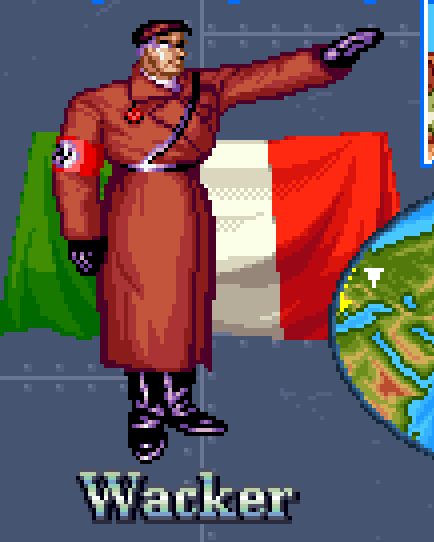
Wacker, Tough Guy


We've seen a few characters with a Nazi influence, but Taiwanese developer Panda Entertainment decided that they weren't going to pussyfoot around the issue in their DOS fighting game Tough Guy and so they included Wacker, a full-on, undeniable Nazi. For all the horrible things I've seen in videogames over the years, the overblown violence and cheap sexual titillation, a pixel sprite of a character giving a Nazi salute still has the power to shock. That's not even the half of it, either: check out Wacker's projectile attack.


Wow. I don't think I'm going too far out on a limb to say that being able to control a playable character who can throw giant energy swastikas around is somewhat beyond the pale. Wacker is an evil character and one of the game's bosses, but still, I'm definitely not comfortable with this and I think "playable Nazi" is a good place to draw this article to a close.
In summary, then: the Germans of the fighting game world are mostly soldiers and often very large. Sometimes their largeness is due to them being stitched together from the reanimated corpses of the dead. A higher percentage of them than you might think can extend their limbs, a trait which I can't think of a way to tie to their Germanness with the possible exception that some Japanese franchise, probably a manga, starred a German character with stretchy body parts who influenced videogame designers. Every German I've ever met has been a thoroughly pleasant and sensible individual, so hopefully they won't be offended by the stereotypes on display here - merely puzzled that, according to videogame designers, there are apparently no women in Germany.

25/08/2011

FIGHTERS OF THE WORLD: SPAIN

Previously on "Fighters of the World":

Hola, and welcome to another installment of Fighters of the World! This time, I'll be looking at beat-em-up characters from sunny Spain. And yes, there are some beside Vega.

Vega, Street Fighter II

And where else could I start except with Spain's most famous fighting export, Vega himself? Or Balrog, if you prefer, or even Claw. I must admit that Vega fared rather well in Capcom's overseas name-change merry-go-round, because he sure doesn't look like he should be named after some hulking demon.
With Vega, we can jump straight into the main stereotype that game developers base their Spanish characters around, and that's matadors. If your national sport involves being chased by a large, angry animal that wants to perforate you with its horns, you have to expect developers to run with it. It's like us British and tea, except tea doesn't revolve around cruelty to animals. Vega's outfit and backstory both point to a past as a matador, but it might have worked out very differently. Here's an early design for Vega:

He was almost some kind of masked Crusader with a sword. It's a good job they changed him, it probably would have been difficult to climb fences in those armoured boots. Actually, I think this early Vega looks a lot like Lancelot from Capcom's side-scrolling Arthurian beat-em-up Knights of the Round, which was released mere months before Street Fighter II.

A bit of cross-pollination in the Capcom offices, perhaps? In the end, Vega's "knight" look didn't come to pass and we ended up with a matador who is also a ninja, two jobs which I'm sure share a lot of common skills. Vega's most notable feature, apart from his claw, is his beauty and the extreme narcissism that comes with it.

That's probably true - you're not going to stay handsome if you keep losing battles, at least. Handsome Spanish gentlemen will also become a theme, and on that note I'd like to mention that there are very few female Spanish fighters. I'm not sure why, other than the lack of female matadors.

Laurence Blood, Fatal Fury

Unlike Vega's flirtation with the matador look, SNK's Laurence Blood goes all-out with the theme. He's a matador, he dresses like a matador, he fights like a matador, (as well as having moves supposedly inspired by a martial art called zipota,) and he's pretty good at flamenco guitar, too.

He's also a villain, but with a name like "Mr. Blood" you probably figured that out. Nominative determinism can really mess up a guy's life - just ask Victor von Doom.

Gerelt, Star Gladiator

Even in space, the Spanish can't escape the matador stereotype. What's he doing up there, fighting astro-bulls? Dancing the cosmo-flamenco while drinking star-sangria? As Capcom's Star Gladiator was a weapon-based beat-em-up, Geralt is given a plasma rapier. Now, this is perhaps a sign of a Zorro influence, or it could be that Japanese games developers lump continental Europe into one whole and the insidious influence of the rapier-wielding French is seeping in.

Geralt also bears something of a resemblance to another Spanish (or Egyptian, or Scottish) swordfighter: Ramirez from the Highlander series.

Don Flamenco - Punch-Out!!

As I discussed in the Russian edition of FotW, Nintendo's Punch-Out!! is less a boxing game and more a pixellated catalogue of as many ethnic clichés as possible. Don Flamenco fills the Spanish slot in this zoo of stereotypes admirably, flouncing into the ring to "Carmen" and carrying a rose. There's a bit of an overlap with the French here, and while the Gallic fighters are still the kings of the rose, there are quite a few Spanish fighter associated with it as well, especially Vega.

Look at that guy - there's no way he's only 23 years old. He looks like someone put Adam Sandler's head in a vice and crushed it. Anyway, when the latest Punch-Out!!, the Wii version, was being developed Nintendo took the opportunity to make Don Flamenco even more stereotypical by depicting him as a narcissistic bullfighter. So much for increased cultural sensitivity. He's also (unsurprisingly) a flamenco dancer, which leads me nicely onto our next fighter.

Nick, Power Moves / Power Athlete

Appearing in Kaneko's dire SNES brawler, Nick here doesn't look like a typical videogame Spaniard. If anything, he looks like a bandit from an RPG. He fights in his own unique way, not acting like a matador or throwing roses at you or anything, so it's a pat on the back for Kaneko and they way they've avoided the obvious stereotypes...

...until he wins a fight and starts playing the castanets. You just couldn't let it go, could you Kaneko?

Miguel, Tekken

Introduced in Tekken 6, Miguel wears his Spanish heritage on his flouncy sleeve. His is a standard "consumed by revenge" story, but that is not the outfit of a man consumed by revenge. Consumed by a desire to dance, perhaps, but it looks like revenge was pretty far from his mind when he was getting dressed that morning.

Joker, Savage Reign

Appearing in SNK's Savage Reign series, Joker is at last a Spanish fighter free of stereotypes, except the stereotype that all clowns are violent psychopaths. I'd say that Joker was a one-off, except...

Joker, Jang Pung 3

Jang Pung 3 is an interesting game in its own right. In 1993, a Korean company called Open released Jang Pung II, a truly dreadful pirate copy of Street Fighter II, for the various Sega consoles. Then in 1994 they performed something of a miracle with the actually rather good (by 8-bit standards) sequel, Jang Pung 3. As well as featuring a brand-new cast of characters, it also has one of videogaming's greatest plots, about Nazis building a robot dinosaur in Leipzig.

One of these new characters was Spanish, specifically from Valencia. He's called Joker, and he's a clown. What are the chances? JP3 came out a year before Savage Reign, but the odds on SNK having copied an obscure Korean Master System game seem very slim indeed. So I have to wonder, are jesters seen as a Spanish thing in the Far East? I could understand it if they were Italian, what with the commedia dell'arte and all, or even French and mime-like. In the end, I fear it comes down to that most boring of explanations - simple coincidence.

Cervantes, Soul Calibur

And finally, a goddamn pirate. Cervantes is almost like a glimpse of what stereotypical Spanish characters could have been, were it not for all that bullfighting and flamencoing, because what else does Spanish history have to offer if not piracy? The Spanish Main, pieces of eight, it's all waiting right there to be plundered. By a pirate. An undead pirate with a gun in his sword.

And that's it for this installment of "Fighters of the World". Will it return? Well, that depends if I can find another country that has more than two fighters in it. I'll be scraping the bottom of the barrel soon enough!

VGJUNK Archive

Search This Blog

Followers