Look, I’m getting to be an old man these days so after getting my arse kicked repeatedly in VR Troopers and playing Dark Souls 2 again in my free time, I’ve decided I need a bit of a break. It’s time for something simple, something gentle, something that doesn’t throw my declining reaction times and mental acuity into sharp, grim relief. So, a kid’s game, then. Considering the last time I played an edutainment game starring Mickey Mouse it turned out to be surprisingly not-terrible, I’ve decided to return once again to the House of Mouse with Novotrade’s 1991 Amiga (also available on PC) rainy-afternoon-em-up Mickey’s Jigsaw Puzzles!
With a cheery blast of “Zip-a-Dee-Doo-Dah” issuing from the speakers, Mickey himself appears to greet us. Jigsaw puzzles! With Mickey Mouse! What more do you need to know? I hope the background is not representative of the actual puzzles contained within the game. I was hoping for an easy ride, after all.
With no other preamble, it’s straight into the puzzle-building action. I suppose I’d better show you the first puzzle then, huh? Yeah, I should, but I’m building anticipation. Get a good, clear picture in your mind of Mickey Mouse’s face. You may need to refer to it later.
So you start the game and you’re immediately presented with this. My decision to play Mickey’s Jigsaw Puzzles has paid off in spades, because Mickey’s facial expression gave me the kind of genuine, chest-rattling, wipe-away-a-tear belly laugh that no piece of intentional comedy has in months. It’s just too, too perfect, and represents the closest I’ve ever come to replacing long-time VGJunk mascot Satan Goat in the site’s header. There’s much fun to be had trying to figure out exactly what could cause such an expression, but my two main candidates are that Mickey gambled on a fart and lost, or Donald Duck’s wearing that faux-innocent look because he’s just whacked Mickey square in his mouse-hole with a pipe wrench. Oh yeah, Donald and Goofy are here too, and they haven’t fared much better, art wise. Goofy’s hat now looks makes him look like he should be dealing ecstasy at Glastonbury circa 1998, and given Donald’s bulging eyes I suspect he’s been buying whatever Goofy’s selling. As for the ghost on the right, well, that thing’s just neat. I don’t know if this is the intent, but I can only see it as being swaddled like a baby. A spooky, floating baby.
Okay, fine, the actual jigsawing. You select which picture you want to puzzle out, then you can choose how many pieces the resulting jigsaw will have, from sixty-four all the way down to a mere four. It’s nice to have the option to make things easier for very young children, but as a grown man who has just about managed to stop laughing at Mickey Mouse’s face I’m sure I can handle a sixty-four piece jigsaw.
Nope, I placed Mickey’s eyes down on the puzzle and now I’m laughing again. This might take longer than I had anticipated.
As you can see, it works much as you’d expect it to. Place the piece in the appropriate segment, and if you click in the wrong place the screen will flash so you know to try again. The cursor feels a bit jerky, but other than that I suppose I can’t fault the mechanics.
Because the jigsaw takes up the whole screen, you do have to go to a separate screen to select your piece. That slows things down a little, but I suppose it’s the best compromise available. Could you imagine how much we’d be missing out on if Mickey’s face had been made smaller to accommodate the jigsaw pieces? It doesn’t bear thinking about.
The most interesting feature of MJP is that once you’ve completed a puzzle, you can press the camera button on the right to play a short animation of the displayed scene. For instance, here Mickey opens the chest and bat flies out, the ghost wobbles ominously and the Disney friends talk about how spooky it all is. And I do mean talk, because there are voice samples for the dialogue and it sounds pretty decent for the most part, although Donald’s rasping quacks were always going to be a challenge for a low bitrate sample and as a result he sounds even more like he’s gargling with broken glass than usual.
It’s a shame that this was the very first puzzle that the game shows you, because nothing else in this game is going to live up to it and we’ve already seen most of the gameplay – but I’ve played through it all now, so for the rest of the article we might as well look at all the other puzzles.
Mickey chills out on Mars while a robot servant brings him drinks – drinks that he’s too lazy to even lift his arms to hold, the robot just pops the straw right in his mouth. If I were a political cartoonist I’m sure I could turn this into a panel highlighting the Disney Corporation’s eventual desire to spread their tendrils beyond the Earth itself, but alas I lack the laser-sharp wit and clear thinking of most political cartoonists.
I know his name’s in the title and everything, but a lot of the puzzles seem to go out of their way to remind you that Mickey Mouse is the coolest dude ever and you cannot hope to ever approach even one percent of his incandescent magnitude. Mickey is the alpha and the omega, the standard against which all others are judged and found wanting. That’s why he gets to be the guitarist in the “MM Band” - and you can guess what “MM” stands for. His coolness is rather undercut by the fact he fashioned his guitar from the anchor of Barbie’s Dream Yacht, but he pulls it back with a rather snazzy shirt.
As expected, viewing the animation for this puzzle plays a brief snippet of the band. Mickey and Goofy want to rock, but Donald uses his curiously massive hands to throttle his saxophone into playing a completely unrelated jazz riff. Ever the rebel, is Donald.
Mickey’s also a sports star, naturally – here we seem him on the gridiron, showing some rare fallibility as he fumbles a pass before eventually recovering the ball and presumably scoring both a touchdown and all the mousey cheerleaders. The thing is, these scenes aren’t fully animated, so Mickey’s body stays in place while his limbs awkwardly rotate. Disney is a company that specialises in imagination, which is handy because you’ll need a lot of imagination to believe that Mickey’s actually playing American football.
Mickey’s also good at football, although scoring goals is much easier when there are no other players on the pitch. Unfortunately, no football team in the world (that I know of) wears a kit of pink shirt with a blue band, pink socks and yellow-and-green shorts – I imagine there’s some kind of rule against it to protect the opposition’s eyes – so I can’t pin Mickey down to a particular club.
Oh, and here’s where I realised there’s a different style of puzzle available to you, one where you get items rather than traditional jigsaw pieces and have to place them in the correct blanked-out areas. Obviously this does little to enliven the gameplay, but if you ever wanted to create an image where Mickey Mouse is kicking his own severed head around in from of a crowd of horrified onlookers, now’s your chance.
Mickey Mouse: Radical Skate Dude now, with a deck that’s so intensely of its time that people who are into the whole retro-80s-synthwave aesthetic could only dream of recreating a fraction of its power. Mickey’s also sporting a palm-tree-patterned shirt that I’m sure set him back about two hundred bucks at a fancy boutique.
Yet more sports with a bit of baseball, although once again the focus is on Mickey’s rampant narcissism. Notice how he wrote “I love Minnie” on the fence back there but then wrote his own name at three times the size? And a scrawled self-portrait, too. A show-off and a vandal, that’s Mickey, although thinking back to the places I used to hang out playing football when I was a kid there are a lot worse things he could have graffitied up there. It might still have involved Minnie, but not the word “love.”
Speaking of Minnie Mouse, she’s been notable by her absence so far, but all that will change now that I’m ready to insert disc two and access the second lot of puzzles. I have no shame in admitting that by this point I had resorted to setting all the puzzles to four pieces each, allowing me to complete each jigsaw in an average of eleven seconds. Hey, it means less time waiting around to see fantastic images such as…
...Minnie doing some exercises in a way that cannot be good for her spine. Mind you, she is a rodent and therefore much more skeletally flexible than any human. “Oh, I just love Gymnastics!” says Minnie in a voice so high-pitched that all my neighbours dogs started barking. Given that all she did was flap her hands around a bit, Minnie’s routine is as much gymnastics as me walking over to the kettle and ducking down to get the teabags out of the cupboard is a biathlon.
Minnie plays tennis. Not much else to this one, folks, beside that stray observation that given his proven track record of narcissism, Mickey clearly only loves Minnie because she looks exactly like him.
Back to the exercising – or “mousercising,” as Minnie calls it. The real star in this image is the radio on the shelf. At first you’re like, “how cute, a Mickey-shaped radio” but then you look more closely at those eyes – pink-rimmed, fleshy and wet with tears – and you start to wonder if that radio is entirely mechanical. It also looks more like a koala than a mouse.
Now we’re in Minnie’s boudoir, in a scene that immediately brought back surprisingly strong memories of the Dream Phone board game. By now Mickey’s constant presence should come as no surprise, but if you’re like me you’ll spend a good few minutes trying to figure out the perspective here that allows Minnie to look at the picture of Mickey even though it’s hanging on the wall behind her.
Don’t you bloody well threaten me, Mickey. I don’t care if you are dressed as a skinhead, I won’t be intimidated by a mouse even if said mouse does look like the kid from This is England.
Oh, and I see Goofy’s got his usual hat back. The big hat is just for spooky castles, I guess.
Yep, those are horses. I think. Okay, so I’m not so sure about the one on the right because it’s only got three legs and glowing demonic eyes. Protoplasmic elder beasts that have temporarily assumed a vaguely equine shape, at the very least. As they ride through the desert on a horse with no soul, look at Mickey and remember that in cowboy movies “black hat” is a term for a bad guy because they, well, wear black hats. I rest my case.
I hadn’t really noticed before, but while I’d say the graphics in MJP are mostly okay (although the Amiga could do a lot better) everything does look very rubbery, as though all the characters are encased in PVC. I mean, look at Minnie’s skirt, that’s definitely not fabric.
And finally, just as we’re getting into “Krusty Visits Relatives in Annapolis, Maryland” territory, we reach the final scene. Mickey goes for a swim. For some unknown reason I was expecting something a bit more… climactic. A group shot of all the characters, Mickey ascending to his eternal throne as the Earth’s new ruler, something like that. Instead we get tiny sharks and a weird-looking starfish. The starfish flops around listlessly, and so I feel a certain kinship with it as Mickey’s Jigsaw Puzzles limps over the finishing line.
Well, those were definitely some jigsaw puzzles. No doubt about that, and as such it’s difficult to judge the game as a whole. I suppose it partly comes down to price: if this was sold as a full-price retail game back in the day, a parent would probably feel a bit ripped off even if it did come with a real 24-piece jigsaw (or at least the PC version did). I reckon kids would enjoy it, though. It’s simple enough to be perfectly suitable for very young children, the selectable piece counts and alternate “shadow” mode give it a bit of extra longevity and the sounds and animation are pretty fun. Put it this way: if this game had featured He-Man or The Real Ghostbusters rather than Mickey Mouse, the six-year-old VGJunk would have been all over it. So, I suppose that’s a tentative thumbs up on MJP, although frankly the game could have caused my monitor to squirt skunk spray into my eyes at regular intervals and that Mickey face in the first puzzle would have made it all worthwhile.
Showing posts with label disney. Show all posts
12/06/2018
02/03/2017
MICKEY'S SAFARI IN LETTERLAND (NES)
If you’ve read any other VGJunk articles, you’ll know that I need some help with this whole “writing words” business. I’m not too proud to admit it, and I’m willing to seek out the help I need so long as I can get it from a cartoon mouse in a pith helmet. Thankfully, in 1993 Beam Software released a NES game called Mickey’s Safari in Letterland!
The titular Mickey is, of course, helium-voiced Disney mascot Mickey Mouse – everyone’s favourite animated rodent, unless you’re British in which case we’ve got Dangermouse, thank you very much. Yes, I’m still unable to see the appeal of Mickey Mouse, and I’ve still yet to meet a child that likes Mickey Mouse. What are you, Mickey? What is the point of you? I suppose his selling point is that he can slip easily into any number of different roles, like on this title screen where he looks more than ready to venture to foreign climes and oppress the natives for King and country. But, you know, in a family-friendly way. There’ll be lessons about appreciating the differences of other cultures and such.
Three difficulty levels are presented to you when you hit start. “Super Advanced” is rather overselling things. So is “Advanced.” Even “Normal” isn’t exactly what you’d expect. All the difficulty levels are very, very easy, because (as the title might have clued you in) Mickey’s Safari in Letterland is an educational game aimed at very young children. What joy! Delight unbounded! You can learn and have fun at the same time, education and entertainment fused into one. Edutainment, if you will. Combined with the star power of Mickey Mouse, this is sure to be a real winner.
Here’s a map. I was going to say it’s a world map, but it’s not a map of our world. Not with those continents it isn’t. The weird thing is, one of the locations is “Yukon,” which is real place on Earth. Most of the others are generic places like “pyramid,” “swamp” and “jungle,” which could be anywhere. There’s a pile of laundry on my bathroom floor that you could basically describe as a “pyramid,” but the Yukon is oddly specific. Could you not have gone with “tundra” or something, Beam Software? I’m sorry, I don’t know why this is bothering me so much. Let’s just go to the bloody Yukon, shall we?
Goofy’s going to drive Mickey to the Yukon in their their military surplus vehicle. That’s right, he’s been reduced to the role of Mickey’s chauffeur, a role that you’d think he’d be terribly unsuited for. I mean, have you seen the size of Goofy’s feet? Putting him in charge of a pedal-operated vehicle seems like an accident waiting to happen.
The latest iteration of Disney on Ice takes a dark turn as Mickey resorts to seal-clubbing for a quick profit. No, of course not, he’s going to leave this cute seal well alone while he undertakes his quest to do… what, exactly?
Why, to find gems, of course! The gems have letters on them, which is what makes this “Letterland” and not just “land.” Get near a gem and press B, and Mickey will scoop it up using the butterfly net he’s carrying. Each stage has three gems to find, and because I’m playing on “advanced” mode – that is, “medium” mode – they are not exactly difficult to track down.
As for the actual process of getting to the gems, it turns out that Mickey’s Safari in Letterland is a platformer. You jump over enemies and across platforms, with the occasional extra feature to spice things up, like these ice-slide in the Yukon stages, and you grab things things with your net. So far, so much like a great many other NES platformers, but there’s one big difference: Mickey cannot die. I don’t mean in the sense that he’s a huge global brand and beloved cartoon friend who will remain in the cultural consciousness long after you and I are dead, either. I mean that none of the creatures can hurt him, and there are no bottomless pits to fall down. The various animals that inhabit the levels will make Mickey stumble if he touches them, wasting precious gem-hunting seconds, but that’s all they do. At the very worst they might bump you off a platform, forcing you to climb back up, but as most stages in this game take less than a minute to complete even that isn’t going to slow Mickey down too much.
I’ll be honest, I kinda like this approach. Mario gets hurt when a turtle walks into his foot, Megaman can be damaged by bubbles, so it’s nice to play a game where a snowman slowly walking into you is a minor inconvenience rather than an agonising, potentially fatal encounter.
At the end of each stage there’s an ancient stone tablet for Mickey to collect, so I guess he really is travelling to distant lands and stealing their artefacts for the museum. The spirit of colonialism lives on in Mickey Mouse, but I’m sure he’s got a good reason for grabbing these things.
If you collected all three gems in the stage, you’re shown a quick scene of the object that the three gem letters spell out. In this case, it’s big, it’s heavy, it’s wood. Mickey gets very excited by this, frantically hopping up and down. Mickey seems like the kind of character that’d get excited by wallpaper paste or manilla envelopes, so this makes sense.
The thing is, this entire section feels completely pointless for what is supposed to be an educational game. Sure, you might teach kids simple three-letter words, but they can get that kind of learnin’ from books. Why not at least make this a mini-puzzle where you have to spell out a word using the letters you picked up? You know, something interactive? Unless that picture of a log is merely meant to be your reward for finishing the stage. I certainly hope not.
As for the stone tablets, Mickey chucks them into a machine operated by Goofy. The machine is made of paint rollers, a metal dustbin and the scavenged remains of a church organ, but what does it do? I have no idea. Cleans the stone slab, maybe? Look, Mickey and Goofy have been given a large amount of grant money for their letterology research, so you can bet you’re ass they’re not going to spend their time using hot soapy water and toothbrushes.
Once the slab is cleaned, a letter is revealed. You must then select the matching space on this alphabet chart and press A. It’s marginally more educational than a picture of a log, I’ll give you that. Impressively, Mickey has a voice sample for each letter of the alphabet, plus a few others for short phrases like his trademark “oh, boy!” They’re even recognisable as Mickey’s voice, too, which is bordering on the miraculous for a NES game.
After that, it’s back to the Yukon for another stage of snowy frolics and snowman-dodging. Or walking through the snowmen. It’s not like you need to avoid them.
That’s how Mickey’s Safari in Letterland works, (at least in Advanced mode,) then. Go through two simple platforming stages in each “world,” collect the gems and the stone tablet, put the tablet in its correct alphabetical slot, repeat for each world in the game.
The next world I visited – you can do them in any order you like – is the Caribbean. Again, that’s a real-world location, although I don’t think the real Caribbean is 90 percent enormous sandcastles with hammocks that double as trampolines stretched between them. It all looks rather nice, and as NES games go MSiLL has some good (if not quite excellent) graphics. 1993 was pretty late in the NES’s life-cycle so I suppose you’d expect it to look better than earlier games, but it’s big and colourful with some cute enemies and a lot of extra animation flourishes that help to sell the cartoon theme.
Is it just me, or is there always something slightly unsettling about seeing a human ear on its own? I find it very difficult to see a picture of a solitary ear without imagining it’s been sliced off a person’s head. Why yes, I did watch Reservoir Dogs when I was a young teen, why do you ask?
Mickey’s invulnerability even extends to monkeys dropping coconuts on his head. It’s a good job he’s wearing a helmet, a blow from a falling coconut can be enough to kill a man so who knows what it would do it a mouse. In fact, the problem of killer coconuts is such that there’s a Wikipedia page entitled “Death By Coconut,” thus fulfilling my desire for unexpected internet absurdism for today.
Onward to the jungle world, where adorable mushroom-men roam the land and Mickey uses a yawning hippo as a springboard, seemingly unconcerned by the hippo’s reputation as the deadliest killer in Africa. Mickey later use the same tactic with crocodiles, so it’s safe to assume that he’s become aware of his own immortality. He laughs in the face of danger now. Nothing, nothing can stop him.
Here’s an example of MSiLL’s presentation taking pains to be more engaging than you might expect from an educational game made by Beam Software – when walking over dangerous ground like the tops of these waterfalls, Mickey will carefully tip-toe across rather than using his usual jaunty, “I have transcended death” stride.
Things get a little more complicated in the pyramid world, where simply walking to the right won’t find you all the gems. There are multiple pathways and even hidden passages, obscured by blocks of hieroglyphics that it took me an embarrassingly long time to realise were walk-through-able. It’s a welcome mix-up of the gameplay, this sudden need to pay even the scantest amount of attention. Even Mickey looks like he’s having fun, but then Mickey always looks like he’s having fun. Mind, I bet Carter had the same beaming smile and can-do attitude when he was raiding Tutankhamen’s tomb.
Well, this proves that this game doesn’t take place in the human world, what with all the ancient pharaohs being mice and ducks and whatever the hell Goofy is. Is Goofy a dog? My confusion stems from Goofy looking nowt like a dog, you see.
It was at around this point in the game that something occurred to me: this game isn’t bad. Sure, it’s not very engaging to anyone over the age of six thanks to its complete lack of challenge, but there’s the core of decent platformer here. Mickey controls fairly well, his movements and jumping physics are sensible and predictable, there are a few gameplay sections that would fit nicely into a “proper” platformer. Yes, I’d say that with a little work and the removal of Mickey’s invincibility you could make a perfectly acceptable 8-bit platformer out of Mickey’s Safari in Letterland. I doubt it would ever reach that top tier of true classics – it’s a bit too stodgy and predictable for that – but I’ve certainly played worse NES platformers that weren’t intended as edutainment for the wee bairns.
There’s a forest world, as mandated by Videogame Law. It’s got all the usual features of a videogame forest world: blue skies, lots of greenery, precious widdle woodland creature, trees with the haunted expression of someone having their soul sucked out of their arse by a demonic vacuum cleaner.
Here’s another minor animation flourish: whenever Mickey has crawled through one of these tunnels he gets up and dusts himself off. It’s cute. The first time. The second time, less so. By the fifth time, the few seconds Mickey spends wiping himself down have extended into an unending chasm of misery, time itself seemingly warped by a cartoon mouse’s desire for a clean shirt. This is also true whenever you fall from a high place: the fall won’t hurt Mickey, but after seeing the same unskippable animation of him hauling himself back up to his feet for the thousandth time you’ll wish it bloody hurt him.
There’s one water fountain shaped like Goofy in the game. Just one. I suppose one is all you need. Who made this, and why is it in the middle of the forest? I assume Goofy made it to satisfy his rampant vanity, but then dumped it in the woods after the (fully deserved) mockery that he received for making a water fountain in his own image.
The final world is the swamp, complete with the cabin from the Evil Dead movies. I’m looking forward to seeing Mickey decapitate Minnie with a shovel.
The rotting shacks and dilapidated paddle steamers mean it’s difficult to play this stage without whistling “Duelling Banjos” to yourself at least once, which brings me to the game’s soundtrack – it’s definitely above average, and almost exactly what you’d expect from a Mickey Mouse platformer. Not amazing, and not likely to haunt your memory after you stop playing, but chirpy and tuneful. MSiLL is really trying hard to get me to like it, and honestly I think it’s sort of working.
As I was jumping around and grabbing these gems, it occurred to me that Mickey is the wrong choice of Disney star for this game. I feel I should really be playing as Scrooge McDuck. Sure, Scrooge is more likely to keep the gems and stone tablets for himself than donate them to the museum, but I still think he’s be a better fit for this kind of adventure. Every day he’s out there making duck tales, after all. What’s Mickey usually doing? Being cheerful and kind to his friends? That’s not that kind of attitude that gets ancient civilizations ransacked, now is it?
In the end, I managed to overcome Mickey’s innate niceness and finish all the stages, delivering the slabs to the museum as promised while an alphabet of gems bounces along the bottom of the screen. Goofy receives no credit for his role in this task. That’s it, the game’s over. In the interests of completion and because I’m willing to suffer for you, dear reader, I went back and played through the game on the “hardest” difficulty setting. In that case there are four or five stages in each world, meaning you have to collect a slab for all twenty-six letters. The only thing that changes at the end is that there’s a credits roll with the names of the staff. Goofy remains unappreciated. It was not worth the extra effort.
Well, it finally happened. I played an edutainment game that doesn’t feel lazily put-together, utterly pointless or downright insulting. Don’t get me wrong, there’s very little of educational merit in this game, and certainly nothing that you couldn’t get out of a kid’s book for (at the time, certainly) a fraction of the price. However, Mickey’s Safari in Letterland is a game made for very young children that I can actually imagine very young children wanting to play. It’s got a very solid gameplay core with plenty of attention lavished on the presentation, and the fact that Mickey cannot be harmed means even the youngest can play it without getting frustrated – and if they do learn anything along the way, that’s a bonus. Am I recommending that you go out and play it? Oh my, no. You’ll be bored almost immediately. But we can appreciate MSiLL for what it is, even if it doesn’t answer the most pressing question of them all: what is the point of Mickey Mouse?
The titular Mickey is, of course, helium-voiced Disney mascot Mickey Mouse – everyone’s favourite animated rodent, unless you’re British in which case we’ve got Dangermouse, thank you very much. Yes, I’m still unable to see the appeal of Mickey Mouse, and I’ve still yet to meet a child that likes Mickey Mouse. What are you, Mickey? What is the point of you? I suppose his selling point is that he can slip easily into any number of different roles, like on this title screen where he looks more than ready to venture to foreign climes and oppress the natives for King and country. But, you know, in a family-friendly way. There’ll be lessons about appreciating the differences of other cultures and such.
Three difficulty levels are presented to you when you hit start. “Super Advanced” is rather overselling things. So is “Advanced.” Even “Normal” isn’t exactly what you’d expect. All the difficulty levels are very, very easy, because (as the title might have clued you in) Mickey’s Safari in Letterland is an educational game aimed at very young children. What joy! Delight unbounded! You can learn and have fun at the same time, education and entertainment fused into one. Edutainment, if you will. Combined with the star power of Mickey Mouse, this is sure to be a real winner.
Here’s a map. I was going to say it’s a world map, but it’s not a map of our world. Not with those continents it isn’t. The weird thing is, one of the locations is “Yukon,” which is real place on Earth. Most of the others are generic places like “pyramid,” “swamp” and “jungle,” which could be anywhere. There’s a pile of laundry on my bathroom floor that you could basically describe as a “pyramid,” but the Yukon is oddly specific. Could you not have gone with “tundra” or something, Beam Software? I’m sorry, I don’t know why this is bothering me so much. Let’s just go to the bloody Yukon, shall we?
Goofy’s going to drive Mickey to the Yukon in their their military surplus vehicle. That’s right, he’s been reduced to the role of Mickey’s chauffeur, a role that you’d think he’d be terribly unsuited for. I mean, have you seen the size of Goofy’s feet? Putting him in charge of a pedal-operated vehicle seems like an accident waiting to happen.
The latest iteration of Disney on Ice takes a dark turn as Mickey resorts to seal-clubbing for a quick profit. No, of course not, he’s going to leave this cute seal well alone while he undertakes his quest to do… what, exactly?
Why, to find gems, of course! The gems have letters on them, which is what makes this “Letterland” and not just “land.” Get near a gem and press B, and Mickey will scoop it up using the butterfly net he’s carrying. Each stage has three gems to find, and because I’m playing on “advanced” mode – that is, “medium” mode – they are not exactly difficult to track down.
As for the actual process of getting to the gems, it turns out that Mickey’s Safari in Letterland is a platformer. You jump over enemies and across platforms, with the occasional extra feature to spice things up, like these ice-slide in the Yukon stages, and you grab things things with your net. So far, so much like a great many other NES platformers, but there’s one big difference: Mickey cannot die. I don’t mean in the sense that he’s a huge global brand and beloved cartoon friend who will remain in the cultural consciousness long after you and I are dead, either. I mean that none of the creatures can hurt him, and there are no bottomless pits to fall down. The various animals that inhabit the levels will make Mickey stumble if he touches them, wasting precious gem-hunting seconds, but that’s all they do. At the very worst they might bump you off a platform, forcing you to climb back up, but as most stages in this game take less than a minute to complete even that isn’t going to slow Mickey down too much.
I’ll be honest, I kinda like this approach. Mario gets hurt when a turtle walks into his foot, Megaman can be damaged by bubbles, so it’s nice to play a game where a snowman slowly walking into you is a minor inconvenience rather than an agonising, potentially fatal encounter.
At the end of each stage there’s an ancient stone tablet for Mickey to collect, so I guess he really is travelling to distant lands and stealing their artefacts for the museum. The spirit of colonialism lives on in Mickey Mouse, but I’m sure he’s got a good reason for grabbing these things.
If you collected all three gems in the stage, you’re shown a quick scene of the object that the three gem letters spell out. In this case, it’s big, it’s heavy, it’s wood. Mickey gets very excited by this, frantically hopping up and down. Mickey seems like the kind of character that’d get excited by wallpaper paste or manilla envelopes, so this makes sense.
The thing is, this entire section feels completely pointless for what is supposed to be an educational game. Sure, you might teach kids simple three-letter words, but they can get that kind of learnin’ from books. Why not at least make this a mini-puzzle where you have to spell out a word using the letters you picked up? You know, something interactive? Unless that picture of a log is merely meant to be your reward for finishing the stage. I certainly hope not.
As for the stone tablets, Mickey chucks them into a machine operated by Goofy. The machine is made of paint rollers, a metal dustbin and the scavenged remains of a church organ, but what does it do? I have no idea. Cleans the stone slab, maybe? Look, Mickey and Goofy have been given a large amount of grant money for their letterology research, so you can bet you’re ass they’re not going to spend their time using hot soapy water and toothbrushes.
Once the slab is cleaned, a letter is revealed. You must then select the matching space on this alphabet chart and press A. It’s marginally more educational than a picture of a log, I’ll give you that. Impressively, Mickey has a voice sample for each letter of the alphabet, plus a few others for short phrases like his trademark “oh, boy!” They’re even recognisable as Mickey’s voice, too, which is bordering on the miraculous for a NES game.
After that, it’s back to the Yukon for another stage of snowy frolics and snowman-dodging. Or walking through the snowmen. It’s not like you need to avoid them.
That’s how Mickey’s Safari in Letterland works, (at least in Advanced mode,) then. Go through two simple platforming stages in each “world,” collect the gems and the stone tablet, put the tablet in its correct alphabetical slot, repeat for each world in the game.
The next world I visited – you can do them in any order you like – is the Caribbean. Again, that’s a real-world location, although I don’t think the real Caribbean is 90 percent enormous sandcastles with hammocks that double as trampolines stretched between them. It all looks rather nice, and as NES games go MSiLL has some good (if not quite excellent) graphics. 1993 was pretty late in the NES’s life-cycle so I suppose you’d expect it to look better than earlier games, but it’s big and colourful with some cute enemies and a lot of extra animation flourishes that help to sell the cartoon theme.
Is it just me, or is there always something slightly unsettling about seeing a human ear on its own? I find it very difficult to see a picture of a solitary ear without imagining it’s been sliced off a person’s head. Why yes, I did watch Reservoir Dogs when I was a young teen, why do you ask?
Mickey’s invulnerability even extends to monkeys dropping coconuts on his head. It’s a good job he’s wearing a helmet, a blow from a falling coconut can be enough to kill a man so who knows what it would do it a mouse. In fact, the problem of killer coconuts is such that there’s a Wikipedia page entitled “Death By Coconut,” thus fulfilling my desire for unexpected internet absurdism for today.
Onward to the jungle world, where adorable mushroom-men roam the land and Mickey uses a yawning hippo as a springboard, seemingly unconcerned by the hippo’s reputation as the deadliest killer in Africa. Mickey later use the same tactic with crocodiles, so it’s safe to assume that he’s become aware of his own immortality. He laughs in the face of danger now. Nothing, nothing can stop him.
Here’s an example of MSiLL’s presentation taking pains to be more engaging than you might expect from an educational game made by Beam Software – when walking over dangerous ground like the tops of these waterfalls, Mickey will carefully tip-toe across rather than using his usual jaunty, “I have transcended death” stride.
Things get a little more complicated in the pyramid world, where simply walking to the right won’t find you all the gems. There are multiple pathways and even hidden passages, obscured by blocks of hieroglyphics that it took me an embarrassingly long time to realise were walk-through-able. It’s a welcome mix-up of the gameplay, this sudden need to pay even the scantest amount of attention. Even Mickey looks like he’s having fun, but then Mickey always looks like he’s having fun. Mind, I bet Carter had the same beaming smile and can-do attitude when he was raiding Tutankhamen’s tomb.
Well, this proves that this game doesn’t take place in the human world, what with all the ancient pharaohs being mice and ducks and whatever the hell Goofy is. Is Goofy a dog? My confusion stems from Goofy looking nowt like a dog, you see.
It was at around this point in the game that something occurred to me: this game isn’t bad. Sure, it’s not very engaging to anyone over the age of six thanks to its complete lack of challenge, but there’s the core of decent platformer here. Mickey controls fairly well, his movements and jumping physics are sensible and predictable, there are a few gameplay sections that would fit nicely into a “proper” platformer. Yes, I’d say that with a little work and the removal of Mickey’s invincibility you could make a perfectly acceptable 8-bit platformer out of Mickey’s Safari in Letterland. I doubt it would ever reach that top tier of true classics – it’s a bit too stodgy and predictable for that – but I’ve certainly played worse NES platformers that weren’t intended as edutainment for the wee bairns.
There’s a forest world, as mandated by Videogame Law. It’s got all the usual features of a videogame forest world: blue skies, lots of greenery, precious widdle woodland creature, trees with the haunted expression of someone having their soul sucked out of their arse by a demonic vacuum cleaner.
Here’s another minor animation flourish: whenever Mickey has crawled through one of these tunnels he gets up and dusts himself off. It’s cute. The first time. The second time, less so. By the fifth time, the few seconds Mickey spends wiping himself down have extended into an unending chasm of misery, time itself seemingly warped by a cartoon mouse’s desire for a clean shirt. This is also true whenever you fall from a high place: the fall won’t hurt Mickey, but after seeing the same unskippable animation of him hauling himself back up to his feet for the thousandth time you’ll wish it bloody hurt him.
There’s one water fountain shaped like Goofy in the game. Just one. I suppose one is all you need. Who made this, and why is it in the middle of the forest? I assume Goofy made it to satisfy his rampant vanity, but then dumped it in the woods after the (fully deserved) mockery that he received for making a water fountain in his own image.
The final world is the swamp, complete with the cabin from the Evil Dead movies. I’m looking forward to seeing Mickey decapitate Minnie with a shovel.
The rotting shacks and dilapidated paddle steamers mean it’s difficult to play this stage without whistling “Duelling Banjos” to yourself at least once, which brings me to the game’s soundtrack – it’s definitely above average, and almost exactly what you’d expect from a Mickey Mouse platformer. Not amazing, and not likely to haunt your memory after you stop playing, but chirpy and tuneful. MSiLL is really trying hard to get me to like it, and honestly I think it’s sort of working.
As I was jumping around and grabbing these gems, it occurred to me that Mickey is the wrong choice of Disney star for this game. I feel I should really be playing as Scrooge McDuck. Sure, Scrooge is more likely to keep the gems and stone tablets for himself than donate them to the museum, but I still think he’s be a better fit for this kind of adventure. Every day he’s out there making duck tales, after all. What’s Mickey usually doing? Being cheerful and kind to his friends? That’s not that kind of attitude that gets ancient civilizations ransacked, now is it?
In the end, I managed to overcome Mickey’s innate niceness and finish all the stages, delivering the slabs to the museum as promised while an alphabet of gems bounces along the bottom of the screen. Goofy receives no credit for his role in this task. That’s it, the game’s over. In the interests of completion and because I’m willing to suffer for you, dear reader, I went back and played through the game on the “hardest” difficulty setting. In that case there are four or five stages in each world, meaning you have to collect a slab for all twenty-six letters. The only thing that changes at the end is that there’s a credits roll with the names of the staff. Goofy remains unappreciated. It was not worth the extra effort.
Well, it finally happened. I played an edutainment game that doesn’t feel lazily put-together, utterly pointless or downright insulting. Don’t get me wrong, there’s very little of educational merit in this game, and certainly nothing that you couldn’t get out of a kid’s book for (at the time, certainly) a fraction of the price. However, Mickey’s Safari in Letterland is a game made for very young children that I can actually imagine very young children wanting to play. It’s got a very solid gameplay core with plenty of attention lavished on the presentation, and the fact that Mickey cannot be harmed means even the youngest can play it without getting frustrated – and if they do learn anything along the way, that’s a bonus. Am I recommending that you go out and play it? Oh my, no. You’ll be bored almost immediately. But we can appreciate MSiLL for what it is, even if it doesn’t answer the most pressing question of them all: what is the point of Mickey Mouse?
10/09/2015
DOUG'S BIG GAME (GAME BOY COLOR)
Today I'm heading into prime "only 90'S KIDS will remember this!!!" territory - and also a potential world of darkness and pain, if my other experiences with licensed Game Boy Color kid's games are anything to go by - with an exploration of ImagineEngine's 2000 dork-em-up Disney's Doug: Doug's Big Game!
Given the subtitle Doug's Big Game I was hoping this was going to be about Doug travelling to Africa and shooting an elephant, but that's not the case. Other lies in the title are "big" (it isn't) and "game" (which I suppose it is, but just barely.) It definitely has Doug in it, though, so that's part's accurate.
If you're not familiar with Doug, he's the eponymous star of the Nickelodeon cartoon (later purchased by Disney) Doug. It concerned the ironically-named Doug Funnie, a pre-teen kid who moves to a new town called Bluffington with his family, where he has a variety of whimsical adventures with a colourful cast of characters. Literally colourful, with everyone aside from Doug's family having skin tones in a variety of bizarre hues from Hypoxia Purple to Electric Lime Green.
The obvious conclusion: Doug's new home town has been heavily irradiated by fallout from nearby nuclear testing. That's why Doug's hair seems to be falling out.
I have to be honest, I've never liked Doug but it still engenders a strange sense of not-quite nostalgia in me. I certainly saw enough of it as a kid - it was a fixture of Nickelodeon's programming, so I ended up absorbing lots of it while I was waiting for something better - Ren and Stimpy or Rocko's Modern Life, for instance - to come on. Being a fairly cynical child, my problem with Doug was that it's just so nice, with everyone learning lessons and basically getting along, while Doug himself is such a wet, limp schlub of a kid that it's hard to root for him. I mean, I was obviously a very dorky kid so when I'm thinking "Jesus, Doug, get it together" you know he must be pretty lame. Of course, now that I'm older I obviously don't hate Doug or anything. That'd be weird. Still, my overall memory of the show is that it was the animated equivalent of the word "bland," so that's bound to colour my perception of this game.
Okay, so Doug's Big Game doesn't look great at first glance but honestly I was expecting it to look much worse than this. Doug is recognisably Doug, which is a good start, although the weird blinking animation threw me slightly, because his eyes don't change shape or anything, they just disappear completely from his face every now and then.
This place is the mall. The mall is where all the cool kids like to hang out, so why is Doug here?
He's waiting to meet Patti Mayonnaise, the girl he has a crush on but he's too much of a wuss to do anything about it. Patti is late, and Doug's getting worried. He's a worrier, is Doug. I'd be more worried about my pencil-thin neck's continuing ability to hold aloft my giant head if I were you, pal. So where is Patti Mayonnaise? I have no idea. Let's ask Doug's hyper-intelligent pet dog Porkchop if he has any ideas.
Thanks. A lot of help you were. Also, why did you bring your dog along to this pseudo-date with the girl you fancy, Doug? That's weird. And why does the background appear to be a giant supercomputer? I have no idea what's going on, Doug has no idea what's going on and Porkchop looks and acts like he's just had a frontal lobotomy, so I suppose I'd better wander around for a while and see if I can find Patti before she stumbles across an activity more interesting than a date with Doug, like staring at a blank wall for several hours.
Heading into one of the mall's stores - supposedly a record shop but clearly some kind of Klax depository - and Doug finds another person. A stiff, person-like mannequin with a crudely-carved human face, anyway. Maybe they know where Patti is?
This kind citizen gives us a lead. Yaktoberfest is currently taking place at Lucky Duck Park, and as it's the highlight of of Bluffington's cultural calendar it makes sense that Patti would have ditched Doug and headed over there for the festivities. Girls cannot resist yaks. Thanks for the advice, mysterious girl. Us giant-headed types have to stick together, you know. Anyway, I hope your jaundice clears up soon. See you later!
To get to the park, you press start to open Doug's map screen. It's the one over on the right. No, not the one at the top shaped like a huge smug girl's head. That's the school, obviously. Doug's Big Game takes place across five different locations, each split into a couple of smaller (like, one or two screens big) areas. You've got the mall and Lucky Duck Park, as well as the school, Doug's neighbourhood and Downtown Bluffington which is, erm, another park. I'm extremely relieved to see that you can warp between each area from the map screen, because Doug saunters around a little too slowly and he seems to get awkwardly caught on the corners of objects a lot, so the less time spend manually walking around the better.
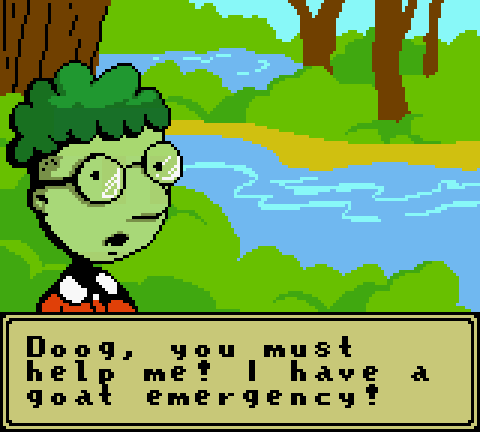
In the park is this stalk of anthropomorphic broccoli. I guess he's Doug's exchange student, because he talks in weird broken English, but he has a goat emergency so you can consider my interest well and truly piqued. He's somehow managed to lose three goats in the park, and although Doug protests that he hasn't got time for goat wrangling I knew there was no way I was getting out of this one, and so it proved. Thus, Doug must search the park for the three goats.
The park has a maze. The goats are inside the maze, which is what I was expecting. Sadly, I didn't realise that the maze was split into a left and right section, and so I spent a fruitless ten minutes or so searching the right maze for a goat. There was no goat there. When I eventually discovered the left section of the maze I found the first goat straight away, and with two goats to go I thought "well, I've already searched the right maze thoroughly and there was no goat in there." Cue another ten minutes of aimless wandering until I eventually decided to check again and discovered that there is a goat in the right side of the maze. It just doesn't appear until you've found the first goat. Thanks for that, Doug's Big Game. So, what, the other two goats were hiding until they saw me find the first one, upon which they crawled from the bushes says "shit, they got Gary, we're going to have to break cover in order to rescue him"?
Finding the goats did not help Doug locate Patti. It does make sense that it could have helped, because the broccoli kid told Doug that Patti was also searching for the goats, but she's already gone by the time you bring them back. What doesn't make sense is Doug then exclaiming that finding the goats "makes me a superhero! Sort of..." which serves as the clumsiest way possible for Doug's Big Game to introduce the other half of its gameplay repertoire.
It's Quailman, Doug's fantasy superhero alter-ego! I think this is one of the reasons that young VGJunk had such a negative opinion of Doug - he strained his imagination for an empowering superhero identity and the best he could come up with was one based on the quail, of all things - a bird famous for producing tiny eggs for middle-class people to eat and having a name synonymous with cowering in fear. Good work, Doug, you loser.
Oh look, it's a shoot-em-up section artlessly crammed into another game of a totally different genre. It's actually been a while since I've come across one of these, which isn't to say this is a welcome return.
Most of Doug's little quests end with a shooter section like this, where he's transformed into Quailman and has to fly around a small area and use his Quail-Eye to shoot a certain part of the stage - either a piece of the scenery or the boss' face - a few times. In this instance he must destroy the machine that has trapped Super Sport, Doug's mentally-constructed damsel-in-distress version of Patti that he can swoop in and save, making him look like a big man until everyone realises that Quailman is literally wearing y-fronts on the outside of his trousers.
So how's the actual gameplay in these sections? Eh, it's... well, it's boring. Quailman moves around okay if with perhaps a touch more inertia than you might expect, and while it can be difficult to avoid the projectiles that constantly home in on you these stages are short enough that you can usually just suck up the damage and get the job done before you die, making them minor diversions rather than a meaty chunk of gameplay goodness.
Alright, Porkchop, simmer down. That's what I'm trying to do, but there was a goat emergency. You can't just ignore something like that.
After finishing that mini-quest, Doug potters around for a while until he finds someone else to talk to. This strange purple girl ropes Doug into delivering party invitations. At first Doug refuses on the grounds that he's busy, but eventually the spineless glob gives in and hey, would you look at that, another mission. This time I've got to find a kid called Skunky - a nickname presumably bestowed upon them for their habit of spraying foul-smelling liquid from their anal glands - and Roger, the town bully.
Not having any idea where Skunky might be, I decided to put some of the quarters I'd been picking up off the ground to use by making a telephone call. Thankfully Doug's friend Skeeter picked up and told Doug where Skunky is. Fans of the cartoon will be disappointed to learn that Skeeter does not say "honk honk" at any point during the conversation.
Skeeter was true to his word, and Skunky is hanging around in the maze, alone. You'd probably expect that from someone named Skunky. Now to find Roger and hey, if calling Skeeter worked last time maybe he'll know where Roger is too. I wouldn't say I'm banking on Skeeter running an elaborate surveillance network over the entire town. but it would be quite helpful.
Skeeter wasn't home, so I tried a few more times and received a variety of "comedy" answers, including ringing Patti's dad and then freaking out when he asked what I wanted with his daughter. Eventually, I managed to get Roger himself on the telephone. When this happened, Doug said "I've got nothing to say to you!" and hung up. Erm, Doug? Is that true? I think you do have something to say to Roger, namely "where the bloody hell are you, you green-skinned freak?" Also, if he picked up his phone you'd think Roger is, you know, at home. However, Roger is not at home, making him the only person in Bluffington to own a mobile phone, a phone which he gave the number for to the dorky kid he likes to bully for some reason.
It turns out that Roger is in the park, too. He doesn't want to go to some loser party, at which point I may have audibly advised him to stick his invitation up his arse. In my defence, it was very late and I was very tired when I was playing this.
Finishing the quest means it's time for another Quailman segment, so here you go. Look at it with your eyes. Enjoy Roger's transformation into a giant samurai with rocket fists, making him ten thousand times cooler than Doug. You've got to shoot him in the face three times, but the gimmick here is that you only have three shots of Quail-Eye at your disposal. You can press A+B together to switch to Quail-Dog (Porkchop with a belt tied around his head) for another three shots, but use those up too and you fail the stage. There's no drawback to this besides having to play the stage again, so I'd recommend getting it right the first time.
After defeating Roger (in his daydreams, anyway), Doug is told that his sister Judy wants to see him ASAP. Here she is, standing in her bedroom that's decorated with a bright pink bed and matching rug, laminate flooring and a massive piece of toast propped up against the top wall.
Judy claims that while Doug was out he missed a phone call from his "little friend," and she uses this to blackmail her younger brother, forcing him to run errands for her before she'll tell him what the phone call was about. Seems like a normal sibling interaction to me, but Doug isn't happy about it. What are you going to, little man? Grow a pair? No, I thought not. Now go and fetch your sister an ice cream.
I would not buy ice cream from this man. I wouldn't go within one hundred feet of this man - if indeed he is a man and not some terrifying cosmic entity trying to force its way into our fragile reality - but apparently he has a monopoly on all the ice cream in town, so I have little choice but to interact with him.
I also had to got back to the Klax Emporium to pick up a "Shakespeare on Ice" CD. I wonder what's on that CD? Is it the soundtrack to a production of a Shakespeare play performed on ice, or is it an audio drama under which you can hear the faint but constant hiss of ice skates? Either way, Judy wants it and what Judy wants, Judy gets. I'm glad Judy's in the game, because as a hugely over-dramatic beatnik she is clearly Doug's best character.
Now Doug is fantasising about killing his sister. He seems to fall into these violent delusions a lot, does Doug. He's the quiet type, seems like a nice enough kid, doesn't have many friends, occasional violent revenge fantasies. I'm just saying, I wouldn't grant Doug a gun license. Maybe make him walk through a metal detector before he goes to school.
Also, in almost any other game I'd be really excited about the prospect of fighting a dragon with the head of a beatnik, but Doug's Big Game is such a dull and plodding experience that I just can't summon up the energy to care. Fortunately, it's almost over.
Once you've completed three tasks, the next person you talk to will tell you that Patti has been sighted in Doug's neighbourhood, so he quickly dashes back to his house and yes, there she is! At long last! I don't think she's so happy to see Doug, mind you, just look at the way she's leaning away from him.
Aww, isn't that sweet: to apologise for standing Doug up (and unaware that doing so made him fly into a nervous frenzy that saw him running around town asking everyone he met where Patti was,) Patti bought him a present: a CD of the Beets latest album. Ah yes, the Beets, Doug's favourite band. If there's one memory of the Doug cartoon that has been permanently seared into my mind, it's the refrain "ooh eee ooh, killer tofu" from this, the Beets' most famous hit. I still think of it when I see tofu. Thanks for that, Doug.
"I love surprises. Thanks, Patti." said Doug, his dead eyes regarding her coldly, no trace of emotion on his face.
And so Doug's Big Game ends with the same kind of mumbly pleasantness that makes up every atom of the Doug universe. Doug and Patti are friends, they have a nice time together and Doug goes home to plan more of his elaborate revenge against society.
Quailman. So, so lame.
But that's not all! You've seen three of the mini-quests that you can enjoy in Doug's Big Game, but there are actually quite a few of them and they're randomised on each playthrough to create the ultimate wandering-about simulator, so here are a few more of them.
In this one, you have to find a super-genius child. He's in this arcade - this painful, retina-frying arcade - but that's beside the point. A significant part of Doug's Big Game has been about collecting quarters, and now here I am, standing in an arcade with twenty dollars worth of change burning a hole in Doug's comfortable yet stylish brown shorts... and none of these machines work. That's just cruel. Could the developers not have least thrown up a cheapo version of Space Invaders or Pong or something? It just doesn't feel right at all.
One of the quests has Doug sneaking into detention - which he accomplishes by getting the foreign kid to yodel in the school car park - in order to speak to Roger. Roger asks Doug if he's in detention for "being a loser," which is obviously not true. If a teacher told Doug he had to go to detention for being a loser, Doug's already fragile sense of self-worth would totally disintegrate and he'd probably torch the school. No, what we learn here is that detention in Doug's world is hardcore. Look at that background, I think Bluffington's naughty children are being set afloat on a prison ship.
You can also meet Doug's neighbour Mr. Dink in his basement. I don't think it's much of a stretch to say that Mr. Dink's basement has a real "torture chamber" vibe going on here, it is? I think it's down to Mr. Dink's sprite, the heavy shadows on his sweater and that fact in the show he's extremely ebullient but here he has the facial expression of a man who is about to do something he knows is terrible but it's the only way to momentarily stop the screaming voices in his head.
I couldn't finish this article without showing you Doug's friend Skeeter. He's blue! He also appears to be trying to warn Doug about and alien race called the Sleeches and their attempts to kickstart human evolution. Was there ever an X-Files parody on Doug? There must have been, they existed in the same time frame and every other show from that time seemed to reference The X-Files at some point.
But she's not waiting, is she, Porkchop? That's the whole premise of the game. She was supposed to be waiting for me but she flounced off somewhere and now I'm trying to find her. Stop being so dramatic. That's Judy's domain.
Porkchop's frustration at Doug's lack of haste are a hint that if you take too long fulfilling your errands, you can get a bad ending, in which the final conversation between Doug and Patti is slightly awkward, as though Patti has just realised that Doug is duller than perhaps any person in the entire cosmos and she's trying to get away from him while still being polite. As "bad ends" go it's hardly being dead in your jeep the whole time or the future refusing to change, but for Doug it must be absolutely crushing.
"Women, huh? Am I right?" No, Doug. You are not right. No-one who daydreams about dressing up like that can ever be right.
In conclusion, Disney's Doug: Doug's Big Game Starring Doug - a Disney Production should really be called Fetch Quests: The Video Game. They're not even interesting fetch quests, either: there are no puzzles to solve, no work for your brain to do at all, just walk from one place to the other and pick up an item or talk to a person, maybe using the payphone if you get stuck. The one saving grace of this part of the game is that map that lets you warp around - if you had to walk from area to area Doug's Big Game would be tedious enough to put the world's anaesthesiologists out of work. The shoot-em-up sections are no better - perfunctory and repetitive, like that one phone call a week you make to your mother out of a sense of duty, but with the added frustration of slippery physics and a chronic lack of variety. The difficulty level is strange, too, because it's so embarrassingly easy. When it comes to these Game Boy Color tie-in games, that's usually because their aimed at four-year-old, but Doug's audience was considerably older than that and could surely have handled a challenge greater than "walking around". The whole thing is presented in a garish package of ugly graphics and annoying sound, too, so there's no relief to be found in the aesthetics.
On the plus side, the concept of the random minigames isn't bad in itself, and at least there's some replayability. I think I'd still rather have a game like this than some abysmal platformer, too, and the developers did come up with scenarios that I could see happening in the cartoon. In the end, though, it's just too stultifyingly dull to be worth bothering with for anyone but most ardent Doug fan. Now, if you'll excuse me, I'm off to listen to the Hampster Dance or the Macarena or something that might dislodge that bloody Killer Tofu song from my brain.
Labels:
disney,
doug,
doug's big game,
game boy color,
imaginengine,
licensed
Subscribe to:
Posts (Atom)