Last time out I wrote about Hangzo, a ninja-based arcade hack-n-slasher that was never actually released, despite being both 99.9% finished and surprisingly good fun to play. In what might turn out to be a foolish attempt at luck-pushing, I’ve decided to once again return to the mysterious world of unreleased videogames in the hope of finding more buried treasure. This time it’s the turn of the NES, with Sunsoft’s Sunman!
That’s a rather familiar-looking logo, hmm? But forget that for the moment and enjoy the use of double exclamation marks on the “press start” message, because it’s kinda sweet. Sunsoft are really excited for you to start playing Sunman! Oh hey, Sunsoft, Sunman - maybe in another universe Sunman is Sunsoft’s corporate mascot, appearing as a hidden character in all those famous Sunsoft games like Waku Waku 7 and Hebereke’s Popoon.
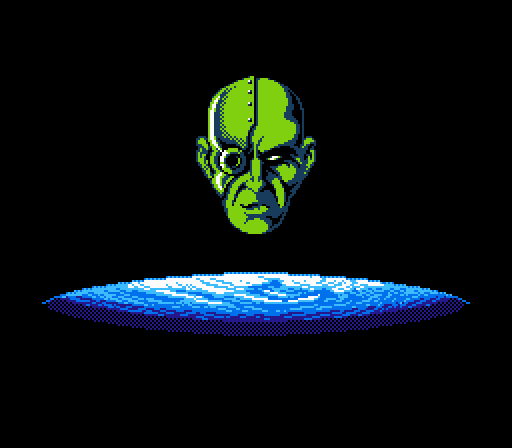
The large green head of the game’s villain hovers above the Earth. Metaphorically hovers, by the way, you don’t have to travel into space to shoot a planet-sized cyborg’s head. Disappointing, I know. Seeing this image, I was convinced that the villain would be named Doctor Thingy or Professor Whatsit, some kind of name that implied the bad guy was terribly proud of his academic achievements, but no. His name is Specter.
And this is Sunman himself, resplendent in a costume that’s all red, all the time. You know, just like the sun. Could have done with a couple of accent colours on there, buddy, although I realise it’s difficult to base a superhero costume on the colours of the sun without looking like a minor McDonaldland character.
Here we see Sunman’s alter-ego - let’s call him Kent Clark – rushing into danger as Megaro City comes under attack the evil forces of Specter. “Defeat all enemies” is the order, but that’s nonsense because it’s much easier and more practical to avoid all the enemies and dash for the end of the stage. Perhaps they’ll feel defeated when the hero ignores them entirely before destroying their evil organisation’s power structure.
As an aside, I’ve been surfing the web for many years now and I’ve visited many… interesting websites, so I hope that explains why I saw Kent Clark as wearing a jumpsuit that’s unzipped to the navel and immediately thought “yaranaika.”
“Help!” screams some poor civilian – or perhaps it’s a metaphor for the city itself crying out for justice, justice that only Sunman can dish out. Sunman delivers justice by punching things, mostly. He was never going to rid the city of crime through programs aimed at reducing the socio-economic factors that drive people to crime in the first place, was he?
First up on the punching block these lesser Specter minions, flappy bat-winged types that have guns but aren’t that keen on actually firing them for whatever reason. It’s not like Sunman is bulletproof. Anyway, what we’ve got here is a fairly straightforward NES action game. Get from one end of the stage to the other while clearing out the bad guys, or avoiding them entirely, whichever is more practical at the time. You’ve got one button to jump and one button to “attack,” which at the moment makes Sunman throw out a punch. Punching gets the job done but it’s hardly the most exciting superpower, so does Sunman have any other special skills?
Well, he can fly. I suppose that’s a super power. Either press jump twice or simply hold up on the d-pad and Sunman will take to the skies, moving wherever you want him to with the merest manipulation of the controller. He can even hover in place like an oversized hummingbird, except he’s got fists instead of a specially-adapted prehensile tongue and he dips those fists into crime rather than nectar-filled flowers. He’s not much like a hummingbird at all, now I think about it. But Sunman can hover, and fly, a superpower that makes this first area extremely easy because you can just fly past all the enemies as they only offer the most token level of resistance.
Area two of the first stage is much less relaxed, with lots of potential death-traps such as crushing spiked pillars and electric barriers. Don’t worry, though: you can take your time and carefully pick your way through the danger. There’s no time limit and very few enemies to hurry you along, so take it as slowly as you need to. This is good advice for any of Sunman’s stages where taking a more leisurely approach is a viable option, because you’ll need to work as hard as you can to preserve your health bar. It’s not just that the game has some rather difficult sections (and it definitely does) but that there are no power-ups in this game at all. Your health is refilled whenever you beat a boss, but apart from that there’s no way to regain lost hit points because there are no health pick-ups, as well as there being no power-ups for the things you might expect to see in an NES action game like special attacks or temporary invulnerability.
Now we’re really flying, heading to the top of this skyscraper while Specter’s agents harry and harass our hero. The villains aren’t very threatening, are they? I think it’s those wings, it’s as though they were all ready to fight Sunman but hadn’t realised that he could fly, so they’ve had to hastily assemble crude canvas bat-wings.
The last section of this first stage is, or course, a boss battle. Sunman fights against a helicopter. The chopper attacks with a spread-shot from the front and homing missiles from the back, and it’ll also try to ram Sunman as it moves from one side of the screen to the other. Position yourself in the gaps between the spread shots and destroy the homing missiles, and when you get the chance you can attack the helicopter by firing your laser eye-beams at it. Okay, okay, let’s address the elephant in the room: Sunman sure seems a lot like Superman, huh?
That’s because he is Superman. There are even earlier prototype versions of the game which reveal that yep, Sunman was originally intended to be a licensed Superman game, with a playable Man of Steel and John Williams’ famous Superman movie theme playing as the in-game music. For whatever reason, the Superman license was very lightly painted over with the new Sunman character. Maybe that’s why Sunman never saw an official release: Sunsoft’s attempts to convince people that this is a Totally Original Character We Swear were patently unsuccessful, so perhaps they were worried about DC Comic’s lawyers getting involved.
Personally I think the switch from Superman to Sunman works in the game’s favour, because it eliminates the Superman Paradox. The invulnerable, incredibly powerful Superman – a character well know for being immune to bullets – can be brought down by a few shots from a hired goon wearing home-made bat-wings? Hard to swallow. But Sunman? We don’t know jack about Sunman. Sure, he can fly and punch hard, but that doesn’t mean he can catch bullets in his teeth. He could be an alien from another planet with a deadly weakness to a certain element, but unlike Superman and kryptonite he’s allergic to lead. Helps to keep Sunman that bit more relatable, you know?
Back to Sunman, and after clearing the first stage we get a shot of our hero in a dramatic pose. Yes, he’s definitely looking “grate,” and I’m enjoying the sheer cheek of giving a Superman clone a big letter S on the chest of his costume. On his planet, it means “the licensing deal fell through.”
Stage two is the Grand Canyon, and Specter has hidden a missile base at one of the United States’ most visited tourist attractions so clearly he’s just doing all this for attention. It begins with another flying section, only now Sunman’s eye-beams are gone and he can only punch the enemies. This reliance on punching is perhaps the biggest problem with Sunman’s core combat, because he’s kinda the short arm of the law and it can be difficult to get close enough to the enemies to hit them without taking damage yourself. A bit of extra range would have gone a long way towards making the fights more enjoyable; something as simple as giving Sunman’s fists a glow of solar power to increase their size by a few pixels would have gone a long way.
The bulk of the stage takes place in these crystal caves. The mineral pillars move up and down to crush our hero, and there are stone walls that need to be punched through along with the usual slew of villains to batter. A lot of the fighting in this game is either against flying enemies or in segments where everyone is flying, and again the punching combat suffers. What Sunman needs is a way to attack upwards, because that’s where ninety percent of the enemies attack from. An uppercut performable on command would, again, make the combat much smoother and more entertaining. Instead you spend a lot of time trying to get Sunman on the right horizontal plain and it can be kinda awkward and fiddly.
Also a bit awkward is this section where Sunman drills into the floor by spinning around really fast. It’s not awkward to control because you just mash the buttons as fast you you can, but Sunman sure looks awkward as he pirouettes on the spot. You wouldn’t see Batman making a fool of himself like this. Hang on, if Sunman is Superman then I wonder what this universe’s version of Batman is called? Moonman? No, that sounds a bit too hippyish for Batman. Darkman? Nope, already taken. Moonbat? Yeah, sounds good, let’s go with that, although I haven’t been keeping up with Pokemon so I’ve got the nagging feeling that might be one of the newer pocket monsters.
The boss battle is against the missile. It took me a while to figure out that the missile itself was my target, because there are four little scuttlin’ robots along the walls of the arena that move up and down shooting lasers at you. You can destroy the robots but they just keep coming back: it turns out the real goal is to punch each individual segment of the rocket until it’s completely crumpled up. Now, I’m well aware that all long range missiles are fitted with safety mechanisms that prevent them from detonating unless they’re specifically intended to explode at that moment, but it still feels like punching an ICBM with my super-fists going to end up doing Specter’s work for him.
Stage three, and all aboard the Rocky Mountain Railroad as Sunman attempts to stop the runaway train. This is another stage that hews quite close to the usual “NES platformer” school of design, albeit with Sunman’s powers of flight making it play somewhat differently. The most dangerous obstacles here are the girders that hang down from the tunnels’ ceilings. If you don’t duck under them in time, they’ll slam into Sunman and cost him a lot of health.
Once you’re out of the tunnels, however, you can bid the minions of Specter a hearty farewell and fuck you by simply flying right over their heads, their feeble grunt brains too slow to keep up with Sunman as he moves at a brisk walking pace six inches above their heads.
I guess Sunman didn’t inherit Superman’s whole “faster than a speeding bullet” shtick, what with having to walk across the whole train in order to stop it, but is he more powerful than a locomotive? Yes, he is, but that’s not the issue here – the real question is whether you have the iron fingers required to hammers the buttons fast enough. I’d consider myself fairly good at mashing buttons, because I play more old videogames than most people, but this section felt especially rough on the old digits. Perhaps there’s a rhythm to it that I just wasn’t getting into. “Problems with rhythm” would definitely be a problem I’d expect to have.
Moving on to the next stage, and Sunman has infiltrated Specter’s aircraft carrier. There’s not much new to say about this area. Fly a bit, punch a lot. But what’s this? Is it a bird? Is it a plane? No, it’s the difficulty level, which has rocketed into the stratosphere. The stage is difficult because there are more enemies about and the ship’s deck being at the mid-level of the screen means the action is more compressed and you have less room to manoeuvre, but the real pain-cherry top this sadism cake are the jump-kicking enemies pictured above. They move very quickly, rolled up in a ball until they fly towards Sunman with their deadly legs extended, bouncing unpredictably around the screen and usually coming in pairs. This is where I really wished there was a way to attack upwards, but no: somehow these guys are stronger and faster than Off-Brand Superman and they kept kicking my arse so thoroughly that the game went from “enjoyable romp” to “deeply frustrating” in about three screens.
To finish off the stage, Sunman must chase down an escaping speedboat and blast it out of the water with his laser vision. Somehow the speedboat is more heavily armed than the battleship. There are a lot of bullets packed into that thing, and then there’s the fact it can sometimes turn invisible to deal with. Okay, fine, so the invisibility isn’t a genuine feature of the boat, but that doesn’t make it any less annoying.
The problem is that this area has a very intense parallax scrolling effect on the sea and the sky. The parallax looks great. I don’t have any complaints about the background. However, the strain on the NES hardware results in so much sprite flickering that you’d be justified in describing it as “sprite vanishing.” Good luck spotting the boat in the screenshot above. Fortunately the boat is always in front of Sunman, so if you just keep firing and dodging the projectiles you’ll hit it enough times to win eventually. I hope the glory of your triumph makes up for the new involuntary spasms you’ve developed in your ocular muscles.
The final stage is Specter’s hideout, as you might expect. It begins with another fly-n-punch section that isn’t all that interesting, before moving into the mechanical deathtrap zone pictured above. The gears of my mind may move slowly – certainly slower than all the spiked crushing traps and electro-barrier in this stage – but it eventually hit me that Sunman is obvious very similar to Sunsoft’s Batman NES games, namely, erm, Batman and especially Return of the Joker. Sunman’s gameplay feels like the mid-point between those two games, and the graphical style is the same: all bright colours, mechanical greeblies and parallax scrolling punched up to the extreme. But you know what finally tipped me off about the similarities? It was the little animation of Sunman’s cape slowly fluttering to the ground when you crouch, because the same thing happens in Batman. Also, Batman: Return of the Joker is called Dynamite Batman in the Japan. I hope you enjoy that fact as much as I do.
Unfortunately, Sunman was saving it’s most obnoxious section for the very end, with a high-speed horizontal race section that will reawaken submerged memories of that one bit from Battletoads as Sunman hurtles through a series of narrow corridors made even narrower by all the blocks filling the area. As you can see above, sometimes you’re forced to guide Sunman though gaps barely wider than he is, with each collision taking two chunks off your health bar. It’s just… bad. A bad bit of gameplay. Not exciting, not engaging and the only pleasure I got from it was the grim and ultimately self-defeating kind when I saw Sunman ram his face full-speed into a metal bar.
But all that’s behind me now – I’ve reached the final confrontation with Specter! Given that he looks an awful lot like Sunman and he seems to have a similar set of powers, I’m going to guess that in the original Superman version of Sunman, Specter was going to be General Zod. He clearly ain’t Doomsday and while his bald appearance on the title screen could point to Lex Luthor, Lex Luthor can’t fly or shoot energy blasts from his hands. Not without his big robot suit, anyway.
After the miserable previous sector, this boss fight is a welcome return to Sunman not being awful. It’s a very simple fight: the boss disappears and then reappears in one of several fixed points around the screen. It’s then you task to clobber Specter before he can attack. If you hit him fast enough, he’ll take damage and teleport away; if you react too slowly, he’ll use one of the aforementioned energy blasts or summon a rain of falling rocks.
I really like this fight, a lot more so than any of the other boss battles in the game. It sounds pretty underwhelming on paper, but I like the tension that comes from having to react quickly to Specter’s new position or avoid his attacks, and he manages to be a challenge without being ludicrously overpowered. However, the main reason I like this fight is that both Sunman and Specter are both so well-animated and fluid that watching them duke it out is a real treat. I was particularly impressed with Specter’s hand motions when summoning his falling rock attack. A lot of games would have just had him raise his hand, but here he looks as convincing as a NES sprite summoning personal attack meteors can look.
Looking cool wasn’t enough to save Specter, though, and in the name of the sun I punished him good and proper. What follows is a perfunctory ending as Sunman flies past the Statue of Liberty. Lady Liberty has been moved from New York to the unspoiled pine forests of the America north, presumably to protect her from attacks by the likes of Specter. You get a message saying “the world returns to a peaceful time. Now and forever.” which strikes me as wildly optimistic, and then the credits roll.
Well hey, look at that: Sunman was directed by the late Kenji Eno, perhaps best known for creating the D games.
Did the videogame world miss out when Sunman was cancelled? Yeah, I suppose so. For the most part it’s an enjoyable game, and the sense of colour and style that permeates Sunman makes up for the parts where the gameplay is unremarkable or, in a couple of spots, outright bad. As a NES game by Sunsoft you know the soundtrack’s going to be good, and it is. Not quite as excellent as some of their other NES soundtracks, sure, but certainly very funky. I’d tell you to listen to it on YouTube but all the videos uploaded there appear to have been recorded in NTSC mode and so the music is playing too fast – the Sunman prototype is a PAL version of the game, you see.
There’s a lot I’d change about Sunman – the lack of an upwards attack, Sunman’s stubby little arms, the fact that the hitbox near his head feels massive yet his feet are often invulnerable, like some kind of reverse Achilles – but on the whole it’s worth checking out for the presentation alone. He might not be Superman, but Sunman has style.
Showing posts with label DC Comics. Show all posts
26/03/2018
06/12/2017
COMIC BOOK ARCADE FLYERS
X-Men, Konami, 1992
(images from The Arcade Flyer Archive, click for bigger)
Let’s begin with a prime slab of comic book art that fuses the powerful nostalgia streams of nineties Marvel and arcade beat-em-ups with Konami’s much-loved X-Men. The game itself might not be quite as much fun to play these days as you remember, but that’s a minor consideration because hearing Magneto croak “Welcome to die!” could transform any game into a masterpiece. Just looking at this artwork means I’ll have “Here Comes the Hero” stuck in my head for hours to come. As for the artwork itself, there’s not much to say about it, honestly. It’s just a nice, large image of all your favourite X-Men characters, plus Dazzler. The most striking thing about it is that I don’t remember Wolverine wearing a huge red belt, but apparently his brown suit did indeed feature a huge red belt. Funny how memory works, huh? And what’s that belt supposed to be holding up, his skin-tight lycra suit? Wolverine’s the best there is at what he does, and what he does is promote the importance of adequate lumbar support.
The Japanese flyer feature the same heroic X-Men in a different pose, overshadowed by the leering face of Magneto. The Master of Magnet looks like he’s just seen someone drop a twenty pound note and he’s about to stand on it until they walk away and then pinch it. As for the rest of the characters, they look good and dynamic, although poor Nightcrawler has to suffer the indignity of having text obscuring his face. If you’re thinking that the art looks like an animation cell, that’s probably because X-Men: The Arcade Game was famously based on the semi-failed cartoon pilot Pryde of the X-Men.
There’s also this flyer, which really gets across the grandeur of the full six-player X-Men cabinet. “Play X-Men today at an arcade near you! No excuses!” it says, and yeah, sure, unless the arcade bought the six-player cabinet and then had to close down because the floor collapsed.
If you’ve ever been lucky enough to enjoy the full six-player X-Men experience - sorry, "eXperience" - please don’t tell me, because I’d just be jealous.
Spider-Man: The Videogame, Sega, 1991
It’s your friendly neighbourhood wall-crawler, and he’s got his own arcade videogame! That’s right, Spider-Man : The Videogame, the game all about Spider-Man starring Spider-Man and three other people Spider-Man knows. Let’s face it, neither Black Cat, Sub-Mariner nor Hawkeye are in the same league as Spider-Man, are they? I’m sure they all have their fans, and I bet Black Cat has plenty of fan “art,” but Spidey’s definitely the star here. Maybe it’s just me, but doesn’t the artwork on this flyer look a bit old-fashioned for a game released in 1991? That’s not a complaint, it’s a classic look for the characters featured here, even if Namor’s raw sexual magnetism is making me a little uncomfortable.
There’s some interesting text down there on the bottom-right. Describing the characters as “three heroes and a heroine” seems like an unnecessary distinction, but I do like Dr. Doom being called “an incarnation of evil.” An incarnation of good common sense and benevolent leadership who is forever being slandered by the accursed Reed Richards might be more accurate, but this description is much less cumbersome.
The US flyer goes with a daft pun, which makes sense to me because there are two things I associate with Spider-Man: radioactive spider blood and bad jokes. The pun is then re-used at the end of the blurb, because if a joke was lame in the first place it can only get better with repetition. In fact, you could say there’s so much value in that pun that it’s really got legs, oh no, I’ve fallen into some kind of meta void.
Speaking of voids, I spent far too long looking at the background thinking it was some kind of abstracted Spider-Man mask before realising the magenta part is the silhouette of an arcade cabinet and the blue bits are supposed to be the trails of the swooshing screenshots. I was looking for depth where there was only ugly graphic design.
Superman: The Video Game, Taito, 1988
The Man of Steel gets a pretty boring flyer for his eponymous arcade adventure, but then I suppose Superman is so iconic that all you need to sell the idea of a Superman game is an image of Superman bursting though a paper sheet like a winning contestant on Gladiators.
The European flyer is a bit more engaging. Superman hurls a meatball into the depths of space, which at least gets a flicker from the needle of the interesting-o-meter because now I’m thinking of the phrase “intergalactic bolognese.” He also breaks apart some chains with a smile on his face. You see, he’s happy because some villain was dumb enough to attack Superman with regular metal chains and not a kryptonite-powered death machine.
Batman, Data East, 1990
After Superman, logically the next superhero to check up on is Batman, and of course he also got his own arcade game. It’s not that great, from what I remember. As you can see, it’s based on Tim Burton’s 1989 Batman movie, which means this flyer contains little more than Michael Keaton doing a kissy face. Seriously, what is with that expression? Batman looks like he’s just seen the kid in front of him buy the last scoop of chocolate ice cream and while he’ll settle for raspberry ripple he’s not happy about it.
Batman Forever, Iguana Entertainment, 1996
The streets of Gotham City are paved with gold, plus cobblestones and fondant-coated cakes shaped like the Bat-Symbol that act as impromptu manhole covers. You know, if Gotham’s streets were paved with gold it’d explain why so many criminals are obsessed with the bloody place. As much as I like Batman, I was something of an over-analytical kid and it always bothered me that all these crimes took place in the city that’s home to the World’s Greatest Detective. Like, c’mon, man: Akron, Ohio has banks too.
Batman, Raw Thrills, 2013
Here’s a surprisingly modern Batman arcade game, a racing-combat title where you hare through the streets of Gotham – thankfully not paved in gold, because that’d play havoc with the Batmobile’s traction – and chase down some of Batman’s famous foes. I’ve seen this game in action, and the strange thing about it is that it still has the same feel as an arcade game from the late nineties / early two thousands. It’s something to do with the way the action is framed, punchy and hyper-kinetic in a manner that you don’t see in console games. Presumably it’s designed that way to grab the attention of potential customers, as though the enormous glowing Bat-Symbol wouldn’t do that on its own.
I’m especially interested in the claim that you can control “every Batmobile ever” in this game. Now, I know that’s not strictly true, but you can play as the Batmobiles from the sixties TV series and Batman: The Animated Series and frankly why would you want to drive any other Batmobiles? So, I’ll let them off.
Justice League Heroes United, Global VR, 2009
Now this one just feels like a cruel practical joke. An arcade beat-em-up starring the likes of Batman, Wonder Woman and the Joker with cel-shaded graphics, supposedly co-developed by Konami? In another universe this is my favourite videogame ever, but from what I’ve seen of the version we received on this Earth Justice League Heroes United is an incredibly simplistic and remarkably ugly brawler with poor hit detection and combat that’s got as much depth as two junior school kids having a thumb war. Just looking at this flyer is disappointing me and, in the case of the Joker’s face, kinda creeping me out. I know the Joker is supposed to be creepy, but in a “sinister and unhinged” way rather than a Tippexed corpse. Throw in Wonder Woman staring at her own hands with an expression of utter bemusement, and I think we can all be glad that this one never got a home release.
Captain America and The Avengers, Data East, 1991
Ah, that’s better, back to some artwork you might actually want to look at. Well, as long as you ignore Vision’s massive hand / tiny head combo. Other than that, it’s pretty good. Captain America takes centre stage, as well he might, with all the most famous features of his design on display: his mighty shield, his red-white-and-blue suit, the two small tufts of grey hair at his temples that remind you hey, Cap fought in World War Two, he’s an old man now.
These days, it’s kinda weird to see Iron Man shuffled into the background of a superhero team-up, huh? Just bide your time, Tony. One day you’ll be Robert Downey Junior and you’ll never have to lurk behind Hawkeye again. And hey, I could have sworn the Red Skull doesn’t usually have ears. Skulls don’t have ears. Then again, skulls don’t have eyes, either, so I suppose it’s down to artistic interpretation. At least if you draw him with ears you know his Nazi hat won’t keep slipping off his head.
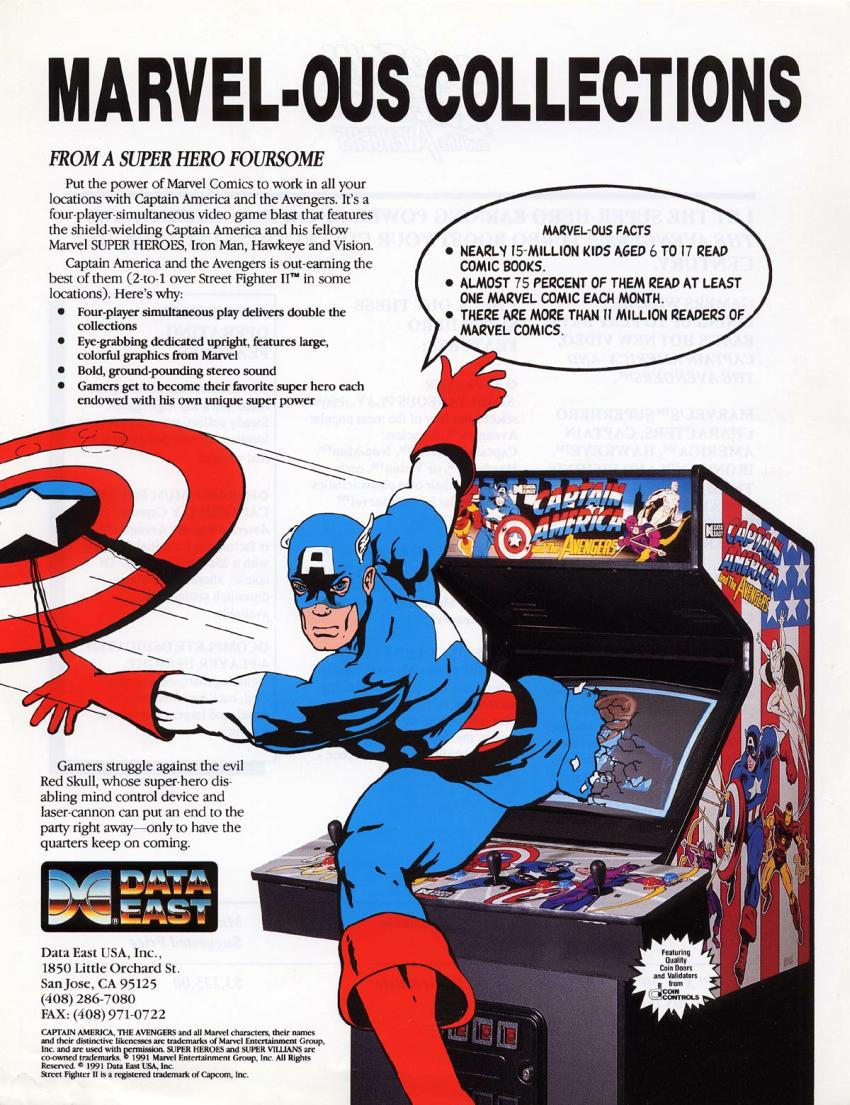
The American flyer for Captain America and The Avengers is… less compelling. Ha ha, “super hero foursome.” Where was I? Oh yeah, you might think Cap’s climbing out of that arcade cabinet, but take a look at the way the monitor glass is broken around his leg. There’s no way his bulging, justice-packed torso would fit through that gap, so clearly he’s just kicked a hole in the cabinet’s screen to get your attention. Now that he has your attention, he can tell you some marvel-ous facts. Go on, read that speech bubble and then admit it, the voice inside your head sounded like a kid giving a class presentation on the exports of Slovakia or something. At least those facts are believable – over on the left there’s the claim that in some arcades, Avengers is out-earning Street Fighter II at a rate of two-to-one. I must conclude those arcades did not contain a Street Fighter II cabinet.
Avengers in Galactic Storm, Data East, 1995
Captain America once more takes the starring role in Avengers in Galactic Storm, and he’s really carrying the whole thing because the other playable characters are… well, they’re down the Marvel Comics pecking order, let’s put it that way. Apart from Cap we’ve got the medieval-themed Black Knight, the element-manipulating Crystal and kinda-Thor-but-not-really Thunderstrike. Crystal has already appeared in the Inhumans TV show, and I’m sure that by 2025 Black Knight and Thunderstrike will have their own movies, movies beamed directly into the population’s brains by the now-sentient Disney-Marvel-Fox Mandatory Entertainment Droids.
Until then, we’ll have to settle for looking at these CG graphics which have not aged well at all. Early low-poly PS1-type stuff can have a lot of charm, but this is a shiny, plasticky nightmare, action figures come to life in a horror-movie version of Toy Story. Cap’s bulbous, over-inflated pectorals are dominating my focus. I can’t look away from them, and I can’t stop imagining the sounds of a clown making a balloon animal when Cap throws his shield.
The US flyer looks a little better. Not good, but better. The nineties really were the heyday of the brown leather jacket, huh? He doesn’t have one in this image but even Thunderstrike wears a brown leather jacket in the comics. I just feel sorry for the baseball pitcher that’s just out of view in the image above, because Thunderstrike has clearly smashed a home run outta the park.
Spawn: In The Demon’s Hand, Capcom, 1999
Oh hey, it’s Spawn! I’d kinda forgotten Spawn was a thing, but here he is in all his gothic, flappy-capes, not-nearly-as-cool-as-Link-Soul-Calibur-guest-character glory. The flyer is a big ol’ picture of Spawn himself, and there’s not much you can say about that. However, the tagline “access the cool and dark mysterious world of SPAWN” is rather glorious, don’t you think? You can access this world, but you are a mere visitor, child: you can never be as cool and dark mysterious as Spawn, emissary of hell and compulsive spike polisher.”
Also, Spawn will strike here. Apparently. Not a believer in the element of surprise, that Spawn.
X-Men: Children of the Atom, Capcom, 1994
To finish, let’s have some palette cleansers with the flyers for Capcom’s Marvel fighting games. I’m not going to cover the “versus Capcom” crossovers in an effort to keep this article comic-book centric, but Children of the Atom is X-Men all the way down and so here it is. Wolverine’s grimacing harder than any Canadian has ever grimaced before, and as someone who was recently told that they grind their teeth in their sleep it’s making me uncomfortable thinking about what this is doing to his teeth. I know Wolverine’s healing factor means he can grow them back, but still, tooth trauma isn’t fun to think about. Luckily Storm’s nearby, and she can calm Wolverine down by electrocuting his hand.
Relatedly, I’m sure I had a Marvel trading card of some sort with this very artwork on it. In this case, I would be happy for the comments to tell me if that was a real thing or something my brain has made up to distract me from the mental image of Wolverine’s teeth shattering under the pressure of his relentless fury.
The Japanese flyer is cool. I have nothing much to add, it just looks really good. Classic X-Men artwork, a strong design, Magneto looking much more menacing than he did on Konami’s X-Men flyer. Good work all around.
Marvel Super Heroes, Capcom, 1995
Finally for today, it’s Marvel Super Heroes and in what has been a running theme, the American flyer is kinda okay but not nearly as interesting as its Japanese counterpart. You’ve got some famous heroes, the game’s title, what more do you really need? Sure, the lighting on Psylocke makes her look very yellow and thus easily mistaken for some kind of wasp monster, especially with her leg(?) looking like a stinger, but aside from that? Perfectly acceptable.
This flyer, though? Get it printed out and hang it on your wall. That way you can live your life under the baleful gaze of Shuma-Gorath, and who wouldn’t want that?
22/01/2017
BATMAN: THE ANIMATED SERIES (GAME BOY)
The great thing about writing about a Batman game is that I don’t have to explain who Batman is. He is, for want of a less overused expression, iconic. If you see the silhouette of a bat, you know that somewhere on the dark and lawless streets of Gotham City, a clown is getting his teeth knocked out. Today that never-ending ballet of violence is cast in the appropriately monochromatic tones of the Game Boy, with Konami’s 1993 I-am-the-Night-em-up Batman: The Animated Series!
In an effort to promote his brand, Batman has stitched the name of the game onto his cape. No, of course not, this is the logo for Batman: The Animated Series, the cartoon on which this adventure is specifically based. BTAS, as the cool kids most certainly do not refer to it, is the good Batman cartoon; the slightly darker, Art-Deco-ish, Mark Hamill as the Joker iteration of the Batman mythos. It’s still probably my favourite version of Batman, so I’m looking forward to playing a video-game version of it.
Here’s Batman now, lurking in the shadows and scowling. As this makes up about eighty percent of being Batman, I feel it’s important that they included it in the game’s intro.
Actually, the intro is a rough recreation of the cartoon’s intro, a minute-long mini-adventure where Batman foils a bank robbery and then poses on top of a building, which is the other twenty percent of being Batman. The Game Boy version does a good job of recreating the show’s opening within the graphical limitations of the Game Boy, and there’s an excellent version of the cartoon’s theme music. Honestly, even if the game itself turns out to be terrible I’ll be glad I played it just to have heard a bleepier yet still atmospheric version of Danny Elfman’s classic Batman theme.
I’m not sure where these kung-fu fighters fit into the proceedings, mind you. This is a picture of two martial artists trying to flying-kick each other while a crowd of gangsters gathers around and flips them the bird, right?
Oh, I see, it’s the bit in the intro where Batman leaves the two tied-up bank robbers in the street. “They’re the police’s problem now,” thinks Batman as he scowls in the shadows on a rooftop. “I should get back to thinking up ways to kill Superman for some reason.”
Upon hitting start, you’re treated to a scene that sets up the first stage. Someone is making explosive teddy bears, presumably in an attempt to undermine Batman’s image as the Dark Knight when the public sees him running through the streets with a load of cuddly toys under his arm. Also, try not to look at that clown’s face for too long, because it’ll give you nightmares.
So, we’ve got clowns, laughter and exploding teddy bears. I wonder which villain could possibly be behind this nefarious scheme?
Calendar Man! I mean, The Joker! Obviously it had to be the Joker’s doing. While there are several DC Comics villains for whom “teddy bear bombs” would be a perfectly acceptable method of attack, I doubt that Toyman or The Dollmaker will be making an appearance in this particular Batman game.
The action begins, and within seconds you’re commanding the Caped Crusader to punch a clown. It’s little wonder I like Batman so much.
So, Batman: The Animated Series is an action-adventure platforming affair, as I’m sure you all expected it to be. In these early moments, it feels like a rather generic example of the genre. Batman walks and jumps and punches, and he does so in a very middle-of-the-road manner: not particularly agile, but also not plodding around the place like he’s just woken up after a Sunday-morning lie-in.
The aim of this first area is to find all the bear-bombs scattered throughout the stage. This isn’t difficult, because the level’s not very big and the bears aren’t that well hidden. They’re placed inside large, gift-wrapped boxes, for starters. How does Batman reveal the bear-bomb within? By punching the box, naturally This isn’t one of those Batman products where the World’s Greatest Detective does any actual detective work. For instance, the Joker gets in touch with Batman and explains his plan at the start of this stage. Batman will not need his Holmesian intellect to crack this case.
This isn’t just any action game hero, though. It’s Batman, and as such he should have some abilities that set him apart from the ordinary run of man otherwise he’s just a bloke in a Halloween costume. Well, he does have some special skills, the first of which is the ability to wall jump in a manner reminiscent of the NES Batman game. It’s the skill you’ll need to use the most in this game, so taking the time to master its complexities is vital. Those complexities mostly boil down to there being two different off-the-wall jumping distances, corresponding to how long you hold the button. Sometimes you will only need the short hop, so don’t forget it’s there.
As we move into the combination Build-A-Bear Workshop / bomb-making facility that makes up the later parts of the first stage, Batman gets the chance to show off his other most useful trick: the handy bat-grapple. Batman’s a close second to Spider-Man when it comes to superheroes known for swinging from a thread, so naturally he comes equipped with a grappling gun. There’s no swinging, though. Yes, as strange as it might sound the grapple gun only works vertically, and even then it’s only to grab onto certain ceilings. You can haul yourself up and down on the cable, but you can’t live out your Tarzan fantasies. The most common applications for the bat-grapple are leaping up through specific platforms to reach a higher level, or to pull Batman up, let go of the rope and use the aerial control you have over Batman’s horizontal movement to nudge him towards platforms below. That’s what I’m trying to do in the screenshot above: when I let go of the rope, I’ll be able to make Batman fall onto the right-hand platform. This lack of swinging might seem disappointingly limiting, but the vertical-only Bat-rope is integrated into the stages well and the lack of swinging eliminates any potential problems with awkward swinging physics and difficult-to-judge dismounts.
The bomb factory is attached to a Gothic mansion, because of course it is. This is Gotham City, after all. The only places in Gotham City that aren’t Gothic mansions are Wayne Tower and the sewers where Killer Croc lives. Inside the mansion are wall-mounted candles, so this being a Konami game I naturally tried punching the candles to see if power-ups would fall out. They did not, sadly.
You can’t blame me for trying, though. Just look at it! If you swapped Batman’s sprite for a bloke with a whip and a leather skirt you’d have no trouble convincing people that this was a Castlevania game.
You and I know both knew that the boss of this stage was going to be the Joker, even if the last few screens did make me think, if only for a very brief moment, that it might be Dracula. No, it’s definitely the Joker, he’s laughing at Batman and everything. He looks pretty good, too: recognisable as the character even when rendered in so few pixels, especially in motion when you can more clearly see that his mouth is opening and closing and he does not, in fact, have a yawning black void where his face ought to be.
The Joker’s battle plan is simple: he ducks into one of the hidden doors in the background while spawning a wave of exploding, ambulatory teddy bears. Your first task is to avoid the bears, something I found was most easily accomplished by grappling up to the ceiling and hiding up there until all the bears have blown up. Once they’re gone, the Joker will reappear for a moment, so you can swoop down and give him a smack. He’ll vanish again, summoning more bears, and so on and so forth. After the seventh or eight punch in the head, Joker will come to realise that his plan was, on the whole, a bit crap. Congratulations, Batman! You’ve saved Gotham City once again, and her citizens will rest easy for, oh, seven seconds or so.
The next stage introduces Mr. Freeze – you’d think he’d call himself Doctor Freeze, wouldn’t you? - and he takes his chance to mornge on about his emotional pain, blah blah blah. Listen, Freeze, we’ve all had tragedies in our lives but we don’t go around building ice guns, now do we? Maybe you should channel your negative emotions into something more worthwhile, like artistic expression or charity work or fighting crime while dressed as a flying mammal.
For his part, Batman responds with a very un-Batman-like pun. What is this, Batman and Robin? C’mon, Bruce, stick to the glowering. Also you appear to be talking to the Batmobile.
Oh, and the Scarecrow is there, too. Hello, Scarecrow! I’m sorry, but Batman doesn’t have a pun for you. If he did, I’m sure he’d say something like “as a creator of fear toxins, you’re outstanding in your field!”
The main point of stage two’s first area is to introduce and acclimatise Batman to a new type of threat: people with guns. The clowns in the first stage could sometime throw exploding bears, but on the whole they weren’t into projectile weaponry. These mobster love guns, though. They enjoy nothing more than standing still and firing bullets at head height, watching Batman slowly advance on them by ducking under their shots each time they fire. Whether they enjoy the following events – when Batman punches them so hard they disappear from this reality – is up for debate. Certainly, no-one’s ever returned from the Batman Punch Dimension, so it must be great.
Robin shows up, late. The time he missed will be docked from his wages, or at least it would if Batman paid him anything. Robin’s inclusion in the game is hardly surprising: he featured quite prominently in the original cartoon, to the point that he was pushed to the forefront and the show was renamed The Adventures of Batman and Robin. Whether this was intended to get people interested in Robin before Batman and Robin (the movie) was released, or because network execs decided what kids really wanted from their Batman cartoon was less Batman, I’m not sure, but here he is. Batman goes after Mr. Freeze while Robin tracks down Scarecrow, in what must be quite a blow to Scarecrow’s self-esteem.
And yes, you do get to play as Robin. There are three main differences between Batman and Robin. Robin has a smaller health bar, and when he grapples up to the ceiling he can move horizontally by swinging along like a kid on some monkey bars. Robin is also the only member of the Dynamic Duo to be harassed by floating pumpkins. But where are these pumpkins coming from?
Why, they’re coming from under the Scarecrow’s hat, of course. No, really, Scarecrow lifts his hat up and pumpkins fly out. I have to assume these are not literal pumpkins but are instead manifestations of Robin’s exposure to the fear toxin, although that implies the thing that Robin fears the most is jack o’lanterns. You’d think it would be faulty trapeze equipment.
This Scarecrow battle is a good example of how many of the boss fights in this game play out. The boss is briefly vulnerable, before deploying a set of projectiles or other hindrances and then disappearing for a short spell. Batman or Robin must avoid the projectiles until the boss reappears, during which time you can hit them. It’s simple, pattern-based gameplay of the most videogame-y sort, but that’s not necessarily a bad thing, especially when the rogue’s gallery are as well-drawn and possess enough individual charm to make each battle feel less similar than they really are.
Back to Batman, who’s making his way through Mr. Freeze’s cryogenic lab. It’s trying to trick me into thinking it’s less linear than the other stages by sending me through various doors to reach the next part of the stage, but there’s still only one path. Let’s put it down to Batman being Batman and thus always knowing exactly where to go, shall we?
The big shake-up here is that the bad guys aren’t just shooting regular bullets at you: they’ve got ice weapons that will freeze Batman solid for a few seconds if he’s hit by them. This forces the player into a more cautious style of play. Getting shot with a regular bullet is an unfortunate but fairly commonplace consequence of being Batman, but being hit by a freeze ray is enough of a pain in the arse that you’ll go out of your way to avoid having to deal with it.
The fight against Mr. Freeze is a little different in that he doesn’t disappear, as such, but he does run away while his massive frosty laser beams bounce around the room, an attack I had an embarrassing amount of trouble avoiding given that they travel along a very predictable path. I was just too eager to punch Mr. Freeze, that was my problem. There’s really not much else to say about this one other than it reminded me of a Mega Man boss fight, but that might just be because of the way the segmented door closes behind you once you enter the room.
Moving on, and Poison Ivy has kidnapped Harvey Dent, who I guess hasn’t become Two-Face yet. Are we looking at a retcon situation, where Two-Face is created when a mutated venus flytrap eats half his face? Sadly not, and Harvey Dent isn’t even the point: Poison Ivy is merely using him as bait to lure Batman into a deadly game of whatever the botanical equivalent of cat-and-mouse is. I’m not especially worried. Any villain whose fiendish schemes can be thwarted by a big bucket of Weedol does not exactly inspire fear.
Then Catwoman shows up and drops a sick burn on Harvey Dent. I know that everyone is boring when compared to Batman, but you could have been a bit gentler on poor old Harv.
The next few areas see Batman making his way through Catwoman’s mansion. I say it’s Catwoman’s because its full of cats and oversized novelty cat-collar bells. She probably stole it from someone else, sure, but she’s put enough of her own stamp on it that I feel justified in calling it Catwoman’s mansion. A lot of it is also on fire, which isn’t very thematically appropriate but does mean that the focus of the action switches from fighting goons to navigating dangerous terrain. It’s a welcome change of pace that feels no less Batman-y than the stages that have come before it.
Here’s Batman with some teeny-tiny cats. They don’t do anything important, I just thought you might like to see Batman surrounded by kittens.
At several points during the stage, you have to fight Catwoman. It differs from most other boss battles because it’s a straight-up one-on-one fight – no gimmicks, no projectiles, just punching and kicking. Specifically, Batman tries to punch Catwoman and then get far enough away that her kicks can’t reach him, which is easier said than done because she’s got surprisingly long legs. Many was the time I thought I’d retreated to a safe distance, only for the tip of Catwoman’s boot to poke me in the eye. She’ll also jump off the back wall and over your head if you try to pin her in the corner, which is the only part of this fight that makes reference to Catwoman’s famed agility. She’s decided to go toe-to-toe with Batman, but as you fight her and she runs away, only to be waiting to do it again in a later part of the stage, it quickly becomes clear that she has no real intention of beating Batman and is doing this for fun. It’s an extension of Catwoman and Batman’s already BDSM-tinged relationship, a superhero 50 Shades of Grey. Well, 4 Shades of Grey, in this case.
“Nothing can stop me from saving Harvey, Selina. Not even our erotically-charged ballet of violence and sweet, sweet pain, two bodies honed to the peak of physical perfection wrapped in leather and latex passionately clashing again and again. No, I’m going to take a very cold Bat-Shower and then save Harvey. I’m definitely going. I’m leaving right now, Yup.”
Now Batman’s heading into Poison Ivy’s botanically-themed lair, a terrifying place of deadly mutated thorns, creeping grass that acts like a conveyor belt and, erm, walking palm trees. I’m sure those are supposed to be coconuts, but they don’t half look like an arse. Fortunately, you can put these waddling freaks of nature out of their misery with a well-placed punch or two. You wouldn’t think punching a tree would be all that effective, but then again you are playing as Batman.
This stage is where the design philosophy behind Batman: The Animated Series’s levels clicked for me. There are a lot of very deliberately-placed traps and enemies that require specific actions, or sequences of actions, to negotiate without taking damage, and as a result the gameplay is less action-oriented than you might expect. There are times when haste is the proper course of action, mostly when you spot an enemy that can be rushed down and eliminated before they have a chance to react, but on the whole this is a game that rewards a slower, more methodical style of play. Paying attention – usually something I struggle with – is key, and although it rarely gets more complicated than figuring out enemy movement patterns and safe landing spots, it all comes together well for two main reasons. One is that it feels like the way Batman would handle things. Superman may be said to have the morals of a Boy Scout, but Batman definitely has the “always be prepared” angle covered and a slower, more thoughtful approach is very much his thing. Then there’s the technical aspect – the Game Boy was not as well-suited to fast, rapidly-scrolling action as the home consoles of the time, so slowing things down prevents the system’s limitations from becoming too apparent.
As for the boss, you don’t fight Poison Ivy directly but rather (surprise surprise) a giant mutated plant. It’s one of those fights that feels difficult at first, but eventually the pattern clicks and it stops being a challenge. Vines appear from the ground, and you avoid them while closing the distance to the big plant. Once you've punched the big plant, a wave of vines will pop up, and the only way to avoid them is to run back to the left of the screen, where you go straight back into dodging vines and closing the distance to the big plant. Ivy will fire the occasional crossbow bolt at Batman, but on the whole it doesn’t really feel like her heart’s in the fight.
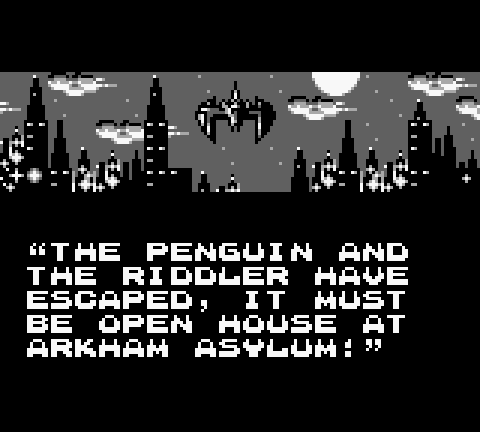
A succinct opening for the next stage: the Riddler and the Penguin have escaped from Arkham Asylum! Hang on, why was the Penguin in Arkham anyway? He’s just a mob boss. A mob boss with a pointy nose and a fixation on umbrellas, granted, but that hardly qualifies him for incarceration in a psychiatric institute rather than a regular prison. Of course, the real question is why anyone is sent to Arkham Asylum, a place that’s easier to escape from than a slightly awkward dinner with your new partner’s family.
When it’s a grown man leaping over rooftops and clobbering criminals while dressed as a bat?
The Riddler-themed part of this stage takes place in a series or rooms that would make Super Mario weep with envy for all the power-ups hidden in those question-mark blocks. There are also tiny Riddler dolls with knives for arms who want nothing more than to stab Batman in the shins. Batman’s appeared in so many crossovers that I’m sure Batman vs Puppet Master can’t be too far away, but for now we can mostly ignore the dolls and the roaming enemies that I think are supposed to be chess pieces and focus on the task at hand. That task is finding the correct route though the Riddler’s maze. Every room has at least one switch – and not a very well hidden switch, I should add – that Batman must punch in order to open the room’s exit. However, some rooms have multiple switches and exits, and only one path will lead you to the end of the stage. So, it’s a matter of trial, error and memorisation, or at least it is if you want to finish the stage quickly. Me? I didn’t have anything better to do, so I spent a while randomly hitting switches and travelling in loops until I eventually stumbled upon the correct order. Let’s pretend I did it just to annoy the Riddler, shall we? Ignoring his meticulously laid-out mental challenge and simply brute-forcing my way to the end seems like the kind of thing that would really piss the Riddler off. Consider it my revenge for having to do the Riddler’s Batmobile challenges in Arkham Knight.
The Riddler fight very much sticks to the usual pattern of “disappear and fire projectiles” school of combat, probably more so than any other boss fight because he actually disappears between attacks. When he’s visible, you’ve got the chance to land a single attack before he splits into four Riddler clones. Normally this wouldn’t be a problem, because four Riddlers aren’t any more handy in a fistfight than one Riddler, but the clones will then turn into balls of energy and fly towards Batman. You can eliminate the clones by hitting them, but as you can see they’re well spaced out, so the key is getting rid of as many clones as you can. One or two clone-balls are easy enough to dodge, avoiding three is tricky but doable but having all four of them flying at you almost guarantees you’re going to take some damage.
Once the Riddler’s been dealt with, you’re back to playing as Robin in the game’s toughest and probably least fun challenge: a vertical chase against the Penguin as he flees to his waiting airship. There’s nothing hugely complicated about this section. You just have to get Robin to the top of the tower before the timer runs out by grappling to the ceiling above and swinging “through” the appropriate, traversable pieces of the scenery. It’s not even especially terrible to play. It’s just that after the slower approach of the rest of the game it’s a bit jarring for speed to suddenly be of the essence, especially when combined with a tight time limit and dismounting controls that are just sticky enough to be frustrating.
It doesn’t help that Robin’s daring chase is immediately rendered moot by Batman turning up and declaring he’s going to do all the work anyway. Thank, Batman. Robin can go and sit in the Batwing, reading the Gotham City A-Z and drinking Panda Pops like when your dad used to go to the pub and leave you in the car outside.
As Batman makes his way through Penguin's airship, beset on all sides by mechanical swans and the dread power that is hummingbirds – yes, you have to punch some hummingbirds, for pity’s sake – here’s something I really like about this game. Batman wears black, yeah? And thanks to the Game Boy’s four-colour display, a lot of the backgrounds are black. Thus, Batman tends to blend into the background. Normally this might be a cause for complaint, because being able to see your character is quite important, but in a Batman game it totally makes sense. Lurking in the shadows is Batman’s whole deal, and he’s easy enough to see when he’s moving that it’s not as much of an issue as some screenshots might suggest. I don’t know whether this effect is something Konami purposefully exploited to give the game a real Batman vibe or just a serendipitous accident, but it adds a lot of character to the visuals.
It’s time to fight the Penguin, who’s riding around on a flying duck, throwing umbrella bombs and generally trying to stay out of Batman’s way, which seems like a good strategy to me. The Batarangs came in handy during this fight, I must say. What’s that? I didn’t mention you can throw Batarangs? Well, you can. You can switch between Batarangs and punches with the select button. Robin even uses a slingshot instead, which is a nice touch. The problem is, the game seems to be deeply opposed to you using the Batarangs. You have to collect them before you can throw them, and Batarang power-ups are few and far between. On top of that, you can only carry nine of them at a time, they don’t do any more damage than a regular punch and the small dimensions of the Game Boy’s screen means that you’re never really that far away from the thing you want to damage. As a result, it’s entirely possible to forget that the Batarangs are even an option. Still, they were helpful here, with the Penguin floating just out of punching range.
A bad day for Batman and Robin gets even worse as the Batwing is shot out of the sky on the way back to stately Wayne Manor. Which fiendish villain could be responsible for this attack? I mean, I’ve punched most of the big names into unconsciousness already. Is it Maxie Zeus? The Clock King? Egghead?
Oh, it’s the Joker. Again. Arkham Asylum really isn’t fit for purpose, is it?
Check out the crashed Batwing, it’s a nice visual flourish in a game that has plenty of them: the falling snow in Catwoman’s stage is also good, as are the defeated poses most of the villains slip into when you beat them.
Rather than ending the game with one last full stage, Batman: The Animated Series draws to a close with a single boss fight against the Joker and his remote-controlled clownbot, a device that was rejected by Dr. Robotnik for being too impractical. It tries to fall on Batman’s head with its spiked underside, and it’s very easy to avoid and subsequently punch. It can also throw playing cards. These are also easy to avoid. It’s a bit of an anticlimax, honestly, but I’ll let the Joker off because his last criminal caper was only a few hours ago, so he’s hardly had the time to put together a truly fiendish master-plan. “I’ve got a clown-themed robot, so I’ll drop it on Batman’s head” probably seemed like a good idea on short notice.
So, you dodge the robot, punch it a few times and eventually it’ll fly up into the air and land on the Joker, teaching him a valuable lesson about never trusting clowns and bringing the game to a close.
For a game that had mini-cutscenes at every opportunity with accompanying (and rather good) art, it’s strange that the game’s ending is nothing but a few lines of text about how Batman and Robin are hungry and they’re going to get Alfred to make them some dinner. It’s not the content that’s the problem – two hard-working buddies talking about grabbing a bite to eat is a much more enjoyable conclusion than Batman standing on top of a building and monologuing about how he’ll never rid the city of crime – but I’m disappointed that there’s no artwork to go with it. Batman and Robin sitting down at the table in full costume while Alfred serves them from a silver platter, that's the kind of thing I wanted to see.
Batman: The Animated Series is a good game. Even though VGJunk was never intended to be a “review” site, I generally try to come to some kind of conclusion, and while those conclusions are usually a little bit more nuanced than this there’s little else I can say about BTAS. It’s just a good game. Solid, dependable, rarely frustrating, true to the source material and respectful of the limitations of the hardware on which it appears. It’s very similar to Ninja Gaiden Shadow in that regard, and both these games are two of the best action-platformers the Game Boy has to offer. Oh, and the soundtrack is great, too. What more could you ask for? Apart from useful Batarangs, I mean?
In an effort to promote his brand, Batman has stitched the name of the game onto his cape. No, of course not, this is the logo for Batman: The Animated Series, the cartoon on which this adventure is specifically based. BTAS, as the cool kids most certainly do not refer to it, is the good Batman cartoon; the slightly darker, Art-Deco-ish, Mark Hamill as the Joker iteration of the Batman mythos. It’s still probably my favourite version of Batman, so I’m looking forward to playing a video-game version of it.
Here’s Batman now, lurking in the shadows and scowling. As this makes up about eighty percent of being Batman, I feel it’s important that they included it in the game’s intro.
Actually, the intro is a rough recreation of the cartoon’s intro, a minute-long mini-adventure where Batman foils a bank robbery and then poses on top of a building, which is the other twenty percent of being Batman. The Game Boy version does a good job of recreating the show’s opening within the graphical limitations of the Game Boy, and there’s an excellent version of the cartoon’s theme music. Honestly, even if the game itself turns out to be terrible I’ll be glad I played it just to have heard a bleepier yet still atmospheric version of Danny Elfman’s classic Batman theme.
I’m not sure where these kung-fu fighters fit into the proceedings, mind you. This is a picture of two martial artists trying to flying-kick each other while a crowd of gangsters gathers around and flips them the bird, right?
Oh, I see, it’s the bit in the intro where Batman leaves the two tied-up bank robbers in the street. “They’re the police’s problem now,” thinks Batman as he scowls in the shadows on a rooftop. “I should get back to thinking up ways to kill Superman for some reason.”
Upon hitting start, you’re treated to a scene that sets up the first stage. Someone is making explosive teddy bears, presumably in an attempt to undermine Batman’s image as the Dark Knight when the public sees him running through the streets with a load of cuddly toys under his arm. Also, try not to look at that clown’s face for too long, because it’ll give you nightmares.
So, we’ve got clowns, laughter and exploding teddy bears. I wonder which villain could possibly be behind this nefarious scheme?
Calendar Man! I mean, The Joker! Obviously it had to be the Joker’s doing. While there are several DC Comics villains for whom “teddy bear bombs” would be a perfectly acceptable method of attack, I doubt that Toyman or The Dollmaker will be making an appearance in this particular Batman game.
The action begins, and within seconds you’re commanding the Caped Crusader to punch a clown. It’s little wonder I like Batman so much.
So, Batman: The Animated Series is an action-adventure platforming affair, as I’m sure you all expected it to be. In these early moments, it feels like a rather generic example of the genre. Batman walks and jumps and punches, and he does so in a very middle-of-the-road manner: not particularly agile, but also not plodding around the place like he’s just woken up after a Sunday-morning lie-in.
The aim of this first area is to find all the bear-bombs scattered throughout the stage. This isn’t difficult, because the level’s not very big and the bears aren’t that well hidden. They’re placed inside large, gift-wrapped boxes, for starters. How does Batman reveal the bear-bomb within? By punching the box, naturally This isn’t one of those Batman products where the World’s Greatest Detective does any actual detective work. For instance, the Joker gets in touch with Batman and explains his plan at the start of this stage. Batman will not need his Holmesian intellect to crack this case.
This isn’t just any action game hero, though. It’s Batman, and as such he should have some abilities that set him apart from the ordinary run of man otherwise he’s just a bloke in a Halloween costume. Well, he does have some special skills, the first of which is the ability to wall jump in a manner reminiscent of the NES Batman game. It’s the skill you’ll need to use the most in this game, so taking the time to master its complexities is vital. Those complexities mostly boil down to there being two different off-the-wall jumping distances, corresponding to how long you hold the button. Sometimes you will only need the short hop, so don’t forget it’s there.
As we move into the combination Build-A-Bear Workshop / bomb-making facility that makes up the later parts of the first stage, Batman gets the chance to show off his other most useful trick: the handy bat-grapple. Batman’s a close second to Spider-Man when it comes to superheroes known for swinging from a thread, so naturally he comes equipped with a grappling gun. There’s no swinging, though. Yes, as strange as it might sound the grapple gun only works vertically, and even then it’s only to grab onto certain ceilings. You can haul yourself up and down on the cable, but you can’t live out your Tarzan fantasies. The most common applications for the bat-grapple are leaping up through specific platforms to reach a higher level, or to pull Batman up, let go of the rope and use the aerial control you have over Batman’s horizontal movement to nudge him towards platforms below. That’s what I’m trying to do in the screenshot above: when I let go of the rope, I’ll be able to make Batman fall onto the right-hand platform. This lack of swinging might seem disappointingly limiting, but the vertical-only Bat-rope is integrated into the stages well and the lack of swinging eliminates any potential problems with awkward swinging physics and difficult-to-judge dismounts.
The bomb factory is attached to a Gothic mansion, because of course it is. This is Gotham City, after all. The only places in Gotham City that aren’t Gothic mansions are Wayne Tower and the sewers where Killer Croc lives. Inside the mansion are wall-mounted candles, so this being a Konami game I naturally tried punching the candles to see if power-ups would fall out. They did not, sadly.
You can’t blame me for trying, though. Just look at it! If you swapped Batman’s sprite for a bloke with a whip and a leather skirt you’d have no trouble convincing people that this was a Castlevania game.
You and I know both knew that the boss of this stage was going to be the Joker, even if the last few screens did make me think, if only for a very brief moment, that it might be Dracula. No, it’s definitely the Joker, he’s laughing at Batman and everything. He looks pretty good, too: recognisable as the character even when rendered in so few pixels, especially in motion when you can more clearly see that his mouth is opening and closing and he does not, in fact, have a yawning black void where his face ought to be.
The Joker’s battle plan is simple: he ducks into one of the hidden doors in the background while spawning a wave of exploding, ambulatory teddy bears. Your first task is to avoid the bears, something I found was most easily accomplished by grappling up to the ceiling and hiding up there until all the bears have blown up. Once they’re gone, the Joker will reappear for a moment, so you can swoop down and give him a smack. He’ll vanish again, summoning more bears, and so on and so forth. After the seventh or eight punch in the head, Joker will come to realise that his plan was, on the whole, a bit crap. Congratulations, Batman! You’ve saved Gotham City once again, and her citizens will rest easy for, oh, seven seconds or so.
The next stage introduces Mr. Freeze – you’d think he’d call himself Doctor Freeze, wouldn’t you? - and he takes his chance to mornge on about his emotional pain, blah blah blah. Listen, Freeze, we’ve all had tragedies in our lives but we don’t go around building ice guns, now do we? Maybe you should channel your negative emotions into something more worthwhile, like artistic expression or charity work or fighting crime while dressed as a flying mammal.
For his part, Batman responds with a very un-Batman-like pun. What is this, Batman and Robin? C’mon, Bruce, stick to the glowering. Also you appear to be talking to the Batmobile.
Oh, and the Scarecrow is there, too. Hello, Scarecrow! I’m sorry, but Batman doesn’t have a pun for you. If he did, I’m sure he’d say something like “as a creator of fear toxins, you’re outstanding in your field!”
The main point of stage two’s first area is to introduce and acclimatise Batman to a new type of threat: people with guns. The clowns in the first stage could sometime throw exploding bears, but on the whole they weren’t into projectile weaponry. These mobster love guns, though. They enjoy nothing more than standing still and firing bullets at head height, watching Batman slowly advance on them by ducking under their shots each time they fire. Whether they enjoy the following events – when Batman punches them so hard they disappear from this reality – is up for debate. Certainly, no-one’s ever returned from the Batman Punch Dimension, so it must be great.
Robin shows up, late. The time he missed will be docked from his wages, or at least it would if Batman paid him anything. Robin’s inclusion in the game is hardly surprising: he featured quite prominently in the original cartoon, to the point that he was pushed to the forefront and the show was renamed The Adventures of Batman and Robin. Whether this was intended to get people interested in Robin before Batman and Robin (the movie) was released, or because network execs decided what kids really wanted from their Batman cartoon was less Batman, I’m not sure, but here he is. Batman goes after Mr. Freeze while Robin tracks down Scarecrow, in what must be quite a blow to Scarecrow’s self-esteem.
And yes, you do get to play as Robin. There are three main differences between Batman and Robin. Robin has a smaller health bar, and when he grapples up to the ceiling he can move horizontally by swinging along like a kid on some monkey bars. Robin is also the only member of the Dynamic Duo to be harassed by floating pumpkins. But where are these pumpkins coming from?
Why, they’re coming from under the Scarecrow’s hat, of course. No, really, Scarecrow lifts his hat up and pumpkins fly out. I have to assume these are not literal pumpkins but are instead manifestations of Robin’s exposure to the fear toxin, although that implies the thing that Robin fears the most is jack o’lanterns. You’d think it would be faulty trapeze equipment.
This Scarecrow battle is a good example of how many of the boss fights in this game play out. The boss is briefly vulnerable, before deploying a set of projectiles or other hindrances and then disappearing for a short spell. Batman or Robin must avoid the projectiles until the boss reappears, during which time you can hit them. It’s simple, pattern-based gameplay of the most videogame-y sort, but that’s not necessarily a bad thing, especially when the rogue’s gallery are as well-drawn and possess enough individual charm to make each battle feel less similar than they really are.
Back to Batman, who’s making his way through Mr. Freeze’s cryogenic lab. It’s trying to trick me into thinking it’s less linear than the other stages by sending me through various doors to reach the next part of the stage, but there’s still only one path. Let’s put it down to Batman being Batman and thus always knowing exactly where to go, shall we?
The big shake-up here is that the bad guys aren’t just shooting regular bullets at you: they’ve got ice weapons that will freeze Batman solid for a few seconds if he’s hit by them. This forces the player into a more cautious style of play. Getting shot with a regular bullet is an unfortunate but fairly commonplace consequence of being Batman, but being hit by a freeze ray is enough of a pain in the arse that you’ll go out of your way to avoid having to deal with it.
The fight against Mr. Freeze is a little different in that he doesn’t disappear, as such, but he does run away while his massive frosty laser beams bounce around the room, an attack I had an embarrassing amount of trouble avoiding given that they travel along a very predictable path. I was just too eager to punch Mr. Freeze, that was my problem. There’s really not much else to say about this one other than it reminded me of a Mega Man boss fight, but that might just be because of the way the segmented door closes behind you once you enter the room.
Moving on, and Poison Ivy has kidnapped Harvey Dent, who I guess hasn’t become Two-Face yet. Are we looking at a retcon situation, where Two-Face is created when a mutated venus flytrap eats half his face? Sadly not, and Harvey Dent isn’t even the point: Poison Ivy is merely using him as bait to lure Batman into a deadly game of whatever the botanical equivalent of cat-and-mouse is. I’m not especially worried. Any villain whose fiendish schemes can be thwarted by a big bucket of Weedol does not exactly inspire fear.
Then Catwoman shows up and drops a sick burn on Harvey Dent. I know that everyone is boring when compared to Batman, but you could have been a bit gentler on poor old Harv.
The next few areas see Batman making his way through Catwoman’s mansion. I say it’s Catwoman’s because its full of cats and oversized novelty cat-collar bells. She probably stole it from someone else, sure, but she’s put enough of her own stamp on it that I feel justified in calling it Catwoman’s mansion. A lot of it is also on fire, which isn’t very thematically appropriate but does mean that the focus of the action switches from fighting goons to navigating dangerous terrain. It’s a welcome change of pace that feels no less Batman-y than the stages that have come before it.
Here’s Batman with some teeny-tiny cats. They don’t do anything important, I just thought you might like to see Batman surrounded by kittens.
At several points during the stage, you have to fight Catwoman. It differs from most other boss battles because it’s a straight-up one-on-one fight – no gimmicks, no projectiles, just punching and kicking. Specifically, Batman tries to punch Catwoman and then get far enough away that her kicks can’t reach him, which is easier said than done because she’s got surprisingly long legs. Many was the time I thought I’d retreated to a safe distance, only for the tip of Catwoman’s boot to poke me in the eye. She’ll also jump off the back wall and over your head if you try to pin her in the corner, which is the only part of this fight that makes reference to Catwoman’s famed agility. She’s decided to go toe-to-toe with Batman, but as you fight her and she runs away, only to be waiting to do it again in a later part of the stage, it quickly becomes clear that she has no real intention of beating Batman and is doing this for fun. It’s an extension of Catwoman and Batman’s already BDSM-tinged relationship, a superhero 50 Shades of Grey. Well, 4 Shades of Grey, in this case.
“Nothing can stop me from saving Harvey, Selina. Not even our erotically-charged ballet of violence and sweet, sweet pain, two bodies honed to the peak of physical perfection wrapped in leather and latex passionately clashing again and again. No, I’m going to take a very cold Bat-Shower and then save Harvey. I’m definitely going. I’m leaving right now, Yup.”
Now Batman’s heading into Poison Ivy’s botanically-themed lair, a terrifying place of deadly mutated thorns, creeping grass that acts like a conveyor belt and, erm, walking palm trees. I’m sure those are supposed to be coconuts, but they don’t half look like an arse. Fortunately, you can put these waddling freaks of nature out of their misery with a well-placed punch or two. You wouldn’t think punching a tree would be all that effective, but then again you are playing as Batman.
This stage is where the design philosophy behind Batman: The Animated Series’s levels clicked for me. There are a lot of very deliberately-placed traps and enemies that require specific actions, or sequences of actions, to negotiate without taking damage, and as a result the gameplay is less action-oriented than you might expect. There are times when haste is the proper course of action, mostly when you spot an enemy that can be rushed down and eliminated before they have a chance to react, but on the whole this is a game that rewards a slower, more methodical style of play. Paying attention – usually something I struggle with – is key, and although it rarely gets more complicated than figuring out enemy movement patterns and safe landing spots, it all comes together well for two main reasons. One is that it feels like the way Batman would handle things. Superman may be said to have the morals of a Boy Scout, but Batman definitely has the “always be prepared” angle covered and a slower, more thoughtful approach is very much his thing. Then there’s the technical aspect – the Game Boy was not as well-suited to fast, rapidly-scrolling action as the home consoles of the time, so slowing things down prevents the system’s limitations from becoming too apparent.
As for the boss, you don’t fight Poison Ivy directly but rather (surprise surprise) a giant mutated plant. It’s one of those fights that feels difficult at first, but eventually the pattern clicks and it stops being a challenge. Vines appear from the ground, and you avoid them while closing the distance to the big plant. Once you've punched the big plant, a wave of vines will pop up, and the only way to avoid them is to run back to the left of the screen, where you go straight back into dodging vines and closing the distance to the big plant. Ivy will fire the occasional crossbow bolt at Batman, but on the whole it doesn’t really feel like her heart’s in the fight.
A succinct opening for the next stage: the Riddler and the Penguin have escaped from Arkham Asylum! Hang on, why was the Penguin in Arkham anyway? He’s just a mob boss. A mob boss with a pointy nose and a fixation on umbrellas, granted, but that hardly qualifies him for incarceration in a psychiatric institute rather than a regular prison. Of course, the real question is why anyone is sent to Arkham Asylum, a place that’s easier to escape from than a slightly awkward dinner with your new partner’s family.
When it’s a grown man leaping over rooftops and clobbering criminals while dressed as a bat?
The Riddler-themed part of this stage takes place in a series or rooms that would make Super Mario weep with envy for all the power-ups hidden in those question-mark blocks. There are also tiny Riddler dolls with knives for arms who want nothing more than to stab Batman in the shins. Batman’s appeared in so many crossovers that I’m sure Batman vs Puppet Master can’t be too far away, but for now we can mostly ignore the dolls and the roaming enemies that I think are supposed to be chess pieces and focus on the task at hand. That task is finding the correct route though the Riddler’s maze. Every room has at least one switch – and not a very well hidden switch, I should add – that Batman must punch in order to open the room’s exit. However, some rooms have multiple switches and exits, and only one path will lead you to the end of the stage. So, it’s a matter of trial, error and memorisation, or at least it is if you want to finish the stage quickly. Me? I didn’t have anything better to do, so I spent a while randomly hitting switches and travelling in loops until I eventually stumbled upon the correct order. Let’s pretend I did it just to annoy the Riddler, shall we? Ignoring his meticulously laid-out mental challenge and simply brute-forcing my way to the end seems like the kind of thing that would really piss the Riddler off. Consider it my revenge for having to do the Riddler’s Batmobile challenges in Arkham Knight.
The Riddler fight very much sticks to the usual pattern of “disappear and fire projectiles” school of combat, probably more so than any other boss fight because he actually disappears between attacks. When he’s visible, you’ve got the chance to land a single attack before he splits into four Riddler clones. Normally this wouldn’t be a problem, because four Riddlers aren’t any more handy in a fistfight than one Riddler, but the clones will then turn into balls of energy and fly towards Batman. You can eliminate the clones by hitting them, but as you can see they’re well spaced out, so the key is getting rid of as many clones as you can. One or two clone-balls are easy enough to dodge, avoiding three is tricky but doable but having all four of them flying at you almost guarantees you’re going to take some damage.
Once the Riddler’s been dealt with, you’re back to playing as Robin in the game’s toughest and probably least fun challenge: a vertical chase against the Penguin as he flees to his waiting airship. There’s nothing hugely complicated about this section. You just have to get Robin to the top of the tower before the timer runs out by grappling to the ceiling above and swinging “through” the appropriate, traversable pieces of the scenery. It’s not even especially terrible to play. It’s just that after the slower approach of the rest of the game it’s a bit jarring for speed to suddenly be of the essence, especially when combined with a tight time limit and dismounting controls that are just sticky enough to be frustrating.
It doesn’t help that Robin’s daring chase is immediately rendered moot by Batman turning up and declaring he’s going to do all the work anyway. Thank, Batman. Robin can go and sit in the Batwing, reading the Gotham City A-Z and drinking Panda Pops like when your dad used to go to the pub and leave you in the car outside.
As Batman makes his way through Penguin's airship, beset on all sides by mechanical swans and the dread power that is hummingbirds – yes, you have to punch some hummingbirds, for pity’s sake – here’s something I really like about this game. Batman wears black, yeah? And thanks to the Game Boy’s four-colour display, a lot of the backgrounds are black. Thus, Batman tends to blend into the background. Normally this might be a cause for complaint, because being able to see your character is quite important, but in a Batman game it totally makes sense. Lurking in the shadows is Batman’s whole deal, and he’s easy enough to see when he’s moving that it’s not as much of an issue as some screenshots might suggest. I don’t know whether this effect is something Konami purposefully exploited to give the game a real Batman vibe or just a serendipitous accident, but it adds a lot of character to the visuals.
It’s time to fight the Penguin, who’s riding around on a flying duck, throwing umbrella bombs and generally trying to stay out of Batman’s way, which seems like a good strategy to me. The Batarangs came in handy during this fight, I must say. What’s that? I didn’t mention you can throw Batarangs? Well, you can. You can switch between Batarangs and punches with the select button. Robin even uses a slingshot instead, which is a nice touch. The problem is, the game seems to be deeply opposed to you using the Batarangs. You have to collect them before you can throw them, and Batarang power-ups are few and far between. On top of that, you can only carry nine of them at a time, they don’t do any more damage than a regular punch and the small dimensions of the Game Boy’s screen means that you’re never really that far away from the thing you want to damage. As a result, it’s entirely possible to forget that the Batarangs are even an option. Still, they were helpful here, with the Penguin floating just out of punching range.
A bad day for Batman and Robin gets even worse as the Batwing is shot out of the sky on the way back to stately Wayne Manor. Which fiendish villain could be responsible for this attack? I mean, I’ve punched most of the big names into unconsciousness already. Is it Maxie Zeus? The Clock King? Egghead?
Oh, it’s the Joker. Again. Arkham Asylum really isn’t fit for purpose, is it?
Check out the crashed Batwing, it’s a nice visual flourish in a game that has plenty of them: the falling snow in Catwoman’s stage is also good, as are the defeated poses most of the villains slip into when you beat them.
Rather than ending the game with one last full stage, Batman: The Animated Series draws to a close with a single boss fight against the Joker and his remote-controlled clownbot, a device that was rejected by Dr. Robotnik for being too impractical. It tries to fall on Batman’s head with its spiked underside, and it’s very easy to avoid and subsequently punch. It can also throw playing cards. These are also easy to avoid. It’s a bit of an anticlimax, honestly, but I’ll let the Joker off because his last criminal caper was only a few hours ago, so he’s hardly had the time to put together a truly fiendish master-plan. “I’ve got a clown-themed robot, so I’ll drop it on Batman’s head” probably seemed like a good idea on short notice.
So, you dodge the robot, punch it a few times and eventually it’ll fly up into the air and land on the Joker, teaching him a valuable lesson about never trusting clowns and bringing the game to a close.
For a game that had mini-cutscenes at every opportunity with accompanying (and rather good) art, it’s strange that the game’s ending is nothing but a few lines of text about how Batman and Robin are hungry and they’re going to get Alfred to make them some dinner. It’s not the content that’s the problem – two hard-working buddies talking about grabbing a bite to eat is a much more enjoyable conclusion than Batman standing on top of a building and monologuing about how he’ll never rid the city of crime – but I’m disappointed that there’s no artwork to go with it. Batman and Robin sitting down at the table in full costume while Alfred serves them from a silver platter, that's the kind of thing I wanted to see.
Batman: The Animated Series is a good game. Even though VGJunk was never intended to be a “review” site, I generally try to come to some kind of conclusion, and while those conclusions are usually a little bit more nuanced than this there’s little else I can say about BTAS. It’s just a good game. Solid, dependable, rarely frustrating, true to the source material and respectful of the limitations of the hardware on which it appears. It’s very similar to Ninja Gaiden Shadow in that regard, and both these games are two of the best action-platformers the Game Boy has to offer. Oh, and the soundtrack is great, too. What more could you ask for? Apart from useful Batarangs, I mean?
Labels:
Batman,
batman the animated series,
DC Comics,
game boy,
konami,
licensed,
platformer
Subscribe to:
Posts (Atom)