Crime City is a dangerous, violent place - I believe it placed second in a recent poll of "worst possible places to live", just behind Herpes-upon-Thames - but luckily there's a pair of dedicated and vigilant police officers who will stop at nothing to clean up the streets. Just how seriously do they take their duties?
 Physics, you can take the week off. Law of the Jungle? Fuhgeddaboudit. There's a new supreme law in town, and their names are Tony Gibson and Raymond Broady. Any similarities between these guys and the heroes of the Lethal Weapon franchise are entirely a product of your twisted mind. You should probably go and see a doctor or something; you're imagining things, seeing Lethal Weapon everywhere. Tony's surname is a mere coincidence, nothing more.
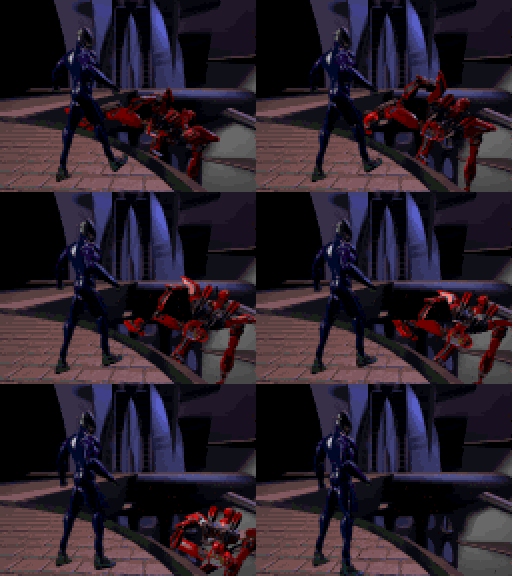
 The call comes in from HQ - there's been a prison break! Tony and Raymond are woken in the middle of the night and tasked with rounding up the escapees. How will our heroes react to having their sleep disturbed?
 Okay, wow. That's quite the opposing set of reactions. I mean, I'm very much not a morning person, but I've never declared a "kill time" when I've been awoken before my eight hours are up, sleep still crusting the corners of my eyes as I wearily load my revolver. Raymond has serious anger issues, and you'd hope he's not like that all the time because it'll put a serious strain on his partnership with Tony if it comes up on a regular basis. What if a crime happens during their lunch break or something? "I'm sorry guys, but you'll have to stop eating because there's a hostage situation downtown."
Tony: Well golly gee!
Raymond: I see, we shall move forward to the murder. *Begins silently loading his firearm*.
 Right, here we are at the start of the game. Have a look at the screenshot, and then take a guess what the gameplay's going to be like. Go on, I'll wait. Done? If you said "you walk across the screen, jumping over obstacles and shooting bad guys in the face" then congratulations, you must have played a videogame before. Crime City is not an innovative game - in fact, it seems to borrow quite heavily from Namco's Rolling Thunder, particularly with your limited-ammo pistol and the way your health bar works (taking a physical hit decreases your health, getting shot is instant death) but without the jumping between different vertical levels and hiding in doors that's so prevalent in Namco's title. As always, the goal is to reach the end of the stage and defeat the boss. Like I say, Crime City is about as fresh and original as a Bruce Forsythe comedy routine.
 Back to the prison break, then. Having escaped from jail, the inmates decide to grab their guns and head straight to the city's shopping district en masse for a spot of retail therapy. It's hard to keep up with the latest fashion trends when you're banged up - just ask this guy in the bright green suit, complete with Peter Pan hat. No wonder he needs a gun. At least Tony's clothes look like something a human being might have conceivably once worn in public, although his common-sense outfit is rather undermined by the way he minces across the screen.
That yellow-and-white thing in front of Tony is a bag of drugs. I don't know what kind of drugs - although it's definitely an insidious poison and not insulin or something. Given that Crime City is about urban crime and was released in the late Eighties, it's almost certainly some kind of new, ultra-addictive and utterly deadly designer drug called something like Thrill or Grind or Salad. Enemies sometimes drop these bags of Flunk when defeated, and you can collect the drugs for points. Remember that, kids: if you see a bag of drugs make sure you pick it up, especially if you find it near the corpse of a gang member.
 The first stage is short - Crime City's shopping district is small, what with all the crime and all - and soon enough you'll reach the first boss. His name is Joe, and he's got a machine gun. What he's also got is the IQ of a small potted plant. He can't escape from behind those boxes, which is ironic given that he presumably led the jailbreak in the first place, and the bullets he fires move so slowly that the only way they could hurt you is if they suddenly developed sentience and started calling you mean names. All you have to do is crouch behind the boxes, wait for Joe to finish firing, stand up and execute him in a manner that will probably lead to an internal investigation (although you will be cleared of all charges in the end).
 Oh look, we made the front page. Is Tony trying to put the cuffs on Joe? I think it's a little late for that, man. Also, STOCK PRICES. The Daily Taito isn't afraid to tackle the big stories, I see.
Now that the first stage is over and I've spent a little time in Crime City, what can I say about it? Well, it's fun. Nothing fancy and certainly nothing original, but it gets the basics right. Tony controls nicely, the level design so far seems challenging but fair, and Taito have given it such a thick layer of the bizarre, colourful madness that defined late-Eighties/early Nineties arcade games that it's impossible not to smile when you're playing it - the over-the-top and weirdly translated text, the fact that half the enemies look like rejects from West Side Story, Raymond's descent into madness, everything comes together in a rather satisfying way.
 A bank robbery is the theme for the second stage, and Tony is rushed to the scene by helicopter. Well, not too the actual scene: for some reason, you're dropped off on top of traffic hurling along a motorway. Am I sensing some hostility towards our hero from the other officers of the CCPD? "Sorry Tony, we can’t take you all the way to the bank. Budget cuts, you know? Good luck!" And then a motorcycle tries to insert itself into your intergluteal cleft. Thanks, guys.
So, you hop your way along the cars. Falling onto the road means instant death, which seems fair enough. Once you've traversed enough vehicles, you can move on to the second part of the stage.
 It's an underground garage filled with even more dangerous cars than the bloody motorway, constantly trying to ram you as you make your way through. Duke Nukem has snapped and taken a girl hostage, possibly as revenge for his treatment in Duke Nukem Forever.
 Then there's a rather abrupt shift to an into-the-screen shooting section that works much like the similar stages in Contra, except not as maddeningly difficult. I don't know why it's here, and there aren't any more of them in the game, but hey: it's a change of pace, at least. Once you've made it through the Parking Lot of Pain, you'll emerge in the bank itself, ready for a confrontation with Richard the Bank Burglar.
 Not wanting to be outdone by Duke, Richard has taken a hostage too. By the looks of her, she's Jessica from Final Fight, so Richard should count himself lucky that it's Tony that turned up to save her and not her dad. Richard has a shotgun that can make fighting him tricky, but as you can (not) see from the picture, Tony's latent mutant ability to turn invisible has just activated after being kicked in the head by a fat man in a ski-mask. You can't hit what you can't see, and soon Richard is dead and Jessica can return home to Metro City.
 The next crime to fight is a smuggling operation that operates out of a junkyard. It's a nice, isolated spot for gunning down criminals without worrying about things like arrest procedures or human rights or the police department's ammunition budget. You know, for all that the Daily Mail and Britain's other right-wing rags bang on about the evils of videogaming, you'd think Crime City and other games of this ilk would be right up their alley. Criminals? Shoot 'em all, that's what I say! Justice should come from the barrel of a gun! They're sub-human scum who don't deserve to live, and they're probably... foreign, too. Disgusting!
 Earlier I mentioned that Crime City takes its inspiration from Rolling Thunder, which seems appropriate given that these cops have a special attack - a rolling attack. Holding diagonally down and pressing jump makes your character roll around like an excitable child at a school sports day, and unlike the usual defensive roll found in videogames this human cannonball act can be used to attack. You're not immune to bullets when you're using it or anything, but if you're careful you can complete the first mission and large parts of the rest of the game just by doing roly-polys everywhere. You can even launch yourself into their air and do it, surprising your foes with the full weight of the law and the full weight of a grown man curled into a ball.
 The second half of the stage takes place in the obligatory warehouse. After all, where else are you going to store your illegally-smuggled good? Waiting at the end is the boss, a rotund man called Fritz who carries what appears to be (judging by the projectiles it fires, at least) the cannon from a pirate galleon. I hope that's what he was smuggling into the country, looking to score a lucrative deal with a pirate-themed supervillain and his ship's crew of hired goons.
Yet again, Fritz is a boss who is trapped behind some boxes. This time you have to jump and shoot him. It's not a difficult fight, and soon Fritz is dead. I mean, incarcerated. Yeah. No time to relax, though: the mayor has been kidnapped!
 Ah ha ha ha! "Oh maaaaan, kidnapped again? Mom's gonna kill me!” I should forgive the mayor his sudden lapse into teen-speak, though - it must be traumatising to be kidnapped by a 1950's biker and a man with a baguette for a head.
 Our hunt for the mayor leads us back onto the streets, although these streets are meaner than the ones in the first stage. They're also a lot busier, with enemies constantly appearing from all angles, throwing fire-bombs, taking pot-shots from high windows and wearing fetching maroon denim ensembles. Crime City is starting to get quite tough now, but I've got to give credit to Taito for implementing a pretty smooth difficulty curve in a game this short. It never feels unfair, just challenging, and that's something that any game should be commended for.
 Here's the boss. He's called Bob. Hello, Bob! Nice weather we're having, eh? Oh, I see you’ve tried to kill me with a flamethrower. Well, if you're going to be like that I shall be forced to fill your kneecaps with enough lead to sink an aircraft carrier. Fuck you, Bob.
 You'd better tell him, Bob. Tony is the good cop. You don't want Raymond to interrogate you - not if you ever want to be able to look at your genitals again without throwing up.
 Either Bob told the cops where the mayor's been taken, or they just burst into a random office building and started shooting everyone inside. Either option seems equally plausible. If it was a random choice, it was a bad one because this otherwise normal-looking office building has laser cannons mounted to the ceiling. I don't know why: to prevent the staff from wasting time on Facebook, maybe? I'd make a joke about "getting fired" here, but we're both too good for that.
 Not wanting to risk facing more laser cannons, Tony decides that the best way to proceed is to take a tiny elevator down to the ground floor, via the outside of the building. A helicopter appears, but it's too shy to appear on screen properly and ends up being an easy target. Still, all this high-tech hardware must mean they're taking me seriously. It'd be nice if my superiors gave me a little support, though - where's my squad car, or SWAT backup, or even a bullet-proof vest? No wonder this is a City.
Once you reach the ground floor, there's a short section on the streets and then bam, you're at the final boss already. Who is the mastermind behind this nefarious scheme? What twisted genius would dare to enact a plot so fiendish?
 Oh, it's the mayor. Wait, what? Well, it's definitely not a twist that I saw coming, or indeed one that makes much sense. The only explanation is that the mayor is suffering from an extreme case of Stockholm Syndrome. He's had his head turned by the exciting life of an outlaw - his cushy job in a comfortable office just wasn't real, man! The street is where a man can feel truly alive, alive for the first time! So he grabs another pirate cannon and starts blasting away at the very man sent to save him. What an ungrateful arse.
He's trapped behind more boxes, you'll notice. Just jump and shoot. All crime can be solved by jumping and shooting, as long as there are enough boxes around. Boxes are the very foundation of our new, just society, where Tony and Raymond reign over all as the Supreme Law.
 Okay, now I'm confused. Tony is confused, too. You can tell by the way he's flouncing off screen.
 The Daily Taito has a fresh new look, but they're still spelling words wrong in their front-page headlines. Poor show, 3/10. We did apparently rescue the mayor, though, so there's that. Now the mayor owes us, we can manipulate him into making all those lawsuits from the families of the criminals we murdered disappear. Beautiful.
With that, Crime City is purged of all forms of villainy forever and ever. It'll have to come up with a new name now. Personally, I'd go with Box City, change its flag to a box on a plain background and give the Mitchell & Sons Crate Manufacturing Company the key to the city.
Rather than any credit being given to the people who actually made Crime City, the ending consists of a sunset scene with a scrolling list of all the characters in the game.
 That's how I knew all the boss' names, you see. Although I'd have called the fourth stage's boss Bob anyway. He looks like a Bob. This is jolly and everything, but then the game suddenly throws a curveball at you.
 So Mike the mayor was kidnapped by his evil twin brother Tom, for reasons we can only guess at. Assuming that's what (BROTHER) means and he's not a monk or something, anyway. Nice of Taito to really flesh out the story there.
Never mind the revelations about fraternal kidnapping: here's my favourite part of the ending.
 Bob, boss of punks, seducer of women, haver of baldness, liver of life!
I complained about Rise of the Robots being stale and unoriginal, so what's the difference between that and Crime City? For a start, CC is fun to play. It does exactly what's expected of it, and it does so without ever frustrating you with shitty controls or arbitrary deaths. It's a short game, optimised for the coin-sucking arcade market, but that's part of its charm - it never outstays its welcome. While it doesn't add anything new, it also doesn't completely ignore/refuse to include any of the features and advancements of games that came before it, unlike Rise of the Robots (you can't turn around in the Amiga version. I still can't get over that).
 Oh, and you enter your name on the high-score chart by shooting it full of bullet holes. That's pretty neat.
 You want an espresso shot of no-nonsense arcade action dressed up in wonky mistranslations and cheerily colourful graphics? Then give Crime City a shot - you'll probably enjoy it. Just remember - these cops may be the Supreme Law, but crates save.
P.S. Did you enjoy the adventures of Tony and Raymond? Does your heart yearn for just one more encounter with these paragons of lawful excellence? Well you're in luck, because it turns out that Tony and Raymond are also the stars of Taito's police driving game Chase H.Q. Here's a bit of text from the Chase H.Q. flyer:
 They also appear in the CHQ sequel Special Criminal Investigation. So there you go - three seemingly-unconnected games that actually share the same heroes.